
Ever looked up at the night sky and wondered what’s really out there? That little spark of curiosity is exactly what space exploration is all about! Let's chat about what it takes to explore the cosmos. This guide is your personal launchpad into the incredible universe of cosmic discovery, taking you on a journey from the brave astronauts floating in the International Space Station to the clever robotic rovers kicking up dust on Mars.
Your Cosmic Adventure Begins Now
Exploring space isn't just about memorising facts about planets. It's about asking colossal questions and setting off on an adventure to find the answers. Think of it as the ultimate detective story, where the clues are scattered across stars, planets, and galaxies millions of miles away.
This journey is for anyone who looks up and dreams. It’s about figuring out our place in this massive universe and using science, technology, engineering, and maths (STEM) to piece together its biggest secrets. We're living in a golden age of discovery, with new missions launching all the time and mind-boggling pictures being sent back from the deepest corners of space.
What Is an Explorer?
At its heart, being an explorer means you’re driven by curiosity. It’s so much more than just travelling to new places; it’s about observing everything around you, constantly asking questions, and solving tricky puzzles. Every scientist who studies a distant star and every engineer who designs a new rocket is an explorer.
Just like in the book Space Ranger Fred and the Tick Tock Tale, being a great explorer is all about using your wits and curiosity to understand the world—and universe—around you. This guide will help you start that journey, breaking down this enormous topic into exciting, bite-sized pieces.
We’re going to tackle some of the biggest questions you might have, like:
- Why do we explore space? From searching for new life to creating amazing tech that helps us right here on Earth, the reasons are as big as the universe itself.
- What mysteries are we trying to solve? Scientists are on the hunt for answers to questions like, "Are we alone?" and, "How did our solar system even begin?"
- Who are the explorers? We'll meet the brave astronauts and brilliant robots who work together to uncover cosmic secrets.
Space exploration is one of the most complex international collaborations ever attempted. The International Space Station alone is a partnership between the space agencies of the United States, Russia, Europe, Japan, and Canada, showing how teamwork makes giant leaps possible.
Think of this guide as your mission briefing. It’s here to spark your imagination and show you that the adventure of space exploration is something everyone can be a part of.
Get ready to ask questions, discover amazing facts, and see our universe in a completely new light. Your cosmic adventure starts right now.
Meet the Heroes of the Cosmos
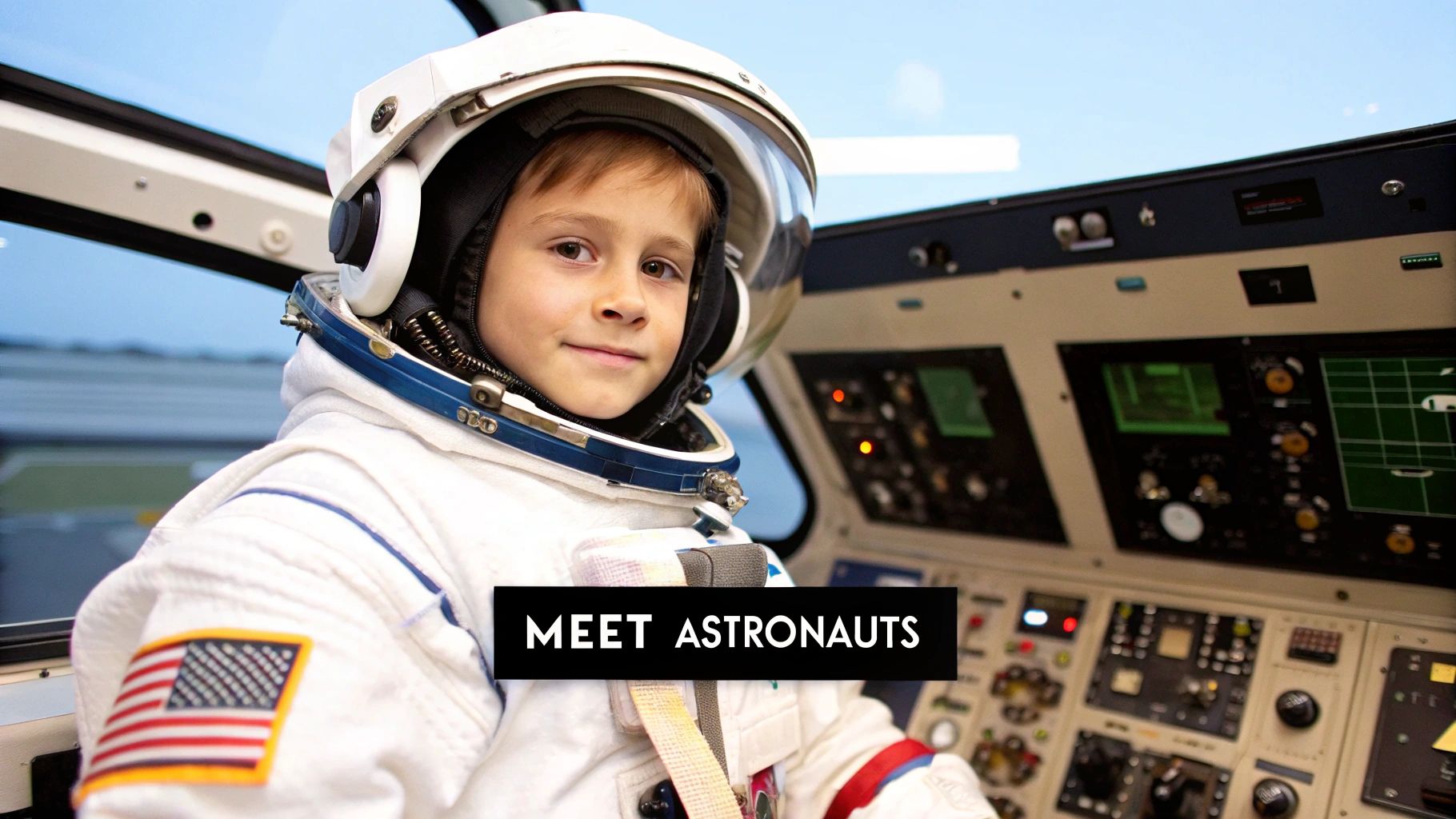
Space exploration isn't just about rockets and planets; it’s a grand adventure starring a cast of real-life heroes. You've got the brave astronauts who journey to the stars, and the brilliant robots they send to explore where humans can't go… yet. They’re an incredible team, working together to unlock the universe’s biggest secrets.
First up, let’s talk about the astronauts. These aren’t just passengers on a rocket—they’re highly trained scientists, pilots, and engineers with one of the most exciting jobs imaginable. They are the human face of our cosmic journey, living and working in incredible places like the International Space Station (ISS), a huge laboratory orbiting 250 miles above our heads.
But what’s it really like to live up there? It’s a world away from life on Earth!
A Day in the Life of an Astronaut
Imagine waking up and not being able to simply stand up. In space, there’s practically no gravity, so everything floats! Astronauts have to sleep in special sleeping bags strapped to a wall to stop them from drifting around the station while they snooze.
Even eating is an adventure. Food is specially packaged so crumbs don't float off and clog up important equipment. Some meals are freeze-dried (just add water!), while others are ready to eat from a pouch. And forget a salt shaker—salt and pepper come in liquid form to keep them from floating away!
To stay strong, astronauts must exercise for about two hours every single day. Without gravity constantly pulling on them, their muscles and bones can get weak. They use special treadmills they have to strap themselves onto and clever resistance machines that let them ‘lift weights’ in a weightless world.
Staying fit is so vital for space missions that it inspires programmes right here on Earth! The Mission X programme, for example, uses astronaut training exercises to get kids excited about being active. It shows how good food and exercise are just as crucial for a healthy life as they are for a space mission. You can discover more about how astronaut fitness inspires kids on the UK Government's publishing service.
Dressed for a Cosmic Walk
When an astronaut needs to work outside the space station, they suit up in what is essentially their own personal spaceship. It’s called a spacesuit, and this incredible bit of kit does a lot more than just look cool.
A spacesuit provides:
- Oxygen to breathe, because space is a vacuum with no air.
- Protection from wild temperature swings, from super-hot to freezing cold.
- Pressurisation to keep the astronaut’s body safe from the vacuum of space.
- A shield against tiny, fast-moving bits of space dust and debris.
Putting one on is like wrapping yourself in a protective bubble, allowing our explorers to make vital repairs and run experiments outside their spacecraft.
The Robotic Sidekicks
Astronauts don't explore alone. They have amazing robotic partners that act as their eyes, ears, and hands on other worlds. Think of them as our remote-controlled scientists, sent to places that are too far away or too dangerous for humans to visit just yet. They’re a huge part of space exploration for kids to get excited about, showing how technology helps us push the boundaries.
Take the Mars rovers, for example. These wheeled robots are basically geologists on another planet. They're kitted out with cameras to send back incredible photos of the Martian landscape, drills to take rock samples, and scientific tools to figure out what they’ve found. These rovers are on a mission to hunt for signs of past life and piece together the Red Planet's history.
This amazing teamwork between humans and machines is what drives exploration forward. Astronauts can control some robots from orbit, while scientists back on Earth send commands to others millions of miles away. It's a bit like playing a very advanced video game, but the prize is pure discovery. From the brave astronauts on the ISS to the tireless rovers on Mars, every hero plays a crucial part in our cosmic journey.
A Grand Tour of Our Solar System
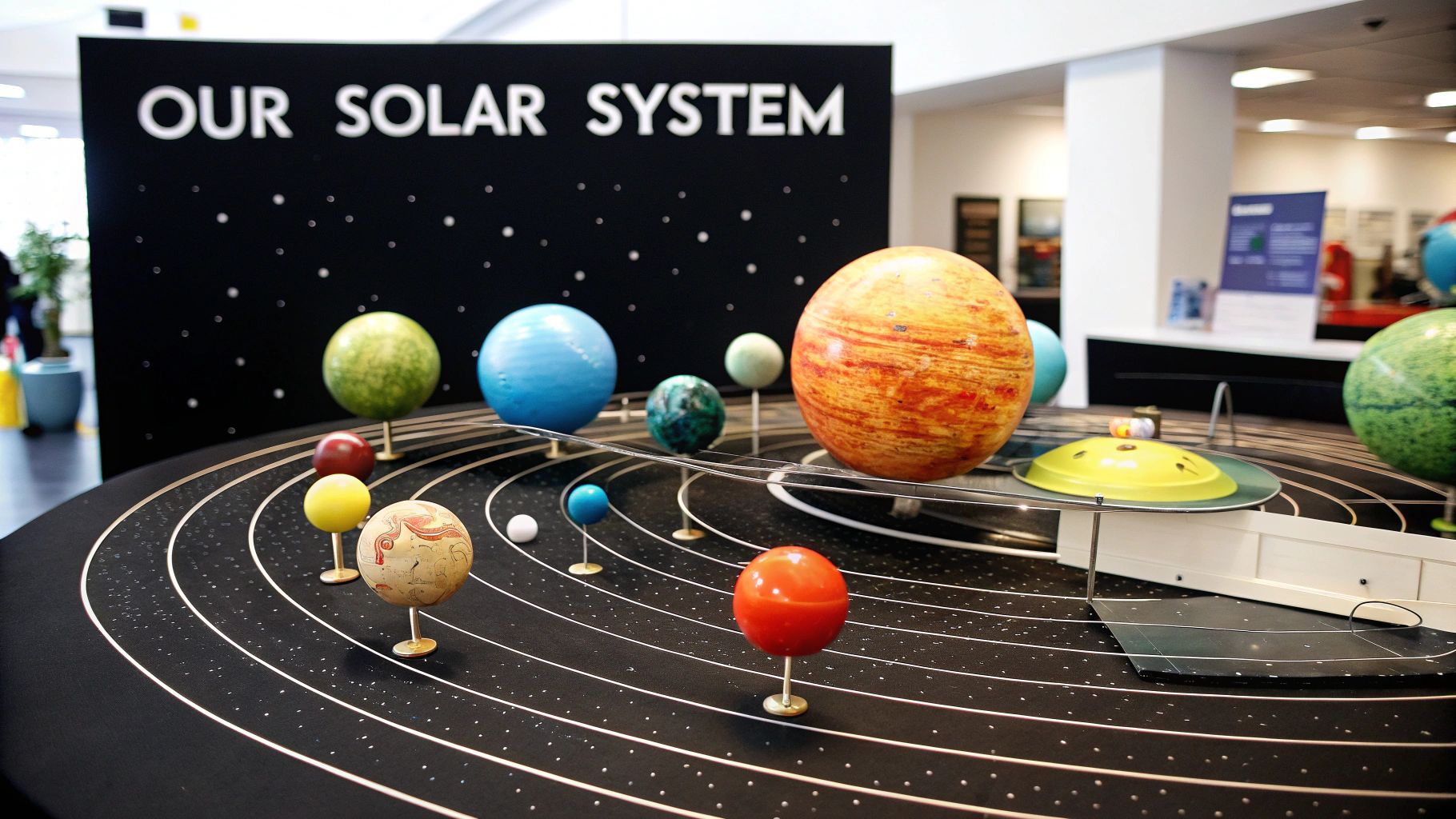
Ready for the ultimate road trip through our cosmic neighbourhood? Buckle up, because we're about to blast off on a tour of the Solar System. It's our special corner of the universe, a huge family of planets, moons, asteroids, and comets all travelling together around a single, brilliant star—the Sun.
This journey will take us from the scorching hot worlds closest to the Sun all the way out to the icy giants floating in the faraway darkness. We’ll find out why some planets are rocky like ours and others are massive balls of gas. Let’s fire up the engines!
Our Star, the Sun
First stop is the heart of it all: the Sun. It’s not a planet, but a gigantic star—a blazing ball of hot gas that’s more than 100 times wider than Earth. The Sun is so mind-bogglingly huge and powerful that its gravity holds our entire Solar System together.
Think of gravity like an invisible string. The Sun sits in the centre, swinging all the planets around it on their own invisible strings. This constant swinging motion is called an orbit, and it’s what keeps the planets from just flying off into deep space. Just like in Space Ranger Fred and the Shoelace Adventure, understanding how things are connected is the key!
The Rocky Inner Planets
Now, let's zoom in and visit the planets closest to the Sun. These are the rocky, or terrestrial, planets because they have solid ground you could (in theory!) stand on.
- Mercury: The smallest planet and the speediest of the lot, zipping around the Sun faster than any other. It’s a world of extremes, sizzling hot on one side and freezing cold on the other.
- Venus: Often called Earth's "twin" because it's a similar size, but it’s no paradise. Venus is wrapped in thick, toxic clouds and is officially the hottest planet in our Solar System.
- Earth: Our home! So far, it's the only planet we know of with liquid water on its surface and bursting with life. Its position is just right—not too hot and not too cold.
- Mars: Known as the "Red Planet" because of the rusty iron in its soil, giving it a cool reddish colour. Scientists are fascinated by Mars because it shows signs that it once had rivers and lakes, making it a top spot in the search for past life.
Our solar system is a vast and fascinating place, full of wonder and mystery. Taking the time to learn about each planet helps us understand our own world's special place in the cosmos. To dive deeper, you can explore what the Solar System is in an easy-to-understand guide that breaks it all down for young explorers.
The Gas and Ice Giants
After passing through the asteroid belt—a huge ring of chunky space rocks—we reach the outer Solar System. This is where things get really big. Here, we find the giant planets, which are enormous and mostly made of gas and ice.
- Jupiter: The undisputed king of the planets! Jupiter is the largest of them all, so big that all the other planets in our Solar System could fit inside it. It’s famous for its Great Red Spot, a gigantic, swirling storm that’s been raging for centuries.
- Saturn: You can't miss this one! Known for its spectacular rings, Saturn is a breathtaking sight. These rings aren't solid; they're made of billions of chunks of ice and rock, some as small as a grain of sugar and others as big as a house.
- Uranus: This chilly giant is a real oddball. Unlike the other planets, Uranus is tilted right over on its side, so it basically orbits the Sun like a rolling ball. Weird, right?
- Neptune: The farthest official planet from the Sun, Neptune is a dark, cold, and incredibly windy world. It boasts the fastest winds in the Solar System, whipping around faster than a jet plane!
Beyond the Planets
But hold on, our journey isn't over yet. Our cosmic neighbourhood doesn't just stop with Neptune. Beyond it lies the Kuiper Belt, a distant, icy region home to dwarf planets like Pluto and countless comets. This is a real frontier for explorers and scientists alike, a place where new discoveries are always waiting.
And beyond that? Our Solar System is just one tiny speck in our galaxy, the Milky Way, which contains billions of other stars. And our galaxy is just one of billions in the entire universe. It’s a mind-bogglingly huge place, filled with wonders like sparkling star nurseries and mysterious black holes.
This grand tour is just the beginning of your amazing adventure into the cosmos.
Hands-On Space Activities for Young Explorers
Reading about space is a brilliant start, but nothing beats doing science to bring the universe into your home. Getting your hands a bit messy is one of the best ways to really get to grips with the big ideas behind space exploration. These simple, fun activities are designed to turn learning into an interactive mission.
Each project connects directly to real STEM concepts, showing you the science behind the fun. Just like the clever problem-solving in Space Ranger Fred and the Umbrella Rescue, these activities teach you to learn by doing. So, let’s roll up our sleeves—it's time to become a space explorer in your own kitchen!
Not sure which cosmic creation to try first? This planner can help you and your little astronaut pick the perfect project.
DIY Space Project Planner
| Activity Idea | Mess Factor (Low/Medium/High) | Time Needed (Minutes) | What You Will Learn |
|---|---|---|---|
| Fizzing Bottle Rocket | Medium | 15-20 | Propulsion and Newton's Third Law of Motion |
| Create Your Own Moon Craters | High | 20-30 | How impact craters are formed by mass and speed |
| Design a Delicious Solar System | Low | 10-15 | The relative sizes of the planets in our Solar System |
Once you’ve picked your mission, it's time to gather your supplies and prepare for launch!
Build a Fizzing Bottle Rocket
Ever wondered how a real rocket blasts off into space? It’s all down to propulsion—a powerful push that sends something shooting forward. You can see this incredible force in action with just a few things from around the house. It's a fantastic way to understand Newton's Third Law of Motion: for every action, there’s an equal and opposite reaction.
What You'll Need:
- An empty plastic bottle (a small fizzy drink bottle is perfect)
- A cork that fits snugly into the bottle's opening
- Baking soda (bicarbonate of soda) and vinegar
- A small piece of paper towel
- Three pencils and some strong tape
Step-by-Step Launch Sequence:
- Construct Your Launchpad: Tape the three pencils firmly to the side of the bottle, pointing downwards. These will act as the "legs" your rocket stands on.
- Prepare the Fuel: Pour about an inch of vinegar into the bottle. Then, pop a spoonful of baking soda into the centre of the paper towel and roll it into a small, tight packet.
- Fuel and Go: You’ll need to be quick for this bit! Drop the baking soda packet into the bottle, quickly push the cork in tightly, and stand your rocket upright on its pencil legs. Step back and get ready for the countdown!
As the vinegar soaks through the paper, it mixes with the baking soda and creates a chemical reaction. This releases loads of carbon dioxide gas, building up pressure inside the bottle until—WHOOSH!—it forces the cork out, pushing the rocket in the opposite direction. That’s propulsion right there!
Create Your Own Moon Craters
The Moon’s surface is covered in craters, which are basically big, bowl-shaped dents left behind after being hit by asteroids and meteorites over billions of years. You can recreate these cosmic collisions to see how different impacts leave behind different kinds of craters. It’s a super fun geology lesson.
To get started, fill a baking tray with a few inches of plain flour. If you want to get fancy, sprinkle a thin layer of cocoa powder over the top. This helps you see the "ejecta"—all the material that gets blasted outwards during an impact.
Next, find some "asteroids." Marbles, pebbles, or small balls of different sizes and weights work perfectly. Drop them from different heights into your floury moonscape. You'll notice how a tiny marble dropped from high up might make a deeper crater than a bigger one dropped from lower down. This shows how both an object's mass and its speed change the size and shape of an impact crater.
By experimenting with different angles and speeds, you're doing exactly what a planetary scientist does. Researchers study craters on planets and moons to piece together the history of our solar system and figure out what it was like billions of years ago.
Design a Delicious Solar System
It’s hard to wrap your head around just how massive the Solar System is. The distances between the planets are absolutely enormous! This bar chart shows the average distance from Earth to just a few of our neighbours.
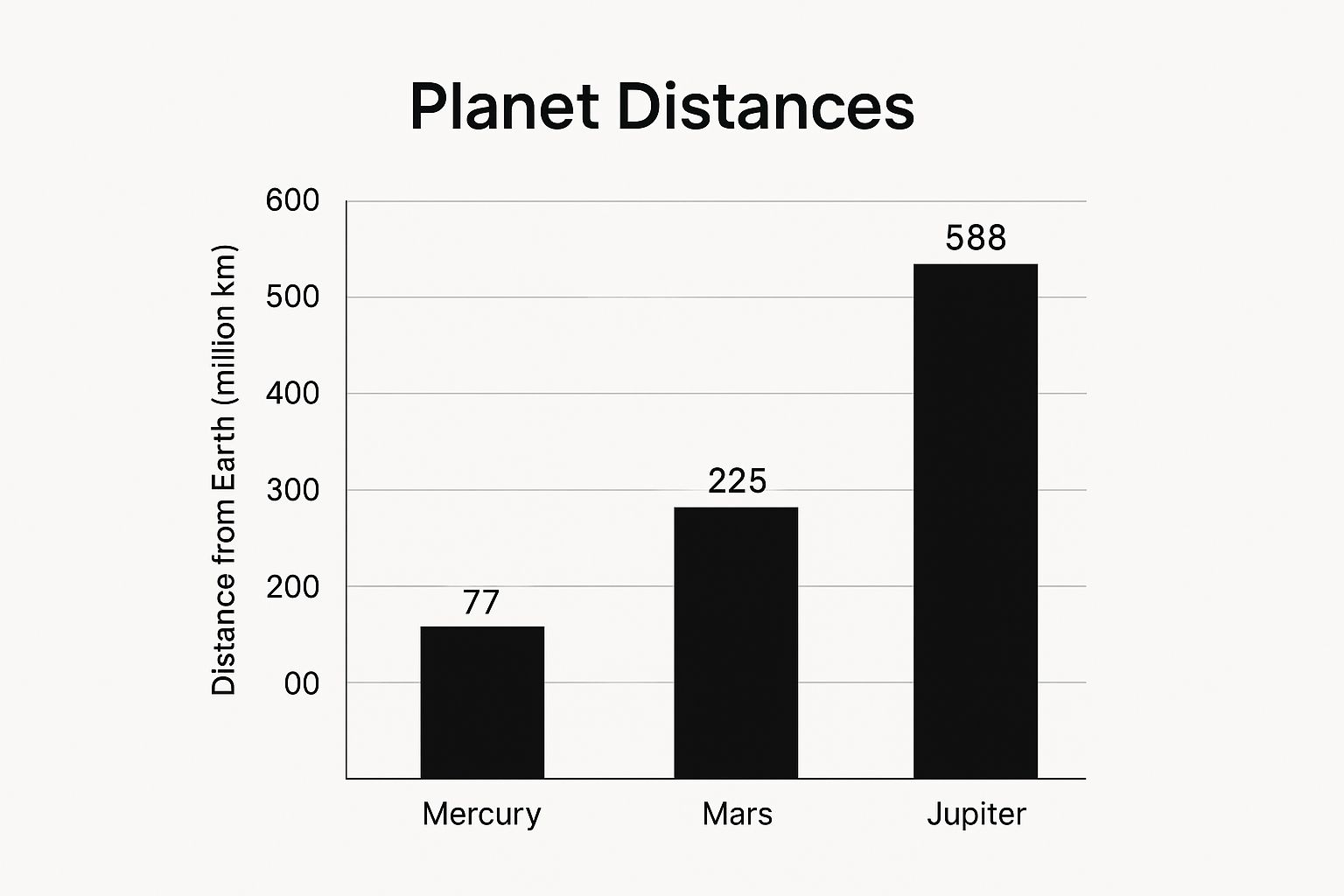
As you can see, even our closest neighbours are incredibly far away. Jupiter is over seven times farther from Earth than Mercury on average!
To bring these cosmic scales down to a more manageable (and tasty) size, you can create a fruit and vegetable model of the Solar System. It’s a great way to see how the different planets measure up against each other.
Your Planetary Shopping List:
- Sun: A large grapefruit or melon
- Mercury: A peppercorn
- Venus: A cherry tomato or a large blueberry
- Earth: Another cherry tomato (our "twin"!)
- Mars: A pea
- Jupiter: A large orange or a small grapefruit
- Saturn: A satsuma (with a fruit leather ring!)
- Uranus: An apricot or a large grape
- Neptune: A lime or a small plum
Lay out your cosmic creations on a big table or across the floor to get a feel for their relative sizes. While it’s tricky to show the true distances in one room, this model makes it crystal clear just how gigantic Jupiter is compared to rocky little Mars! It’s the perfect starter for any space exploration for kids activity night.
How Space Exploration Helps Us on Earth
Exploring the stars and planets feels like it’s all about faraway places, right? But what if I told you that reaching for the Moon actually makes our lives better right here on Earth, every single day? It’s absolutely true! The incredible technology invented for astronauts and space missions often finds its way into our homes, schools, and hospitals in the most surprising ways.
This brilliant little trick is often called a "spin-off". It’s where a tool designed for a high-stakes space mission gets a brand-new job down on the ground. Think of it like a superhero's gadget being used to help with everyday chores. Loads of things we use all the time started out this way, from the tiny cameras in our phones to the special gear that keeps firefighters safe.
It all comes down to creative problem-solving. When you're trying to send someone to another world, you have to invent mind-boggling new things. Just like in Space Ranger Fred and the Shoelace Adventure, big challenges push us to think differently and dream up solutions that can help everyone.
From the Moon to Your Living Room
So, where can you spot these space-age inventions? They’re hiding in plain sight! The next time you snap a picture on a mobile phone, you’re using technology that NASA first improved to take crystal-clear pictures of distant planets.
Here are a few more everyday items with cosmic connections:
- GPS Navigation: The Global Positioning System that helps your family find their way on a road trip? That works thanks to a whole network of satellites orbiting Earth, a system first developed for military and scientific use.
- Memory Foam: That super comfy mattress or pillow you love was first invented to make aeroplane seats safer and more comfortable for pilots and astronauts.
- Cordless Tools: To get work done in space, astronauts needed powerful tools without clumsy cords getting in the way. This mission led directly to the cordless drills and dustbusters we use around the house.
Solving problems for space missions often means creating something completely new. These inventions don't just stay in orbit; they spin off to improve our health, safety, and daily lives in countless ways, proving that reaching for the stars has real benefits on the ground.
Understanding Our Own Planet Better
But space exploration isn't just about creating cool gadgets. It’s also our best tool for looking back and studying our home. Satellites are constantly zipping around Earth, keeping an eye on our weather, oceans, and forests. They’re like doctors for our world, giving us a check-up from way up high.
This global view helps scientists track everything from hurricanes to the effects of climate change. By studying the atmospheres of other planets like Mars and Venus, we can also learn valuable lessons about what can happen to a planet’s climate over time. It’s a vital way to understand how we can better protect our home for the future. You can find more awesome facts and details by learning about space for kids in our other guides.
Inspiring the Next Generation of Explorers
Perhaps the most important benefit of all is the inspiration it sparks. Missions to space get kids everywhere excited about science, technology, engineering, and maths (STEM). In the UK, the Destination Space project was a huge initiative that reached over 900,000 schoolchildren through fun, space-themed workshops linked to their schoolwork. You can read more about how this project inspired a new generation on the UK Science Festivals Network website.
At its heart, space exploration pushes us to work together as a global team to achieve incredible things. It’s a brilliant reminder that with enough curiosity and teamwork, anything is possible.
Your Top Space Questions, Answered!
Every great explorer starts with a question. Curiosity is the rocket fuel that launches every mission and every new discovery we make out there in the big, starry unknown. So, let’s tackle some of the biggest questions kids have about space exploration, with answers to help your imagination really take off.
Just like in the stories of Space Ranger Fred and the Shoelace Adventure, asking questions is the very first step on any brilliant journey.
Can I Really Become an Astronaut?
You absolutely can! While space agencies usually select astronauts when they're between their late 20s and mid-40s, the real journey starts much, much earlier. In fact, it starts right now!
The best things you can do are to get a great education in a STEM subject—that’s science, technology, engineering, or maths—and to stay fit and healthy. So, you can start your training today by working hard at school, never being afraid to ask questions, and looking after yourself.
Did you know the path to a space career can start in any classroom? The 2020 UK Space Census found that most people working in the British space sector went to state-funded schools. This just goes to show that a real passion for science and a good education are what truly launch you towards the stars.
What's the Hardest Thing About Living in Space?
Floating around in zero gravity looks like a blast, doesn't it? But astronauts often say one of the toughest parts is something much closer to home: being so far away from their family and friends on Earth. It can get lonely being millions of miles from everyone you love.
Another huge challenge is just getting used to a weightless world. Simple things we take for granted, like eating or brushing your teeth, become tricky when everything just floats away! Astronauts also have to exercise for about two hours every single day to keep their muscles and bones strong, because without gravity, their bodies don't have to work as hard.
Will We Ever Find Aliens?
Now that is one of the biggest and most exciting questions in all of science! So far, we haven’t found any definite proof of alien life, but the universe is almost too enormous to even think about. It’s packed with billions of galaxies, and each of those galaxies has billions of stars.
Many scientists think it’s very likely that some kind of life exists somewhere else out there. It might be tiny microbes or something we can’t even imagine yet! This is one of the main reasons we send telescopes and robotic probes into deep space—to keep searching for clues and maybe, one day, finally answer that question. For more amazing tidbits, check out our other mind-blowing space facts for kids.
Could We Travel to Another Star?
Travelling to another star system, even the one closest to us, is a massive challenge because of the mind-boggling distances. Proxima Centauri, the nearest star to our Sun, is over 4 light-years away. That means it would take a beam of light—the fastest thing in the universe—four whole years to get there!
With the rockets we have today, a trip like that would take tens of thousands of years. It’s simply too far for us to travel right now.
But don't lose hope! Scientists and engineers are always dreaming up new ideas for faster travel, like engines powered by light or other futuristic technologies we haven't even invented yet. While it's not possible today, future generations of explorers—maybe even you—might just be the ones to crack the code and take that giant leap to another star.
Continue your family’s cosmic journey with Space Ranger Fred! Discover a universe of stories, activities, and fun that makes learning about space an unforgettable adventure. Blast off with us at https://spacerangerfred.com.