
Alright, space cadets, welcome aboard! Are you ready to blast off on a journey through time? We're about to explore the most incredible moments in the history of space exploration, charting a course from our very first glimpses of the stars to actually flying right up there among them. Let's get this epic adventure started with our space exploration timeline for kids!
Your Mission to Explore Space History
Consider this your official mission briefing. We’re about to uncover the biggest breakthroughs in our cosmic story, starting with that very first satellite beeping its way around Earth all the way to those legendary first footprints on the Moon. It’s a tale filled with curiosity, courage, and some truly brilliant ideas.
Just like in the book Space Ranger Fred and the Tick Tock Tale, knowing where we've been helps us figure out where we’re going next. Our timeline is packed with amazing moments that inspired humans to dream bigger and keep reaching for the stars.
Key Moments at a Glance
To kick off our voyage, here’s a quick look at three giant leaps for humankind that happened in just a few decades.
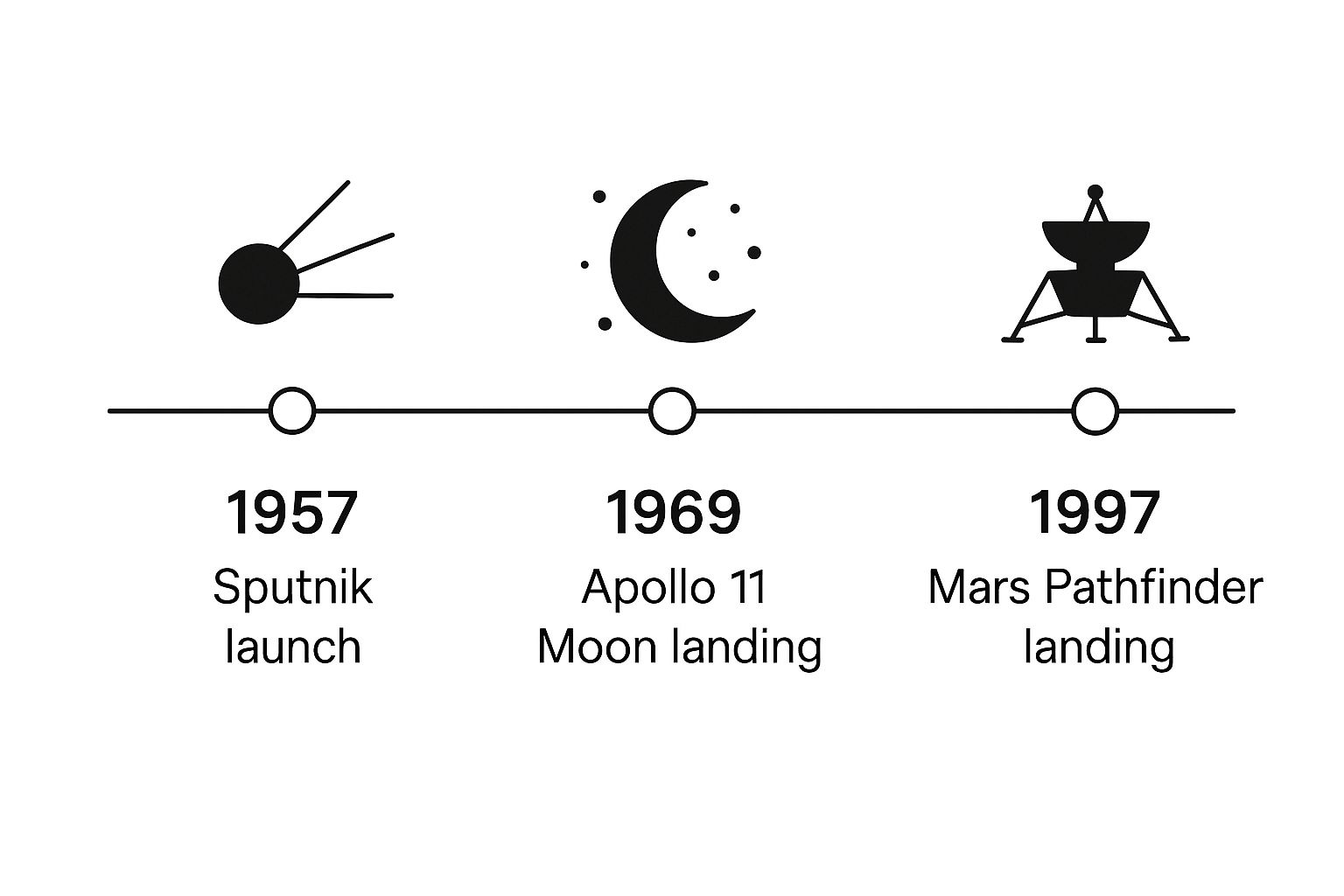
This snapshot shows just how fast things moved! We went from launching our first-ever satellite in 1957 to landing on the Moon in 1969, and then sent a robotic explorer to Mars in 1997. Each of these was a huge achievement that unlocked a whole new part of the solar system for us.
Time to strap in and learn more about each of these incredible moments
The Great Race to the Stars
Have you ever pictured a race where the whole planet was watching? Not a running race, but one with gigantic rockets blasting off into the unknown! That’s pretty much what happened during a time everyone now calls the Space Race.
This incredible competition was mainly between two huge countries: the United States and the Soviet Union (which is now Russia and several other countries).
It all blasted off on 4 October 1957, when the Soviet Union launched Sputnik 1. It was just a small, shiny metal ball, no bigger than a beach ball, but it completely changed the world. As it circled the Earth, it sent out a simple "beep-beep-beep" that anyone with a radio could hear. For the very first time, something made by humans was orbiting our planet!
A Parade of Firsts
That little beep sparked a massive, but mostly friendly, rivalry. All of a sudden, both sides wanted to be the first to do everything in space, leading to an amazing parade of ‘firsts’.
The Soviet Union had a lot of early wins. They sent the first animal into orbit – a brave little dog named Laika – aboard Sputnik 2 in 1957. A few years later, in 1961, a cosmonaut named Yuri Gagarin became the first person to ever travel into space and orbit the Earth. As his rocket took off, he famously shouted, "Poyekhali!" which means "Let's go!"
This period of intense competition was amazing for science. It pushed engineers and scientists to solve problems faster than ever before, a bit like how Space Ranger Fred has to think on his feet in Space Ranger Fred and the Umbrella Rescue.
This cosmic race pushed technology forward at lightning speed. Every time one country achieved something new, it made the other aim even higher. All of these incredible steps were building towards one huge, shared dream that seemed almost impossible back then: sending a person all the way to the Moon.
One Giant Leap for Humankind
After all the incredible firsts of the Space Race, the biggest prize of all was still out there: the Moon.
On 16 July 1969, the whole world seemed to hold its breath. Three brave astronauts—Neil Armstrong, Buzz Aldrin, and Michael Collins—were strapped inside a tiny capsule called Apollo 11.
This small craft sat on top of the Saturn V, the most powerful rocket ever built by humans. With a roar that shook the ground for miles, it blasted off on an incredible four-day journey across 240,000 miles of empty space, all aimed at our rocky neighbour. The mission was simple, but breathtakingly ambitious: land people on the Moon and bring them home safely.
Their spacecraft was made of two main parts. The Command Module, named Columbia, would stay in orbit around the Moon with Michael Collins at the controls. The other part was a strange, spider-like lander called the Eagle, designed to carry Armstrong and Aldrin down to the surface.
The Eagle Has Landed
The final descent to the Moon was a nail-biter. Alarms suddenly started ringing inside the cockpit! The Eagle's little computer was getting overloaded with data. Thinking fast, Neil Armstrong took manual control, skillfully steering the lander away from a field of giant boulders to find a smoother spot.
Finally, with just a few heart-stopping seconds of fuel left, he set it down. A crackly voice travelled all the way back to Mission Control on Earth: "Houston, Tranquility Base here. The Eagle has landed." Back on the ground, cheers erupted. A few hours later, the hatch swung open.
Neil Armstrong carefully climbed down the ladder and became the very first person to step onto another world. As his boot pressed into the fine, grey dust, he spoke the now-famous words: "That's one small step for a man, one giant leap for humankind."
It was a moment that showed what we can do when we dream big and work together. Getting to the Moon wasn't just about three astronauts; it took a massive team of thousands of engineers, scientists, and technicians, all pulling in the same direction.
Just like in Space Ranger Fred and the Shoelace Adventure, teamwork was the real superpower that made it all possible. The Moon landing proved that even the wildest, most impossible-sounding dreams can come true.
Sending Robots to Explore Our Solar System
After that giant leap to the Moon, our curiosity didn't stop. It stretched right across the solar system! Since people couldn't travel to faraway planets just yet, we did the next best thing: we sent our amazing robotic explorers to go for us.
Think of these robots as our eyes, ears, and hands on other worlds. They’re like super-tough space detectives, built to handle the freezing cold, intense radiation, and incredibly long journeys that would be far too dangerous for human astronauts.
Our Robot Geologists on Mars
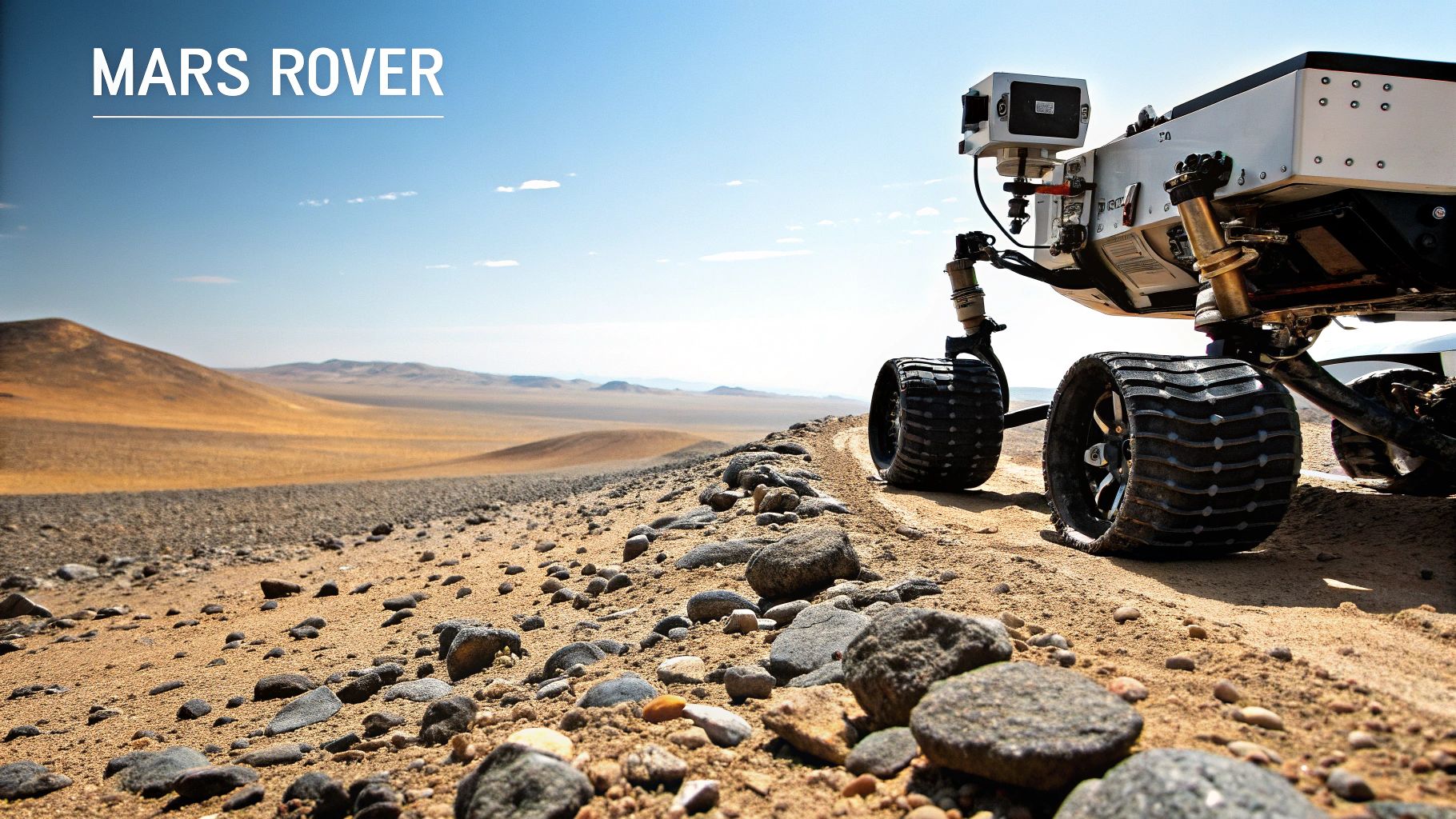
Right now, a couple of our most famous robot explorers are trundling around on the dusty, red surface of Mars.
- Curiosity Rover: This car-sized science lab has been exploring a massive crater on Mars since 2012, drilling into rocks to figure out what they’re made of.
- Perseverance Rover: Landing in 2021, "Percy" is on a special mission to search for clues of ancient life. It’s even collecting rock samples that a future mission will one day bring back to Earth!
These rovers send back the most incredible pictures and data, helping scientists piece together the secret history of Mars. It's a bit like the problem-solving in Space Ranger Fred and the Umbrella Rescue, where paying close attention is the key to making a brilliant discovery.
Journey to the Outer Solar System
Our robot friends haven't just been to Mars, though. Some have made truly epic trips to the giant planets that live far, far away from the Sun.
The twin Voyager 1 and 2 probes, launched way back in 1977, zipped past Jupiter and Saturn. They gave us our very first close-up pictures of their swirling storms and stunning rings. And they didn't stop there—they just kept going and are now in interstellar space, further from home than anything else we have ever sent!
These robotic missions completely changed how we see our solar system. We discovered erupting volcanoes on Jupiter's moon Io, a hidden ocean under the ice of Europa, and so much more.
From the rocky plains of Mars to the icy edges of our solar system, these hardworking robots are continuing our incredible journey of discovery. They are the true pioneers in this part of our space exploration timeline, and you can learn more about their amazing journeys in our complete guide to space exploration for kids.
Great Britain's Journey into Space
When people talk about the Space Race, they usually mention America and the Soviet Union. But did you know Great Britain has its own fantastic space story?
The UK’s adventure didn’t begin with a big rocket launch. It started with a group of brilliant thinkers and dreamers who looked to the stars long before anyone else. Way back in the 1930s, a group called the British Interplanetary Society (BIS) was already sketching out plans for missions to the Moon!
This incredible group, which included the famous science fiction writer Arthur C. Clarke, was founded in 1933. It's now the world's oldest organisation dedicated to dreaming up ways to explore space. You can discover more about the UK's early space visionaries on orbitaltoday.com.
Britain Reaches Orbit
As the world blasted off into the space age, the UK was right there with them. In 1962, Britain sent its very first satellite, Ariel 1, into space. Although it hitched a ride on an American rocket, the satellite itself was completely designed and built in the UK. This clever bit of teamwork made Britain the third country in the world to operate its own satellite in orbit.
It was a massive moment for British science! Ariel 1 was built to study our atmosphere, and it sent back loads of important information that helped us understand the environment just above our heads.
But just a few years later, the UK did something even more special.
On 28 October 1971, the UK launched its Prospero satellite using its very own rocket, the Black Arrow. This incredible feat made Britain one of only a handful of nations to launch its own satellite with its own rocket.
This showed the world that British engineers could handle every single part of a space mission, from designing the satellite to building the rocket that carried it into orbit. It’s a brilliant example of solving a huge challenge, a bit like the clever thinking in Space Ranger Fred and the Shoelace Adventure.
You can find even more cool tidbits in our full list of amazing space facts for kids. From early dreamers to launching its own rockets, Great Britain has truly earned its place in the space exploration timeline for kids.
The Future of Space Exploration
Our incredible cosmic adventure is really just getting started! We’ve journeyed through some amazing moments in space history, but what’s next on the launchpad for humanity’s explorers? The answer is even more exciting than you might think, with brand new missions being planned right now.
One of the biggest is NASA’s Artemis program. This mission aims to take humans back to the Moon, but this time, it will include the first woman and the first person of colour to walk on its dusty surface. It’s a huge step towards building a permanent base there, kind of like a cosmic outpost for future adventures into deep space.
The Next Giant Leap: Mars
After the Moon, the next giant leap for humankind is Mars. Ambitious plans are already underway to one day send astronauts on the very long journey to the Red Planet. This would be one of the most challenging things we’ve ever tried, but just imagine the incredible discoveries waiting for us there!
To make these journeys possible, clever new technologies are making space travel easier and more affordable. Companies like SpaceX are building amazing reusable rockets that can launch, land, and be used all over again. This simple idea makes getting into space much, much cheaper than before.
A Future Built by Teamwork
This new era of space travel isn't just about one country doing all the work. It’s a real team effort, with many nations working together. The UK, for example, has a long history of contributing to space science. Way back in 1962, it became the third nation to operate a satellite, Ariel 1, which was designed in Britain. Then, in 1971, the UK launched its very own satellite, Prospero, using its own Black Arrow rocket, showing off some incredible engineering skills. You can read more about the UK's history in space on forcesnews.com.
The future of space exploration relies on collaboration. By working together, we can achieve things that would be impossible alone, a valuable lesson often seen in books like Space Ranger Fred and the Shoelace Adventure.
Today’s young explorers—people just like you—could be the ones making these amazing journeys, designing the next generation of rockets, or even living and working in space. The future is bright, and the greatest adventures are still to come. To keep your curiosity soaring, check out our guide on learning about space for kids.
Are you ready for more cosmic fun? The Space Ranger Fred book series blends awesome stories with real science to make learning about space a thrilling adventure. Start your mission at spacerangerfred.com today!