
Ever wondered what a black hole really is? Let's chat about it. Imagine an object in space with a gravitational pull so mind-bogglingly strong that absolutely nothing can get away from it. Seriously, not even light.
Think of it as the ultimate cosmic one-way street. Once you cross the line, there’s no turning back.
A Bowling Ball on a Cosmic Trampoline
Let's do a little thought experiment. Picture the entire universe as one giant, stretchy trampoline.
When you place things on it, like planets or stars, they create little dips and dimples. But a black hole? That’s like dropping an impossibly heavy bowling ball right in the centre. It creates a pit so deep that anything that tumbles in is stuck there for good.
That little analogy gets right to the heart of it. A black hole isn't an empty void or some kind of portal. It’s actually a huge amount of "stuff" squashed into a tiny, tiny space, which gives it that incredible gravitational power.
This guide is your friendly tour of these cosmic wonders, and we’ll ditch the complicated jargon. Together, we'll find out:
- How black holes are born from the spectacular deaths of giant stars.
- What they’re actually made of and the mysterious parts that define them.
- How scientists manage to find these invisible giants lurking in the dark.
Just like Space Ranger Fred discovered in Space Ranger Fred and the Tick Tock Tale, some things in space can bend the rules of time and space in the strangest ways. And as we're about to see, black holes are the biggest rule-benders in the entire universe.
A lot of people think black holes are like cosmic vacuum cleaners, sucking up everything around them. The truth is, their gravity works just like any other big object—you have to get really, really close to get pulled in. If our Sun was suddenly replaced by a black hole with the exact same mass, the Earth would just keep orbiting it like nothing happened
The Violent Birth of a Cosmic Giant
So how do these things even get started? Well, black holes don’t just appear out of thin air. Their creation story is one of the most dramatic events in the entire universe, starting with the spectacular death of a truly massive star.
Picture a star far, far bigger than our Sun. For millions of years, it blazes away, a brilliant powerhouse in its corner of the galaxy. But like all things, it can't burn forever. Eventually, its fuel begins to run low.
When that happens, the star's own immense gravity takes over. Unable to support its own weight, the core collapses in a fraction of a second, triggering a colossal explosion known as a supernova. This cosmic firework display is so incredibly bright it can briefly outshine its entire home galaxy.
So, what’s left behind after the dust settles? A tiny, unbelievably dense remnant. To get your head around just how dense we're talking, imagine taking the whole of Mount Everest and crushing it down until it's the size of a sugar cube. That’s the kind of mind-boggling pressure that forges a black hole.
This fantastic illustration breaks down how scientists believe these cosmic monsters are born.
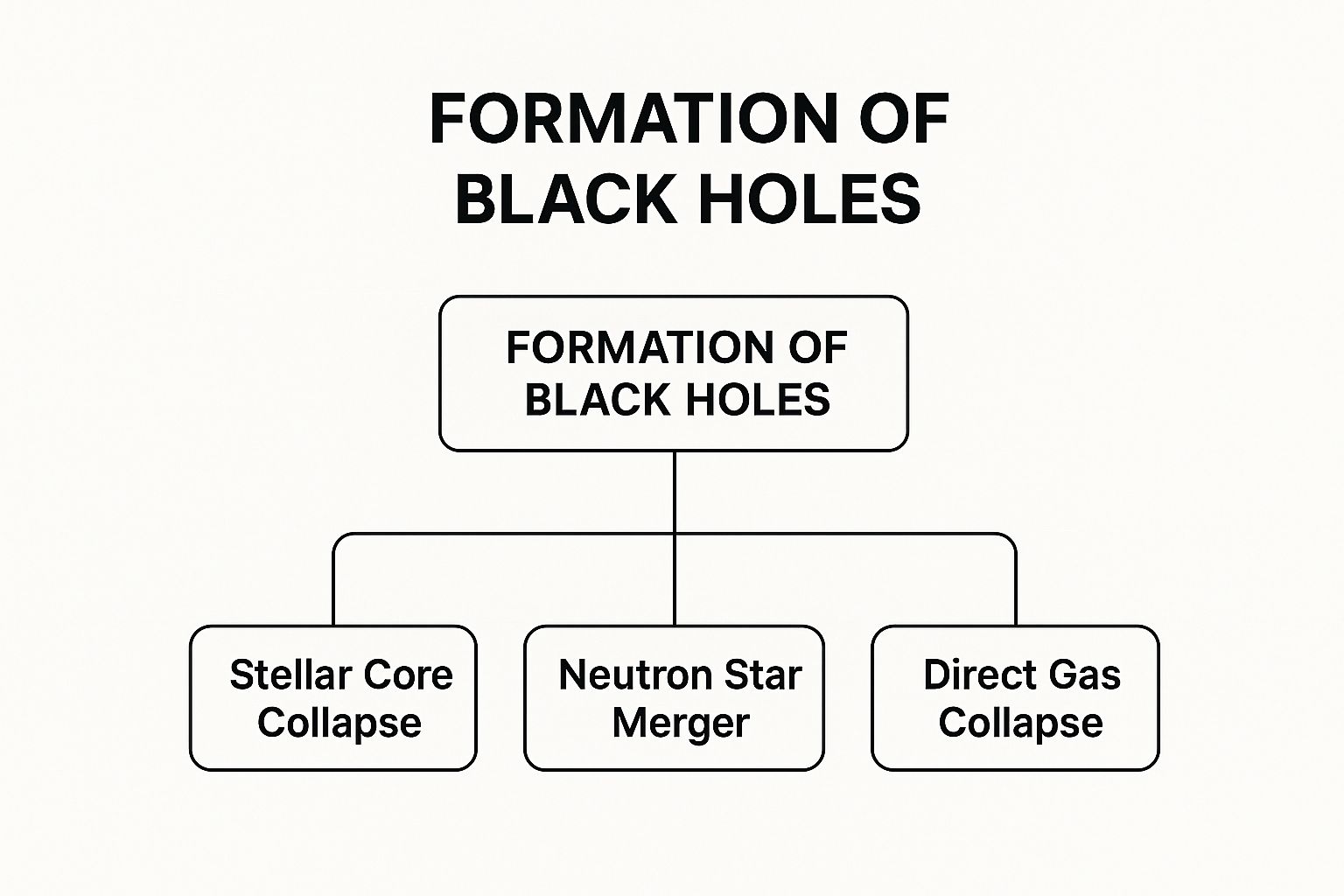
As you can see, the collapse of a single giant star is just one of the ways a black hole can spring into existence.
Different Sizes of Black Holes
It turns out not all black holes are created equal. They come in a few different flavours, and each one has its own incredible origin story. One of the heroes of space exploration—just like Space Ranger Fred in Space Ranger Fred and the Umbrella Rescue—is an astronomer named Jocelyn Bell, whose work helped us understand what happens to stars after they die.
Her discovery of neutron stars in 1967 was a huge leap forward, as these are basically the cosmic cousins of black holes. Just a few years earlier, in 1964, astronomers found the first strong evidence of a real black hole, a source of X-rays called Cygnus X-1, proving these invisible giants were truly out there. You can find out more about these early discoveries over at the University of St Andrews website.
To make things a bit clearer, here's a quick look at the main types of black holes you'll find floating around the cosmos.
A Quick Guide to Black Hole Types
| Type of Black Hole | Formation Process | Typical Mass |
|---|---|---|
| Stellar-Mass | The collapse of a single, massive star. | 5 to 20 times the mass of our Sun. |
| Supermassive | Believed to form from the merging of smaller black holes and stars. | Millions to billions of times the Sun's mass. |
| Intermediate-Mass | Still a bit of a mystery! Possibly from stellar collisions in dense star clusters. | 100 to 100,000 times the Sun's mass. |
From the 'common' stellar-mass black holes to the galactic giants, each type tells a different story about the life and death of stars in our universe.
What’s Inside a Black Hole?
So, we know how a black hole is born, but what’s it actually like? If we could take a (very brave!) trip towards one, what would we find? Let's take a peek inside and break down its mysterious parts.
As we get closer, the first thing we'd come across is the event horizon. Think of this as the ultimate point of no return. It isn’t a solid wall you could bump into, but an invisible line drawn around the black hole.
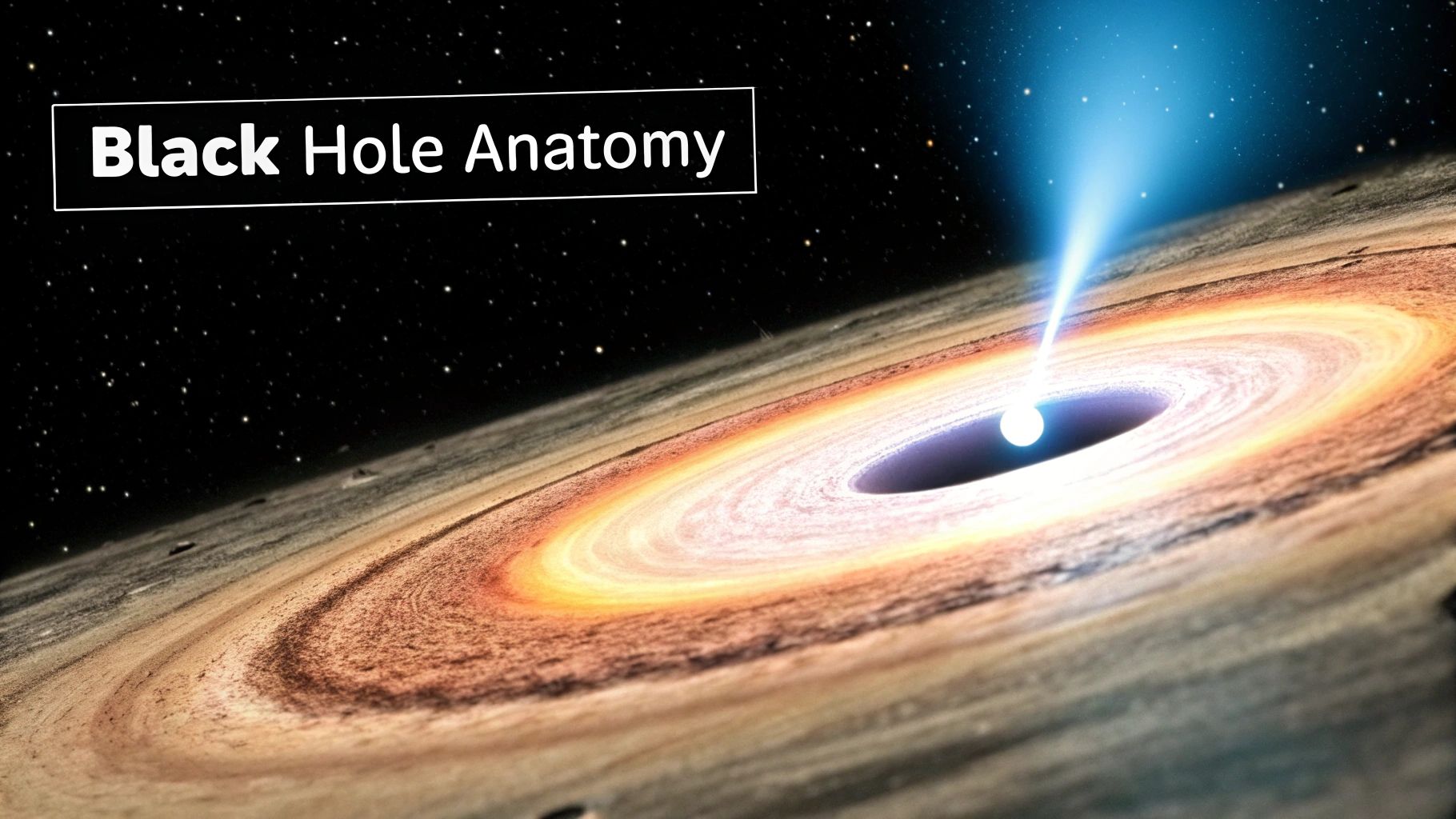
Imagine you're in a little boat, drifting down a river that leads to a massive waterfall. At a certain point, the current gets so strong that no matter how hard you paddle, you can’t escape being pulled over the edge. The event horizon is just like that—a boundary where gravity’s pull becomes unstoppable.
The Mysterious Centre
Now, if we could somehow zip past that event horizon, our journey would lead us to the very heart of the black hole. This is where we find the most baffling part of all: the singularity.
A singularity is a single point where all the stuff that makes up the black hole has been squashed into a space that is infinitely small and incredibly dense. At this point, all the rules of physics as we know them just completely stop working.
It’s one of the biggest puzzles in science. The conditions are so bonkers that they defy everything we understand about how the universe works. In a way, it’s a bit like the dilemmas Space Ranger Fred faces in Space Ranger Fred and the Umbrella Rescue, where the normal rules just don’t seem to apply. Scientists are still scratching their heads, trying to figure out what really goes on at the centre of a black hole.
How We Find These Invisible Objects
If a black hole is a cosmic ghost that even light can't escape from, you’re probably wondering, "How on Earth do we even know they're there?" It's a fantastic question! Since we can't see them directly, astronomers have to become cosmic detectives, hunting for the clues these invisible giants leave behind.
One of the biggest giveaways is the way things move around them. Scientists can spot stars zipping through space, orbiting what looks like absolutely nothing at incredible speeds. When they see this, they know a seriously massive object with a powerful gravitational pull must be hiding there—a classic tell-tale sign of a black hole.
Watching a Black Hole Eat
Another way we find them is by catching them in the middle of a meal. A black hole can be surrounded by a swirling, superheated ring of gas and dust called an accretion disc.
Imagine water swirling down a drain just before it disappears. An accretion disc works a lot like that, but instead of water, it’s made of stellar material that heats up and glows brightly as it spirals closer to the event horizon.
This glowing disc is something our telescopes can see, creating a bright beacon that signals a black hole's location. By studying these discs, we can learn a huge amount about the black hole's size and behaviour. You can find out more about the different tasks astronauts do to observe our universe by exploring what astronauts do in space.
Hearing Ripples in Spacetime
Perhaps the most amazing way we find them involves "hearing" the universe. When two black holes collide, they create ripples in the very fabric of spacetime itself called gravitational waves. These waves travel across the cosmos, and we can now detect them right here on Earth. Just like in Space Ranger Fred and the Shoelace Adventure, where a small action can have big consequences, these tiny ripples tell a huge story.
Projects like the Vera C. Rubin Observatory are set to take this detective work even further. The UK has played a major part in this collaboration, which will create a real-time movie of the night sky, helping to spot events like black hole mergers as they happen. Discover more about how researchers will probe black hole mysteries.
Busting Common Myths About Black Holes
Thanks to blockbuster films and exciting stories, black holes often get a bad reputation. They’re usually painted as cosmic vacuum cleaners, zipping around the universe and sucking up everything in their path. But the truth is a lot less dramatic and, honestly, far more interesting.
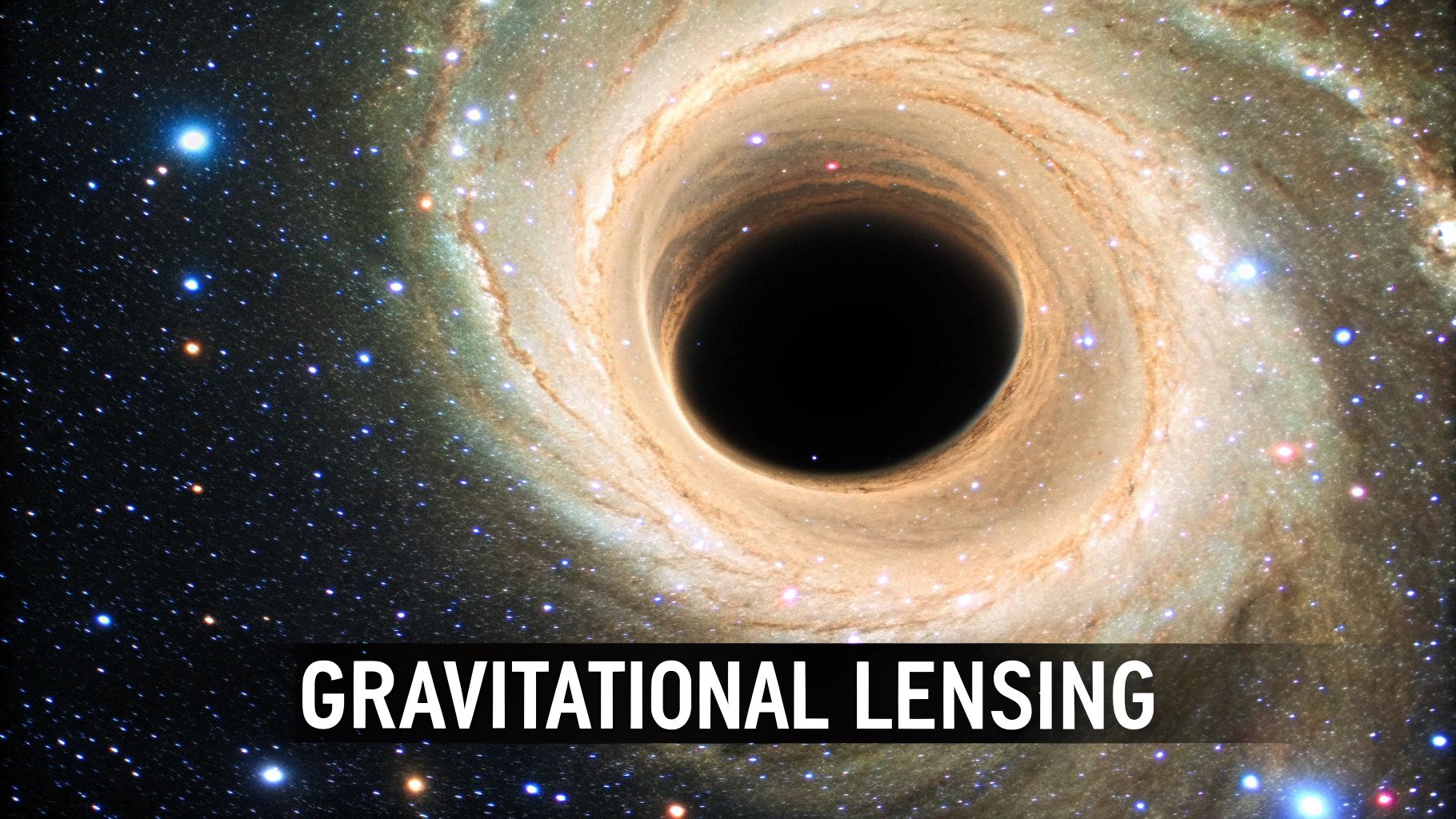
A black hole’s gravity actually works just like any other object with the same amount of mass. You have to get incredibly close to be caught in its pull.
If our Sun were magically replaced by a black hole of the exact same mass, the Earth wouldn’t get sucked in. We would just keep orbiting it safely, although it would get very, very cold!
This means a black hole isn’t actively hunting for planets or stars to devour. An object has to drift very near to its event horizon to be captured. Exploring cool space facts for kids is a great way to separate the real science from the science fiction.
What About Wormholes
Another popular idea is that black holes are secret gateways to other parts of the universe, often called wormholes. This concept makes for amazing adventures, like those in Space Ranger Fred and the Shoelace Adventure, where heroes can zip across galaxies in the blink of an eye.
While the mind-bending maths behind black holes allows for the possibility of such tunnels through spacetime, they remain purely theoretical. Scientists have found zero evidence that wormholes actually exist.
So, for now, black holes are not cosmic shortcuts. They are fascinating, powerful objects that follow the same laws of gravity as everything else in the universe, just taken to the absolute extreme.
Why Black Holes Are So Important to the Universe
When you think of a black hole, you probably imagine a cosmic vacuum cleaner, sucking up everything in sight. But what if I told you they’re not just wrecking balls? In fact, they’re some of the universe’s most important builders.
It turns out that many of the biggest galaxies, including our very own Milky Way, have a supermassive black hole sitting right at the centre. It’s like a giant, gravitational anchor holding everything in place, helping to shape how stars are born and where they travel.
Pushing the Boundaries of Science
Beyond being galactic architects, black holes are the ultimate cosmic laboratories. They stretch our understanding of physics to its absolute limits, forcing scientists to figure out how two very different ideas—gravity and the bizarre world of quantum mechanics—can possibly work together.
Black holes represent the frontier of physics. Studying them forces us to ask the biggest questions about space, time, and the very nature of reality itself. They are where our current science breaks down and new discoveries begin.
This constant push for answers leads to some truly mind-blowing breakthroughs. For example, scientists recently detected the biggest black hole merger ever seen—an event where two giants slammed together to create a new black hole 240 times the mass of our Sun! You can read all about this groundbreaking black hole discovery.
Unlocking their secrets is a huge part of modern science, inspiring a new generation of explorers—much like the missions in Space Ranger Fred and the Tick Tock Tale. You can check out more about the ongoing journey of space exploration for kids.
A Few Black Hole Questions Answered
Black holes can feel a bit like something out of a comic book, so it's no surprise we have lots of questions! Let's clear up a few of the biggest ones and separate the science facts from the science fiction.
Could a Black Hole Ever Swallow the Earth?
Good news: you can sleep soundly tonight! There isn’t a black hole anywhere near us that could cause any trouble.
The closest one we know of is thousands of light-years away—that’s an unbelievably long distance. For a black hole to gobble up Earth, it would have to somehow wander right into our cosmic neighbourhood, and the chances of that happening are practically zero. Phew!
So, What's Actually Inside a Black Hole?
This is one of the biggest and most exciting unsolved mysteries in the entire universe! What we think happens is that everything that falls in gets squashed down into a single, super-tiny point with infinite density. Scientists call this a singularity.
The tricky part is that our current rules of science and physics completely break down when we try to describe it. It's a puzzle that some of the cleverest people on Earth are working hard to solve.
Does Anything Ever Get Out?
Once you cross that invisible line—the event horizon—you’re pretty much stuck for good. It's a one-way trip!
However, a brilliant scientist named Stephen Hawking came up with a mind-bending idea called Hawking radiation. He suggested that because of some weird and wonderful quantum effects, black holes can slowly "leak" tiny particles over an incredibly long time. This means that, after billions and billions of years, a black hole could eventually evaporate and disappear completely.
Ready for your next mission? Join Space Ranger Fred on his own cosmic journeys! Dive into exciting stories like Space Ranger Fred and the Umbrella Rescue that make learning about space a thrilling adventure. Explore our universe at https://spacerangerfred.com.