
Have you ever wondered what is zero gravity? It’s that amazing feeling you see when astronauts float about in their spaceships, but here’s a little secret… it’s not really about having zero gravity at all! It's one of the coolest, most mixed-up ideas in science, and we're about to untangle it for you.
The Big Secret: It's Not Really Zero Gravity
When you watch astronauts glide through the International Space Station (ISS), it’s easy to think gravity has just been switched off. But that’s one of the biggest myths about space travel. Up on the ISS, the pull of Earth's gravity is actually about 90% as strong as it is down here on the ground!
So, if gravity is still pulling on them, why do they float? The answer is a brilliant little word: freefall.
Imagine you’re in a lift and the cable suddenly snaps (don't worry, this is just a thought experiment!). For those few terrifying seconds as the lift plummets, you and everything else inside it would float. You'd feel completely weightless because you, the lift, and even the air inside are all falling together at the exact same speed.
That’s precisely what’s happening to astronauts! The ISS is constantly falling towards Earth, but it’s also zooming sideways so incredibly fast that it keeps missing. This never-ending tumble is what creates the feeling of weightlessness. It's a bit like the adventures in Space Ranger Fred and the Shoelace Adventure, where figuring out the science of a tricky situation is the only way to save the day. You can find more awesome secrets about the cosmos in these space facts for kids.
This picture helps show how it all connects.
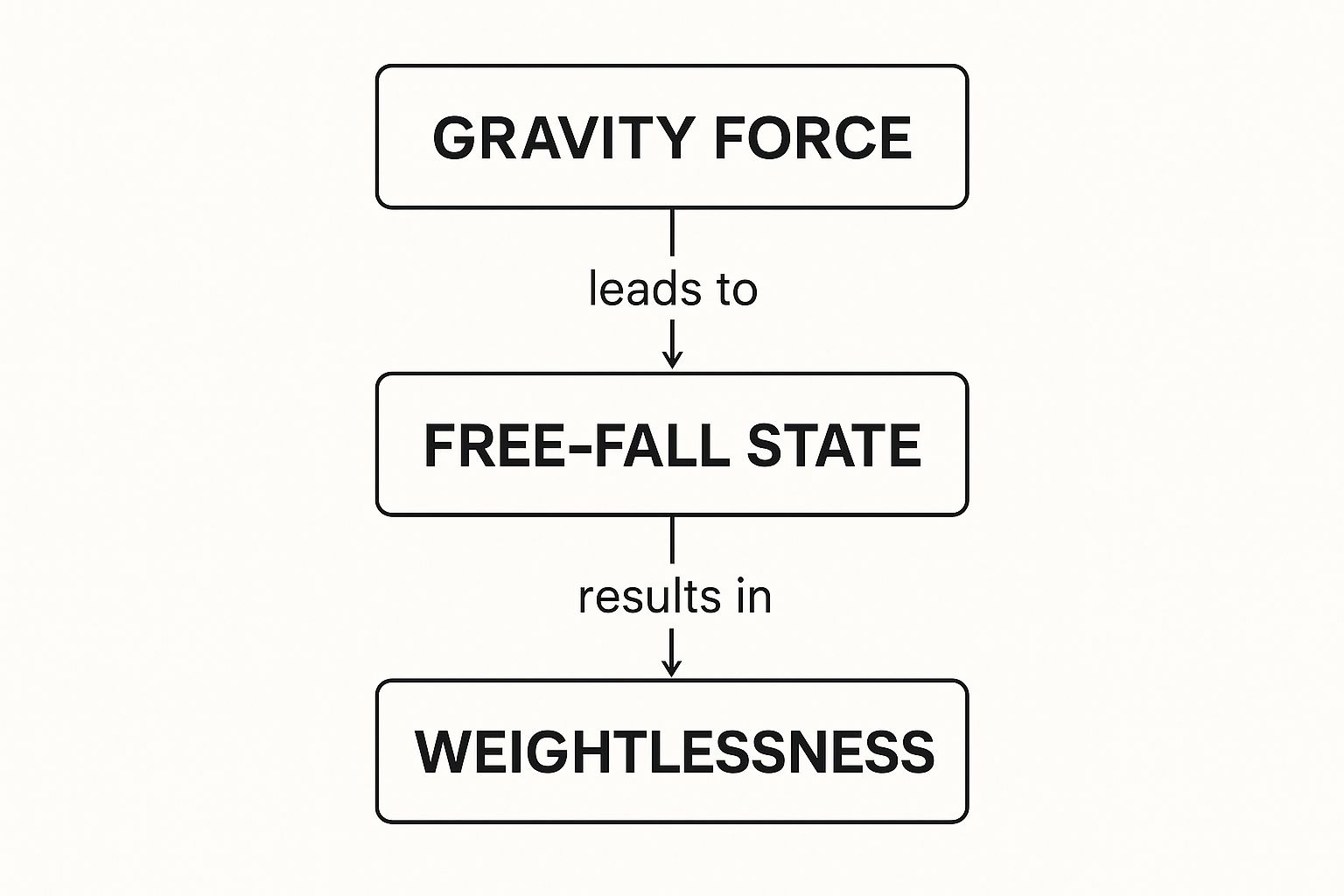
As you can see, Earth’s gravity is the real hero here. It causes the state of freefall, which is what gives astronauts that amazing feeling of floating around.
To make it even clearer, here’s a quick summary of the main ideas.
Zero Gravity at a Glance
| Concept | Simple Explanation |
|---|---|
| Gravity in Orbit | It's still there! Astronauts on the ISS feel about 90% of Earth's gravity. |
| Freefall | The ISS is constantly falling towards Earth but moves sideways so fast it never hits. |
| Weightlessness | This is the feeling of having no weight, caused by being in constant freefall. |
| The Lift Analogy | If a lift cable snapped, you'd feel weightless as you fell with it, just like astronauts. |
So, next time you see someone floating in space, you'll know the real secret. It’s not a lack of gravity, but a super-fast, never-ending fall around our planet.
So Why Do Scientists Call It Microgravity?
If there's no such thing as 'zero gravity' in space, what do the experts call it? Well, they use a much more accurate term: microgravity. It might seem like astronauts on the International Space Station (ISS) are completely weightless, but they actually feel around 90% of Earth's gravitational pull. That incredible floating feeling is all thanks to them being in a constant state of freefall as they whizz around our planet.
So, if gravity is still that strong, where does the 'micro' part come in? It's all about the other tiny, almost unnoticeable forces that are still pulling and pushing everything around up there.

These tiny forces come from all sorts of places. The Sun and the Moon, for instance, still have a very small gravitational tug on the spacecraft. Even the huge ISS itself creates a minuscule gravitational field that gently pulls things towards its centre.
The Small Forces That Really Matter
These forces are incredibly weak—we're talking millionths of the gravity we feel on Earth—and that’s exactly where the name microgravity comes from. While they're nowhere near strong enough to stop an astronaut from floating about, they're big enough for scientists to measure and consider when they're running delicate experiments.
Getting these little details right is what real science is all about. For a scientist, being precise about gravity is just as important as a space explorer having an accurate map for a mission. It’s a bit like in Space Ranger Fred and the Umbrella Rescue, where paying attention to the small stuff makes all the difference between success and a very soggy disaster!
Using the term 'microgravity' shows that while the effects of gravity are massively reduced, they haven't vanished entirely. It’s this scientific accuracy that helps us truly understand what’s happening up there.
Switching from 'zero gravity' to 'microgravity' is more than just swapping words. It shows we have a much deeper, more precise understanding of the forces that run our universe, from falling apples on Earth to entire space stations orbiting high above.
How We Create Weightlessness on Earth
Believe it or not, you don’t actually need to be an astronaut to get a taste of what is zero gravity is like. Scientists have cooked up some brilliantly clever ways to create that amazing floating feeling right here on Earth, which is super important for training astronauts and testing new kit before it blasts off into space.
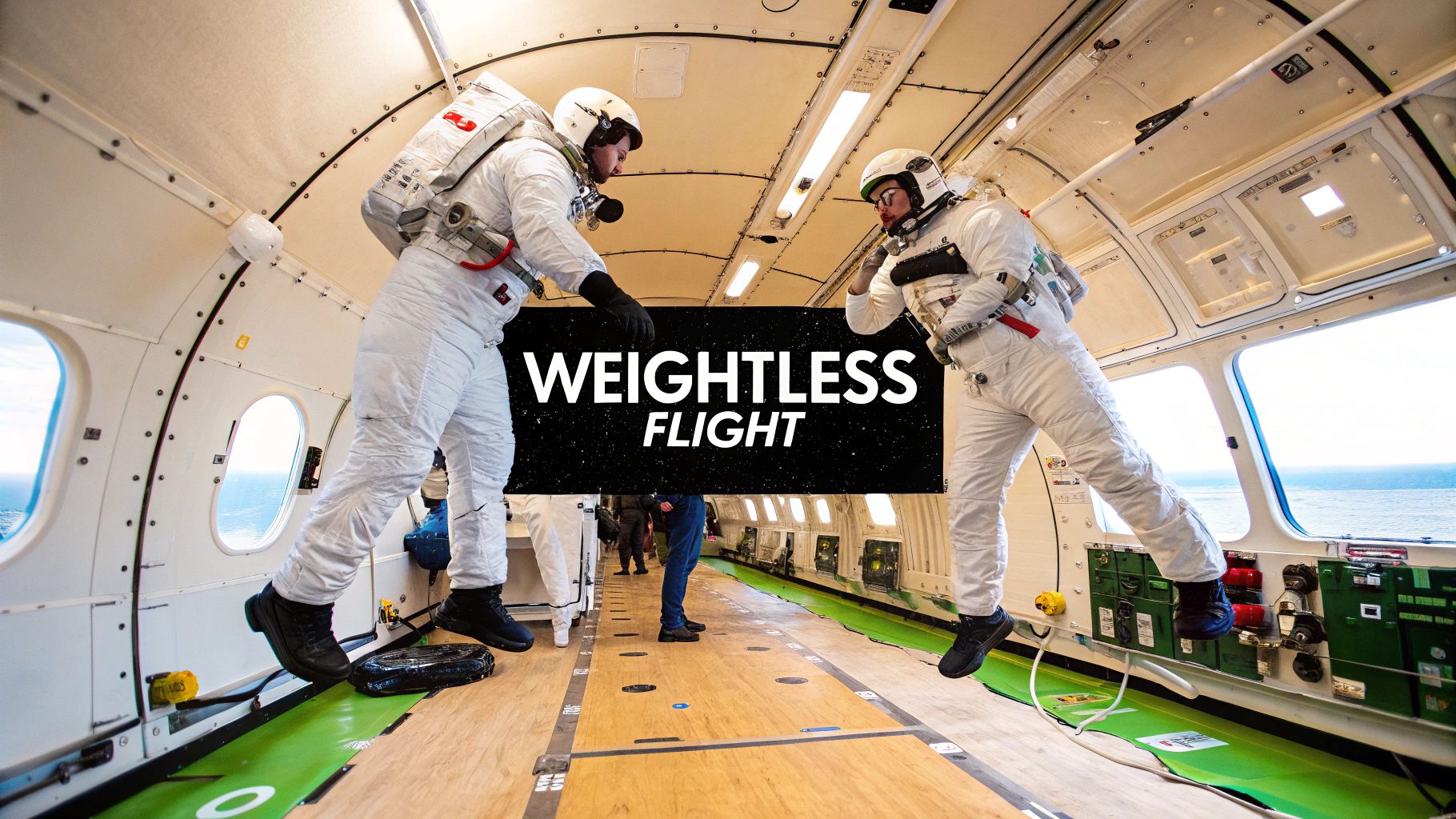
The most famous method involves a special aeroplane that performs a pretty amazing trick in the sky. These planes, often nicknamed the 'Vomit Comet' (for reasons you can probably guess!), fly in a pattern that looks just like a giant rollercoaster.
First, the plane climbs steeply upwards, pinning everyone to their seats. Then, it noses over the top of the arc and dives back towards the ground. For about 20-30 seconds during this dive, the plane and everyone inside are in freefall, just like the International Space Station. In that short window, you're completely weightless!
Simulating Space on the Ground
Parabolic flights are a fantastic way to prepare for the real thing. Here in the UK, scientists use these flights to carry out vital research into how microgravity affects the human body. In fact, the UK Space Agency has invested over £500,000 in projects that use these unique conditions to better understand our own physiology. You can read more about these exciting UK space projects and see how they're getting us ready for future missions.
This rollercoaster-in-the-sky is a perfect example of human ingenuity. By mimicking the physics of an orbit, we can bring a little piece of space right down to Earth.
While these flights are the most well-known method, scientists also use other cool techniques. One is the drop tower – a massive, tall structure where experiments can be dropped inside a vacuum. As they fall, they experience a few precious seconds of perfect microgravity.
It’s a bit like the problem-solving in Space Ranger Fred and the Tick Tock Tale, where a bit of creative thinking is needed to get the job done. These methods just go to show how we can cleverly recreate the conditions of space without ever leaving our planet.
What Living in Microgravity Feels Like
Ever woken up and just floated out of bed instead of standing up? That’s the wild reality for astronauts living in microgravity. At first, it’s an absolute blast, just like being a superhero. You can glide down a corridor with a gentle push and even play with little bubbles of water that just hang in the air.
But after the initial fun wears off, you realise just how tricky everyday life can be. Simple things we do without thinking become a real challenge. Want to type on a laptop or eat your dinner? You'll need to strap yourself down so you don't drift away halfway through. Even sleeping is different – astronauts have to zip themselves into special sleeping bags that are tied to a wall.
Your Body in Space
Living without the constant tug of Earth's gravity has some seriously strange effects on the human body. Our bodies are built for life on Earth, and when you take that downward pull away, things start to change in some surprising ways.
Without gravity constantly pulling you down, your body doesn't have to work to support its own weight. It sort of gets a bit lazy, which creates some major health challenges that astronauts have to fight against every single day.
For starters, your muscles don't have to hold you up anymore, so they begin to weaken. This is called muscle atrophy. Your bones also start to lose density because they aren’t carrying your weight around.
To stop this from happening, astronauts have a super strict exercise routine, spending about two hours every single day working out. They use special machines designed to create resistance, which keeps their muscles and bones strong and healthy. It's a huge part of understanding what astronauts do in space to stay in shape for their return home.
Just like in the book Space Ranger Fred and the Tick Tock Tale, astronauts have to be incredibly clever problem-solvers, managing both their amazing new environment and the peculiar needs of their own bodies.
The Scientific Breakthroughs of Weightlessness
Weightlessness isn't just about floating around and having fun—it’s a one-of-a-kind laboratory where scientists can make discoveries that would be completely impossible down here on Earth. The amazing environment of microgravity lets researchers see our world in a whole new light, leading to some truly incredible breakthroughs.
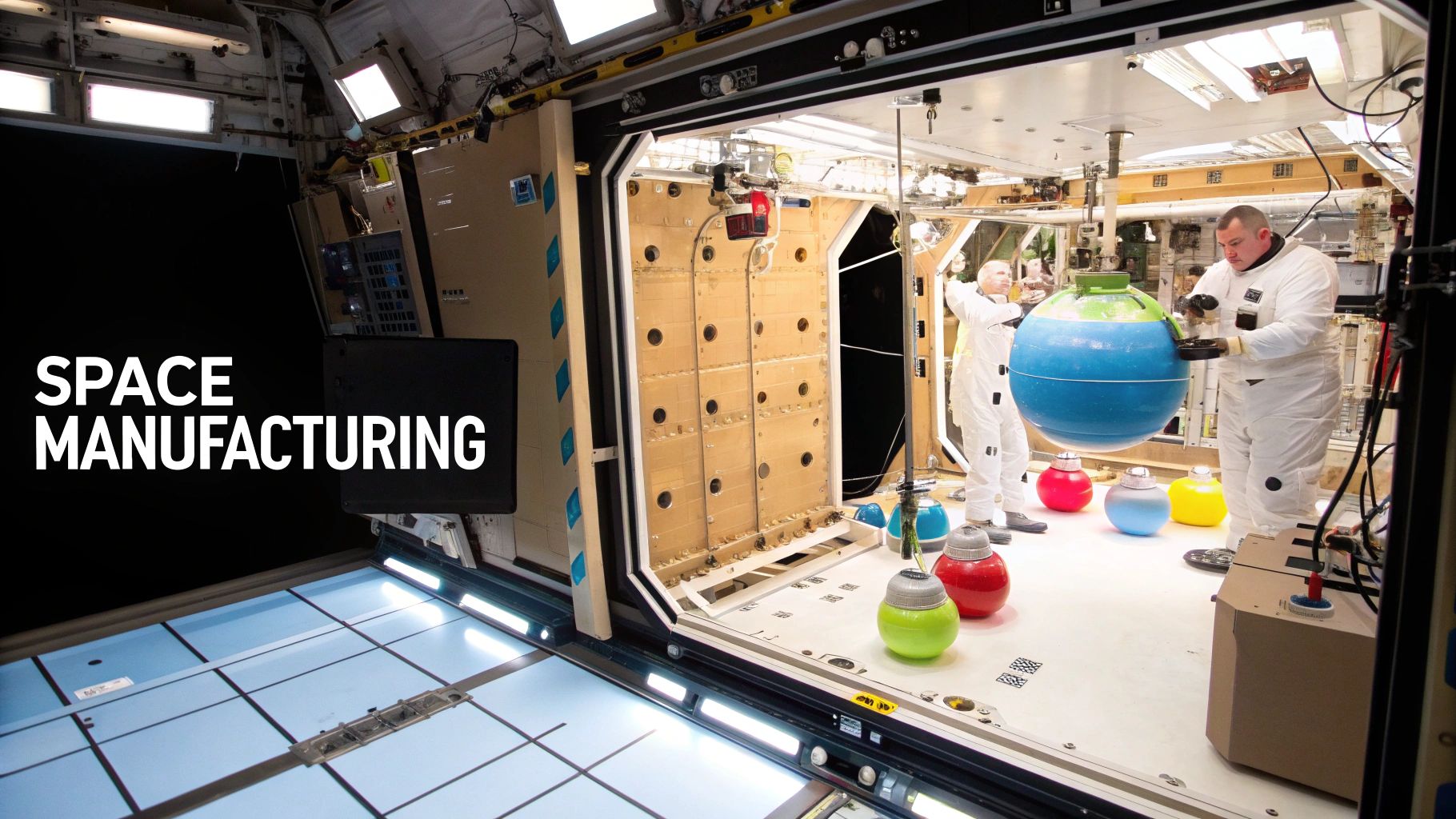
When you take gravity out of the picture, things start to behave in very weird and wonderful ways. For instance, without gravity pulling everything downwards, scientists can grow much purer crystals. This is a huge deal for developing new medicines back home, as purer crystals help create more effective treatments for diseases. It also helps them understand illnesses like osteoporosis by studying bone density loss in astronauts with amazing clarity.
Powering the Future with Space Research
And the benefits don't stop there. UK researchers and their partners around the globe use this unique setting to explore all sorts of things, from how fire burns without gravity to testing advanced new materials for future technology.
Microgravity allows us to strip away a fundamental force of nature and see what happens. The results often reveal secrets that can improve our health, our technology, and our understanding of the universe itself.
A brilliant example of this comes from UK universities, which are right at the forefront of this research. Scientists at the University of Cambridge have been testing graphene—an incredible material just one atom thick—in simulated zero gravity. They're exploring how it can create better cooling systems for satellites, making them more efficient and longer-lasting. You can learn more about their zero-gravity graphene research and see how it’s shaping space tech.
Much of this vital work happens aboard incredible platforms like the ISS, a true hub of cosmic science. You can discover more about what the International Space Station is in our detailed guide. These experiments prove that learning about space isn’t just about exploring other worlds; it’s about making life better for all of us, right here on Earth.
Your Zero Gravity Questions Answered
We’ve zipped through the concepts of freefall, poked around in microgravity, and even seen how scientists cook up weightlessness right here on Earth. Now, it’s time to tackle some of the biggest questions about what is zero gravity and what it’s like to float around in space.
Think of this as our final mission debrief—tying up all the loose ends for a crystal-clear picture.
Is There Really No Gravity on the ISS?
This is the number one myth we need to bust! Far from it. The International Space Station (ISS) is actually so close to Earth that it experiences about 90% of the gravity we feel on the ground.
So why do astronauts float? It’s because the ISS and everyone inside it are in a constant state of freefall, zooming sideways around our planet. It’s a bit like being in a lift when the cable snaps (but way more fun and a lot safer!). That's why scientists much prefer the term ‘microgravity’—it’s a lot more accurate.
How Do Astronauts Eat and Drink Without Making a Mess?
Very, very carefully! You can't just open a bag of crisps up there. Food is often packaged in special pouches or made slightly sticky to stop crumbs from flying off and gumming up the high-tech equipment.
Even salt and pepper are liquids, so they can be squeezed onto food instead of shaken. Drinks come in sealed bags with special straws that have clamps to prevent any cosmic spills. It’s all about clever problem-solving for a totally new environment, just like you might read about in Space Ranger Fred and the Shoelace Adventure, where a bit of everyday science saves the day!
Living and working in space means mastering the small details. From eating a meal to conducting an experiment, every single action has to be carefully planned.
What Happens to the Human Body in Space Long-Term?
Our bodies are used to gravity constantly pulling on us. Take that away, and some strange things start to happen. Muscles can get weaker since they don't have to work as hard, and bones can lose some of their density over time.
To stop this from happening, astronauts have a pretty tough workout routine, exercising for about two hours every single day. They use special resistance machines that mimic weightlifting to keep their bodies strong, healthy, and ready for their return to Earth. Scientists are always studying these effects to make longer space journeys—like a future mission to Mars—safer for the next generation of explorers.
Are your kids fascinated by the mysteries of space and the science of adventure? At Space Ranger Fred, we turn curiosity into a cosmic journey! Our books make complex STEM topics fun and accessible for young explorers.
Blast off into a universe of learning and laughter by checking out the adventures at spacerangerfred.com.