
Ever gazed up at the stars and spotted those hazy, colourful smudges floating in the darkness? Those aren't just pretty patches of light; they're nebulae—gigantic, magnificent clouds of gas and dust drifting through space. Think of them as the universe's very own art studios, or even cosmic nurseries where brand new stars are born.
Your Guide to Cosmic Clouds
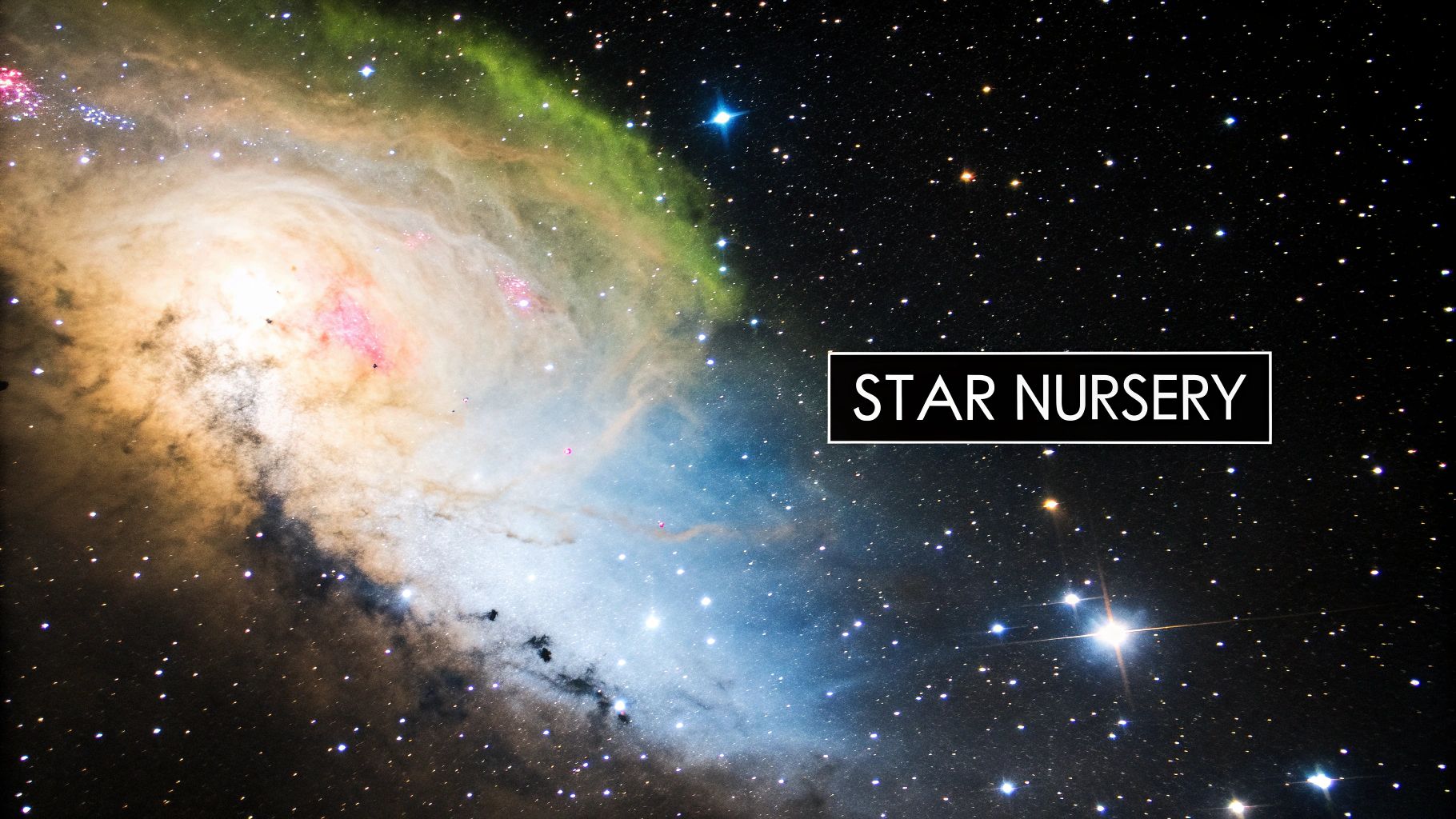
Alright, space explorers, let's blast off on a journey into the incredible world of nebulae! These aren't just any old clouds; they're some of the most beautiful and important objects in the entire universe. They're dotted all across our galactic home, which you can learn more about in our guide on what is the Milky Way.
Just like in Space Ranger Fred and the Shoelace Adventure, where Fred figures out a huge problem by breaking it down into smaller pieces, we're going to do the same with nebulae. You'll see, it's a lot simpler than you might think!
The Ingredients of a Nebula
So, what's the recipe for one of these cosmic clouds? It's pretty straightforward, with just two main ingredients and a little something extra for cosmic flavour.
- Hydrogen Gas: This is the most common stuff in the entire universe, and it makes up almost all of a nebula.
- Helium Gas: The second-most-common ingredient, helium, hangs out right alongside the hydrogen.
- Cosmic Dust: Sprinkled all through the gas are tiny specks of dust, a bit like super-fine sand or soot. This dust is a huge deal, helping to shape how nebulae look and what they do.
These enormous clouds can be star factories, churning out new suns, or they can be the stunning leftovers of stars that have reached the end of their lives. UK scientists are at the forefront of studying these amazing objects, working on big projects like the European Space Agency’s Euclid mission to decode their secrets. You can read about the UK's contribution to understanding the universe and their brilliant work.
A nebula is more than just a pretty picture in space. It's a place of creation and transformation, where the building blocks of stars, planets, and even life itself are gathered together.
You could say nebulae are the universe's ultimate recycling centres. They scoop up the material from old, exploded stars and use it to build shiny new ones, keeping the great cosmic cycle of life turning.
How Do Nebulae Form in Space?
So, where do these incredible cosmic clouds actually come from? It’s not magic, but the story behind them is seriously cool. Nebulae have two main origin stories, a bit like a superhero's tale. One is all about brand-new beginnings, and the other is about truly spectacular endings.
The first way a nebula comes to be is from all the stuff already floating around between the stars. Think of giant, chilly clouds of gas and dust just drifting through the galaxy. Over millions of years, the gentle tug of gravity starts pulling all these little bits closer and closer together.
It's a bit like tiny dust bunnies hiding under a bed. At first, they're all scattered, but slowly they drift towards each other and form one big, fluffy clump. Gravity does the exact same thing in space, pulling gas and dust into enormous clouds that eventually become a nebula—the perfect nursery for new stars to be born.
The Birth of a Star Factory
These massive clouds, which astronomers call Giant Molecular Clouds, are the very starting point for making stars. They are unbelievably cold, which helps gravity get the job done without all the little gas particles zipping away.
As the cloud gets thicker and clumpier, small pockets of gas and dust start to collapse under their own weight. This is how the seeds for future stars are planted. It's a slow but powerful cycle of cosmic creation.
A single nebula can become the birthplace for hundreds or even thousands of stars! The famous Orion Nebula, for instance, is a bustling star factory where we can see this happening right now.
A Star's Explosive Finale
The second story of how a nebula is born is way more dramatic. It happens when a really, really big star reaches the end of its life. Stars much bigger than our Sun don't just quietly fade out—they go out with a massive bang!
This incredible explosion is called a supernova. When a huge star runs out of fuel, its centre collapses, and all its outer layers are blasted out into space at mind-boggling speeds. Just like the clever problem-solving in Space Ranger Fred and the Umbrella Rescue, a supernova is a powerful event that completely changes the scene.
These exploded layers of gas and dust create a beautiful, expanding shell, forming a brand-new, glowing nebula. The famous Crab Nebula was actually created by a supernova that people on Earth saw nearly 1,000 years ago. These leftover clouds are packed with important stuff like oxygen and iron that were cooked up inside the star. Sometimes, the star's collapsed core can form something even more mysterious, and you can learn all about it in our guide on what is a black hole.
So, you see, a nebula can be either a cosmic cradle for new stars or a stunning memorial to a star that has lived its life to the fullest.
Exploring the Different Kinds of Nebulae
Now that we know how nebulae get started, let’s go on a visual tour of the different kinds you might see floating around in space! Just like the clouds in our sky can be fluffy, wispy, or stormy, nebulae come in a few spectacular varieties. They don’t all look the same, and each one has a special reason for its incredible appearance.
Figuring out which type of nebula you’re looking at is a bit like a cosmic detective game. You have to search for clues in its colours and shape to understand what’s happening deep inside. It’s a puzzle worthy of the clever thinking you'd find in Space Ranger Fred and the Tick Tock Tale.
The Glowing Giants: Emission Nebulae
First up are the real show-offs of the nebula world: emission nebulae. These are the ones you’ve probably seen in pictures, glowing with brilliant shades of red and pink. So why are they so colourful? It’s because these nebulae are basically star factories, buzzing with hot, young baby stars.
These newborn stars shine so brightly that they energise all the gas around them, making it light up like a giant neon sign in the cosmos. The most common gas out there, hydrogen, just happens to glow with a very distinct red light when this happens, giving these nebulae their signature rosy hue.
The Cosmic Mirrors: Reflection Nebulae
Next, we have reflection nebulae. Instead of glowing on their own, these clouds act more like enormous mirrors scattered across the universe. They don’t have those super-hot baby stars inside them to make the gas light up.
Instead, they're usually found near bright, hot stars, and the dust inside them simply reflects the starlight. This reflected light often appears as a cool, shimmering blue. It’s the very same reason our sky on Earth looks blue—blue light scatters more easily than red light, so that’s the colour we see bouncing off the dust.
Nebulae can be places of birth or the remnants of a star's death. This handy infographic shows the two main paths a nebula can take.
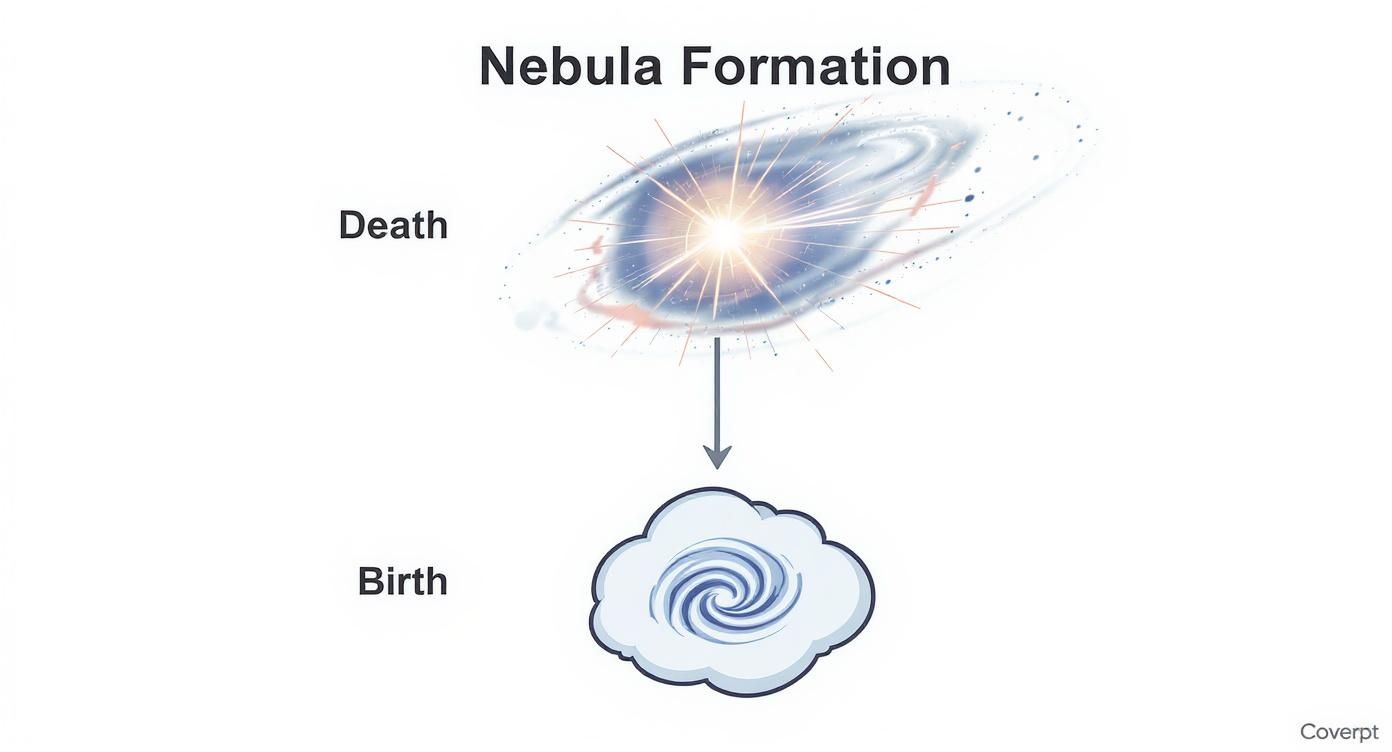
This visual guide helps us see that whether a star is just beginning or has reached its explosive end, the result is a beautiful cosmic cloud that helps shape the galaxy for whatever comes next.
The Mysterious Shadows: Dark Nebulae
Finally, let’s investigate the most mysterious-looking kind: dark nebulae. These aren’t empty patches in space, as you might think. They’re actually clouds of dust so incredibly thick and dense that they completely block out all the light from the stars shining behind them.
They look like spooky, dark holes punched into a starry background. While they don't glow or shine themselves, they are often where the ingredients for future stars are gathering, hiding away until gravity eventually brings them all together to light up the cosmos.
A Quick Guide to Nebula Types
To make telling these amazing cosmic clouds apart a little easier, we’ve put together this quick guide.
| Type of Nebula | What It Looks Like | Why It Looks That Way |
|---|---|---|
| Emission Nebula | Bright, glowing clouds, often red or pink. | Hot, young stars inside are heating up the gas. |
| Reflection Nebula | Shimmering blue clouds near bright stars. | Dust is reflecting light from nearby stars. |
| Dark Nebula | Dark, shadowy shapes against starry backgrounds. | Thick dust is blocking the light from behind it. |
So next time you see a picture of a nebula, you'll know exactly what you’re looking at—whether it’s a star-making factory, a cosmic mirror, or a secret stellar nursery in hiding
A Tour of the Most Famous Nebulae
Alright, space explorers, are you ready for an incredible journey? Let's blast off on a tour of the most famous and breathtaking nebulae in our cosmic neighbourhood. These are the celestial landmarks that astronomers absolutely love to study, and each one tells a story as amazing as the tales in Space Ranger Fred and the Shoelace Adventure.
Our first stop is one of the brightest jewels in the night sky: the Orion Nebula. You can find it hanging just below the three stars that form Orion's belt. Think of it as a bustling star nursery, packed with hundreds of hot, young stars that have only just been born.
The Orion Nebula is so bright that you don't even need a super-powerful telescope to see it. On a clear night, far from the glare of city lights, a simple pair of binoculars is all it takes to spot this glowing, fuzzy patch in the sky. It's also one of the closest star-forming regions to Earth, sitting about 1,344 light-years away.
The Majestic Eagle Nebula and its Pillars
Next, we'll swing by the magnificent Eagle Nebula. This amazing place is home to one of the most famous space pictures ever taken: the "Pillars of Creation." Of course, they aren't actual pillars, but gigantic towers of cool hydrogen gas and dust that stretch for light-years.
These towering structures are like cosmic sculptures, constantly being shaped by the fierce winds and brilliant light from a cluster of massive young stars nearby. And deep inside these dusty pillars, even newer stars are quietly forming, hidden from our view until they become bright enough to burst out.
Before modern telescopes, seeing these structures in such detail was impossible. It was actually UK astronomers in the 19th century who hugely improved our understanding of nebulae. William Parsons, the 3rd Earl of Rosse, built a massive telescope that allowed him to make groundbreaking sketches of these distant objects, transforming them from blurry smudges into structured wonders. You can discover more about these amazing early observations and see how they changed astronomy forever.
The Pillars of Creation are always changing. Astronomers believe a supernova explosion may have already destroyed them, but because they are so far away, we won't actually see the light from that event for another few hundred years!
The Spooky Horsehead Nebula
Our final stop is at one of the most recognisable shapes in the cosmos: the Horsehead Nebula. This is a perfect example of a dark nebula. It doesn’t glow or shine; instead, it's a colossal, shadowy cloud of cold gas and thick dust that looks just like a horse's head silhouetted against a backdrop of glowing red light.
That beautiful red glow comes from a bright emission nebula behind it, which is being lit up by a nearby star. The Horsehead Nebula itself is so dense that it completely blocks the light from everything behind it, creating that famous shape. It’s a powerful reminder that even the dark, empty-looking patches in space are filled with incredible things.
Why Nebulae Are So Important to the Universe
Nebulae are a whole lot more than just pretty, colourful clouds drifting through space. They’re cosmic superstars with a seriously important job! Without these magnificent clouds of gas and dust, our universe would be a very different, and much darker, place.
To put it simply, without nebulae, no new stars could be born. That means no new suns, no new planets, and no new solar systems. They are the essential starting point for pretty much everything we see twinkling in the night sky.
The Great Cosmic Recycling Factory
Think of a nebula as a giant cosmic recycling factory. It gathers up all the dust and gas left over from old stars that have reached the end of their lives and uses those raw ingredients to build brand-new ones from scratch.
This cycle is what keeps the universe going. It means everything is always changing and creating, never letting good material go to waste. Everything gets reused in a brilliant, star-making loop.
Everything in the universe, including the stars, the planets, and even you, is made from ‘star stuff’. The elements created inside ancient stars were scattered across space by nebulae, eventually coming together to form everything we know.
That amazing fact connects us directly to the cosmos. The tiny building blocks that make up our bodies were once forged deep inside a star and later swirled through a colourful nebula, just waiting to become part of something new.
Clues to How Galaxies Grow
Studying nebulae is also a bit like being a cosmic detective. By looking closely at these massive clouds, scientists can piece together how entire galaxies, like our own Milky Way, grow and change over billions of years. It’s a lot like how the hero in Space Ranger Fred and the Tick Tock Tale learns how things work by carefully observing them.
For example, a team including UK researchers studying a nebula called NGC 6164/6165 figured out how violent events, like stars clashing together, can shape the universe. This particular nebula is full of nitrogen, carbon, and oxygen—elements that are normally hidden deep inside stars but were blasted out into space when two stars merged. You can discover more about how this stellar mystery was solved and what it teaches us about the lives of stars.
By examining the ingredients and movements within a nebula, astronomers can read the past and future of our galaxy. It’s like turning the pages of the universe's own history book, one beautiful gas cloud at a time.
How You Can Spot a Nebula Yourself
You don't need a giant observatory or a rocket ship to become a real-life nebula spotter. With a little bit of patience and a keen eye, you can start your very own stargazing adventure right from your back garden! It’s an exciting mission, just like the ones in Space Ranger Fred and the Umbrella Rescue.
Believe it or not, one of the most famous nebulae is actually bright enough to see without any fancy equipment. The magnificent Orion Nebula, that bustling star nursery we visited earlier, is waiting for you to find it. All you really need is a dark night, far away from the bright lights of a city.
Finding the Orion Nebula
Ready for your first challenge, space explorer? Finding the Orion Nebula is a brilliant way to begin your journey. It's a fun and rewarding quest that makes you feel like a proper astronomer.
Here’s your simple, step-by-step guide to spotting this cosmic wonder:
- Look for Orion's Belt: First, you’ll need to find the famous constellation of Orion the Hunter. The easiest part to spot is his belt, which is made of three bright stars in a perfect, straight line.
- Find Orion's Sword: Just below the belt, you should see another, fainter line of what looks like three stars hanging downwards. This is known as Orion's Sword.
- Spot the Fuzzy Star: Take a close look at the middle "star" in the sword. You'll notice it's not a sharp point of light like the others. It looks a bit fuzzy or misty—that fuzzy patch is the Orion Nebula!
With a simple pair of binoculars or a small telescope, that fuzzy smudge will transform into a beautiful, glowing cloud. You are officially looking at a place where brand new stars are being born, more than 1,300 light-years away.
Seeing Nebulae in Dazzling Colour
While your binoculars will show you the nebula's ghostly shape, they won't reveal the stunning pinks, blues, and reds you see in all the pictures. Those incredible colours are captured by powerful space telescopes like the Hubble and the James Webb Space Telescope. They can collect light for hours and hours to see details our eyes simply can't.
You can become a digital space explorer anytime! Websites from NASA and the European Space Agency are treasure troves filled with breathtaking, colourful images of nebulae. It's like having a window to the deepest parts of the universe right on your screen.
Exploring these images online is a fantastic way to see what a nebula is up close. You can zoom in on the Pillars of Creation or marvel at the ghostly glow of a reflection nebula, all from the comfort of your home. It’s the perfect way to fuel your curiosity for our amazing cosmos.
Your Nebula Questions Answered
Still got a few questions whizzing around your head like little asteroids? Brilliant! Asking questions is exactly what makes a top-notch space explorer, just like in the Space Ranger Fred books. Let's dive into some of the most common things kids wonder about when it comes to nebulae.
Can We See a Nebula from Earth Without a Telescope?
You bet! The most famous one you can spot is the Orion Nebula.
Find a really dark, clear night and look for the Orion constellation. That fuzzy-looking star in his sword? That’s it! A telescope will give you a mind-blowing view, but there’s something truly special about spotting it with nothing but your own eyes.
Are All Nebulae Colourful?
Those incredible pictures of bright pink, blue, and purple nebulae are amazing, but they’re a little different from what you’d see yourself.
Those vibrant colours are captured by special cameras on giant space telescopes that can collect light for a very, very long time. Through a back garden telescope, most nebulae look more like faint, greyish-white smudges. The stunning colours in photos come from gases giving off different kinds of light—like hydrogen, which glows a brilliant red.
Nebulae can be mind-bogglingly huge. Some are so vast they measure hundreds of light-years across. A single light-year is already about six trillion miles, so that's a cloud bigger than you can even imagine!
Will Nebulae Last Forever?
Nope, these cosmic clouds are always changing. Over millions of years, the gas and dust inside them are either pulled together by gravity to create brand-new stars, or they slowly drift apart and fade back into the vast emptiness of space. They are a beautiful, but temporary, part of the universe.
To keep exploring these amazing topics, check out our other guides on space science for kids.
Ready for more cosmic fun? The adventures continue with Space Ranger Fred! Blast off into a universe of stories that make learning about science an exciting journey. Explore the books and activities today at spacerangerfred.com.