
Let’s be honest, the words "screen time" can make any parent flinch. But what if staring at a screen wasn't just a passive activity? What if it was an adventure? Children's educational video games are doing just that, turning tablets and consoles into incredible digital playgrounds where a child's imagination and brainpower can really take off. These aren't just distractions; the right kind of game can make even the most complex subjects, especially in STEM, feel like an exciting quest.
Learning Through Play in a Digital World
The whole conversation around screen time is shifting, and rightly so. Many of us are starting to realise that not all screen-based activities are the same. There's a world of difference between passively watching videos and actively tackling a challenge that demands creativity and problem-solving.
Think of these games as a digital sandpit. In a real sandpit, a child can build castles, dig holes, and learn about basic physics without any fear of making a permanent mess. Educational games offer that same safe space to explore ideas, test theories, and learn from mistakes, all without real-world consequences. This is the heart of game-based learning—using the fun and mechanics of play to hit specific learning goals.
Making STEM Subjects Fun, Not Frightening
One of the biggest wins for educational games is how they make tricky STEM subjects feel approachable and genuinely fun. A child might learn the basics of coding logic simply by guiding a character through a maze, or they could get a feel for physics by designing a rocket that actually flies (or explodes, which is also a lesson!). It’s a hands-on approach that beats a dry textbook explanation any day of the week.
It’s the same spirit of discovery you find in a great children’s book. A story like Space Ranger Fred and the Shoelace Adventure sparks a kid's curiosity about space and problem-solving through a brilliant narrative. Educational games just take it one step further, putting the child right in the hero’s seat and making them an active part of the story.
These games aren’t here to replace traditional learning. They’re here to complement it. They give children an interactive way to apply what they’ve learned in the classroom or from a book, building both their knowledge and their confidence.
The trick is to harness this technology in the right way. For parents here in the UK, getting to grips with game-based learning is the first step towards choosing digital experiences that build real, future-proof skills. A great place to start is by exploring some of the best online educational games for kids to see what’s out there.
What Makes a Game Genuinely Educational?
With a galaxy of apps and games all shouting "educational," how do you tell the real deal from just a bit of flashy fun? The secret isn't in the whiz-bang graphics or catchy sounds; it’s all about what the game actually asks your child to do. A truly great educational title is a digital playground for the brain, not just another digital chore.
And let's be honest, gaming is a huge part of modern childhood. It’s no longer a niche hobby but a central part of how kids play and connect. Here in the UK, a staggering 89% of children aged 3–17 play games on at least one device, according to Ofcom's 2025 Children’s Media Literacy Report. You can get the full picture by checking out their full 2025 media literacy report.
That level of engagement is massive, which makes it all the more important to find the games that genuinely build skills. So, what are the key ingredients to look for?
Beyond Digital Flashcards
First things first: look for meaningful problem-solving. A game that just asks a child to tap the correct answer from a list is nothing more than a digital flashcard. A genuinely educational game, on the other hand, throws down a challenge that needs a bit of thought, a dash of strategy, and usually some good old-fashioned trial and error.
Think of it as the difference between a pop quiz and a hands-on science experiment. The quiz just tests what you can remember, but the experiment teaches you how to think and figure things out. It’s the same spark you see in books like Space Ranger Fred and the Umbrella Rescue, where kids are encouraged to think through a problem alongside the characters instead of just being handed the answer.
A top-tier educational game doesn't just test what a child already knows; it gives them the tools and the space to figure something new out for themselves. It builds curiosity, not just recall.
Core Elements of Quality Learning Games
When you're trying to size up a game, keep an eye out for these fundamental features. They’re what turn simple play into powerful learning.
- Adaptive Difficulty: A great game grows with your child. If it’s too easy, they’ll get bored and switch off. Too hard, and they’ll just get frustrated. The best learning games cleverly adjust the difficulty based on how the player is doing, keeping them in that perfect sweet spot where they feel challenged but not overwhelmed.
- Constructive Feedback Loops: Mistakes should be learning moments, not dead ends. A good game offers clear, helpful feedback that explains why something didn't work and nudges the player to try another way. This is fantastic for building resilience and a healthy, can-do attitude towards tackling problems.
- Intrinsic Motivation: The learning has to be part of the fun, not a chore you have to complete to get to the "good bit." The joy should come from mastering the skill itself—whether that’s designing a cool bridge, cracking a clever puzzle, or using STEM principles to navigate a tricky obstacle course.
How Gaming Builds Essential STEM Skills
It’s one thing to hear a game is “educational,” but it’s another thing entirely to see how those digital adventures actually build real-world skills. The connection between children's educational video games and STEM (Science, Technology, Engineering, and Maths) is surprisingly direct. Put simply, play is the brain’s favourite way of learning, and these games create the perfect playground.
When a child is lost in a sandbox game like Minecraft, they aren't just placing blocks at random. They’re dipping their toes into foundational engineering, figuring out resource management, and getting a hands-on lesson in spatial relationships. It’s this active approach that makes abstract concepts feel tangible, intuitive, and genuinely exciting.
From Puzzles to Problem-Solving
Puzzle games are absolute powerhouses for sharpening logical reasoning and critical thinking. They teach kids to break down big, intimidating problems into smaller, more manageable steps—a core skill in both maths and computer programming. Every single level they solve reinforces a systematic way of thinking that’s invaluable for any STEM field.
This infographic neatly shows the core elements that make these games such effective learning tools.
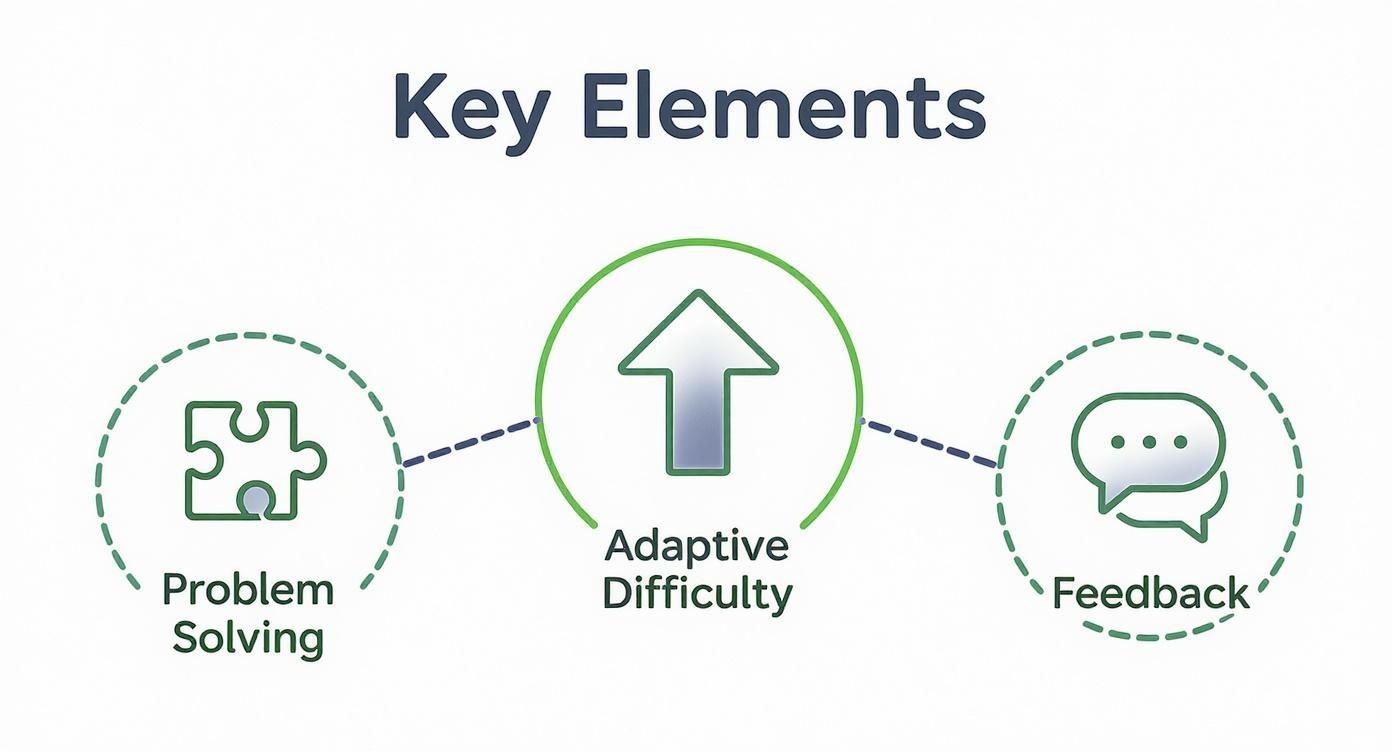
As you can see, the most effective games are built on a loop of problem-solving, adaptive challenges, and helpful feedback. It's this cycle that makes the learning stick.
Interestingly, this sequential, problem-solving mindset isn’t just found on screens. It's the same kind of thinking that great children's books nurture. A story like Space Ranger Fred and the Tick Tock Tale gets young readers to follow a trail of clues and think through a challenge step-by-step, perfectly mirroring the logic used to beat a level in a puzzle game.
Cultivating an Engineer's Mindset
So many of today’s educational video games are built around design and construction, which directly nurtures an engineering mindset from a young age.
- Systematic Thinking: Strategy games are all about cause and effect. Kids learn pretty quickly that planning ahead and thinking through the consequences of their actions are the keys to success.
- Creative Construction: Building games practically scream "experimentation!" A child might build a dozen different bridges before finding a design that holds, learning about physics and structural integrity through good old trial and error.
- Resource Management: Lots of games require players to gather, allocate, and use their resources wisely. This introduces basic economic and logistical thinking in a fun, low-stakes environment.
This process of building and creating is fundamental to STEM. It’s not just about finding the one right answer; it’s about designing a solution that works. If you're curious about the thinking behind these digital learning spaces, understanding how developers approach building games for kids gives you a fascinating peek behind the curtain.
To see how different game types match up with specific skills, this table breaks it down.
Mapping Game Genres to Core STEM Skills
| Game Genre | Primary STEM Skill Developed | Example Game Concept |
|---|---|---|
| Puzzle & Logic Games | Problem-Solving & Algorithms | A game where players arrange a series of commands to guide a robot through a maze. |
| Sandbox & Building Games | Engineering & Spatial Reasoning | Constructing a city with a stable power grid and efficient road network. |
| Strategy & Simulation | Resource Management & Systems Thinking | Managing a delicate ecosystem, balancing predator and prey populations to avoid collapse. |
| Adventure & Quest Games | Critical Thinking & Sequential Logic | Solving environmental riddles to unlock new areas by following a sequence of logical steps. |
Choosing the right genre can help target the specific STEM muscles you want your child to flex.
Games give children a safe space to fail and try again. An experiment that 'fails' in a game isn’t a setback; it’s simply new data for the next attempt. This resilience is perhaps the most critical skill for any future scientist, engineer, or innovator.
By turning learning into an interactive quest, these games do more than just teach STEM subjects. They foster the curiosity, persistence, and creative problem-solving that truly define what it means to be a scientist or an engineer. They show kids that these subjects aren’t intimidating hurdles but exciting new worlds to explore and build within.
Choosing the Right Game for Your Child
Navigating the vibrant universe of children’s educational video games can feel a bit overwhelming. With so many choices out there, how do you find the perfect one that’s both fun and genuinely useful? The trick is to have a simple game plan, one that helps you pick titles that truly engage, motivate, and teach.
A great place to start is with what your child already loves. If they’re captivated by stories of exploration and clever problem-solving, like the adventures in Space Ranger Fred and the Shoelace Adventure, then a physics-based game set in the cosmos could be a perfect fit. Tapping into their natural interests is the best way to make sure they’ll stick with it and actually soak up the learning.
A Practical Checklist for Parents
Before you hit 'download' or head to the shops, it helps to run through a few quick checks. These questions will help you see past the flashy graphics and spot a high-quality learning tool.
- What are the learning goals? A good educational game has a clear purpose. Is it trying to teach coding logic, sharpen maths skills, or encourage creative design? If the point isn't obvious, it might be more about entertainment than education.
- Is it easy to get started? Kids learn best when they can jump straight in and start experimenting without needing a thick instruction manual. A game with a simple, intuitive design lets them focus on the challenges, not on wrestling with confusing controls.
- How does it handle mistakes? Look for games that offer helpful feedback instead of just a 'Game Over' screen. Real learning happens when a child understands why something didn’t work and feels encouraged to try a different way.
The goal is to find experiences that feel like play, not a test. The learning should be woven directly into the game itself, making the process of mastering a new skill the most rewarding part of the adventure.
Understanding UK Age Ratings
One of the most useful tools for parents in the UK is the PEGI (Pan European Game Information) rating system. This isn't about how difficult a game is, but whether its content is suitable for certain ages. For educational titles, you’ll usually see ratings like PEGI 3 or PEGI 7, which gives you instant peace of mind. Always check the PEGI label on the box or in the app store description. It’s a straightforward, reliable guide for making age-appropriate choices. Our guide to understanding a children's video game offers more detailed advice on this.
The value of using games for learning is also being recognised more and more in schools across the country. According to the 2023-2024 Games in Schools research project, 63% of educators said they wanted more training on how to use video games as effective teaching tools. This really shows a shift towards embracing game-based learning in the classroom. You can discover more insights from the Games in Schools research project.
By matching these simple checks with your child’s unique personality, you can confidently choose educational games that will spark their curiosity and support them on their learning journey.
The Hidden Benefits of Gaming Beyond Academics

While it’s easy to see the STEM benefits of children's educational video games, their impact stretches far beyond the classroom. The right kind of game can be a fantastic playground for a child's social and emotional intelligence, building skills just as vital for their future happiness and success.
Many games pull children into compelling stories, inviting them to walk in another character’s shoes. This is a brilliant, natural way to build empathy. When a child has to make choices that shape a story’s outcome, they get to explore consequence and emotional cause-and-effect in a safe, interactive space.
From Storytelling to Social Skills
This narrative power is a game-changer for literacy, too. A brilliant story-driven game can hook a reluctant reader in a way that a traditional book sometimes can't. The educational potential here is becoming more widely recognised in the UK, with research showing strong links to both literacy and wellbeing.
In fact, a study from the National Literacy Trust found that 73% of young people who don't enjoy reading said playing video games helps them feel more part of a story than reading a book does. This shows just how powerful games can be as an exciting gateway into storytelling. You can read the full research from the National Literacy Trust about video games and literacy.
This is the kind of magic found in children’s books like Space Ranger Fred and the Tick Tock Tale, where solving a puzzle is part of an engaging adventure. Games take this a step further, making the child an active participant, which strengthens their connection to the story and boosts reading comprehension along the way.
Gaming can offer a unique space for children to practise vital social skills. In a collaborative game, they learn that working together and communicating clearly is the only way to achieve a common goal.
Learning to Play Well Together
So many modern educational games are now designed for more than one player, creating a fun environment for developing teamwork and communication. These shared experiences teach children how to:
- Communicate Effectively: Players have to share information, coordinate plans, and give clear instructions to win. It’s a crash course in essential verbal and listening skills.
- Negotiate and Compromise: When you’re on a team, you quickly learn to listen to other people’s ideas and sometimes meet in the middle to move forward.
- Practise Good Sportsmanship: Learning to win humbly and, more importantly, lose gracefully is a huge life lesson. Multiplayer games provide countless chances to practise resilience and respect for others.
By nurturing both intellectual and emotional growth, the right gaming experiences help shape a child's all-round development, preparing them for challenges in the classroom and beyond.
Your Questions About Educational Gaming Answered
https://www.youtube.com/embed/c5AN0JDmQY4
Diving into the world of children's educational video games can feel a bit like exploring a new galaxy. As a parent, you naturally want to make sure you're making the best choices for your child's learning and wellbeing.
This section is here to tackle some of the most common queries we hear, offering clear, practical answers to help you feel confident about navigating this exciting space.
How Much Screen Time Is Right for Educational Games?
There's no single magic number here. The truth is, the quality of the activity matters far more than the clock. Experts, including the NHS, now encourage parents to focus on building balanced digital habits rather than getting bogged down by strict time limits.
The key is to think about context. Is your child actively creating and problem-solving, or just passively watching videos? Educational gaming is all about active engagement.
Think of screen time like a diet. There's a huge difference between 'nutritious' interactive games that build skills and 'junk food' content with little value. The goal is a healthy, balanced mix.
Agree on reasonable limits together as a family, and make sure gaming doesn't get in the way of essentials like sleep, homework, or outdoor play. It's all about finding a rhythm that works for you.
Are Free Educational Games Safe for My Child?
While there are some brilliant free games out there, it always pays to be a little cautious. Many titles that are 'free' to download rely on in-app purchases or a constant stream of advertising to make their money.
Before your child jumps in, it’s a great idea to do a quick bit of investigating. Look for games from reputable creators like BBC Bitesize or PBS Kids, or from established educational studios with a solid track record of making safe, high-quality content.
Always check the privacy policy to see what data, if any, is being collected. A good rule of thumb? Play the game yourself for five minutes first. It's the fastest way to spot any aggressive ads, frustrating paywalls, or unsuitable material.
How Can I Get Involved in My Child’s Gaming?
Jumping in is the single best thing you can do to boost the learning benefits and ensure your child stays safe. It's easier than you might think—just start by showing some genuine curiosity.
Ask them to teach you how the game works or to give you a tour of what they’ve built. Many educational games have a co-op mode, meaning you can solve puzzles together as a team. This turns a solo activity into a fantastic shared family experience.
You can also connect what they're doing on-screen to real-world activities. If they're obsessed with a game about building bridges, why not try a simple construction project at home? If they love space adventures like those in Space Ranger Fred and the Umbrella Rescue, you could visit a science museum or go stargazing together.
What Are PEGI Ratings and How Should I Use Them?
PEGI (Pan European Game Information) is the age rating system we use in the UK to help parents make informed choices. It's a simple, reliable tool for checking if a game's content is appropriate for your child.
The ratings appear as numbers on the game's box or in the app store listing:
- PEGI 3
- PEGI 7
- PEGI 12
- PEGI 16
- PEGI 18
Crucially, these numbers refer to the age appropriateness of the content, not the difficulty level. A PEGI 3 game isn't necessarily easy, it just means its content is suitable for all ages. Alongside the number, you'll see small icons called content descriptors that flag things like violence or bad language. For most educational games, you'll be looking at PEGI 3 or PEGI 7.
At Space Ranger Fred, we believe learning should be an exciting adventure. Our stories and games are designed to spark curiosity in STEM and encourage creative problem-solving, turning education into an unforgettable journey. Discover our universe of fun and learning at https://spacerangerfred.com.