
There's a special kind of magic in an illustrated children's book. It's that beautiful blend of art and words that doesn't just tell a story—it brings it to life, sparking a child's imagination and turning learning into a grand adventure. These books rely on pictures just as much as text, creating a rich, immersive world that captivates young minds.
What Makes Illustrated Books So Special
Have you ever watched a child’s eyes light up as they trace a picture with their finger while you read? That’s the real power of an illustrated story at work. These books aren't just words with a few drawings sprinkled in; they are a true partnership where illustrations and text dance together on every page to create something truly memorable.
This unique format does so much more than entertain. It quietly lays the groundwork for literacy, emotional intelligence, and critical thinking. The pictures give children vital clues to the story, helping them figure out new words and wrap their heads around big ideas without ever feeling overwhelmed. They’re an open invitation to look closer, ask questions, and guess what might happen next.
In this guide, we're going to dive into the wonderful world of illustrated stories. We’ll explore:
- The fascinating history of picture books and how they’ve evolved.
- The incredible developmental benefits that come from reading illustrated stories.
- The different art styles that bring these tales to life.
- Practical tips for choosing the perfect STEM book to inspire your little explorer.
Getting to know the craft behind these books can give you a whole new appreciation for them and help you understand why certain stories become such cherished favourites. To explore the delightful and diverse world of children's literature even further, you can discover a range of children's book titles that open up new worlds.
From classic tales passed down through generations to modern adventures in space, that powerful combination of art and narrative is what makes these books stick with us. By the time you finish this guide, you’ll have a fresh perspective on how to choose and share these literary treasures. We've also gathered more insights on selecting the best children's books to help you find titles that will truly connect with your child.
How Picture Books Evolved Through Time
It’s easy to imagine that illustrated children's books have always been a part of childhood, but they have a fascinating story all their own. The journey from simple woodcuts to the vibrant, full-colour adventures we love today is filled with creative leaps, technological breakthroughs, and a growing understanding of what truly captures a child's imagination.
Believe it or not, the earliest books for children were often dry, moral tales with very few pictures, if any at all. They were designed to instruct, not to delight. The first book widely considered a true picture book for children was Orbis Pictus (The Visible World in Pictures), created way back in 1658 by John Amos Comenius. It used simple woodcut illustrations to teach Latin vocabulary—a very practical start for what would become such a magical medium.
The Dawn of Colour and Character
For a very long time, printing in colour was incredibly expensive, so most books for children remained in black and white. That all changed in the 19th century with the arrival of chromolithography, a new printing technique that finally made colourful illustrations affordable. Suddenly, books could burst with life and energy, completely changing the reading experience for kids.
This era gave us some of the first true superstars of children's illustration:
- Randolph Caldecott: He was known for his lively and humorous drawings that seemed to leap right off the page. Caldecott was a master at adding action and personality to his illustrations, and the prestigious Caldecott Medal, awarded each year to America's best picture book, is named in his honour.
- Kate Greenaway: Her charming, delicate illustrations of children in idyllic country settings created a gentle, whimsical world that captured the hearts of families everywhere.
- Walter Crane: A key figure in the Arts and Crafts movement, Crane treated the entire book as a work of art. He created beautifully designed pages with intricate details and bold outlines, proving that a children's book could be a masterpiece.
These pioneers showed the world that illustrations weren't just decorations; they were a vital part of telling the story.
"A picture book is a small door to the enormous world of the visual arts, and they're often the first art children see." – Tomie dePaola
The Golden Age and Beyond
The early 20th century is often called the "Golden Age" of children's illustration. This was a time when classic tales like The Tale of Peter Rabbit by Beatrix Potter and the wildly imaginative works of Dr. Seuss completely redefined what illustrated children's books could be. Potter blended scientifically accurate drawings with charming, relatable stories, while Dr. Seuss used playful absurdity and bouncy rhymes to turn learning to read into a joyful game.
From these brilliant foundations, the world of children's literature has continued to blossom. It has embraced countless new art styles, celebrated diverse voices, and tackled more complex themes. Today's books can take us on thrilling STEM adventures through space—like the ones with our friend Space Ranger Fred—or help children understand and navigate big feelings. The evolution continues, but the goal is still the same: to create that magical space where words and pictures come together to spark wonder in a young reader's mind.
Why Illustrations Supercharge Early Learning
Think of illustrations in children's books as far more than just pretty pictures. They're powerful engines for a child's development, turning a simple story into a rich, multi-layered learning experience. Long before a child can even read the words on the page, their brain is doing incredible work just by looking at the images.
Pictures give context, making huge, abstract ideas—like the vastness of space or how a rocket ship works—feel tangible and real. They act as a visual dictionary, helping children forge a link between a new word and its meaning. A picture of a "nebula" in a book like Space Ranger Fred and the Lost Stardust isn't just a colourful cloud; it’s a direct connection that helps a child truly grasp what that word represents.
Building Visual and Emotional Literacy
One of the biggest wins with illustrated children's books is how they develop visual literacy. This is the skill of interpreting and making sense of information presented in images. Children learn to “read” the pictures by hunting for clues in a character’s expression, the setting, or the colours used.
For instance, a drawing of a character with wide eyes and a dropped jaw instantly communicates surprise, helping a child understand that emotion without a single word of text. In our increasingly visual world, this skill is vital. By decoding illustrations, children are flexing crucial thinking skills that lay the groundwork for deeper comprehension down the road.
"A picture book is a shared experience. A performance. The adult reading the story is the narrator, the kid is the audience. The picture book is the stage." – Mo Willems
Illustrations are also brilliant teachers of emotional intelligence. By watching how characters react to different situations, children learn to recognise and name their own feelings. Seeing a character look sad after losing a toy or excited when making a new friend helps them build empathy and understand social cues. For parents focused on these developmental milestones, it's worth exploring how different formats can support this growth; this ultimate guide to personalized story books for toddlers offers fantastic insights into how custom stories can really boost early learning.
Fuelling Cognitive Skills and Curiosity
Beyond emotional growth, illustrations are a fantastic workout for the brain. They encourage children to make predictions ("What do you think will happen next?") and draw their own conclusions ("Why do you think the alien looks so friendly?"). These little moments of shared discovery turn reading into an interactive conversation rather than just a passive activity.
The demand for these kinds of engaging, educational books speaks for itself. The UK market for illustrated children's books has shown steady growth, proving just how much parents and educators value visual storytelling. In fact, the total UK books market generated a revenue of USD 8.9 billion in 2024, with educational books making up the largest slice of the pie—a trend clearly driven by the focus on early childhood development. This shows just how much we value books that make learning feel like an exciting adventure. You can discover more insights about the UK books market on grandviewresearch.com.
A Visual Guide to Illustration Styles
From whimsical watercolours to bold, graphic designs, the art in an illustrated children's book is what sets the entire mood of the story. Think of the illustration style as the story’s personality—is it playful and energetic, or soft and dreamy? Understanding these different artistic approaches helps you choose books that will truly click with your child’s tastes and the kind of tale you want to share.
Just like a film's soundtrack, different illustration styles create different feelings. A book filled with bright, simple cartoons feels exciting and fun, perfect for a silly adventure. On the other hand, soft, realistic pencil drawings might create a quiet, thoughtful mood for a more serious story. Recognising these styles is a great way to find the perfect book for any occasion.
This visual guide helps explain how illustrations support early learning, connecting visual literacy with emotional and cognitive development.
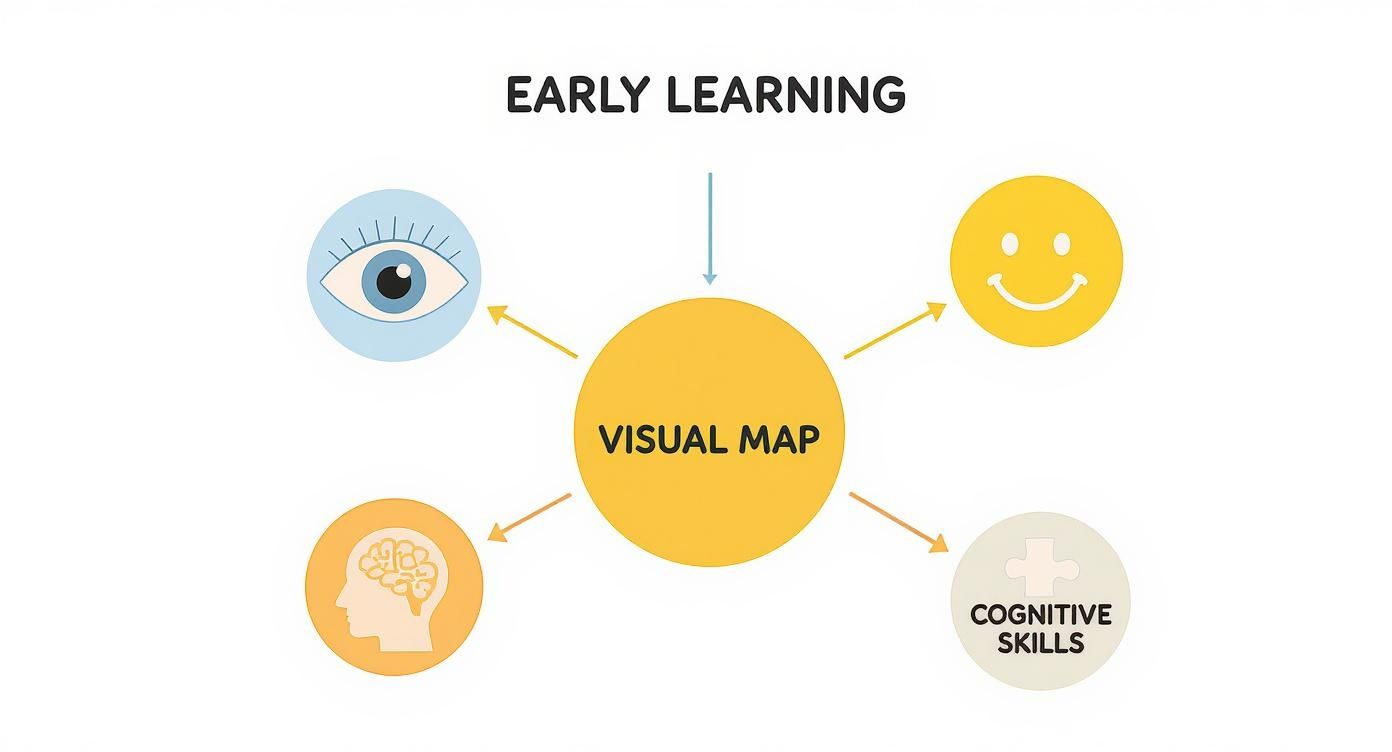
The map above shows how a single illustration can build multiple skills at once, strengthening a child’s ability to understand the world around them.
Spotting the Different Styles
Let's break down some of the most common illustration styles you’ll find. Once you start noticing them, you’ll see them everywhere! It’s like learning to identify different types of birds—suddenly, you see the variety and beauty in a whole new way.
-
Cartoon or Graphic Style: This is one of the most popular styles out there. It uses bold outlines, bright colours, and often simplifies characters and objects. Think of the classic Dr. Seuss books or modern favourites like Mo Willems' Pigeon series. It’s fantastic for humorous and action-packed stories.
-
Whimsical or Painterly: This style often uses watercolours, gouache, or digital painting to create a soft, dreamy, and often magical feel. The illustrations in books by Beatrix Potter are a classic example. It’s perfect for fairy tales, gentle adventures, and stories that stir the imagination.
-
Realism or Representational: These illustrations aim to look as true-to-life as possible, with careful attention to detail, light, and texture. This style is often found in non-fiction or informational books about animals, history, or science, as it helps make the subject feel real and believable. For example, a book about space might use realistic art to show planets accurately.
A Quick Guide to Children's Book Illustration Styles
Choosing the right style can make a huge difference in how a child connects with a story. Here's a quick way to compare them at a glance.
| Illustration Style | Key Characteristics | Typical Mood or Feeling |
|---|---|---|
| Cartoon / Graphic | Bold lines, bright colours, simplified shapes | Energetic, funny, and action-packed |
| Whimsical / Painterly | Soft edges, layered colours, often watercolour | Dreamy, magical, and gentle |
| Realism | Detailed, true-to-life, accurate textures | Informative, serious, and awe-inspiring |
| Mixed Media | Combines collage, photos, and drawing | Creative, surprising, and unique |
Ultimately, there’s no single “best” style. A child might love the zany energy of a cartoon one day and the detailed world of a realistic drawing the next. The fun is in exploring the huge variety of illustrated children's books out there.
Why not check out our free activities to see how different art styles can inspire creativity off the page? By trying different books, you’re not just reading—you’re visiting a new art gallery with every story you open.
How to Choose the Best STEM Illustrated Books
Finding a book that turns science and maths into a proper adventure can be an absolute game-changer for a young mind. With so many illustrated children's books out there, picking the right STEM-themed one can feel a bit overwhelming. The real secret is to look for stories that cleverly blend real science with a fantastic narrative, turning complex topics into something kids can't wait to dive into.
A brilliant STEM book doesn’t just rattle off facts; it weaves them into a story that gets kids asking "why?" and "how?". It pulls them in, making them part of the discovery. When you're browsing, look for titles where the illustrations are more than just pretty pictures—they should be accurate, clear, and actually help explain tricky concepts in a simple, visual way.
Key Ingredients for a Great STEM Book
When you're on the hunt for your next great read, keep an eye out for these key elements. A book that ticks these boxes is almost guaranteed to be a hit with any budding scientist or engineer.
- An Engaging Narrative: The story should always be the star of the show. You want a captivating plot with relatable characters your child can really root for. In a Space Ranger Fred adventure, for example, the science is baked right into the mission, not just a dry lesson shoehorned in.
- Accessible Science: The best books take huge ideas and break them down into bite-sized, understandable chunks. They use simple language and clever analogies to explain things like gravity or planetary orbits without making a child’s head spin.
- Illustrations That Teach: The pictures need to work hard. They should actively help explain the concepts, with clear diagrams, labels, and visuals that make the science leap off the page.
- Inspires Curiosity: A truly great STEM book leaves a child with more questions than answers—in the best possible way! It should make them want to learn more, try their own experiments, or just look up at the night sky with a brand new sense of wonder.
This blend of storytelling and learning is clearly a winning formula. The popularity of illustrated children's books in the UK continues to grow, with countless bestsellers mixing gorgeous pictures with strong narratives. In 2025, picture books remain a firm favourite for younger children, showing that the demand for visual storytelling is as strong as ever. You can discover more insights about bestselling children's books in the UK at accio.com.
Choosing the right book is like giving a child a key to a new world. A great STEM story doesn't just teach them about space; it invites them to become an explorer.
Ultimately, you're looking for that perfect balance between education and entertainment. It should feel like a thrilling adventure first and a science lesson second. For more ideas on finding stories that hit this sweet spot, check out our guide on how to pick fantastic educational books for kids.
By choosing books that make learning an exciting journey, you're not just sharing a story—you're nurturing the next generation of innovators and thinkers.
Bringing Illustrated Stories to Life Beyond the Book
The magic of an illustrated children's book doesn’t have to fizzle out when you turn the final page. Think of the story as a brilliant launchpad for creativity and hands-on fun. It's a chance to turn reading into an interactive experience that helps concepts stick while creating wonderful memories together.
Bringing a story to life is much easier than you might think. It can be as simple as getting out the crayons and drawing a brand-new scene or character from the world you’ve just visited. This simple act fires up a child’s imagination and helps them process what they've just read in a really natural way.
Turn Reading into an Adventure
Why stop there? Take things a step further and turn the story into a playful activity. You could act out your favourite scenes together, putting on funny voices for all the different characters. It’s a fantastic way to build both confidence and comprehension at the same time.
For books with a STEM theme, like the Space Ranger Fred series, you could even try a simple, related science experiment. If Fred visits a bubbling alien planet, maybe you can create your own fizzy concoction with a bit of baking soda and vinegar. These kinds of activities make learning feel less like a lesson and more like an exciting game.
"A book is a dream that you hold in your hand." – Neil Gaiman
For a perfect first step to keep the adventure going, why not explore our free activities page? It's packed with creative ideas inspired by our stories that you can do right at home.
Still Curious? Your Illustrated Book Questions Answered
We’ve explored the colourful universe of illustrated books, but you might still have a few questions buzzing around. Let's tackle some of the ones we hear most often from parents, teachers, and fellow book lovers.
What is the best age to start reading illustrated books?
Honestly? You can start from day one. For tiny babies, high-contrast, black-and-white board books are fantastic for their developing eyesight. As they wobble into toddlerhood, bright, sturdy picture books with simple words help build their vocabulary and, most importantly, plant the seeds for a lifelong love of reading. There's really no such thing as too young to share a story.
How do illustrations help a reluctant reader?
Illustrations are a secret weapon for drawing in kids who find a page full of words a bit daunting. The pictures give them vital clues to the story, helping them figure out tricky words and follow the plot without feeling overwhelmed by text. A visually thrilling book can transform reading from a chore into a proper adventure, which is the key to building up their confidence.
Getting all children hooked on books is a huge passion of ours. Recent data in the UK shows a bit of a gender gap, with 39.1% of girls aged eight to eighteen saying they enjoy reading, compared to a lower figure for boys. This is exactly why compelling, visual stories are so crucial—they can spark that fire for reading in absolutely everyone. You can explore more UK reading enjoyment trends on statista.com.
Should I still read picture books to older children?
Absolutely! Don't pack them away just because your child has become a confident reader. Picture books for older kids often tackle really complex themes and feature stunning, sophisticated art that can spark much deeper conversations. Plus, cuddling up to read one together is a wonderful way to stay connected and enjoy a shared story, no matter how old they get.
For a little extra hands-on fun, don't forget to swing by our free activities page. It's packed with creative ideas to bring your favourite stories to life long after you've turned the last page.
Here at Space Ranger Fred, we believe every book is a launchpad for imagination. Come and explore our universe of stories and start a new adventure today at spacerangerfred.com.