
When we talk about 'parent involvement in education', what do we really mean? It’s far more than just showing up for parents' evening or helping with homework.
Think of it as an active partnership between you, your child, and their school. You become a crucial member of their learning team, helping them feel supported, confident, and ready for anything. You're the co-pilot on their educational spaceship, there to help navigate the tricky bits and celebrate the amazing discoveries.
What is Parent Involvement and Why Does It Matter?
At its heart, parent involvement in education covers all the ways families and guardians support a child's learning, both at home and at school. It's about building a strong, reliable bridge between those two worlds, allowing encouragement, ideas, and support to flow freely in both directions.
Every action you take, big or small, sends a powerful message to your child: their education matters. And the impact is huge.
Research from the Education Endowment Foundation (EEF) found that meaningful parental engagement can boost a child's academic progress by an average of four extra months over a single school year. This incredible advantage holds true across both early years and primary school, making a real difference in core subjects like reading and maths.
Key Areas of Parent Involvement at a Glance
To get a clearer picture, let's break down what this partnership looks like in practice. There are many ways to get involved, and they all contribute to building a strong foundation for your child's success.
This table offers a quick summary of the different roles you can play.
| Area of Involvement | What It Looks Like | Why It Matters |
|---|---|---|
| Home-Based Support | Reading together, discussing their school day, creating a quiet space for homework, exploring learning games. | Reinforces classroom learning and shows that education is a priority for the whole family. |
| School-Based Engagement | Attending parents' evenings, volunteering in class, joining the PTA, communicating with teachers. | Builds a strong, collaborative relationship with the school and shows your child you're part of their community. |
| Advocacy & Decision-Making | Participating in school governance, attending school council meetings, providing feedback on school policies. | Helps shape the school environment to better serve all students and ensures parent voices are heard. |
As you can see, involvement isn't a one-size-fits-all approach. It’s about finding what works for your family and staying connected to your child's journey.
The Ripple Effect of Getting Involved
So, what does all this effort actually achieve? The positive effects ripple through a child's entire school experience, creating a solid foundation for everything that comes next.
Here are some of the fantastic outcomes we see when parents get on board:
-
Better Academic Performance: Children often achieve higher grades and test scores when they feel supported.
-
Improved Attendance and Behaviour: Kids who know their family is invested are more likely to show up ready to learn with a positive attitude.
-
Greater Confidence and Motivation: Your belief in them becomes their belief in themselves, making them more eager to tackle challenges.
-
Stronger Social Skills: A supportive home environment helps children develop better ways of communicating with their friends and teachers.
Building this connection doesn’t mean you have to be an expert in phonics or long division. It's about showing you care, staying in the loop, and celebrating their effort. Your enthusiasm is the most powerful tool you have.
For some practical ideas to get started, you might be interested in our guide on professional development for educators. It’s packed with simple strategies to help make learning an adventure at home.
What Great Parent Involvement Actually Looks Like
Let's be honest, the phrase "parent involvement in education" sounds a bit stiff and academic, doesn't it? It might conjure up images of PTA meetings or spending hours supervising homework. But in reality, it’s much more natural and personal than that.
Think of it as the partnership between you, your child, and their school. It’s not about one single grand gesture but a whole collection of supportive actions—big and small—that create an environment where your child can thrive.
To get a clearer picture, it’s helpful to see where this partnership plays out. It really boils down to two main areas: what happens at home, and what happens at school.
Building a Foundation at Home
This is where the real magic begins. Home-based involvement is all about creating a positive and curious atmosphere that champions learning in your everyday life. It’s about laying the groundwork for your child’s entire educational journey, long before they even step into the classroom.
This doesn't mean you need to transform your living room into a classroom. It’s much simpler—and more fun—than that.
-
Make Reading an Adventure: Cuddling up with a book, like one of the Space Ranger Fred adventures, turns reading into a special bonding moment. It shows kids that stories are exciting, not just a chore for school.
-
Feed Their Curiosity: Every time your child asks "why?", it's an opportunity. Talking about what they learned at school over dinner or exploring a new park on the weekend keeps their mind buzzing and shows them that learning happens everywhere.
-
Set Up for Success: Something as simple as having a consistent, quiet spot for homework sends a powerful message. It shows you value their efforts and are there to help if they get stuck.
The most powerful form of parent involvement is what happens in the small, consistent moments at home. These everyday actions build a lifelong love for learning.
Connecting with the School Community
Next up is school-based involvement. This is about extending that support system beyond your front door and building a connection with your child's teachers and the wider school community. When your child sees you and their teacher as a team, it makes a world of difference.
This flowchart paints a perfect picture of how these two worlds—home and school—come together to support your child.
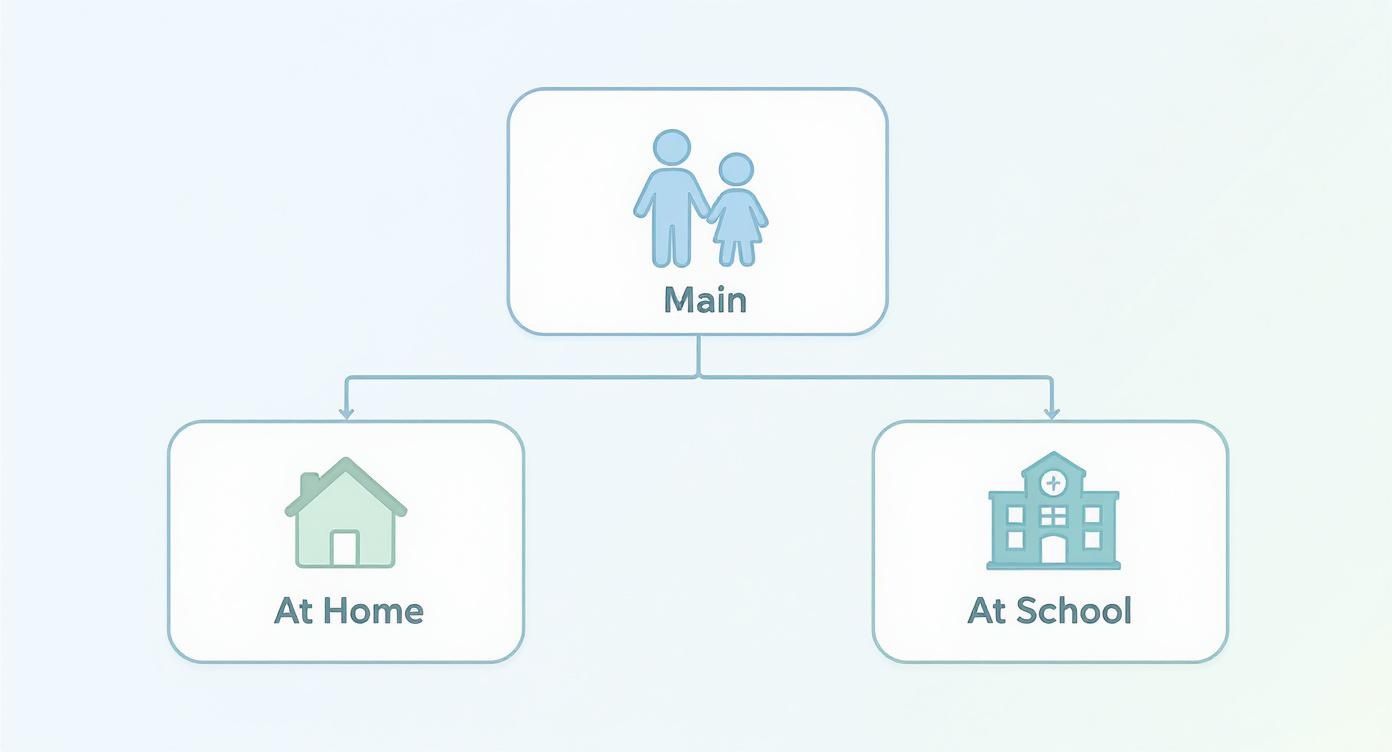
As you can see, a strong partnership is built on active engagement both inside the home and within the school environment.
And getting involved doesn't have to mean a massive time commitment. It can be as simple as:
-
Attending parents' evenings when you can.
-
Keeping the lines of communication with teachers open and positive.
-
Volunteering for a one-off event that fits your schedule.
Shaping the Bigger Picture
Finally, there’s advocacy and decision-making. This is about having a voice in how the school operates, whether it's by joining a parent council or simply sharing your perspective on school policies. While not every parent has the time or desire to get involved at this level, these voices are vital for ensuring a school truly serves the needs of all its families.
Ultimately, great parent involvement is about finding a blend of these activities that feels right for you and your family. Every little bit counts, from reading a bedtime story to attending a school play. Each action helps your child's confidence and curiosity grow.
The UK Picture on Parent and School Partnerships
So, what does parent involvement in education actually look like across the UK? It’s one thing to talk about how beneficial it is, but it’s another to see just how many families are already active partners in their child’s learning journey.
Let’s zoom in on the national picture.
Recent studies paint a fantastic, detailed picture of parents and schools working together. The overwhelming story is one of genuine enthusiasm from parents who truly want to be involved. This isn’t just a nice idea; it’s a reality playing out in communities everywhere.
This high level of engagement translates directly into brilliant outcomes for children, impacting everything from their behaviour and attendance to their academic results. When parents feel connected to their child's school, it creates a powerful support network that helps children feel secure, motivated, and ready to learn.
What the Data Tells Us
Looking at the numbers helps us get a clearer sense of the UK context. Surveys of parents with children in secondary school (Key Stages 3 and 4) reveal just how deeply families are getting stuck in. A huge percentage of parents and guardians report being actively engaged, showing a real commitment to their child’s education.
But it goes beyond just checking homework. Research also highlights that parents value a well-rounded education. According to a recent government survey, almost half of parents (49%) of children without special educational needs or disabilities (SEND) said their school teaches important life skills alongside academic subjects.
This shows that parents see school as a place for holistic development, not just exams. You can dive deeper into these findings in the latest Parent, Pupil and Learner Voice survey.
Pastoral Care and Specialist Support
Another key piece of the puzzle is pastoral care. Around half of all parents (49%-51%) confirmed their child’s school provides this crucial support, which helps with emotional and social well-being. This tells us that parents view their partnership with schools as a way to support the whole child.
For families with children who have additional needs, this partnership is even more vital. Understanding and accessing special educational needs (SEN) support is a massive part of parent involvement. Thankfully, there's an essential guide for UK parents on SEN support available to help navigate this process and ensure children get the help they deserve. This kind of collaboration is a perfect example of home-school teamwork at its best.
The UK's educational landscape shows a clear and positive trend: parents want to be involved, and schools that embrace this partnership see incredible results in student well-being and achievement.
The message from this national snapshot is clear and encouraging. You are part of a huge community of parents and carers across the UK making a real difference every single day, simply by being present and engaged in your child’s educational adventure.
Practical Strategies for Getting Involved Today
Alright, let's get down to it. Now that we know just how much of a difference parent involvement in education can make, it's time to talk about what that actually looks like day-to-day. This is your action plan, full of simple, easy-to-implement strategies you can start using today.
The best part about getting involved is that it doesn’t demand a huge time commitment or a degree in child psychology. It’s really about finding those small, meaningful moments to connect with your child’s learning journey, both at home and at school. Let's explore some fun and achievable ideas that feel less like another chore and more like a shared adventure.

Making Learning an Everyday Adventure at Home
Your home is the most powerful learning hub there is. When you weave educational moments into your daily routines, you spark a natural curiosity that makes learning feel exciting and normal, not something that’s just for school. The trick is to tap into what your child already finds interesting.
Here are a few ideas to get you started:
-
Turn the Kitchen into a Lab: Baking a cake isn't just about making a delicious treat; it’s a brilliant science experiment! Measuring ingredients is a great way to introduce maths concepts like fractions and volume, and watching the mixture rise in the oven is a perfect, hands-on chemistry lesson.
-
Explore the Universe from Your Garden: You don’t need a fancy telescope to get your child excited about space. On a clear night, just lay a blanket on the grass and look up at the stars. Talk about the moon, see if you can spot any constellations, and wonder together about what’s out there. It’s a fantastic way to introduce astronomy.
-
Make Storytime Interactive: Reading together is one of the most powerful things you can do. Instead of just reading the words on the page, ask questions like, "What do you think is going to happen next?" or "How do you think that character is feeling?"
The goal is to show that learning isn't confined to a classroom; it’s a part of everything we do. These small, consistent actions build a powerful foundation for a lifelong love of learning.
Connecting with Your Child's School
Building a positive relationship with your child’s school and teacher is the other half of the puzzle. Even if you have a jam-packed schedule, there are plenty of manageable ways to contribute and stay in the loop.
Remember, teachers see you as a vital partner. No one knows your child better than you do, so your insights are invaluable, and your support makes a huge difference in the classroom.
Building a Strong Teacher Partnership
A friendly, collaborative relationship with your child's teacher is one of the most effective tools you have. It doesn't have to be complicated.
-
Start with a Positive Introduction: At the beginning of the school year, pop a quick email over to the teacher to introduce yourself. Let them know you're keen to work together to support your child.
-
Attend Parents' Evenings: These meetings are your best chance to get a snapshot of your child's progress. Come prepared with one or two specific questions to really make the most of your time.
-
Share Important Information: If something is happening at home that might affect your child’s behaviour or concentration, a quiet word or a brief email to the teacher can be incredibly helpful. They appreciate the heads-up.
For parents looking to provide more direct academic help, especially for older children, exploring resources like essential math problems for 10th graders can be a great way to support their learning at home.
Finding Flexible Ways to Contribute
Volunteering doesn't always mean committing to a regular weekly slot. Many schools need help in ways that can fit around even the busiest schedule.
Think about these options:
-
Offer specific skills: Are you a whiz at organising, gardening, or graphic design? Let the school know you can help out with a specific, one-off project.
-
Help from home: Some tasks, like preparing materials for a class project or helping with the school newsletter, can often be done from the comfort of your sofa.
-
Support school events: Even if you can only spare an hour to help at the school fete or sports day, your contribution will be hugely appreciated.
Every small action reinforces the crucial home-school partnership. For some hands-on ideas you can do together, explore our freebies and activities page, which is packed with fun, STEM-inspired projects that make learning an exciting family mission.
How Schools Can Build Stronger Family Partnerships
Creating a school where parents feel welcome, valued, and essential isn't just a nice idea—it's a shared mission. These powerful family-school partnerships don't happen by accident. They're built through deliberate effort, clear communication, and a genuine desire to work together as a team.
This is a true team effort, involving everyone from the headteacher right down to the classroom teacher. The goal is to move beyond the occasional newsletter or parents' evening and create a real, ongoing dialogue. It’s all about building a foundation of trust that makes parents feel like true partners in their child's educational adventure.
Cultivating a Welcoming Atmosphere
The very first step is making the school feel like an accessible and friendly space for all families. A warm welcome can break down barriers before they even form, encouraging parents to get more involved. It’s often the simplest actions that have the biggest impact.
For instance, making sure school communications are easy to understand—and available in multiple languages if needed—can make a world of difference. Offering flexible times for meetings shows you respect parents' busy schedules, and even creating a designated parent area in the school can provide a physical space for connection and community.
Moving Beyond the Newsletter with Two-Way Communication
Effective communication is the lifeblood of any strong partnership. While newsletters and official updates are important, true engagement comes from opening up channels for a two-way conversation. This means actively listening to parents and making them feel heard.
Research from the parent charity Parentkind shows just how much parents want this connection. Their studies reveal that an incredible 85% of parents want to play an active role in their child's education. What's more, 72% wish to have a say in school-level decisions, but only 57% feel that schools currently listen to them properly.
To close this gap, schools can:
-
Use a mix of communication tools: Combine traditional emails with more immediate platforms like a school app or class messaging groups.
-
Host informal 'drop-in' sessions: A casual coffee morning with the headteacher can feel far more approachable than a formal meeting.
-
Actively ask for feedback: Use simple surveys to get parents' opinions on school events, policies, and how you communicate.
Launching Engaging School Programmes
One of the best ways to build a real community is through shared experiences. School programmes that bring families together for fun, hands-on activities are a fantastic way to strengthen relationships and show off the brilliant learning happening every day.
Building a strong school community is like building a bridge. It requires effort from both sides, but once it’s built, it creates a powerful pathway for student success.
Think about organising events that appeal to a range of interests and schedules. A 'Family STEM Night', for instance, is a perfect way to make learning an exciting, collaborative adventure. Families can work together on fun challenges, like building a rocket or programming a simple robot, turning tricky subjects into a memorable evening of discovery.
Other brilliant ideas include:
-
Parent Workshops: Host sessions on topics parents really care about, like supporting reading at home, navigating online safety, or getting to grips with the maths curriculum.
-
'Come and Learn' Afternoons: Invite parents into the classroom to see what their children are learning and maybe even join in on a lesson.
-
Community Events: A school fete, a cultural celebration, or a community garden project can bring everyone together in a relaxed and positive way.
These events are not just fun; they’re also a great way for educators to share practical tips. For teachers looking for new ways to get families involved, exploring professional development for educators can offer fresh ideas and strategies for building these vital partnerships. The key is to create opportunities that are enjoyable, valuable, and inclusive for every single family in your school community.
Overcoming Common Barriers to Parent Involvement
Let’s be honest: life gets incredibly busy. Between work, home, and everything in between, finding the time and energy to get involved at school can feel like an impossible task. But here’s the secret: effective parent involvement in education isn’t about doing everything. It's about finding what works for your family and knowing that every single contribution, no matter how small, makes a real difference.
This section is all about realistic solutions. We'll look at the common hurdles that trip parents up and explore gentle, practical ways to navigate them.

Time Constraints and Busy Schedules
This is the big one for most families. It can feel like there are simply not enough hours in the day. The good news? High-impact involvement doesn’t actually require a huge time commitment.
-
Think 'quality over quantity'. A focused, five-minute chat about their school day over dinner can be far more powerful than an hour of distracted homework help.
-
Embrace quick digital check-ins. A short, positive email to a teacher sharing a small win your child had at home takes just minutes but does wonders for strengthening your partnership.
-
Redefine what 'volunteering' means. You don’t have to sign up for weekly classroom duty. Offer to do something from home, like prepping materials for a craft project or proofreading a section of the school newsletter.
Feeling Unsure About Schoolwork
As children get older, the curriculum can get a lot more challenging. It’s completely normal to feel a bit out of your depth, especially if you struggled with certain subjects yourself.
Your role isn't to be the expert; it’s to be their number-one cheerleader.
Your encouragement is the most powerful educational tool you have. You don’t need to know all the answers—you just need to show you’re on their team, ready to figure things out together.
If you feel less than confident with maths or science, storytelling can be a brilliant way in. Fun adventures like The Space Ranger Fred books explore complex STEM topics like planets and gravity through exciting stories. Reading together can spark curiosity in both of you, turning learning into a shared discovery rather than a stressful test.
Language and Cultural Differences
For families new to the UK or who speak another language at home, the school system can feel a bit overwhelming at first. It’s so important to remember that your unique background and perspective are a huge asset to the school community.
-
Ask for a translator. Schools want to support you, so never hesitate to request translation services for important meetings or documents.
-
Share your culture. Offering to share a story, a song, or a traditional food during a cultural awareness day is a fantastic way to contribute and build bridges.
-
Find a parent buddy. Many schools have programmes that pair new families with those who know the ropes. It gives you a friendly face to turn to for all those little questions.
Every parent's contribution is valuable. By finding a rhythm that fits your family's life, you can build a strong and supportive partnership with your child's school.
A Few Common Questions From the Crew
We hear these questions all the time from parents and teachers navigating their child's educational journey. We hope these answers give you a boost of confidence for the mission ahead.
"I Barely Have Any Free Time. How Can I Possibly Get More Involved?"
This is the number one challenge for practically every working parent, so trust us, you're in good company! The secret isn't finding more hours in the day—it's about making the small moments count.
Think quality, not quantity. Real involvement isn't about volunteering for hours on end; it's about creating small, consistent touchpoints. Reading a quick story together before bed or asking a specific question like, "What was the coolest thing you did in science today?" over dinner can make a huge difference. Even a single, positive email to their teacher each term helps build that crucial home-school connection without demanding time you simply don't have.
"My Child's Schoolwork Is Way Over My Head. How Can I Help?"
It's completely normal to feel like your child's homework is written in another language as they get older. But here's the good news: you don't need to be a whizz at algebra or an expert on the Tudors to be a fantastic homework helper.
Your real job is to be their mission commander—the motivator, the organiser, and the one who knows where to find reinforcements. You can help by setting up a quiet, consistent space for homework, making sure they've got the supplies they need, and cheering them on to try solving problems themselves first. Show you're interested, praise their effort more than the final mark, and if you're both stumped, model how to look for answers together. Your encouragement is the most powerful tool in your arsenal.
"What’s the Best Way to Build a Good Relationship with My Child's Teacher?"
The best partnerships with teachers start with a simple shift in mindset: you're on the same team, working towards the same goal.
Try to introduce yourself at the start of the school year, whether it's in person or just with a quick, friendly email. When it’s time for parents' evenings, have one or two thoughtful questions ready that show you're paying attention and you're engaged in the process.
Most importantly, read the communications they send home and don't hesitate to share a little about your child—their strengths, quirks, or any challenges at home. When you approach every conversation as a supportive partner, you build a foundation of trust that makes everything else easier.
At Space Ranger Fred, we truly believe that every parent is a vital member of their child’s learning crew. Our stories and activities are all about making subjects like science and space feel like a fun adventure you can share together.
Ready for your next mission? Blast off into a universe of fun and learning at https://spacerangerfred.com to discover books, games, and free resources that will ignite your child’s curiosity.