
The very best space books for 10 year olds manage to do two things at once: they spin a thrilling adventure while weaving in real, mind-expanding science. What you're looking for are stories that spark a genuine curiosity about our universe, challenging young readers with clever plots, characters they can relate to, and big scientific ideas served up in a fun, digestible way.
Launching Your Reader on a Cosmic Adventure
Finding the perfect space book for a 10-year-old is a bit like plotting a course to a new star system. At this brilliant age, children are ready to blast off from simple picture books and dive into stories with real depth—narratives filled with complex challenges, detailed worlds, and bigger, bolder ideas. They aren't just reading; they're exploring what's possible.
Think of this guide as your mission control, here to help you navigate the vast universe of children's literature. Our goal isn't just to find books that teach facts, but ones that ignite a real passion for STEM. Whether your young reader is a future astrophysicist, a daring explorer, or a storyteller dreaming of distant galaxies, the right book is the launchpad for a lifelong journey of discovery.
Finding the Right Trajectory
Every reader is on their own unique journey, guided by their personal interests. Some children are fascinated by the "how" and "why" of the cosmos, devouring facts about black holes and planetary orbits. Others are completely captivated by the "what if"—the imaginative tales of alien worlds and futuristic technology.
To help you match a book to your reader's profile, we’ve put together a simple decision tree to guide your choice.
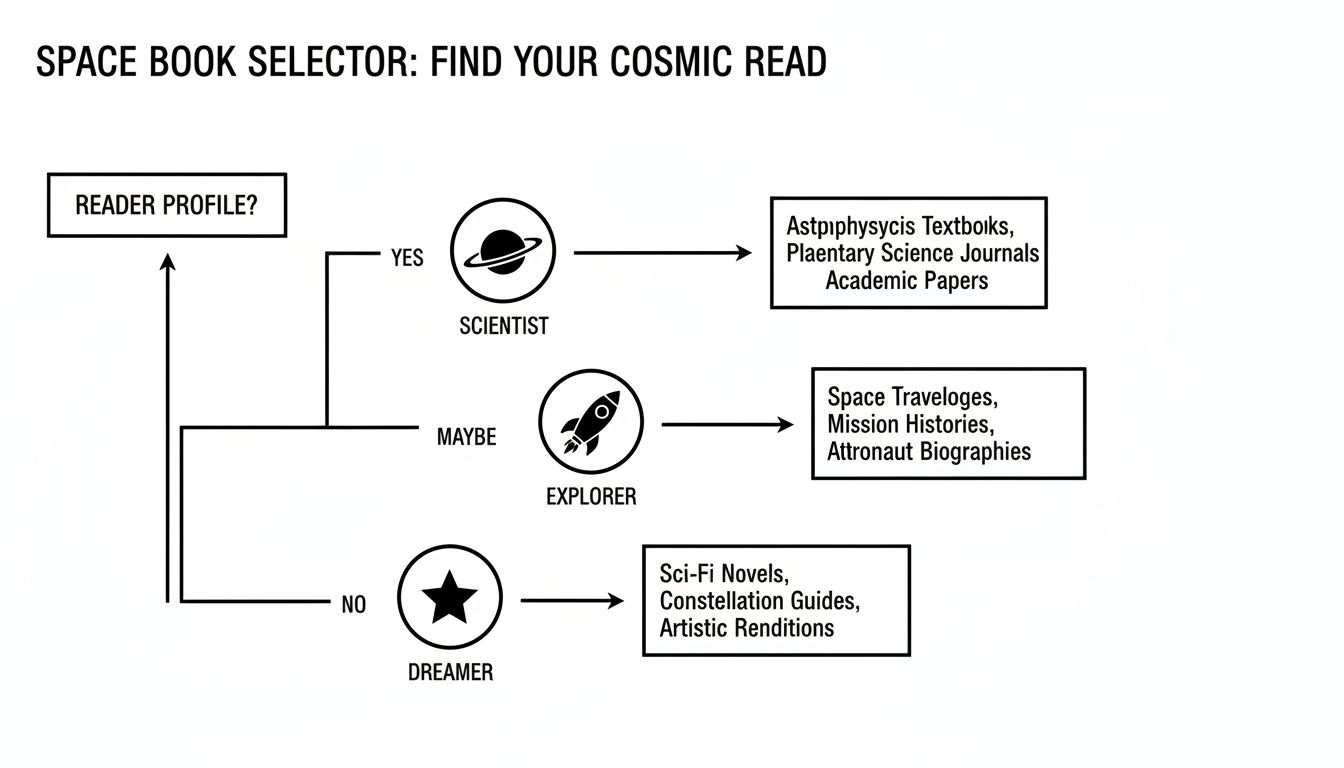
This visual guide helps you quickly figure out if your child connects more with factual discovery, adventurous quests, or imaginative storytelling. Nailing down their core interest is the first step to finding a book that truly lands.
The children's book market here in the United Kingdom is a wonderfully lively industry, which just goes to show how much families value stories that capture young minds. For 10-year-olds, this means there's a huge appetite for space books that cleverly mix education with pure fun. We're talking thrilling rocket launches and mysterious alien encounters that secretly teach a bit of physics and astronomy on the side. You can learn more about the children's publishing landscape and its exciting trends.
To make things even easier, here's a quick comparison to help you narrow down the options.
Quick Guide to Choosing Space Books for Your 10-Year-Old
Use this table to quickly identify the best type of space book based on your child's interests and reading preferences.
| Reader Profile | Book Type Recommendation | Key Features to Look For |
|---|---|---|
| The Scientist | Non-Fiction & Factual Fiction | Detailed diagrams, real scientific principles, biographies of astronomers, encyclopaedias. |
| The Explorer | Action & Adventure Sci-Fi | Fast-paced plots, problem-solving challenges, stories of survival on other planets, epic quests. |
| The Dreamer | Imaginative & Character-Driven Sci-Fi | Unique alien cultures, stories about friendship and discovery, thought-provoking themes. |
No matter which path you take, the goal is the same: to find a story that sticks with them long after they've turned the last page.
Choosing a book is less about finding a specific title and more about fuelling an interest. The best space books for 10 year olds act as a catalyst, encouraging them to ask questions, imagine solutions, and see themselves as part of the grand cosmic story.
Ready to explore some options? Let's dive into what makes a space book truly unforgettable.
The Secret Formula for a Great Space Book
So, what’s the secret sauce that turns a good book into a cosmic journey a 10-year-old just can't put down? It’s that perfect blend of mind-blowing science and a story with genuine heart. At this age, children are looking for more than a list of facts; they want to feel the adventure and connect with the characters who are out there exploring the vastness of space.
For non-fiction, the magic is all about making enormous ideas feel exciting and, crucially, understandable. The best books use brilliant infographics to get across the sheer scale of a galaxy or feature stunning, real-life photos from telescopes like the Hubble to bring distant nebulae right onto the page. They have a knack for turning complex physics into a thrilling story of discovery.
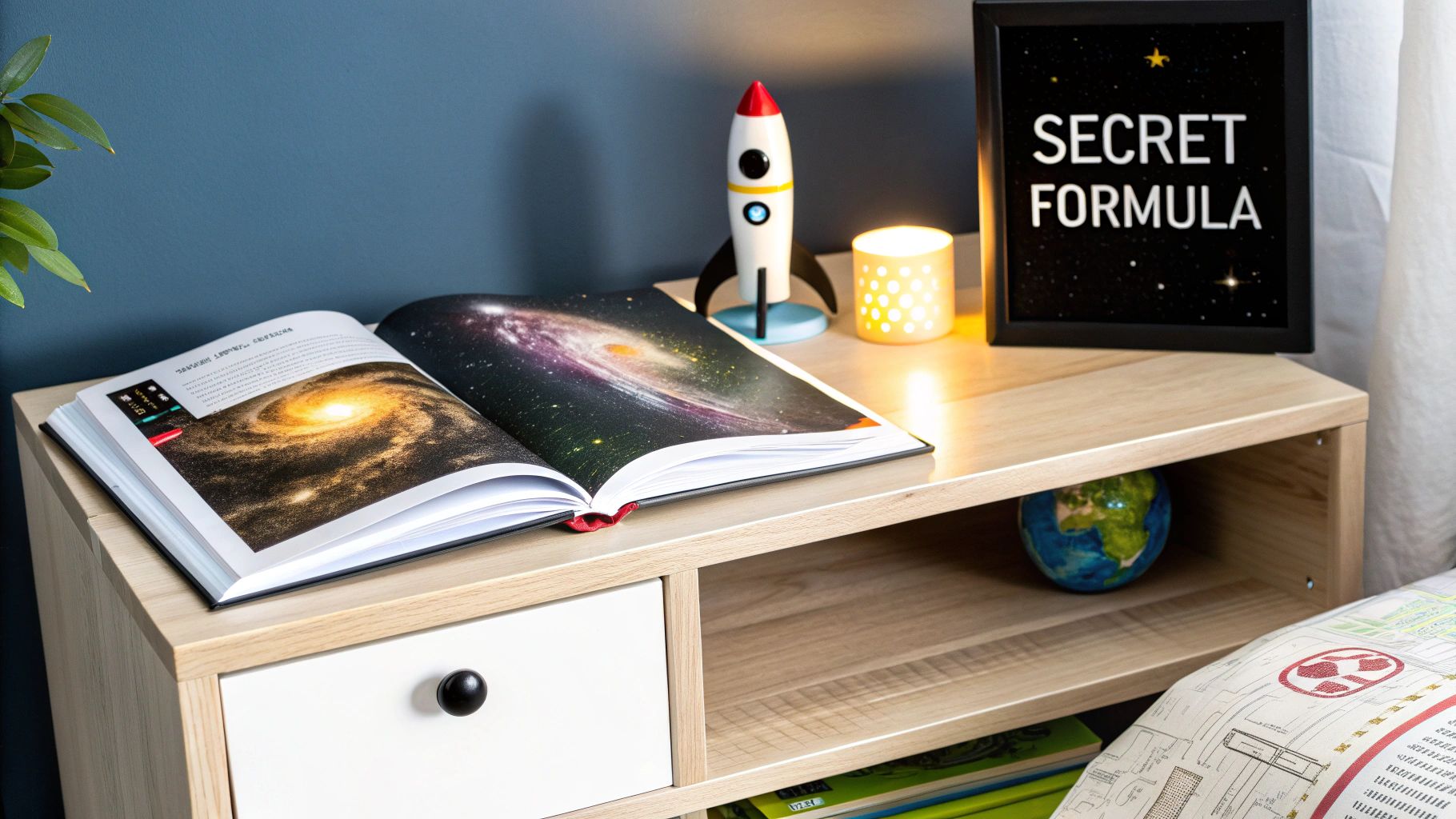
When we’re talking fiction, it’s all about the characters. Children want heroes they can see themselves in. Stories about children their own age facing incredible challenges—using their wits to fix a broken spaceship or plucking up the courage to communicate with a new alien species—are incredibly powerful.
Ingredients for an Unforgettable Read
A truly great space book for this age group usually mixes a few key elements together:
- Relatable Heroes: Characters who feel real, with recognisable fears and strengths, even if they're light-years from home.
- Clever Problem-Solving: Stories that show characters thinking their way out of a tight spot using science, teamwork, and a bit of creativity.
- A Sense of Wonder: Writing that captures the jaw-dropping beauty and mystery of the universe, making the reader feel small in the very best way.
- Authentic Science: Even in fiction, grounding the story with plausible scientific ideas makes the whole adventure feel more real and satisfying.
This is the exact blend we’ve poured into the Space Ranger Fred series, where adventure and science work hand-in-hand. You can get a peek into how we balance story and learning in our approach to creating engaging children's books.
The goal is to choose books that encourage young readers to ask "what if?" and imagine their own answers. A book isn't just a collection of pages; it's a launchpad for their own imagination, turning them from a passive reader into an active explorer.
Ultimately, the secret formula is simple: a story that makes them care, paired with science that makes them curious. This potent combination is what creates space books for 10 year olds that are not just read, but truly experienced and remembered for years to come.
Top Fiction Picks for Galactic Adventures
Ready to blast off into worlds of pure imagination? Fiction is where the hard facts of space meet the magic of storytelling, creating unforgettable adventures that can stick with a reader for life. For ten-year-olds, the best stories have characters they can champion, problems they can chew on, and worlds so vivid they feel like they could actually visit.
This hand-picked list features some of the best fiction space books for 10 year olds, covering everything from laugh-out-loud missions to epic quests across uncharted planets. We've chosen titles that are brilliant at sparking curiosity and getting those creative gears turning.
Adventures with Humour and Heart
Sometimes, the best way to explore the cosmos is with a good giggle. Humorous space stories are fantastic for grabbing the attention of even the most reluctant readers, wrapping clever scientific ideas in witty dialogue and wonderfully chaotic situations.
- For the Problem-Solver: Look for books where the crew stumbles from one comical disaster to another, forcing them to use science and teamwork to get out of a jam. These stories are brilliant at showing that STEM is all about creative thinking under pressure.
- For the Aspiring Captain: Stories focusing on leadership, friendship, and responsibility are perfect. A young hero trying to manage a quirky crew can teach valuable lessons without ever feeling like a lecture.
This is the very spirit we try to capture in the Space Ranger Fred books. Fred’s adventures blend real science with plenty of fun and friendship, showing children that learning and laughter really do go hand-in-hand. You can see how our stories encourage playful problem-solving by checking out our free activities page.
Here’s a little glimpse of the kind of thing that makes space fiction so captivating for young readers.
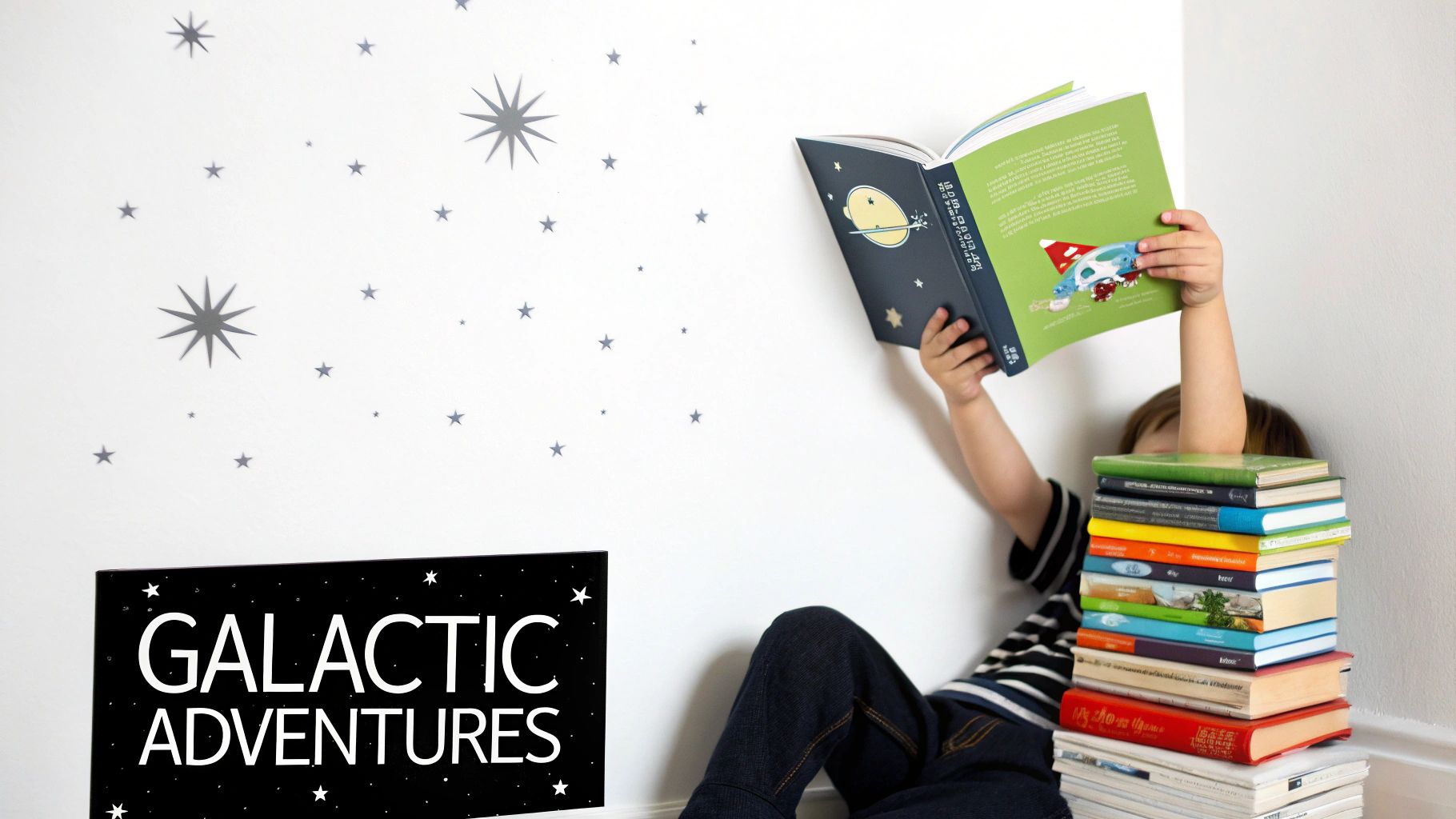
This image just nails that quiet magic of getting lost in a story, where the world on the page spills out and becomes part of a child’s own imagination.
Epic Quests and Grand Discoveries
For children who crave high stakes and sprawling adventures, epic science fiction is the perfect launchpad. These books often feature incredible world-building, complex plots, and genuinely thought-provoking themes about exploration and what it means to be human.
The best space sagas for this age group make the reader feel like part of the crew. They’re not just reading about a journey; they’re experiencing every thrilling discovery and narrow escape right alongside the characters.
These stories often come in a series, which is a brilliant way to keep a ten-year-old hooked on reading for the long haul. Once they fall in love with the characters and their universe, they’ll be eagerly waiting for the next instalment. This helps build reading stamina and a lasting connection to the world of books—a strategy we explore more in our post about finding the best science books for 10-year-olds.
Must-Have Non-Fiction Books About Our Universe
While fiction launches us into imaginary galaxies, non-fiction books bring the real, awe-inspiring universe right to our fingertips. For those curious 10-year-olds with a thirst for facts, these books are treasure chests filled with mind-blowing information and jaw-dropping photos from deep space.
Forget dry, dusty textbooks. The best non-fiction space books for 10 year olds are written with the energy and excitement of a mission commander, explaining big concepts like gravity, black holes, and the life cycle of a star in a simple, conversational way that just makes sense. They're perfect for the children who love to ask, "Why?"
Books That Invite You to Explore
The most engaging non-fiction titles don’t just throw facts at you; they invite the reader to become part of the discovery. They turn learning into an adventure.
- Visual Encyclopaedias: Look for books packed with high-quality images from NASA and the European Space Agency. These visuals are brilliant for helping children grasp the sheer scale and beauty of the cosmos.
- Focused Deep Dives: Some of the best books zoom right in on one topic, like the engineering behind the Mars rovers or the intense training astronauts have to go through. These are perfect for children who already have a specific passion.
- Interactive Elements: The interactive children's book market is booming, especially for space adventures. Lift-the-flap rockets and augmented reality planets make learning irresistible, blending physical fun with digital features to bridge the gap between technology and traditional reading.
From Page to Play
A brilliant fact book can be the start of a fantastic hands-on activity. A book about constellations might inspire a night of stargazing in the back garden, while learning about rocket propulsion could lead to building a simple bottle rocket.
A great non-fiction book does more than teach; it inspires action. It encourages a child to look up at the night sky, to build a model, or to visit a science museum, turning passive reading into active, playful learning.
This is exactly why we created a whole collection of missions and projects over on our activities page. You can download colouring sheets of the planets or try out a fun space-themed craft.
Finding the right factual book can ignite a lifelong passion for science. To explore more about choosing titles that blend education and excitement, check out our guide to the best science books for 10-year-olds. It’s full of tips for finding books that make learning feel like the greatest adventure of all.
Bringing Space Stories to Life with Fun Activities
A brilliant story is just the beginning; the real adventure starts when the book closes. Turning the themes from space books for 10-year-olds into hands-on activities is a fantastic way to connect their imagination with real-world science, extending the learning long after the final page is turned.
It’s all about making STEM feel like play. After reading about an epic space voyage, why not try building your own rocket? Or after discovering the challenges of living on another planet, you could design a Mars colony using everyday household items. These aren't just projects; they're missions!
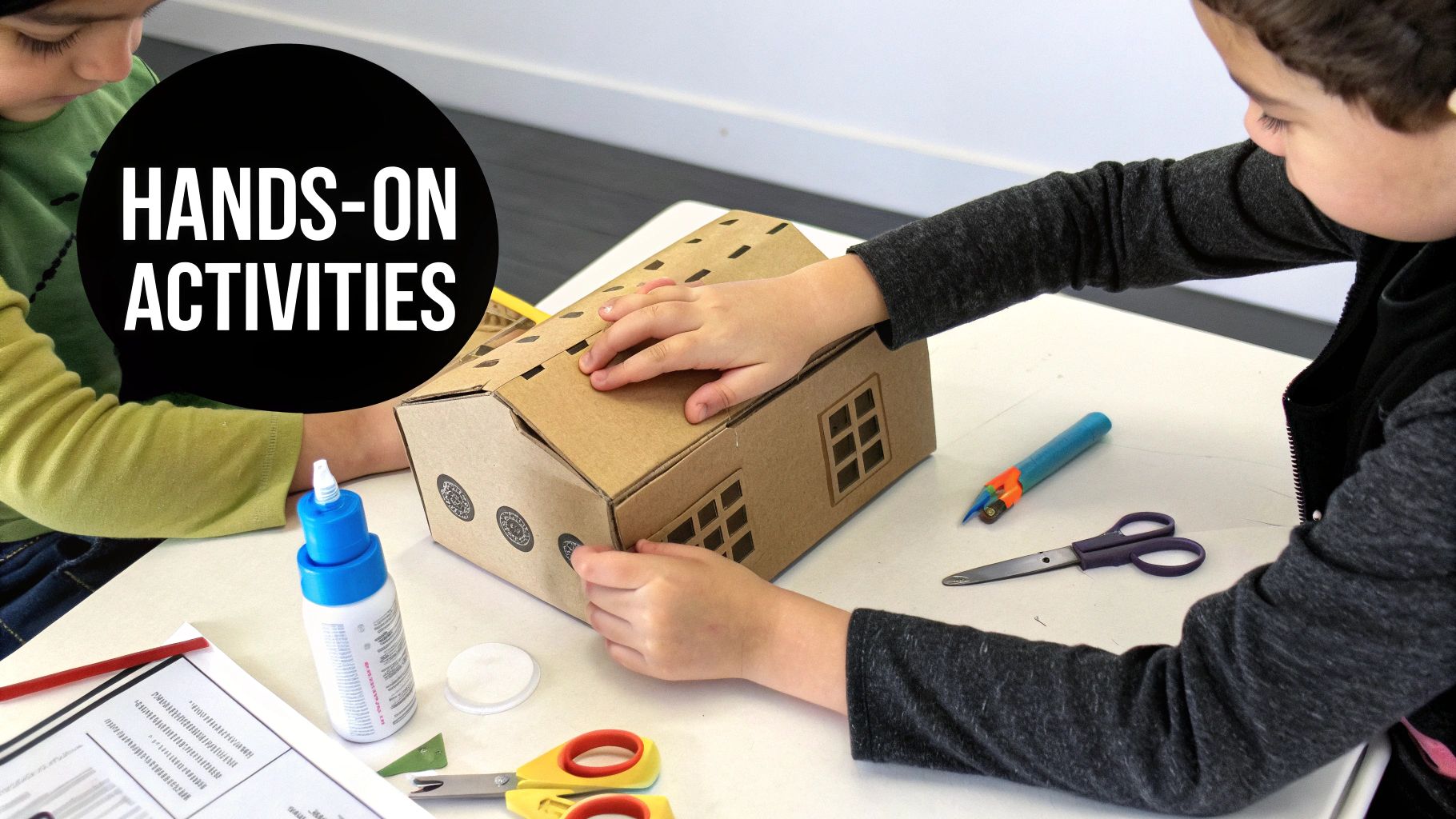
Your Next Family Mission
Framing these challenges as adventures is a great way to spark creativity and encourage a bit of teamwork. Instead of just "doing a craft," your young reader is solving a real problem, just like the heroes in their favourite books. This approach quietly builds confidence and shows them that science is an amazing tool for exploration and discovery.
Here are a few mission ideas to get you started:
- Mission: Build a Bottle Rocket: After reading about space travel, use a plastic bottle, water, and a bicycle pump to explore the basic principles of thrust and propulsion. It's noisy, messy, and brilliant fun.
- Mission: Design a Mars Colony: Grab some cardboard boxes, tubes, and whatever else is in the recycling bin to create a model habitat for the Red Planet. This naturally sparks conversations about what humans really need to survive in space.
- Mission: Create an Alien Language: Inspired by a first-contact story, invent a secret code or a set of symbols for communicating with a new alien species. This is a fantastic exercise in creative thinking.
When children get their hands on activities inspired by what they’ve read, they form much deeper connections to the story's concepts. Learning moves from being something they are told to something they do—and that’s far more powerful and memorable.
These activities are perfect for sparking conversations about teamwork, problem-solving, and scientific principles, all in a low-pressure, playful way. For even more inspiration, check out our guide to some wonderfully fun science activities for kids you can try at home.
Let the mission begin!
Got Questions About Space Books? We’ve Got Answers.
Picking the right book for a 10-year-old can feel like navigating an asteroid field. Even with a map, a bit of extra guidance always helps. Here are a few common questions we hear from parents and educators, along with some down-to-earth answers.
How Can I Get a Reluctant Reader Interested in Space Books?
The trick is to forget the book for a moment and focus on what they already love. Is your child a master builder with LEGO? Hand them a non-fiction book overflowing with incredible diagrams of rockets and space stations. Are they more into fast-paced video games? An action-packed sci-fi graphic novel will feel instantly familiar and exciting.
You can also make it a shared mission. Read a chapter aloud together before bed or pop on an audiobook during the school run. Suddenly, reading isn't a chore; it's a brilliant adventure you get to share.
Are Graphic Novels a Good Choice for This Age Group?
Absolutely! Graphic novels are a fantastic format, especially for children who think and learn visually. They’re brilliant for building reading confidence and making complex ideas—both scientific and narrative—feel much more approachable.
Many space-themed graphic novels combine stunning artwork with genuinely gripping science fiction, offering a storytelling experience every bit as rich as a traditional novel. They make for excellent space books for 10 year olds and often act as a brilliant gateway to a lifelong love of reading.
Reading is reading, no matter the format. Whether it’s a dense novel, a colourful graphic novel, or a fact-filled encyclopaedia, the goal is to spark curiosity and joy. Honouring a child's preference is the best way to support their journey as a reader.
What’s the Right Mix of Fiction and Non-Fiction?
Honestly, there’s no magic formula here. The perfect balance is whatever follows your child’s curiosity. Some children are fact-finders who want to devour every detail about black holes, while others just want to get lost in a story about a mission to a distant galaxy.
A great approach is to offer a mix and see what sticks. The two often work beautifully together, too. A thrilling novel about surviving on Mars might just spark a desire to learn the real science behind it, sending them on a hunt for a non-fiction book on the very same topic.
This is more important than ever. With reading habits changing, personalised space books offer a powerful way to cut through the digital noise. As reading for pleasure declines among students, custom tales that feel exciting and personal are thriving, especially those that let a child see their own name on a cosmic quest. You can explore more about this trend in children's publishing to see how it's shaping the market.
How Do I Know if a Book Is Age-Appropriate?
The age guide on the back is a good start, but it’s not the whole story. Here are a few other things to consider:
- Thematic Depth: Does the story tackle bigger ideas like conflict, loss, or fear in a way that a 10-year-old can process?
- Reading Level: Open to the first page and read a few sentences. Does the language flow, or is it a bit of a struggle? A book that’s too difficult can be more frustrating than fun.
- Character Age: Children often connect with characters who are their age or a little older. It makes the challenges and triumphs feel that much more relatable.
At the end of the day, you know your child best. Trust your gut, and don’t be afraid to let them have the final say. Letting them explore and discover what they love is a huge part of the adventure.
At Space Ranger Fred, we believe every book is a launchpad to a new adventure. Explore our stories and join a universe where learning, laughter, and imagination collide. Discover the world of Space Ranger Fred and find your next favourite mission.