
Have you ever looked up at the night sky and wondered what’s really out there? Our universe is a gigantic, mysterious, and super-exciting place, filled with sparkling stars, giant planets, and things so strange they sound like they’re from a sci-fi film! It's a bit like the amazing journeys in Space Ranger Fred and the Shoelace Adventure, where every new discovery leads to more questions and fun.
From planets where a day is longer than a year to stars so dense that a spoonful would weigh more than a mountain, space is packed with mind-boggling secrets. Understanding these big ideas is a fantastic way to stretch your brain and realise just how incredible the cosmos is. In this list of amazing space facts for kids, we're going to explore some of the coolest, weirdest, and most awesome truths about our universe. These facts will give you a new appreciation for the vastness of space and everything within it. Get ready to have your mind blown and gather some amazing trivia to share with your friends and family! Let’s explore the wonders that lie beyond our world.
1. A Day on Venus Lasts Longer Than Its Year
Imagine celebrating your birthday, but the sun hasn't even set on the day you were born! That’s what it would be like on Venus, one of the most peculiar planets in our solar system. This is one of those mind-boggling space facts for kids that sounds like science fiction, but it's completely true.
The Slowest Spin in the Solar System
Here on Earth, a day is about 24 hours long, and a year is 365 days. We experience one full spin (a day) many times before we complete one trip around the Sun (a year). Venus, however, is a bit of a cosmic slowpoke.
- A Venusian Day: Venus rotates incredibly slowly. It takes 243 Earth days for Venus to spin just once on its axis.
- A Venusian Year: Meanwhile, it zips around the Sun much faster, completing its orbit in only 225 Earth days.
This means a single day on Venus is actually longer than an entire year on Venus! You would celebrate your first birthday before you even experienced your first full day-night cycle.
A Backwards World
As if that wasn't strange enough, Venus also spins in the opposite direction to Earth and most other planets. This is called retrograde rotation. If you could stand on the surface of Venus and see through its thick, toxic clouds, you would see the Sun rise in the west and set in the east.
Fun Fact: Because Venus spins so slowly and in the "wrong" direction, scientists believe a giant object may have collided with it billions of years ago, knocking it off-kilter and changing its rotation forever.
This backwards, slow-motion world makes Venus a truly unique place in our solar system. The concept of time on different planets can be tricky, a bit like the puzzle in the book, Space Ranger Fred and the Tick Tock Tale, which explores just how weird time can be.
2. Jupiter Could Fit All Other Planets Inside It
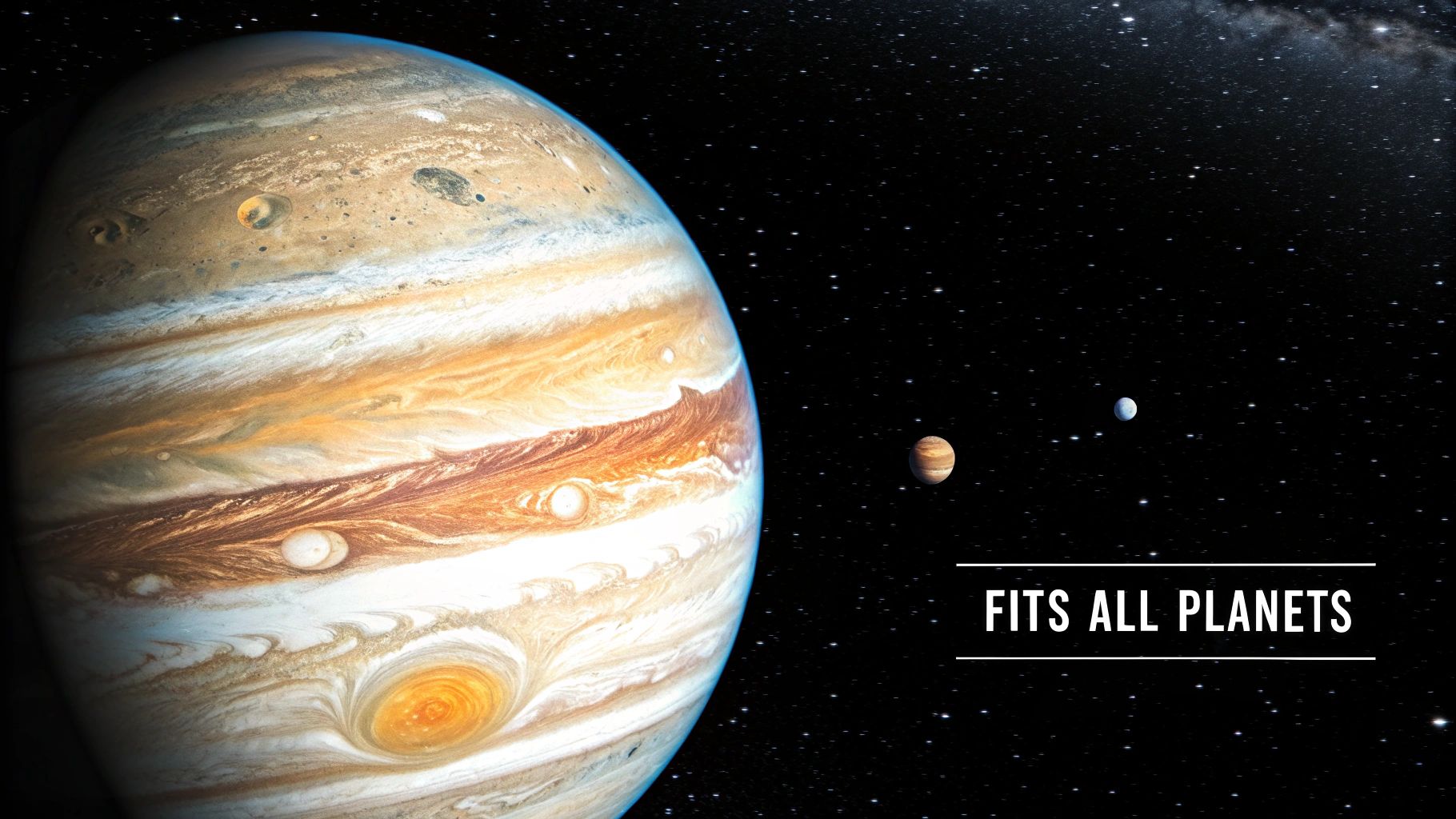
Have you ever wondered which planet is the king of our solar system? Look no further than Jupiter! This colossal gas giant is so mind-bogglingly big that it’s hard to imagine its true scale. This is one of those space facts for kids that shows just how extreme our cosmic neighbourhood can be.
The True Giant of the Solar System
Jupiter isn't just a little bigger than Earth; it's a completely different league. It is more than twice as massive as all the other planets in our solar system combined. Its sheer size is astounding.
- A Cosmic Container: You could take every other planet, Mercury, Venus, Earth, Mars, Saturn, Uranus, and Neptune, and fit them all inside Jupiter at the same time, and you'd still have some room to spare!
- Earth vs. Jupiter: To put it another way, if Jupiter were a giant, hollow gumball machine, you could fit over 1,300 Earth-sized gumballs inside it.
This incredible size is why Jupiter is known as a gas giant. It doesn't have a solid surface like Earth but is instead a swirling ball of gas and liquid, mostly made of hydrogen and helium.
More Than Just Big
Jupiter's massive size gives it some amazing features. Its famous Great Red Spot is a gigantic storm that has been raging for hundreds of years and is wider than our entire planet. Jupiter also acts like a giant bodyguard for Earth, using its powerful gravity to pull in or fling away dangerous asteroids and comets.
Fun Fact: Jupiter has dozens of moons, but its four largest, known as the Galilean moons, are fascinating worlds themselves. The largest moon, Ganymede, is even bigger than the planet Mercury!
Understanding the scale of planets like Jupiter is a huge part of space exploration, a bit like the challenges Fred faces in Space Ranger Fred and the Umbrella Rescue, where thinking big is key to solving a problem. You can discover more about the giant planet Jupiter and its incredible features.
3. Neutron Stars Are So Dense a Teaspoon Would Weigh 6 Billion Tons
Imagine trying to lift a spoon so heavy it weighs more than every single person on Earth combined! That’s what it would be like if you had a teaspoon of material from a neutron star, one of the most extreme objects in the entire universe. This is one of those incredible space facts for kids that shows just how wild our cosmos can be.
The Heaviest Stuff in the Universe
When a truly massive star, much bigger than our Sun, runs out of fuel, it explodes in a spectacular event called a supernova. What’s left behind can be a tiny, super-dense core called a neutron star. All the star’s weight gets squashed into a ball only about 20 kilometres (12 miles) across, the size of a city.
- Mind-Boggling Density: The material is packed so tightly that a single teaspoon of it would weigh around 6 billion tons on Earth.
- A Mighty Comparison: That’s the same weight as about 900 Great Pyramids of Giza, all balanced on the tip of one tiny spoon!
The gravity on a neutron star is so powerful that if you dropped something from just one metre high, it would hit the surface in a millionth of a second.
Cosmic Lighthouses and Super Magnets
Neutron stars aren't just heavy; they are also some of the strangest and most fascinating objects for scientists to study.
Some neutron stars, called pulsars, spin incredibly fast and shoot out beams of radiation, like a cosmic lighthouse. One of the fastest, PSR J1748−2446ad, spins a dizzying 716 times every single second. Others, known as magnetars, have magnetic fields so powerful they are a quadrillion times stronger than Earth’s.
Fun Fact: The famous Crab Pulsar is a neutron star created by a supernova that was so bright, astronomers in China recorded seeing it in the daytime sky back in the year 1054 AD.
Understanding these extreme objects helps scientists figure out the rules of the universe, a bit like the puzzles Fred solves in Space Ranger Fred and the Shoelace Adventure, where even small things can have big consequences.
4. Saturn Would Float in Water If You Had a Bathtub Big Enough
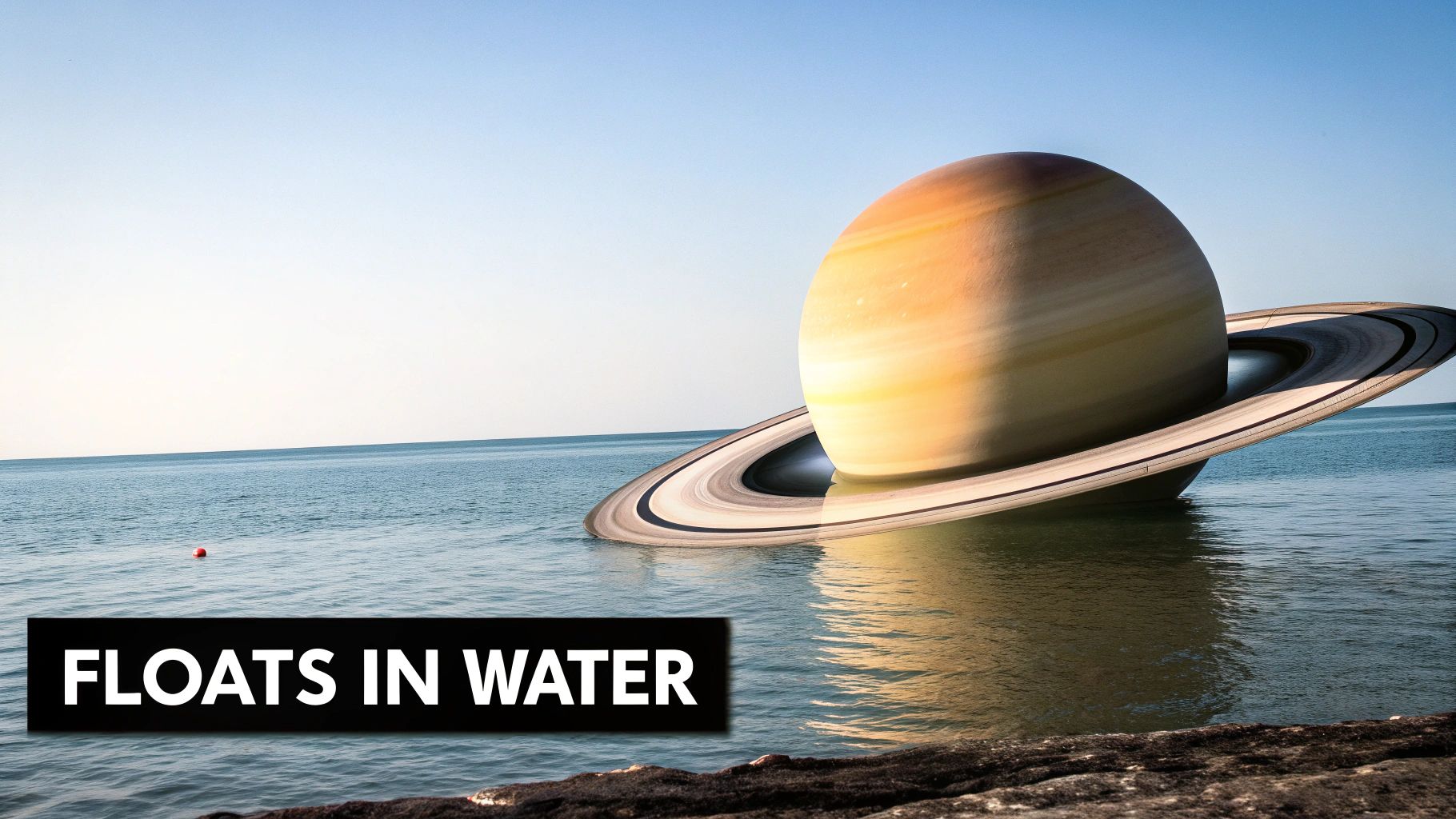
Have you ever wondered if a planet could float in a swimming pool? It sounds like a silly question, but for one of the giants in our solar system, the answer is yes! This is one of those amazing space facts for kids that shows just how wonderfully strange the universe can be. If you could find a bathtub big enough, the magnificent ringed planet Saturn would float.
The Gas Giant Lightweight
Saturn is the second-largest planet, but it's surprisingly light for its enormous size. This is because it’s not made of solid rock like Earth. Instead, it’s a gas giant, composed mostly of the two lightest gases in the universe: hydrogen and helium.
- Earth's Density: Our home planet is dense and rocky, much denser than water.
- Saturn's Density: Saturn is the least dense planet in our solar system. Its average density is less than that of water.
This low density means that if you placed Saturn in a colossal tub of water, it wouldn't sink; it would bob on the surface like a giant, stripy bath toy. It's the only planet in our solar system that could do this.
More Than Just a Floater
Saturn is famous for its stunning rings, which are made of billions of pieces of ice, rock, and dust. Some are as small as a grain of sugar, while others are bigger than a house. Its many moons are just as fascinating. Titan, Saturn's largest moon, has lakes and rivers filled with liquid methane, while another moon, Enceladus, shoots massive geysers of water out into space from its south pole.
Fun Fact: You don't always need a powerful telescope to see Saturn! On a clear night, it's often visible to the naked eye as a bright, yellowish point of light that doesn't twinkle like a star.
Learning about different planets helps us understand how things work in space, kind of like when Fred learns about gravity in Space Ranger Fred and the Umbrella Rescue. Each planet has its own unique properties that make it a special place to explore.
5. There Are More Stars in the Universe Than Grains of Sand on All Earth's Beaches
Have you ever tried to count all the grains of sand on a beach? It seems impossible, right? Well, get ready for a number so big it’s hard to imagine, because there are far more stars in the universe than all the grains of sand on every beach and desert on Earth combined. This is one of those space facts for kids that truly shows how enormous the cosmos is.
A Universe Packed with Stars
When you look up at the night sky, you can see a few thousand stars with just your eyes. But that's only a tiny, tiny fraction of what's out there. Our own galaxy, the Milky Way, is home to between 200 and 400 billion stars. And the Milky Way is just one of countless galaxies.
- Total Stars: Scientists estimate there are at least 1,000,000,000,000,000,000,000,000 (that’s a 1 with 24 zeros!) stars in the observable universe.
- Total Sand Grains: The best guess for the number of sand grains on Earth is about 7,500,000,000,000,000,000 (that's seven and a half quintillion).
This means for every single grain of sand on our planet, there are roughly 100,000 stars twinkling out there in the vastness of space!
Stars of All Sizes
Just like people, stars come in all different sizes. Our Sun is a medium-sized star, but some are much, much bigger. One of the largest known stars, UY Scuti, is so gigantic that if you replaced our Sun with it, its surface would stretch out past the orbit of Jupiter. Trying to grasp these huge scales is a bit like the puzzle in Space Ranger Fred and the Shoelace Adventure, where understanding size and distance is key to solving the mission.
Fun Fact: The next time you're at the beach, pick up a single grain of sand. Hold it in your palm and remember that it represents about 100,000 stars scattered across the universe.
This infographic helps to visualise just how these mind-bogglingly large numbers compare to one another.
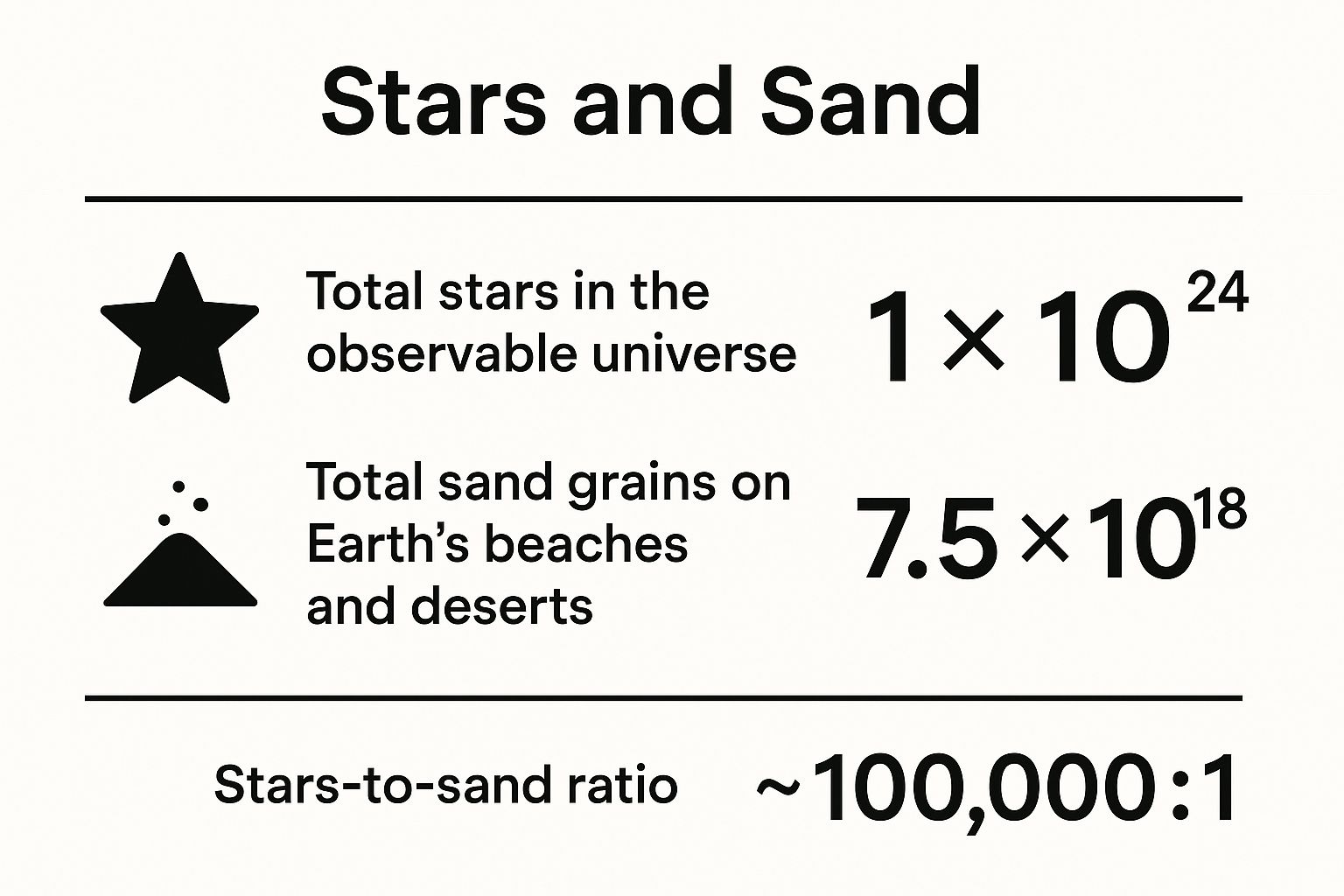
The visualisation clearly shows that the number of stars is thousands of times greater than the number of sand grains, highlighting the sheer scale of our universe.
6. One Day on Mercury Equals 176 Earth Days
Can you imagine a single day that lasts for months? On Mercury, the planet closest to the Sun, time behaves in a very strange way. This is another one of those amazing space facts for kids that shows just how different other worlds can be from our own.
A Speedy Orbit, A Slow Spin
Mercury is the fastest planet in our solar system when it comes to orbiting the Sun, but it's incredibly slow when it comes to spinning on its axis. This combination creates a very long and unusual day.
- A Mercurian Year: Mercury zips around the Sun in just 88 Earth days. This is the length of one year on Mercury.
- A Mercurian Day: However, one solar day on Mercury (the time from one sunrise to the next) lasts an incredible 176 Earth days.
This means that a single day on Mercury is twice as long as its entire year! You would experience a very long, hot morning that lasts for weeks, followed by an equally long and freezing cold night.
A World of Extremes
This long day-night cycle creates a planet of incredible temperature differences. During its long day, the surface of Mercury can get hot enough to melt lead, reaching over 427°C. But during its long night, with no atmosphere to trap the heat, temperatures can plummet to a freezing -183°C.
Fun Fact: Mercury is covered in craters from impacts over billions of years. One of the largest is the Caloris Basin, which is a massive 1,550 kilometres wide. Scientists study these craters to understand the history of our solar system.
Understanding how time works differently on other planets is a big part of space exploration, a bit like the time-based puzzles in Space Ranger Fred and the Tick Tock Tale, where learning about clocks is key to the adventure.
7. Astronauts Grow Up to 2 Inches Taller in Space
Can you imagine going on a trip and coming back taller than when you left? For astronauts, this is a normal part of space travel! It’s one of the most surprising space facts for kids and shows just how differently our bodies work when we leave Earth behind.
The Great Space Stretch
Here on Earth, gravity is constantly pulling us down. This force gently squashes the soft, cushiony cartilage discs between the bones in our spine, called vertebrae. In space, however, there is very little gravity, a condition known as microgravity.
- No Gravity, More Height: Without the constant downward pull, the vertebrae in an astronaut's spine can spread apart.
- Growing Taller: This expansion allows the spine to lengthen, and astronauts can grow up to 2 inches (5 centimetres) taller during long missions on the International Space Station.
Of course, this growth spurt is temporary. Once the astronauts return to Earth, gravity takes over again and they gradually shrink back to their original height within a few months.
Staying Strong in Space
While growing taller sounds fun, living in microgravity can be tough on the body, weakening muscles and bones. To stay healthy, astronauts must take special care of themselves, a bit like the problem-solving needed in Space Ranger Fred and the Shoelace Adventure.
Fun Fact: Astronaut Scott Kelly grew about 2 inches during his year-long mission in space! Mission controllers even have to plan for astronauts' spacesuits to be adjusted to fit their taller frames.
To combat the negative effects, astronauts exercise for about two and a half hours every day using special equipment with harnesses and resistance bands to keep their bodies strong enough for their return to Earth.
8. The Footprints on the Moon Will Last for Millions of Years
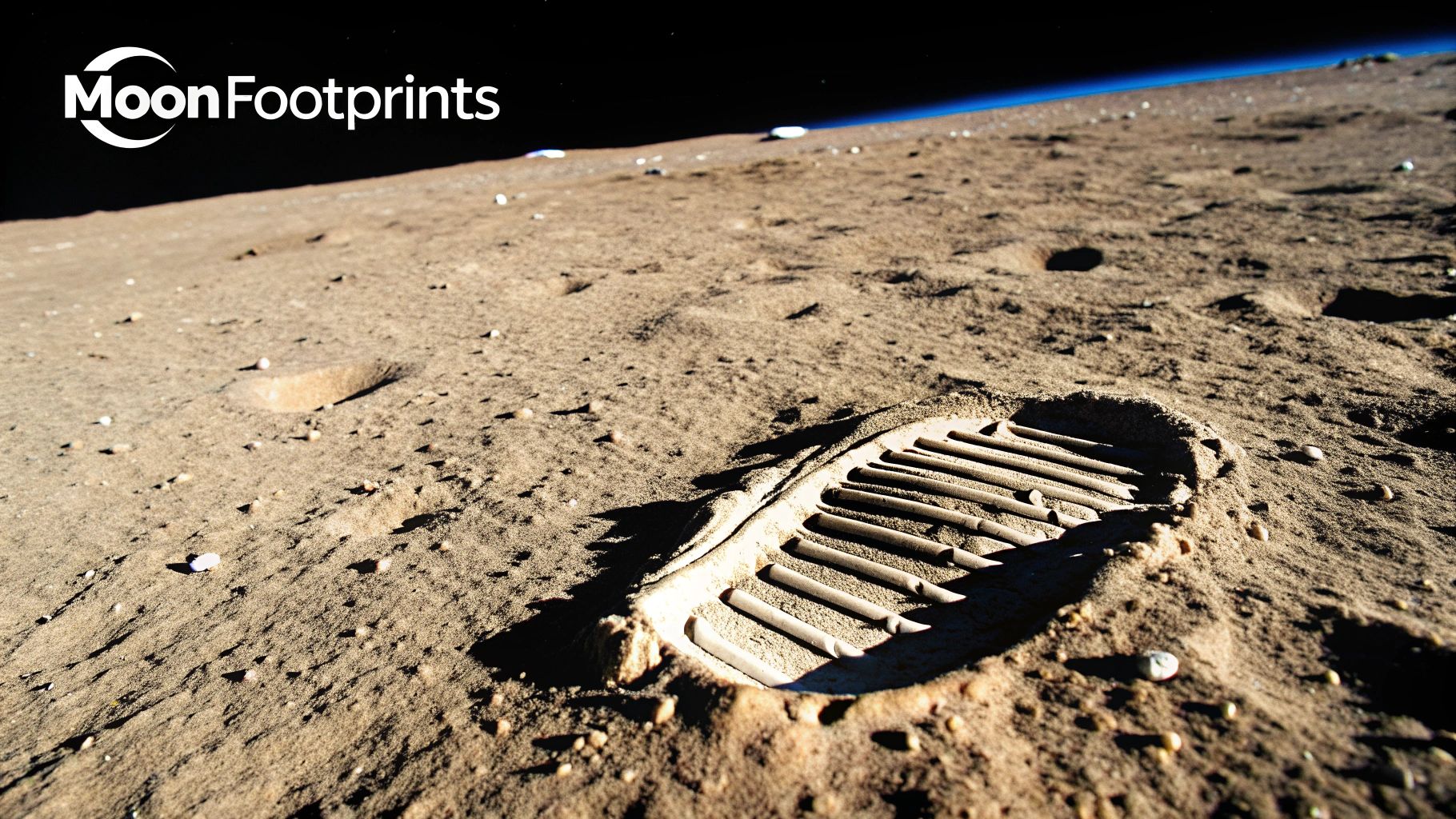
Have you ever left footprints in the mud or sand, only to have them washed away by the rain or blown away by the wind? On the Moon, things are very different. The footprints left by the Apollo astronauts will stay there for an incredibly long time, possibly millions of years! This is one of the most amazing space facts for kids that shows just how unique the Moon is.
A World Without Weather
The main reason these footprints are so permanent is because the Moon has almost no atmosphere. Here on Earth, our atmosphere creates weather, which erodes and changes the surface over time. The Moon doesn't have this.
- No Wind: Without air, there is no wind to blow the dust around and smooth over the footprints.
- No Rain: There is no water on the Moon's surface, so there's no rain to wash the prints away.
This means that Neil Armstrong's first bootprint from 1969 is still there, looking almost exactly as it did the day he made it. The tyre tracks from the lunar rovers and equipment left behind by the missions are also perfectly preserved, like a museum on the Moon.
A Frozen Moment in Time
The only things that can disturb these historic marks are tiny micrometeorites constantly raining down from space and the rare "moonquake". However, these processes are incredibly slow. They will gradually wear down the footprints over millions of years, but for now, they remain a silent tribute to humanity's first steps on another world.
Fun Fact: Because there is no protection from an atmosphere, the dust on the Moon is very sharp and abrasive, almost like tiny shards of glass. It caused lots of problems for the astronauts' spacesuits and equipment!
It's fascinating to think about these preserved moments, a bit like how time can be captured in different ways, a concept explored in the book, Space Ranger Fred and the Tick Tock Tale. You can even imagine what these footprints look like by checking out some fun Moon-themed colouring pages.
8 Fascinating Space Facts for Kids Comparison
| Item Title | Implementation Complexity 🔄 | Resource Requirements ⚡ | Expected Outcomes 📊 | Ideal Use Cases 💡 | Key Advantages ⭐ |
|---|---|---|---|---|---|
| A Day on Venus Lasts Longer Than Its Year | Moderate – requires understanding planetary rotation and orbit dynamics | Low – mostly observational and theoretical | Unique day-night cycle; slow rotation insights | Studying planetary rotation and solar system anomalies | Highlights retrograde rotation and extreme day length |
| Jupiter Could Fit All Other Planets Inside It | Simple concept, complex in scale | High – requires vast observational data | Demonstrates massive planet volume and protective role | Education on planetary size and gas giants | Largest planet, protects inner solar system |
| Neutron Stars Are So Dense a Teaspoon Would Weigh 6 Billion Tons | High – involves advanced astrophysics and extreme physics | Very high – demands complex modeling and observation | Extreme density and gravity understanding | Research on stellar remnants and extremes | Reveals limits of matter density and gravity |
| Saturn Would Float in Water If You Had a Bathtub Big Enough | Moderate – combines density and volume analysis | Moderate – requires data on gas giants | Demonstrates low density despite large size | Teaching about planetary density and rings | Only planet that would physically float in water |
| There Are More Stars in the Universe Than Grains of Sand on All Earth's Beaches | Low – statistical/comparative estimation | Moderate – requires astronomical surveys | Perspective on vastness of universe | Cosmic scale education and statistics | Emphasizes staggering scale of stars vs. Earth objects |
| One Day on Mercury Equals 176 Earth Days | Moderate – requires orbital mechanics knowledge | Low – observational data and mission studies | Explains extreme day length and temperature variations | Studying extreme planetary conditions | Demonstrates resonance and extreme temperature swings |
| Astronauts Grow Up to 2 Inches Taller in Space | Moderate – involves physiological studies | Moderate – requires space mission data | Insights into human body changes in microgravity | Space medicine and astronaut health | Shows reversible human adaptation to microgravity |
| The Footprints on the Moon Will Last for Millions of Years | Low – understanding environment and erosion | Low – observational and historical data | Demonstrates preservation in absence of atmosphere | Lunar surface studies and preservation | Highlights lack of erosion and long-term preservation |
Keep Exploring the Universe!
From the mind-bogglingly long days on Venus to the everlasting footprints on the Moon, we've journeyed through some truly amazing space facts for kids. Think about it: we've discovered a planet that could float in a giant bathtub, a star so heavy that a tiny spoonful would weigh more than all the cars in the United Kingdom combined, and a planet so enormous it could swallow all its neighbours!
Each of these incredible facts is like a single puzzle piece. On its own, knowing that Jupiter is gigantic is cool. But when you put all these pieces together, you start to see a bigger picture: our universe is a place of incredible extremes, amazing beauty, and endless mysteries waiting to be solved. Learning these facts isn't just about memorising trivia for a school quiz; it’s about training your brain to think big and ask brilliant questions.
Your Cosmic Adventure is Just Beginning
The most important thing you can take away from this journey is that the universe is yours to explore. The curiosity that made you wonder why astronauts get taller in space or how a day on Mercury can last for 176 Earth days is the same curiosity that drives real scientists and astronauts. It’s the engine of discovery!
So, what’s next on your adventure? You can keep that spirit of exploration alive in so many ways. Here are a few ideas to get you started:
- Look Up: On a clear night, step outside and just look at the stars. Can you spot any constellations? Can you find the Moon? Even without a telescope, you're looking at distant suns and ancient light that has travelled for years to reach your eyes.
- Visit a Planetarium: Check if there's a local science museum or planetarium near you. Seeing the planets and stars projected onto a giant dome is an unforgettable experience that makes the universe feel so much closer.
- Read and Imagine: Dive into stories that take you to other worlds. Books like Space Ranger Fred and the Tick Tock Tale show how characters use their cleverness and curiosity to understand cosmic mysteries, just like real explorers. Reading about space adventures is a fantastic way to let your imagination soar to new galaxies.
- Start a Space Journal: Grab a notebook and start your own collection of space facts for kids. Every time you learn something new and amazing, write it down! You could even draw pictures of planets, comets, or your own imaginary alien life.
The universe is the biggest and most exciting adventure story ever told, and you are part of it. Every star you see is a potential destination, and every question you ask is a step towards a new discovery. Keep that sense of wonder alive, stay curious, and never stop looking up. Your journey is only just getting started!
Ready for an adventure that makes learning about the cosmos fun and exciting? The Space Ranger Fred book series is packed with thrilling stories that cleverly weave in real STEM concepts. Continue your exploration by joining Fred on his next mission at Space Ranger Fred
Article created using Outrank