
Ever looked up into the night sky and spotted a bright star moving purposefully across the darkness? Chances are, you’ve just seen the International Space Station (ISS)! It’s a gigantic floating science lab, a home, and a spaceship all rolled into one, hurtling high above our planet.
Think of it as Earth’s very own clubhouse in the cosmos—a special place where astronauts from all over the world live and work together, unlocking the secrets of space. It’s a bit like the adventures in my book, Space Ranger Fred and the Umbrella Rescue, where teamwork is the key to exploring amazing new places!
Your Adventure to the International Space Station
Imagine trying to build the most complicated LEGO set you’ve ever seen. Now, imagine doing it while floating weightlessly in space! That’s pretty much what it was like for the astronauts who built the International Space Station.
It wasn’t launched in one giant piece. Instead, it’s a collection of different parts—modules, laboratories, and living quarters—that were sent up one by one and carefully snapped together by astronauts on daring spacewalks. It’s truly one of humanity’s greatest engineering marvels.
This incredible orbital outpost is also a shining example of teamwork between many different countries. For over two decades, nations have worked together to keep the station flying, sharing their knowledge and resources. This spirit of cooperation is a lot like the missions you’ll find in many space adventures, where working as a team is the only way to solve the biggest problems.
A Laboratory in the Sky
So, what exactly goes on up there? At its heart, the ISS is a one-of-a-kind laboratory. Scientists use it to run all sorts of experiments that just wouldn’t be possible here on Earth because of gravity.
Here are a few of the amazing things they study:
- Human Health: Scientists learn how living in space for a long time affects the human body. This is super important for planning future missions to the Moon and even Mars!
- Biology and Biotechnology: Researchers see how plants, animals, and even tiny cells behave without gravity. This has led to some amazing discoveries in medicine and farming.
- Earth Science: With the best view in the house, astronauts watch over our planet’s weather, oceans, and land, gathering important info about things like climate change.
The ISS zooms around the Earth at an incredible speed of about 17,500 miles per hour. That’s so fast that the crew on board get to see 16 sunrises and 16 sunsets every single day!
Before we dive deeper, here's a quick look at some of the most amazing facts about our home in orbit.
International Space Station At A Glance
| Feature | Details |
|---|---|
| Orbit Altitude | Approximately 400 km (250 miles) above Earth |
| Orbital Speed | Roughly 28,000 km/h (17,500 mph) |
| Orbits per Day | About 16 |
| Launch Date | First module launched in 1998 |
| Occupancy | Continuously occupied since November 2000 |
| Size | As long as a football pitch |
| Living Space | Equivalent to a six-bedroom house |
| Weight | Over 420,000 kg (925,000 pounds) |
Pretty incredible, right? It’s a testament to what we can achieve when we work together.
A Home Among the Stars
Beyond being a busy workplace, the ISS is also a home. Astronauts live up there for months at a time, forming a small, tight-knit community as they orbit our planet. In this guide, we'll continue our adventure to discover everything about this amazing place—from how it was built to what life is really like for the crew who call the stars their home.
How Was the ISS Built in Space?
Alright, Space Cadets, picture this: you have to build the world’s biggest, most complicated model aeroplane. But there’s a catch. You have to do it while floating in space, wearing puffy gloves, and with all the pieces zooming around the Earth at thousands of miles per hour!
That’s pretty much how the International Space Station was put together. You can't just send a crane up into orbit, so the engineers had to get super creative.
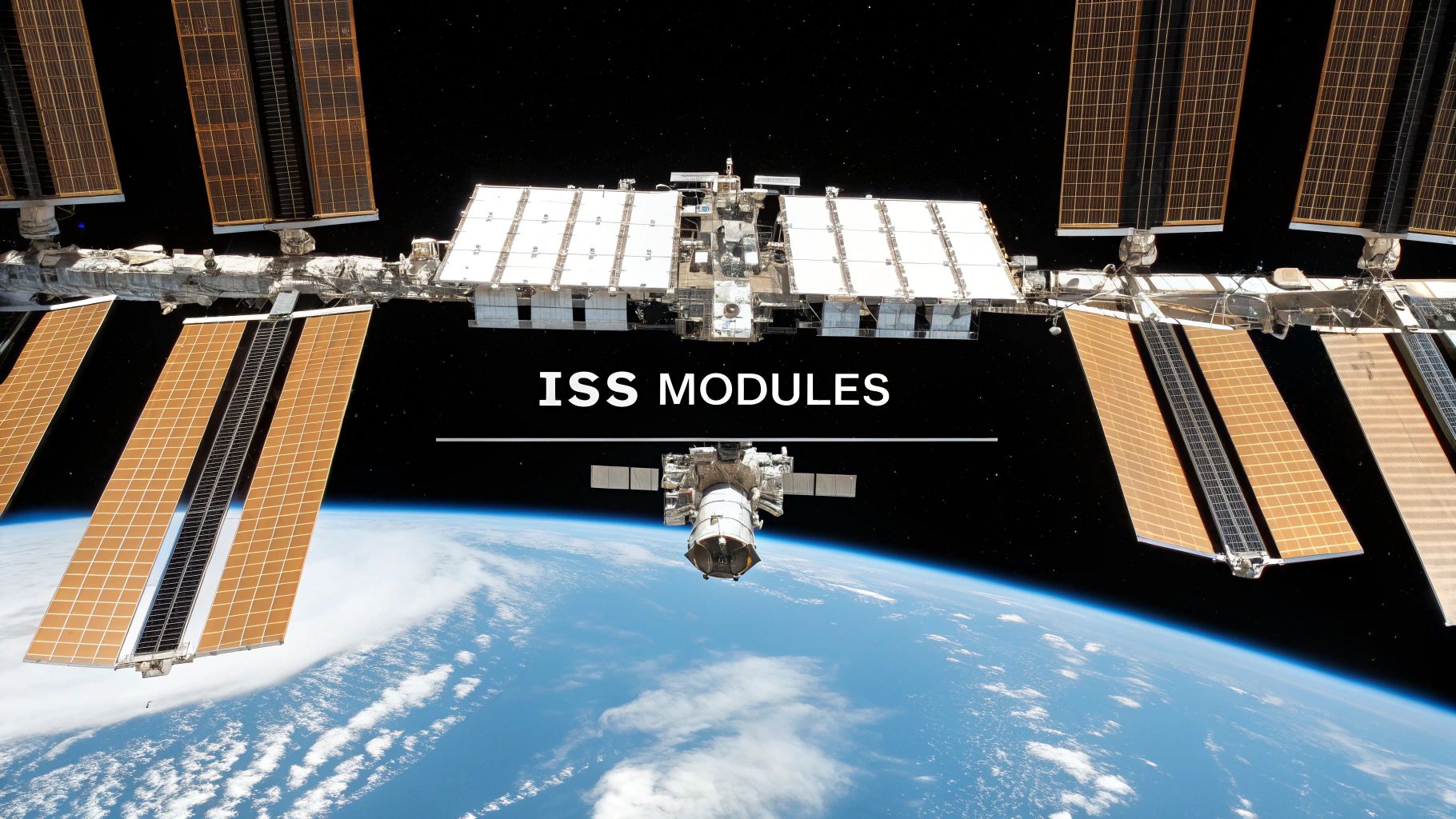
The ISS wasn't launched in one go. Nope, it was assembled piece by piece, like a giant cosmic Lego set. For more than a decade, different countries sent up enormous sections called modules on powerful rockets and space shuttles. Once a new piece arrived, it was up to the astronauts to perform daring spacewalks to connect it all.
Floating outside the station, they became space construction workers. Their job? To bolt these massive modules together and hook up all the complicated cables and pipes. It was an incredible feat of engineering that took amazing teamwork from space agencies all over the world.
A Global Team Effort
Building the ISS was a massive international project. The main players were the United States (NASA), Russia (Roscosmos), Europe (ESA), Japan (JAXA), and Canada (CSA). Each partner built different parts and brought their own unique skills to the table, proving that we can achieve unbelievable things when we work together.
Sometimes, these partnerships grow and change over time.
Take the United Kingdom, for example. At first, the UK was a bit cautious about funding the ISS directly. But after the UK Space Agency was formed in 2010, its role grew bigger, and it started contributing more to the European space activities that support the station's missions.
It just goes to show that even in space exploration, teamwork can evolve, just like a mission plan in Space Ranger Fred and the Shoelace Adventure. You can read more about the UK’s journey with the ISS and see how its involvement developed.
This step-by-step process flow infographic shows the very first assembly milestones for the International Space Station.
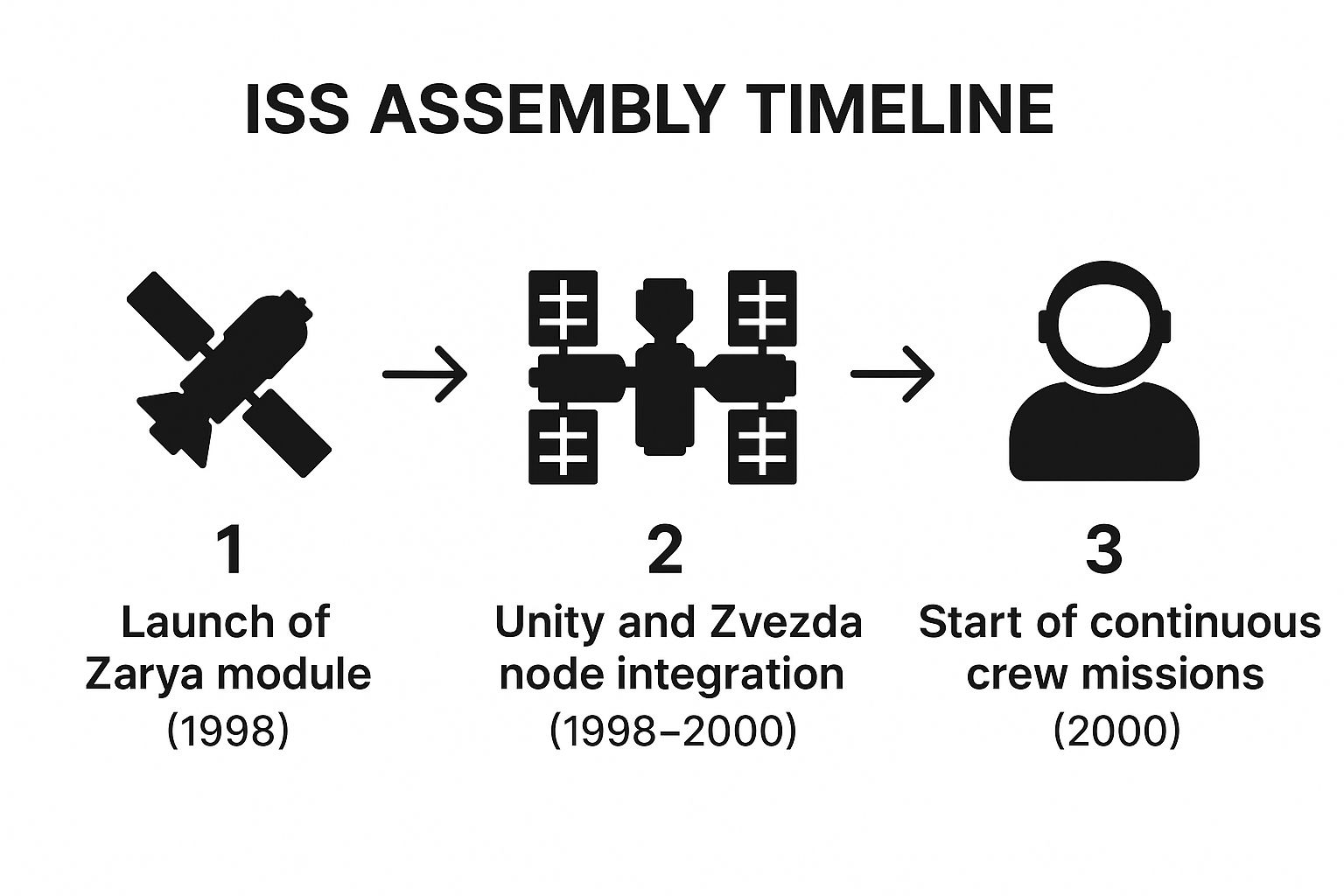
The infographic highlights how the first core modules—Zarya, Unity, and Zvezda—were connected. This laid the foundation for astronauts to begin living and working on the station continuously from the year 2000.
A Day in the Life of an Astronaut
So, what’s it really like to live and work aboard the International Space Station? It’s not all floating around and gazing at the Earth, though that’s definitely one of the best parts! An astronaut's day is actually jam-packed with science, chores, and exercise, all scheduled down to the very minute.
Their most important role is being a scientist in space. The ISS is an incredible laboratory where astronauts can do experiments that are totally impossible on Earth. The secret ingredient? A special kind of weightlessness called microgravity, which changes how everything works.
These experiments are helping us figure out how to travel to the Moon and Mars one day, and they often lead to amazing discoveries that help us right here on the ground. To get a better idea of their missions, you can check out our deep dive into what do astronauts do in space.
Working in an Orbiting Lab
A normal day for an astronaut is a busy one, filled with fascinating jobs planned by mission control. They make sure every single moment is put to good use!
A day’s work could involve all sorts of things:
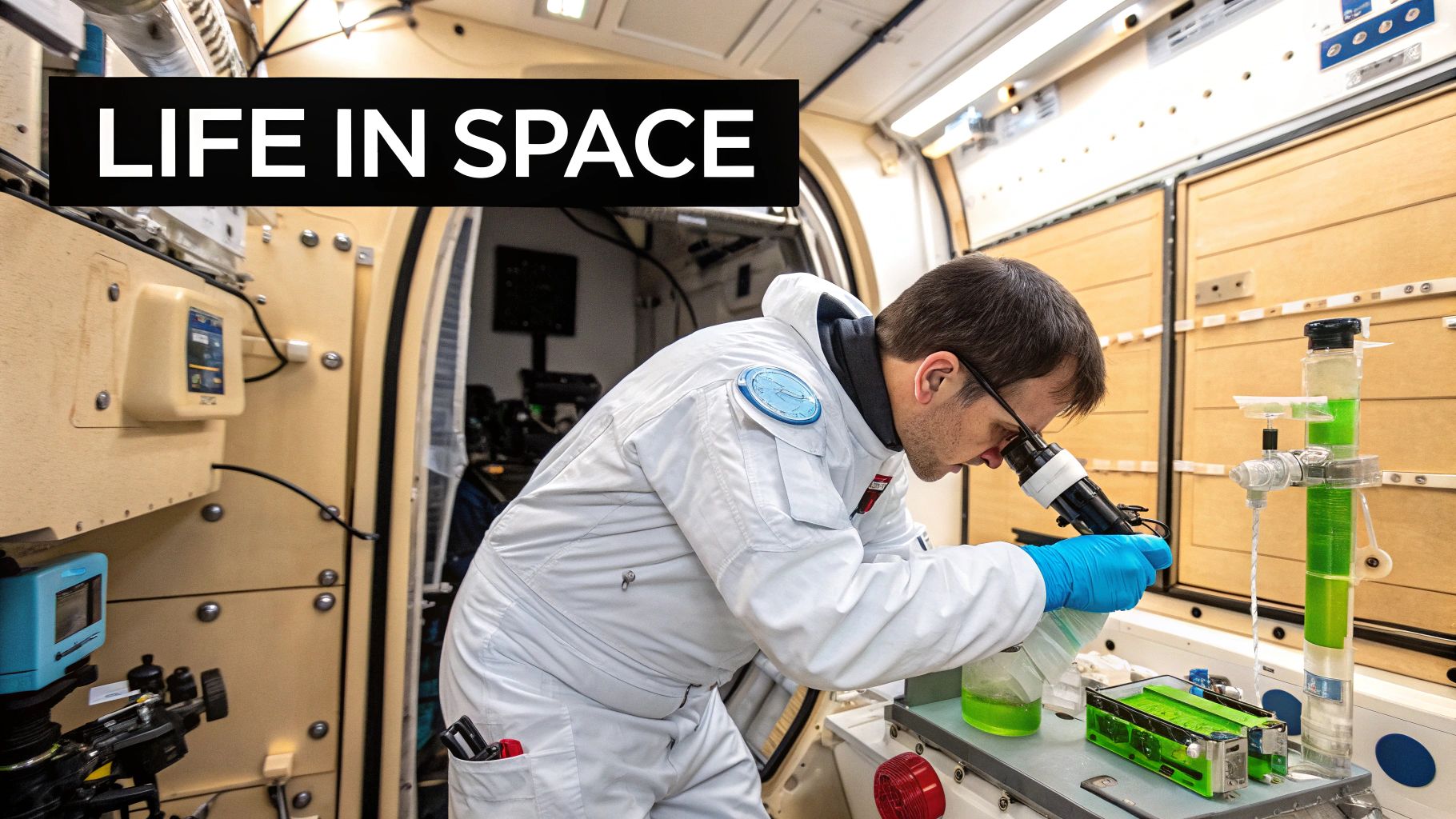
- Running Experiments: They might be studying how bone cells behave without gravity, figuring out how to grow plants without soil, or testing out brand-new technology.
- Keeping the Station Shipshape: Just like a house, the ISS needs plenty of care. Astronauts spend hours checking systems and fixing anything that might have broken.
- Going on Spacewalks: Sometimes, a job needs to be done on the outside. These spacewalks, officially called Extravehicular Activities (EVAs), can last for several hours.
It’s like being a scientist, an engineer, and a mechanic all rolled into one. When something goes wrong, they have to be expert problem-solvers, just like in Space Ranger Fred and the Tick Tock Tale, where a bit of quick thinking saves the entire day.
Astronauts have a really structured day. They usually work for about 10 hours on a weekday and five hours on a Saturday. Sundays are for resting up, cleaning the station, and calling their families back home on Earth.
Staying Healthy in Space
Living in microgravity is surprisingly tough on the body. Without gravity constantly pulling them down, an astronaut's muscles and bones can start to get weak. To stay strong, they have to exercise for at least two hours every single day!
The ISS has its own special gym with a treadmill, an exercise bike, and even a weightlifting machine that uses resistance instead of actual weights. This is super important for keeping their bodies ready for the mission and for their return to Earth.
Even eating is a whole different ball game. Food is kept in special packets to stop crumbs from floating off and gumming up important equipment. At the end of a long day, there’s no bed to flop into—astronauts zip themselves into sleeping bags attached to the wall so they don’t float away in their sleep. It’s a truly out-of-this-world way to live.
The Technology That Keeps the ISS Flying
Keeping a giant space station whizzing around our planet with astronauts living inside is a seriously tricky business. The International Space Station is filled with amazing tech that makes life possible hundreds of miles above our heads. It’s like a self-contained little world, generating its own power and even recycling its own air and water!
You can’t just plug the ISS into a wall socket, can you? So, it has its own massive power station that runs entirely on sunlight. The station gets all its juice from the Sun using eight enormous solar arrays that look like a pair of giant golden wings.
These panels are covered in thousands of tiny solar cells that soak up sunlight and turn it into electricity. They’re so huge that if you laid them all out flat, they’d cover an entire American football field! They’re constantly twisting and turning, following the Sun across the sky to catch every last ray. This clever bit of kit provides all the power needed to run the computers, life support, and all the incredible science experiments happening on board.
Making a Home in the Void
Power is one thing, but astronauts also need the basics we all take for granted—clean air to breathe and fresh water to drink. Sending up supplies from Earth is complicated and super expensive, so the ISS has an incredibly clever recycling system. It’s one of the most important bits of tech for understanding what is the international space station and how it keeps its crew safe.
This system, called the Environmental Control and Life Support System (ECLSS), is an absolute master of recycling. It pulls moisture right out of the air—even from the astronauts' breath and sweat—and purifies it until it’s cleaner than most of the tap water we drink on Earth. It also scrubs the air, removing the carbon dioxide the crew breathes out and adding fresh oxygen back in.
The life support systems on the ISS are so good that they recycle about 93% of all the water used on board. That includes everything from an astronaut's sweat during a workout to the water from a damp towel!
Teamwork Makes the Tech Work
Inventing technology this amazing takes a huge team from all over the world. Countries like the United Kingdom play a big part through the European Space Agency (ESA), lending their brainpower to invent and improve these life-or-death systems. It just goes to show how teamwork is vital for solving the biggest challenges in space.
The UK's role is getting bigger all the time. By putting money into the ESA’s Exploration Programme, the UK helps develop the tech needed for astronauts to travel further into space for longer. This includes the very same recycling systems that keep the crew on the ISS alive and well. You can find out more about the UK’s strategy for space exploration and its contribution to these incredible missions. It’s this global partnership that keeps the ISS a top-notch laboratory in the sky.
What's Next for the Space Station?
Even the most amazing adventures have to end eventually, and one day, the International Space Station will take its final bow. The current plan is for our orbital home to keep flying until around 2030. But don't worry—its incredible legacy of discovery will continue to inspire new generations of explorers for a very, very long time.
Just like in my book Space Ranger Fred and the Tick Tock Tale, time is ticking! But every single moment is being used to gather as much knowledge as possible before the mission changes. Think of the ISS as a wise old teacher, passing on all its lessons to the next class of space adventurers.
The station’s final years are absolutely packed with important science. Every experiment helps us solve a piece of the giant cosmic puzzle: how can humans live and work safely in space for longer and longer? The answers are essential for our next giant leaps, like building bases on the Moon or sending the first astronauts to Mars.
A New Era of Space Stations
So, what comes after the ISS? The future of living in Earth orbit looks seriously exciting. Private companies are already getting ready to launch their own commercial space stations! These will be brand-new places for astronauts, scientists, and maybe even space tourists to visit.
The ISS has been a home in orbit for over 20 years, hosting more than 270 astronauts from 21 different countries. Its spirit of global cooperation has truly set the stage for the next chapter of space exploration.
These new outposts will be built on everything we’ve learned from the ISS. They’ll continue the important work of space-based science and manufacturing, creating new medicines and materials that can help everyone back here on Earth. This is a key part of what makes understanding what the International Space Station is so important—it’s the foundation for everything that comes next.
Fuelling Our Next Great Adventures
That incredible spirit of curiosity and teamwork that built the ISS is exactly what will fuel our journey into the great unknown. From learning how to recycle water to figuring out how to keep astronauts healthy far from home, the lessons from our orbital home are priceless.
As we look towards missions to the Moon and beyond, the ISS will always be remembered as the place where humanity truly learned how to live among the stars. To keep that sense of wonder alive, check out our guide to space exploration for kids and get ready for the next adventure.
Your Questions Answered!
Still got a few questions buzzing around your space helmet? Brilliant! Let's tackle some of the top things young explorers like you ask about our amazing home in the stars.
How Fast Does the ISS Travel?
Strap yourselves in! The ISS zooms around our planet at an eye-watering 17,500 miles per hour. That's nearly eight kilometres every single second.
It’s moving so fast that it completes a full lap of the Earth in just 90 minutes. For the astronauts on board, this means they get to see a mind-boggling 16 sunrises and 16 sunsets every day. Imagine that!
Can You See the ISS from Earth?
You bet you can! After the Sun and the Moon, the ISS is actually the third brightest object you can spot in the night sky. It looks a bit like a very bright, fast-moving aeroplane, but without any of the blinking lights.
So, why does it shine? Its gigantic solar panels are like massive mirrors, reflecting sunlight back down to us on Earth. There are even special apps and websites that tell you the exact moment it will be flying over your house, so you can run outside and give the astronauts a wave! For more jaw-dropping tidbits, check out these other amazing space facts for kids.
How Big Is the International Space Station?
It’s absolutely massive! If you were to lay the whole structure out on the ground, end to end, it would stretch across an entire football pitch.
And the inside is just as impressive. The living and working space is bigger than a six-bedroom house, all floating in orbit.
It's a proper city in the sky, complete with science labs, sleeping pods, and even a gym to help keep the crew strong and healthy.
Join the adventure and learn more about science and space with Space Ranger Fred! Explore our books and activities at https://spacerangerfred.com.