
At its heart, project based learning is a way of teaching that transforms learning into an exciting quest. Instead of just memorising facts for a test, children get to grips with a real-world problem or a complex question, working over an extended period to investigate and find a solution.
It’s the difference between reading about simple machines in a textbook and actually designing and building one to solve a problem – much like the hands-on challenges in Space Ranger Fred and the Umbrella Rescue.
What Is Project Based Learning Really?
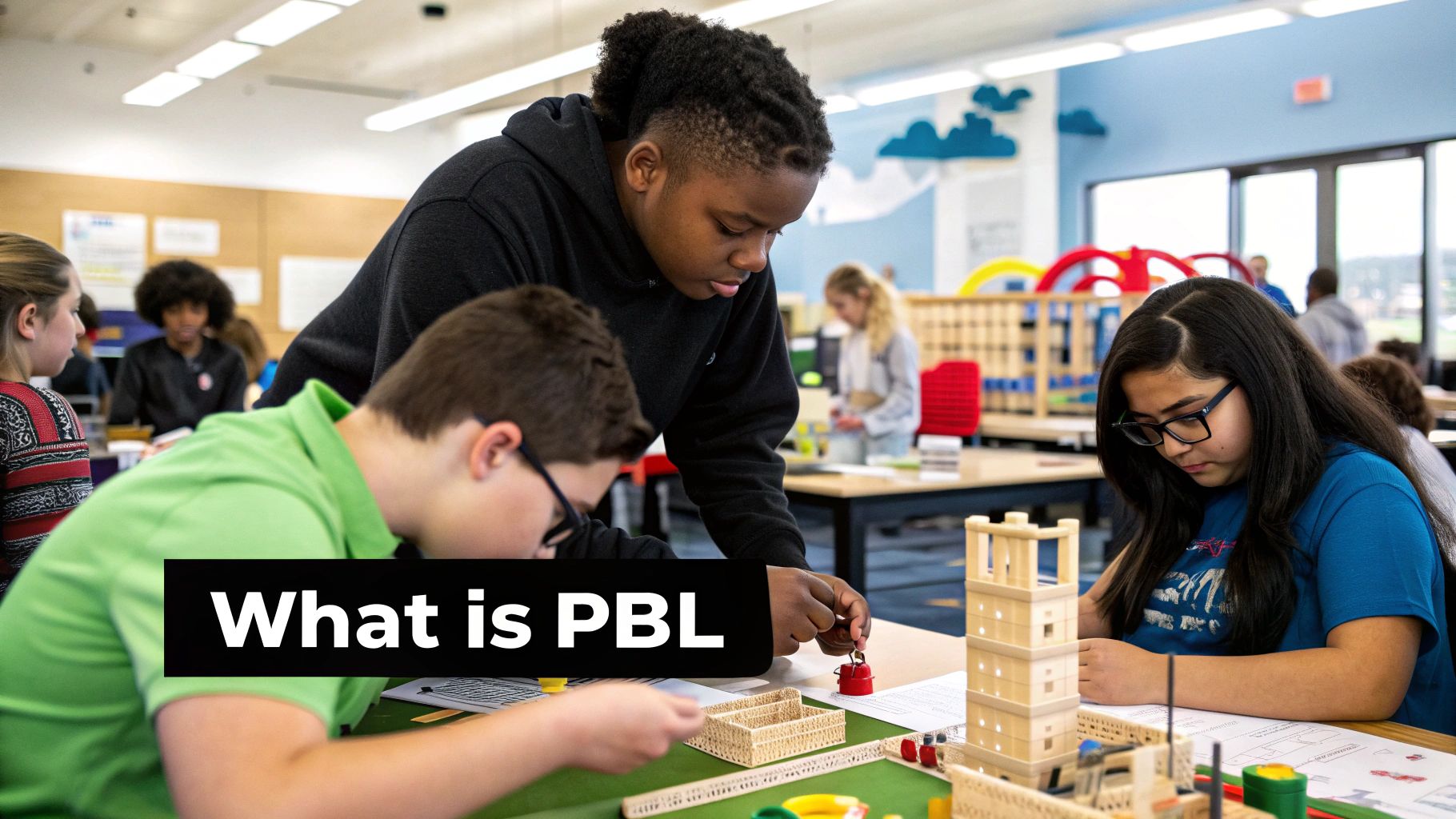
Imagine your child's classroom turning from a place of quiet listening into a bustling inventor's workshop or a detective's office. That’s the magic of project based learning (PBL). It’s not about doing a fun activity at the end of a topic; the project is the topic. All the learning happens through the process of tackling the challenge itself.
This approach flips the script, shifting the focus from passively receiving information to actively building knowledge. Children stop being just consumers of facts and become creators, problem-solvers, and collaborators. They learn by doing, which is a fantastic way to make abstract ideas stick.
A Shift from Knowing to Doing
Traditional learning often asks, "What do you know?" Project based learning asks, "What can you do with what you know?" It’s a subtle change, but it makes a world of difference for engagement and skill development. Rather than just learning about ecosystems from a book, a PBL classroom might ask students to design a sustainable school garden to attract local wildlife.
This dynamic method helps children develop skills they’ll need for the rest of their lives, including:
- Critical Thinking & Problem-Solving: Children learn to analyse problems, ask thoughtful questions, and come up with their own solutions.
- Collaboration: Working in teams is central to PBL, teaching kids how to communicate, listen, and cooperate effectively.
- Creativity: There's rarely a single "right" answer, which encourages imaginative thinking and original ideas.
- Self-Management: Learners take ownership of their work, learning to manage their time and resources to meet project goals.
Project based learning is essentially the main course, not the dessert. It's the entire framework for learning, blending knowledge and skills into a meaningful, hands-on experience that mirrors how problems are solved in the real world.
Let's have a quick look at how this plays out in the classroom.
Traditional Learning vs Project Based Learning
Here’s a simple table to show the core differences between a teacher-led classroom and one centred around student-driven projects.
| Aspect | Traditional Classroom | Project Based Learning Classroom |
|---|---|---|
| Driver | Teacher-led instruction | Student questions & inquiry |
| Focus | Memorising facts & concepts | Applying knowledge to solve problems |
| Student Role | Passive listener & fact consumer | Active participant & creator |
| Assessment | End-of-unit tests & exams | Ongoing assessment & final presentation |
| Outcome | Knowing information | Being able to do something with it |
As you can see, PBL isn't just a small tweak; it's a fundamental shift in how we approach education, prioritising real-world application over rote memorisation.
This method is closely related to other hands-on approaches. You can learn more about experiential learning in our detailed guide to see how these student-centred strategies overlap.
Ultimately, by grounding lessons in authentic challenges, project based learning finally answers that age-old question every child asks: "Why do I need to learn this?" The answer becomes crystal clear when they’re using their knowledge to build something real and make a tangible impact.
The Core Elements of a Great Project
So, what separates a fun afternoon activity from a genuine project based learning experience? It all comes down to the ingredients. A truly effective project isn't just about making something cool; it's a carefully structured learning adventure, built on a few essential components that spark deep curiosity and build real skills.
Think of it like building a rocket. You need more than just cardboard and sticky tape – you need a blueprint, a mission, and a destination. A great project starts with these core elements, ensuring the learning journey is both meaningful and exciting.
The Driving Question that Ignites Curiosity
Every powerful project is fuelled by a driving question. This isn't your typical quiz question with a single correct answer you could find on Google. Instead, it’s a big, open-ended challenge that demands investigation, creativity, and critical thinking to crack. It’s the central mission that guides the entire project.
A great driving question should be:
- Challenging: It needs to be complex enough to demand real effort over time.
- Engaging: It must tap into children's interests and feel relevant to their world.
- Authentic: It should mirror a problem or question that actually exists outside the classroom walls.
For example, instead of asking, "What do birds eat?", a far better driving question would be, "How can we design a bird-friendly space in our school playground to help local birds survive the winter?" This question immediately frames a real-world problem with a tangible, inspiring goal.
This infographic shows how student-led inquiry, real-world application, and teamwork are the foundational pillars of project based learning.
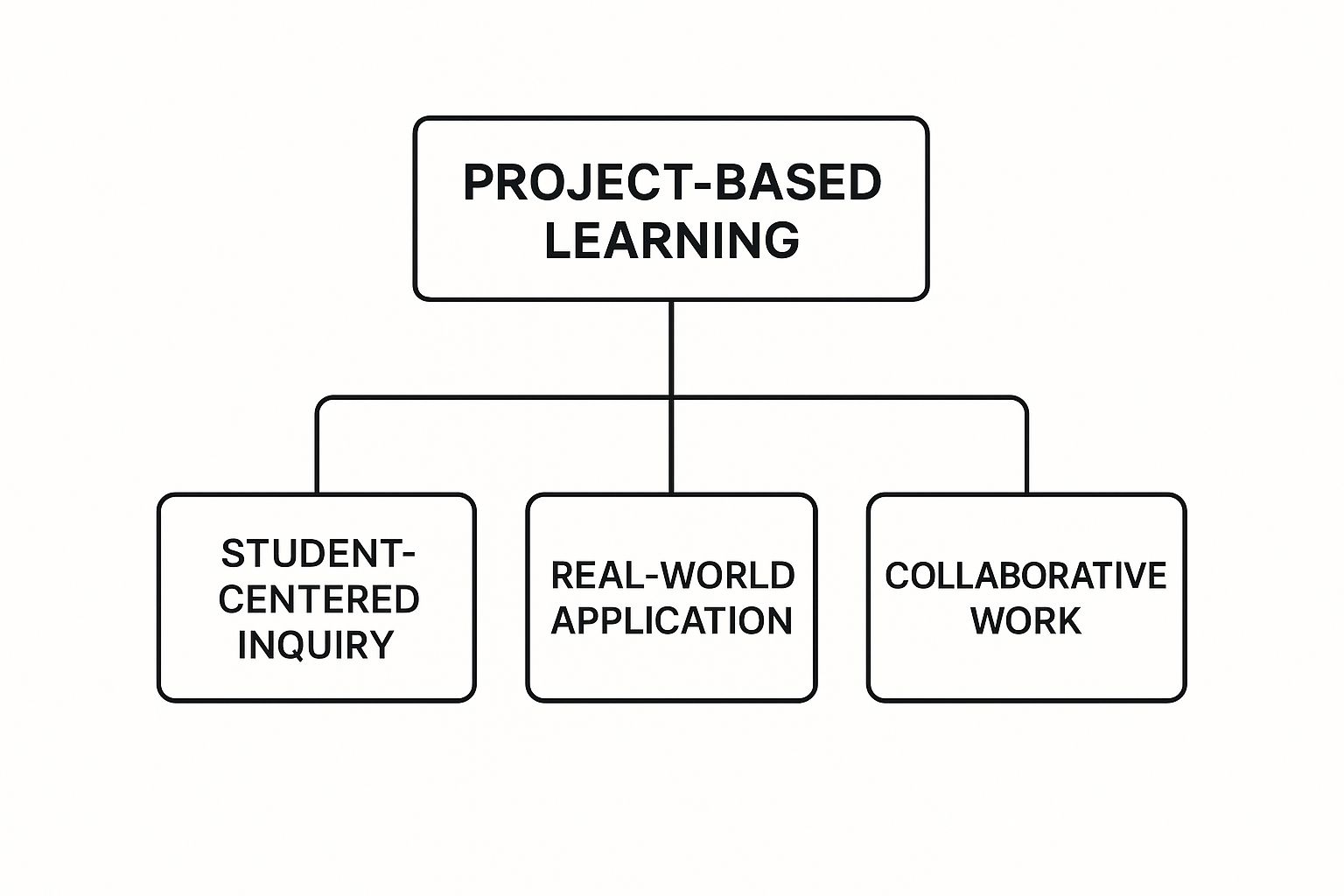
This visualisation highlights that true PBL isn’t just one thing, but a combination of core principles working together to create a powerful learning experience.
Student Voice and Choice
One of the key things that makes project based learning click is giving children a real sense of ownership. Student voice and choice means learners get a say in how they tackle the driving question. They might choose which part of the problem to focus on, how to do their research, or what kind of final product they want to create.
This doesn't mean it’s a free-for-all, of course. The adult’s role is to provide a framework and guide the process, but allowing children to make meaningful decisions ramps up their investment and motivation. It empowers them to become active drivers of their own learning, not just passive passengers.
Authenticity and Real-World Connections
Projects should feel real because they are real. Authenticity is all about connecting the project to genuine issues, tools, and audiences. When children see that their work has a purpose beyond just getting a good mark, their engagement skyrockets. It answers the classic "why are we learning this?" question before it’s even asked.
For instance, in Space Ranger Fred and the Umbrella Rescue, Fred doesn't just learn about forces as an abstract concept; he uses that knowledge to solve an immediate, practical problem. In the same way, a project on local wildlife could involve talking to a real conservationist, using professional data-gathering tools, and presenting findings to a community group.
When learning is authentic, it’s no longer just an academic exercise. It becomes a meaningful contribution to the world, helping children see themselves as capable problem-solvers who can make a real impact.
Critique, Revision, and a Public Product
Learning rarely happens in a straight line. A vital part of the process is the cycle of critique and revision. Students share their work in progress, get constructive feedback from their peers and adults, and use that advice to improve their project. This builds resilience and teaches them that making mistakes is a perfectly natural part of creating something great.
Finally, every great project culminates in a public product. This just means sharing the final work with an audience beyond the classroom. It could be a presentation to parents, an exhibition for the whole school, or a proposal sent to the local council. Presenting their work publicly gives it a real purpose and celebrates the children’s hard work, building immense confidence.
Research backs this approach up. A comprehensive 2016 review of UK educational studies found that students in PBL classrooms were consistently more engaged and showed stronger collaboration and problem-solving skills. Discover more insights from this UK literature review.
How Project Based Learning Fuels STEM Skills
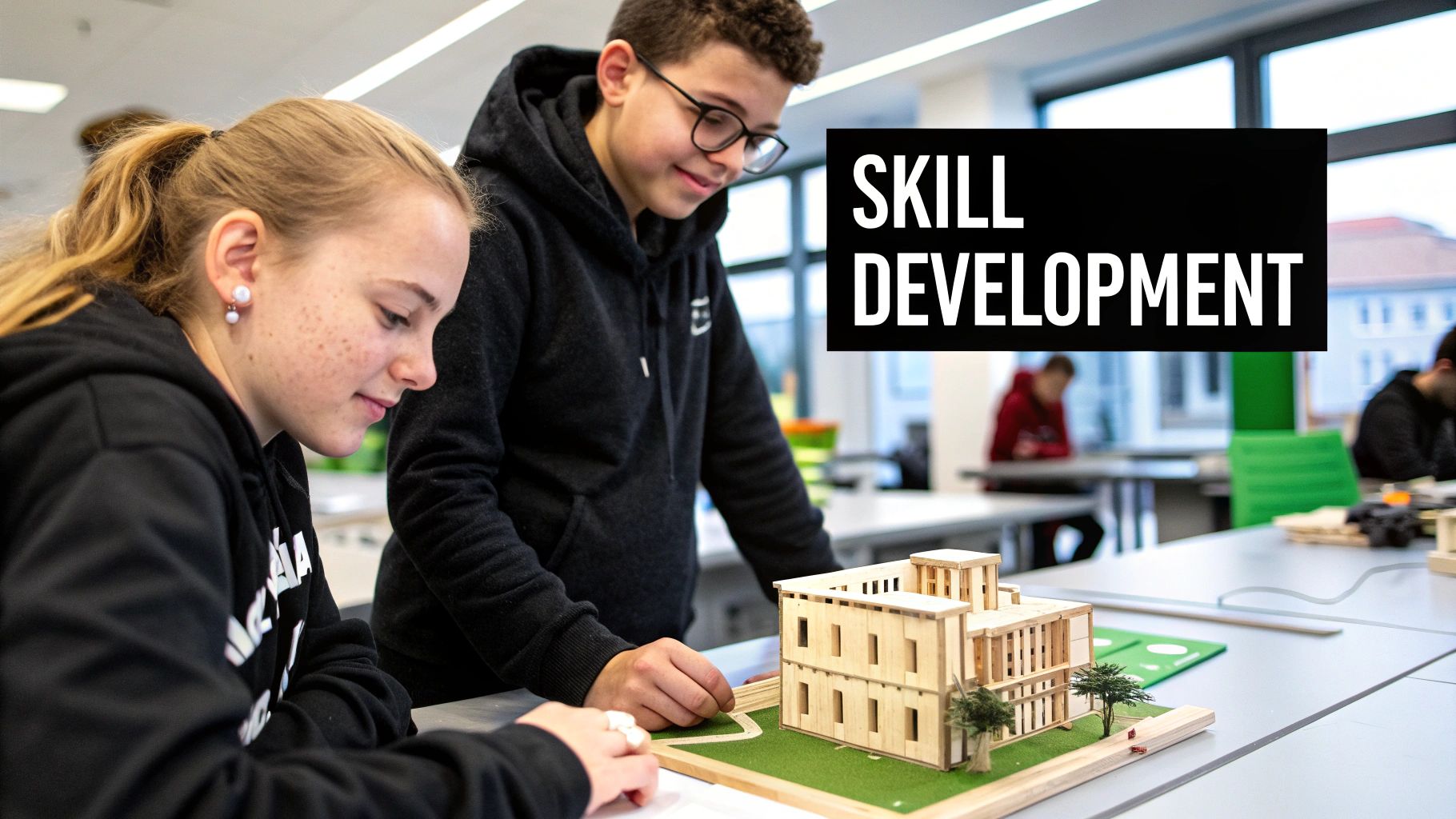
Project based learning and STEM subjects—Science, Technology, Engineering, and Maths—are a perfect match. They fit together so naturally because STEM isn't just about memorising facts; it's about getting your hands dirty building, designing, and solving real-world challenges.
This hands-on approach is where the magic happens, shifting learning from abstract theory into something kids can actually see and touch.
Instead of just reading about the principles of physics from a textbook, a child might be tasked with designing a gadget to solve a genuine problem. Think of the scenario in Space Ranger Fred and the Tick Tock Tale, where understanding the science behind telling time isn't just a lesson—it's the key to the entire adventure. That’s the heart of what project based learning brings to STEM.
From Theory to Tangible Creation
For a lot of children, STEM subjects can feel a bit distant and, let's be honest, a little dry. A project completely changes that. It turns a page of equations or scientific laws into a practical toolkit.
Most importantly, it finally answers that classic question every parent and teacher has heard: "When will I ever use this?" It shows them exactly when and how.
This method also encourages a mindset of experimentation and discovery. Failure isn’t a red mark on a test; it’s just a valuable clue that helps improve the next prototype. This iterative process of trying, failing, and trying again is the very heartbeat of engineering and scientific innovation.
By grounding STEM concepts in a meaningful project, we help children move beyond memorisation. They don't just learn about the scientific method; they live it, building a deep, practical understanding that lasts a lifetime.
It's an approach that naturally develops the core skills essential for any future scientist or innovator.
Developing Core STEM Competencies
A well-designed project is basically a training ground for the skills that define a great scientist, engineer, or mathematician. It’s less about what children learn and more about how they learn it.
Here are the key STEM skills that project based learning actively develops:
- Critical Thinking: Learners have to analyse problems from all angles, break them down into smaller pieces, and figure out the best way forward. They quickly learn to ask clever questions and challenge their own assumptions.
- Problem-Solving: At its core, every project is a big, juicy problem waiting to be solved. Kids learn to come up with strategies, test their ideas, and adapt when things inevitably don't go to plan.
- Creativity and Innovation: STEM is deeply creative. Projects give children the freedom to brainstorm wild ideas and design original solutions, nurturing the kind of out-of-the-box thinking that leads to breakthroughs.
- Collaboration: Real-world science and engineering are team sports. By working together, kids learn to communicate their ideas, listen to others, and combine their strengths to reach a common goal.
The benefits are clear in the classroom, too. Research in UK primary schools has shown that pupils in project based learning environments perform better in mathematics compared to their peers. These studies found that children showed superior problem-solving skills, especially when faced with real-world scenarios that required complex thinking.
Making Connections Across Disciplines
STEM subjects don't exist in little boxes. An engineering project needs maths for calculations, science for understanding principles, and technology for design and modelling. Project based learning beautifully highlights these connections.
A project to design a model Mars rover, for example, would naturally blend:
- Engineering: Designing the chassis, wheels, and suspension system.
- Technology: Maybe using simple coding to control its movements or 3D printing for parts.
- Science: Researching the Martian environment to figure out the challenges the rover will face.
- Maths: Calculating gear ratios, dimensions, and how much power it needs.
This interdisciplinary approach helps children see the bigger picture. They start to understand that subjects aren't just separate items to be ticked off a list, but interconnected tools for understanding and shaping the world. This is especially true when you start building games for kids as a learning project, as that requires a brilliant mix of storytelling, logic, and design.
By igniting a genuine passion for discovery, we set them on a path to becoming lifelong learners and innovators.
Bringing a STEM Project to Life
Understanding the theory is all well and good, but seeing project-based learning in action is where the magic really happens. Let's walk through a fun STEM example, the kind of creative problem-solving you'd find right in Space Ranger Fred and the Tick Tock Tale. This will show you how a single, simple question can blossom into an incredible learning adventure.
Our entire project will orbit around one compelling question designed to ignite curiosity.
Driving Question: How can we design a device that tells the time without using any numbers?
This question immediately throws down a gauntlet. It’s open-ended, packed with STEM principles (engineering, design, a bit of history), and gives creativity free rein. It’s the perfect launchpad for a hands-on project that both parents and teachers can run with.
Phase 1: The Spark of an Idea
The journey doesn't start with answers; it starts with more questions. The first step is a good old-fashioned brainstorming session where no idea is a bad one. We gather the children, pose our driving question, and just let their imaginations take over.
What might that initial chat sound like?
- "Could we use shadows, like on a sundial?"
- "What about something with dripping water?"
- "How did people tell time before there were clocks?"
- "Could we make something that makes a different sound every hour?"
This first burst of creativity is so important for building a sense of ownership. The kids aren't just following instructions; they are co-creators from the get-go. This phase is all about sparking their interest and mapping out all the different paths our investigation could take.
Phase 2: The Inquiry and Research Adventure
With a flurry of ideas on the table, it’s time to put on our history detective and scientific explorer hats. This is the sustained inquiry phase, where children dive deep to build their background knowledge. We’re not hunting for a single correct answer; we’re exploring the entire concept of timekeeping itself.
Their research could be a fun mix of activities:
- Exploring Ancient Methods: The group might look into how ancient civilisations, like the Egyptians or Romans, told time. They’d discover sundials, water clocks (clepsydras), and giant obelisks, blending history and science perfectly.
- Understanding the Science: They’ll need to investigate the science behind their best ideas. If they’re leaning towards a sundial, they’ll need to understand how the Earth’s rotation makes shadows move in a predictable way—a direct link to astronomy. For other fantastic space-themed projects, you can find some great solar system project ideas on our blog.
- Gathering Inspiration: Looking at modern, non-digital clocks could also spark some clever ideas. What other creative ways do people visualise the passage of time?
This phase is about arming the learners with everything they need to move into the design stage. They are actively seeking out information to solve their own problem.
Phase 3: Design and Prototyping
Now for the really hands-on part! Armed with research, the kids can start designing their time-telling device. This is where engineering and technology take centre stage. Let's say the team decides to build a modern-day water clock.
Their process might look a little something like this:
- Sketching Designs: Each child or small group draws their vision for the water clock. They think about materials they'll need (plastic bottles, tubing, a container) and how all the parts will fit together.
- Building the First Prototype: Then, they get to work building their first version. This attempt is all about testing the core idea. Does the water drip at a steady rate? How can they mark the time as it passes?
This stage is messy, experimental, and incredibly valuable. It’s where abstract knowledge becomes a real, tangible object. The first prototype almost certainly won't be perfect, and that’s exactly the point.
Phase 4: Test, Revise, and Refine
With a prototype in hand, it’s time for the crucial cycle of critique and revision. The team tests their water clock. Maybe they discover the water drips too fast at the beginning and too slowly at the end. This isn't a failure; it’s a discovery!
They get feedback from their friends and their teacher or parent. "What if we change the shape of the container?" someone might suggest. "Could we make the hole smaller?" asks another. Based on this feedback, they go back to the drawing board, make adjustments, and build a new, improved version. This cycle of testing, getting feedback, and refining is the very heart of project-based learning.
Phase 5: The Public Showcase
Finally, the project comes together in a public product. After several revisions, the team has a working, numberless clock they are genuinely proud of. Now it's time to share their journey and their creation with an audience.
This could be a presentation to their class, their parents, or even the whole school. They would explain their initial question, what they discovered in their research, the challenges they faced while building, and how they solved them. They get to demonstrate their final device, explaining how it works and what they learned along the way. This final step builds communication skills, boosts confidence, and gives all their hard work a real sense of purpose.
Your New Role as a Learning Guide
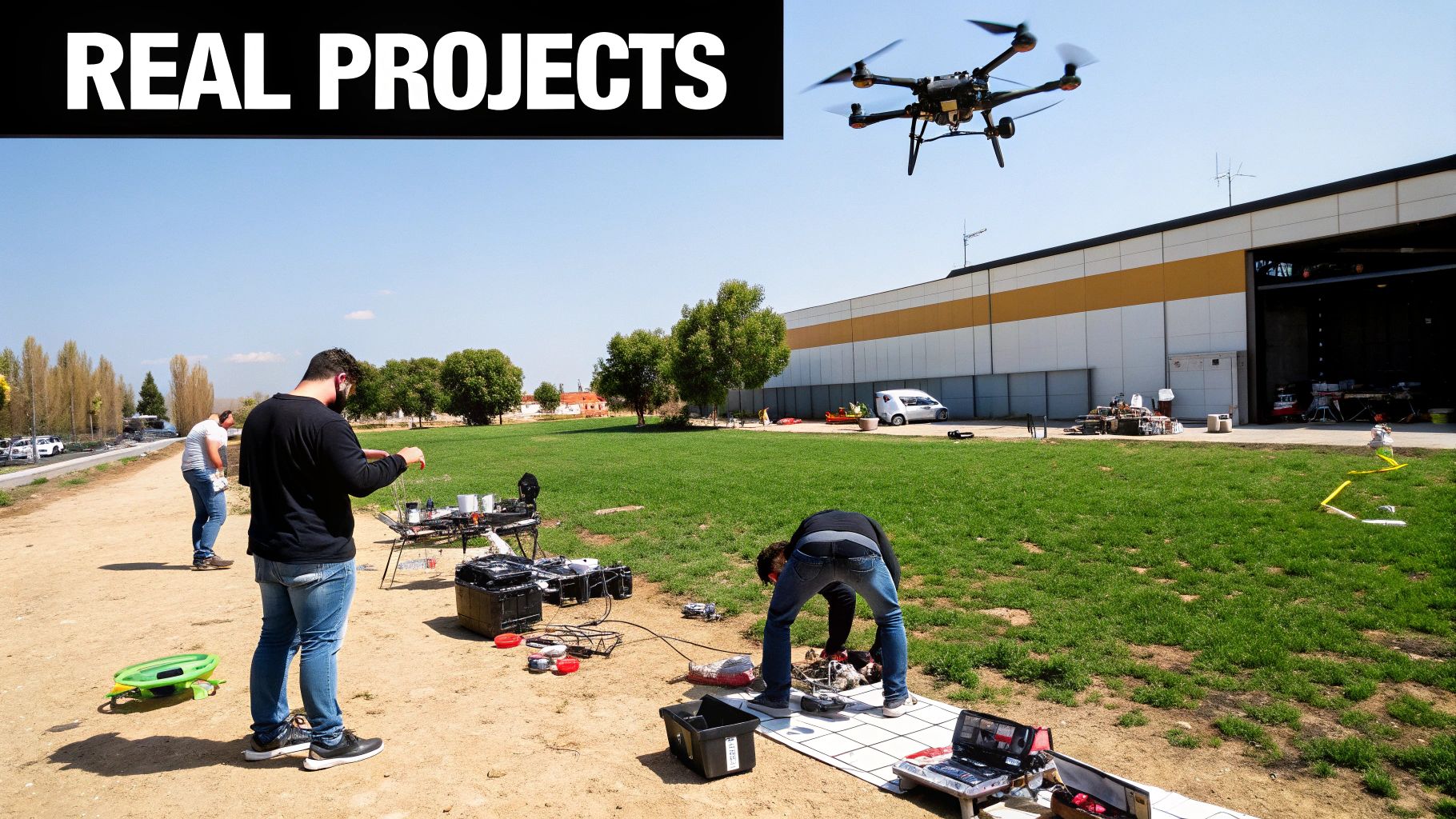
When you step into a project-based world, your role as a parent or teacher undergoes a fascinating change. You're no longer the 'sage on the stage'—the sole keeper of knowledge. Instead, you become the 'guide on the side'. A facilitator, a coach, and a fellow explorer on your child's learning adventure.
This shift can feel a bit odd at first, but it's incredibly empowering for everyone. Your main job isn't to hand out answers anymore. It’s to help children figure out how to find the answers for themselves. It’s all about creating an environment where curiosity thrives, a safe space for them to experiment, make mistakes, and try again.
Think of it this way: your new mission is to support and steer their journey, but never to take the wheel.
Fostering a Collaborative Spirit
Project-based learning absolutely thrives on collaboration. Whether you're guiding a classroom of students or working with your child at home, building a spirit of teamwork is key. This means leaving the top-down approach behind and creating a genuine partnership where every idea is shared and respected.
Instead of directing every single step, spark a discussion. Model what it means to be a good listener and show them how to build on each other's ideas. In a story like Space Ranger Fred and the Shoelace Adventure, Fred and his team don't win because one person has all the answers; they succeed by working together. That’s the exact atmosphere you want to create.
Your goal is to be a mentor, not a manager. It’s about asking the right questions to provoke deeper thought, rather than giving direct instructions. This simple change helps children develop the confidence to lead their own learning.
By creating a collaborative space, you're teaching them invaluable life skills in communication and cooperation without them even realising it.
Asking Powerful Questions
One of the best tools in your new toolkit is the art of asking powerful questions. I’m not talking about questions with a simple ‘yes’ or ‘no’ answer. These are open-ended prompts designed to spark deeper thinking, encourage investigation, and challenge assumptions.
Good questions are what get a project moving again when it hits a wall. So, instead of saying, "Your tower keeps falling over, try using a wider base," you could ask something like:
- "What have you noticed happens each time the tower falls?"
- "What other designs have you seen that are really strong and stable?"
- "What do you think would happen if you changed the shape of the bottom?"
This simple switch in approach encourages children to analyse the problem and invent their own solutions, building genuine problem-solving skills that will stick with them for life.
Providing Resources at the Right Time
Being a guide also means being a curator of resources. You don't have to be an expert on every topic under the sun. Your role is to connect your child with the information they need, right when they need it. This could mean pointing them to a helpful website, finding a brilliant book, or even arranging a chat with someone in your community who has real-world expertise.
This approach has been refined over decades. While project-based learning feels very modern, its roots go back to early 20th-century education. More recently, it has seen huge growth in UK higher education, particularly in engineering courses where mixed-year groups collaborate on industry-linked problems—just like a real-world team. To see how this works in UK universities, you can read the full research paper on PjBL here.
Your support in providing resources at just the right moment is what keeps the project's momentum going without ever overwhelming the learner.
Common Questions About Project-Based Learning
As parents and teachers start to explore project-based learning, a few common questions naturally pop up. It makes sense to wonder how this student-led approach fits into a world that often feels quite structured. Let’s tackle some of the most frequent queries to help you move forward with confidence.
After all, it’s one thing for learning to be fun, but quite another to be sure that core educational goals are being met.
How Does Project-Based Learning Fit the UK National Curriculum?
This is a brilliant question, and one I hear a lot. High-quality projects don’t just happen by accident; they are intentionally designed from the very beginning to meet specific curriculum standards. Instead of teaching subjects in isolated blocks, a single project can weave multiple learning objectives together seamlessly.
Think about a project centred on designing a school garden. It could easily cover:
- Science: Exploring plant life cycles and local ecosystems.
- Maths: Measuring the area, calculating seed quantities, and managing a small budget.
- Design Technology: Constructing raised beds or simple irrigation systems.
- English: Writing a proposal to the headteacher or presenting the final design to the class.
This method allows children to hit curriculum targets in a meaningful, cohesive way, which almost always leads to a deeper and more lasting understanding.
Is Project-Based Learning Suitable for All Children?
Yes, absolutely—because it’s incredibly adaptable. The emphasis on student voice and choice means children can dive into topics that genuinely excite them and work in ways that play to their strengths. A project like designing a solution in Space Ranger Fred and the Shoelace Adventure appeals to a huge range of both creative and logical thinkers.
Of course, some children might need a bit more structure or scaffolding from their adult guide, especially when they're just starting out. But the hands-on, engaging nature of PBL often motivates a really diverse range of learners, including those who sometimes struggle in a more traditional classroom.
How Is Learning Measured in a Project?
This is where things look quite different from a standard, end-of-unit test. Assessment in project-based learning is an ongoing process that values the journey just as much as the destination. It’s all about focusing on both the final product and the crucial skills developed along the way.
Rather than just a single mark, assessment becomes a continuous conversation. It's about observing growth in real-time, celebrating progress in problem-solving, and providing feedback that builds resilience, not just knowledge.
Teachers and parents often use simple tools like checklists or rubrics. These help to assess key skills like collaboration, critical thinking, and creativity, right alongside the child's grasp of the core subject concepts they've been exploring.
Ready to launch your own learning adventure? The Space Ranger Fred book series is packed with thrilling stories that spark curiosity and model the kind of creative problem-solving at the heart of project-based learning. Discover the entire collection and inspire the young explorer in your life.