
A really good children’s dinosaur game is so much more than a way to keep the kids quiet for an hour. It’s an interactive portal to the past, a hands-on way to explore a bit of science, history, and even problem-solving. Think of it as a storybook that comes alive, dropping your child right into a world where magnificent creatures once roamed the Earth. This guide will show you how to turn that playtime into a genuine journey of discovery.
Welcome to Your Prehistoric Playground
Step into a world where the T-Rex roars and gentle Brachiosauruses graze on treetops. For some reason, dinosaurs hold an almost universal fascination for kids, perfectly blending the thrill of giant monsters with the mind-boggling reality of ancient history. It’s this unique mix that makes a children’s dinosaur game one of the most powerful tools for fun-fuelled learning you can have.
It works in much the same way a captivating book series does. Stories like Space Ranger Fred and the Shoelace Adventure ignite a passion for problem-solving by wrapping up big scientific ideas in an exciting, character-driven narrative. Dinosaur games pull off a similar trick, turning abstract concepts like palaeontology or extinction into something kids can see, touch, and interact with. They offer a safe and engaging space to explore huge ideas about the natural world.
What Makes These Games So Special?
The best dinosaur games are built to do more than just entertain. They’re carefully designed to build essential skills while keeping children completely immersed in their prehistoric world. As we dig into this guide, you’ll see how these games can support your child's development in a few crucial ways.
- Igniting Scientific Curiosity: They cleverly introduce core STEM concepts, from identifying different species to understanding ancient habitats and food chains.
- Developing Problem-Solving Skills: Many games are packed with challenges that demand strategic thinking, whether it’s escaping a volcano, digging for fossils, or managing a dinosaur park.
- Encouraging Historical Exploration: They create a real, tangible connection to our planet’s distant past, making history feel alive and incredibly exciting.
A great dinosaur game is a bridge between imagination and education. It lets a child become a scientist, an explorer, and a storyteller all at once, transforming their playroom into a prehistoric playground.
Think of this guide as your trusted resource. We’ll walk you through all the hidden educational benefits, explain what features make for a truly brilliant game, and share our top picks. Our goal is to help you find that perfect match for your little palaeontologist, making sure their next adventure is as enriching as it is fun.
Right then, let's start digging.
Why Dinosaurs Capture Every Child's Imagination
What is it about dinosaurs that makes a child’s eyes light up? It’s a magical mix of sheer scale, ancient mystery, and a genuine link to our planet’s past. These creatures were bigger than buildings, stranger than any dragon, and here’s the best part—they were absolutely real.
That blend of fantasy and fact is the perfect recipe for a young, curious mind. Dinosaurs give children a safe space to explore concepts that are usually pretty scary, like huge power, sharp teeth, and life-or-death struggles. Because they’re long gone, the threat is comfortably in the past, letting kids grapple with these thrilling ideas without any real fear.
This built-in fascination is a brilliant launchpad for STEM learning. A simple question like, "What did a Triceratops eat?" can spiral into wonderful chats about herbivores, ancient ecosystems, and geology. Every childrens dinosaur game taps into this natural curiosity, turning playtime into a science lesson that doesn't feel like a lesson at all.
The Science Behind the Fascination
At its heart, a love for dinosaurs comes from a child’s deep-seated need to make sense of the world. They’re the ultimate puzzle, pieced together from fossilised clues buried deep within the earth. It’s a process that perfectly mirrors the scientific method: gathering evidence, creating a hypothesis, and slowly building a picture of what once was.
It's an adventure that feels both enormous and incredibly personal. Just as a book like Space Ranger Fred and the Umbrella Rescue makes complex physics feel like a relatable mission, playing with dinosaur toys turns palaeontology into a thrilling game of discovery. This hands-on exploration is key to how children learn to categorise and understand their environment.
Dinosaurs are history's superstars. They provide a tangible link to a world that existed millions of years before us, making abstract concepts like deep time and evolution feel immediate and exciting for young minds.
You can see this deep-seated interest reflected all over the UK toy market. Dinosaur-themed toys are consistently among the most popular choices for children, proving they have a timeless appeal. Back in 2020, "dinosaur toys" were the second most searched-for emerging toy category online. This trend is backed by a massive increase in consumer spending on toys and games, which ballooned from around £6.7 billion in 2005 to nearly £12.5 billion in 2023. You can explore more data on the UK toy industry and see just how big the demand really is.
Ultimately, dinosaurs represent that perfect sweet spot where education and excitement meet. They are big, powerful, and mysterious, yet they’re also a very real part of our planet’s scientific story. It’s this powerful combination that ensures they’ll keep capturing the hearts and minds of children for generations to come, making any dinosaur-themed game a worthwhile investment in their learning and creativity.
The Hidden Educational Power of Dinosaur Games
Beyond the satisfying stomps and roars, every children’s dinosaur game is secretly a classroom in disguise. While your child is busy excavating fossils or building a dinosaur sanctuary, they’re also digging into a rich world of science, technology, engineering, and maths (STEM). These games are so much more than just entertainment; they are interactive tools that build foundational skills for life.
Much like a brilliant book, such as Space Ranger Fred and the Tick Tock Tale, which cleverly introduces concepts of time through an engaging story, the best dinosaur games weave scientific principles into thrilling adventures. They transform abstract ideas into hands-on challenges that children are eager to solve. This is the heart of what is known as experiential learning, where kids learn best by doing.
Building Minds One Fossil at a Time
A good dinosaur game is a powerhouse for skill development. When a child navigates a prehistoric landscape or decides which dinosaur enclosure to build next, they aren’t just playing—they’re practising critical thinking and strategic planning. These activities encourage them to think ahead, weigh up their options, and understand cause and effect.
It's amazing how naturally these games introduce tricky concepts in a way that just makes sense:
- Palaeontology and Geology: Kids learn about different dinosaur species, the eras they lived in, and how fossils are formed, all without cracking open a single textbook.
- Problem-Solving: A virtual T-Rex escaping its enclosure isn’t a disaster; it’s a puzzle that needs a logical solution. Figuring out how to contain it or prevent it from happening again really hones their analytical skills.
- Basic Maths and Resource Management: Counting fossils, managing a park's budget, or calculating how much food a herd of Triceratops needs are all fantastic, practical maths lessons hiding in plain sight.
The real magic of a dinosaur game is its ability to make complex STEM concepts feel like an exciting quest. It turns your child into a scientist, an engineer, and a historian, all while they think they are just having fun.
A Perfect Match for Modern Play
This educational focus is exactly what parents across the UK are looking for. The UK toy market is seeing a major shift towards more educational and interactive play, and dinosaur games fit this trend perfectly. Market analysis shows that STEM toys accounted for about 41% of the market for children aged 8-12.
What's more, interactive toys—including those awesome dinosaur-themed playsets—are expected to grow faster than standard toys, thanks to new features that really boost engagement. You can discover more insights about the UK toy market and see for yourself how educational value is driving what families buy.
Ultimately, a well-chosen children’s dinosaur game does more than just occupy an afternoon. It sparks a genuine curiosity about the natural world, nurtures essential problem-solving abilities, and makes learning an adventure. By embracing these prehistoric playgrounds, you’re not just giving your child a toy; you’re giving them a powerful tool for intellectual growth and discovery.
How to Choose the Right Dinosaur Game
With a whole prehistoric world of options out there, finding the perfect childrens dinosaur game can feel like a tricky expedition. But don’t worry—choosing a game that will truly captivate your child is much simpler when you know what to look for. It’s all about matching the game to your child's developmental stage, how they learn best, and what really fascinates them.
Just like having the right tool is essential for a mission in Space Ranger Fred and the Umbrella Rescue, the right game is key to unlocking a brilliant play experience. Your child's age is the first thing to consider. A game built for a nine-year-old might be way too complicated for a preschooler, leading to frustration instead of fun. On the flip side, a simple matching game won't hold the attention of an older child who’s ready for a real strategic challenge.
The format of the game plays a huge role, too. Does your child love the hands-on, social fun of a physical board game? Or are they more drawn to the bright, interactive world of a digital app? Each one offers different benefits and suits different personalities.
This decision tree gives you a simple way to pick the right style of childrens dinosaur game, based on your child's age and what kind of format they'd prefer.
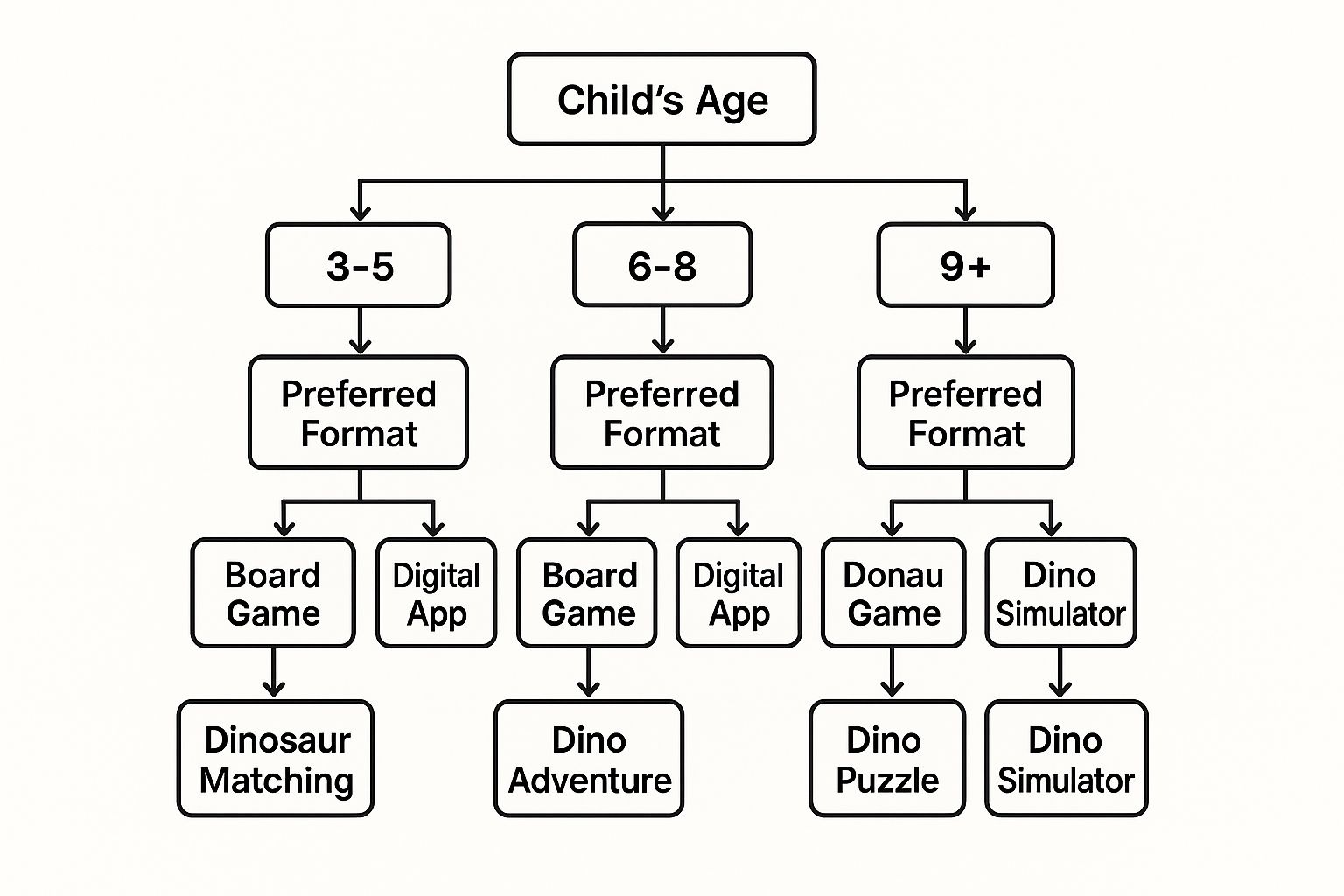
As you can see, the flowchart helps steer you towards either a physical or digital game depending on age, with suggestions tailored to what’s most engaging and appropriate for each group.
Key Features to Look For
Once you’ve got the age group and format figured out, it’s time to dig a little deeper. The best games, whether they’re on a screen or a tabletop, all share a few key qualities that turn them from simple entertainment into something genuinely enriching. For a closer look at what makes some digital options stand out, you can check out our guide on finding a high-quality childrens video game.
As you’re weighing your options, keep these three elements in mind:
- Educational Value: Does the game subtly teach scientific facts, like dinosaur names, their habitats, or different time periods? Does it get kids thinking strategically or solving problems?
- Cooperative vs. Competitive Play: Think about your child’s personality and what you want to encourage. Cooperative games are fantastic for building teamwork and communication skills, while a bit of friendly competition can help teach good sportsmanship.
- Replayability: A great game is one your child will want to come back to again and again. Look for games with varied challenges, different outcomes, or chances for creative expression to make sure it has lasting appeal.
A truly fantastic childrens dinosaur game should grow with your child, sparking their curiosity and challenging them in new ways each time they play. It’s not just about the first impression, but the lasting adventure it provides.
To help you compare your options at a glance, we've put together this handy table. It breaks down the most common formats so you can see which might be the best fit for your family.
Comparing Types of Childrens Dinosaur Games
| Game Type | Best For Age Range | Key Skills Developed | Parental Involvement | Pros & Cons |
|---|---|---|---|---|
| Board Games | 3-12+ years | Turn-taking, strategy, social skills, basic maths | Moderate to high; great for family game night. | Pros: Promotes social interaction, screen-free. Cons: Requires setup, can have small parts. |
| Card Games | 4-10+ years | Memory, matching, quick thinking, number/colour recognition | Low to moderate; easy to join in. | Pros: Portable, quick to play. Cons: Can be less immersive, easy to lose cards. |
| Digital Apps | 2-8 years | Hand-eye coordination, problem-solving, digital literacy | Varies; many can be played independently. | Pros: Interactive, often adaptive to skill level. Cons: Screen time concerns, potential in-app purchases. |
| Video Games | 6-12+ years | Complex problem-solving, spatial reasoning, strategic planning | Low; often an independent activity. | Pros: Deeply immersive, complex narratives. Cons: Can be costly, requires a console/PC. |
Choosing the right game doesn't have to be a monumental task. By considering these factors—age, format, and the core features—you can look past the colourful box art and pick a game that will genuinely support your child’s development while feeding their passion for all things prehistoric.
Our Top Dinosaur Game Recommendations
Ready to dive into a prehistoric adventure? The world of dinosaur games is bigger and better than ever. We’ve done the digging for you, unearthing our absolute favourites to help you find the perfect one for your little explorer. Whether you’re raising a budding scientist, a creative storyteller, or just looking for some top-notch family fun, there’s a fantastic childrens dinosaur game waiting for you.
This explosion in high-quality, educational toys isn't just a coincidence. The UK toy market, which includes these games, was valued at around USD 3.91 billion and is growing steadily. What's even more telling is that the market for children up to 5 years old—a prime age for dino-mania—is set to grow even faster. You can discover more insights about the United Kingdom's toy market and see for yourself how this demand is fuelling real innovation.
Best for Budding Scientists
If you've got a child who’s always asking "why?" and is captivated by facts, then these games are an absolute must. They’re all about scientific accuracy and problem-solving, introducing core palaeontology concepts in a way that feels more like a thrilling expedition than a lesson.
- Palaeontology Dig Kits: These brilliant hands-on kits let children step into the boots of a real fossil hunter. Using proper tools, they’ll carefully excavate a "fossil" from a block of plaster, which is fantastic for teaching patience, building fine motor skills, and learning the basics of archaeological discovery.
- Dinosaur Park Simulators (Apps): Some brilliant apps challenge players to build and manage their own dinosaur park, which is a fantastic way to sharpen strategic thinking. Kids have to learn about different species' habitats, diets, and social needs to keep their dinosaurs happy and their visitors safe.
These games make learning feel like a grand adventure, much like how books such as Space Ranger Fred and the Tick Tock Tale turn a complex topic like telling the time into an exciting mission.
Best for Creative Storytellers
Does your child love to spin tales and get lost in imaginary worlds? These games are the perfect launchpad for their creativity. They're less about rigid rules and more about open-ended play that encourages brilliant storytelling and role-playing.
A great game for a storyteller doesn't just provide characters; it provides a world. It gives them the dinosaurs, the scenery, and the freedom to create their own epic tales of survival, friendship, and adventure.
Look for high-quality dinosaur figure sets with lots of different species, along with detailed playsets that feature volcanoes, jungles, and caves. These physical toys offer a kind of tactile, imaginative play that screens just can’t replicate. You can fuel their creative fire even further by pairing the toys with adventure books like Space Ranger Fred and the Shoelace Adventure. For more great ideas, feel free to explore our detailed guide on engaging dinosaur games for children.
Best for Family Game Night
Nothing brings the family together quite like a fantastic board game. These options are designed for multiple players, nurturing teamwork, a bit of friendly competition, and crucial social skills like taking turns and being a good sport.
- Dinosaur Escape (Cooperative Game): In this type of game, everyone works together to get the dinosaurs to safety before the volcano erupts. It’s a wonderful way to teach collaboration and problem-solving without the pressure of having a single winner.
- Dinosaur-Themed Trivia or Card Games: Perfect for older kids and adults to play together. These games test everyone’s knowledge of prehistoric facts in a fun, fast-paced format and are a brilliant way to share a learning experience as a family.
Got Questions About Dinosaur Games? We’ve Got Answers
Picking the right childrens dinosaur game can feel like a prehistoric puzzle. It’s a big world out there, so it's only natural to have a few questions. Here are some of the most common ones we hear from parents, with clear answers to help you on your quest.
At What Age Can My Child Start Playing?
Dinosaur fun can start surprisingly early. Simple toys and chunky puzzles are great for little hands from around 18 months, helping them get to grips with basic shapes and colours.
As they grow, the games evolve right alongside them.
- Ages 3-5: This is the sweet spot for simple board games and digital apps. Look for easy-to-follow rules that gently introduce matching, counting, and taking turns.
- Ages 6-9: Kids in this age group are ready for a bit more of a challenge. They can tackle more complex strategy games, including those with a scientific twist like identifying fossils or running their own dinosaur park.
Are Digital Dinosaur Games as Educational as Board Games?
That’s a great question, and the answer is that they’re both fantastic—they just build different skills. A physical board game is brilliant for developing social skills like patience, turn-taking, and teamwork. There's a special kind of magic that happens around a table.
On the other hand, high-quality digital games are often excellent for teaching scientific facts, boosting reaction times, and encouraging quick problem-solving. Honestly, a healthy mix of both is probably the best approach for a well-rounded dino enthusiast.
A great game, whether it's on a screen or a board, is one that sparks curiosity. The real learning happens in the conversations and exploration that spring up around the game itself.
How Can I Use a Game to Encourage an Interest in Science?
Think of the game as a launchpad for a bigger adventure. If a Velociraptor is the star of the show, why not look it up together in a book or online? You could find out where they lived, what they ate, and how big they really were. Better yet, plan a trip to a local museum to see a real fossil and connect the dots.
Asking good questions during playtime is also a powerful tool. A simple prompt like, "Why do you think the Stegosaurus had those plates on its back?" gets their gears turning and encourages them to think like a scientist. It’s the same idea we use in books like Space Ranger Fred and the Tick Tock Tale, where a fun, silly story opens the door to much bigger scientific ideas.
Ready for your next adventure? The world of Space Ranger Fred is packed with stories that make learning about science and problem-solving an absolute blast. Explore the books and discover a universe of fun