
When you’re looking for the best educational toys for 6-year-olds, the real magic happens when hands-on building meets problem-solving and storytelling. The top choices that nail this formula are often things like magnetic tiles, beginner coding robots, and science discovery kits. They get children experimenting, asking questions, and building crucial STEM skills, all while having an absolutely brilliant time.
Choosing the Perfect Educational Toys for Your Young Explorer
Welcome, mission control! Finding the right educational toy for a six-year-old can feel a bit like navigating an uncharted galaxy. It's a vast universe of options out there.
At this incredible age, children are brimming with curiosity and are more than ready for bigger, more exciting challenges. They’re moving beyond simple play and starting to ask those fantastic 'why' and 'how' questions about everything around them. This guide is your mission plan to discover toys that do more than just entertain—they build crucial skills in STEM, literacy, and creative thinking.
Think of us as your friendly co-pilot on this exciting journey. We'll help you match a toy to your child’s natural interests while gently stretching their abilities. The goal is to find those treasures that spark a genuine, lifelong love for learning through story and play.
Why Play is Your Child's Superpower
Play really is the language of childhood, and for a six-year-old, it’s how they make sense of it all. Every tower they build, story they invent, or puzzle they solve is a mini-mission where they are the hero. This hands-on, experience-led learning is central to our Menturity™ approach, helping children grow in four key areas:
- Curiosity: Toys that get them wondering "what happens if I do this?" are like rocket fuel for a young mind.
- Confidence: Successfully building something or solving a puzzle gives them a powerful sense of "I did it!" achievement.
- Communication: Playing with others teaches teamwork, how to share ideas, and the art of storytelling.
- Real-World Thinking: Many toys mimic real-world scenarios, helping them understand concepts from engineering to biology in a way that makes sense to them.
The UK toy market, valued at a whopping £11.1 billion in 2024, shows a huge surge in the popularity of educational and STEM toys. This isn't just a fleeting trend; parents and teachers are seeing real, tangible benefits. In fact, reports show 70% of 6-year-olds engage more in school subjects after regular play with STEM-focused toys. You can explore more data on the UK toy market trends to see just how big an impact learning through play is making.
By choosing the right tools for their toy box, you’re not just giving them a gift; you're equipping them for all their future adventures. This guide will help you turn the whole process into an exciting discovery, ensuring you feel confident picking toys that inspire your young explorer, just like the missions in The Discovery of Planet Grelon.
Understanding the World of a Six-Year-Old
Ever wonder what's really going on inside the head of a six-year-old? It’s a bit like watching a tiny scientist suddenly get a massive lab upgrade. They're moving past just noticing things ('what's that?') and diving headfirst into figuring out how it all works ('why does it do that?' and 'how can I make it do something else?').
Getting a handle on this incredible growth spurt helps us pick toys that don’t just entertain, but genuinely connect with them. Think of it as supporting three big missions they're on all at once: a cognitive mission, a physical one, and a social-emotional adventure. Each area is developing at light speed, and the right kind of play is the perfect rocket fuel.
Their Growing Mind: Cognitive Development
At six, a child's brain is working like a brilliant little detective, constantly piecing together clues. They’re starting to think logically, properly connecting cause and effect for the first time. When they build a tower too high without a solid base, they don't just see it fall—they're starting to understand why.
This is a huge leap! They're shifting from random guesswork to more planned, strategic thinking. Their memory is also getting a serious boost, which means they can finally follow multi-step instructions or remember the rules of a proper board game without needing a reminder every two minutes.
A six-year-old’s ability to reason is blossoming. They can now sort objects into multiple categories (like by colour and shape at the same time) and their attention span is long enough to finish a 20-minute project, making more complex toys incredibly engaging.
Mastering Movement: Physical Development
Sure, they've been running and jumping for years, but now their fine motor skills—those small, precise movements in their hands and fingers—are really levelling up. Suddenly, they can handle smaller building bricks, thread beads with confidence, and hold a pencil with much greater control.
This newfound dexterity opens up a whole universe of play. Intricate construction sets, science kits with fiddly tools, and detailed art supplies become less frustrating and way more fun. Their hand-eye coordination is also getting sharper, making them brilliant at puzzles and games that need quick, accurate moves.
Navigating Big Feelings: Social and Emotional Growth
The social world of a six-year-old is getting complicated. They're learning the delicate dance of cooperation, negotiation, and sharing, and their main training ground for all these essential life skills is playtime.
Here’s how play helps them grow:
- Board Games: These are fantastic for teaching turn-taking, patience, and how to handle both winning and losing gracefully. It’s a safe space to practise following rules and being a good sport.
- Role-Playing: Whether they're pretending to be astronauts on a mission or doctors in a clinic, imaginative play helps them walk in someone else's shoes and develop empathy.
- Collaborative Building: Getting together to work on a huge LEGO creation or a sprawling fort teaches teamwork and communication. They learn to share ideas, compromise, and work towards a common goal.
When we look for the best educational toys for 6 year olds, we’re really searching for tools that support these amazing developmental leaps. A great toy meets them where they are but also gives them a gentle nudge towards their next discovery, building their curiosity and confidence one playful moment at a time. For some brilliant, playful missions you can try at home, check out our free activities page.
Exploring Different Types of Learning Toys
Right, let's open up the toy box. This is the fun part.
We're going to explore the different kinds of educational toys out there and what makes each one so brilliant for a six-year-old. Think of it this way: just like Space Ranger Fred needs a whole toolkit for his cosmic missions, your little explorer needs a variety of play experiences to thrive.
Knowing what's out there helps you pick toys that tap into their natural curiosity and support their growth from all angles. Whether they're building mighty fortresses or dreaming up galaxy-saving stories, each toy is its own unique adventure in learning.
This map gives you a quick visual of how a six-year-old's development is all interconnected—their thinking skills, physical abilities, and emotional understanding are all growing together at this amazing age.
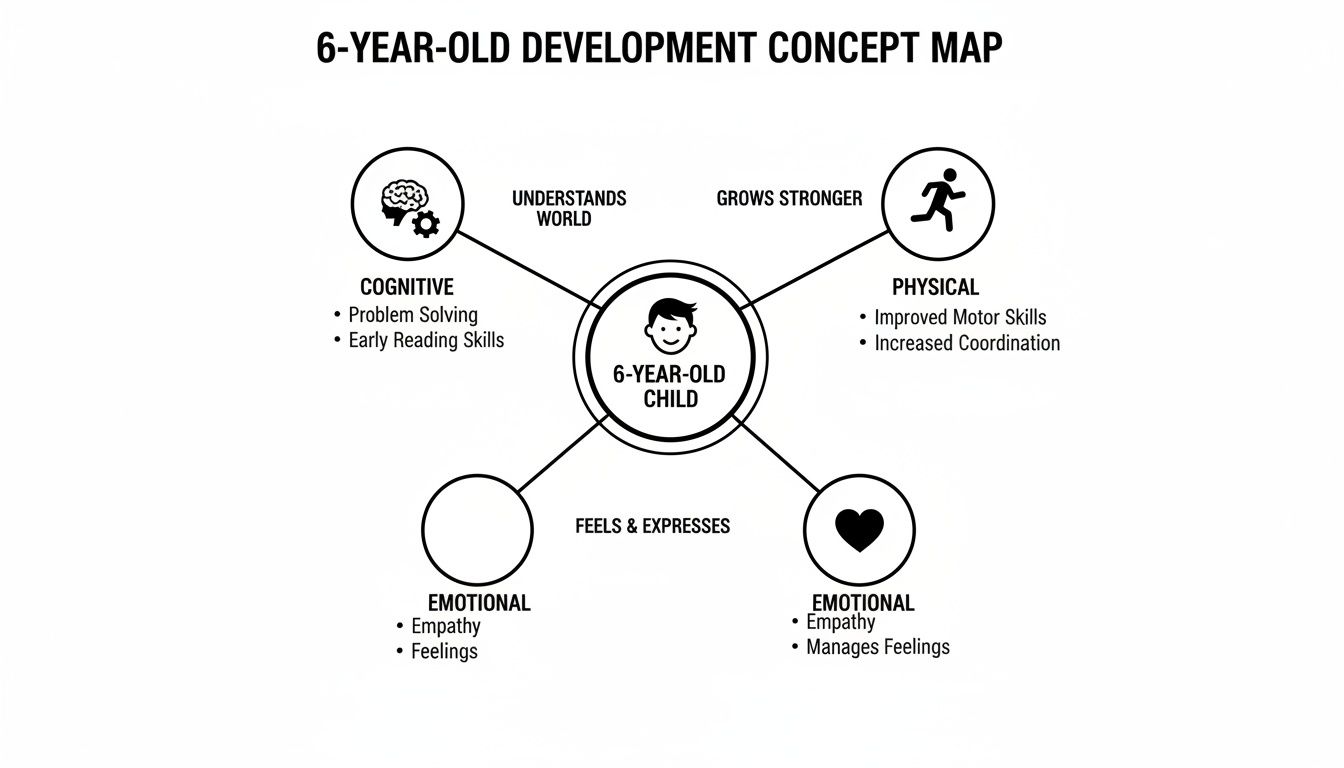
As you can see, the best toys often hit that sweet spot where they support more than one area at once, blending physical coordination with problem-solving and a bit of creative flair.
Building and Construction Toys
These are the absolute classics, and for good reason. Sets with magnetic tiles, chunky interlocking blocks, or even simple gears are playgrounds for tomorrow's engineers and architects. They give children a chance to do and try, turning abstract thoughts into real, 3D creations they can touch.
When a child builds a tower, they aren't just stacking bits of plastic. They're getting a hands-on lesson in balance, gravity, and what makes a structure strong. It’s physics, but without the boring textbook.
My advice? Look for sets that are open-ended. The best construction toys are the ones that can be a castle today and a spaceship tomorrow. That’s where the real creativity kicks in.
Science and Discovery Kits
Ready to turn your kitchen into a mini science lab? Discovery kits are fantastic for nurturing that inner scientist every child has. Whether it's a volcano-making set, a crystal-growing kit, or just a good old bug-viewing pot, these toys are all about asking questions and finding answers for themselves.
They make big ideas like chemical reactions or biology feel real and exciting. Better still, they teach the scientific method in the most natural way possible: make a guess, try it out, and see what happens.
A brilliant science kit doesn't just provide instructions; it sparks curiosity. It gets a child wondering, "What if I tried it this way instead?" That's the start of all great scientific thinking.
The UK toys market is set to hit a massive USD 7.74 billion by 2033, with a big push towards toys that build maths and science skills. For six-year-olds, these kits and building sets are right on trend, with this age group's toy market expected to grow at a rate of 4.5% each year. It just shows that parents and educators are looking for tech-savvy toys that make learning genuinely fun. Discover more insights into the UK toys market.
Creative and Arts-Based Toys
From a simple box of crayons to a big tub of modelling clay or a puppet theatre, creative toys are absolutely vital. They give children a powerful way to talk about their feelings, ideas, and the wild stories brewing in their imaginations.
This isn't just about making a mess (though that’s part of the fun!). This kind of play is crucial for building communication skills. When a child draws a picture of a family trip or squishes clay into a monster, they’re organising their thoughts and telling a story.
Here's a quick look at how these toys build essential skills:
- Storytelling: Creating characters and scenes helps them understand how a story works from beginning to end.
- Emotional Expression: Art is a safe space for exploring big feelings that might be hard to talk about.
- Fine Motor Skills: All that cutting, drawing, and sculpting is brilliant for strengthening little hand muscles.
Coding and Tech Toys
Getting started with coding doesn't have to mean more screen time. In fact, many of the best coding toys for this age are completely screen-free. They use physical blocks or programmable little robots to teach the building blocks of computational thinking.
These toys introduce core concepts like sequencing, loops, and cause-and-effect in a really playful way. A child might lay out a series of command cards to get a robot across the room, learning to plan, test, and fix their "program" until it works. It’s a fantastic foundation for future STEM learning, and it never once feels like a lesson.
Launching STEM Adventures Through Play
Let’s be honest, STEM shouldn’t feel like another lesson they have to sit through at school. For a six-year-old, it should feel like a brilliant adventure. The best way to get them excited about Science, Technology, Engineering, and Maths is to let them get their hands dirty. This is where play becomes the ultimate launchpad, turning tricky ideas into fun, real-world experiments.
Think about a simple set of magnetic tiles or even a pile of wooden blocks. When your young explorer starts building a bridge, they aren't just stacking shapes. They're grappling with balance, gravity, and what makes a structure strong. That’s engineering in its purest, most playful form, all driven by their own curiosity.
The real goal here is to demystify STEM. It's about showing them it’s just a way of asking questions, trying things out, and figuring out how stuff works—just like Space Ranger Fred on one of his missions.
Bringing STEM to Life at Home
You definitely don't need a fancy laboratory to spark a love for STEM. Your back garden can transform into a safari for studying insects, and a box of junk modelling supplies is really a workshop for inventing a new robot. The secret is connecting these big ideas to things they can actually see and touch.
Take a basic coding robot, for example. It introduces the logic of programming without a single intimidating line of code. By arranging simple command cards to make the robot move, children learn about sequencing and problem-solving. This hands-on approach builds a strong, intuitive grasp of what computational thinking is all about. If you're curious about the basics, our guide explains more about what STEM education really means.
Your Mission: A Back Garden Safari
Here’s a simple, playful mission you can launch together. It’s a fantastic way to introduce the idea of scientific observation.
-
Prepare Your Tools: Grab a magnifying glass (or a bug pot with a magnifier lid) and a small notebook. You could also use our downloadable Space Ranger Fred activity sheets.
-
Launch the Mission: Head outside and become wildlife explorers! Your mission is to find and gently observe three different types of 'creatures'—this could be anything from ants and woodlice to spiders or even worms.
-
Record Your Findings: For each creature, talk about what you see. How many legs does it have? What colour is it? What’s it doing? Encourage them to draw what they see in their notebook.
This simple activity teaches observation, classification, and respect for nature, all wrapped up in a fun adventure.
STEM play isn’t about getting the 'right' answer. It's about the process of discovery—the thinking, the testing, and the 'Aha!' moments. It’s what builds confident, curious problem-solvers.
For children fascinated by prehistory, connecting their play to the real world is electrifying. Discovering things like actual dinosaur fossils like a Spinosaurus toe claw can make learning about palaeontology truly unforgettable, linking their imagination to tangible pieces of Earth's incredible history.
As children move into primary school, their appetite for these kinds of discoveries just grows and grows. The fact that STEM toys like microscopes and science kits see thousands of online searches each month shows just how keen families are to support this curiosity. Better yet, UK data reveals that 75% of parents who invest in instructional toys see noticeable improvements in their children's language and spatial skills. By choosing toys that encourage exploration, you’re giving them the best possible tools for their learning journey.
Fuelling Imagination with Creative and Storytelling Toys
Beyond the world of science and numbers lies a universe just as important: imagination. This is where we celebrate toys that spark creativity, storytelling, and communication—the skills that are at the very heart of what makes us human. These aren’t just things to keep a six-year-old busy; they are tools for building entire worlds.
Creative play is how a child makes sense of their day, learns to see things from another person's perspective, and figures out how to share their big ideas. A simple set of art supplies, a puppet theatre, or a box of dress-up clothes can become a gateway to unbelievable adventures, building a child's confidence and vocabulary in the most natural way imaginable.
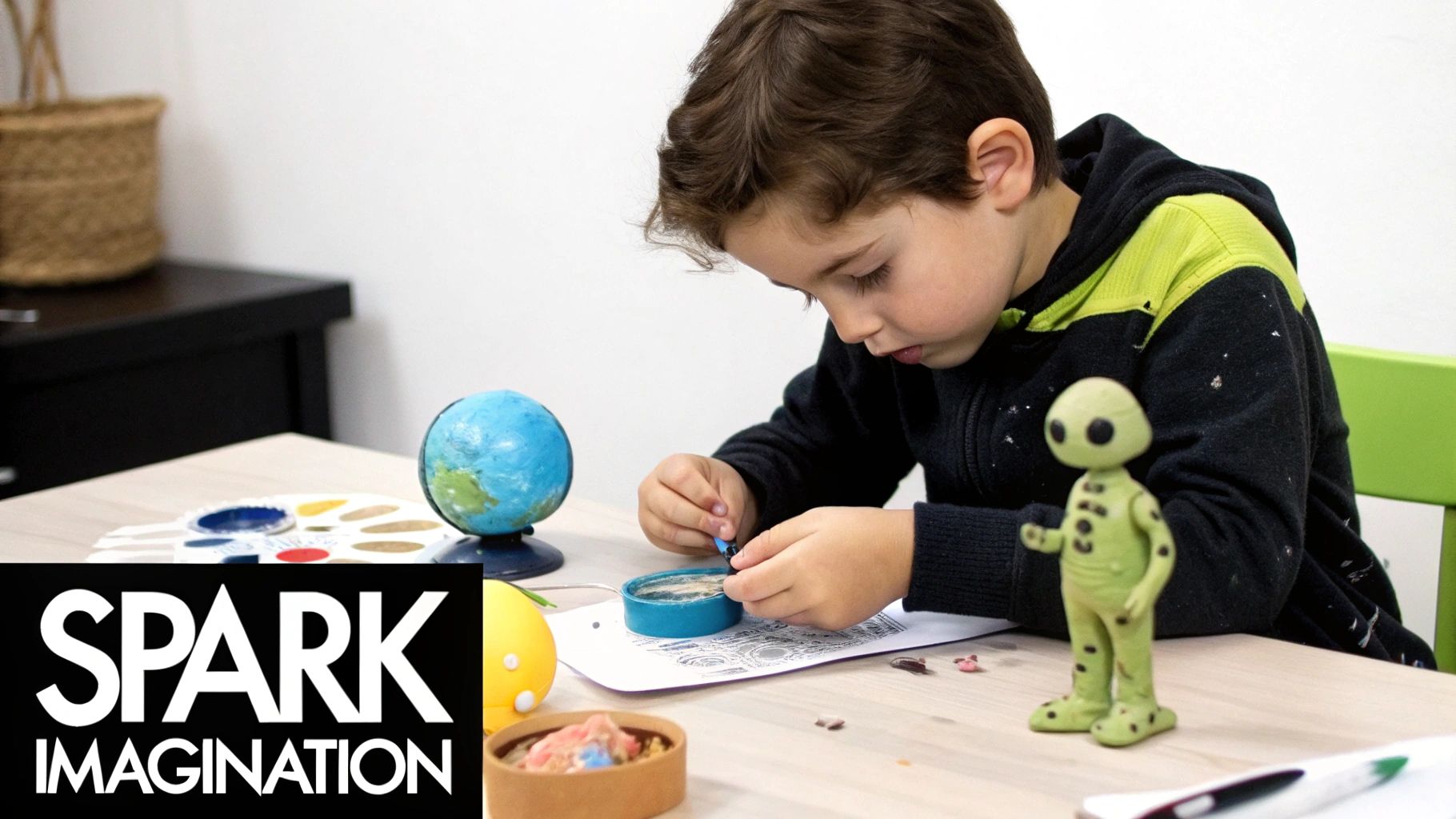
It’s through this kind of play that they process their experiences, friendships, and feelings. This isn't just about having fun—it’s how they learn to understand themselves and others, building essential life skills that are every bit as vital as any academic subject.
The Power of Open-Ended Creativity
The best creative toys don't have a single, fixed purpose. Think about a box of colourful modelling clay. In a child's hands, it can become anything they can dream up—a strange new alien, a fleet of spaceships, or a fantastic meal for a toy picnic. It’s this open-ended quality that sparks true innovation.
These toys invite children to become creators, not just consumers. They get to plan, design, and bring their own ideas to life. That whole process builds resilience and problem-solving skills as they figure out how to make their creations match the vision in their head.
Creative play is a child’s first laboratory for ideas. It’s where they learn that there is more than one right answer to a problem and that their unique perspective has value. It’s the foundation for thinking differently and developing confidence in their own voice.
Sparking Stories and Adventures
You can easily get imaginative scenarios going with just a few simple story-starters. These prompts give children a launchpad, inviting them to take the lead and build out a whole narrative. The goal is to encourage them to do, try, and talk about their amazing ideas.
Here are a few missions to get them started:
- Design a New Planet: Grab some paper and crayons. What would a new planet for Space Ranger Fred to visit look like? What strange plants and creatures would he find there?
- Create an Alien Friend: Using modelling clay or recycled junk, build a new alien friend. What’s its name? What special powers does it have? How does it communicate?
- Stage a Puppet Show Rescue: Create simple stick puppets and put on a show where one character has to rescue another from a tricky situation on a faraway moon.
Just as creative toys fuel imagination, there are also incredible tools out there for making educational videos that teach storytelling, proving just how powerful a good narrative is for learning. Whether it's through a puppet or a screen, stories are what help children make sense of the world.
Storytelling is at the very core of human connection, and encouraging it through play is one of the most important gifts you can give a child. To see how stories can inspire learning about our amazing universe, you might enjoy our review of amazing children's books about space.
Your Pre-Purchase Mission Checklist
Right, you’ve scouted the terrain and found some brilliant toy candidates. But before you launch your wallet, every good mission commander runs through a final pre-flight checklist. This is how you make sure you’re choosing toys that are not only fun but also built to last and packed with long-term play value.
Making a confident choice means looking beyond the flashy packaging. Let’s run through a few key checks that will help you spot a genuinely great educational toy that’s ready for countless adventures.
Safety and Durability Checks
First things first: mission safety is paramount. In the UK and Europe, always look for the CE mark, which shows the toy meets required safety standards. It’s a simple check that tells you it's been tested for things like sharp edges and small parts. The 'small parts' risk is lower for a six-year-old, of course, but it’s still good practice to be mindful.
Next up, consider what I call the 'enthusiasm factor'. Can it withstand an energetic mission?
- Materials Matter: Look for sturdy materials like solid wood or high-quality, BPA-free plastics. Flimsy construction is a dead giveaway that a toy won't survive many adventures.
- Built to Last: Check the joints and connections. Do they seem robust? A well-made toy can be passed down for years, making it a much more sustainable choice.
- Easy to Clean: Let’s be realistic—toys get mucky. You'll thank yourself later for choosing items that are easy to wipe down, especially things like science kits or art supplies.
Gauging Long-Term Play Value
This is the big one. How do you spot a toy that will hold their interest for more than a week? The secret is open-ended play. A toy with a single, rigid function gets boring fast, but one that can be used in a hundred different ways becomes a cornerstone of the toy box.
The best educational toys don't tell a child what to do; they ask a child what they can imagine doing. They are a starting point for creativity, not a final destination.
Before you buy, ask yourself these questions:
- Can it grow with my child? A set of magnetic tiles is just as fun for a four-year-old as it is for an eight-year-old; they just build more complex things as they get older.
- Does it spark imagination? Can it be a spaceship today and a secret fort tomorrow? Versatility is the absolute key to lasting engagement.
- Does it encourage problem-solving? Toys that challenge a child to figure something out—like a tricky construction set or a puzzle—will keep them coming back again and again.
Investing in one versatile, high-quality toy is often much better value than buying several single-purpose ones. It leads to deeper, more imaginative play and a lot less clutter. This thoughtful approach helps you become a savvy toy-picker, choosing items that deliver lasting educational fun. As you think about different play options, you might also find our guide to the best educational apps for 6-year-olds helpful for balancing screen time with hands-on activities.
Your Questions Answered: FAQs About Learning Toys
Even with a plan, choosing the right toys can bring up some tricky questions. Here are some of the most common ones we get from parents and teachers, along with our thoughts.
How many educational toys does a six-year-old actually need?
Honestly, it’s all about quality over quantity. A few really good, open-ended toys will always beat a room full of one-trick gadgets. Think about it: a fantastic building set or a well-stocked art station can fuel hundreds of different adventures.
Here’s a little trick we love: try rotating toys every few weeks. Tucking some away and bringing them out later makes them feel brand new, encouraging your child to explore them in ways they hadn't thought of before.
Are screen-based educational games a good choice?
They can be, but they should be a supplement, not a replacement. There’s a special kind of learning that happens when children build, create, and get their hands messy with real-world objects. That tactile experience is absolutely vital for developing fine motor skills and understanding how things work in three dimensions.
If you do use educational apps, our advice is to aim for balance and try to make it a shared activity. Playing a game with your child turns screen time into connection time, opening up conversations and teamwork.
What if my child rejects “educational” toys?
The golden rule is never to force it. Real learning is sparked by curiosity, not by a sense of duty. The secret is to look at what they already love and find the learning hiding inside.
Is your child obsessed with cars? Fantastic! That's a natural gateway to exploring speed, friction, and building ramps. Do they love to draw? You’ve got a budding storyteller and designer on your hands. The moment a toy feels like a lesson, the magic is gone.
How can I spot a genuinely educational toy?
The best educational toys rarely come in a box that screams "LEARN WITH ME!" Instead, look for the quiet heroes—the toys that make your child think, wonder, and experiment.
Ask yourself: Can this be used in more than one way? Does it make my child ask questions? Does it encourage them to think, create, or experiment? If you're nodding along, you've probably found a brilliant learning tool disguised as simple fun.
The greatest adventures always start with a spark of curiosity. At Space Ranger Fred, we believe story and play are the ultimate launchpads for a lifelong love of discovery.
Ready to fuel your young explorer's next mission? Check out the world of Space Ranger Fred for books, activities, and stories that will send their imagination into orbit. Launch your next adventure with Space Ranger Fred today!