
Welcome, explorers! Are you ready to turn everyday moments into exciting cosmic missions? At Space Ranger Fred, we believe the best learning happens when we're playing, creating, and figuring things out together. Problem-solving isn't just for astronauts or scientists; it’s a superpower every child can build, helping them tackle challenges with creativity and confidence.
It's about looking at a puzzle, asking 'what if?', and trying out brilliant, brave, and sometimes bonkers new ideas. This guide is packed with fantastic kids problem solving activities designed to spark curiosity and make STEM feel like the greatest adventure in the galaxy. We’ll journey through hands-on challenges that get your young explorer thinking like a true innovator, engineer, and adventurer, transforming them from a passive learner into an active creator.
From designing escape rooms and engineering towering structures to cracking cosmic codes and embarking on choose-your-own-adventure stories, these activities are perfect for parents, teachers, and home educators. Each one is a launchpad for developing crucial life skills such as critical thinking, communication, and resilience. This isn't about finding the one 'right' answer; it's about the thrill of trying things out and the joy of discovery.
Ready to nurture the next generation of thinkers and doers? Let’s blast off into a universe of fun and learning!
1. Escape Room Challenges
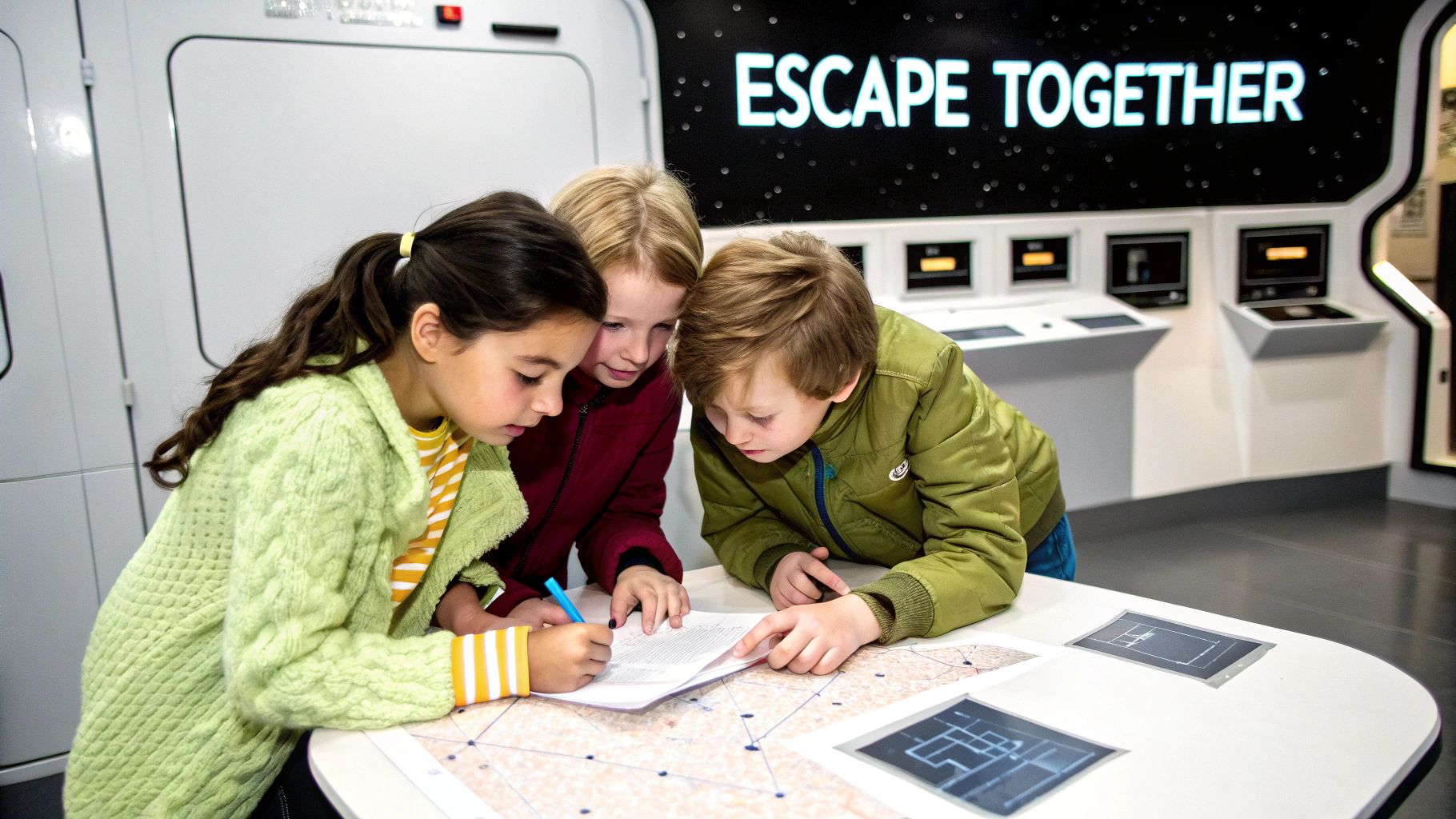
Escape rooms are brilliant, story-driven challenges where a team works together to solve a series of puzzles and riddles to "escape" a room within a time limit. These activities are fantastic for nurturing problem-solving skills, as children get to be the active heroes of their own adventure. They have to decipher codes, find hidden objects, and connect clues, all while the clock is ticking.
This type of hands-on, narrative-led play is perfect for developing crucial life skills. It's one of the most engaging kids problem solving activities because it demands communication, teamwork, and logical reasoning in a fun, low-pressure setting. Success isn't just about finding the answer; it's about the process of working together to figure it out.
Why It Works for Young Problem-Solvers
Escape rooms are so effective because they put children in a scenario where their decisions have immediate results. This helps build confidence and resilience. The themed environments, from ancient tombs to futuristic spaceships, spark imagination and make the thinking feel like play rather than work.
For example, many science museums and attractions like Escape Hunt now offer kid-friendly versions focused on educational themes, blending learning with adventure.
How to Create Your Own Escape Challenge
You don’t need a professional setup to bring this experience home. You can create a simple DIY escape room with a few household items.
- Set a Goal: The objective could be finding a hidden "treasure" (like a favourite toy or snack) or unlocking a box with a special message inside.
- Design Puzzles: Create 3-5 simple puzzles. Try riddles, simple maths problems written in code, or a scavenger hunt where one clue leads to the next.
- Set the Scene: Dim the lights, play some atmospheric music, and create a simple story to get everyone excited.
Space Ranger Fred Mission: Imagine your living room is the bridge of the Starship Infinity! An asteroid is heading for a friendly planet, and the crew must solve three puzzles to activate the ship’s tractor beam in 15 minutes. Space Ranger Fred has left a series of coded messages to guide them. This simple story turns a puzzle into an epic mission.
2. STEM Building Challenges (Coding & Engineering)
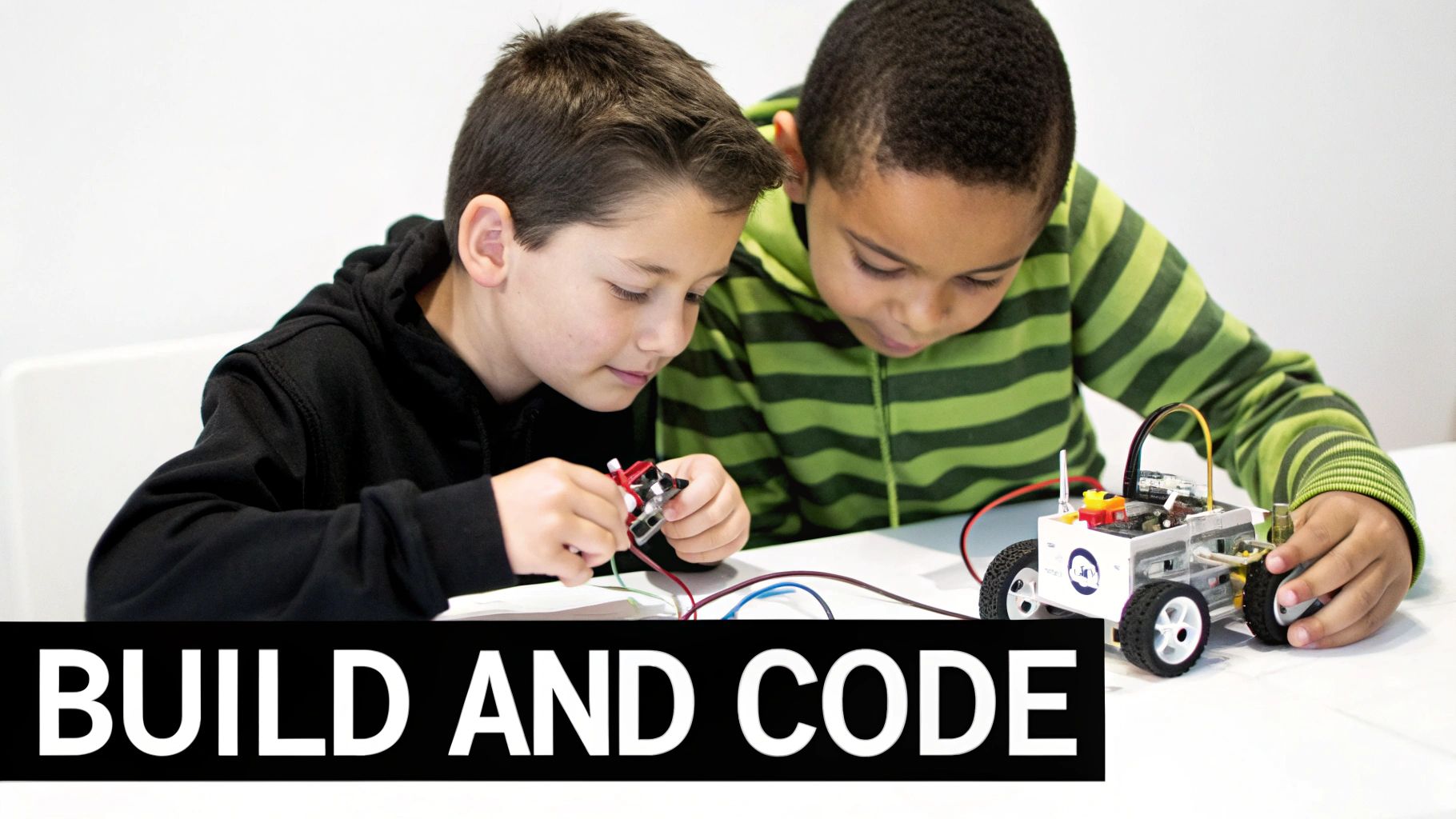
STEM building challenges are activities where children design and construct solutions to specific problems using engineering materials, robotics kits, or coding platforms. Whether they are building a bridge to support weight or programming a robot to navigate a maze, these tasks put children in the roles of engineers and innovators. They get to analyse a problem, design a solution, build a prototype, and test it out.
This process of design, construction, and iteration makes these some of the most effective kids problem solving activities. They directly connect abstract ideas in science, technology, engineering, and maths to real, hands-on outcomes. To specifically boost logical thinking and hands-on construction, you could try using learning STEM toys that challenge children to build and innovate. Success is measured not just by the final product, but by the critical thinking and resilience they develop along the way.
Why It Works for Young Problem-Solvers
These challenges are fantastic because they mirror the real-world engineering design process. Children learn that failure isn't the end, but a crucial part of learning. When a structure collapses or a code has a bug, it’s a chance to figure out what went wrong and improve the design. This process builds perseverance and a growth mindset.
From low-tech paper bridge challenges to high-tech coding with platforms like Scratch or LEGO® Education robotics, these activities make complex STEM principles feel approachable and fun. They empower children to see themselves as creators and inventors.
How to Create Your Own STEM Challenge
You can easily set up a meaningful STEM challenge at home or in the classroom with everyday materials. The key is to present a clear problem with a few rules.
- Set a Goal: Define a clear mission. For example, "Design a catapult that can launch a marshmallow at least one metre" or "Build a boat from foil that can hold the most coins."
- Provide Materials: Offer a limited set of materials, such as lolly sticks, rubber bands, paper clips, and cardboard. Having limits encourages creativity!
- Encourage Trying Again: Emphasise that the first attempt is just a draft. Allow plenty of time for testing, making changes, and rebuilding.
Space Ranger Fred Mission: The Starship Infinity's cargo bay door is jammed! Space Ranger Fred needs a robotic arm to reach the emergency release switch. Using a robotics kit (or just cardboard, string, and tape), your mission is to design and build a grabber arm that can pick up a small object from 50cm away.
3. Mystery/Detective Stories & Investigations
Mystery and detective stories are interactive activities where children become investigators, trying to solve a puzzle by gathering clues, talking to characters, and looking at evidence. The story unfolds as they piece together information, making them the heroes of their own whodunnit. They have to use observation, logic, and critical thinking to uncover the truth.
This kind of story-driven play is a powerful way to foster problem-solving skills. It's one of the most compelling kids problem solving activities because it requires children to connect information, think about sources, and build a logical argument in a really engaging, story-based way. Success is not just about finding the culprit; it's about the adventure of following the clues.
Why It Works for Young Problem-Solvers
Detective investigations are brilliant for teaching children how to manage and organise complex information. They learn to tell the difference between facts, red herrings, and opinions, which is a key skill for thinking analytically. The immersive story makes abstract ideas like deductive reasoning feel real and exciting.
For instance, many UK libraries and schools run mystery events or reading challenges, inspired by classic characters like Sherlock Holmes or modern interactive games, that blend literacy with logic.
How to Create Your Own Mystery Investigation
You don’t need an elaborate setup to stage a thrilling mystery at home. A simple story and a few clever props are all it takes to spark your child's inner detective.
- Set a Goal: The mystery could be finding a "stolen" biscuit, discovering who left muddy footprints in the hallway, or locating a missing toy.
- Design Clues: Create 3-5 clues that lead children on a trail. Try riddles, "fingerprints" made from flour, or "witness statements" from other family members or toys.
- Set the Scene: Make simple character cards with backstories and potential motives. Use props like a magnifying glass or a notepad to make it feel official.
Space Ranger Fred Mission: Imagine the International Space Station has a mystery on its hands: the experimental Super-Growth Plant has vanished! Commander Eva tasks the crew with finding it before it gets too big. They must interview three "suspects" (toys placed around the room), analyse a "smudged alien fingerprint" (a paint smudge on a piece of paper), and follow a trail of fallen "glowing leaves" (green craft paper) to solve the case. This simple plot turns a scavenger hunt into a cosmic investigation.
4. Collaborative Group Challenges (Team-Based Games)
Collaborative group challenges are activities where children must work together towards a single, shared goal. Instead of competing against each other, the entire group succeeds or fails as a team. This format, seen in cooperative board games or team-building exercises, shifts the focus from individual victory to collective success.
This type of play is one of the most effective kids problem solving activities for developing social and emotional skills alongside critical thinking. It creates a space where communication, negotiation, and compromise are essential for reaching the goal. Children learn to listen to different ideas, value other perspectives, and understand that sharing their skills leads to a better result for everyone.
Why It Works for Young Problem-Solvers
Team challenges are powerful because they are just like real-world problem-solving, where working together is key. They teach children that asking for help and combining strengths is a smart strategy, not a weakness. When a plan doesn't work, the group has to rethink and try a new approach, which builds resilience and adaptability.
Many cooperative board games, such as Forbidden Island or Pandemic, provide a brilliant, contained version of this experience. Similarly, organisations like Outward Bound have long used outdoor group challenges to build character and teamwork skills in young people.
How to Create Your Own Team Challenge
You can easily set up a collaborative challenge at home or in the garden with just a few things. The key is to create a goal that is impossible to achieve alone.
- Set a Goal: The objective could be to build the tallest possible tower using only spaghetti and marshmallows, or to get a "rover" (a ball on a tray) across an obstacle course without it falling off.
- Assign Roles: Give each child a specific job, like "Chief Engineer" (the builder), "Resource Manager" (in charge of materials), or "Lead Communicator" (the only one who can talk). Rotate roles for the next challenge.
- Set Constraints: Add a rule to make teamwork essential. For example, some builders might be blindfolded while others give them verbal instructions.
Space Ranger Fred Mission: The crew of the Starship Infinity has crash-landed on Planet Gloop! They must build a rescue beacon from salvaged parts (cardboard boxes, tape, and string). The challenge is that the "Cosmic Radiation" on this planet means they must work together in pairs, with one partner blindfolded and the other giving clear, precise instructions. They have 10 minutes before the ship's power fails completely!
5. Digital Problem-Solving Games & Apps
In today’s digital world, interactive games and apps offer a brilliant platform for children to practise their problem-solving skills in a structured and engaging way. These digital experiences often present challenges as puzzles, quests, or construction tasks, motivating children to think critically, experiment with solutions, and learn from their mistakes in a fun environment.
This type of guided play is one of the most accessible kids problem solving activities, as it provides instant feedback and challenges that get progressively harder. From coding games like ScratchJr to physics-based puzzles like Angry Birds, digital tools can make abstract ideas like logic, spatial reasoning, and sequencing feel real and fun. The goal is to solve a puzzle not just for a reward, but for that satisfying "eureka!" moment of figuring it out.
Why It Works for Young Problem-Solvers
Digital games are great at creating a safe space for failure and experimentation. If a solution doesn't work, a child can simply try again without real-world consequences, which helps build resilience and a growth mindset. Many apps, such as those from Toca Boca or DragonBox, are designed with educational psychology in mind, ensuring the challenges are perfectly balanced to prevent frustration while encouraging persistence.
For even more inspiration on blending digital and real-world engagement, you can find a great collection of fun activities for a family day that cater to all ages.
How to Choose and Use Digital Games
The key is to select high-quality apps that encourage active thinking over passive entertainment. Look for games that require strategy, planning, and creativity.
- Focus on Open-Ended Play: Choose apps like Minecraft or the Toca Boca series that allow children to set their own goals and solve problems creatively.
- Introduce Logic and Coding: Platforms like Code.org and Lightbot use game-like mechanics to teach the fundamentals of computational thinking in a simple, visual way.
- Play Together: Sit with your child and play with them. Talk through the challenges, ask what they think they should do next, and celebrate their successes.
Space Ranger Fred Mission: Imagine a new training module on the Infinity’s flight computer! The mission is to guide a small robot through a digital asteroid field. Your young ranger must use simple directional commands (forward, turn left, turn right) to create a sequence that navigates the robot to a stranded alien. Each level adds a new obstacle, like a black hole or a floating bit of space junk, requiring them to rethink their plan and try again.
6. Design Thinking Workshops (Innovation Challenges)
Design Thinking is a brilliant, human-centred way to innovate, made popular by organisations like IDEO and Stanford's d.school. It gives children a structured framework to solve real-world problems by working through five phases: Empathise, Define, Ideate, Prototype, and Test. This process encourages them to understand what people need, challenge assumptions, and create innovative solutions.
These workshops turn children into inventors and designers, empowering them to tackle meaningful challenges. This is one of the most comprehensive kids problem solving activities because it teaches a method for creative thinking and innovation that they can use again and again. It moves beyond finding a single "right" answer and instead focuses on the process of creating, testing, and improving ideas.
Why It Works for Young Problem-Solvers
Design Thinking builds empathy, resilience, and creative confidence. By starting with the "Empathise" phase, children learn to think about problems from another person's perspective. The process of building and testing "imperfect" prototypes teaches them that failure is a valuable part of learning, which helps them become more resilient and willing to take creative risks.
For example, the Design Museum in the UK offers programmes that guide children through this exact method to solve challenges, showing how effective this structured approach is for nurturing young innovators.
How to Create Your Own Innovation Challenge
You can easily adapt the Design Thinking framework for a fun activity at home or in the classroom, using simple craft materials.
- Set a Goal: Identify a real, kid-relevant problem. For example, "How can we make it easier to water the plants without spilling?" or "How can we organise our toys better?"
- Follow the Process: Guide children through the five steps. Use large sheets of paper to brainstorm ideas (Ideate) and then provide cardboard, tape, and craft supplies to build a rough model (Prototype).
- Frame the Challenge with a Story: A compelling story can ignite imagination and give the problem a clear context that makes it more fun.
Space Ranger Fred Mission: The new colony on Planet Gliese-581g is struggling to grow its space vegetables because the soil is too dry. Your mission is to design a new watering system for the colony’s biodome. Use the Design Thinking process to empathise with the colonists, define their core problem, brainstorm solutions, build a prototype of your invention, and test if it works!
7. Logic Puzzles & Brain Teasers Collections
Logic puzzles and brain teasers are focused challenges designed to test and develop a child's deductive reasoning, spatial awareness, and lateral thinking. From classic Sudoku and tangrams to clever riddles and code-breaking tasks, these activities provide short bursts of mental stimulation that build critical thinking muscles one puzzle at a time.
These collections are brilliant kids problem solving activities because they isolate specific thinking skills in a clear, manageable format. Unlike bigger projects, a single puzzle offers a distinct beginning, a focused period of effort, and a satisfying conclusion. This builds mental stamina and teaches children the value of persistence and methodical thinking in a fun, game-like way.
Why It Works for Young Problem-Solvers
Logic puzzles are fantastic for building cognitive flexibility. They encourage children to approach a problem from multiple angles and to see that there isn't always one single path to a solution. This process strengthens analytical skills and resilience, teaching them how to handle frustration and try a new strategy when their first attempt doesn’t work.
Well-known collections like the Brain Quest series or features in Highlights magazine have long proven how effective this format is for making learning feel like a rewarding challenge rather than a chore.
How to Create Your Own Puzzle Collection
Putting together a set of puzzles at home or in the classroom is simple and really effective. The key is variety and choosing the right difficulty level.
- Gather Different Puzzles: Mix up the types of challenges. Include number puzzles (like KenKen), word riddles, visual tasks (like spot the difference), and pattern recognition games.
- Organise by Difficulty: Label puzzles as 'easy', 'medium', or 'hard'. This allows children to build confidence by starting with manageable tasks before tackling more complex ones.
- Provide Answer Keys: Always include an explanation of the solution, not just the answer itself. This helps children understand the logic they might have missed.
Space Ranger Fred Mission: Fred’s ship computer, the Stell-R 9000, has scrambled its navigation data! To get back on course, young cadets must solve a series of cosmic puzzles. They need to decipher an alien number sequence to unlock the engine coordinates and solve a planetary logic grid to determine the safest route through an asteroid field. Each solved puzzle reveals a piece of the final star map.
8. Science Experiments & Hypothesis Testing
Science experiments are hands-on investigations that allow children to explore the world by asking questions, testing ideas, and seeing what happens. By forming a hypothesis (an educated guess), children step into the shoes of a scientist, using a controlled test to see if their prediction is right. It’s a powerful way to turn abstract ideas into real, memorable experiences.
This process is one of the most effective kids problem solving activities because it teaches a systematic way to find answers. Children learn to isolate variables, collect data, and draw conclusions based on evidence, not just assumptions. This structured way of asking questions builds critical thinking and analytical skills in a way that feels like pure fun.
Why It Works for Young Problem-Solvers
This activity is brilliant for making the scientific method feel approachable and exciting. Instead of just being told a fact, children get to discover it for themselves, which helps them understand it much more deeply. It's also really important to embrace "failed" experiments as learning opportunities, as this teaches resilience and shows that finding out what doesn't work is just as valuable as finding out what does.
Many fantastic resources, like the hands-on kits from KiwiCo or the demonstrations popularised by Steve Spangler Science, are designed to guide children through this process of discovery.
How to Create Your Own Science Experiment
You can set up a simple, curiosity-driven experiment at home with just a few things. The key is to start with a question.
- Form a Hypothesis: Ask a "what if" question. For example, "What will happen if we add bicarbonate of soda to vinegar?" Encourage your child to predict the outcome and write it down.
- Conduct the Test: Carefully measure and mix the ingredients in a controlled way. Use a clear container to see the reaction up close.
- Observe and Conclude: What happened? Did it match the prediction? Talk about why the reaction occurred, connecting it to the science of acids and bases.
Space Ranger Fred Mission: Imagine you're on Planet Gloop, and Space Ranger Fred needs to create a fast-foaming rocket fuel to escape a sticky swamp! Your mission is to test different "fuel" mixtures (like vinegar with bicarbonate of soda versus lemon juice with bicarbonate of soda) to see which one creates the biggest and fastest fizz. This story transforms a simple chemical reaction into a vital mission to save the day.
9. Narrative & Adventure Journeys (Choose-Your-Own-Adventure)
Narrative and adventure journeys are interactive stories where the reader becomes the hero, making important decisions that shape the plot and decide the outcome. Whether in a book or a digital game, each choice sends the story down a different path, teaching children about cause and effect in a powerful, engaging way. They aren't just reading a story; they are living it, one decision at a time.
This type of story-driven play is one of the most effective kids problem solving activities because it directly links decisions to consequences. Children learn to think ahead, weigh up their options, and consider what might happen next, all within the safety of a fictional world. It encourages critical thinking and foresight, turning passive reading into an active, thinking exercise.
Why It Works for Young Problem-Solvers
Choose-your-own-adventure stories are great because they give children control over the story. This ownership makes them more invested in the outcome and more thoughtful about their choices. It’s a brilliant way to practise strategic thinking without the pressure of a right or wrong answer, as different paths simply lead to different adventures.
The format is incredibly versatile, seen in the classic Choose Your Own Adventure book series and modern interactive platforms like Twine. It naturally builds resilience, as a "bad" outcome simply encourages the child to go back and try a different approach.
How to Create Your Own Narrative Journey
Creating a simple branching story is a fun project for a rainy afternoon. All you need is paper and a pencil to map out your adventure.
- Set a Goal: Define a clear objective, such as "Rescue the stranded alien" or "Find the lost moon crystal."
- Map Out Choices: Start with an opening scene and present the first choice. For each choice, write a separate outcome on a different page. A simple flowchart is great for keeping track of the branching paths.
- Keep It Simple: Limit each decision point to two or three clear options to avoid overwhelming the reader. Make the consequences of each choice clear in the following scene.
Space Ranger Fred Mission: Space Ranger Fred has crash-landed on the ice planet of Glacia! His communications are down. He sees a shimmering cave to his left and a strange, pulsating plant to his right. If he enters the cave, he might find shelter. If he investigates the plant, it might be an energy source. What does he do? Each choice leads to a new challenge and a different part of the story, putting your child in the commander's seat.
10. Maker Spaces & Hands-On Creation Projects
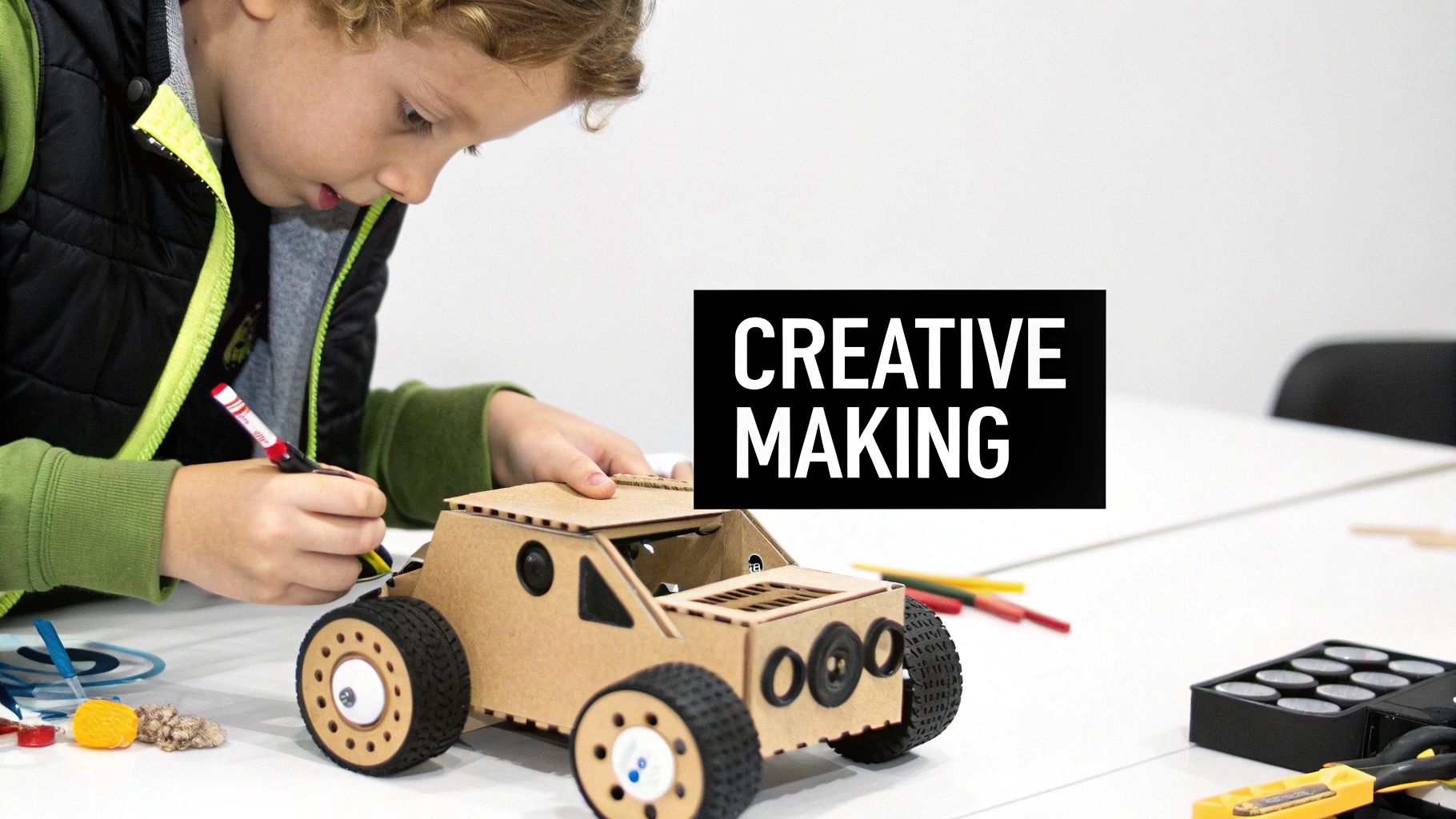
Maker spaces are creative workshops where children can explore, invent, and build with a variety of tools and materials. These hands-on creation projects shift the focus from finding a single "right" answer to embracing the entire creative process. Children are given the freedom to tinker, experiment, and learn through doing, using everything from recycled cardboard to craft supplies to bring their ideas to life.
This open-ended approach is one of the most powerful kids problem solving activities because it champions curiosity and resilience. Unlike structured tasks, maker activities encourage children to define their own problems and invent their own solutions, learning that trial and error is a vital part of innovation.
Why It Works for Young Problem-Solvers
Maker projects nurture an inventor's mindset. When children are free to create without fear of failure, they develop confidence in their ability to tackle unfamiliar challenges. The physical act of building and changing an object makes abstract ideas real, helping them understand principles of design, engineering, and physics in a practical, memorable way.
Many local libraries and museums, like the Design Museum in London, now offer maker spaces or programmes that provide the tools and inspiration for children to get creating.
How to Create Your Own Maker Challenge
A dedicated maker space can be as simple as a corner of a room with a box of interesting materials. The key is to provide resources and a spark of inspiration, then step back.
- Gather Materials: Stock a "maker box" with recycled items (cardboard tubes, plastic bottles, boxes), craft supplies (tape, glue, string), and basic tools.
- Set an Open-Ended Challenge: Instead of giving instructions, pose a question. For example, "Can you build a vehicle that can roll down a ramp?" or "Design a home for an alien creature."
- Celebrate the Process: Display all creations proudly, and talk about what was learned during the building process, not just the final result.
Space Ranger Fred Mission: The Intergalactic Exploration Team needs a new lunar rover to explore the rocky craters of Planet Xylos! Using only the materials in your maker kit, design and build a moon buggy tough enough for the mission. It needs to be able to carry a small rock (the mission sample!) from one side of the room to the other.
10-Point Comparison: Kids Problem-Solving Activities
| Activity | 🔄 Implementation Complexity | ⚡ Resource & Logistics | 📊 Expected Outcomes | 💡 Ideal Use Cases | ⭐ Key Advantages |
|---|---|---|---|---|---|
| Escape Room Challenges | High — themed design, timed puzzles, facilitator training | Physical space, props, setup time; moderate–high cost | Teamwork, sequential reasoning, persistence, time management | Museums, birthday events, school workshops, themed exhibits | Immersive, memorable, strong narrative fit |
| STEM Building Challenges (Coding & Engineering) | Medium–High — kits, curriculum, iterative tasks | Robotics kits/devices, tools, technical facilitation; higher cost | Computational thinking, engineering process, perseverance | Classroom STEM units, clubs, competitions, maker camps | Direct STEM alignment, measurable outcomes, iterative learning |
| Mystery/Detective Stories & Investigations | Medium — narrative design, clue placement, pacing control | Props, character scripts or digital clues; moderate cost, possible actors | Deductive reasoning, synthesis of information, narrative comprehension | Library programs, literacy lessons, live events, classroom projects | Highly immersive, adaptable to mixed-ability groups |
| Collaborative Group Challenges (Team-Based Games) | Low–Medium — clear rules and facilitation required | Minimal props or cooperative games; flexible spaces, low cost | Communication, empathy, leadership, cooperative problem-solving | Classrooms, outdoor activities, SEL programs, group sessions | Inclusive, low-cost, builds social-emotional skills |
| Digital Problem-Solving Games & Apps | High — software development, adaptive design, QA | Developer time, devices, platform costs; scalable after build | Digital literacy, logical reasoning, progress analytics | Home learning, large-scale reach, blended learning platforms | Scalable, adaptive difficulty, data-driven personalization |
| Design Thinking Workshops (Innovation Challenges) | High — trained facilitators, multi-phase process | Facilitator training, prototyping materials, multi-session time | Creative problem-solving, user-centered design, communication | Project-based learning, interdisciplinary units, innovation weeks | Teaches transferable methodology and iterative creativity |
| Logic Puzzles & Brain Teasers Collections | Low — curate and level puzzles; minimal delivery complexity | Printables, books, or apps; very low cost and minimal supervision | Logical reasoning, pattern recognition, math thinking | Independent practice, classroom warm-ups, take-home activities | Low-cost, accessible, immediate feedback, easy to scale |
| Science Experiments & Hypothesis Testing | Medium — safety planning, controlled procedures | Experiment kits, supervision, materials; moderate cost and cleanup | Scientific method, data collection, analysis, curiosity | Labs, science weeks, museum demos, STEM lessons | Hands-on inquiry, tangible demonstrations of concepts |
| Narrative & Adventure Journeys (Choose-Your-Own-Adventure) | Medium–High — branching writing and outcome balancing | Authors/designers, digital or print platforms; variable production time | Decision-making, cause-and-effect reasoning, literacy engagement | Literacy programs, interactive ebooks, classroom storytelling | High engagement, replayability, strong narrative learning |
| Maker Spaces & Hands-On Creation Projects | Medium — space setup, safety, material management | Dedicated space, tools, ongoing materials; initial setup cost | Creativity, resourcefulness, fine motor skills, iterative design | Libraries, after-school clubs, makerspaces, community centers | Encourages ownership, creativity, inclusive of learning styles |
Your Mission Continues: Keep Exploring!
Your mission, should you choose to accept it, has been a huge success! We've journeyed through a galaxy of engaging kids problem solving activities, from designing complex escape rooms to solving thrilling detective mysteries. Each activity we’ve explored is a launchpad, equipping young explorers with the essential tools they need to navigate challenges, both in their learning and in life. The goal isn't just to find the right answer; it's about building the resilience, creativity, and critical thinking skills needed to ask the right questions and design innovative solutions.
Remember, the true power of these activities lies in the process, not the final product. A wobbly tower built with spaghetti and marshmallows teaches brilliant lessons about engineering and trying again. A detective case that takes a few wrong turns sharpens reasoning skills. A choose-your-own-adventure story that ends in a comical disaster encourages children to think about cause and effect. These moments of trying, failing, and finally succeeding are where the most profound learning happens. This is what we call the Menturity™ approach: fostering curiosity, building confidence, and enhancing communication through playful, hands-on experiences.
Key Takeaways from Your Problem-Solving Voyage
As you continue your adventures, keep these core ideas in mind:
- Embrace the Process over Perfection: The journey of figuring things out is more valuable than getting it right the first time. Celebrate the "aha!" moments, the clever questions, and the perseverance shown when things get tricky.
- Variety is the Spice of Learning: By mixing logic puzzles with hands-on maker projects and collaborative games with solo stories, you cater to different learning styles and build a more versatile problem-solving toolkit.
- Make it Meaningful with a Story: Connecting activities to a story, like one of Space Ranger Fred's missions, adds a layer of purpose and excitement. Framing a science experiment as a mission to analyse a new planet's soil, for example, transforms a simple task into an epic adventure.
- Foster Teamwork: Many of the universe's greatest challenges are solved by teams. Activities that encourage communication and shared responsibility prepare children for future success in a highly connected world.
Your Next Steps: Charting the Course Forward
So, where do you go from here? The universe of problem-solving is vast and ever-expanding. Start by choosing one or two activities from our list that genuinely excite your child or students. You don’t need to do them all at once. Perhaps begin with a simple logic puzzle or a design challenge using household recycling.
Notice what sparks their interest. Do they love the methodical nature of coding games, or do they thrive on the creative chaos of a maker space project? Use these observations to guide your next choice. The most effective kids problem solving activities are those that line up with a child’s natural curiosity. For a steady stream of inspiration, why not download some of our freebies and activities to keep the adventure going? Or, for a deeper dive, explore our post on how to develop critical thinking skills.
The ultimate goal is to bring a problem-solving mindset into everyday life. Encourage your young explorers to ask "what if?" and "how can we?" when faced with daily puzzles, from fixing a broken toy to planning a family outing. By doing so, you're not just teaching them how to solve problems; you're nurturing a generation of confident, creative, and resourceful thinkers ready to tackle any mission the universe throws their way. Keep asking questions, keep creating, and keep exploring. The next great discovery is just around the corner!
Ready to blast off on more learning adventures? The world of Space Ranger Fred is packed with stories and challenges designed to make STEM exciting and accessible. Explore our books and resources at Space Ranger Fred to see how storytelling can ignite a lifelong passion for problem-solving.