
Ready to turn a blank piece of paper into a cosmic adventure? Learning how to draw astronauts is a brilliant way to blast off on a creative mission, and it’s as simple as starting with a few basic shapes. So grab your pencils, and let’s get ready for lift-off!
Ready for a Cosmic Drawing Adventure?
Hello, space explorers! Today, we're on a special mission to learn how to draw our very own astronaut, and our pal Space Ranger Fred is here to guide the way. It’s a chance to take a creative journey into a galaxy of fun without even leaving home.
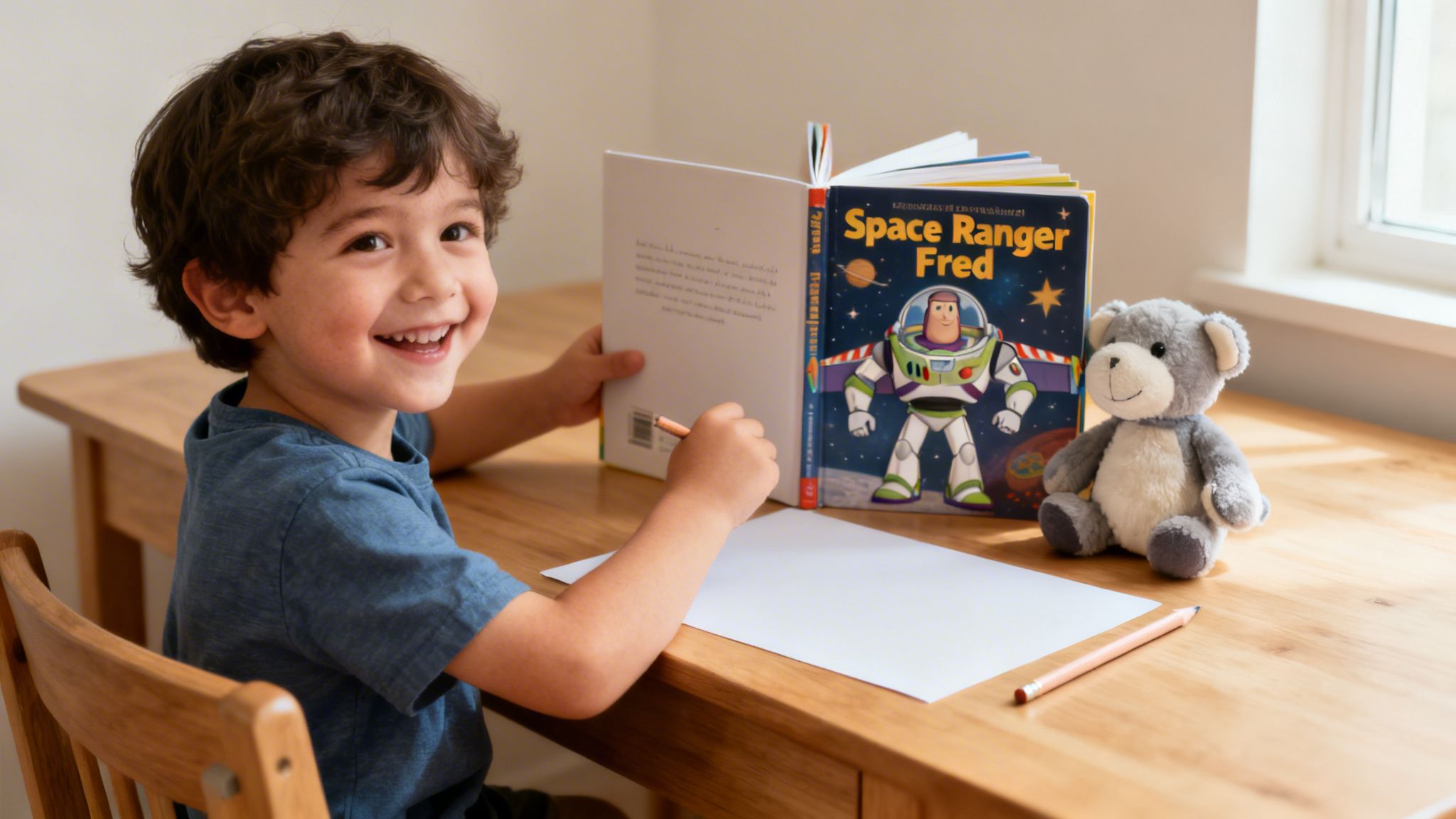
This isn’t just about lines and circles; it’s about sparking your curiosity and telling a story of epic voyages to distant stars. We'll start with a simple drawing for our youngest cadets (ages 6–8) before tackling a more detailed mission for our seasoned commanders (ages 9–12).
Drawing is a fantastic way to explore huge ideas like space travel and STEM. Even Fred admits his first drawings looked a bit like wobbly aliens! The real goal is to have fun, try your best, and make learning feel like an exciting playtime adventure.
If you're looking for more ways to blend art and science, we have plenty of other brilliant space activities for kids to keep the mission going.
Gathering Your Mission Supplies
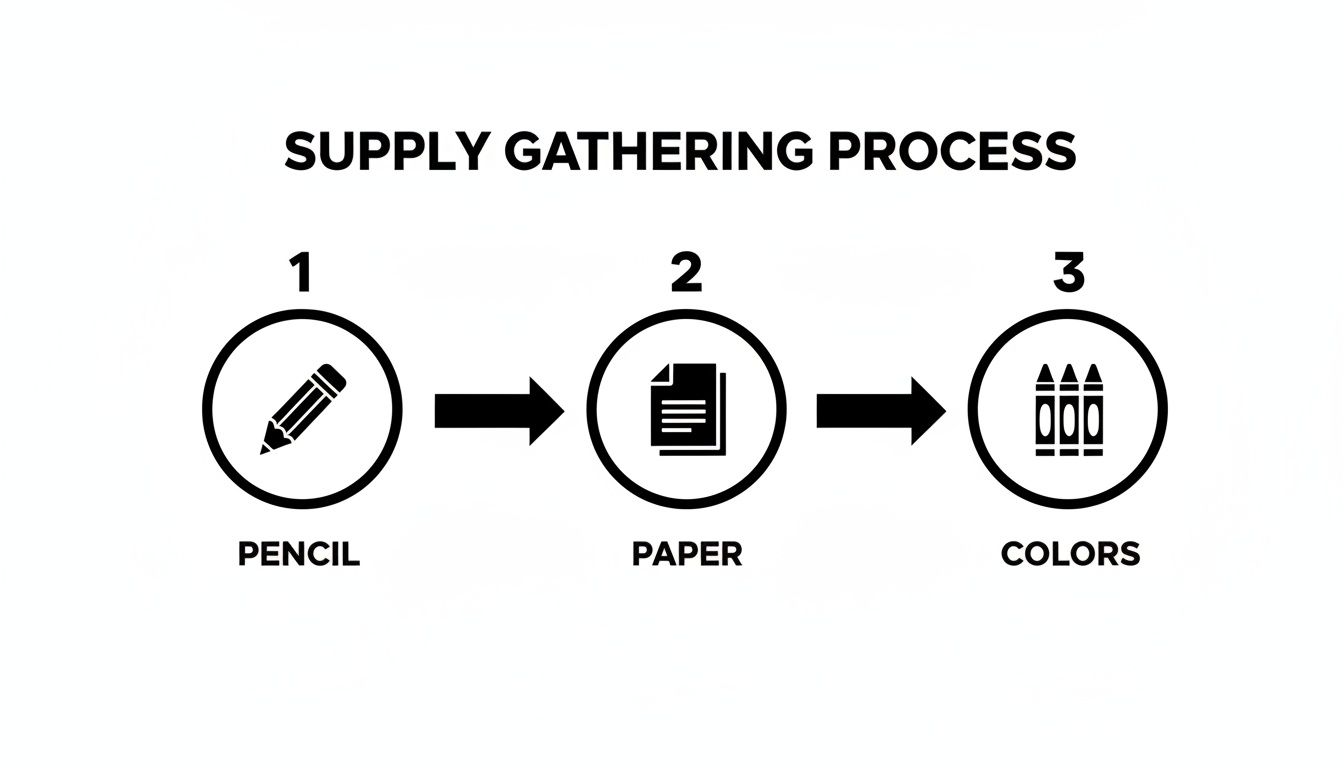
Every great mission starts with the right gear. Before we blast off on our drawing adventure, let's get our creative supplies ready. Don't worry, you won't need a high-tech laboratory—just a few simple things you probably already have at home.
Just like Space Ranger Fred has to think on his feet when he’s exploring a new planet, we can get creative with our tools. It’s all about using what you’ve got to make something amazing. This is a brilliant way to build your problem-solving muscles!
Your Astronaut Drawing Toolkit
Here is a simple checklist of our recommended supplies. I’ve included some tips for young artists, but remember, the most important tool is always your imagination!
| Supply | Why It's Useful | Pro Tip for Young Artists |
|---|---|---|
| Pencil | Perfect for sketching out your initial ideas. A soft 2B pencil is fantastic because it's easy to rub out. | Don't press too hard! Start with light lines so you can easily change things as you go. |
| Paper | Any plain paper will do the job. Printer paper is absolutely fine for practice. | If you can, use slightly thicker paper (often called "cartridge paper") if you plan to use felt-tips, so the ink doesn't bleed through. |
| A Good Rubber | Everyone makes mistakes—it's part of drawing! A quality rubber will clean them up without smudging. | This is your "undo" button! You can also use it to create highlights by lifting off pencil marks. |
| Black Outlining Pen | A fine-tipped black pen makes your final lines pop and gives your astronaut a clean, bold look. | Wait for your pencil lines to be exactly where you want them before you go over them with ink. |
| Colouring Pencils, Crayons, or Felt-Tips | This is where you bring your astronaut to life! Use whatever you enjoy most. | Try mixing colours! What happens if you put a light layer of yellow over blue? Experiment and see what you discover. |
A Quick Tip for Grown-Ups: Please don’t feel you need to rush out and buy expensive art materials. The real magic comes from a child's imagination. Encouraging them to experiment with what’s in the house is a wonderful way to build their confidence and resourcefulness.
Want to warm up those drawing muscles? You can find some fun exercises on our Freebies page. Using an online drawing program for kids is another excellent way to practise your skills digitally.
All set? Great! Let’s get drawing.
Your First Zero-Gravity Drawing Steps
Alright, time for the artistic countdown! We’re about to learn how to draw astronauts by starting with some simple, cosmic building blocks. Anyone can do this, so grab your pencil and let’s get this zero-gravity sketch off the ground.
Think of it like building with LEGO®, but on paper. We’re going to construct our astronaut piece by piece using basic shapes.
Cadet Level Drawing (Ages 6–8)
For our younger cadets, the mission is all about keeping it fun and simple. The goal? A friendly, cartoonish space explorer who looks ready for an adventure.
- Start with the Helmet: Draw a big, round circle. This is your astronaut's "fishbowl" helmet, giving them a perfect view of all the amazing stars and planets.
- Add the Body: Attach a chunky rectangle right underneath for the body of the spacesuit. Easy-peasy!
- Draw the Arms and Legs: Add four long ovals—two for the arms and two for the legs. Don’t worry if they aren't perfect! Wobbly lines just make it look like your astronaut is floating in space. In our story, Space Ranger Fred and the Lost Moon-Pies, Fred’s suit is extra puffy, which is always fun to draw.
- Don't Forget the Details: Draw two smaller circles for hands and two chunky rectangles for boots. Inside the helmet, a simple smiley face is all you need!
There you have it! A brilliant basic astronaut, ready for action.
Adding Mission-Ready Details and Colours
You've got the basic shape of your astronaut down—fantastic! But the real fun starts now. This is where we add all the cool details that give your space explorer a story and a personality.
Let’s get them kitted out with mission patches, high-tech control panels, and proper space boots.
Commander Level Details (Ages 9–12)
For our older artists, let’s add some realistic touches.
- Add a Visor: Draw a smaller curve inside your helmet to create the shiny visor. You could even draw a little reflection of a planet in it.
- Draw a Control Panel: On the chest, draw a small square with some tiny circles and switches. What do they do? Maybe one is for talking to Mission Control!
- Design a Mission Patch: Every real astronaut wears a mission patch. What's your astronaut's mission? Dream up a cool name and design a patch for it. You could draw a tiny rocket, a swirling galaxy, or your own initial!
- Bring it to Life with Colour: Now, it’s time for a splash of colour. Here’s a cool fact: real astronaut suits are almost always white. That’s because white is the best colour for reflecting the intense heat from the sun. You can learn more about what astronauts wear in our other post.
Of course, in your drawing, the rules are yours to make! Maybe your astronaut has a bright pink suit or a sparkly one. The choice is all yours.
Try This Challenge: Imagine your astronaut has just landed on a brand-new planet you’ve invented. What does it look like? Is the sky orange or purple? Are the plants spiky, or are they soft and fluffy? Grab your colouring pencils and draw the background!
From Crayons to Careers in Space
When your child learns how to draw an astronaut, they’re not just doodling. They’re sketching a real-life hero and connecting with the incredible world of STEM! It’s amazing to think that a simple drawing session can be a launchpad for talking about the exciting things happening in Britain's space industry.
Who knows? A simple drawing today could spark a conversation about what it takes to explore the stars, planting the seed for a future career.
Believe it or not, the UK's space sector is booming! It employs thousands of people, from engineers who build rockets to scientists who study distant galaxies. That's a huge team of real-life space rangers, proving that the adventures we imagine in our Space Ranger Fred books aren't just make-believe. You can find out more about what astronauts do from this fantastic NASA resource for students.
Your Next Creative Mission Awaits!
Well done, space artist! You've just learned how to draw an astronaut, and I bet your creation looks absolutely out of this world. But don't hang up your pencils just yet—your creative adventure is only just getting started.
Every great artist starts with a single sketch. Keep practising, keep imagining, and see where your creativity takes you. The UK government is investing millions in our national space programmes, supercharging the technology that makes space travel possible—just like the cool gadgets on your astronaut's suit! You can read more about the UK's inspiring space strategy right here. It just shows how art and science are connected.
Ready for more interstellar fun?
- Blast off on a new reading adventure with our latest Space Ranger Fred book.
- Download more creative activities from our Freebies page.
- Sign up for our newsletter to get exclusive printables sent straight to your inbox.
- Follow our adventures on social media!
We’d love to see your amazing drawings! Share them with a grown-up’s help and tell us in the comments what planet your astronaut is off to explore.
Frequently Asked Questions (FAQs)
Still have a few questions floating around? We get lots of brilliant queries from our community of young artists. Here are some of the most common ones.
What's the easiest way for a beginner to draw an astronaut?
If you're just starting, the secret is to think in simple shapes. Start with a big circle for the helmet. Then, add a rectangle for the body and four ovals for the arms and legs. Thinking of it this way makes learning how to draw astronauts feel less tricky and more like a fun game. Before you know it, you’ll have a basic space explorer ready for adventure.
How can I make my drawing look more three-dimensional?
Ready to level up your astronaut? The magic is in the details! Adding a few curved lines on the arms and legs can make the suit look puffy and less flat. A bit of shading down one side is another great trick—it instantly makes your astronaut look more rounded, just like a real Space Ranger floating in zero gravity.
My lines are all wobbly. How can I draw straighter?
Wobbly lines are okay! In fact, they can make your drawing look like it has more movement. But if you want to practise, try drawing lots of lines and circles on a spare piece of paper as a warm-up. Don't worry about being perfect—the more you draw, the more confident your hand will become. Every artist starts here!
What colours should I use for my astronaut's suit?
That's a fantastic question! While most real-life astronaut suits are white to reflect the sun’s heat, your drawing is your own universe. There are no rules! Why not give your astronaut a rainbow-striped suit, or one that sparkles with all the colours of a distant galaxy? The only limit is your imagination.
Happy drawing, space cadets