
Meta title: Keepy Uppy World Record for Young Rangers
Meta description: Discover the keepy uppy world record, the simple science behind it, and fun, safe challenge ideas for UK children at home or school.
Can a child learn science, balance, and confidence just by keeping a football off the ground?
That sounds like playground fun, but it’s also a brilliant learning challenge. In Britain, we call it keepy uppy, and it mixes timing, patience, body control, and a bit of stubborn determination.
For many families and schools, it already feels familiar. In England alone, over 2 million children participate in grassroots football every week, according to The FA statistic noted on the keepie uppie overview. So when children try keepy uppy in the garden, on the playground, or in PE, they’re joining a much bigger football culture.
Ready for a Galactic Juggling Challenge?
A keepy uppy challenge starts with a simple question. How many times can you tap a ball into the air before it falls?
For one child, the answer might be one. For another, it might be three. For a very skilled player, it becomes a world-record idea.
That’s part of the magic. A keepy uppy world record sounds huge and dramatic, but the first step is tiny. One bounce. One tap. One retry.
Why children love it
Children like keepy uppy because it feels like a game, not a worksheet. They can test themselves. They can improve fast in small ways. They can notice progress without needing fancy equipment.
Adults like it too for a different reason. It builds perseverance in a very visible way.
- You try once: The ball drops.
- You try again: You get one touch.
- You keep going: One touch becomes two, then three.
- You notice growth: Practice turns into confidence.
Keepy uppy teaches a quiet lesson. Improvement often looks messy before it looks impressive.
Why records make it exciting
World records add a spark of wonder. They turn an ordinary football skill into something children can talk about, copy safely, and adapt into their own challenge.
It also helps children see that records aren’t only about being the best in the world. Sometimes they’re about being creative. Sometimes they’re about doing something in an unusual way. Sometimes they prove what practice can do.
If you’re a parent, teacher, or librarian, that’s useful. A record gives children a story. A challenge gives them a reason to join in. The learning slips in almost by stealth, like vegetables hidden in pasta sauce.
What is Keepy Uppy Anyway?
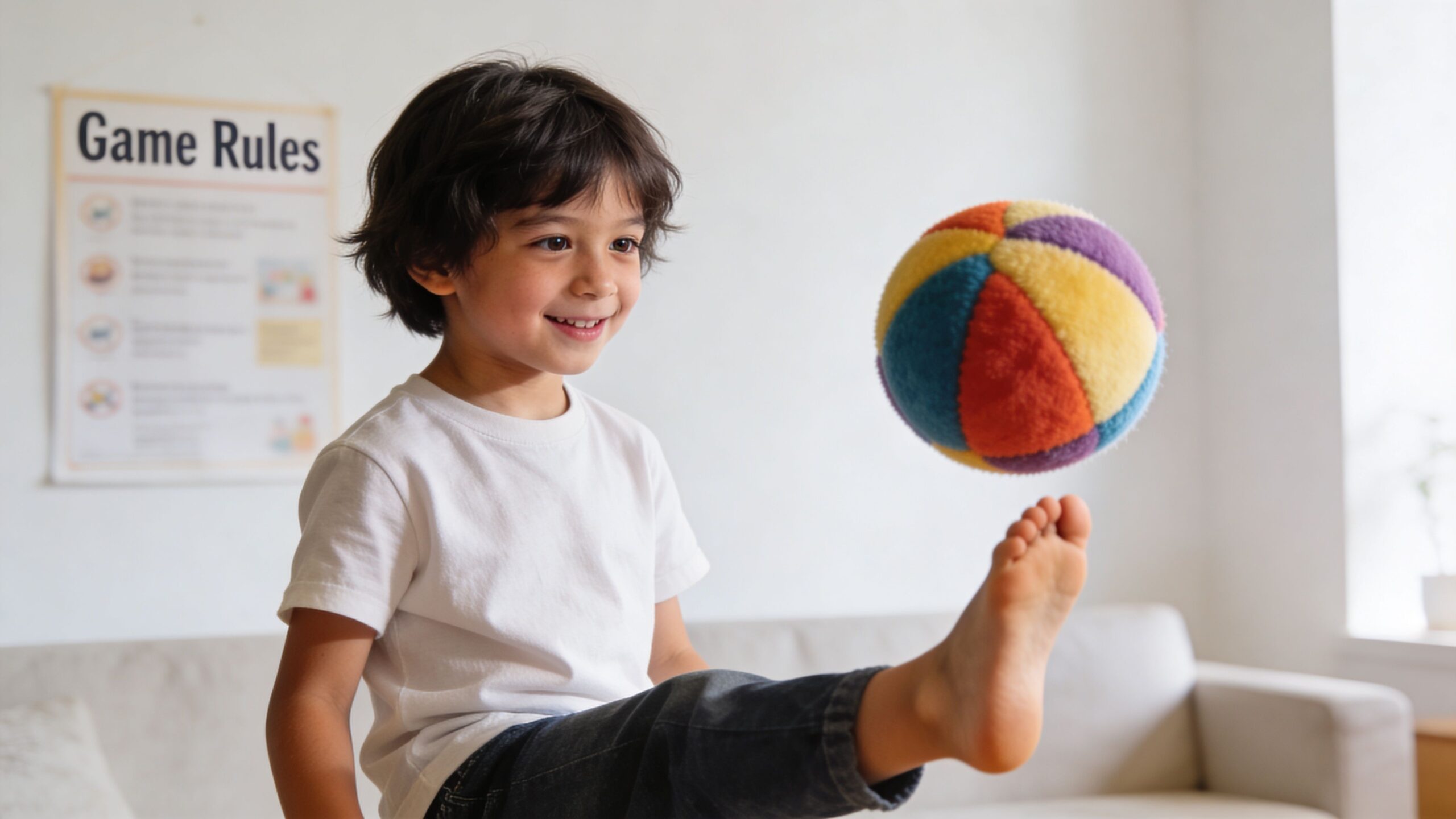
Keepy uppy means keeping a ball in the air without letting it touch the ground. You use parts of your body such as your feet, knees, chest, or head. You don’t use your hands or arms.
A simple way to picture it is this. Think of a balloon at a party. Everyone taps it before it reaches the floor. Keepy uppy is similar, but with a football, and with more control.
The basic rules children understand quickly
Most beginners do best when the rules stay simple.
- Keep the ball off the floor: That’s the main aim.
- Use safe body parts: Feet and knees are usually easiest to start with.
- No hands: Once hands join in, it becomes a different game.
- Catch if needed: Beginners can catch the ball between attempts while learning.
What it isn’t
Keepy uppy isn’t the same as advanced freestyle football. Freestyle often includes tricks, spins, stalls, and performance moves. Keepy uppy is more basic and more accessible.
That’s good news for children. They don’t need to learn a showy routine. They just need to make one controlled touch, then another.
Practical rule: Start with success, not perfection. One clean touch is a real achievement.
Why people get confused
Some children think the ball must never be caught while learning. That’s not true for practice. Catching the ball can help them reset calmly.
Some adults think only sporty children will enjoy it. That’s not always true either. Keepy uppy can suit children who enjoy pattern, rhythm, and small personal goals.
It also works well in PE because the challenge can be adapted. A soft ball, a lighter ball, or a balloon can make the skill easier for beginners. The point is learning control, not showing off in front of Year 4.
The Most Amazing Keepy Uppy World Records
The fun part about a keepy uppy world record is that there isn’t just one kind. Some records test speed. Some test endurance. Some test control in unusual positions.
One of the best examples comes from Nottingham. On 3 April 2016, Laurent Kelly completed 1,052 keepie uppies while seated on a bench, a striking feat of concentration and ball control, as recorded by RecordSetter’s bench keepie uppy entry.
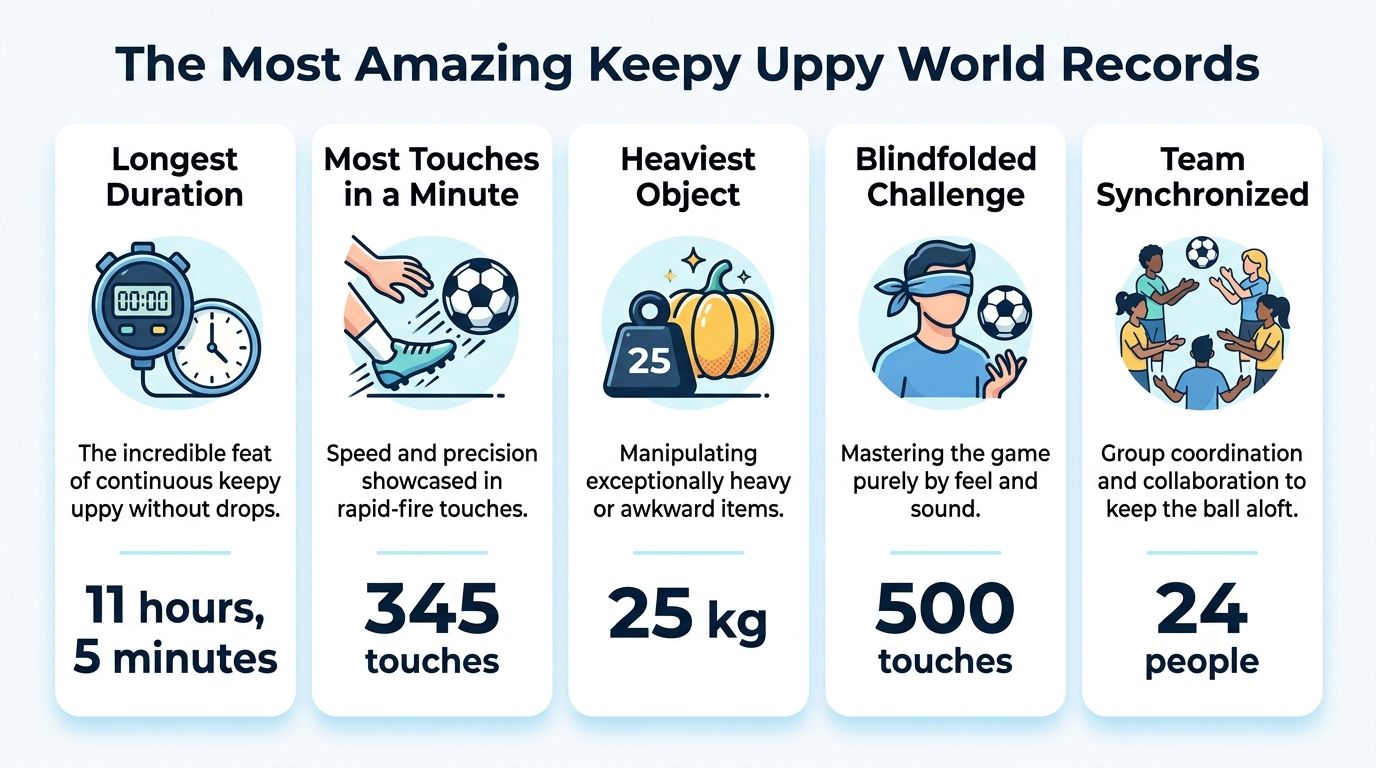
That record matters because it reminds us that skill isn’t only about running around a pitch. Seated keepy uppy demands balance, timing, and repeatable touches from a very awkward position. It’s unusual, memorable, and brilliant for getting children to ask, “Wait, you can do that on a bench?”
Records can be creative
Children often think a world record means one giant category. In reality, keepy uppy records can vary by method, position, or special rule.
That’s useful in schools. If one child isn’t interested in a standard challenge, a themed version might hook them instead. A seated challenge, a partner challenge, or a soft-ball challenge can feel fresh and inclusive.
A famous UK example
Laurent Kelly’s name is a great one to remember because it links world-record skill with an everyday football activity children recognise.
Here’s why his bench record is so fascinating:
- It happened while sitting down: That changes balance completely.
- It required sustained focus: A single lapse would end the run.
- It turns a familiar skill into a puzzle: Children immediately see the challenge.
Types of Keepy Uppy Records
| Record Type | What it Measures | Famous Example |
|---|---|---|
| Seated control | Balance and touch from a fixed position | Laurent Kelly on a bench |
| Speed challenge | How quickly a target number is reached | Alternating-foot record categories |
| Endurance challenge | How long a player can keep going | Long continuous juggling attempts |
| Technique variation | Skill using a special pattern or body part | Knee-only or alternating-foot attempts |
Why records inspire rather than intimidate
A good record should make children curious, not discouraged. The message isn’t, “You must do this.” The message is, “Look what practice can build.”
Try saying it this way in class or at home:
“You don’t need a world record. You need your next personal best.”
That shift matters. It takes the pressure off. A child who moves from one touch to four has done something worth celebrating.
For teachers, this also opens up discussion. Which type of challenge is hardest? Which needs more balance? Which needs more rhythm? Suddenly, a football activity becomes a thinking activity too.
The Simple Science Behind Every Touch
Every keepy uppy attempt is a tiny science experiment. The ball goes up, comes down, changes direction, and reacts to each touch.
Children don’t need a long physics lecture to understand this. They just need a few clear ideas.
Gravity is the bossy bit
Gravity pulls the ball down every time. That’s why the challenge keeps going. If gravity took a tea break, the game would be much easier.
Your job is to send the ball back up with the right amount of force. Too soft, and it drops. Too hard, and it flies away.
If you want a child-friendly way to build on this idea, this short explainer on what gravitational pull means can help connect movement with simple space science.
Force and control must work together
Lots of beginners think they need to kick harder. Usually, they need to kick smarter.
A gentle, controlled touch often works better than a big whack. The foot acts a bit like a cushion and a launcher at the same time. It softens the impact, then lifts the ball back into the air.
Here’s a simple classroom way to explain it:
- Gravity pulls down
- Your foot pushes up
- Your eyes track the ball
- Your brain adjusts the next touch
That’s coordination in action.
The best touches usually look calm, not wild.
Your brain is the mission computer
Keepy uppy is not only about feet. It’s about prediction.
Your eyes notice where the ball is moving. Your brain estimates where it will land. Then your body tries to get there in time. This is one reason the skill can support physical learning in PE and active play.
For adults who want a wider look at design and materials, this article about technology in footballs gives useful context on how football construction affects feel and movement.
Spin changes the story
Sometimes the ball rises neatly. Sometimes it wobbles off like it has its own opinions.
That’s often spin. If the ball spins after a touch, it may drift slightly or feel harder to predict. Children notice this quickly, even if they don’t know the word for it yet.
A nice follow-up question is, “What kind of touch makes the ball easier to control?” That encourages observation, testing, and explanation. In other words, science with trainers on.
Your First Keepy Uppy Training Mission
The best beginner session is short, cheerful, and safe. Children don’t need a dramatic training montage. They need a ball, a bit of room, and permission to be beginners.
Start small and make it winnable
A child’s first mission should feel possible. If the task is too hard, frustration arrives before learning does.
Try this sequence.
Drop and tap
Hold the ball in your hands. Drop it. Tap it gently with one foot. Catch it again.Tap twice
Drop, tap, tap, then catch. Two touches is a strong early target.Count your best run
Let the child aim for a personal best. Not someone else’s. Their own.Swap feet if ready
Once one foot feels steady, try the other. This builds balance and awareness.
What adults should watch for
Children usually improve when adults praise the process rather than the score.
Useful things to notice:
- Calm eyes: Are they watching the ball carefully?
- Gentle touches: Are they trying to control, not smash?
- Reset habits: Do they restart without getting cross?
- Body position: Are they staying balanced and upright?
A child who says, “I nearly did three,” is learning exactly the right lesson. Near success still counts as progress.
Safety first, always
Keepy uppy should feel playful, not chaotic.
- Choose the space carefully: Move away from windows, lamps, and crowded areas.
- Use suitable footwear: Trainers help with grip and comfort.
- Pick the right ball: Softer options can help nervous beginners.
- Keep sessions short: Stop before tiredness turns into flailing.
Children also learn well through movement-rich methods. If you’d like a simple explanation of why active practice works so well, this piece on kinesthetic learning is a helpful read.
This short clip can also give beginners a visual sense of rhythm and body position.
A simple mission script for home or school
Some children respond well to playful storytelling. You can say:
“The ball is a meteor. Your mission is to keep it from landing.”
That tiny story adds purpose. It can also reduce fear of failure because the focus shifts from performance to play.
If a child gets stuck, simplify the task. Use a bounce between touches. Use a larger soft ball. Use knee taps instead of feet. A good challenge stretches skill a little, not too much.
Launch Your Own Space Ranger Keepy Uppy Challenge
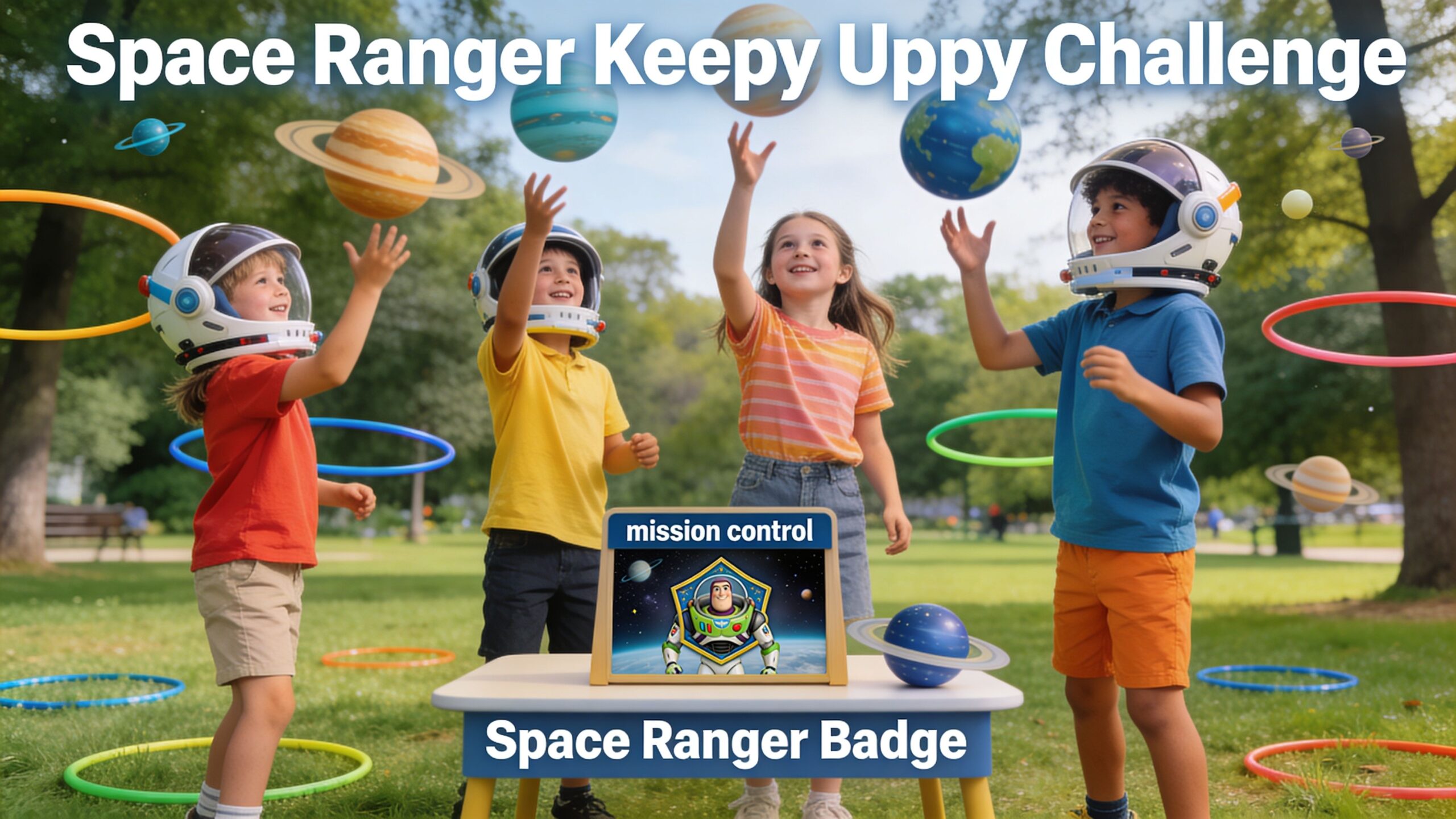
A themed challenge can turn a standard PE activity into something children remember. You don’t need a huge event. You just need a simple idea, a clear mission, and a chance for everyone to join in.
Easy challenge ideas for schools and families
Try one of these playful setups:
- Meteor rescue: The ball is a falling rock from space. Keep it off the ground.
- Alien egg mission: The ball must stay safe in the air.
- Planet pass: Children work in pairs and alternate touches.
- Silent astronaut round: Players focus without talking, which sharpens attention.
Make it inclusive
Not every child wants a competitive contest. Some prefer cooperation or creativity.
You can offer different success routes:
| Challenge style | Best for | Example goal |
|---|---|---|
| Personal best | Children who like private progress | Beat your own score |
| Team relay | Group participation | Keep the ball going together |
| Story challenge | Imaginative learners | Complete the mission |
| Skill station | Mixed abilities | Try feet, knees, or bounce version |
That’s often where the best school activities happen. One task. Many entry points.
If you’re planning a bigger sports-themed day and want ideas for event-style setups, an interactive football game can show how football activities can be turned into shared experiences.
Add printable fun
Certificates, score cards, and mission sheets make the activity feel official. Children love writing down their personal best, even if it’s just one or two touches.
For extra movement ideas that fit active play at home or school, this collection of games for the trampoline may spark more inspiration for energetic learners.
A good mini-event might include:
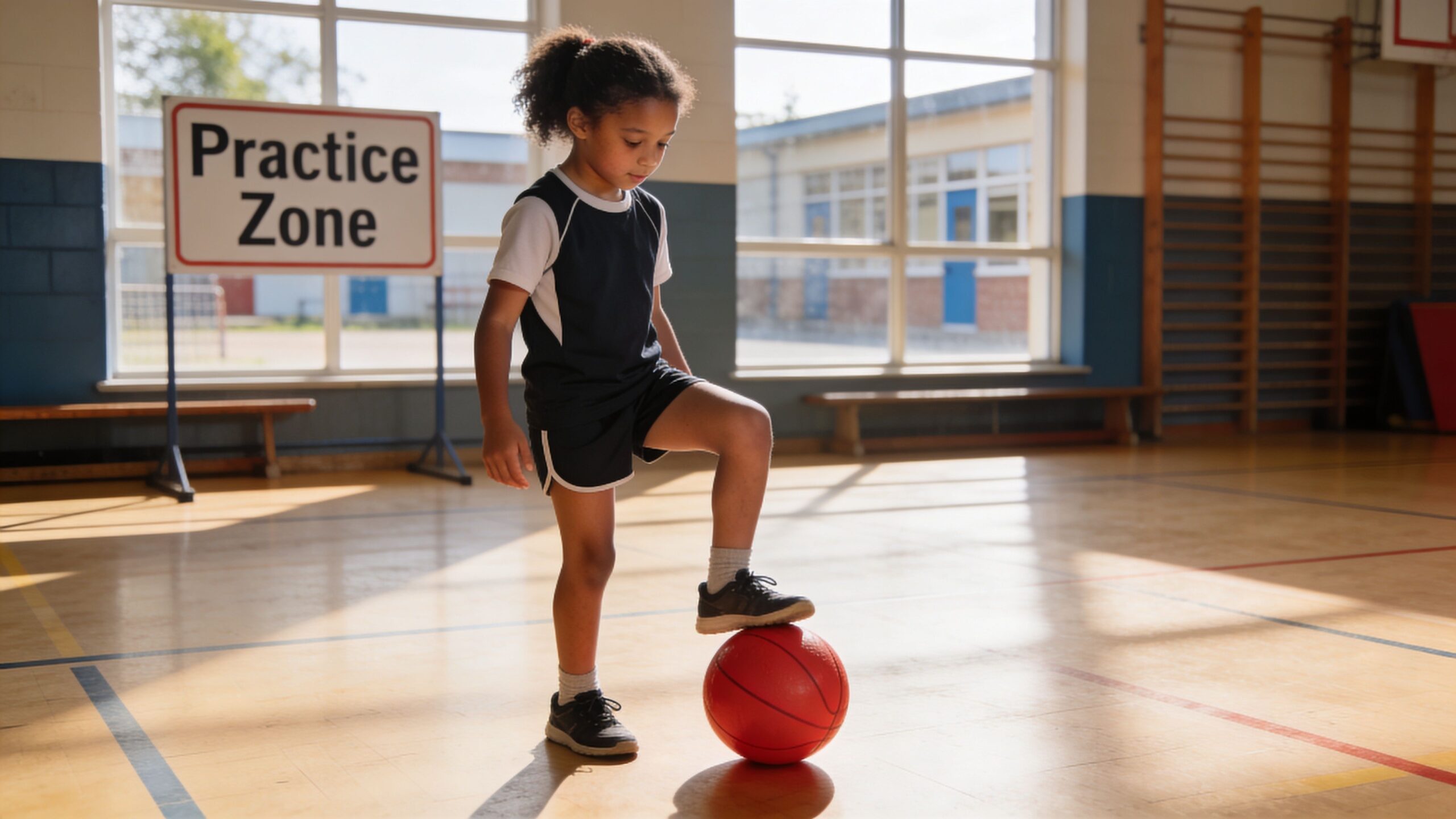
- A practice zone: Children test different balls
- A mission board: Names and personal bests go up
- A reflection moment: Each child says what they improved
- A celebration finish: Everyone gets recognised for effort
That final part matters most. The children should leave thinking, I think, I try, I can, I can explain.
You Can Do It Ranger Your Mission Awaits
What if today’s keepy uppy score is only 1? That still counts as a brilliant start to the mission.
Keepy uppy gives children something bigger than a football trick. It gives them a safe, active way to practise balance, patience, and noticing small changes. For parents, teachers, and club leaders, it also works beautifully as a simple STEM challenge. One ball, one goal, and lots of chances to test, observe, and improve.
World records make the challenge feel exciting, like spotting the biggest rocket in the sky. Your own attempts are where core learning happens. Each touch is a tiny experiment. Too hard, and the ball zooms away. Too soft, and it drops. After a few tries, children start to spot patterns and make smart adjustments without even realising they are thinking like young scientists.
That is a powerful mix.
A child does not need a huge score to succeed. They might discover that their knee gives steadier touches than their foot. They might notice that a softer ball is easier to control in the playground or hall. They might explain, in their own words, why keeping the ball low helps them stay ready for the next tap. That kind of learning sticks because they can feel it, see it, and talk about it.
For UK primary school children, sport, science, and imagination converge. A keepy uppy mission can become a class challenge, a wet-play activity with a foam ball, a lunchtime practice station, or a garden mission at home. Space Ranger Fred would call that proper explorer work. Test an idea. Try again. Learn something useful. Have fun while doing it.
So start small. Count your touches. Stay safe. Celebrate progress.
Then ask two great mission questions. How many can you do today? What did you learn while trying?
If you’d like to keep the adventure going, explore the Space Ranger Fred books for story-led fun that blends humour, curiosity, and simple STEM in a way children enjoy. You can also find more family-friendly ideas on the activities and freebies page, plus extra inspiration on the Space Ranger Fred blog. For schools, libraries, and reading events, Space Ranger Fred school visits bring interactive storytelling, science-rich discussion, and confidence-building communication into one memorable session. Learning should be experienced, not just delivered.