
Learning about space isn't just a science lesson; it's a grand adventure that kicks off the moment a child looks up at the night sky. It’s about transforming that simple glance into a real journey of exploration by sparking curiosity with brilliant stories, fun activities, and incredible facts that make our universe feel just within reach.
Your Amazing Journey into Space Begins Here
Welcome aboard, future space explorer! That feeling you get when you stare up at the stars? That’s the first step on one of the greatest adventures you can ever take. Think of this guide as your personal rocket ship, built to make learning about space a thrilling mission, not a boring lecture. Together, we’ll explore twinkling stars, mysterious planets, and galaxies so vast they boggle the mind.
Our mission is to make the cosmos come alive. We're not going to just list off dry facts. Instead, we'll use storytelling to make sense of the big ideas. Ever thought of gravity as a giant, invisible cosmic string that stops the Moon from floating away? Or a black hole as a colossal space waterfall? It's these kinds of pictures that turn tricky science into something you can really imagine.
Why Stories Make Learning Easier
There's a reason we love stories – they're powerful. When you wrap a complex idea inside an exciting narrative, it just clicks. Take a hero like Space Ranger Fred, for example. In books like Space Ranger Fred and the Shoelace Adventure, big concepts like planetary orbits or problem-solving on a strange new world become part of a brilliant quest. This approach taps right into a child’s natural sense of wonder and makes learning about science, technology, engineering, and maths feel like part of the fun.
By blending adventure with education, we can show children that science isn't just a subject in school—it's the key to unlocking the mysteries of the universe and becoming a hero in their own story.
Fostering a Lifelong Passion for Space
When we encourage an interest in space, we’re doing more than just teaching kids about planets and stars. We're building a foundation for critical thinking, curiosity, and problem-solving that will last a lifetime. Here in the UK, there’s fantastic support for this, with a huge range of resources designed to bring space science into the classroom.
The UK Space Education Office (ESERO-UK), for instance, offers loads of free resources to boost STEM education for all ages. It’s well worth exploring these space-related educational resources to see how they can support young learners on their journey.
This guide is here to set the stage for your own cosmic adventure, showing you just how interactive storytelling and simple, hands-on activities can make the universe feel close enough to touch.
Prepare for lift-off
Exploring Our Solar System One Planet at a Time
Ready for a grand tour of our cosmic neighbourhood? Our solar system is a bustling place, filled with incredible planets, mysterious moons, and swirling asteroids, all dancing around a giant star we call the Sun.
Think of the Sun as the friendly, super-strong captain of our cosmic team. It holds everything together with an invisible force called gravity—a bit like a giant, invisible magnet. The Sun’s immense pull keeps all eight planets spinning in neat paths, or orbits, so they don’t wander off into the depths of space. This constant cosmic dance is what makes our solar system a stable and fascinating place to explore.
Meet the Planets Big and Small
The planets in our solar system aren't all the same; they come in two main flavours. The ones closest to the Sun are small, rocky worlds, while the ones further out are enormous giants made of gas and ice.
This handy diagram below shows how our eight planets are organised into these two groups: the Terrestrial Planets and the Gas Giants.
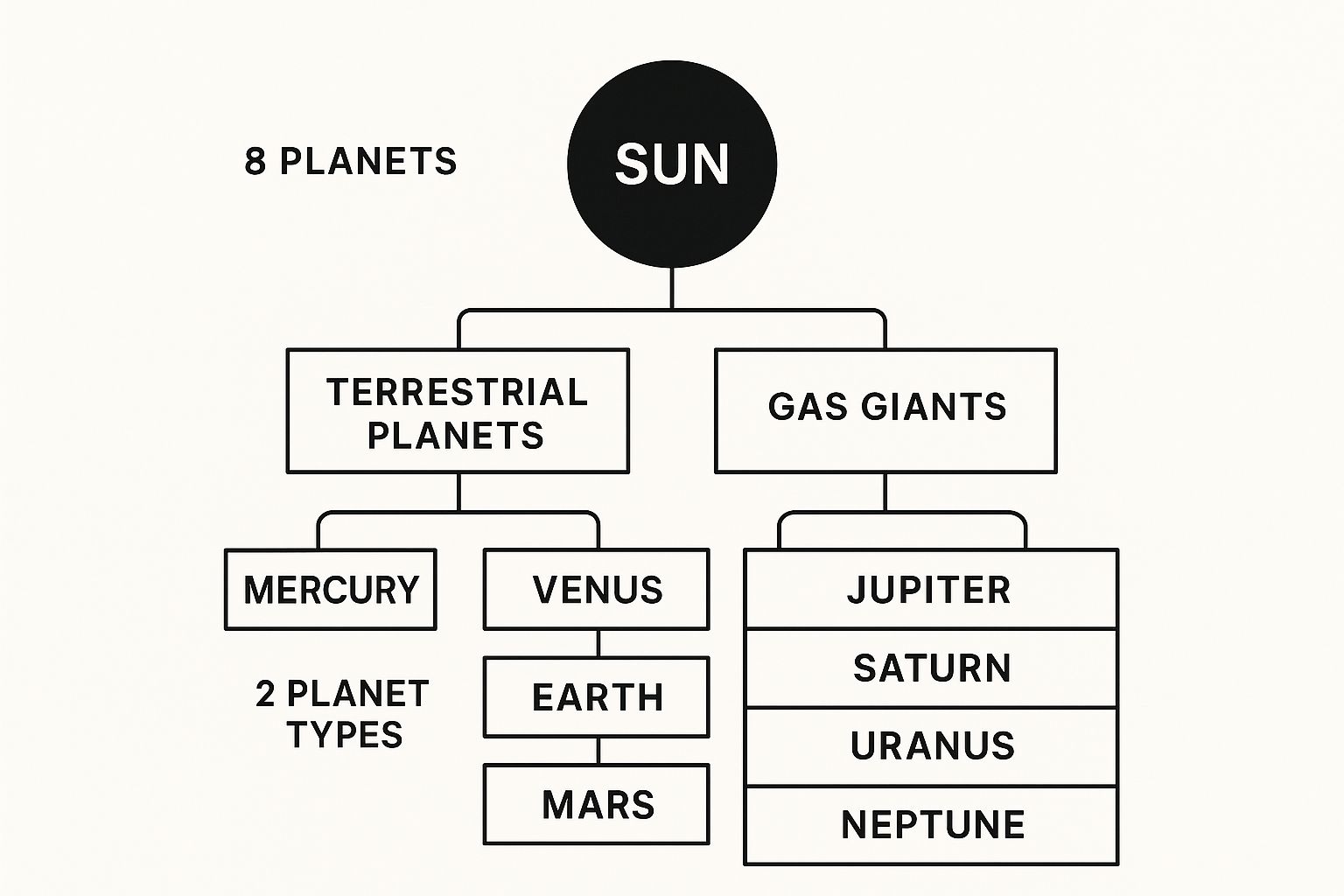
As you can see, where a planet lives in relation to the Sun shapes what it's like, separating the warm, solid inner worlds from the cold, swirling outer giants.
The Inner Rocky Worlds
First up are the Terrestrial Planets. That’s just a fancy way of saying they are "Earth-like," with solid, rocky surfaces you could theoretically stand on—though you'd need a very special suit!
- Mercury: The smallest and fastest planet, zipping around the Sun in just 88 Earth days. It’s a world of extremes, scorching hot on one side and freezing cold on the other.
- Venus: Often called Earth’s "sister planet" because it’s a similar size, but it's not a friendly twin! Venus is the hottest planet in our solar system, with a thick, toxic atmosphere that traps heat like a runaway greenhouse.
- Earth: Our home! It's the only planet we know of with liquid water on its surface and life as we know it. Its position is just right—not too hot and not too cold.
- Mars: The famous "Red Planet" gets its colour from rusty iron in its soil. Scientists are fascinated by Mars because it has polar ice caps and evidence that water once flowed there, making it a key target in the search for past life.
Understanding these different environments is exactly what a space explorer needs to do. In Space Ranger Fred and the Shoelace Adventure, Fred has to think on his feet to solve problems on strange new worlds, using his knowledge of different planetary conditions to save the day. For a deeper look into our cosmic home, you can find out more about what the solar system is in our easy guide.
The Outer Gas Giants
Way out beyond the rocky planets lie the giants of our solar system. These enormous worlds don't have solid surfaces to stand on; they are mostly made of swirling gases and liquids.
- Jupiter: The undisputed king of the planets. Jupiter is so massive that all the other planets could fit inside it! Its most famous feature is the Great Red Spot, a gigantic storm that has been raging for centuries.
- Saturn: Known for its breathtaking rings, Saturn is a true showstopper. These rings aren't solid; they're made of billions of chunks of ice and rock, some as small as a grain of sand and others larger than a house.
- Uranus: This icy giant is unique because it spins on its side, almost like a rolling ball. Scientists believe a massive collision long ago might have knocked it over.
- Neptune: The most distant planet from the Sun, Neptune is a dark, cold, and incredibly windy world. It has the strongest winds in the solar system, whipping around faster than the speed of sound!
To help you get to know our planetary neighbours a little better, here’s a quick-glance table with a few fun facts.
Our Solar System's Planets at a Glance
| Planet | Type | Key Feature | A Fun Fact |
|---|---|---|---|
| Mercury | Terrestrial | Smallest & fastest planet | A year on Mercury is only 88 Earth days long! |
| Venus | Terrestrial | Hottest planet | It spins backwards compared to most other planets. |
| Earth | Terrestrial | Only known planet with life | Our planet is about 70% covered in water. |
| Mars | Terrestrial | The "Red Planet" | Mars has the tallest volcano in the solar system. |
| Jupiter | Gas Giant | Largest planet | Its Great Red Spot is a storm bigger than Earth. |
| Saturn | Gas Giant | Famous for its rings | The rings are made of billions of ice and rock particles. |
| Uranus | Ice Giant | Spins on its side | It's often called the "ice giant" because it's so cold. |
| Neptune | Ice Giant | Windiest planet | Its winds can reach over 2,000 km per hour! |
Each planet offers a glimpse into the incredible diversity of our solar system.
Every planet tells a different story—from the fiery volcanoes of Venus to the icy rings of Saturn. Exploring them helps us understand not just our solar system, but also our own unique place within it.
Beyond these eight main planets, our solar system is also home to other fascinating objects. Dwarf planets like Pluto, icy comets that streak across the sky, and millions of asteroids in the asteroid belt all add to the richness of our cosmic neighbourhood. Each one is a clue to how our solar system was born and grew over billions of years.
Bringing the Cosmos to Life with Fun Activities
Reading about space is a brilliant start, but what if you could hold a swirling galaxy in your hands or launch your very own rocket? Turning huge, abstract ideas into tangible fun is the secret to making learning stick. This is where hands-on projects and great stories come together for a proper learning adventure.
When science gets woven into a story, it stops being just a lesson—it becomes an exciting plot twist. Adventure stories are fantastic tools for teaching tricky STEM principles in a way that feels completely natural and thrilling. They put science into action, showing how it solves real problems.
Think about a book like Space Ranger Fred and the Umbrella Rescue. When Fred uses his knowledge of physics to figure out a clever solution, kids see science as a creative, even heroic, tool. It’s a powerful way to show that understanding how the universe works can help you save the day. This story-driven approach is what really sparks genuine curiosity.
Your At-Home Space Mission Control
You don’t need a high-tech lab to start exploring the cosmos. With just a few bits and bobs from around the house, you can turn your kitchen or back garden into a launchpad for discovery. These activities are designed to connect the dots between what kids read in books and what they can see, touch, and build for themselves.
Here are a few simple at-home experiments you can try:
- Build a Bottle Rocket: This classic experiment is a fantastic way to get to grips with the concept of thrust. All you need is a plastic bottle, some water, and a pump to show how pressure pushes the rocket upwards—the very same principle that sends real rockets to the Moon!
- Create a Galaxy in a Jar: Watch a nebula come to life right before your eyes. Just fill a jar with water, add a few drops of different coloured paint, and sprinkle in some glitter for stars. Give it a swirl, and you have a mesmerising, miniature galaxy that shows how cosmic clouds of gas and dust mix together out in space.
- Make Your Own Craters: Ever wondered how the Moon got all its bumps? You can find out by filling a tray with flour and dropping marbles of different sizes into it. This simple activity brilliantly shows how impacts from asteroids and meteorites have shaped the surfaces of moons and planets over billions of years.
These hands-on projects prove that science is something you do, not just something you read about. They lock in big ideas through creative and memorable play.
Connecting Stories to Hands-On Science
The real magic happens when you link these fun activities back to the stories your child loves. After building your bottle rocket, you could chat about how Space Ranger Fred might use thrust to escape a tricky spot. Or while admiring your galaxy jar, you could wonder if Fred has ever visited a real nebula.
This blend of storytelling and hands-on creation builds a much deeper understanding. It transforms passive learning into active engagement, helping children see the scientific principles hidden within their favourite adventures.
By making these connections, you’re not just teaching facts; you’re building a framework for scientific thinking. You’re encouraging your child to ask "how?" and "why?" and to look for answers through experimenting. This process nurtures problem-solving skills and a real passion for discovery that can last a lifetime. To keep the journey going, you can explore even more amazing space facts for kids that are sure to inspire your next activity.
Ultimately, these activities are about more than just fun and games. They are a gateway to understanding our incredible universe, proving that anyone can be a scientist, an engineer, or an explorer—all it takes is a bit of curiosity and a willingness to get your hands dirty.
Stargazing from Your Own Back Garden
You don’t need a powerful, expensive telescope to start exploring the universe. Believe it or not, your own back garden can be the perfect observatory, and your eyes are the only tools you need to get started.
Looking up at the night sky is a brilliant way to begin an adventure into space, connecting the dots between the stories you read and the real stars twinkling above.
The first thing you’ll probably notice are the stars themselves. They look like tiny, shimmering diamonds scattered across a dark velvet blanket. But what are they, really? Stars are actually gigantic, glowing balls of incredibly hot gas, just like our own Sun. They only look small because they are an unimaginable distance away from us.
And that famous twinkling? It's not the star wobbling. It’s a clever trick played by the Earth's atmosphere. As the starlight travels millions upon millions of miles to reach your eyes, it has to pass through the air surrounding our planet. Because this air is always moving, it bends the light just enough to make the star appear to shimmer and dance.
Finding Patterns in the Stars
For thousands of years, people have stared at the stars and connected the dots to make pictures, almost like a giant celestial colouring book. We call these patterns constellations.
Way back when, they helped ancient sailors navigate the vast oceans and farmers figure out the best time to plant their crops. Each one also comes with a story, often an exciting myth about heroes, heroines, and amazing creatures. Spotting them is a fun challenge and a great way to find your way around the night sky.
Here in the UK, some of the most famous and easiest-to-find constellations are:
- The Plough (or The Big Dipper): This one is part of the larger Ursa Major (Great Bear) constellation and looks just like a giant saucepan. It's one of the most recognisable patterns in the sky and is visible all year round.
- Orion the Hunter: A real standout in the winter sky, Orion is famous for the three bright stars that make up his belt. You can easily spot his shoulders and feet, making him look like a giant cosmic hunter on the prowl.
- Cassiopeia: Keep an eye out for a big 'W' or 'M' shape in the sky (it flips depending on the time of year). This constellation is named after a mythical queen from an ancient story.
Once you can find these patterns, the night sky starts to feel like a familiar map, full of amazing tales and scientific wonders.
Your First Stargazing Adventure
Ready to start your own astronomical journey? It’s much easier than you think. You don’t need lots of fancy gear—a clear night and a little patience are all it takes.
The night sky is a shared storybook, open to everyone. Looking up at the same stars that ancient storytellers and explorers saw connects us to a long history of human curiosity and wonder.
To make your first stargazing session a success, find a good spot away from bright streetlights. City lights create something called light pollution, which makes it much harder to see the fainter stars. The darker your spot, the more you’ll be able to see.
Most importantly, give your eyes about 15-20 minutes to properly adjust to the darkness. You’ll be amazed at how many more stars seem to pop into view once they have.
Tools and Tips for Young Astronomers
While your eyes are fantastic tools, a little help can make the experience even better. There are some brilliant star-finder apps for phones and tablets. Just point your device at the sky, and the app will show you exactly which stars, planets, and constellations you're looking at.
Mixing these modern tools with real-world looking is a fantastic way to learn. Recent research from the Royal Society shows that UK students are keen for more hands-on science activities. Blending a practical activity like stargazing with a helpful app combines the best of both worlds, making the whole thing both interactive and educational.
Thinking about just how far away everything is can also be part of the fun. In space, we don’t measure distance in miles but in light-years. A light-year is the distance light zips across in one whole year, which is a mind-boggling 5.88 trillion miles!
This is a massive concept that Space Ranger Fred grapples with in books like Space Ranger Fred and the Tick Tock Tale, where understanding vast distances and time is key to the mission. Stargazing from your garden is your first step into this incredible, expansive universe.
Your Future in Space Exploration
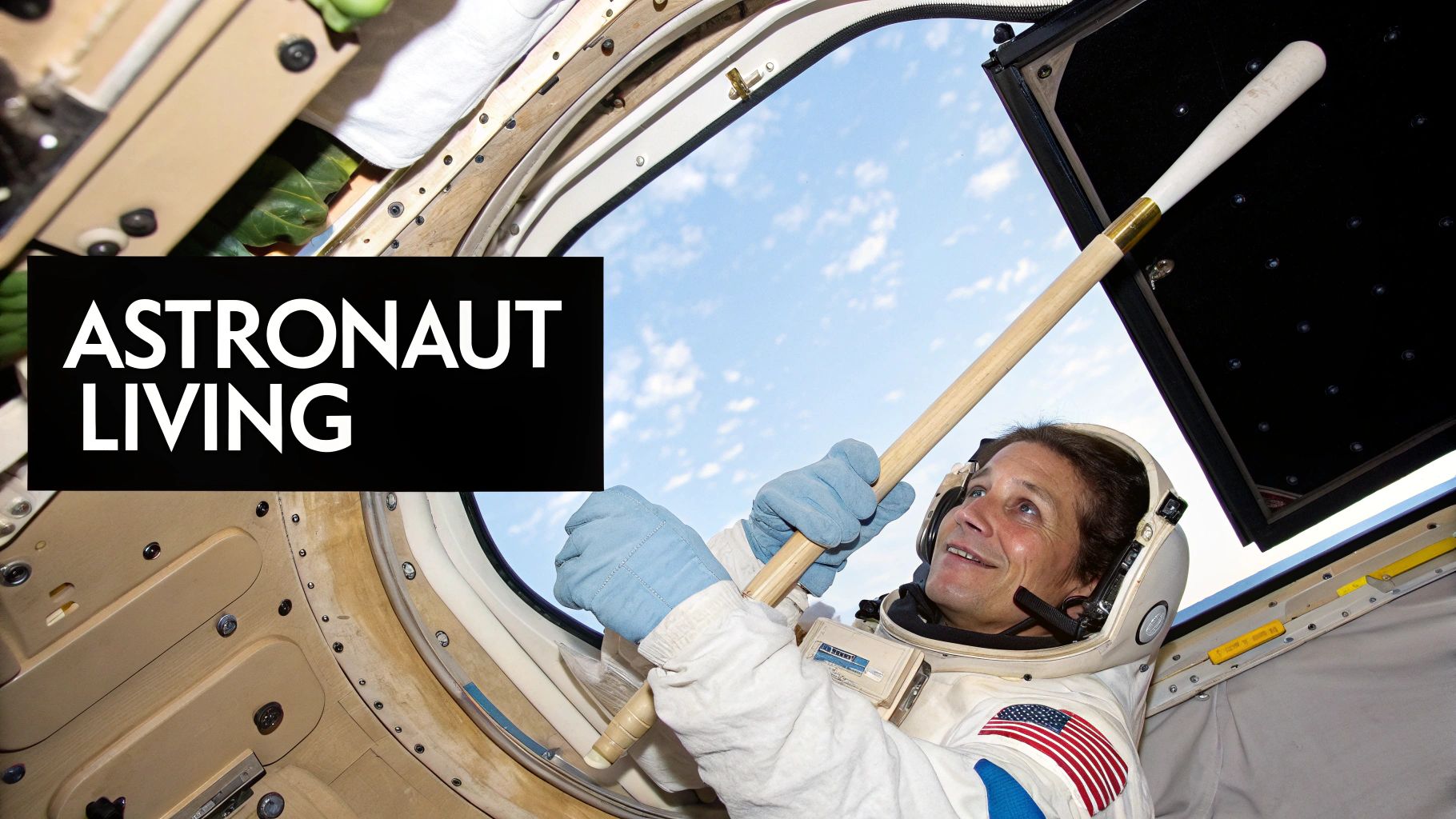
When we talk about space, it’s easy to think about amazing moments from the past, like the first Moon landing. But exploring space is really all about looking forward. Right now, incredible missions are happening all across our solar system. Robotic rovers are digging in the red dust of Mars for signs of ancient life, while powerful new telescopes are gazing into the farthest corners of the cosmos, trying to catch a glimpse of the universe’s very first stars.
And that’s just the start. Scientists and engineers are already cooking up the next big ideas, like building bases on the Moon where astronauts can live and work, or sending probes to the icy moons of Jupiter and Saturn that might be hiding vast oceans under their frozen shells. This isn't science fiction anymore—it's the future of exploration, and it needs a new generation of dreamers and doers to make it a reality.
More Than Just Astronauts
What’s the first thing you picture when you think of a job in space? An astronaut in a big white suit, right? While becoming an astronaut is an incredible goal, it's only one small piece of a giant puzzle. It takes thousands of people, all with different talents, working together to get a single mission off the ground.
For every astronaut who blasts into orbit, there are hundreds of people back on Earth cheering them on and making sure everything goes to plan.
Space exploration is a team sport. It needs scientists, engineers, artists, and storytellers all working together to push the boundaries of what’s possible.
This means there are so many different ways to get involved in the space industry. You definitely don’t have to be a rocket scientist!
- Engineers and Technicians: These are the master builders. They design everything from the mighty rockets that roar into the sky to the nimble rovers and delicate instruments that gather clues from distant worlds.
- Scientists and Researchers: These are the cosmic detectives. They study all the data sent back from missions to answer huge questions, like "Could there be life on other planets?" or "How did our solar system even get here?"
- Programmers and Coders: Every spaceship, satellite, and robot needs a brain. Programmers write the clever code that tells a Mars rover where to drive or a satellite which way to point its camera.
- Artists and Designers: These creative minds help us see the future before it happens. They make exciting animations of missions, design the cool patches astronauts wear, and help explain tricky ideas to the world in ways everyone can understand.
Building Skills for Tomorrow
The skills you need for these jobs are the very same ones you’re building right now when you get curious about STEM. Critical thinking, creativity, and problem-solving are at the heart of every single space mission. When you read a story like Space Ranger Fred and the Tick Tock Tale, you see Fred using logic and careful observation to figure out a tough puzzle. That’s exactly what a mission controller at NASA does every day.
A good grounding in STEM subjects at school is a fantastic launchpad for a future career in space. Interestingly, the first national workforce survey of the UK's space industry found that people working in space come from all sorts of educational backgrounds. You can explore more about the UK space workforce demographics on spaceskills.org to see just how many different paths can lead to an amazing job.
Whether you love building with LEGOs, drawing futuristic spaceships, or tackling maths problems, you’re already developing the skills that future space explorers need. And as the journey into STEM learning is becoming more fun and accessible, there’s never been a better time to get involved. So, keep asking questions, keep experimenting, and keep dreaming big. Your future in space might be closer than you think
Your Top Space Questions Answered
As you and your little one start exploring the cosmos, you’re bound to have questions. The universe is a big, weird, and wonderful place, after all! To help you on your mission, we’ve tackled some of the most common head-scratchers that pop up when learning about space with kids, complete with simple answers to keep that curiosity buzzing.
Think of this as your go-to guide for those big cosmic queries.
How Do We Even Start Learning About Space at Home?
The secret is to make it an adventure, not a lesson. Forget dense textbooks for now. The best starting point is always a great story. Books like the Space Ranger Fred series are brilliant for this, turning tricky science into a thrilling quest that grabs a child’s imagination.
Once you’ve lit that spark, you can build on it with some simple, fun activities.
- Build a Model Solar System: Grab some different-sized balls (or even fruit!) to show the planets. It’s a great hands-on way to help them grasp just how massive Jupiter is compared to tiny Mercury.
- Use Stargazing Apps: Head out into the garden after dark and use a free app on your phone to point out constellations. Suddenly, the patterns in their books are right there in the real sky above them.
- Watch Documentaries Together: There are some fantastic, kid-friendly space documentaries that use incredible visuals to explain everything from black holes to colourful nebulae.
The trick is to connect the stories they read to things they can see and do. This blend of storytelling, real-world observation, and hands-on fun is what makes the learning stick.
How on Earth Do I Explain Black Holes to a Child?
Black holes can sound pretty scary, but you don’t need to dive into complex physics. Simple analogies are your best friend here. Focus on the main idea: super-strong gravity.
Try thinking of it as a cosmic waterfall. You could describe a black hole as a place in space where gravity is pulling everything in, like a giant waterfall with no bottom. It’s so powerful that once something gets too close, it can’t escape—not even light!
A stretchy sheet is another fantastic way to show how it works.
Picture space as a giant, flat trampoline. If you put a heavy bowling ball in the middle, it makes a big dip. Now, roll some smaller marbles (like planets or stars) nearby. You’ll see them get pulled right into the dip.
This simple visual is a perfect demonstration of how a massive object can bend space and pull things towards it—the basic idea behind a black hole. Stories help too; in books like Space Ranger Fred and the Umbrella Rescue, a big part of the adventure is solving problems by understanding forces like gravity, making it part of an exciting plot.
What Are Some Simple Space-Themed Activities We Can Do?
You don’t need a science lab to have some cosmic fun at home. There are loads of brilliant activities you can do with stuff you’ve probably already got in your cupboards.
- Create 'Moon Sand': For an amazing sensory activity, just mix eight parts plain flour with one part baby oil. You get this crumbly, mouldable texture that feels just like you’d imagine the lunar surface to be. It's perfect for making craters or leaving little astronaut footprints.
- Make Constellation Jars: This is a lovely way to bring the night sky indoors. Take a piece of black paper that fits inside a glass jar, punch holes in it to match a constellation (like The Plough), and pop a small battery-powered light inside. In a dark room, the stars will shine through beautifully.
- Planet Scavenger Hunt: Print out pictures of the planets and hide them around the house or garden. Write clues describing each one, like "I’m known as the Red Planet" or "I have beautiful rings made of ice." It’s a great way to turn learning facts into an active game.
These activities are all about making big, abstract ideas tangible and, most importantly, fun.
Are There Any Good Online Resources for Kids?
Absolutely! The internet is packed with amazing resources for young space explorers. Loads of organisations have created fantastic websites designed to make learning about space interactive and exciting.
Here are a few of the best places to start your online journey:
- NASA Space Place: This site, run by NASA itself, is filled with games, animations, and easy-to-read articles that break down complex topics for kids.
- ESA Kids: The European Space Agency’s kids’ site is another brilliant resource, full of fun facts, activities, and updates on current European space missions.
- UK Space Education Office (ESERO-UK): For families here in the UK, this is an excellent hub for fun, curriculum-linked materials.
- YouTube Channels: Channels like National Geographic Kids and SciShow Kids have incredible videos that explain space concepts with tonnes of energy and great visuals.
These online tools are a wonderful way to add another layer to the books and hands-on experiments, giving you a well-rounded and exciting way to discover the cosmos together.
Ready to blast off on your next reading adventure? Space Ranger Fred offers a universe of stories that blend science, humour, and thrilling quests. Discover the books, games, and learning resources at spacerangerfred.com and inspire the next generation of explorers today