
Ever wondered what the solar system actually is? Imagine it’s our giant cosmic family, all spinning through space together. And right in the very centre of it all is a super-bright star we call the Sun.
Like a cosmic maypole, everything else, from the tiniest pebble-like planets to the giant gassy ones, is held in place by the Sun’s mighty gravity. Think of it as an invisible string that keeps everyone dancing in their own special path.
Welcome to Our Cosmic Neighbourhood
If Earth had a postal address, it would probably start with “The Solar System.” It’s our home, our little patch of the universe.
Think of it like a giant, cosmic roundabout. The Sun sits in the middle, and all the planets are like cars, each driving perfectly in its own lane. These lanes are called orbits, and they stop everyone from bumping into each other on their long journey around the star of the show.
But it’s not just planets! This cosmic crew is packed with other cool characters. We’ve got moons that tag along with planets like loyal sidekicks, rocky asteroids tumbling through space, and icy comets that zoom past with long, glowing tails. It’s a busy place, with everything constantly on the move. That’s why we call it a ‘system’—all these different parts work together in a gravitational dance choreographed by the Sun.
Who’s Who in the Solar System
So, how is this big space family organised? The Sun is the undisputed boss, with all the planets falling into two main groups based on where they are and what they’re made of.
The picture below gives you a great idea of the basic layout, with the Sun at the top, followed by the two different planetary groups.
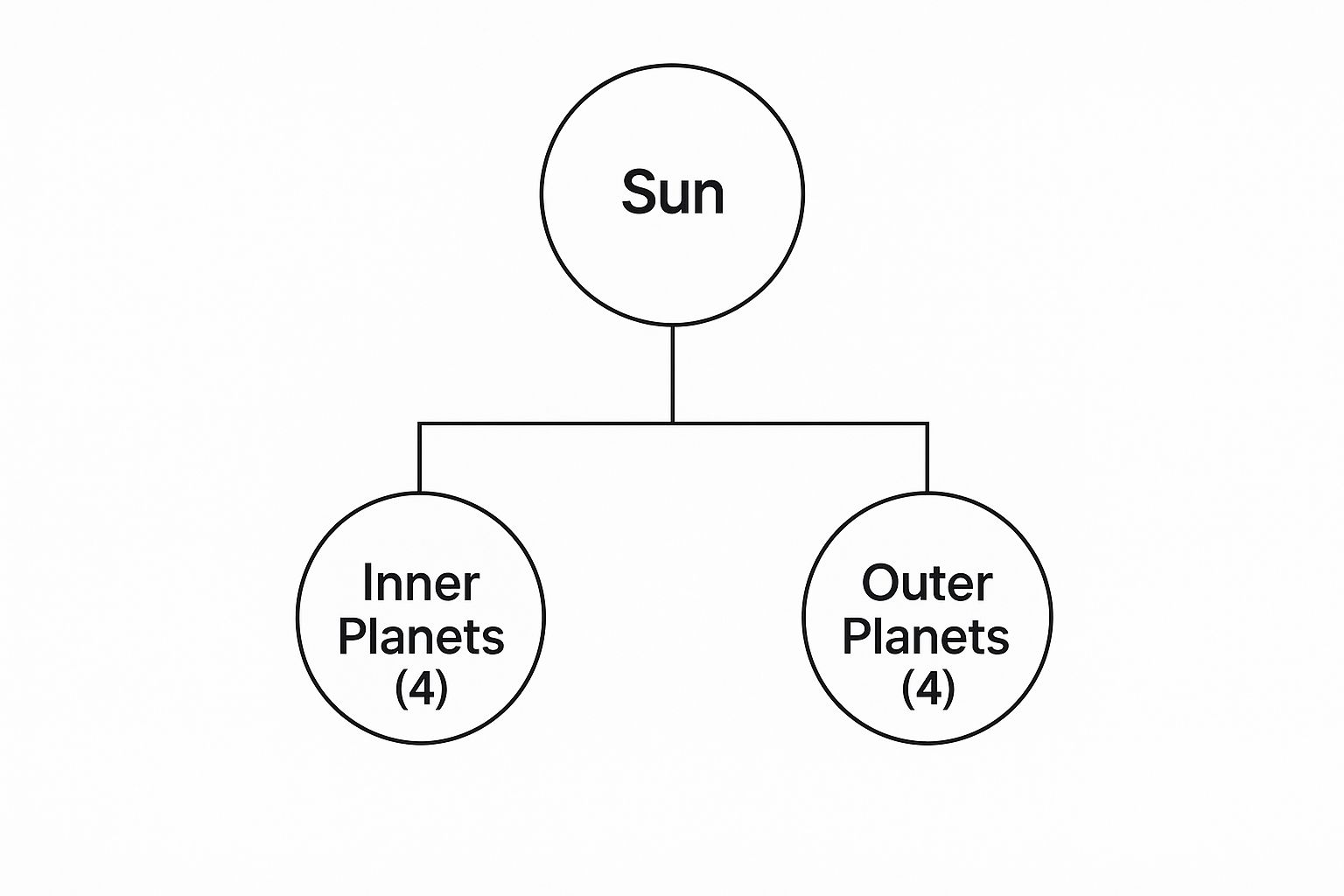
This simple chart helps us see that the solar system isn’t just a random jumble of stuff. It’s a really structured family, with the inner, rocky planets huddled closer to the Sun and the huge, gassy giant planets hanging out much farther away. This organisation is the key to why they are all so different, something we’ll get into soon
The Sun: Our Neighbourhood’s Star
Right at the very heart of the solar system, you’ll find our incredible star, the Sun. It’s not a planet but a gigantic, glowing ball of super-hot gas, basically acting as the power plant for our entire cosmic neighbourhood. Think of it as the ultimate anchor—the team captain that everything else follows.
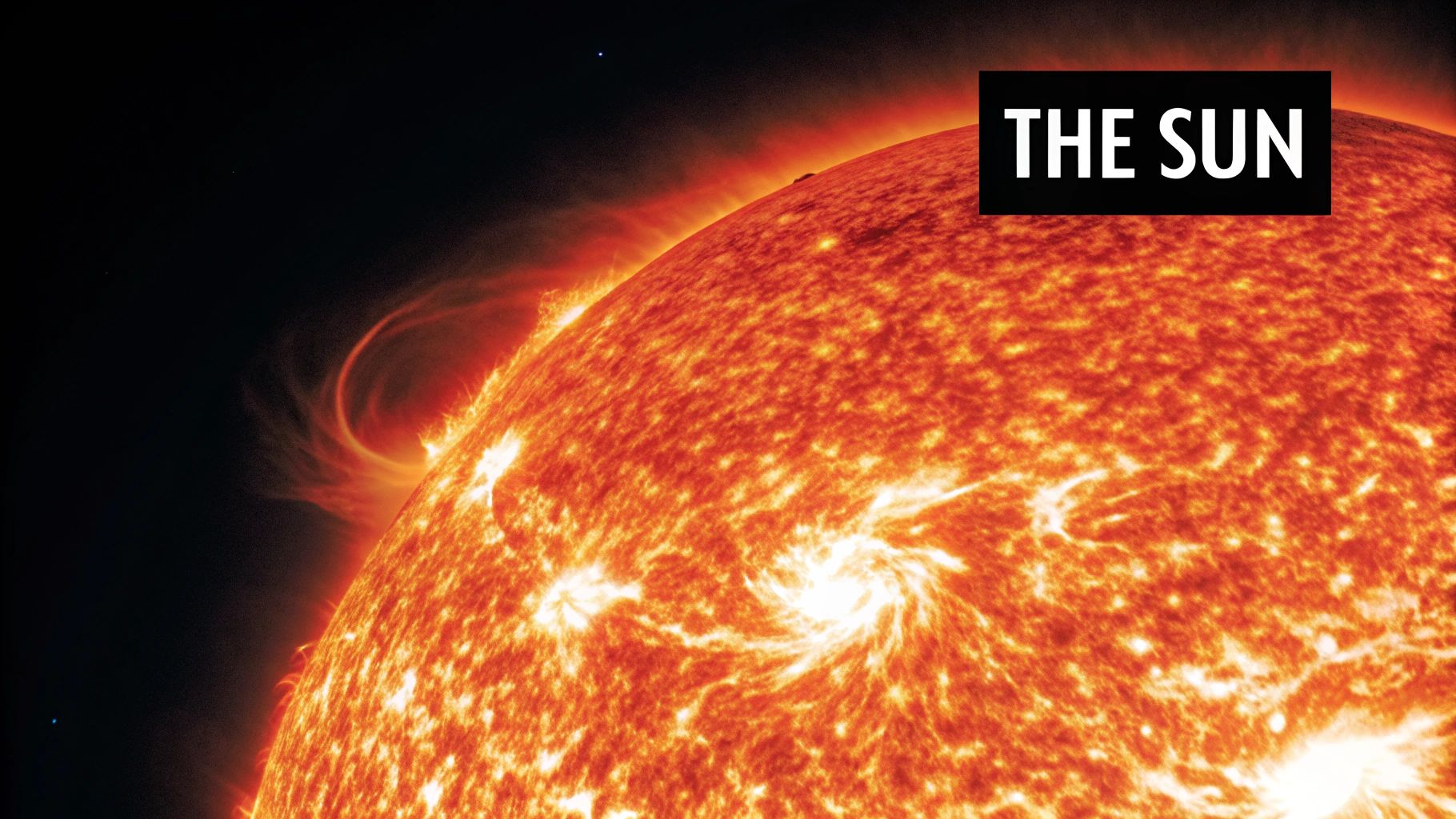
Its immense gravity is like cosmic glue, a powerful force that reaches out across millions of miles. This force keeps every planet, from tiny Mercury to icy Neptune, locked in its special path, or orbit. Without the Sun’s gravitational pull, the planets would just wander off into the cold, dark emptiness of space.
The Sun is so big that you could fit about 1.3 million Earths inside it! It makes up more than 99% of all the mass in our entire solar system.
A Giant Space Engine
But the Sun does more than just hold things in place; it’s also a seriously powerful engine. Deep within its core, it smashes atoms together in a process called nuclear fusion. This process releases an unbelievable amount of energy.
This energy travels outwards for thousands of years before finally escaping the Sun’s surface as light and heat. These waves of energy, which we call sunlight, then journey across space in every direction. It takes about eight minutes for this light to travel the 93 million miles to reach us here on Earth.
This solar energy is what makes life on our planet possible. It warms our world, powers our weather, and gives plants the fuel they need to grow through photosynthesis. Without the Sun’s constant glow, Earth would be a frozen, lifeless rock. You can see just how important the Sun’s energy is, and you can even bring its power to life through creative activities like those in the new Space Ranger Fred colouring book.
Harnessing the Sun’s Power
We’ve even learned how to capture the Sun’s energy right here on Earth using solar panels. These clever devices turn sunlight directly into electricity to power our homes, schools, and even hospitals. It’s a clean, renewable way to generate power because the Sun won’t be running out of fuel for billions of years.
The UK government is using this amazing technology to help schools and hospitals save money and become more eco-friendly. Through the Great British Energy initiative, a huge £180 million investment was set aside to install solar panels on hundreds of public buildings. The first 11 schools with these panels are already saving a combined £175,000 a year on their energy bills, showing just how powerful our local star can be. You can learn more about how the UK is using solar power for schools on GOV.UK.
Exploring the Inner Rocky Planets
Now that we’ve met our cosmic powerhouse, the Sun, let’s blast off on a tour of the planets! Our first stops are the four worlds huddled closest to the Sun, known as the terrestrial or rocky planets. It’s a fancy way of saying they all have a solid, rocky surface you could (in theory) stand on—unlike the gassy giants we’ll meet later.
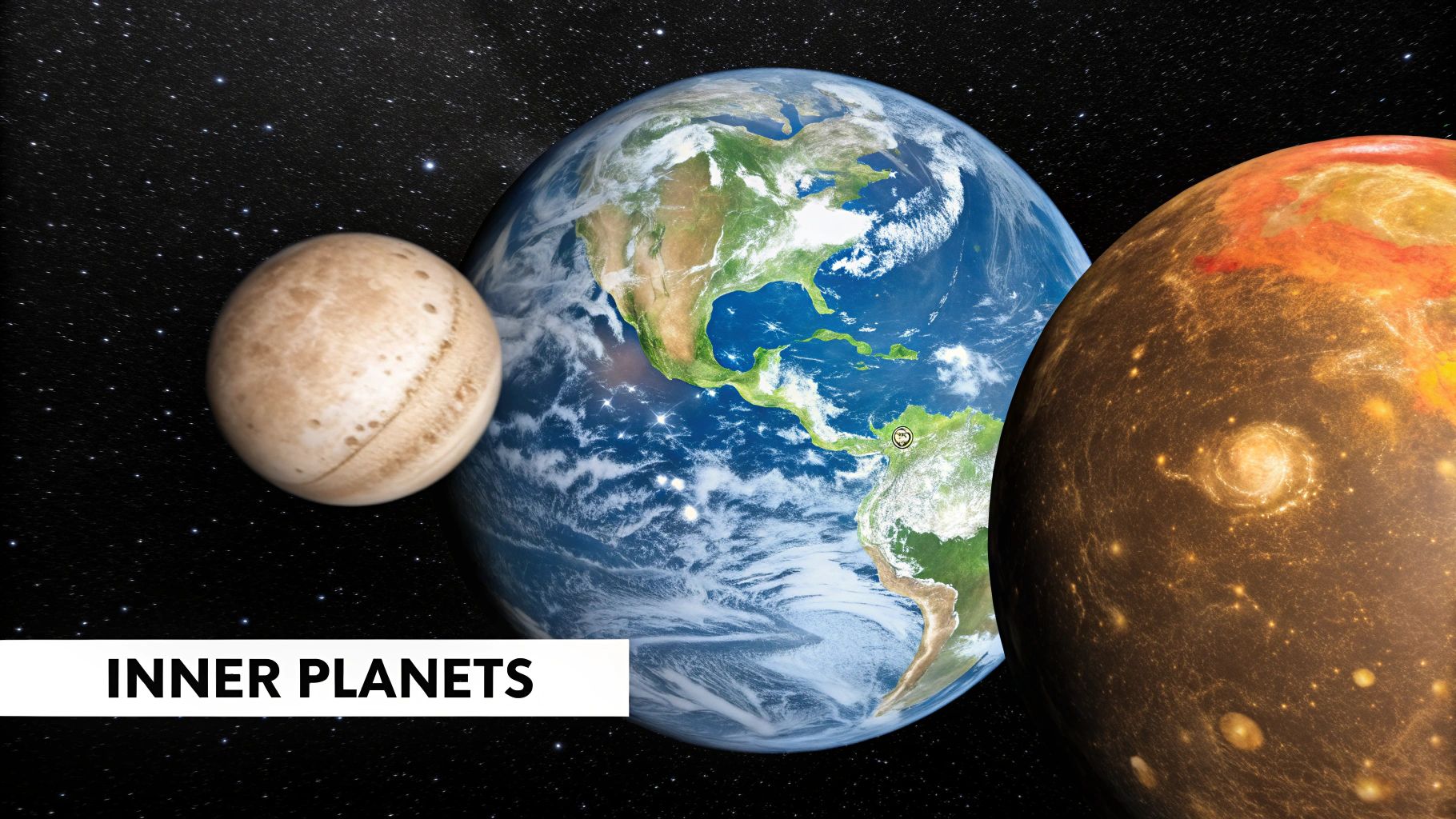
Think of these inner planets as the Sun’s closest neighbours, living in the warmest part of our solar system. But don’t be fooled—each one has a wildly different personality and a unique story to tell.
Let’s fire up the engines and meet them one by one!
Mercury: The Speedy Planet
First up is Mercury, the smallest planet in the solar system and the one that practically skims the Sun. Being so close means it zips around our star faster than any other planet, finishing a full trip in just 88 Earth days. That’s right, a whole year on Mercury is shorter than three of our months!
But life on Mercury is all about extremes. During the day, it’s hot enough to melt lead, with temperatures soaring to a blistering 430 degrees Celsius. But with almost no atmosphere to trap that heat, nighttime temperatures plunge to a bone-chilling -180 degrees Celsius. Yikes!
Venus: Earth’s Fiery Twin
Our next destination is Venus, a planet often called Earth’s “evil twin.” It’s almost the exact same size as our home, but that’s where the family resemblance ends. Venus is actually the hottest planet in our solar system, even hotter than Mercury!
Its thick, toxic atmosphere is a suffocating blanket of carbon dioxide, creating a runaway greenhouse effect. This traps heat and keeps surface temperatures at a staggering 465 degrees Celsius, day and night. Venus is also permanently wrapped in thick, yellowish clouds of sulphuric acid, hiding its fiery surface from our view.
Ever heard of the Goldilocks Zone? It’s the ‘just right’ region around a star where temperatures are not too hot and not too cold for liquid water to exist. Venus is too hot, Mars is too cold, but Earth is just right!
Earth: The Living World
Our third stop is a very special one—our home, Earth! It’s the only planet we know of that has all the right ingredients for life as we know it. We’re perfectly positioned in the Sun’s “Goldilocks Zone,” where things aren’t too hot or too cold.
This perfect spot allows for vast oceans of liquid water, a protective atmosphere to breathe, and a stable climate. From its deep blue oceans and lush green forests to its sprawling deserts, Earth is a dynamic and vibrant world teeming with millions of different species. It’s pretty special.
Mars: The Rusty Red Planet
Our final stop in the inner solar system is Mars, famously known as the Red Planet. Its cool reddish colour comes from iron oxide—that’s just rust—in its soil, exactly like the rust you might find on an old bike.
Today, Mars is a cold, desert world with a very thin atmosphere. It’s also home to the tallest volcano in the entire solar system, Olympus Mons, which stands nearly three times the height of Mount Everest! Scientists are fascinated by Mars because there’s strong evidence that it once had liquid water and a thicker atmosphere billions of years ago, making it a top target in the search for past life.
Journeying to the Gas and Ice Giants
Okay, wave goodbye to the small, rocky worlds! Our journey is about to take a massive leap into the outer solar system. This is where the real giants live—colossal worlds that make our home planet Earth look like a tiny marble. Get ready to meet the gas giants, Jupiter and Saturn, and the chilly ice giants, Uranus and Neptune.
One of the coolest things to remember about these planets is that they are totally different from the ones we’ve met so far. You couldn’t land a spaceship on them! Instead, they’re mostly made of swirling gases, strange liquids, and ice, all wrapped around a small, rocky core hidden deep, deep inside.
The King and the Jeweller
First up, we arrive at the undisputed king of the planets: Jupiter. This world is so enormous that all the other planets in our solar system could comfortably fit inside it. Jupiter is famous for its stripes, which are actually colourful clouds of ammonia and water, and for its incredible Great Red Spot. Just imagine a colossal, swirling storm bigger than our entire planet that’s been raging for hundreds of years!
Next, we’ll cruise over to what many people think is the most beautiful planet of all, Saturn. While it’s another huge gas giant like Jupiter, Saturn is famous for one thing in particular: its breathtaking rings.
Think of a giant cosmic hula-hoop spinning around a planet, made from billions of individual pieces of ice and rock. That’s what Saturn’s rings are like! Some of these pieces are as small as a grain of sugar, while others are as big as a house.
The Sideways Spinner and the Windy World
Venturing even further into the cold, dark reaches of our solar system, we meet the ice giants. These planets get their name because they contain more icy materials—like water, methane, and ammonia—than their gassy cousins.
Our first stop is Uranus, a truly mysterious and odd planet. Unlike every other planet, which spins like a top, Uranus is tilted so far over that it actually spins on its side! Scientists believe that long, long ago, something massive may have crashed into it, knocking it over. This extreme tilt gives it some of the most bizarre seasons in the solar system, with each one lasting for over 20 years.
Finally, we reach our last official stop, the deep blue world of Neptune. It’s the furthest planet from the Sun, making it an incredibly cold and dark place. Neptune gets its stunning blue colour from methane gas in its atmosphere, which soaks up red light and reflects blue light back into space.
But Neptune’s most extreme feature is its wind. It is the windiest planet in our solar system, with supersonic winds that whip around at more than 1,200 miles per hour—that’s faster than a fighter jet! It’s a beautiful but incredibly wild and stormy world, showing just how diverse and amazing our solar system truly is.
Meet the Rest of the Cosmic Crew
Beyond our sun and the eight big-shot planets, the solar system is buzzing with all sorts of other incredible objects. Think of them as the supporting cast in our cosmic neighbourhood—they might be smaller, but the story wouldn’t be the same without them! Let’s get to know the moons, asteroids, and comets that make our little corner of space so wonderfully busy.
These smaller bodies are like cosmic clues, the leftovers from when the planets were first being built billions of years ago. By studying them, scientists can piece together the entire history of how our solar system came to be.
Loyal Moons and Their Planets
Most planets aren’t travelling through space alone; they have loyal companions called moons that tag along, orbiting them on their journey. Our own Earth has one moon that beautifully lights up our night sky, but some planets have dozens!
Jupiter, the absolute giant of our solar system, has at least 95 known moons, and Saturn has an incredible 146! These moons come in all sorts of shapes and sizes. Some, like Jupiter’s moon Ganymede, are even bigger than the planet Mercury, while others are just little chunks of rock that got captured by the planet’s gravity.
Moons are also known as natural satellites. A planet’s gravity keeps its moons in orbit, just like the Sun’s gravity keeps all the planets circling around it. It’s a cosmic dance happening on a smaller scale!
The Asteroid Belt: A Cosmic Scrapyard
Way out between Mars and Jupiter, there’s a massive, doughnut-shaped ring filled with millions of rocky objects. This is the Asteroid Belt, and you can imagine it as a giant cosmic scrapyard, packed with all the leftover building materials that never quite became a planet.
These space rocks, known as asteroids, are what was left over after the main planets formed. They range from the size of tiny pebbles to massive objects hundreds of miles wide. But even with millions of them, their total weight is actually less than our own Moon. You can see just how exciting these space objects can be for young readers in stories like Space Ranger Fred in The Shoelace Adventure.
Comets: The Dirty Snowballs of Space
Finally, let’s chase down the most dramatic members of our cosmic crew: comets. Often called “dirty snowballs,” comets are lumps of frozen gases, rock, and dust that zoom around the Sun in huge, looping orbits.
When a comet gets close to the Sun, things get exciting. The ice on its surface heats up and instantly turns into gas. This process releases a cloud of gas and dust that forms a glowing head (called a coma) and a spectacular tail that can stretch for millions of miles across the sky.
How Space Exploration Helps Us on Earth
So, why should we care about what’s happening way out there in the solar system? Because believe it or not, exploring distant planets and mysterious stars actually helps us solve problems right here at home! The incredible challenges of space travel push us to invent some truly amazing new things.
Think about it this way: by studying the Sun’s awesome power, scientists were inspired to create clever renewable technologies like solar panels. These gadgets turn ordinary sunlight into electricity, powering our homes and schools without making our planet poorly.
It doesn’t stop there. Figuring out how planets orbit the Sun is the secret sauce behind launching satellites. We rely on these high-flying helpers every day for things like GPS to stop us from getting lost, clear phone calls, and even the weather forecasts that tell us whether to pack a brolly.
Turning Space Science into School Smarts
Exploring the cosmos is a huge boost for science, technology, engineering, and maths (or STEM for short). For instance, when UK schools install solar panels on their roofs, they’re not just getting clean energy—they’re getting a brilliant new teaching tool.
Teachers can use real-time energy data to bring maths lessons to life, explaining concepts like percentages and graphs in a way that feels practical and exciting. You can find out more about how solar panels power learning in UK schools right here.
Every question we ask about space leads to a solution that can improve our world. From creating better materials to developing new medicines, our cosmic curiosity makes life better on Earth.
This same spirit of discovery is exactly what fuels awesome projects designed to make learning a blast. In fact, you can see how Space Ranger Fred makes STEM learning fun with his exciting adventures.
Learning about our solar system isn’t just about exploring space—it’s about building a better future right here on the ground.
Burning Questions About Our Solar System
Even after our grand tour of the cosmos, you might have a few questions still buzzing around your head. That’s brilliant! Curiosity is the fuel that powers every great explorer. Let’s tackle some of the most common head-scratchers people have when they first start exploring our cosmic neighbourhood.
We’ll keep the answers simple, straight to the point, and just as fun as the rest of our journey.
Why Isn’t Pluto a Planet Anymore?
Ah, the classic! For ages, everyone knew Pluto as the ninth and final planet. But as our telescopes got more and more powerful, we started spotting lots of other small, icy worlds hanging out in Pluto’s neck of the woods. Some were even bigger than Pluto!
This got scientists thinking. They needed a clearer set of rules for what makes a planet, well, a planet. To get into the exclusive “planet club,” an object has to tick three boxes:
- It must be in orbit around the Sun.
- It has to be big enough for its own gravity to squash it into a round shape.
- It must have “cleared its neighbourhood” – meaning its gravity is strong enough to have hoovered up or flung away all the other space rocks in its path.
Pluto nails the first two, no problem. But it hasn’t quite managed to clear its orbit of all the other cosmic clutter. So, in 2006, scientists gave it a cool new title: dwarf planet. It’s still an amazing and mysterious world, just in a different category!
Is Earth the Only Planet with a Moon?
Not even close! Our Moon feels like our special cosmic companion, but most of the other planets have moons of their own. In fact, having just one moon is pretty unusual.
The real moon-collectors are the giant gas planets. Jupiter has at least 95 known moons, while Saturn boasts an incredible 146! And these aren’t just boring rocks, either. Some of these moons are incredible worlds with erupting volcanoes, hidden oceans of water, and maybe even the perfect recipe for life.
Ready for more out-of-this-world adventures? Explore the universe with Space Ranger Fred and discover a galaxy of fun books, games, and activities that make learning about space an exciting mission for everyone. Start your next adventure at spacerangerfred.com
Article created using Outrank