
Ever wondered what happens to old satellites or rocket parts after a mission? Put simply, space debris is any piece of machinery or junk left behind by humans in space. Think of it as a growing collection of all the non-functional, human-made stuff zipping around our planet. This ranges from entire dead satellites all the way down to tiny flecks of paint travelling faster than a bullet.
A Junkyard Above Our Heads
Imagine a massive, invisible scrapyard whipping around Earth at breathtaking speeds. That’s pretty much what we’re dealing with. It’s everything we’ve left floating up there after more than sixty years of exploring the cosmos.
Think of it as a chaotic, high-speed motorway with no traffic laws, where even the smallest nut or bolt poses a massive threat.
These items, which no longer serve any purpose, continue to circle the planet at about 17,500 mph—a blistering pace that lets them orbit Earth in just 90 minutes.
To give you an idea of what’s up there, let's take a quick look at the main culprits.
A Quick Look at Common Types of Space Debris
This table categorises the main sources of space junk to give you a clear, at-a-glance understanding of what's orbiting above.
| Type of Debris | Common Examples | Typical Size Range |
|---|---|---|
| Defunct Satellites | Old satellites that have run out of fuel or stopped working | Car-sized to bus-sized |
| Discarded Rocket Stages | Large parts of rockets that separate after launch | Often several metres long |
| Collision Fragments | Tiny to large pieces created when objects smash into each other | From microscopic flecks to football-sized chunks |
| Mission-Related Items | Things like lost tools, bolts, and even frozen astronaut waste | From tiny screws to larger pieces of equipment |
As you can see, the junk comes in all shapes and sizes, each with its own story of how it ended up there.
This infographic gives you a brilliant visual breakdown of space debris by size, showing just what makes up most of our orbital clutter.
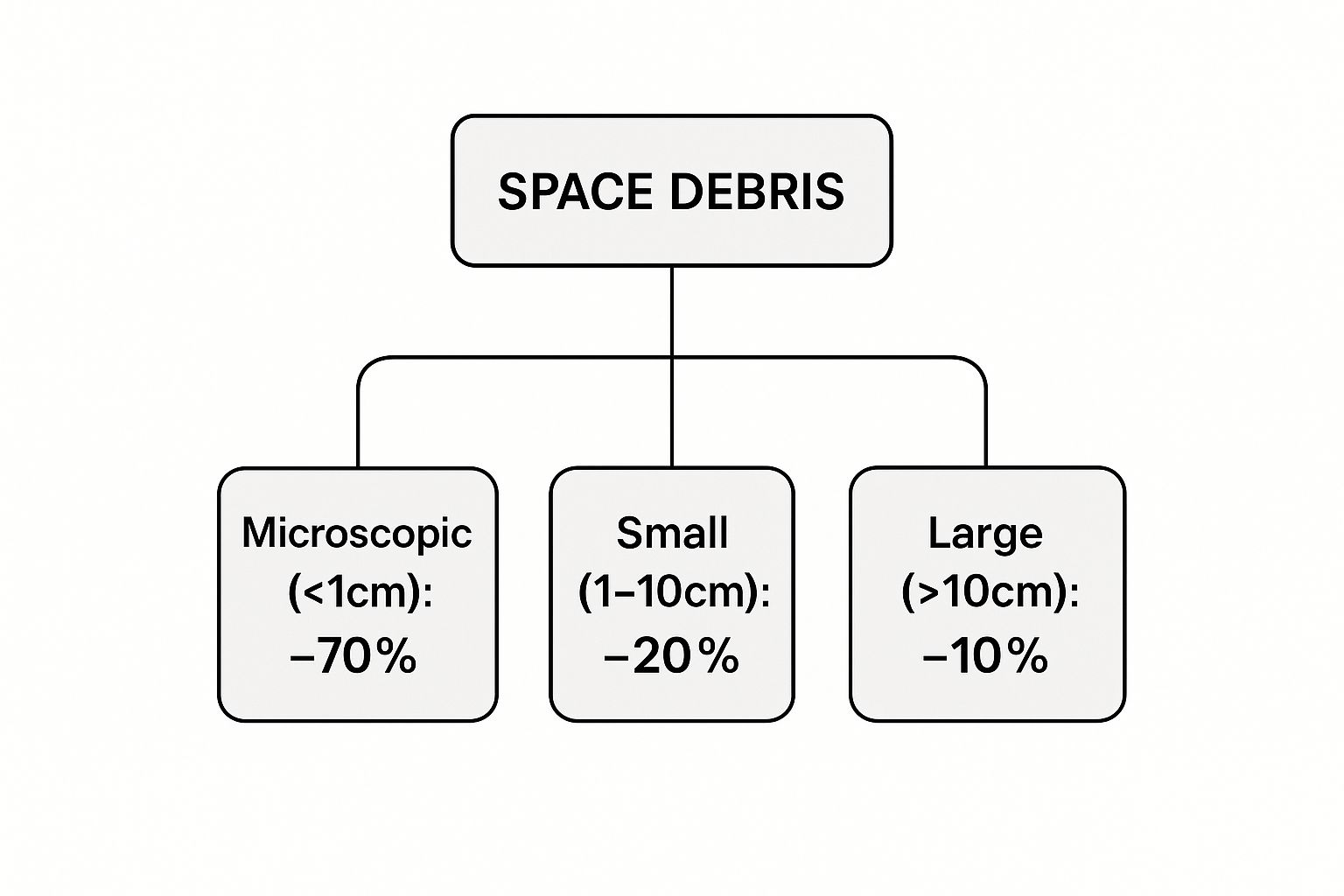
It’s pretty clear that microscopic debris makes up the vast majority of objects. But don't be fooled by their size—at orbital speeds, even these tiny fragments can cause catastrophic damage.
Why Does It Matter?
Navigating all this clutter is a genuine challenge for our active satellites and, of course, for astronauts. A hero like Space Ranger Fred would need to be incredibly careful on his missions. A simple mistake could easily create a new piece of high-speed debris, adding to the problem for decades to come.
Getting to grips with our vast solar system also means facing up to the challenges we've created within it. You can learn more about our cosmic neighbourhood by exploring our easy guide to the solar system.
This ever-growing field of junk seriously threatens the technology we all rely on every single day for weather forecasts, GPS, and global communications. It's a problem we made, and one we need to solve.
The Hidden Dangers Lurking in Orbit

It's easy to think, "What harm can a tiny lost screw really do in the sheer vastness of space?" But the secret isn't in its size; it’s in its incredible speed.
Up in orbit, even the smallest object packs an astonishing punch because of its kinetic energy—the energy of motion. To put it in perspective, a single fleck of paint travelling at orbital speeds can hit with the same force as a bowling ball dropped from a three-storey building. Ouch.
This isn’t just a what-if scenario; it’s a very real threat to the technology we depend on every single day. The number of objects whizzing around our planet is simply staggering. Estimates suggest there are 140 million pieces of space debris smaller than 1 cm, and over 54,000 tracked objects larger than 10 cm.
Even the tiniest fragments can cause catastrophic damage to the satellites that give us GPS, weather forecasts, and emergency communications. You can get a sense of the scale of the problem and the work being done to safeguard our orbital services on innovationnewsnetwork.com.
The Kessler Syndrome: A Domino Effect in Space
This is where the problem gets much, much bigger. Scientists have a name for their biggest worry: the Kessler Syndrome. Think of it as a chain reaction in orbit.
Imagine one satellite collides with a large piece of junk. That single crash instantly shatters into thousands of new, smaller pieces of debris. Each of those fragments now becomes a tiny missile, dramatically increasing the chances of more collisions with other satellites.
If this happens enough times, it could trigger a runaway domino effect.
This cascading series of collisions could eventually wrap a thick, impassable shell of debris around our planet. It would make certain orbits completely unusable for future rockets and satellites, potentially cutting us off from space for generations.
This is exactly why managing every single object, no matter how small, is so critical. In stories like Space Ranger Fred and the Shoelace Adventure, every piece of equipment is tracked with care, because losing just one tool can create long-lasting problems for everyone exploring the cosmos.
Tracing the Origins of Our Space Junk Problem
Our orbital neighbourhood didn’t get this cluttered overnight. This story began over sixty years ago, right at the dawn of the Space Race. Every single launch, every satellite deployed, and every mission completed has left a little something behind.
The problem has been building for decades. The moment the first satellite, Sputnik 1, shot into orbit in 1957, we officially started leaving our mark on space. Since then, thousands of missions have followed suit, each adding to the ever-growing cloud of junk.
Think of it like a garden where we've planted incredible flowers but never bothered to tidy up the leftover pots and tools. Over time, the mess has just piled up, making it harder to move around without tripping over something.
The Main Culprits in Orbit
So, what exactly makes up this high-speed junkyard whizzing above our heads? The debris comes from a few main sources, each contributing to the orbital traffic jam in its own unique way.
- Defunct Satellites: These are the ghosts of missions past. Once a satellite runs out of fuel or its electronics give up, it becomes a big, uncontrollable piece of junk, silently tumbling through space.
- Discarded Rocket Stages: Rockets are built in stages. After a stage uses up its fuel to give its payload a final push into orbit, it’s cast off and left to drift. Many of the largest pieces of debris are these spent rocket bodies.
- Collision Fragments: When two objects collide in space, they don't just get a dent—they can shatter into thousands of smaller, lethal fragments. This also includes junk from intentional anti-satellite tests, which create massive, dangerous clouds of shrapnel.
Even the smallest, most harmless-looking things can become a permanent hazard. A lost glove from an astronaut's spacewalk or a stray bolt can orbit for centuries, posing a real threat to future missions.
This is exactly why managing every little detail is so critical. A story like Space Ranger Fred and the Shoelace Adventure perfectly illustrates this idea for kids. In the book, a simple lost shoelace seems trivial, but in the reality of space, an object that small becomes a permanent piece of high-speed junk—a tiny missile just waiting to cause big problems.
How We Keep an Eye on Space
With so many bits and pieces whizzing around up there, you have to wonder: how does anything avoid a cosmic crash? It all comes down to a worldwide effort to watch the skies, a bit like air traffic control, but for space.
Specialist organisations use a huge network of powerful ground-based radar and optical telescopes to spot, track, and catalogue everything floating in orbit. Groups like the UK's National Space Operations Centre (NSpOC) keep tabs on tens of thousands of the largest pieces of debris. They can predict where these objects are going with incredible accuracy, creating a constantly updated map of our orbital neighbourhood.
The Art of the Orbital Dodge
So, what happens when that map shows a working satellite and a chunk of junk are about to get a little too close? That’s when it’s time for some seriously high-stakes driving. Satellite operators get an alert and sometimes have to perform a collision avoidance manoeuvre.
This means they fire the satellite’s tiny thrusters to gently nudge it into a slightly different, safer orbit. It’s a delicate dance that has to be planned carefully so they don’t waste precious fuel. It’s just like in Space Ranger Fred and the Umbrella Rescue—a small, smart move can prevent a much bigger disaster down the line.
This screenshot shows the official page for the UK Space Agency, one of the key players in keeping our orbits safe.
The site explains their mission to ensure the UK’s activities in space are safe and sustainable, which includes tackling the growing problem of space debris.
And these efforts are genuinely working. In May 2025, for example, NSpOC reported some fantastic results: a 30% decrease in objects falling back into the atmosphere and an amazing 41% fall in collision risks for UK satellites compared to the month before. It just goes to show how vital this active monitoring is for protecting the technology we all rely on. You can read more about the UK's work in protecting space on gov.uk.
The Big Cleanup Missions Securing Our Future in Space

Knowing where all the space junk is floating is one thing, but what about cleaning up the mess that’s already there? To keep the dream of space exploration alive, we need to think like a cosmic cleanup crew. It's time to get clever and figure out how to remove the most dangerous bits and pieces from our orbital junkyard.
Engineers and scientists all over the world are dreaming up some truly brilliant ideas. Imagine giant nets swooping through space to capture a tumbling satellite, or powerful magnets latching onto old bits of metal. Some are even testing robotic arms and harpoons to grab old rocket bodies. It’s resourceful thinking at its best, a bit like in Space Ranger Fred and the Umbrella Rescue, where a smart fix stops a much bigger problem from happening.
And these aren't just ideas on a whiteboard anymore. They're starting to happen.
Pioneering the Orbital Cleanup
The UK Space Agency is funding a really ambitious mission to remove two old UK satellites from orbit in a single trip. The plan involves sending up a special spacecraft to chase them down, grab them, and then drag them back towards Earth’s atmosphere where they’ll burn up safely. It's a huge step forward in proving that cleaning up space isn't just possible—it’s essential.
Successfully removing even a few large objects can have a massive impact. Each piece of debris taken out of orbit prevents it from potentially smashing into other objects and creating thousands of new, smaller fragments.
Designing for a Cleaner Future
Beyond just tidying up, the real long-term solution is all about how we build satellites in the first place. The goal is to design them for a clean end from the very beginning.
This means every new satellite needs a clear plan for when its job is done. Some of the key ideas are:
- Built-in Propulsion: Giving satellites enough fuel to push themselves out of orbit and into the atmosphere to burn up when they're finished.
- Magnetic Docking Plates: Adding simple metal plates so future cleanup missions can easily grab onto them.
- Standardised Components: Using common parts to make it much simpler for a robot to service or remove them later on.
By thinking ahead like this, we can avoid making the same mistakes again. Combining active cleanup missions with smarter, more responsible design will help make sure that vital places like the International Space Station and all our future missions have a clear, safe path for generations to come.
Common Questions About Space Junk
Got a few more questions buzzing around your head about space debris? Let's tackle some of the most common ones. These quick-fire answers should help clear things up.
Can Space Junk Fall Out of the Sky and Hit Someone?
It sounds like something straight out of a movie, but the chances of being hit are unbelievably small. Most of this stuff is tiny and burns up completely as it tears through our atmosphere, putting on a brief show as a shooting star.
What about the bigger chunks that make it all the way through? Well, they're far more likely to splash down harmlessly in the ocean, which covers over 70% of our planet. So far, there has never been a single confirmed report of anyone being seriously hurt by falling space junk.
So, Whose Job Is It to Clean Up All This Mess?
Now that is a tricky question, and one that world leaders are still figuring out. Right now, there isn't a single galactic cleanup crew in charge. The Outer Space Treaty, a big international agreement, says that anything launched into space forever belongs to the country that sent it up.
That means one country can’t just go and grab another’s old satellite without getting permission first. It's a bit of a puzzle, but forward-thinking groups like the UK Space Agency are busy developing clever missions and international rules to tackle the problem together.
How Do Astronauts on the ISS Stay Safe?
Think of the International Space Station (ISS) as a heavily armoured outpost orbiting the Earth. It’s covered in special shielding to protect it from tiny debris impacts. For the bigger, more dangerous pieces that can be tracked from the ground, space surveillance networks give the crew a heads-up.
If a piece of junk is projected to get a little too close for comfort, the ISS simply fires its thrusters to perform a "Debris Avoidance Manoeuvre" and nudges itself out of the way. It’s a bit like a car changing lanes to avoid something on the motorway. To get a better feel for their daily routines, you can read our guide on what astronauts do in space.
These manoeuvres have become a regular part of life on the station, happening several times a year to keep the crew and their incredible orbiting home safe from harm.
The folks on the ground are always watching. In one recent month alone, out of 52 tracked objects re-entering our atmosphere, 39 were old satellites. The good news is that active tracking works: the collision risk for UK-licensed satellites actually dropped by 18%. But it’s an ongoing challenge, as the total number of objects in orbit is still growing. You can discover more insights about orbital monitoring on gov.uk.
Why Can’t We Just Send Up a Giant Magnet?
It’s a fantastic idea, and one that would be great fun to see! But unfortunately, most space junk isn't actually magnetic. The bits and pieces are made from all sorts of materials, including lots of aluminium, special plastics, and ceramics.
Plus, trying to capture something zipping along at thousands of miles per hour is a massive engineering headache. That’s why the real-world solutions focus on clever, targeted methods like launching giant nets or using robotic arms to grab specific large objects—the kind of creative problem-solving you’d see in a book like Space Ranger Fred and the Tick Tock Tale.
At Space Ranger Fred, we believe learning about space should be just as thrilling as exploring it. Our books and adventures are crafted to spark that sense of wonder in young minds, making big STEM topics fun and easy to grasp for the next generation of explorers and innovators. Visit spacerangerfred.com to start your adventure!