
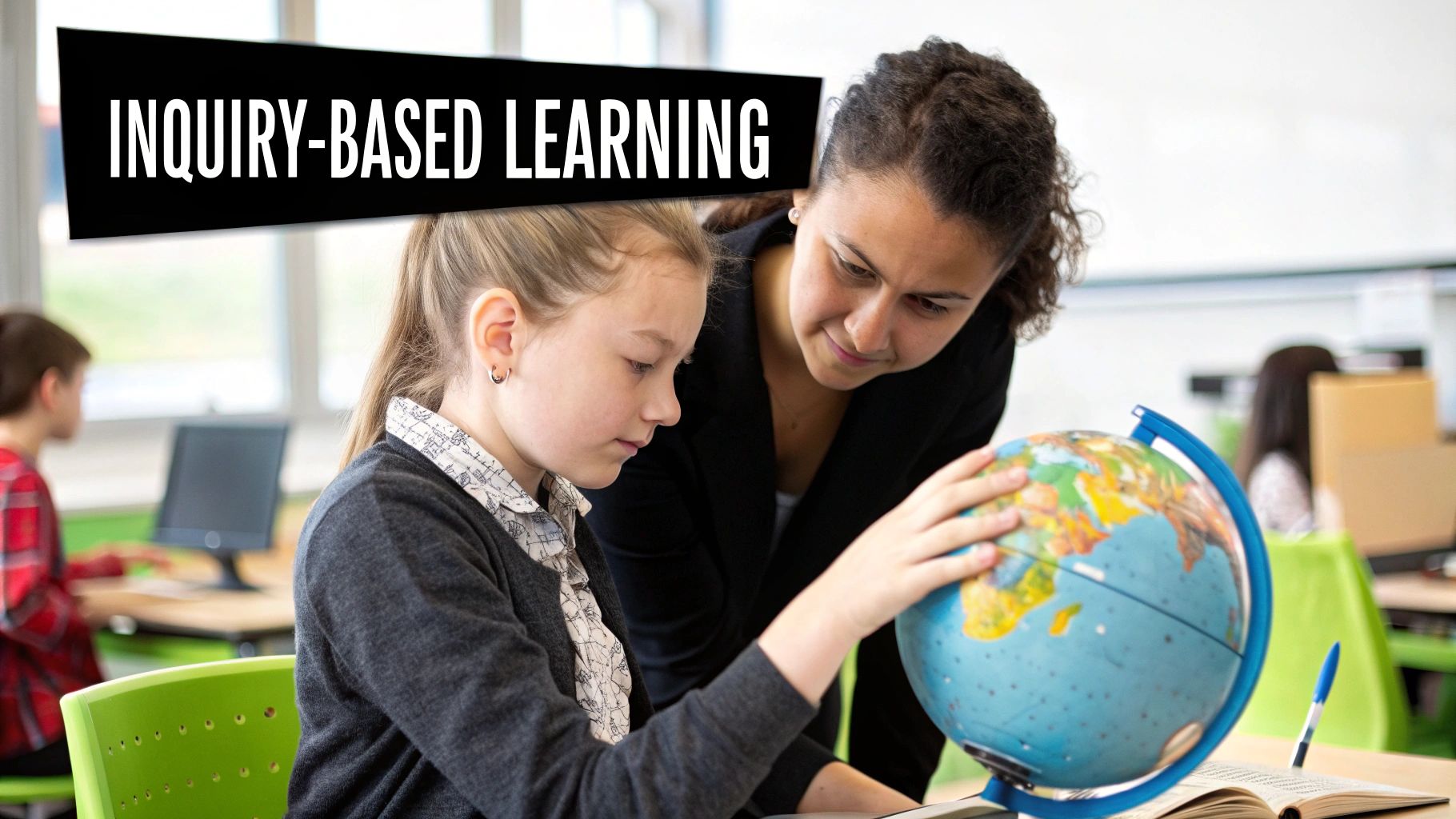
At its heart, inquiry-based learning is an approach that puts your child's natural curiosity in the driver's seat. Instead of sitting back and having information fed to them, kids get to ask questions, dig into problems, and discover the answers for themselves. It’s all about building understanding from the ground up and turning learning into a hands-on adventure. Think of it as the difference between reading a recipe and actually getting your hands messy in the kitchen to bake a cake.
From Memorising Facts to Solving Mysteries
Imagine you're reading a story like Space Ranger Fred and the Shoelace Adventure with your child. A traditional approach might end with a quick quiz on the characters and what happened. But with inquiry-based learning, it starts with a simple, curious question from you: "I wonder why Fred's shoelaces come undone in space, but ours stay tied on Earth?"
Suddenly, that one little question opens up a whole world of discovery. You and your child aren't just reading anymore; you're investigating the physics of knots, experimenting with different loops and pulls, and figuring out which methods create the most friction to hold tightest. You might even chat about how gravity (or the lack of it!) could affect things. Your child isn’t just memorising a fact; they're piecing together knowledge through real, hands-on exploration.
This is the fundamental difference. Learning shifts from focusing on the 'what' to the 'why' and 'how', empowering kids to become genuine thinkers and problem-solvers, not just listeners.
The Student as the Detective
Think of a traditional classroom as a guided tour where the teacher points out all the important sights. An inquiry-based classroom, on the other hand, is more like a science lab where the students are the detectives. They get the clues, but it's their job to ask the right questions, follow the leads, and piece together the solution.
Inquiry-based learning nurtures inquisitive habits that will aid children in their lifelong search for knowledge. It transforms them from passive recipients of information into active participants in their own education.
This method champions the idea that real understanding comes from doing, not just from hearing. It's a powerful shift that has a lasting impact on how children see challenges and pick up new skills.
To see just how different these two approaches are, let's break them down side-by-side.
Inquiry Based Learning vs Traditional Learning
Here's a quick comparison that highlights the key differences between the student-led world of inquiry and the more classic teacher-led classroom.
| Aspect | Inquiry Based Learning | Traditional Learning |
|---|---|---|
| Student's Role | Active investigator, problem-solver, and question-asker. | Passive listener, fact-memoriser, and direction-follower. |
| Teacher's Role | Facilitator, guide, and co-explorer. | Lecturer, expert, and primary source of information. |
| Learning Process | Driven by student questions and curiosity; hands-on exploration. | Follows a set curriculum and textbook; teacher-led instruction. |
| Focus | Understanding concepts and developing critical thinking skills. | Memorising facts and arriving at a single 'correct' answer. |
As you can see, the roles and the entire dynamic of the classroom are completely flipped. One is about discovery, and the other is about delivery.
The Four Stages of a Curious Mind
Inquiry-based learning isn’t just about letting kids run wild with their questions; it's more of a guided journey with a clear, natural structure. The process usually unfolds in four distinct stages, transforming a fleeting moment of curiosity into a really powerful learning experience. It’s a cycle of discovery that just keeps building on itself.
This image shows a simplified version of the inquiry cycle, highlighting the core steps from asking questions to thinking about what you've found.
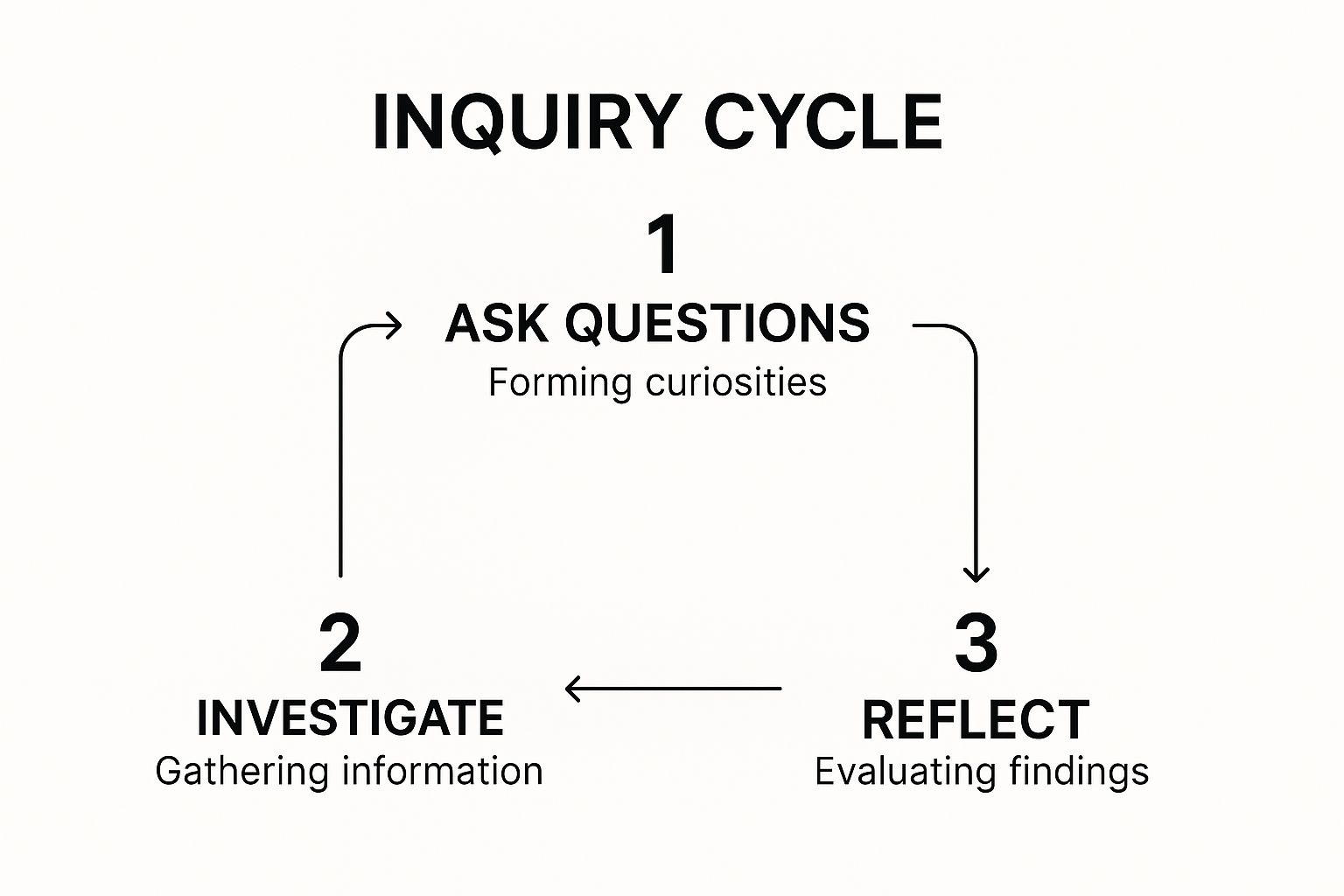
As you can see, it's not a one-off event. It's a continuous loop where looking back on what you've learned often leads straight to new, deeper questions. Let's break down each stage.
Stage 1: Questioning
It all begins with a question. This first phase is all about nurturing a child's natural wonder and helping them put words to what they want to know. Think of it as the spark that ignites the entire investigation.
Instead of simple yes-or-no questions, the goal is to encourage those big, open-ended "what if," "how," and "why" questions. A child might wonder, "Why do bubbles always pop?" or "How do rockets get into space?"
Stage 2: Investigating
This is where the real fun starts. The investigating stage is the hands-on part of the journey where children become active detectives, gathering information to figure out the answers. It’s about doing, not just listening.
For the popping bubbles question, this could mean mixing up your own bubble solution and trying out different wands. Through direct experimentation—testing wire wands, straw wands, and even their own hands—the child gathers their own data. They might also flick through books or even learn some amazing space facts for kids to see how liquids behave in zero gravity.
The investigation phase is crucial because it teaches children how to learn. They discover that answers can be found through observation, testing, and gathering evidence, not just by asking a grown-up.
This process empowers them to find solutions for themselves, building up their confidence and critical thinking skills. It turns learning from something passive into an engaging, memorable adventure.
Stage 3: Creating
After investigating, children need a way to make sense of everything they’ve discovered. The creating stage is about organising their findings and sharing them in a meaningful way, which helps to cement their new knowledge.
This doesn't have to be a formal lab report. A young child could:
- Draw a picture showing the different bubble wands and which one made the biggest bubbles.
- Build a model of a super-wand using pipe cleaners.
- Explain their findings to a family member, showing off their best bubble-blowing technique.
Even a simple act like telling a story about their experiment helps them process what they’ve experienced.
Stage 4: Reflecting
The final stage is reflection, where the learning journey comes full circle. In this phase, children think back on their process and their discoveries. It’s a quiet but powerful step that deepens their understanding.
Parents and teachers can guide this with a few gentle prompts:
- "What surprised you the most during your experiment?"
- "If you did it again, what would you do differently?"
- "What new questions do you have now?"
This reflection often sparks new curiosities, launching the cycle all over again. Perhaps now the child wonders why bubbles are always round, leading them into a whole new investigation about surface tension.
Building a Problem Solver, Not Just a Student
Inquiry-based learning isn’t just about filling a child’s head with interesting facts; it’s about handing them the mental toolkit they need to become confident, adaptable problem-solvers. This is absolutely vital in STEM fields, where the answers rarely come neatly packaged in a textbook. It's about building the skills to face the unknown with creativity and a bit of grit.

Think about it. When a child’s carefully built LEGO rocket keeps toppling over, they’ve stumbled upon a classic engineering problem. Instead of an adult swooping in with the solution, they’re encouraged to ask, "Why does it keep falling?" That simple question is the launchpad for a powerful thinking process.
They start to poke and prod at the problem, maybe noticing the base is too narrow or the top is too heavy. From there, they form a little theory ("Maybe if I add fins to the bottom…") and immediately put it to the test by rebuilding. This cycle of analysing, testing, and trying again is the very heart of critical thinking.
From Playtime Puzzles to Real-World Readiness
This hands-on, figure-it-out approach is brilliant preparation for the complex, messy challenges they’ll face later in life. Whether it’s debugging a line of code, designing a model Mars rover, or solving a tricky puzzle in a story like Space Ranger Fred and the Tick Tock Tale, the core skills are exactly the same. They learn not to fear failure, but to see it as a clue.
This kind of active engagement naturally strengthens key cognitive muscles:
- Analytical Skills: Kids learn to break down a huge, scary problem into smaller, bite-sized pieces they can actually tackle.
- Creative Thinking: They’re encouraged to dream up lots of potential solutions instead of hunting for one single "right" answer.
- Persistence: When one idea flops, they build the resilience to dust themselves off and try another angle.
You can easily nurture this at home with simple activities. For a bit of inspiration, have a look at our guide on 10 mind-blowing science experiments for kids to try in 2025.
The Proof Is in the Process
The impact this has on developing sharp thinking skills isn’t just a nice idea; it's backed by some pretty solid findings. Research looking into the effects of inquiry-based instruction on UK students has shown a remarkable link to their critical thinking abilities.
A notable meta-analysis revealed an effect size of 1.02 on critical thinking skills from inquiry-based instruction, which points to a very strong positive impact.
This really drives home the point: letting children lead their own learning doesn’t just help them remember facts. It fundamentally develops transferable skills like planning, analysing information, and evaluating outcomes. By nurturing these abilities early on, we aren't just helping them get good marks in school—we're setting them up for a lifetime of discovery.
Bringing Inquiry-Based Learning to Life
So, what does inquiry-based learning actually look like when you get down to it? It’s far less complicated than it sounds and often feels more like guided play than a formal lesson. The real magic happens when you shift from just giving out answers to asking great questions—and then providing the space and tools for kids to explore.
Whether you're in a buzzing classroom or a quiet living room, the core idea is the same. The adult’s role changes completely. You stop being a lecturer and become more of a facilitator, a guide who helps spark curiosity without telling kids which way to go. It’s all about turning everyday moments into little learning adventures.
This approach is really starting to take hold in schools. In UK primary education, inquiry-based learning is increasingly seen as a hallmark of brilliant teaching, especially in science and technology. In fact, a 2014 report from the Education and Training Inspectorate (ETI) highlighted that the very best primary lessons were those driven by active, inquiry-based learning, where children ask their own insightful questions and hunt for the answers themselves. You can dive deeper into the findings in this insightful report on primary science teaching practices.
Inquiry in the Classroom Setting
In a school, a teacher might use a simple story to kickstart a whole project. Imagine a class reads Space Ranger Fred and the Umbrella Rescue, where Fred needs to find a way to stay dry from meteor showers. That’s the perfect launchpad for a fantastic hands-on STEM challenge.
The teacher’s guiding question could be something like, "What material would make the best waterproof shelter for Fred?"
From that one question, the students take the lead. The classroom transforms into a laboratory filled with different materials for them to test.
- Investigation Station: Kids might get scraps of fabric, plastic sheets, cardboard, and foil. Armed with spray bottles or droppers, they can test each material to see what happens when it gets wet.
- Data Collection: They could create simple charts, using drawings or words to record what they see—which materials let water through and which ones kept it out?
- Creative Construction: Finally, they use their findings to design and build their own miniature waterproof dens, putting their new knowledge into practice.
Throughout this whole process, the teacher isn’t just giving them the answer. Instead, they’re asking clever questions like, "What did you notice about the plastic?" or "Why do you think the cardboard got so soggy?" This nudges their thinking along without taking away that incredible "aha!" moment of discovery.
Inquiry in Your Own Home
You don’t need a classroom to bring this to life; your home is the perfect laboratory. Inquiry-based learning at home is often more spontaneous and can be woven right into your daily routines, like reading a bedtime story.
Let's say you're reading Space Ranger Fred and the Shoelace Adventure. As Fred fumbles with his laces, you can pause and spark a mini-investigation with a simple, wondering question.
"That's funny, Fred's knot keeps coming undone. I wonder why this bow holds so tight, but a simple loop just falls apart?"
That one question opens the door to a playful experiment. You don't need a formal plan—just grab a few different types of laces or string. Together, you can explore different knots, testing which ones are strongest and why. Suddenly, you’re not just reading a story anymore. You’re exploring physics, friction, and engineering in a way that just feels like a game. The learning becomes a shared, memorable experience.
How to Fuel Your Child's Natural Curiosity
When it comes to your child's learning journey, your role isn't to be a teacher with all the answers. Think of yourself more as a 'curiosity coach'—someone who helps them figure out how to find the answers for themselves.
The first step is simply creating a home where questions are celebrated. This can start with small but powerful shifts in how you chat about their discoveries.
Instead of just saying "That's right!" when they get an answer, try asking, "That's so interesting, how did you figure that out?" This little tweak shifts the focus away from just the answer and onto the thinking process behind it. It gives them a chance to reflect on their own logic and builds their confidence as a problem-solver.
Creating a Home for Questions
A brilliant and simple way to keep that curious spirit alive is to create a "wonder wall" or a "curiosity corner" somewhere in your home. It can be a small whiteboard, a chalkboard, or even just a designated section of the fridge.
Whenever a question pops up during the day—especially one you can't answer on the spot—jot it down.
A wonder wall shows your child that questions are valuable and worth remembering. It transforms "I don't know" from an endpoint into an exciting starting point for a future adventure together.
This simple act validates their curiosity and builds a fun backlog of investigations to tackle on a rainy afternoon. It also models a vital life skill: it’s okay to not know something, as long as you make a plan to find out.
Embracing the Joy of a 'Failed' Experiment
So, what happens when an experiment doesn't quite go to plan? These moments, which can feel like frustrating dead ends, are actually golden opportunities for learning.
When a meticulously folded paper boat sinks the second it hits the water, or a magnificent block tower comes crashing down, resist the urge to jump in and fix it. Instead, reframe the "failure" as a discovery.
Try saying something like, "How fascinating! Our first design didn't work. What did we learn from that? What should we try differently next time?" This approach turns setbacks into valuable data points, teaching resilience and the iterative nature of problem-solving—a core skill in any STEM field. It really works, too. Studies show that when schools and industry partners support inquiry-based learning, student engagement in STEM subjects climbs. You can read more about how integrated programmes boost STEM interest on frontiersin.org.
Making STEM fun is at the very heart of books like Space Ranger Fred and the Tick Tock Tale. To see more about how great stories can make tricky topics click, you might be interested in how the Space Ranger Fred website makes STEM learning fun. By providing simple materials and asking open-ended questions, you can nurture an inquisitive mindset and make learning a joyful, shared experience.
Common Questions from Parents
It's completely natural to have questions when you're exploring a new way of learning for your child. Getting to grips with what is inquiry based learning can feel a bit like charting new territory. Let's tackle some of the most common questions and concerns that pop up for parents.

Is Inquiry Based Learning Suitable for All Children?
Yes, but it won’t look the same for every child—and that’s a good thing! This approach is wonderfully flexible and can be adapted to all sorts of personalities and learning styles.
For a child who’s a natural-born explorer, it provides the freedom to really dive deep into things that fascinate them. For a quieter child who might prefer a bit more structure, a teacher or parent can provide more "scaffolding" at the start. This might mean offering more focused questions or a smaller set of materials to help build their confidence.
The key is to match the level of guidance to the child's comfort level, gradually encouraging more independence as they get the hang of exploring on their own.
This way, every child gets to enjoy the thrill of discovery without feeling overwhelmed.
How Does This Align with the School Curriculum?
This is a big—and very important—question. It’s easy to assume inquiry-based learning is just unstructured playtime, but in a classroom setting, it’s actually a very thoughtful way of meeting curriculum standards.
Teachers don't just let children follow random whims. They design projects and investigations that are cleverly aligned with specific learning goals. For example, a class project to build a miniature greenhouse might touch on key points in:
- Biology: Discovering what plants need to survive—sunlight, water, and warmth.
- Physics: Learning about heat transfer and how the greenhouse effect works.
- Mathematics: Using measurements and geometry to design and build the structure.
The teacher’s role is to gently steer the students' natural curiosity towards these learning objectives. In the UK, the National Curriculum even has a "Working Scientifically" component, which is a perfect example of how these inquiry skills are officially built into the system.
What if I Do Not Know the Answers?
Fantastic! Not knowing the answer is one of the best things that can happen. It shows your child a crucial life skill: how to find things out for yourself.
Your job isn't to be a walking encyclopaedia; it's to be a co-adventurer. When your child stumps you with a question, you can say something really powerful: "That is a brilliant question. I'm not sure… how could we find out together?"
That simple phrase turns the moment into a joint mission. You could look through a book like Space Ranger Fred and the Shoelace Adventure, watch a documentary, or try a simple experiment side-by-side. You’re teaching your child that learning never stops and that it's okay not to have all the answers—the fun part is knowing how to look for them.
Ready to launch your child’s next learning adventure? The Space Ranger Fred book series is packed with fun stories that spark curiosity and make STEM accessible for young explorers.