
Ever looked up at the night sky and seen all those thousands of twinkling stars? Well, get ready for a journey that’s even bigger and more exciting than Space Ranger Fred and the Shoelace Adventure! We live inside a giant, sparkling star-city called the Milky Way, and it’s our special home in the universe.
Our Galactic Home: The Milky Way
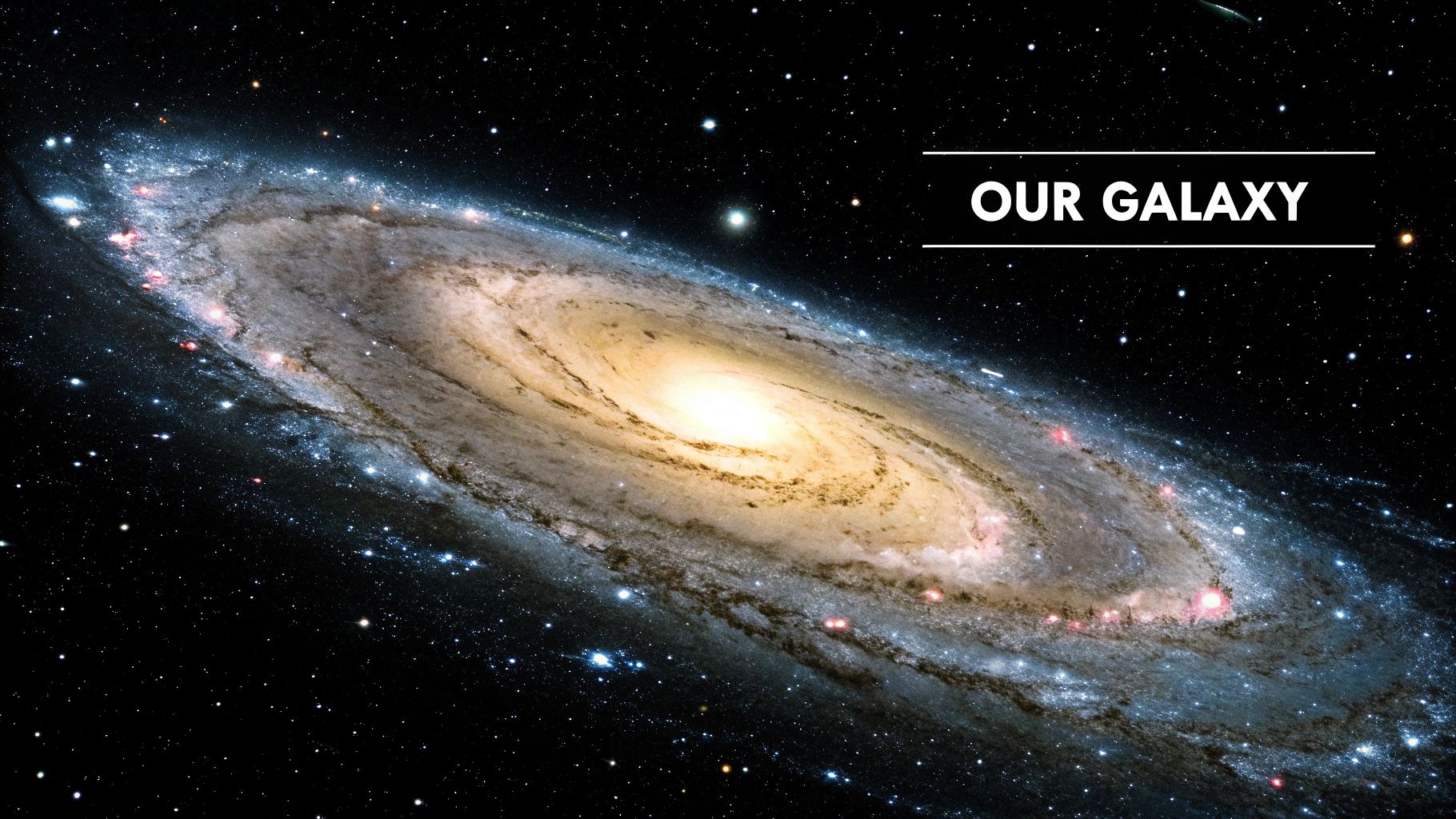
So, what exactly is the Milky Way? And no, I'm not talking about the chocolate bar!
Imagine a massive, spinning firework, like a pinwheel. But instead of sparks, it’s made of billions and billions of stars, planets, gas, and dust all swirling together. We live on a tiny little speck inside this cosmic swirl, on our planet called Earth.
This star-city of ours is absolutely enormous. If you could travel at the speed of light (which is the fastest anything can go!), it would still take you 100,000 years to fly from one side to the other. It's so big that scientists think it has up to 400 billion stars. That’s more stars than grains of sand on a huge beach!
To make sense of it all, it helps to think of our galaxy as having different neighbourhoods, each with its own job to do.
The Milky Way is our address in the universe. It’s what’s known as a barred spiral galaxy, which means it has a bright bar of stars in the middle and beautiful arms that spiral outwards, a bit like a Catherine wheel on Bonfire Night.
Let's break down the main parts of our galaxy to see how it all fits together.
The Milky Way at a Glance
Here are the most important facts about our galaxy in a simple chart.
| Feature | Simple Description |
|---|---|
| Galactic Centre | The bright, busy heart of the galaxy, where millions of stars are packed tightly together. |
| Spiral Arms | Long, curving arms of stars, gas, and dust that spin out from the centre. We live in one! |
| Stars & Planets | The main residents of our galaxy, including our own Sun and the eight planets in our Solar System. |
| Gas & Dust | Huge clouds called nebulae where new stars are born, like cosmic nurseries for baby stars. |
Thinking about our galaxy in these parts helps make this giant, amazing place feel a little more like home.
Finding Our Place in the Galaxy
If you were writing a letter to an alien friend, what would your address be? You’d probably start with your house, street, and town. Then you’d add your country, and of course, Planet Earth! But to be really, really specific, you’d need to include your galactic neighbourhood, too.
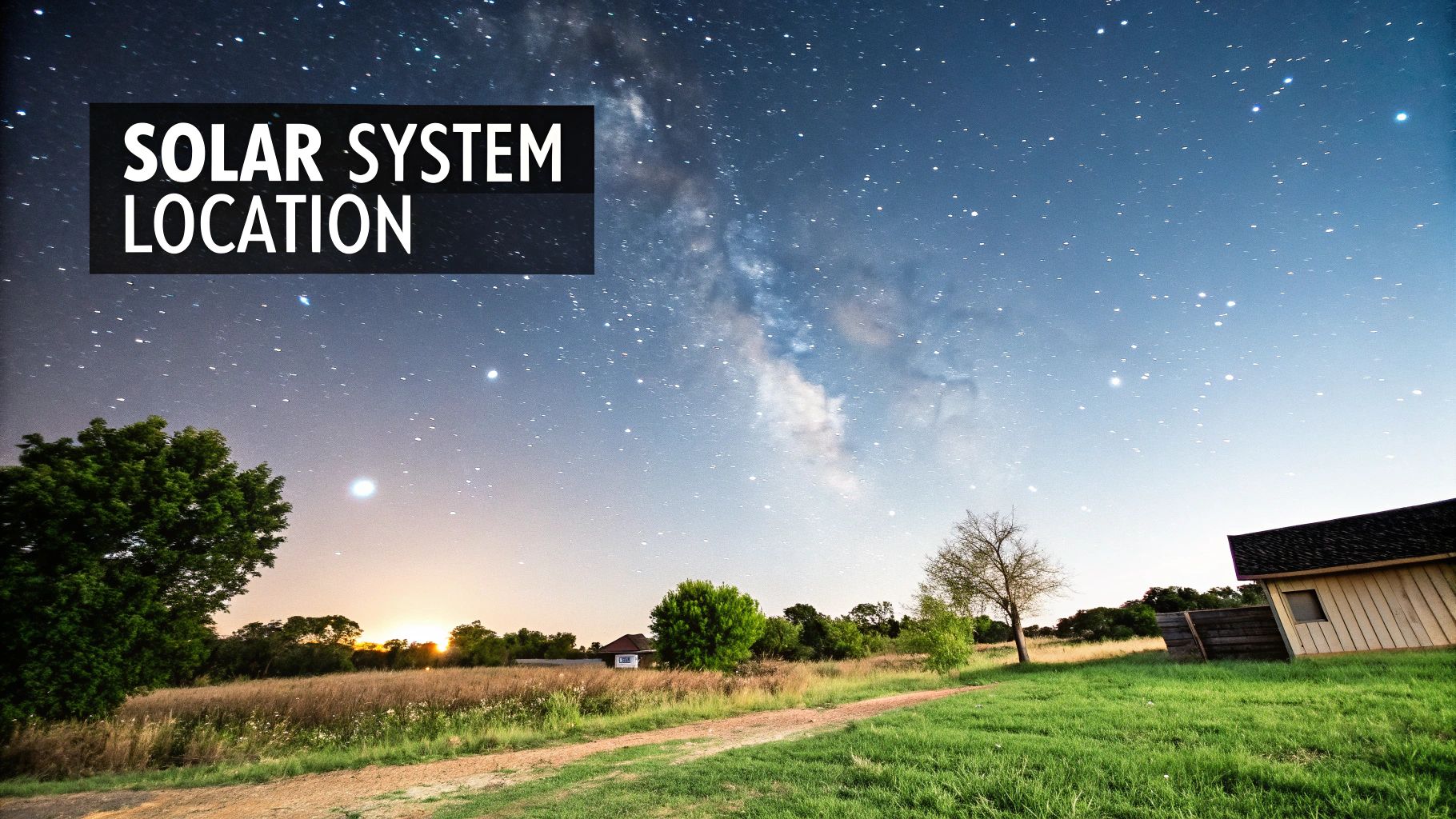
So, where exactly are we inside this massive, spinning star-city we call the Milky Way? We don't live in the super-bright, bustling city centre. Instead, our home is in a much quieter, calmer part of the galaxy.
Our Galactic Suburb: The Orion Arm
Our Solar System is tucked away about halfway from the galaxy's centre, in one of its beautiful spiral arms. Imagine the Milky Way as a giant, spinning Catherine wheel. Those curving streams of light and stars are the spiral arms, packed with stars, gas, and dust.
The arm we call home is a smaller one called the Orion Arm, sometimes known as the Orion Spur. It’s a bit like living in a peaceful suburb instead of a noisy, crowded downtown.
Our special spot in the galaxy is sometimes called the “Goldilocks zone” for life. It’s not too close to the chaotic galactic centre, with its powerful gravity and dangerous radiation, but it’s not so far out in the empty regions where there aren’t enough materials to build planets. It’s just right!
This quiet location is what makes it a perfect, safe spot for a planet like Earth to exist. If you’d like to zoom in on our immediate cosmic family, you can explore this easy guide to what the Solar System is and see how it all fits together.
Knowing our place makes the enormous galaxy feel a little more like home, kind of like finding your own house on a map of the whole world. It’s a huge universe out there, but even Space Ranger Fred knows it’s important to remember your address—as he learned in Space Ranger Fred and the Umbrella Rescue.
Exploring the Galaxy's Amazing Structure
The Milky Way isn't just a random splash of stars; it's a beautifully organised place, a bit like a giant cosmic city with different neighbourhoods. To really get what the Milky Way is, let’s take a grand tour of its main parts.
First, let’s zoom into the very heart of our galaxy, a bright and bustling hub called the Galactic Centre. It’s jam-packed with millions of stars, all zipping around a supermassive black hole named Sagittarius A*. Don't worry, though—it’s thousands of light-years away, so it’s not going to slurp us up! If you're curious about these mysterious space munchers, you can find out more about what a black hole is in our guide.
The Disc and Halo
Next up is the main part of the galaxy, the Galactic Disc. This is the flat, spinning bit that holds the gorgeous spiral arms, including our very own Orion Arm. Most of the young, bright, blue stars live here, along with enormous clouds of gas and dust where brand-new stars are born.
Floating all around this disc is a huge, ghostly ball of very old stars called the Stellar Halo. Think of it like a faint, sparkly bubble wrapping around the entire galaxy. These stars are some of the first ones that ever popped into existence in the Milky Way!
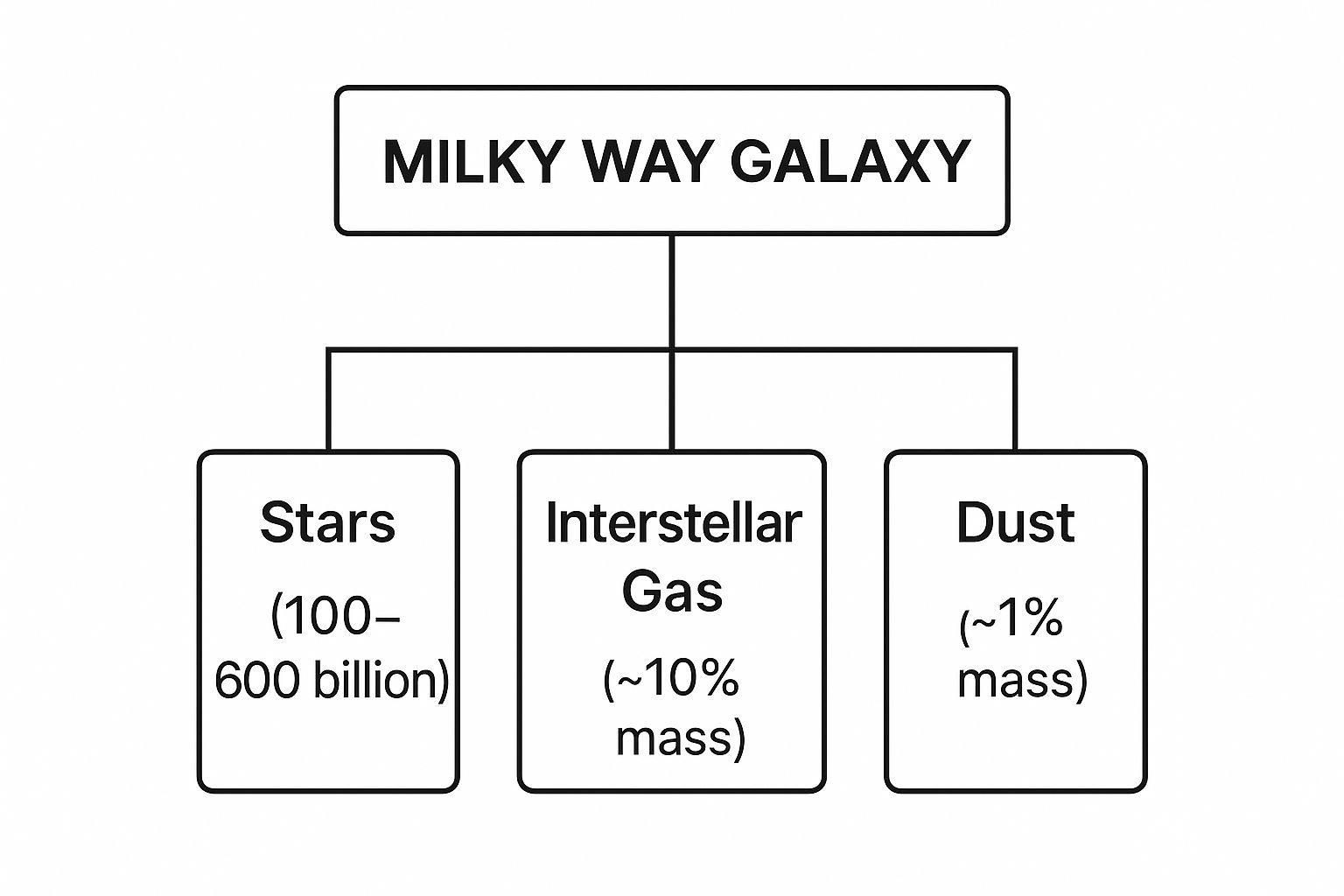
As you can see, while stars are the most common things you'd find, that gas and dust is super important for cooking up new ones.
But what holds all this together? Scientists reckon there’s an invisible substance called dark matter. We can’t see it, but its gravity acts like cosmic glue, stopping our galaxy from flying apart as it spins.
Figuring out the exact shape of our galaxy is a huge job, a bit like solving a puzzle from Space Ranger Fred and the Tick Tock Tale. The European Space Agency’s Gaia telescope, with some clever help from UK scientists, has been carefully mapping the Milky Way’s shape, from the spin of its central bar to the warp in its disc. It’s an incredible mission with some truly amazing findings.
Meeting Our Cosmic Neighbours
Our galaxy is a wonderfully busy place, packed with all sorts of amazing cosmic objects. You can think of it as a gigantic neighbourhood in space, with lots of different residents living side-by-side. Let’s go and meet a few of them!
The first neighbours you’d notice are the stars, of course. There are billions upon billions of them in the Milky Way, from tiny, cool red dwarfs that can live for trillions of years to absolutely enormous, blazing hot blue supergiants that burn out much, much faster. Our own Sun is a pretty average yellow dwarf star, and it’s just one of countless others scattered across the galaxy.
And where you find stars, you often find planets! Just like Earth and our other planetary pals orbit the Sun, scientists believe there are billions of other planets orbiting stars all across the Milky Way. Some might be rocky like Earth, while others could be huge swirling balls of gas. If you're curious about our next-door neighbours, you can find out more about what Mars is like in our special guide.
Star Nurseries and Sparkling Clusters
But not everything out there is a star or a planet. Drifting between the stars are these incredible, beautiful clouds made of gas and dust called nebulae. Honestly, they are some of the most colourful and breathtaking sights in the entire universe!
Nebulae aren’t just pretty to look at; they’re super important places that astronomers call 'stellar nurseries'. Think of them as giant cosmic cradles, providing all the materials needed for brand new stars to be born and start shining.
We also find huge groups of stars that travel together through space, a bit like a cosmic family on a road trip. We call these star clusters, and there are two main types you might spot:
- Open Clusters: These are younger, looser collections of a few hundred to a few thousand stars that were all born together from the same nebula.
- Globular Clusters: These are much, much older. They’re tight, ball-shaped swarms of hundreds of thousands, or even millions, of ancient stars.
From swirling nebulae to sparkling clusters, our galaxy is a truly dynamic and exciting place. It’s full of incredible things to discover, much like the worlds Space Ranger Fred gets to explore in his amazing adventures.
Solving the Galaxy Puzzle
So, how on Earth do we know what the Milky Way looks like when we're stuck right inside it? That’s a brilliant question. It’s a bit like trying to draw a map of your house without ever stepping outside to see the whole building from the street.
For hundreds of years, clever astronomers have been piecing this cosmic puzzle together, much like Space Ranger Fred solves mysteries in Space Ranger Fred and the Tick Tock Tale. Long before we had super-powerful telescopes, scientists had to think like detectives. They started with a simple idea: counting the stars in different parts of the sky.
The First Galactic Maps
One of the very first people to try this was a British astronomer named William Herschel. Way back in 1785, he spent night after night counting stars to create one of the first-ever maps of our galaxy. He figured out that the stars seemed to form a giant, flattened disc shape, though he guessed that our Solar System was somewhere near the middle. You can discover more about his early efforts that laid the groundwork for UK astronomy.
These days, our methods are a lot more high-tech. We use incredible telescopes, both on the ground and floating in space, that can see things our eyes could only dream of.
Powerful space observatories, like the European Space Agency’s Gaia mission, are our super-powered eyes in the sky. They can measure the exact positions, distances, and movements of billions of stars, helping us build an incredibly precise 3D map of our galaxy from the inside out.
By putting all these clues together—from simply counting stars to using amazing modern technology—we’ve slowly built up a clear picture of our beautiful, swirling home. Every new discovery is like finding another piece of a giant cosmic jigsaw puzzle, helping us understand exactly what the Milky Way is.
Your Milky Way Questions Answered
It’s brilliant to be curious about our home in the universe! You’ve already learned a lot about the Milky Way, but I bet you’ve got even more questions buzzing around in your head. Let's explore some of the most common ones that space explorers like you ask.
Why Is It Called the Milky Way?
Great question! Imagine you're on a camping trip, far away from all the bright city lights. If you look up on a really clear, dark night, you’ll see a faint, hazy band of light stretching across the entire sky. It looks a bit like a cosmic milk spillage.
Thousands of years ago, the ancient Greeks thought exactly that! They called it galaxias kyklos, which means ‘milky circle’. The Romans later called it Via Lactea, which translates to ‘Milky Way’. The name just stuck because that’s exactly what it looks like from our little spot inside it!
Can We Take a Photo of the Whole Galaxy?
That’s a very clever thought, but sadly, we can’t. Since our Solar System is inside the Milky Way, trying to take a picture of the whole thing is like trying to take a photo of your entire house while you're still standing in your bedroom. You just can't get it all in the frame!
To get an outside view, we’d have to travel thousands and thousands of light-years away. A journey like that would take longer than all of human history put together!
So, what about all those amazing pictures of spiral galaxies? Those are either incredible paintings by talented artists or real photographs of other galaxies, like our massive neighbour, Andromeda.
Is the Black Hole at the Centre Dangerous to Us?
It sounds pretty scary, doesn't it? But you don’t need to worry one bit. The supermassive black hole at the centre of our galaxy, named Sagittarius A*, is about 27,000 light-years away from Earth. It’s way too far away to ever ‘hoover’ us up.
Our Sun and all the planets are in a safe, steady orbit around the galaxy’s centre, far from any danger. Think of the black hole as a gravitational anchor keeping everything in place, but it doesn't affect our daily lives at all. It’s less of a mystery than some of the puzzles in Space Ranger Fred and the Shoelace Adventure!
Are There Other Galaxies Like Ours?
Yes, absolutely! The universe is packed with them. Astronomers think there could be hundreds of billions, maybe even trillions, of other galaxies out there. Some are spirals just like ours, while others are shaped like giant round blobs (elliptical galaxies) or have all sorts of weird shapes (irregular galaxies).
Our closest large galactic neighbour is the Andromeda Galaxy. And here’s a cool fact: it's slowly moving towards us for a cosmic crash in about 4.5 billion years!
Ready for more cosmic fun? The Space Ranger Fred book series is packed with thrilling stories that make learning about space an incredible adventure. Explore the universe with Space Ranger Fred today!