
Forget everything you’ve been told about learning being a one-way street. At its heart, constructivist learning is the idea that children build their own understanding of the world rather than just soaking up facts like a sponge.
Fancy a simple analogy? You wouldn't just hand a child a finished LEGO® castle and say, "There, you've learned." Instead, you give them a box of bricks and let them build something from their own imagination. That’s constructivism in a nutshell.
Building Knowledge, Brick by Brick
Have you ever watched that magical moment when a child finally figures something out for themselves? The look of triumph on their face when they tie their own shoelaces after ages of fiddling with the loops is pure constructivism in action. They didn't just memorise the steps; they experimented, made mistakes, and built a mental model of how it all works.
This active, hands-on approach is the very soul of constructivist learning. It completely flips the script on the traditional classroom, shifting the teacher from a "sage on the stage" to a "guide on the side." The child is no longer a passive passenger but the active driver of their own educational journey.
From Passive to Active Learning
The theory goes that we learn best when we connect new experiences to what we already know. It’s like weaving a giant, personal tapestry of understanding. This is the difference between rote-learning a list of historical dates and creating a sprawling timeline that shows how different events influenced one another.
This idea has profoundly shaped modern teaching, especially here in the UK. The widespread adoption of constructivist principles in universities, for instance, owes a lot to John Biggs' 'constructive alignment' theory from 1996. His framework ensures that lessons and assessments are designed to support a student's active construction of knowledge, moving far away from just passively receiving it.
Core Ideas Behind Constructivist Thinking
At its core, constructivism champions curiosity and discovery, all built on a few simple but powerful ideas:
- Learning is an active process: To really learn, children need to do something—solve problems, ask questions, or hash out ideas with their friends.
- Knowledge is constructed: Understanding isn't just downloaded into our brains. It's built, piece by piece, from our own experiences and interactions.
- Learning is a social thing: We often build the strongest understanding when we share ideas, debate concepts, and work together with others.
A great teacher designs lessons that help students discover the relationship between bits of information. To do this, they must give students the information they need, but without organising it for them.
This mirrors the problem-solving spirit you see in stories like Space Ranger Fred and the Tick Tock Tale. Fred has to figure out a solution through trial, error, and a bit of creative thinking. He's actively building his understanding of the problem, much like a child in a constructivist classroom.
This method is also a close cousin to another powerful educational model. In fact, you can learn more about experiential learning in our dedicated guide.
Constructivist Learning vs Traditional Learning at a Glance
To make this distinction crystal clear, it’s helpful to see the two approaches side-by-side. The traditional model, often based on rote memorisation, stands in stark contrast to the active, hands-on world of constructivism.
| Aspect | Traditional Learning (Rote Memorisation) | Constructivist Learning (Active Construction) |
|---|---|---|
| Learner's Role | Passive recipient of information. | Active participant in creating knowledge. |
| Teacher's Role | Expert who dispenses knowledge ("sage on the stage"). | Facilitator who guides and supports ("guide on the side"). |
| Focus | Memorising facts and repeating correct answers. | Understanding concepts and developing problem-solving skills. |
| Classroom Activity | Teacher-led lectures, drills, and individual seatwork. | Collaborative projects, experiments, and open-ended discussions. |
| Assessment | Standardised tests that measure recall of information. | Portfolios, projects, and observations that show understanding and application. |
| Curriculum | Fixed, rigid curriculum delivered piece by piece. | Flexible curriculum that builds on students' prior knowledge and interests. |
This table really highlights the fundamental shift in mindset. Instead of seeing a child's mind as an empty bucket to be filled, constructivism sees it as a fire to be lit.
The Core Principles of Constructivism
To really get what constructivist learning is all about, we need to peek behind the curtain at the powerful ideas holding it all together. Think of these principles less like stuffy academic rules and more like the solid foundations that support a child’s natural curiosity and drive to figure things out. They're the "how" behind the "what" of building real knowledge.
At its heart, constructivism is built on a few core beliefs about how our minds work. These aren't just abstract theories; you can spot them in action on any playground, in any classroom, or even at home when a child is completely lost in an activity. Let's break these pillars down into simple ideas we can actually use.
Knowledge Is Actively Constructed
First and foremost, learning is an active process, not a passive one. A child’s mind isn't an empty bucket waiting for us to pour facts into it. Instead, they build knowledge for themselves, piece by piece, as they poke, prod, and play with the world around them.
Picture a Year 3 class in Manchester learning about botany. The old-school way might be to memorise the parts of a flower from a textbook diagram. But the constructivist approach? It gives each small group of children a real plant to observe, touch, and even carefully take apart.
By drawing what they see, wondering aloud why the roots are at the bottom, and asking what the petals do, they are actively constructing their own understanding. They become little scientists, piecing together information to form a complete picture that makes sense to them.
Learning Is a Personal Interpretation
Building on that idea, constructivism tells us that every child’s learning journey is completely unique. Because we all build new knowledge on top of our existing experiences, two children can sit through the exact same lesson and walk away with slightly different understandings.
And that’s a good thing! It means learning is a deeply personal process of making sense of the world. A child who helps out in a garden at home will connect with the plant lesson differently from a child living in a high-rise flat—and both viewpoints are equally valid and valuable.
The essence of constructivism is that learners construct their own understanding. This allows them to build strong, personal foundations of knowledge rather than just memorising someone else's.
This is exactly why a one-size-fits-all lecture often falls flat. Real, sticky learning happens when a child can link new information to their own life, creating a mental map that is truly meaningful to them.
Learning Is a Social Activity
While personal understanding is key, constructivism also knows that we rarely learn in a vacuum. Learning is fundamentally a social experience, shaped by our conversations and interactions with friends, teachers, and family.
Think about a group of kids trying to build a rocket from cardboard boxes and plastic bottles. One might know a bit about aerodynamics from a telly programme, another might have a brilliant idea for the fins, and a third might suggest a clever way to make a nose cone. Through chatting, sketching ideas, and working towards a shared goal, they create something far better than any one of them could have managed alone.
That’s social constructivism right there. In a classroom, it might look like a group project researching local wildlife, where children share what they’ve found, challenge each other's ideas, and build a collective understanding together. This teamwork is central to building robust knowledge, and if you're interested, you can discover more about what is collaborative learning in our detailed article.
Learning Is Tied to Context
Finally, constructivist theory insists that learning is most effective when it is anchored in a meaningful context. Abstract ideas are tough to grasp, but they snap into focus when they’re linked to real-world situations.
Why does Space Ranger Fred need to figure out how his umbrella works in Space Ranger Fred and the Umbrella Rescue? Because he’s in a real jam! The context gives his problem-solving a purpose. In the same way, learning about measurements is far more engaging when it involves baking a cake or building a model car than when it’s just a bunch of numbers on a worksheet.
A school trip to the London Science Museum, for example, makes abstract scientific principles tangible. Children can push buttons, pull levers, and play with the exhibits, connecting the 'what' of a theory with the 'how' of its real-world application. It’s this contextual anchor that makes knowledge stick.
Exploring Different Types of Constructivism
Just like there are endless ways to build with a pile of LEGO® bricks, constructivism isn’t one single, rigid idea. It’s more like a family of related theories that share core values but each has its own unique personality. Getting to know the main ‘flavours’ helps us see how this powerful approach to learning can be applied in different ways.
The two big players are cognitive constructivism and social constructivism. While they both agree that children are the active builders of their own knowledge, they put the spotlight on different parts of the process. One champions the individual’s inner world of discovery, while the other celebrates the sheer power of learning together.
Cognitive Constructivism: The Lone Explorer
Imagine a child sitting alone, totally absorbed in figuring out a tricky puzzle. They twist a piece, try it in a new spot, and suddenly have that brilliant "Aha!" moment when it clicks perfectly into place. That right there is the essence of cognitive constructivism, a theory most famously connected to the psychologist Jean Piaget.
This approach zooms in on the individual's mental journey. It suggests that as a child explores their environment, they are constantly creating and organising new information into mental maps, or what Piaget called 'schemas'. Real learning happens when they bump into something new that doesn't quite fit their existing map. This forces them to rethink, adjust their ideas, and build a more complex and accurate understanding of the world. It’s a deeply personal, internal process of discovery.
This infographic does a great job of showing how the constructivist model completely flips the script on the roles of both the learner and the teacher compared to old-school methods.
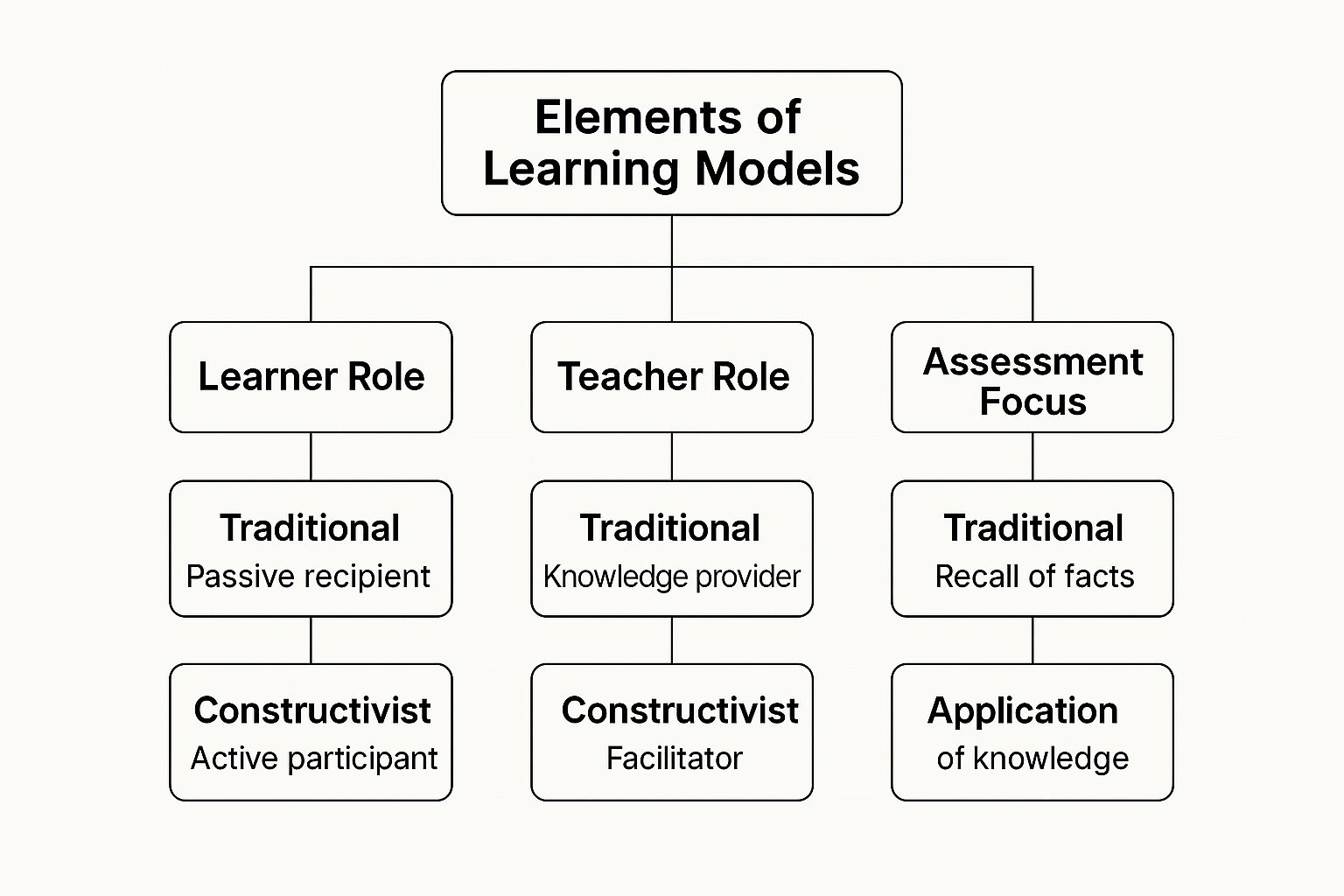
As you can see, constructivism puts the child in the driver's seat as an active creator of knowledge, with the teacher stepping into the crucial role of a guide and facilitator.
Social Constructivism: Building Together
Now, picture a group of children trying to build a den in the woods. One has an idea for the frame, another suggests using certain branches, and a third starts a debate on the best way to make it waterproof. The knowledge of how to build the den isn't locked inside one child's head; it’s created between them through their conversation, collaboration, and shared efforts.
This is the heart of social constructivism, a theory championed by psychologist Lev Vygotsky. His big idea was that learning is, at its core, a social activity. We learn most effectively through dialogue, teamwork, and interaction with others—whether that’s our peers, our teachers, or our family. Knowledge is something we co-create and share within a community.
"The most effective way to develop a coding system is to discover it rather than be told by a teacher." – Jerome Bruner
This quote from psychologist Jerome Bruner fits perfectly here. That 'discovery' he talks about often happens when children talk through problems together, bouncing ideas off each other and challenging one another's thinking.
Comparing Cognitive and Social Constructivism
To make the distinction clearer, let's break down the main differences between these two powerful ideas. While they both see the learner as an active participant, they have different views on where the most important learning happens.
| Feature | Cognitive Constructivism (Piaget) | Social Constructivism (Vygotsky) |
|---|---|---|
| Main Focus | The individual's mental processes and internal cognitive structures. | Social interactions, language, and cultural context. |
| Key Driver of Learning | Cognitive conflict—when new information clashes with existing schemas. | Collaboration and co-construction of knowledge with others. |
| Role of the Learner | An independent discoverer, like a scientist exploring the world. | An active collaborator who learns through social participation. |
| Role of Peers | Important for creating cognitive conflict and new perspectives. | Essential for learning; knowledge is built together. |
| Role of the Teacher | Creates learning environments for individual exploration; a facilitator. | Facilitates group work and dialogue; a co-constructor of knowledge. |
Ultimately, both perspectives offer valuable insights. One reminds us of the importance of personal reflection and discovery, while the other highlights the power of community and shared understanding.
A Water Play Scenario
Let's see how these two approaches might look in a real classroom using a simple water-play activity.
-
A Cognitive Constructivist Approach: A teacher sets up a water table with all sorts of objects (sponges, plastic toys, stones, leaves). A child is encouraged to explore independently, dropping items into the water to see what happens. The teacher observes, perhaps asking open-ended questions like, "What did you notice about that stone?" The focus is squarely on the child's individual discoveries and the mental models they build about floating and sinking.
-
A Social Constructivist Approach: The same water table is set up, but now a small group of children work together. The teacher might pose a challenge: "Can you work as a team to build a boat that floats?" The children discuss ideas, test materials, and negotiate roles. The learning happens right there in their conversation, their shared problem-solving, and the collective knowledge they build as a group.
Of course, both approaches are incredibly valuable and often blend together in a modern classroom. A child might have an individual 'Aha!' moment (cognitive) that was sparked by a classmate's comment during a group project (social).
Even a solo mission, like in Space Ranger Fred and the Shoelace Adventure, involves Fred building on knowledge he’s gained from interacting with others in the past. Understanding these different flavours shows just how flexible constructivist learning is, allowing educators to shift the focus from individual exploration to collaborative creation depending on the learning goal.
Benefits of a Constructivist Classroom
So, why does all this theory about building knowledge actually matter in a real classroom? The answer is simple: the benefits are enormous. When we move away from just memorising facts and towards active discovery, it doesn't just change how subjects are taught—it completely transforms how children feel about learning itself.
A constructivist classroom is a buzzing hub of energy, not a silent hall of passive listeners. The moment children are empowered to ask their own questions and hunt for their own answers, their engagement and motivation go through the roof. Learning suddenly becomes an exciting adventure rather than a chore.
Fostering Deeper Engagement and Motivation
The real magic of constructivist learning is how personal it makes education. When a child can connect what they're learning to their own experiences and interests, the material instantly becomes more relevant and meaningful. This personal investment is the secret ingredient for genuine motivation.
Just think about the difference between being asked to memorise a physics formula versus being given a hands-on design challenge. In stories like Space Ranger Fred and the Umbrella Rescue, Fred doesn’t just learn about forces; he has to figure out how his umbrella works to solve a very real problem. That sense of purpose is incredibly motivating.
And this isn’t just a nice idea; the data backs it up. Research into UK workplace learning found that when people were given autonomy over their learning—a core constructivist principle—their engagement scores were in the 79th percentile. That’s a massive leap from the 24th percentile for those stuck in traditional, top-down learning environments. You can dig deeper into how these methods boost motivation in this detailed Growth Engineering UK analysis.
By shifting the focus from performance to the process of discovery, constructivist classrooms reduce the fear of failure. Instead, mistakes are reframed as valuable learning opportunities, building resilience and encouraging children to take intellectual risks.
This kind of environment nurtures a love for learning that lasts a lifetime. Children who see themselves as capable builders of knowledge are far more likely to stay curious and engaged long after they leave the classroom.
Developing Essential Life Skills
Beyond just boosting motivation, the constructivist approach is a powerhouse for developing the skills children need to thrive in a complex world. These aren't just academic skills but fundamental life skills that prepare them for any challenge they might face.
The very nature of this learning model helps children become better thinkers, collaborators, and problem-solvers.
Here are just a few of the core skills that a constructivist classroom actively cultivates:
- Critical Thinking: Instead of just accepting facts at face value, children are constantly encouraged to question, analyse, and evaluate information. They learn to think for themselves and form well-reasoned conclusions.
- Creative Problem-Solving: By tackling open-ended challenges, students learn there’s often more than one right answer. They get to experiment with different solutions, think outside the box, and develop real mental flexibility.
- Collaboration and Communication: Group projects are at the heart of constructivist learning. Children learn how to listen to others' ideas, articulate their own thoughts, and work together towards a common goal.
- Ownership and Independence: When children are in charge of their learning journey, they develop a strong sense of responsibility and self-direction. They become more independent and confident learners.
These are the very skills that employers consistently rank as most valuable. A constructivist classroom isn't just preparing children for their next test; it's preparing them for life.
An Example in Action
Let’s bring this to life. Imagine a Year 4 teacher in Bristol reads Space Ranger Fred and the Umbrella Rescue to their class. Instead of handing out a simple comprehension worksheet, the teacher poses a challenge: "In your teams, design and build a device that can safely slow the fall of a small object, just like Fred's umbrella did."
Immediately, the classroom becomes a laboratory. Children start brainstorming, sketching ideas, and debating which materials—paper, plastic bags, string—would work best. They are not just being told about air resistance; they are experiencing it, testing it, and building a deep, intuitive understanding of the physics involved. This is what is constructivist learning in its purest form—active, collaborative, and deeply memorable.
Constructivist Learning Activities in Action
Theory is one thing, but seeing constructivism in a bustling classroom is where the magic really happens. It’s all about moving beyond textbooks and worksheets to create vibrant, hands-on experiences where children become the architects of their own understanding. These activities can transform the classroom into a laboratory, a design studio, or an explorer’s hub.
The teacher's role shifts dramatically here. Instead of standing at the front delivering facts, they become more of a facilitator—a guide who poses intriguing questions, provides the right resources, and then steps back to let the discovery unfold. Let’s look at a few concrete examples of how this comes to life in a primary school.
Sparking Curiosity with Inquiry-Based Learning
Inquiry-based learning is the beating heart of constructivism. It all starts with a question that ignites a child’s curiosity and sends them on a quest for answers. Best of all, the questions often come from the children themselves. This approach puts them in the driver's seat, empowering them to investigate, experiment, and draw their own conclusions.
Imagine a Year 2 science lesson on electricity. Rather than just showing a diagram of a circuit, the teacher gives each small group a few batteries, some wires, and a small bulb. The challenge is simple: "Can you figure out how to make the bulb light up?"
What follows is a flurry of organised chaos. Children will try connecting wires in different ways—some will work, some won't. They’re actively testing hypotheses, bouncing ideas off their friends, and building a genuine, functional understanding of how a circuit works. The teacher moves between groups, asking guiding questions like, "What have you tried so far?" or "What do you think will happen if you connect the wire here?"
This process of questioning and discovery is a powerful model. To see how you can apply this in more detail, check out our guide on what is inquiry-based learning.
Building Deeper Understanding with Project-Based Learning
Project-based learning takes this a step further, challenging students to apply their skills and knowledge to create something tangible over a longer period. It’s a fantastic way to weave multiple subjects together and show children how what they’re learning connects to the real world.
A great example for a Year 5 class would be launching a classroom blog about local history. This single project brings together so many different skills:
- Research: Children have to visit local libraries or use online resources to gather information.
- Writing: They get to practise structuring articles, writing in an engaging way, and checking their grammar.
- Collaboration: Students work in teams to decide on topics, edit each other's work, and manage the blog's schedule.
- Digital Literacy: They learn the basics of publishing content online.
Through a project like this, they aren’t just memorising historical facts; they’re becoming historians, writers, and digital creators all at once. The final blog becomes a proud showcase of the knowledge they have constructed together.
Tackling Problems with Collaborative STEM Challenges
Collaborative STEM challenges are brilliant for showing constructivist principles in action. These tasks are typically open-ended, hands-on, and demand teamwork to solve a specific problem with limited resources.
Think of the classic bridge-building challenge for a Year 6 class. Each team gets a set amount of lollipop sticks and glue, with the goal of building the strongest possible bridge. This isn't just a fun activity; it’s a deep dive into engineering principles. The children learn all about structures, load distribution, and material strength through good old-fashioned trial and error.
The real learning happens in the conversations, the debates over design, and the analysis of why one bridge held more weight than another. The teacher’s role is to facilitate this process, not to hand out the "right" design.
By fostering an environment where students actively engage, question, and collaborate, constructivist methods have a measurable impact. This approach builds not just knowledge, but the critical thinking skills essential for lifelong learning.
Research from the UK reinforces this, showing that students taught with a constructivist approach significantly outperform those in traditional settings. A study found a positive and significant difference in critical thinking skill scores, with an effect size (β) of 0.534. This highlights how active construction of knowledge leads to deeper, more robust understanding. You can read the full research on how this approach boosts student outcomes on frontiersin.org.
Stories can be a fantastic launchpad for these challenges, too. After reading Space Ranger Fred and the Tick Tock Tale, a teacher could spark an inquiry into how we measure time. The challenge? "Design and build your own device that can measure a minute." This simple prompt could lead to children creating everything from sand timers and water clocks to complex pendulum devices, all while constructing their own deep understanding of time and mechanics.
Got Questions About Constructivist Learning?
When parents and teachers first hear about constructivist learning, it’s completely normal for a few questions to bubble up. It can feel like a big departure from the way many of us were taught, so it makes sense to wonder what it actually looks like in a real classroom.
Let's dig into some of the most common questions to clear up the picture and show just how practical and powerful this approach can be.
One of the biggest worries we hear is about classroom structure. The idea of child-led discovery can sometimes conjure images of a chaotic free-for-all, which naturally leads to a big question.
Is This Just Letting Children Do Whatever They Want?
That’s a common misconception, but the answer is a definite no. A constructivist classroom isn't unstructured at all; it’s just structured differently. It’s carefully and thoughtfully organised to support exploration, not just enforce quiet listening.
The teacher’s role here is absolutely vital. They aren't just standing back and watching; they are skilled facilitators who design the learning environment, pose thought-provoking questions, and make sure the right resources are on hand. Think of them as expert guides on a grand expedition. They don't tell the explorers exactly what to find, but they provide the map, the compass, and the support to make the journey a success.
For example, a teacher might set up a "tinkering table" with gears, pulleys, and cardboard after reading a story like Space Ranger Fred and the Shoelace Adventure, where Fred has to invent a clever solution. The goal—to build a simple machine—is clear, but the path to get there is wide open for the children to discover. The teacher artfully guides the process, keeping the learning focused and purposeful, not just random play.
A constructivist classroom isn't about the absence of structure; it's about a different kind of structure. It’s one built around inquiry, collaboration, and guided discovery, where the teacher's role is more complex and responsive than in a traditional setting.
This purposeful framework ensures that freedom leads to genuine learning, not chaos. The children are empowered, but they are also supported every step of the way.
How Do You Measure Progress Without Traditional Tests?
This is another great question. If children aren't just memorising facts for a multiple-choice test, how do we know they’re actually learning? Constructivism moves beyond simple recall to measure a much deeper kind of understanding.
Assessment in a constructivist classroom is ongoing and authentic. Instead of relying on a single, high-stakes exam, teachers gather a rich, detailed picture of a child's progress over time using all sorts of methods.
Here are some of the ways they track that growth:
- Portfolios: Children often keep a collection of their work. This isn't just a folder of finished pieces; it’s the story of their learning journey, showing drafts, reflections, and final projects. It’s real, tangible evidence of how their skills and understanding have evolved.
- Observations: A good teacher is always observing. They watch how a child tackles a problem, listen to the questions they ask, and notice how they work with their friends. These observations offer priceless insights into a child's thinking process that a written test could never hope to capture.
- Project-Based Assessments: The projects themselves are a brilliant form of assessment. A team that successfully designs a working model boat to learn about buoyancy has shown a far deeper understanding of physics than a child who can only recite the definition of the word.
- Presentations and Discussions: Asking children to explain their thinking—whether in a group chat or a short presentation—is a fantastic way to see if they’ve truly grasped a concept. It reveals not just what they know, but how they know it.
This approach gives a much more holistic and accurate picture of a child’s abilities. It measures not just what they can remember, but what they can actually do with what they know.
Does Constructivism Work for Core Subjects Like Maths?
Absolutely! In fact, many would argue that this approach is especially powerful for subjects like mathematics, which often get a bad rap for being rigid and all about memorisation. The old-school way of just memorising times tables and formulae can leave children able to spit out answers but with no real intuitive feel for what the numbers actually mean.
Constructivist maths flips that on its head. It’s all about building a deep, conceptual understanding—what’s often called 'number sense'. It encourages children to explore mathematical ideas through hands-on activities, problem-solving, and discovering patterns for themselves.
Imagine a lesson on multiplication. Instead of just chanting "3 times 4 is 12," children might be given building blocks and asked to create as many different rectangular shapes as they can with 12 blocks. Through this hands-on exploration, they physically see and feel that 3 groups of 4, 4 groups of 3, 2 groups of 6, and 6 groups of 2 all equal 12.
This isn't just a fun activity; it’s building a solid foundation. They are constructing the knowledge for themselves, which makes it far more likely to stick. This method helps children see maths not as a scary list of rules, but as a creative and logical tool for making sense of the world.
At Space Ranger Fred, we believe learning should always be an adventure. Our stories and activities are built on the idea that children are natural explorers, problem-solvers, and builders of knowledge. We want to spark that curiosity and empower them on their journey of discovery.
Explore the universe of fun and learning at https://spacerangerfred.com to find stories and resources that bring these principles to life.