
Welcome, fellow adventurers! Are you searching for a brilliant new game for children to play? One that swaps screen-time squabbles for shouts of discovery? You're in the right galaxy. Play is more than just a pastime; it's the launchpad for learning, especially in the exciting realms of Science, Technology, Engineering, and Maths (STEM). But how do you find games that are genuinely fun and secretly educational?
Don't you worry, we've got you covered. Inspired by the problem-solving spirit of our favourite explorer, Space Ranger Fred, we’ve put together a list of ten fantastic games. These aren't just your average pastimes; they are missions in disguise, designed to spark curiosity and build crucial skills. Just like Fred uses his wits to tackle challenges in books like Space Ranger Fred and the Tick Tock Tale, your young explorer will learn to think critically, solve puzzles, and collaborate, all while having an absolute blast.
From outdoor scavenger hunts to mind-bending puzzle games, this guide provides actionable ideas for parents and teachers. We'll explore how to transform classic activities into cosmic adventures that foster creativity and teamwork. So, buckle up and prepare for a journey through the best STEM-inspired games for children aged 6–12. Let the mission begin!
1. Cosmic Scavenger Hunt: A Mission in Your Garden
Turn your back garden or local park into a distant planet with a cosmic scavenger hunt. This isn't just about finding hidden objects; it's an active, hands-on game for children to play that cleverly combines physical activity with STEM learning. Children become space explorers on a mission, solving clues to discover "alien artefacts" or "planetary samples."
Each clue is a mini-science puzzle. Instead of "find something red," the clue might be, "I get my energy from the sun, just like a solar panel. What am I?" leading them to a sun-loving plant that demonstrates photosynthesis. This approach encourages critical thinking and makes abstract scientific concepts tangible and exciting. The hunt is an ideal activity for a sunny afternoon, a school science club, or even a space-themed birthday party, blending learning seamlessly with energetic fun.
How to Organise Your Mission
- Create Your Clues: Write simple, age-appropriate riddles based on basic physics, biology, or astronomy. For example, "Find the smoothest rock (a sedimentary sample)" or "I fall due to gravity, but what helps me fly?" (a sycamore seed).
- Set the Scene: Define the "mission zone" with clear boundaries. Provide a simple map or even a compass to add a navigational challenge, making them feel like real astronauts exploring new terrain.
- Incorporate a Story: Tie the challenges to a narrative. Perhaps, like in Space Ranger Fred and the Shoelace Adventure, they need to find items to build a simple machine or learn a special knot to complete their mission.
- Reward the Discovery: Conclude the hunt by awarding a "Space Ranger Certificate" or a small prize to celebrate their successful exploration and scientific discoveries.
Key Insight: This activity transforms passive learning into an active quest. By linking physical objects to scientific principles, children connect with STEM concepts in a memorable way, reinforcing observation and problem-solving skills.
2. Board Games and Strategy Games: Galactic Adventures on Your Tabletop
Transform your family game night into a mission control centre with board games and strategy games. More than just a way to pass a rainy afternoon, these tabletop adventures are a fantastic game for children to play, teaching them vital skills in strategy, decision-making, and friendly competition. Players navigate game boards, manage resources, and think ahead, all while learning to follow rules and engage in fair play.
From the simple turn-based fun of Snakes and Ladders to the more complex resource management of Catan Junior, board games offer a universe of challenges. They provide a structured environment for children to practise critical thinking and problem-solving, turning abstract concepts like planning and consequence into tangible outcomes. A good board game session is perfect for a family evening, a classroom activity, or a playdate, promoting social interaction and strategic thinking in a fun, contained setting.
How to Organise Your Game Night
- Select Age-Appropriate Games: Choose games that match your child's developmental stage. Start with simpler, luck-based games before introducing more complex strategy titles like Ticket to Ride.
- Create a Story Context: Frame the game within a narrative. Perhaps players in a strategy game are like the characters in Space Ranger Fred and the Tick Tock Tale, managing their time and resources to complete a critical mission before the clock runs out.
- Play and Guide: Participate in the games to model good sportsmanship and explain rules. Gently guide younger players by discussing potential moves and their consequences to help them build their strategic skills.
- Establish a Game Rotation: Keep a selection of 2-3 games and rotate them regularly to maintain excitement and prevent boredom. This also allows children to master one game before moving on to the next challenge.
Key Insight: Board games create a low-stakes environment for children to learn complex life skills. They teach patience, turn-taking, and how to handle both victory and defeat gracefully, all while strengthening family bonds and cognitive abilities.
3. Shadow Tag: A Celestial Chase
Classic tag gets a cosmic upgrade with Shadow Tag, an imaginative and active game for children to play that requires nothing more than a sunny day. This variation on the traditional chase game turns a simple concept into a lesson on light and shadows. Instead of tagging a person, players must "catch" each other by stepping on their shadow.
This clever twist encourages children to think strategically about their position relative to the sun. They’ll quickly learn how shadows lengthen and shorten depending on the time of day and the angle of the light, making it a playful, hands-on demonstration of basic physics. It’s a perfect game for break time at school or a sunny afternoon in the park, promoting physical agility, spatial awareness, and a curiosity about the world around them.
How to Organise Your Celestial Chase
- Choose Your Time: Play when the sun is out and shadows are clearly visible. A late afternoon sun creates long, dynamic shadows that make the game more challenging and exciting.
- Establish the Rules: Define the play area and explain that only stepping on a shadow counts as a "tag." Decide if there are safe zones, such as areas in the shade where no one has a shadow.
- Add a Story Element: Frame the game as a space mission. Perhaps players are astronauts trying to avoid being caught by an alien's shadow, or like in Space Ranger Fred and the Umbrella Rescue, they must use their understanding of their environment to outsmart a challenge.
- Rotate Roles: Ensure everyone gets a chance to be the chaser. This keeps the game fair and engaging for all participants, allowing each child to practise both defensive and offensive strategies.
Key Insight: Shadow Tag transforms a familiar game into an interactive science lesson. It makes abstract concepts like light and angles tangible, encouraging children to observe their environment and think critically while staying active.
4. Role-Playing and Pretend Play: Building Worlds with Imagination
Role-playing is a classic game for children to play where they step into the shoes of different characters and act out imaginative scenarios. This form of pretend play is a powerful tool for developing empathy, social skills, and complex storytelling abilities. Children create and navigate their own worlds, whether they're commanding a starship, running a bustling alien café, or organising a rescue mission on a distant moon.
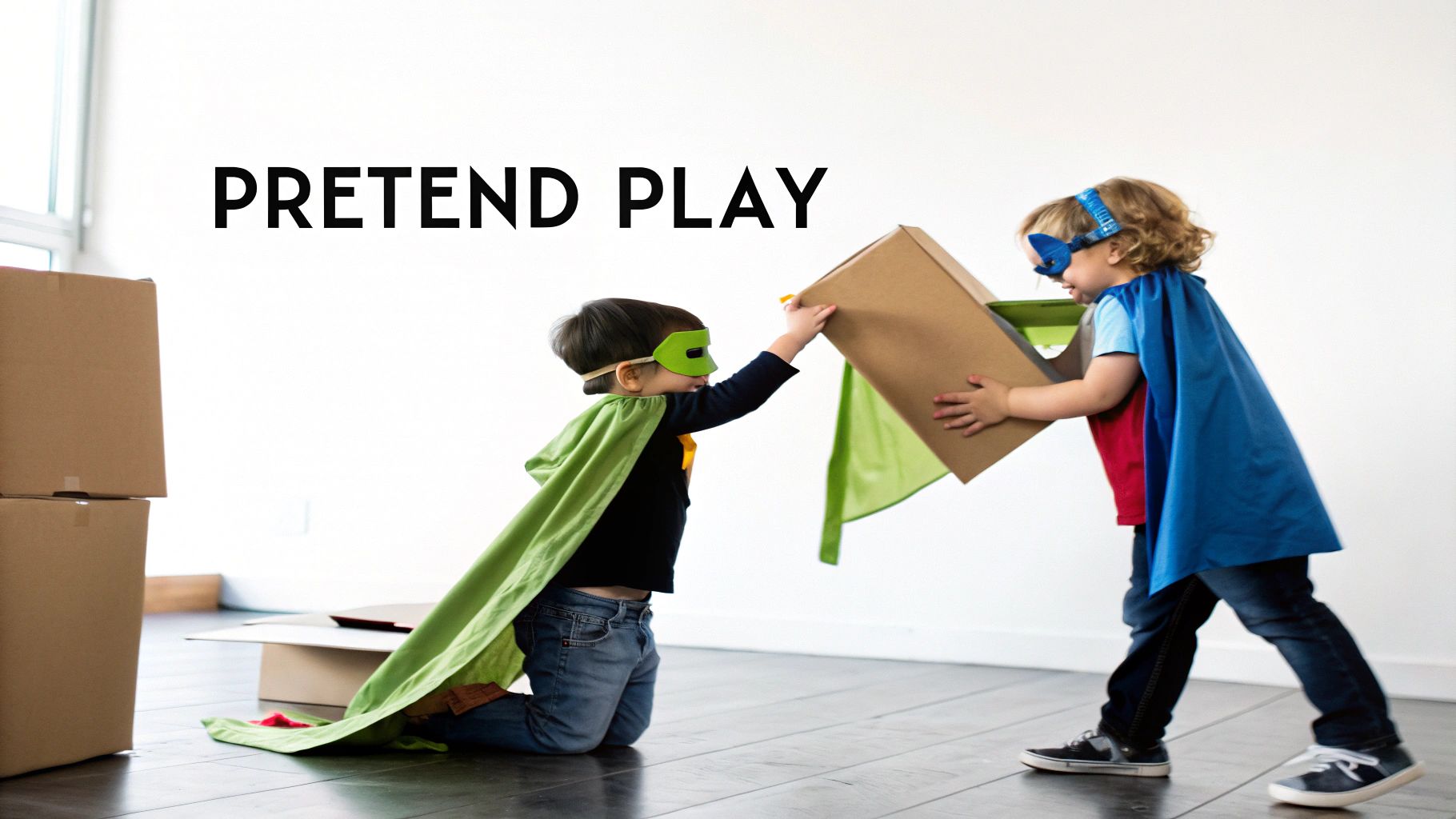
Through these unscripted adventures, children explore complex emotions and real-world situations in a safe, controlled environment. They learn to negotiate, cooperate, and resolve conflicts as they build a shared narrative with others. This type of play is perfect for any day, requiring nothing more than a spark of imagination to transform a living room into the bridge of a spaceship or a garden into an uncharted jungle planet.
How to Encourage Imaginative Play
- Provide Simple Props: You don't need elaborate costumes. Cardboard boxes can become control panels, blankets can become capes, and kitchen utensils can become futuristic tools. A simple prop can ignite a whole new storyline.
- Establish a Scenario: Offer a starting point to get the story moving. For example, "Your spaceship has crash-landed! What tools from your kit, like the one in Space Ranger Fred and the Shoelace Adventure, will you use to make repairs?"
- Join In as a Supporting Character: Occasionally participate by playing a minor role. Let the children lead the narrative while you model positive interactions, ask questions, and help move the plot along if it stalls.
- Create Themed Environments: Use simple decorations to set the scene. Blue streamers could be a wormhole, and silver foil could represent the hull of a rocket, making the imaginary world feel more tangible.
Key Insight: Role-playing empowers children to become the authors, directors, and stars of their own stories. This active form of play builds confidence and communication skills, allowing them to practise problem-solving and understand different perspectives in a dynamic and creative way.
5. Video Games and Gaming Apps
Digital worlds offer a unique and powerful game for children to play, transforming screens into interactive playgrounds for learning and adventure. Modern gaming apps and video games are far more than just entertainment; they are sophisticated tools that can enhance problem-solving, strategic thinking, and even creativity. From building elaborate structures in Minecraft to embarking on quests, these platforms provide structured challenges that can boost resilience and technical literacy.
A well-chosen video game can align perfectly with educational goals, making abstract concepts interactive and engaging. For instance, a game might require players to manage resources or solve physics-based puzzles, much like the practical challenges Space Ranger Fred faces in his missions. When balanced with other activities, digital play provides a valuable space for children to experiment, collaborate with friends in a controlled online environment, and develop crucial digital citizenship skills for the modern world.
How to Organise Your Digital Playtime
- Choose Wisely: Select age-appropriate games using PEGI ratings. Prioritise titles with educational value or creative freedom. For more ideas, you can explore our guide to the best children’s educational video games.
- Set Clear Boundaries: Establish consistent rules for screen time. Use parental controls on consoles and devices to manage playtime and access to online features, ensuring a safe gaming environment.
- Play Together: Occasionally join your child in their game. This not only shows you value their interests but also gives you first-hand insight into the content and the skills they are developing.
- Encourage Balance: Frame gaming as just one of many enjoyable activities. Ensure it is balanced with outdoor play, reading books like Space Ranger Fred and the Tick Tock Tale, and other offline hobbies.
Key Insight: Video games can be a powerful medium for "scaffolded learning," where children tackle progressively harder challenges in a low-stakes environment. This process builds confidence and teaches persistence, proving that failure is just a step towards eventual success.
6. Engineering Marvels: Building and Construction Games
Unleash your child's inner architect with building and construction games. More than just stacking blocks, this is a powerful game for children to play that nurtures spatial reasoning, problem-solving, and foundational engineering principles. From physical LEGO sets to digital worlds like Minecraft, children can design and construct everything from towering skyscrapers to intricate spaceships, turning abstract ideas into tangible creations.
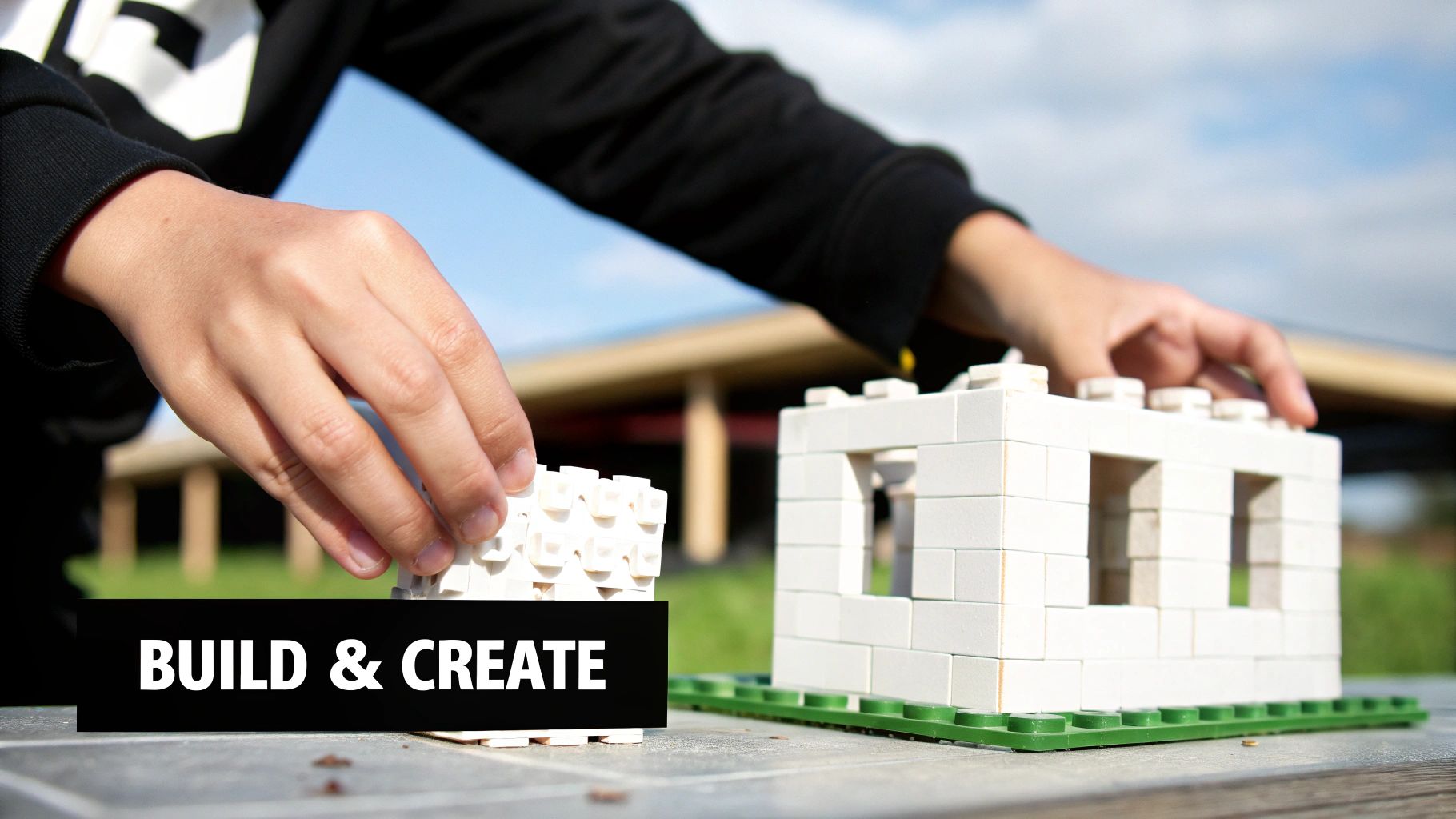
These games are the perfect playground for experimentation. A child learns about gravity when a tower topples, discovers principles of support and balance, and develops persistence as they refine their designs. This hands-on process is ideal for visual and kinaesthetic learners, offering a satisfying way to see their imagination come to life. Whether for a quiet afternoon indoors or a collaborative classroom project, building games provide endless creative potential.
How to Organise Your Build
- Set Themed Challenges: Instead of free play, propose a mission. "Can you build a lunar base strong enough to withstand a meteor shower?" or, inspired by Space Ranger Fred and the Umbrella Rescue, challenge them to construct a device to solve a specific problem.
- Organise the Parts: Keep building frustration-free by sorting pieces into containers by colour, size, or type. This makes finding the right component easier and teaches organisational skills.
- Provide Inspiration: Use instruction booklets, pictures of real-world architecture, or our guide to Building and Construction Games to spark ideas without stifling creativity.
- Showcase Creations: Create a "gallery" to display finished projects. This instils a sense of pride and accomplishment, validating their hard work and creative effort.
Key Insight: Building games bridge the gap between imagination and reality. They provide a safe space for children to test ideas, learn from failure, and understand complex concepts like physics and geometry through direct, hands-on experience.
7. Sports Games and Physical Competitions: Athletic Adventures
Organised sports offer a structured and exciting game for children to play, channelling their energy into developing physical skills, teamwork, and resilience. Activities like football, swimming, or gymnastics become athletic adventures where children learn the value of practice, discipline, and sportsmanship. Far more than just winning, these competitions are about personal growth, physical literacy, and understanding how their bodies move with force and precision.
This kind of play teaches complex concepts like biomechanics and strategy in a practical, hands-on way. A young footballer learns about projectile motion with every kick, while a gymnast experiences principles of balance and momentum firsthand. Much like Space Ranger Fred learns to master a new skill in Space Ranger Fred and the Umbrella Rescue, children in sports learn to overcome challenges through persistence. This framework is ideal for building confidence, fostering social skills, and promoting a lifelong love of physical activity.
How to Organise Your Athletic Adventure
- Prioritise Fun and Participation: Focus on enjoyment and effort over winning, especially for younger children. The goal is to build a positive relationship with physical activity.
- Encourage Variety: Expose children to a range of sports to help them discover their passions. Trying different activities develops a broader range of motor skills and prevents burnout.
- Focus on Skill Development: Choose coaches and clubs that prioritise teaching fundamental techniques and sportsmanship. Proper form not only improves performance but also helps prevent injuries.
- Ensure Safety First: Always provide the correct, well-fitting safety equipment for any sport, and teach children the rules that keep them and others safe during play.
Key Insight: Competitive sports provide a unique environment for children to learn about setting goals, handling both success and disappointment, and working collaboratively. These experiences build character and teach life lessons that extend far beyond the playing field.
8. Galactic Arts and Crafts: Crafting the Cosmos
Transform your kitchen table into an interstellar art studio with galactic arts and crafts. This creative game for children to play merges artistic expression with the wonders of space, allowing young explorers to build, draw, and design their own cosmic creations. Instead of just painting a picture, they're designing a new alien species or constructing a model of a Mars rover, turning a simple craft session into an imaginative engineering challenge.
This hands-on approach makes abstract space concepts tangible and personal. Children can learn about constellations by creating their own with black paper and glow-in-the-dark stars, or explore planetary science by making colourful solar system mobiles. This type of play is perfect for a rainy afternoon or a themed party, offering a calm yet deeply engaging way to connect with STEM topics. It’s a fantastic way to develop fine motor skills, encourage patience, and let creativity blast off.
How to Organise Your Creative Mission
- Set a Themed Challenge: Instead of open-ended crafting, give them a mission. For example, "Design a spaceship that can land on a water-covered planet" or "Create a useful gadget for an astronaut," inspired by the problem-solving in Space Ranger Fred and the Tick Tock Tale.
- Use Cosmic Materials: Provide a mix of standard and unique craft supplies. Think tin foil for spaceship hulls, black paint with glitter for a starry nebula, and recycled bottles or boxes for building robot companions or space stations.
- Combine Art with Storytelling: Encourage children to create a story behind their artwork. Who is this alien? What does this planet look like up close? This adds a narrative layer that deepens their imaginative investment in the project.
- Display Their Universe: Create a "gallery of the galaxy" on a wall or shelf to display their finished masterpieces. This gives them a sense of pride and accomplishment in their cosmic engineering and artistic feats.
Key Insight: This activity demonstrates that science and art are not separate disciplines. By using creativity to explore STEM themes, children learn to visualise complex ideas, solve problems with imagination, and appreciate the beauty of the universe.
9. Party and Group Games: Galactic Gatherings for Every Occasion
Party and group games are the social heartbeat of any gathering, turning a simple get-together into an interactive adventure. This type of game for children to play is perfect for birthdays, classroom celebrations, or any event with multiple children, as they are designed to foster communication, teamwork, and a healthy dose of friendly competition. From the organised chaos of Musical Statues to the quiet hilarity of Chinese Whispers, these activities break the ice and ensure everyone feels included.
The beauty of group games lies in their adaptability. You can easily give classics a space-themed twist; for instance, Musical Statues becomes "Musical Planets," where children orbit chairs until the "interstellar music" stops. Trivia can quiz them on facts from books like Space Ranger Fred and the Tick Tock Tale, testing their memory and comprehension. These games are brilliant for managing group energy, allowing you to alternate between high-energy activities like Limbo and calmer, focused games like Charades.
How to Organise Your Galactic Gathering
- Mix It Up: Plan a schedule that alternates between active and quiet games to keep energy levels balanced. Start with an icebreaker and end with a cool-down activity.
- Keep Everyone Involved: Modify elimination games to prevent children from sitting out for too long. For example, eliminated players in Musical Planets can become "judges" for the next round. For more ideas on inclusive party games, you can learn more about Pass the Parcel variations here.
- Assign a Mission Commander: Designate one adult as the games coordinator. This person can explain the rules, manage the flow, and ensure the atmosphere remains fun and inclusive for everyone.
- Prizes for All Participants: Instead of one big prize, have small rewards or certificates for participation. This focuses the experience on the fun of playing together rather than just winning.
Key Insight: Group games are more than just entertainment; they are a powerful tool for developing social skills. They teach children about turn-taking, good sportsmanship, and how to communicate effectively within a group, all while creating shared, joyful memories.
10. Puzzle and Brain Games: Training for the Mind's Mission Control
Sharpen young minds for complex missions with puzzle and brain games. This category of game for children to play focuses on mental agility, transforming activities like jigsaws, Sudoku, and chess into training exercises for a space ranger's most important tool: their brain. These challenges are designed to develop critical thinking, pattern recognition, and problem-solving skills in a quiet yet deeply engaging way.
Rather than relying on physical action, these games build cognitive endurance and patience. A 500-piece jigsaw puzzle becomes a mission to assemble a new galaxy, while a game of chequers or chess teaches strategic planning, just like plotting a spacecraft's trajectory. These activities are perfect for rainy days, quiet evenings, or classroom brain-breaks, offering a focused and rewarding alternative to high-energy play.
How to Organise Your Mind Mission
- Match the Challenge to the Cadet: Select puzzles appropriate for the child's age and skill level. Start with 100-piece jigsaws or simple logic grids and gradually increase the difficulty to build confidence without causing frustration.
- Create a Theme: Connect puzzles to a compelling narrative. Perhaps they need to solve a Sudoku grid to unlock a starship's launch sequence or complete a Rubik's Cube to re-align a satellite.
- Guide, Don't Solve: When a child gets stuck, offer strategic hints instead of the solution. Ask questions like, "Have you tried finding all the edge pieces first?" or, like in Space Ranger Fred and the Tick Tock Tale, encourage them to think about how different parts connect to solve a larger problem.
- Celebrate the Process: Emphasise the value of persistence. Praise their effort and strategies, not just the final completion. This teaches resilience and the satisfaction of overcoming a difficult mental challenge.
Key Insight: Puzzle and brain games are the intellectual gym for young minds. They methodically build essential cognitive skills like memory, logic, and spatial reasoning, proving that the most exciting adventures can happen right inside your head.
10 Childrens Games Comparison
| Activity | Implementation Complexity 🔄 | Resource Requirements ⚡ | Expected Outcomes 📊 | Ideal Use Cases 💡 | Key Advantages ⭐ |
|---|---|---|---|---|---|
| Outdoor Scavenger Hunt | Low — list and boundary prep; needs supervision | Minimal — paper/phones, simple props | Observation, teamwork, physical activity | Parks, camps, parties, field days | Highly adaptable, low-cost, active |
| Board Games & Strategy Games | Medium — explain rules; manage turns | Low–Medium — game purchase, table space | Strategic thinking, patience, social skills | Family nights, classrooms, rainy days | Teaches strategy; screen-free; versatile |
| Tag & Chase Games | Very low — set rules/boundaries | Minimal — open safe space | Cardiovascular fitness, agility, spatial awareness | Playgrounds, recess, quick energy breaks | High-energy, no equipment required |
| Role-Playing & Pretend Play | Low–Medium — occasional guidance to steer themes | Minimal — costumes/props optional | Creativity, emotional intelligence, language | Early childhood, indoor imaginative play | Fosters imagination, empathy, low cost |
| Video Games & Gaming Apps | Variable — device setup and moderation | High — devices, games, internet | Problem-solving, subject learning, social play | Educational sessions, indoor entertainment, accessibility | Immediate feedback, adaptive difficulty |
| Building & Construction Games | Low–Medium — choose sets and challenges | Medium — kits, storage space, cost | Spatial reasoning, fine motor, engineering thinking | STEAM activities, collaborative play, quiet time | Hands-on creativity; reusable; scalable |
| Sports & Physical Competitions | Medium–High — coaching, rules, scheduling | High — equipment, facilities, supervision | Fitness, teamwork, discipline, confidence | Organized programs, PE classes, clubs | Strong health and social development benefits |
| Arts & Crafts Games | Low — prep materials and workspace | Low–Medium — art supplies, cleanup area | Fine motor skills, self-expression, calming effects | Afterschool, therapy, quiet creative sessions | Accessible, therapeutic, produces tangible keepsakes |
| Party & Group Games | Low — simple setup; coordinator helps | Minimal — music, small props | Social bonding, inclusion, excitement | Parties, large gatherings, team-building | Inclusive, low-cost, highly engaging |
| Puzzle & Brain Games | Low–Medium — match difficulty to child | Low — puzzles, apps, chess sets | Critical thinking, memory, patience | Quiet time, classrooms, cognitive development | Scalable difficulty; low injury risk |
Your Mission: Go Forth and Play!
And there you have it, Mission Control, a complete mission briefing on ten fantastic, STEM-powered games ready for deployment. We’ve journeyed through the great outdoors with scavenger hunts, navigated the strategic landscapes of board games, and even ventured into the digital realms of educational apps. The core mission has always been clear: finding the perfect game for children to play is about more than just passing the time. It’s about igniting curiosity, fostering resilience, and building the essential skills of the future, one playful moment at a time.
Each activity we've explored, from imaginative role-playing to intricate puzzle-solving, is an opportunity to cultivate the qualities of a true explorer. Think of it as a training ground for young innovators. When children collaborate on a building project or strategise their next move in a tag game, they are developing critical thinking, teamwork, and creative problem-solving skills that will serve them for a lifetime.
Key Takeaways from Our Gaming Expedition
Let’s recap the most important discoveries from our exploration:
- Play is Learning in Disguise: Every game, whether it's an organised sport or a simple arts and crafts challenge, is packed with learning potential. It’s the perfect vehicle for introducing concepts in science, technology, engineering, and maths in a way that feels natural and exciting.
- Variety is Your Best Strategy: Don’t stick to just one type of game. A healthy mix of physical activity, mental challenges, creative expression, and social interaction provides a well-rounded developmental experience. Balance screen time with outdoor adventures and quiet focus with energetic group activities.
- Adaptation is Everything: The best game for children to play is one that can be adapted to their age, interests, and environment. Our space-themed twists are just the beginning; feel free to customise rules, create new challenges, and let your child’s imagination lead the way.
Just as Space Ranger Fred learns in Space Ranger Fred and the Shoelace Adventure, understanding the mechanics of a problem is the first step towards a brilliant solution. These games provide a safe and engaging environment for children to experiment, fail, and try again, building the confidence they need to tackle real-world challenges.
Your next step is simple: pick a game and get started. Don't overthink it. The true value lies in the shared experience and the joy of discovery. Whether you are building a towering LEGO rocket, organising a neighbourhood sports tournament, or solving a tricky logic puzzle together, you are not just playing; you are creating memories and nurturing a lifelong love of learning. The universe of play is vast and full of possibilities. Now, which mission will your young explorer embark on first?
Ready to launch your child’s next learning adventure? The Space Ranger Fred book series blends thrilling stories with real STEM concepts, making it the perfect companion for any young explorer. Discover how Fred solves cosmic crises with science and ingenuity at Space Ranger Fred today.