
Have you ever looked up at a sky full of stars and wondered what’s really out there? That feeling of pure awe is the heart of what space exploration is all about: our grand adventure to journey into the cosmos and figure out our place in it all.
Charting the Final Frontier

Space exploration is so much more than just firing rockets into the sky. Think of it like the great sea voyages from centuries ago. Those early explorers weren’t just sailing for the fun of it; they were mapping new coastlines, discovering incredible new things, and broadening their understanding of the world. Exploring space is driven by that exact same spirit—a deep curiosity and an unstoppable desire for knowledge.
It’s a huge effort made up of many different parts, all working together to solve the universe's biggest puzzles.
The Four Pillars of Space Exploration
To get a better grip on how we do it, you can think of our cosmic quest as standing on four main pillars. Each one represents a different way we push the boundaries of what we know.
| Pillar of Exploration | What It Means | Example |
|---|---|---|
| Robotic Missions | Sending machines to places too far or too dangerous for humans (for now!). | The Mars rovers drilling into rocks on another planet. |
| Observational Astronomy | Using powerful telescopes to look deep into space and, essentially, back in time. | The James Webb Space Telescope capturing images of the first galaxies. |
| Human Spaceflight | Sending astronauts to live and work in space, pushing human limits. | Astronauts conducting experiments on the International Space Station. |
| Scientific Research | Analysing all the data we collect to answer fundamental questions about the universe. | Studying meteorites to understand how our solar system formed. |
Each pillar supports the others, helping us build a more complete picture of the vast and incredible universe we call home.
Our Eyes, Hands, and Boots in the Cosmos
So, how does this all work in practice? We have a few key tools in our exploration kit.
-
Robotic Explorers: We send out amazing machines like probes and rovers to be our eyes and hands on other worlds. They collect data from planets, moons, and asteroids that are just too tough for us to get to right now. To see just how clever these robots are, check out our guide on what is a space probe.
-
Telescopic Time Machines: With giant telescopes, both here on Earth and floating in space, we can peer across billions of light-years. They capture light that has been travelling for so long that we're literally looking back in time, watching the birth of stars and entire galaxies. It’s pretty mind-blowing.
-
Human Missions: Putting boots in space (or on the Moon!) lets us run unique experiments that can only be done in zero gravity. More than that, it inspires millions of us back home and reminds us of what we can achieve when we work together.
This incredible journey isn’t just about satisfying our curiosity. It’s about learning to solve really, really big problems. It’s the same creative spark that sends a mission to Mars that you’ll find in stories like Space Ranger Fred and the Shoelace Adventure, where a simple problem needs a clever, out-of-the-box solution.
Ultimately, space exploration is humanity’s way of asking the biggest questions of all: Where did we come from? Are we alone? And where are we going next?
The UK's Pioneering Journey into Space
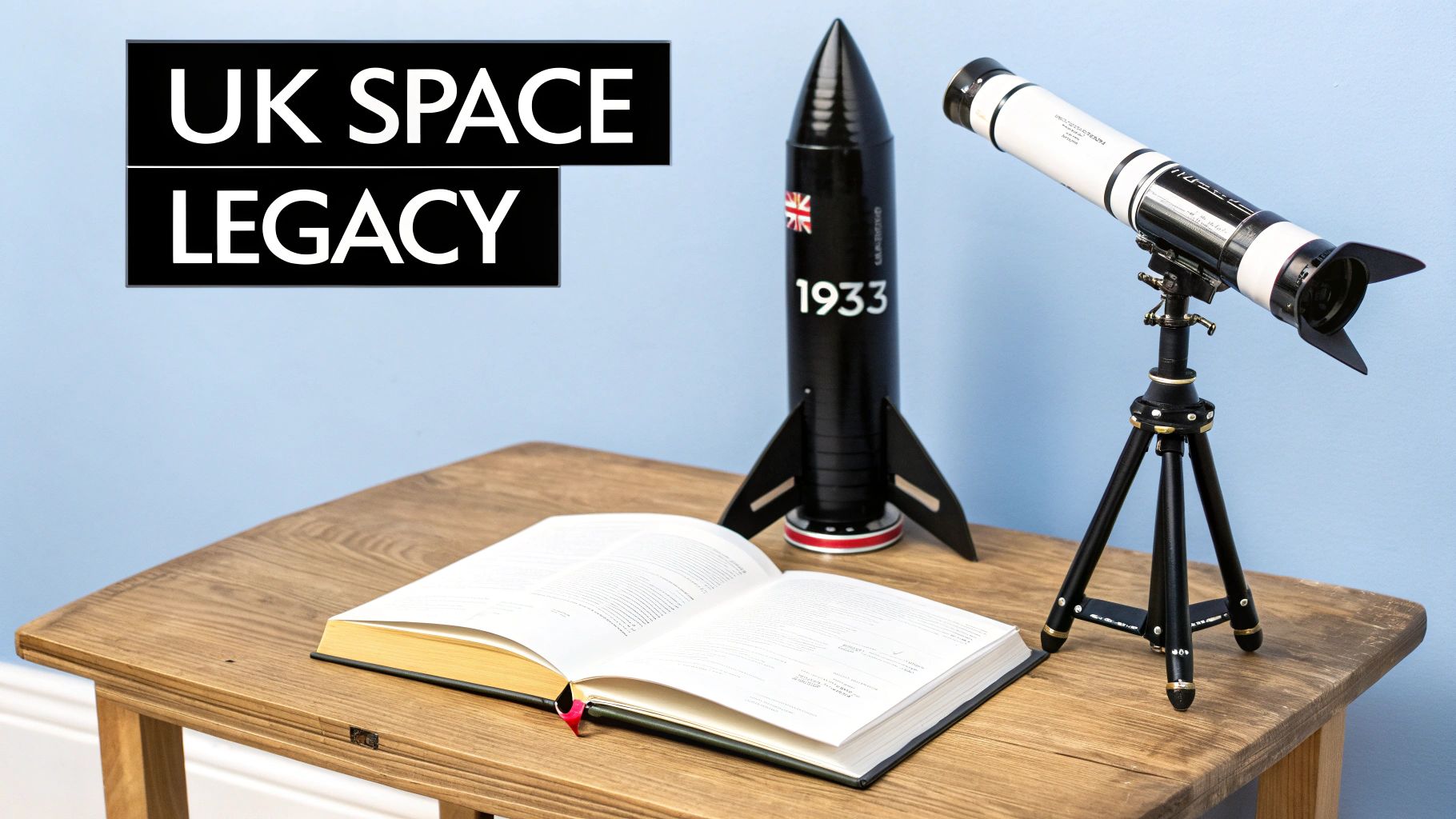
When we think of the space race, it’s easy to picture a two-horse contest between superpowers. But many people don’t realise Britain has its own rich and fascinating history of reaching for the cosmos.
This journey wasn’t just about building rockets; it was driven by ambition, ingenuity, and a quiet determination that laid the groundwork for the UK's modern role as a world leader in space science. It’s a tale of clever problem-solving, much like the challenges faced in stories such as Space Ranger Fred and the Umbrella Rescue.
Believe it or not, the story of British space exploration began with big ideas long before the first rockets ever launched. The cosmic journey officially kicked off way back in 1933 with the founding of the British Interplanetary Society (BIS). Co-founded by none other than the legendary science fiction writer Arthur C. Clarke, the BIS was one of the world's very first space advocacy groups.
Even in those early days, its members were dreaming up theoretical missions, including a bold plan for a manned lunar expedition, proving the dream of spaceflight was alive and well in the UK. Discover more insights about British space history on orbitaltoday.com.
From Theory to Orbit
As the world blasted off into the space age, the UK started turning those dreams into real-world achievements. The first official British space programme got underway in 1952, with a sharp focus on developing cutting-edge satellite technologies. This hard work paid off in a landmark moment a decade later.
On 26 April 1962, the UK's first-ever satellite, Ariel 1, was successfully launched into orbit aboard an American rocket. It was a huge milestone, making Britain the third country in the world to operate a satellite, right behind the Soviet Union and the United States. Ariel 1 was a triumph of international collaboration and British scientific skill, designed to study the ionosphere and its relationship with the Sun.
The Black Arrow and Prospero
But perhaps the most impressive chapter in the UK's early space story is that of the Black Arrow rocket. In a stunning display of home-grown engineering, Britain developed its very own orbital launch vehicle.
The Black Arrow programme represents a significant, though often overlooked, achievement in space history. It demonstrates a nation's ability to develop and execute a complete end-to-end space launch capability, from rocket design to satellite deployment.
On 28 October 1971, a Black Arrow rocket thundered into the sky from Woomera, Australia, carrying the Prospero satellite into orbit. This incredible feat made the United Kingdom the sixth nation to demonstrate orbital launch capability with its own vehicle.
To this day, Prospero remains the only British satellite launched on an all-British rocket. It’s a powerful testament to the nation’s pioneering spirit and a true source of inspiration for generations of engineers and astronomers to come.
Why Exploring Space Matters to Us on Earth
It’s a fair question. With all the money and brainpower we pour into space missions, you have to wonder, "What's in it for us back here?" Beyond the jaw-dropping photos and heart-pounding launches, does heading for the stars actually make a difference at home?
The answer is a massive yes, and in ways that might surprise you.
Exploring space isn't just about looking out; it’s also about looking back. The same missions designed to study faraway planets often turn their high-tech cameras towards Earth, giving us an incredible bird's-eye view of our own world. This perspective is absolutely crucial for tracking climate change, letting us monitor melting ice caps, shrinking forests, and shifting ocean currents with pinpoint accuracy.
This cosmic vantage point helps us in more immediate ways, too. The weather forecast you glance at on your phone? That’s powered by a whole fleet of satellites watching our atmosphere around the clock. This data lets us predict everything from a bit of afternoon drizzle to a major hurricane, which saves lives.
From the Stars to Your Sitting Room
One of the coolest things about space exploration is how often its technology ends up in our everyday lives. When you challenge engineers to solve ridiculously hard problems—like keeping astronauts safe in a vacuum or making a robot work millions of miles away—they come up with some seriously clever solutions.
Pushing the boundaries of what is possible in space often leads to unexpected breakthroughs on Earth. Many technologies we take for granted today were born from the necessity of solving complex problems for space missions.
Think about the GPS that guides your car or helps you navigate a new city. That whole system works because of a network of satellites, a technology first developed for scientific and military use. It’s that same kind of creative problem-solving you see in Space Ranger Fred and the Umbrella Rescue that drives real-world invention.
Here are a few more everyday items that have their roots in the final frontier:
- Scratch-Resistant Lenses: Astronaut helmets needed protection from tiny, abrasive bits of space dust. The super-tough coating NASA developed is now used on most eyeglasses.
- Medical Imaging: The techniques created to sharpen and analyse the first digital images sent back from the Moon helped pioneer the technology behind CT scans and MRIs.
- Cordless Tools: To get work done without being tethered to a spacecraft, astronauts needed powerful, lightweight tools. This led to the cordless drills and vacuum cleaners we all use today.
Pushing Humanity Forward
Beyond all the gadgets and scientific data, space exploration fuels something much deeper: our collective spirit of discovery. Big missions pull together thousands of scientists, engineers, and dreamers from countries all over the world, all focused on a single, ambitious goal.
Working together on these grand projects shows us what we can achieve when we unite. But this great adventure also throws up new challenges to solve, like how to deal with the growing cloud of junk orbiting our planet. To get the lowdown on that particular problem, you can learn all about what is space debris in our detailed guide. Tackling these issues is all part of the journey.
The UK's Modern Mission in the Cosmos
So, what's Britain's role in space these days? It's more exciting and vital than you might think. Instead of pouring billions into building its own gigantic rockets, the UK has played a smarter game, becoming a world leader in a hugely important area: designing and building small, sophisticated satellites.
These aren't just tin cans floating in orbit; they’re the unsung heroes of our modern world. Some weave a global web of communication, connecting us all, while others act as vigilant guardians, keeping a close eye on our planet's weather and environmental health. This sharp focus has cleverly positioned the UK right at the heart of the global space industry.
This whole effort is guided by the UK Space Agency, set up in 2010 to unite the nation's cosmic goals. The agency nurtures a powerful partnership between government and private enterprise, blending world-class scientific research with the drive to build a booming space economy packed with high-tech jobs.
A Partner in Discovery
A massive part of the UK's modern space story is about teamwork. Britain is a key player in major international missions, particularly through its collaboration with the European Space Agency (ESA). Rather than building an entire spacecraft from scratch, British scientists and engineers often create the most critical instruments—the mission's "brains" and "senses," if you like.
The UK’s space strategy is a masterclass in collaboration. By contributing key technologies to larger missions, Britain ensures it is at the forefront of scientific discovery without bearing the entire cost of a mission alone.
This means that when a rover trundles across the Martian dust or a probe gracefully orbits the Moon, there’s a very good chance that technology designed and built in Britain is on board, gathering priceless data.
Powering a New Space Economy
This collaborative spirit isn't just about pure science; it's about building a solid future. The partnership between government and industry is firing up the UK's ambitions, with the global space economy expected to be worth around £490 billion by 2030. By focusing on commercial innovation and international teamwork, the UK is cementing its place as a leader in this new space age. You can get the full picture by reading the official UK's Space Exploration Technology Roadmap.
This forward-thinking mindset reminds me a lot of the problem-solving you find in great kids' stories. Just like in Space Ranger Fred and the Tick Tock Tale, where a bit of creative thinking is needed to solve a tricky puzzle, the UK is using its ingenuity to tackle the huge challenges of space exploration in a clever and sustainable way.
Landmark Missions That Defined Exploration
Some space missions are just so gutsy, so out-there, they become the stuff of legend. These are the voyages that didn't just find answers to big questions; they completely redrew our map of the cosmos and captured the imagination of everyone back on Earth.
From the first moonwalk to little robot explorers trundling across distant worlds, these missions are the most thrilling chapters in humanity's greatest adventure story. They're tales of incredible courage, clever problem-solving, and our unstoppable urge to know what's out there.
Each one stretched the limits of what we thought was possible, turning yesterday's science fiction into today's scientific fact. Let's look back at a few of these epic journeys that have forever shaped what space exploration means to us all.
Putting Boots on the Moon
The Apollo missions are, without a doubt, one of humanity’s most incredible achievements. On 20 July 1969, the whole world seemed to stop and watch as Neil Armstrong and Buzz Aldrin climbed out of the Apollo 11 lunar module, becoming the first people to ever walk on another world.
But this was far more than just winning a race. Apollo was a massive win for science and engineering. Over the course of the missions, astronauts brought back 382 kilograms of moon rocks and soil, which completely turned our ideas about how the Moon—and even our whole solar system—came to be.
The Grand Tour of the Gas Giants
Back in 1977, two amazing spacecraft, Voyager 1 and Voyager 2, set off from Earth on what was called the "Grand Tour" of the outer solar system. Their path took them flying past Jupiter, Saturn, Uranus, and Neptune, sending back the first-ever close-up pictures and mind-blowing details about these giant planets and their dozens of moons.
The Voyager probes are a brilliant example of human ingenuity. They were only built to last five years, but they’ve kept going for over four decades! Each one carries a Golden Record—a sort of cosmic mixtape with sounds and pictures of Earth—for any intelligent life that might find them one day.
Today, both Voyager probes have travelled so far they've actually left our solar system and entered interstellar space—the huge, empty void between the stars. They are humanity's farthest travellers, still sending faint messages home from the darkness.
Our Robotic Eyes on Mars and Beyond
While sending people into space grabs the headlines, our robotic explorers have been the tireless workhorses of space exploration. Rovers like Curiosity and Perseverance have been driving across Mars for years, acting like robot geologists as they hunt for clues of ancient life. They drill into rocks, check the weather, and send back stunning pictures of the Red Planet.
At the same time, amazing space telescopes like Hubble and the new James Webb Space Telescope have totally changed what we know about the universe. They’ve given us jaw-dropping images of faraway galaxies, exploding stars, and planets circling other suns, letting us see almost all the way back to the beginning of time.
This chart shows how the UK's modern space missions have changed over time, with a focus on satellites, working with the European Space Agency (ESA), and helping the space economy grow.
The timeline really shows Britain's smart move towards creating value through specialised technology and teaming up with other countries. To see how these missions slot into the bigger picture, you can check out this fun space exploration timeline for kids.
Inspiring the Next Generation of Explorers
The future of what space exploration becomes truly rests in the hands and hearts of today’s young dreamers. But how do we nurture that natural spark of curiosity about the cosmos into a lifelong passion for discovery?
The fantastic thing is, space is a natural gateway to some of the most important subjects a child can learn. The journey from wondering about the stars to understanding them is paved with science, technology, engineering, and maths (STEM). Every mission to Mars and every image from a deep space telescope is a real-world lesson in physics, chemistry, and problem-solving.
Fuelling Cosmic Curiosity at Home
Igniting this interest doesn't require a degree in astrophysics or a high-powered telescope. It can start with simple, accessible activities that bring the universe a little closer. The goal is to make learning feel like an adventure.
The most powerful tool we have for inspiring the next generation is storytelling. When a child can see themselves as the hero of a great adventure, whether it's navigating an asteroid field or simply fixing a broken gadget, they begin to believe in their own potential.
You can start the journey with these simple steps:
- Visit a Science Museum or Planetarium: Immersive exhibits can bring the scale and wonder of space to life in a way that books and screens sometimes can't.
- Use Stargazing Apps: Apps like Star Walk or SkyView turn your phone into a window to the cosmos, identifying constellations, planets, and satellites in your own back garden.
- Read Engaging Stories: A brilliant story is often the best launchpad. Children's books that wrap scientific ideas in fun narratives are perfect for introducing complex concepts without it feeling like a lesson. Books like Space Ranger Fred and the Tick Tock Tale expertly use a fun, adventurous plot to explore ideas like time and logic, showing that the biggest journeys begin with a single, curious thought.
Got Questions About Space Exploration?
We get it—space is a massive, mind-boggling subject! It’s only natural to have a few head-scratchers. To help you on your own voyage of discovery, we’ve put together answers to some of the questions we hear the most.
How Much Does Space Exploration Actually Cost?
There's no getting around it: sending things into space is expensive, with big missions often running into billions of pounds. But here’s some perspective. When you look at a country's entire budget, spending on space is usually a tiny sliver—often less than half a penny for every pound the government spends.
Considering the incredible scientific breakthroughs and everyday tech that spin off from these missions (think everything from camera phones to satellite navigation), most people agree it’s a brilliant investment in our future.
Why Haven't We Been Back to the Moon?
After the incredible Apollo missions landed humans on the Moon, the world’s attention shifted to other ambitious projects, like building the Space Shuttle and the International Space Station. It wasn’t that we forgot about the Moon, but there were new frontiers to explore closer to home.
The good news? We are officially going back! NASA's Artemis programme is gearing up to send astronauts to the lunar surface once again. This time, the goal is to build a long-term base and figure out how we can live and work there, all in preparation for the next giant leap: sending humans to Mars.
So… Are Aliens Real?
This is the big one, isn't it? As of today, we haven't found any concrete proof of life anywhere else but Earth.
But the universe is almost unimaginably vast, with billions of galaxies, each home to billions of stars. Statistically, the odds that we're the only ones out here seem pretty slim. Missions like the Mars rovers and the James Webb Space Telescope are always on the lookout for signs of life, whether it’s tiny microbes from the past or something entirely new.
The search for extraterrestrial life isn't just about finding little green men. It's about answering one of humanity's oldest questions: Are we alone? Every rock we analyse on Mars and every new exoplanet we discover brings us one small step closer to an answer.
For young explorers keen to learn about the cosmos through exciting stories, check out books like Space Ranger Fred and the Shoelace Adventure, which make these big ideas fun and accessible.
Continue your own journey of discovery with Space Ranger Fred! Our books and activities are designed to make STEM learning an unforgettable adventure. Visit https://spacerangerfred.com to find stories that will launch your child’s imagination into orbit.