
Ever looked up at the stars and wondered what’s really out there? Well, a big part of how we find out is by sending robotic explorers on amazing adventures into space. So, what is a space probe? Put simply, it’s a robotic spacecraft we send out to explore the cosmos and gather scientific clues. These uncrewed adventurers are our eyes and ears in places humans can't yet reach, venturing to distant planets, moons, and asteroids. Unlike satellites, which tend to stick close to home, probes are the true long-haul travellers of our solar system.
Our Robotic Explorers in the Cosmos
Have you ever wondered how we get those stunning, up-close photos of Mars or Jupiter? A space probe is your answer. Think of it like a mechanical adventurer on an epic quest, not unlike the hero in the children's book Space Ranger Fred and the Shoelace Adventure, who bravely journeys into the unknown to unravel cosmic mysteries.
These incredible machines are kitted out with all sorts of scientific instruments, each with a specific job. One probe might have powerful cameras to map a planet’s surface, while another could be fitted with sensors to sniff out the chemical makeup of a comet's tail. Their main mission is to collect data and beam it back to scientists on Earth, helping us piece together the grand puzzle of our universe.
What Makes a Probe Different?
It's easy to get probes and satellites muddled up, but they’re built for entirely different jobs. While both are uncrewed spacecraft, their destinations and goals couldn't be more distinct.
A quick look at the table below makes the difference clear.
Space Probe vs Satellite: What Is the Difference?
| Feature | Space Probe | Satellite |
|---|---|---|
| Primary Mission | Exploration and scientific discovery in deep space. | Communication, navigation, or observation from orbit. |
| Destination | Journeys to other planets, moons, asteroids, or comets. | Typically orbits a single celestial body, most often Earth. |
In short, satellites are workhorses that provide ongoing services from a stable orbit, like GPS or weather forecasts. Probes, on the other hand, are on a one-way trip of discovery. They might perform a quick fly-by, settle into orbit around another planet, or even touch down to conduct experiments right on the surface.
A great way to remember it is that satellites generally work for Earth, while probes work away from Earth, pushing the boundaries of what we know on our behalf.
This is what a space probe is all about: dedicated exploration. From the legendary Voyager probes, which have now punched through into interstellar space, to the Parker Solar Probe getting up close and personal with the Sun, these robotic pioneers are constantly expanding our understanding of the universe, one distant world at a time.
How Space Probes Work on Their Cosmic Journeys
Ever wondered how a lone space probe pulls off its incredible solo flight across millions of miles of empty space? It’s a bit like a cosmic camper van, kitted out with everything it needs for a long, lonely trip into the great unknown. Every single part has to work in perfect harmony to navigate the void, gather mind-blowing data, and phone home from the darkest depths of the solar system.
At its heart, every space probe is built around a few essential systems—you can think of them as the robot’s body parts. The scientific instruments are its ‘senses’: cameras, spectrometers, and detectors that see, taste, and feel the universe in ways we can only dream of. These tools let the probe study distant planets, analyse the gases in their atmospheres, or measure cosmic radiation.
Then you have the power system, which is like a packed lunch that never, ever runs out. For probes travelling towards the Sun, like the Parker Solar Probe, huge solar panels soak up all that light. But for those heading out to the dim, distant reaches of space, a small nuclear power source provides a steady trickle of energy that can last for decades.
The Brains and the Voice
Of course, a probe needs to be told what to do and how to send back its amazing discoveries. The communication system acts as its long-distance telephone, using massive antennae to beam data across the vastness of space. At the same time, the propulsion system is its engine, firing tiny thrusters to make small course corrections or to slam on the brakes and enter orbit around another world.
The infographic below shows how probes and satellites fit into the bigger picture of our cosmic exploration.
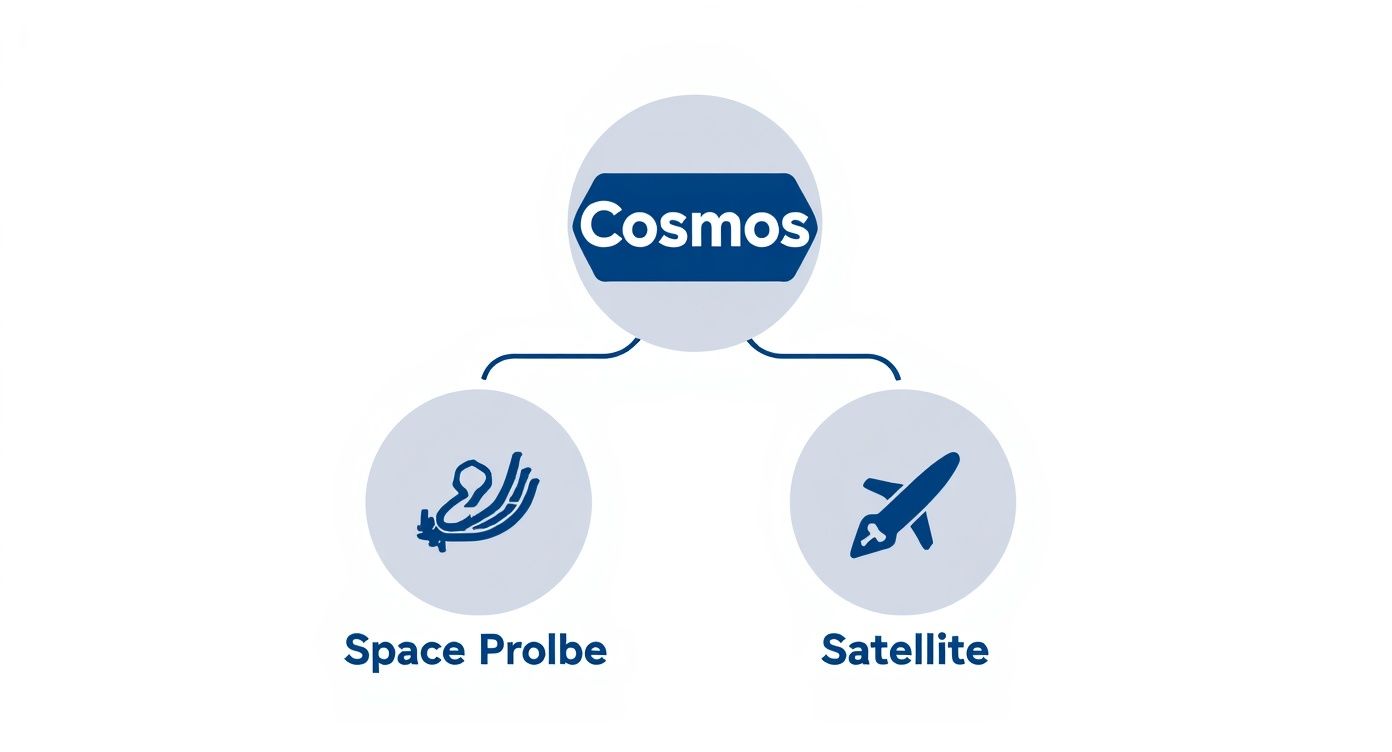
It really highlights that while both are vital tools, probes are the true pioneers built for those deep-space voyages. Together, these systems give a probe everything it needs to complete its mission, whether that’s touching down on the Red Planet or whizzing past a distant comet. If you're curious about our robotic explorers on Mars, you should check out these fascinating Mars rover facts.
It's this brilliant combination of technology that lets us reach out and touch the cosmos. Just like in the book Space Ranger Fred and the Tick Tock Tale, every single component must work perfectly for the mission to be a success.
The UK's Pioneering Role in Space Exploration
When we think of space exploration, missions from NASA often steal the limelight. But for decades, the UK has been a quiet but formidable force, carving out a unique story built on clever science and crucial international teamwork. Britain's focus has always been on uncrewed scientific missions—the kind that have massively expanded what we know about the cosmos.
This journey didn't start yesterday. The UK’s civil space programme officially kicked off way back in 1952. By strategically concentrating on uncrewed space probes, Britain managed to become a key player without ever launching its own astronauts.
A Legacy of Innovation
The UK made its mark early on. After teaming up with the US on its first satellite, Ariel 1, the nation hit a major milestone in 1971 by launching its very own satellite, Prospero. Although it was the UK’s only independent launch, it was the start of a different kind of success story.
Instead of trying to do everything alone, Britain became an expert collaborator. UK institutions have since contributed vital technology and scientific brainpower to over 210 space missions. It just goes to show you don't need your own rockets to make groundbreaking discoveries.
Collaboration is Key
This spirit of teamwork is what really defines the UK’s place in space. British scientists and engineers are constantly building essential instruments for huge international projects run by organisations like NASA and the European Space Agency (ESA). It’s how the UK gets a seat at the table for some of humanity's most ambitious adventures.
The UK's strength lies in its ability to provide world-class, specialised technology that other nations rely on for their missions to succeed. It's a fantastic example of global scientific teamwork.
From creating ultra-sensitive cameras for deep-space telescopes to developing systems that map our own planet, British ingenuity is baked into countless missions. It’s an adventure built on smarts and cooperation, a bit like the problem-solving in Space Ranger Fred and the Umbrella Rescue.
For younger explorers keen to see how these events fit together, our space exploration timeline for kids offers a brilliant overview. This legacy proves that asking 'what is a space probe?' in the UK uncovers a fantastic story of pioneering science and global partnership.
Incredible British Contributions to Famous Probes
While it's easy to think of space exploration as a national effort, the real magic happens in the details, where international collaboration brings incredible missions to life. And when you look closely, you’ll find British scientists and engineers have built some of the most advanced instruments ever sent into space.
These aren't just minor add-ons; they are often the key bits of kit that make mind-blowing discoveries possible, playing a vital part in missions rewriting our understanding of the universe.
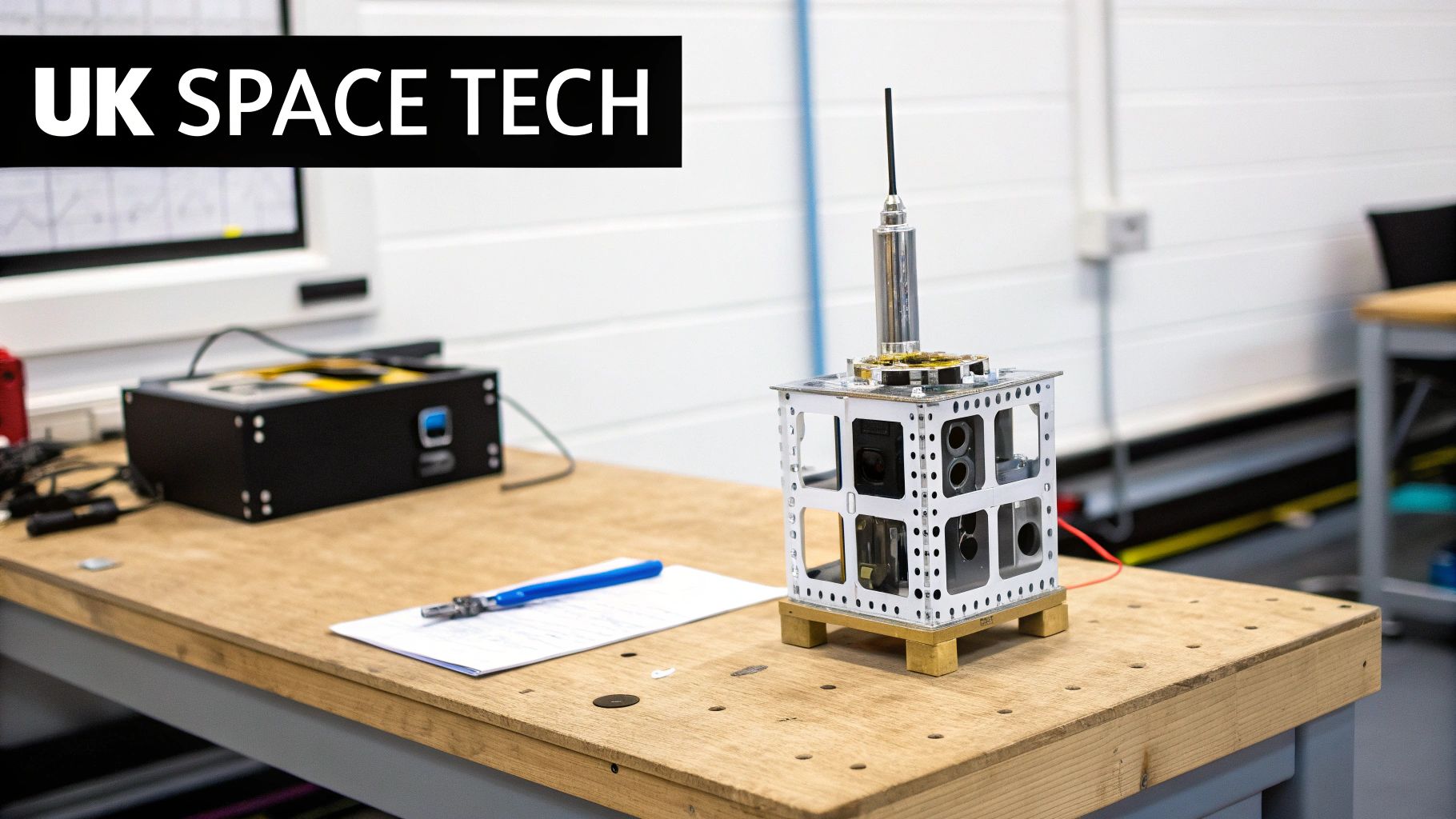
From mapping our own galaxy to peering back to the dawn of time, UK-led technology is at the very forefront of space exploration. Let’s take a look at a few of these stellar achievements.
Seeing the Universe in a New Light
One of the most jaw-dropping examples of British expertise is the Mid-Infrared Instrument (MIRI), perched aboard NASA’s James Webb Space Telescope. Led by UK teams from RAL Space, MIRI is an unbelievably sensitive camera and spectrometer.
To give you an idea of its power, it’s sensitive enough to spot a single candle flame on one of Jupiter’s moons! This amazing instrument allows the telescope to cut through cosmic dust and capture images of the very first stars and galaxies forming. It’s a true triumph of UK engineering.
Mapping Our Galaxy and the Dark Universe
The UK's contributions don't stop there. British universities and labs were also essential to several other major European Space Agency (ESA) missions that are changing the face of modern astronomy.
- The Euclid Mission: Launched in 2023, this probe is on a quest to map the mysterious dark universe. UK scientists are playing a huge role in processing its colossal amounts of data.
- The Gaia Mission: This remarkable probe has created the most detailed 3D map of our Milky Way galaxy ever made. By the time its data collection wrapped up in 2025, it had charted the positions of nearly 2 billion stars.
These missions show just how fundamental UK science is to our cosmic journey. In fact, over the last five decades, RAL Space has contributed to over 210 space missions, shaping our view of the cosmos one instrument at a time. These collaborations require immense precision and teamwork, a bit like the careful planning Fred and Zando use in Space Ranger Fred and the Tick Tock Tale.
You can dive deeper into these and other projects by exploring the UK Space Agency's recent activities.
How Probes Keep an Eye on Our Home Planet
Not all space probes are built for grand tours of the outer solar system. In fact, some of the most critical robotic explorers have their sights set much closer to home, looking back at Earth. Think of them as our sentinels in orbit—a special class of probe tasked with monitoring the health of our own planet.
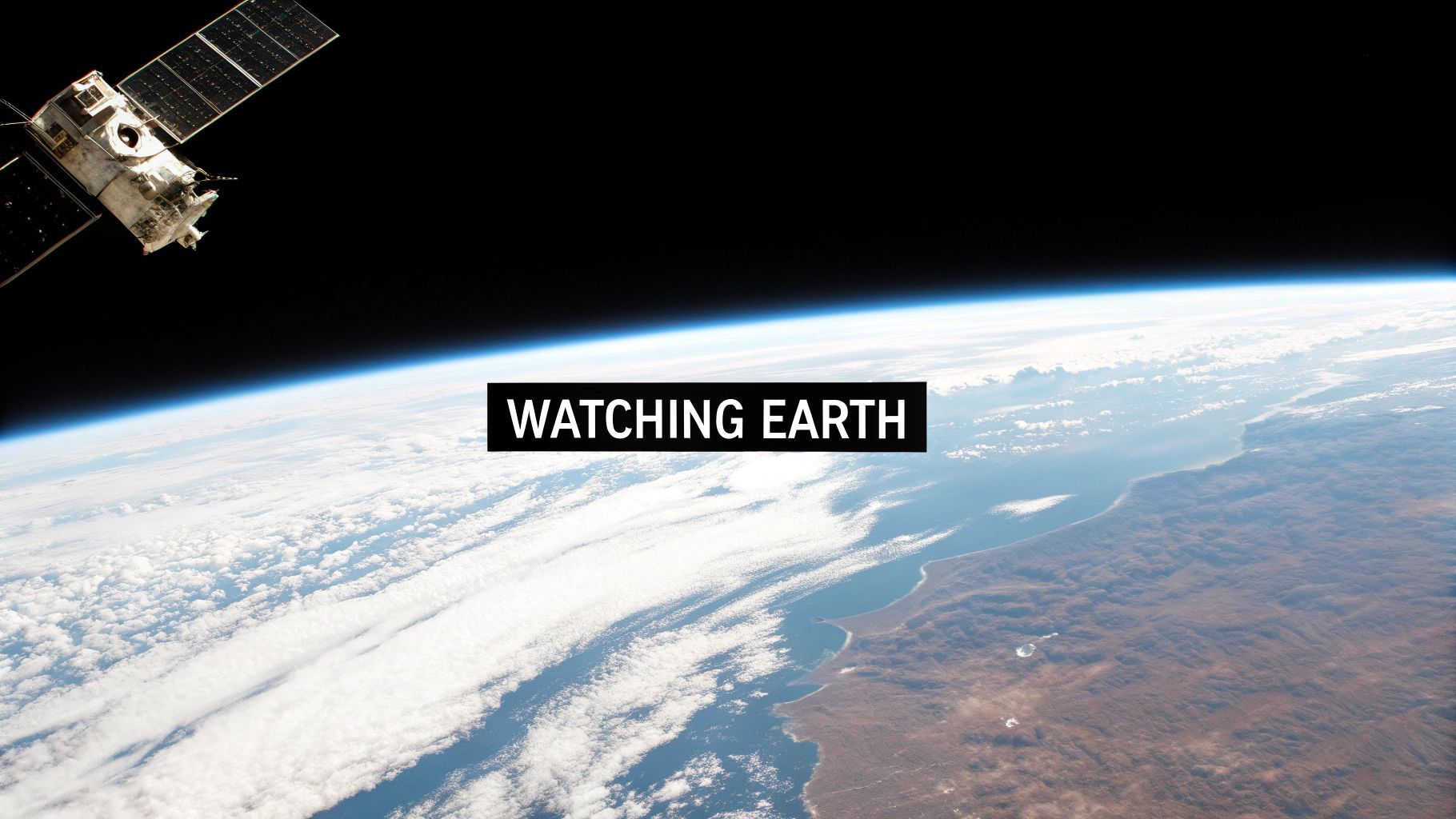
These Earth-watchers are constantly gathering vital data on everything from our weather patterns and ocean currents to the thickness of our polar ice caps. Just as Space Ranger Fred uses his tools to solve problems in Space Ranger Fred and the Shoelace Adventure, these probes use their sophisticated instruments to help us understand and protect our world.
The UK’s Vital Role in Earth Observation
The UK has a strong history of leading missions that keep a close eye on our planet. A brilliant example is the European Remote Sensing satellite 1 (ERS-1), which launched way back in 1991. Over nearly a decade, it completed an incredible 45,000 orbits, creating spectacularly detailed 3D digital maps of Earth’s surface.
That pioneering work really set the stage for modern climate science and the missions that followed.
This legacy continues with missions like the UK-led CryoSat, launched in 2010. CryoSat has a very specific job: to measure the precise thickness of the ice sheets in Greenland and Antarctica. It gives us an unbroken, decade-plus record of how our poles are changing.
The data from these Earth observation probes isn’t just for scientists. It directly informs global policy on climate change and helps us prepare for environmental challenges, connecting the dots between space exploration and protecting our home.
The information gathered by these probes helps us track everything from sea-level rise to deforestation, providing the hard evidence needed to make smart decisions. It also ties into understanding powerful events like solar flares, a topic you can dive into in our guide explaining what space weather is.
Ultimately, these missions prove that sometimes the most important discoveries a space probe can make are about the planet right beneath our feet.
Common Questions About Space Probes
Now that we’ve explored the incredible world of these robotic explorers, a few questions always seem to pop up. It’s only natural! From their epic travel times to what happens when their work is done, let's tackle some of the most common curiosities.
How Long Does a Space Probe Take to Reach Another Planet?
That’s a brilliant question, and the answer is… it depends! There's no single "space speed limit," so the travel time varies hugely based on where the probe is going and the clever path it takes to get there.
Think of it this way: a trip to our cosmic next-door-neighbour, Mars, usually takes around seven months. But if you're aiming for a gas giant like Jupiter, you're in for a much longer haul—we're talking several years. And for the really distant destinations? The New Horizons probe took nearly a decade to finally say hello to Pluto!
Can We Control a Space Probe in Real-Time?
It would be amazing to fly a probe around with a joystick like in a video game, but sadly, it's completely impossible. The biggest hurdle is simply the mind-boggling distance, which creates a massive time lag for any signals we send.
Imagine trying to have a chat with someone on Mars. Even at the speed of light, a command zipping from Earth can take anywhere from 5 to 20 minutes just to reach the Red Planet. That means mission scientists have to be master planners, meticulously mapping out every single action far in advance. They upload a whole sequence of commands for the probe to follow on its own. It's less like playing a game and more like setting up an incredibly complex and very, very distant domino rally.
That signal delay means mission controllers are always solving a problem that actually happened minutes or even hours ago. It takes incredible foresight, a bit like the time-bending challenges faced in the book Space Ranger Fred and the Tick Tock Tale.
What Happens to a Probe After Its Mission Ends?
The final chapter for a space probe can be just as fascinating as its mission. Their fates are carefully planned to make sure we don't accidentally contaminate other worlds and to keep space tidy.
Here are a few of the most common end-of-life scenarios:
- A Safe, Quiet Retirement: Some probes are nudged into a stable, permanent orbit around the planet they were studying or the Sun. They'll circle silently for ages to come, becoming permanent fixtures of the solar system.
- A Final, Fiery Plunge: To avoid any chance of contaminating moons that might harbour life, like Jupiter's icy moon Europa, some probes are deliberately sent on a collision course. NASA’s Galileo probe, for instance, was sent into Jupiter’s atmosphere to burn up safely.
- The Great Escape: A special few, like the legendary Voyager 1 and 2, have finished their main jobs and are now on a one-way trip to the stars. They'll drift through interstellar space for billions of years, carrying golden records with messages from all of us here on Earth.
Are you looking for fun and educational space adventures to share with your young explorer? The Space Ranger Fred book series is designed to make STEM learning an exciting journey. Discover a universe of stories that blend science, humour, and imagination. Find your next adventure at spacerangerfred.com.