
Ever wondered how your favourite telly shows beam all the way from another country? Or how a satnav magically knows the exact route to your holiday destination? It’s not magic—it’s science, happening high above our heads with some incredible machines called satellites.
Your Mission to Understand Satellites
Welcome, fellow space explorer! Get ready to blast off on a mission to uncover the secrets of these amazing space robots. Think of this guide as your personal rocket ship, and I promise it’s going to be an exciting adventure into the world of satellites.
Starting with the Basics
So, what exactly is a satellite? In simple terms, a satellite is anything that orbits, or circles, a much larger object in space. The Moon is a natural satellite of Earth, and our Earth is a satellite of the Sun! But the ones we're talking about are the artificial ones—the machines we build and launch into space.
But how do they stay up there without crashing back down to Earth? It all comes down to a fantastic balancing act.
- Gravity's Constant Tug: Earth's gravity is always pulling the satellite towards the ground, just like it pulls you back down when you jump.
- Super-Fast Speed: At the same time, the satellite is zooming forwards at thousands of kilometres per hour. It’s seriously fast.
This perfect mix of falling and flying sideways creates what we call an orbit. The satellite is constantly falling towards Earth, but it’s moving so quickly that it keeps missing! It just keeps curving around our planet instead.
It's a bit like a cosmic game of catch where the ball never lands! Imagine throwing a ball so fast that by the time gravity pulls it down, the Earth has already curved away from under it.
A Quick Look at Different Satellite Missions
Satellites have many important jobs that help us every day. This table shows some of their key missions.
| Satellite Mission | How It Helps Us on Earth |
|---|---|
| Communication | Beams TV shows, phone calls, and internet signals around the globe. |
| Navigation (GPS) | Helps satnavs in cars and phones know exactly where they are. |
| Weather Forecasting | Takes pictures of clouds and storms to help predict the weather. |
| Earth Observation | Monitors our planet for things like climate change and deforestation. |
| Astronomy | Acts as a telescope in space to see distant stars and galaxies clearly. |
As you can see, these high-flying helpers are busy making our lives better in all sorts of ways.
Your Satellite Mission Guide
Throughout this guide, we'll break down these big ideas into fun, bite-sized pieces. We’ll use simple analogies to make even the most complicated science feel like an exciting story. It reminds me of the clever problem-solving in one of my favourite books, Space Ranger Fred and the Shoelace Adventure, where a simple idea solves a huge problem.
We'll look at the different jobs satellites do, what they're made of, and how they talk to us back on the ground.
Prepare for lift-off!
Building the Ultimate Space Robot
Ever thought about building the ultimate space robot? One tough enough to survive the silent, chilly vacuum of space? Well, that's exactly what a satellite is. Just like any robot, it needs a bunch of special parts all working together as a team to get the job done.
At the very core of every satellite is its main body, which engineers call the bus. Think of it as the satellite's skeleton and armour rolled into one. It’s a super-strong frame that holds all the important, and often delicate, equipment safely inside, protecting everything during that bumpy rocket launch into orbit.
The Brain and Power Station
Every robot needs a brain to tell it what to do, and a satellite is no different. A powerful onboard computer is its mission control centre, managing everything from moment to moment. This computer tells the satellite where to point, when to switch on its instruments, and how to phone home to us on Earth. It's the boss of the whole show!
But how does it stay powered up way out in space? You can't just plug it into a wall! Instead, satellites have huge solar panels that unfold like giant wings once they reach orbit. These panels are covered in special cells that soak up sunlight and turn it into electricity.
The solar panels work like a personal power station, constantly charging the satellite’s batteries. This is super important because the satellite has to keep working even when it flies through Earth’s shadow and the Sun disappears from view.
This stored energy makes sure the satellite's brain and all its gadgets can keep running 24/7. Without that constant supply of juice, our space robot would simply power down.
The Mission's Special Tools
Now for the really exciting bit: the payload. This isn't just one thing; it's the whole collection of special tools and instruments a satellite carries to do its specific job. The payload is the entire reason we send a satellite into space in the first place!
So, what kind of tools are we talking about? It all depends on the mission:
- Eyes on the World: An Earth-observation satellite might carry incredibly powerful cameras and sensors to snap detailed pictures of our planet’s weather, keep an eye on forests, or map our cities.
- Cosmic Messengers: A communications satellite is packed with special antennas that act as its mouth and ears. These are designed to catch signals from Earth and beam them straight back down to a different spot.
- Navigational Guides: A GPS satellite contains a fantastically precise atomic clock. It sends out timing signals that our satnavs and phones use to figure out exactly where we are on the ground.
Each payload is uniquely designed for a single purpose. While these satellites have important jobs circling Earth, some robotic missions are sent even further into the cosmos. You can discover more about these long-distance explorers in our guide on what is a space probe.
Just like in the book Space Ranger Fred and the Umbrella Rescue, where every gadget has its own special purpose, every single component on a satellite is vital. From its tough bus to its specialised payload, each part has to work perfectly for the satellite to complete its incredible journey.
The Invisible Highways Satellites Travel
Satellites don't just float about randomly in space; they follow very specific paths called orbits. Think of them as invisible motorways in the sky. It's a delicate dance between the satellite's incredible forward speed and the constant, gentle tug of Earth's gravity. When that balance is just right, the satellite keeps 'falling' around our planet, sometimes for many years.
Just like we use different roads for different journeys, satellites use different orbits depending on their job. Getting the orbit right is a massive part of any mission's success, a bit like the clever planning Space Ranger Fred uses in Space Ranger Fred and the Tick Tock Tale to make sure everything happens at the right time.
This infographic shows the core parts of a satellite that help it cruise along these orbital highways.
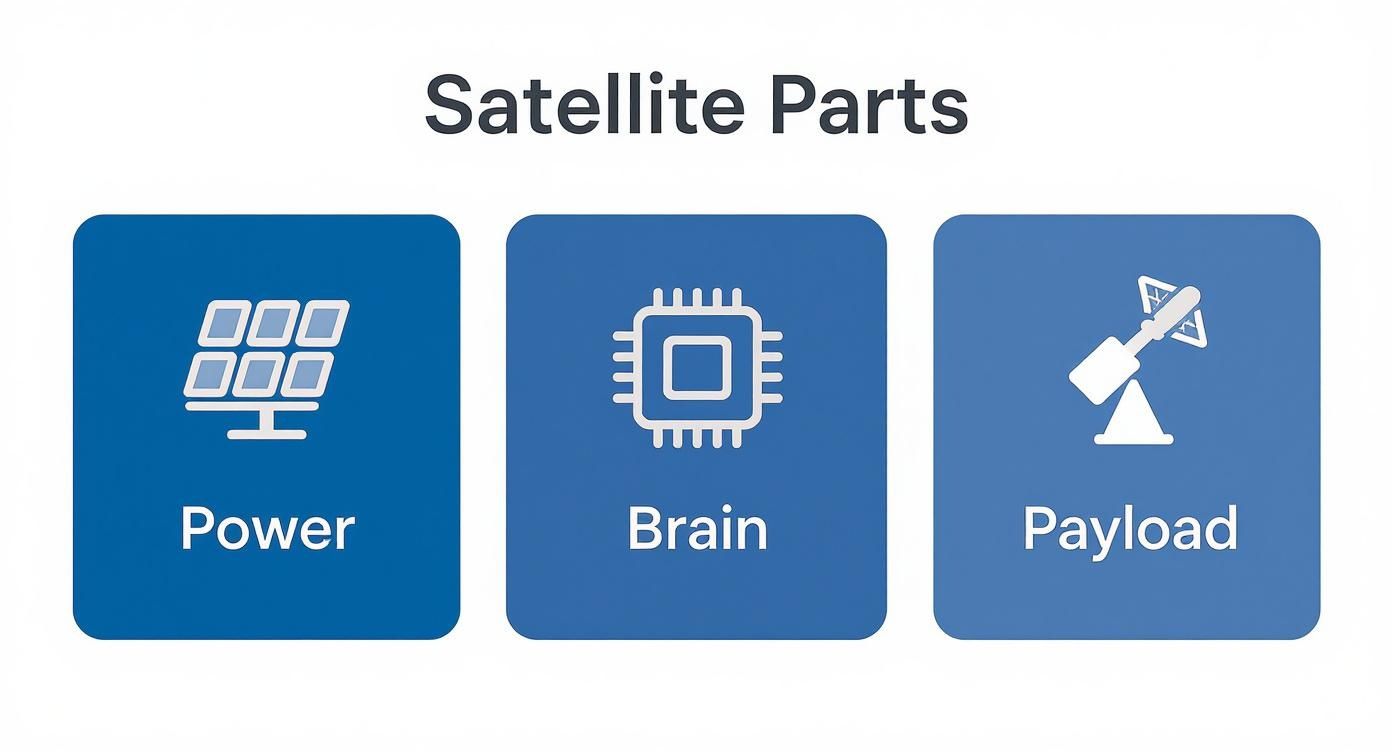
From its solar panels for power to its payload for the mission, every component has to work perfectly in its specific orbit.
Close and Fast Orbits
One of the most common orbital highways is Low Earth Orbit (LEO). Satellites here are relatively close to home, flying anywhere from about 160 to 2,000 kilometres above us. Because they’re so close, gravity's pull is stronger, which means they have to travel at mind-boggling speeds—around 28,000 kilometres per hour—to stop them from falling back to Earth.
They can zip around the entire planet in as little as 90 minutes! This makes LEO perfect for a few important jobs:
- Detailed Photography: Being closer lets satellites take super clear, detailed pictures of the Earth's surface for mapping or keeping an eye on changes to our environment.
- Fast Internet: Companies are launching huge groups of LEO satellites, called constellations, to provide speedy internet connections with less delay.
The UK satellite communications market is seeing huge growth, largely thanks to these new LEO technologies. The market was valued at about £1.8 billion and is expected to grow to over £8.5 billion by 2034, all driven by the demand for better data speeds that LEO satellites provide. You can discover more about the UK's growing satellite market on datainsightsmarket.com.
High and Steady Orbits
If you travel much, much farther out—to about 35,786 kilometres—you'll find a very special road called Geostationary Orbit (GEO). This orbit is incredible because a satellite travelling along it moves at the exact same speed that the Earth spins.
From our perspective on the ground, a satellite in GEO appears to hang completely still in the sky over one fixed spot. It's like it's parked in a specific cosmic parking space!
This unique feature makes GEO extremely useful. It's the ideal orbit for broadcasting television signals, as a ground dish can point at the same spot in the sky all day long without ever needing to move. It’s also used for weather satellites that need to constantly watch over one part of the world to monitor developing storms.
Keeping the Highways Clear
With thousands of satellites orbiting Earth, these invisible highways can get pretty crowded. Old, non-working satellites and bits of broken rockets can become a real hazard. This is why scientists carefully track everything in orbit. You can learn more about the challenges of keeping space tidy by reading our article on what is space debris.
How Satellites Send Messages to Earth
So, we have these amazing space robots zipping around high above us, but how do they actually talk to us back on Earth? How does a signal travel thousands of kilometres from the blackness of space to your telly, phone, or satnav? It’s all part of a super-fast cosmic game of catch using invisible messengers called radio waves.
This incredible two-way communication is what makes so many things we rely on every day possible. It’s a brilliant system that keeps us connected to our helpful friends in the sky.
The Journey from Earth to Space
The conversation always starts on the ground at a special place called a ground station. These places have huge dish aerials, which are pointed with pinpoint accuracy at a specific satellite way up in orbit.
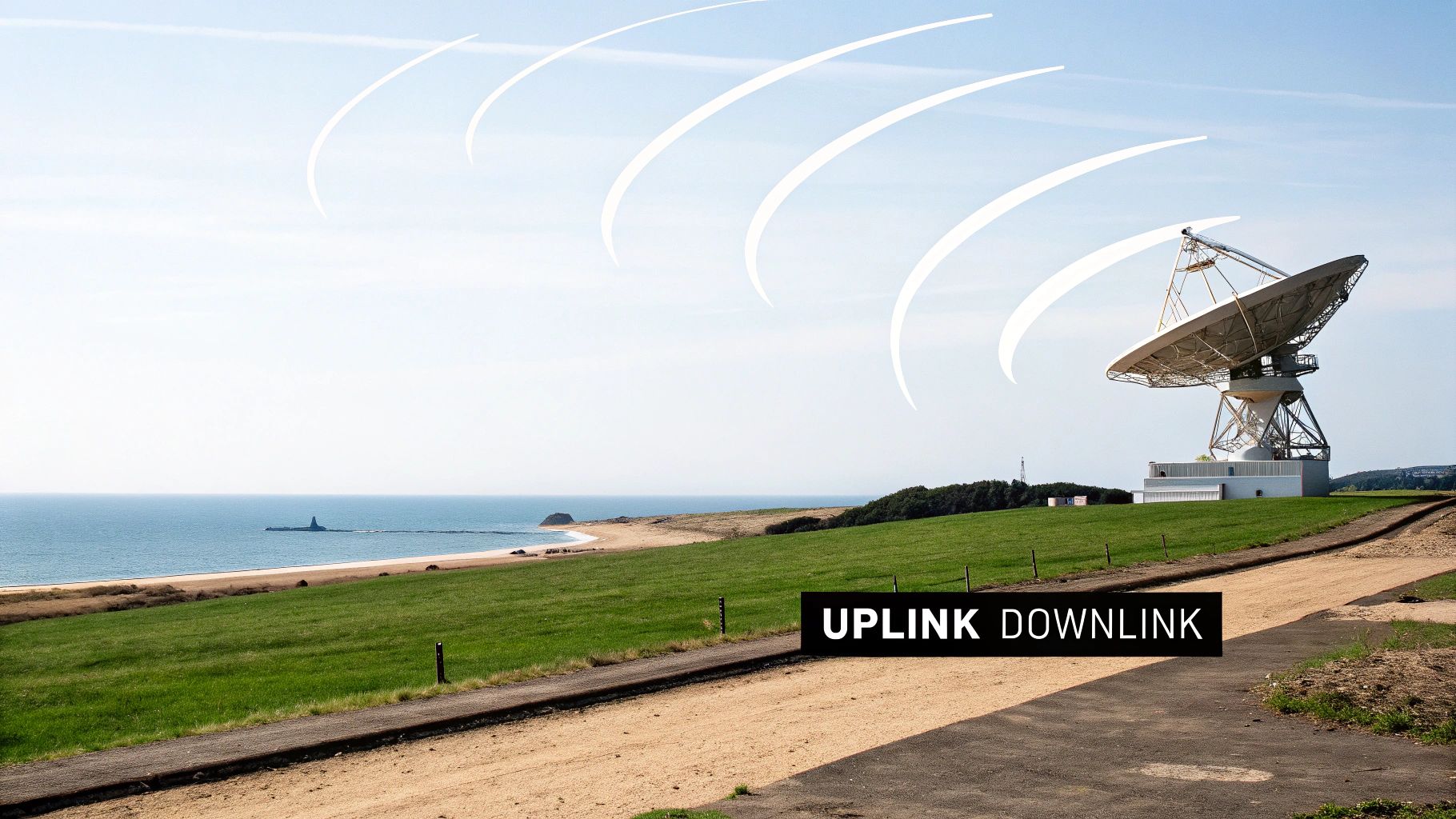
When it’s time to send a message—like a live football match or a phone call—the ground station converts that information into radio waves. It then beams a focused signal straight up to the satellite. This journey from the ground up to space is called the uplink.
Think of it like whispering a secret to a friend standing on top of a very tall hill. You have to aim your voice just right so only they can hear you.
The Satellite's Big Job
Once the satellite catches that faint uplink signal, it gets to work. Its first job is to act like a giant megaphone in space. It grabs the weak signal and uses its own power to amplify it, making it much, much stronger.
This is a really important step. Without this power boost, the signal would be far too weak to make the long journey back down to Earth and still be heard clearly. A satellite needs to be strong and reliable, but sometimes its job can be disrupted by cosmic events. You can find out more about how things like solar flares affect our tech in our guide on what is space weather.
After giving the signal a boost, the satellite often changes its frequency. This is a bit like changing the radio channel to make sure the returning message doesn’t get mixed up with all the other signals still coming up from the ground.
The Return Trip to Earth
Now for the final leg of the journey! The satellite aims its own aerial towards a different spot on Earth and sends the newly beefed-up signal back down. This return trip is known as the downlink.
The big satellite dishes you see on the roofs of houses or on top of buildings are designed to catch these specific downlink signals. Your telly or GPS device then unscrambles the signal, turning it back into pictures, sounds, or location data.
It's like your friend on the hill using a giant megaphone to shout your secret back down to another friend waiting in the next valley. The satellite is the perfect go-between, making sure the message gets from A to B loud and clear.
This whole process—uplink, amplify, downlink—happens in the blink of an eye. It’s what lets us watch live sports from the other side of the world or get instant directions in the car.
Keeping Messages Safe and Secure
For some missions, especially for the military, keeping these messages secret is incredibly important. Special satellites are built to handle encrypted, or coded, communications to make sure that pesky space villains can't listen in.
The United Kingdom's Skynet programme, which started way back in 1969, is a brilliant example of how satellites work for defence. Today’s modern Skynet 5 satellites provide secure, real-time voice, data, and video for the military, letting them talk safely over huge distances. It's a capability just as important as any of the gadgets used in a Space Ranger Fred and the Shoelace Adventure story. You can read about the fifty-year history of UK military satcoms on kclpure.kcl.ac.uk.
Finding Satellites in Your Daily Life
You might not even realise it, but satellites are working hard for you all day, every day. These amazing space robots are the unsung heroes behind so much of what we do, quietly making modern life possible from way up high above the Earth.
Ever watched a live football match happening on the other side of the planet? That incredible feat is thanks to a communications satellite that beams pictures and sound across continents in a flash. It’s like a cosmic delivery service just for your entertainment!
This connection to space is all around us. When you check the weather forecast on a tablet or phone, that info comes from weather satellites constantly watching our planet’s clouds and storm systems from orbit.
Your Everyday Satellite Helpers
From the moment you wake up to the time you go to sleep, satellites are probably playing a part in your day. They're essential for keeping our world running smoothly and safely.
Let’s look at a few examples:
- Navigation: When your family uses a satnav in the car, it’s listening for signals from at least four different satellites to pinpoint your exact location on a map.
- Farming: Farmers use satellite images to check on their crops, seeing which fields need more water or attention without ever leaving the office.
- Emergency Services: Rescue teams can use satellite signals to find people lost in remote areas, like thick forests or out at sea. It reminds me a bit of a mission in Space Ranger Fred and the Umbrella Rescue, helping to save lives when it matters most.
Satellites are like the ultimate multi-taskers of the space world. They are our eyes in the sky for science, our global postmen for information, and our guides for travel, all at the same time.
The UK's Thriving Space Scene
Here in the United Kingdom, we have a really exciting and growing space industry that uses satellite data to solve all sorts of problems right here on Earth. From helping ships navigate safely through busy waters to bringing better internet to people in the countryside, UK companies are finding clever ways to use this space tech.
This industry isn't just about cool science; it’s a big deal for the economy, too. The UK satellite communications market is a fantastic example of this growth.
It recently generated around £4.4 billion in revenue, and that figure is expected to nearly double by 2030! The UK's share of the global satellite communication market is about 6.1%, making it the fastest-growing regional market in Europe. It just goes to show how important satellites are for our country's infrastructure and future jobs. You can learn more about the UK's satellite market growth on grandviewresearch.com.
From banking transactions that need precise timing signals to scientists tracking climate change by measuring ice caps, these invisible helpers are truly woven into the fabric of our connected world. They show us just how much we can achieve when we look up to the stars for answers.
Exploring the Future of Satellite Technology
Believe it or not, this amazing adventure in space is only just getting started! Just when we think we’ve got a handle on how satellites work, clever engineers and scientists are dreaming up incredible new ideas that are set to change our world all over again. The future of satellite technology is brighter than the shiniest star in the sky.
One of the biggest game-changers on the horizon is the arrival of mega-constellations. Forget one or two satellites whizzing overhead; imagine vast networks of thousands of smaller, smarter satellites, all working together as a team. Their main mission? To beam fast, reliable internet to every single corner of the globe, from the busiest cities to the most remote villages.
Smarter Satellites on the Horizon
Future satellites won't just be waiting for instructions from Earth. They’ll be able to think for themselves, using a type of computer brain we call artificial intelligence (AI). This will let them do some truly amazing things all on their own.
- On-the-Spot Analysis: Instead of sending huge amounts of raw data back down to us, these satellites will analyse information right there in orbit. They'll send back only the most important bits, saving a ton of time.
- Smart Decisions: They'll be able to make their own choices, like dodging a piece of space debris that gets too close or quickly pointing their cameras at something unexpected, like a volcano suddenly erupting.
- Self-Repairs: In the future, satellites might even fix themselves! Using tiny robotic arms, they could patch up a problem, which means they could keep working for much, much longer.
With these new skills, satellites will be able to help us in even more ways, from managing traffic for flying drones to giving us a clearer, more detailed picture of our changing planet.
The next generation of satellites will be like having super-smart assistants in space. They won't just collect information; they will help us understand it faster and better than ever before, transforming our world in ways we can only dream of today.
A Secure Future with British Innovation
As we start to rely on satellites for more and more things, keeping their signals safe is a huge deal. The UK is right at the front of this challenge, developing some seriously clever tech to protect our space communications from pesky space pirates.
One of the most exciting ideas is something called quantum communications. This brainy technology uses the weird and wonderful rules of quantum physics to create signals that are practically unhackable. If anyone tries to eavesdrop, the signal itself changes, and we know immediately that someone is snooping! It’s like a secret code that’s impossible to crack. It’s the kind of brilliant thinking you might find in a book like Space Ranger Fred and the Tick Tock Tale, where a simple but clever idea saves the day.
From AI brains to unhackable signals and giant internet constellations, the future is all about making satellites smaller, smarter, and more connected. The sky above is about to get a whole lot busier—and a whole lot more exciting.
Got More Questions About How Satellites Work?
We’ve covered a lot on our mission today, from what satellites are made of to the invisible highways they travel on. But even the cleverest space explorers have a few more questions buzzing around in their helmets. Let's tackle some of the most common ones we hear.
Why Don't Satellites Just Fall Down?
This is a fantastic question, and the answer is a little mind-boggling: a satellite is always falling! The trick is that it's also moving sideways at an incredible speed, a speed that’s perfectly matched to the curve of the Earth.
Think about throwing a tennis ball. It flies forward for a bit, but gravity always wins, pulling it down to the ground. Now, imagine you could throw that ball so fast that as it falls, the Earth curves away underneath it at the exact same rate. That’s an orbit!
A satellite is in a constant state of falling around our planet, but its huge forward speed means it keeps missing the ground. This perfect balancing act between speed and gravity is the secret to how satellites stay up in the sky.
How Long Do Satellites Last in Space?
Most satellites are built for missions that last between 5 and 15 years. Their time in orbit is usually limited by two main things: running out of fuel and the general wear and tear from living in the harsh environment of space.
A satellite needs a tiny bit of fuel to make small adjustments to its orbit, helping it stay on the right path. Once that fuel is gone, it can't steer properly anymore. At the same time, the extreme temperatures and constant radiation in space slowly wear out its electronic parts.
When a satellite’s mission is over, engineers will either move it to a special, faraway ‘graveyard orbit’ or guide it to burn up safely in Earth’s atmosphere. It’s a bit like the end of an adventure in Space Ranger Fred and the Shoelace Adventure, where every mission has a clear beginning and end.
Can I See a Satellite from My Garden?
Yes, you absolutely can! On a clear night, especially if you can get away from bright city lights, it's quite easy to spot satellites moving steadily across the sky.
They look like stars that have decided to go for a walk. Here’s what to look for:
- A Steady Light: Unlike aeroplanes with their flashing lights, satellites shine with a constant, solid glow.
- No Twinkling: They don't twinkle like stars do. The light you see is simply sunlight reflecting off their shiny solar panels.
- A Straight Path: They travel in a straight, determined line right across the night sky.
There are loads of fun apps and websites you can use that will tell you exactly when and where to look to see famous satellites, like the International Space Station, passing right over your head!
At Space Ranger Fred, we believe learning about science and space should be an exciting adventure. Our books and stories are designed to spark curiosity and make big topics, like how satellites work, fun and easy to understand for the next generation of explorers.
Ready for your next mission? Blast off into a world of fun and discovery by exploring our stories at https://spacerangerfred.com.