
Hello, fellow space explorers! Have you ever spotted a bright flash of light zipping across the night sky and quickly made a wish on a ‘shooting star’? It’s a magical moment, isn't it?
Well, the real story behind that magic is even cooler. A meteor shower happens when Earth cruises through a trail of cosmic dust left behind by a comet. Imagine our planet is a car driving through a cloud of glitter—each tiny speck lights up as it hits our atmosphere, creating a spectacular light show for us down below.
What Are Shooting Stars, Really?
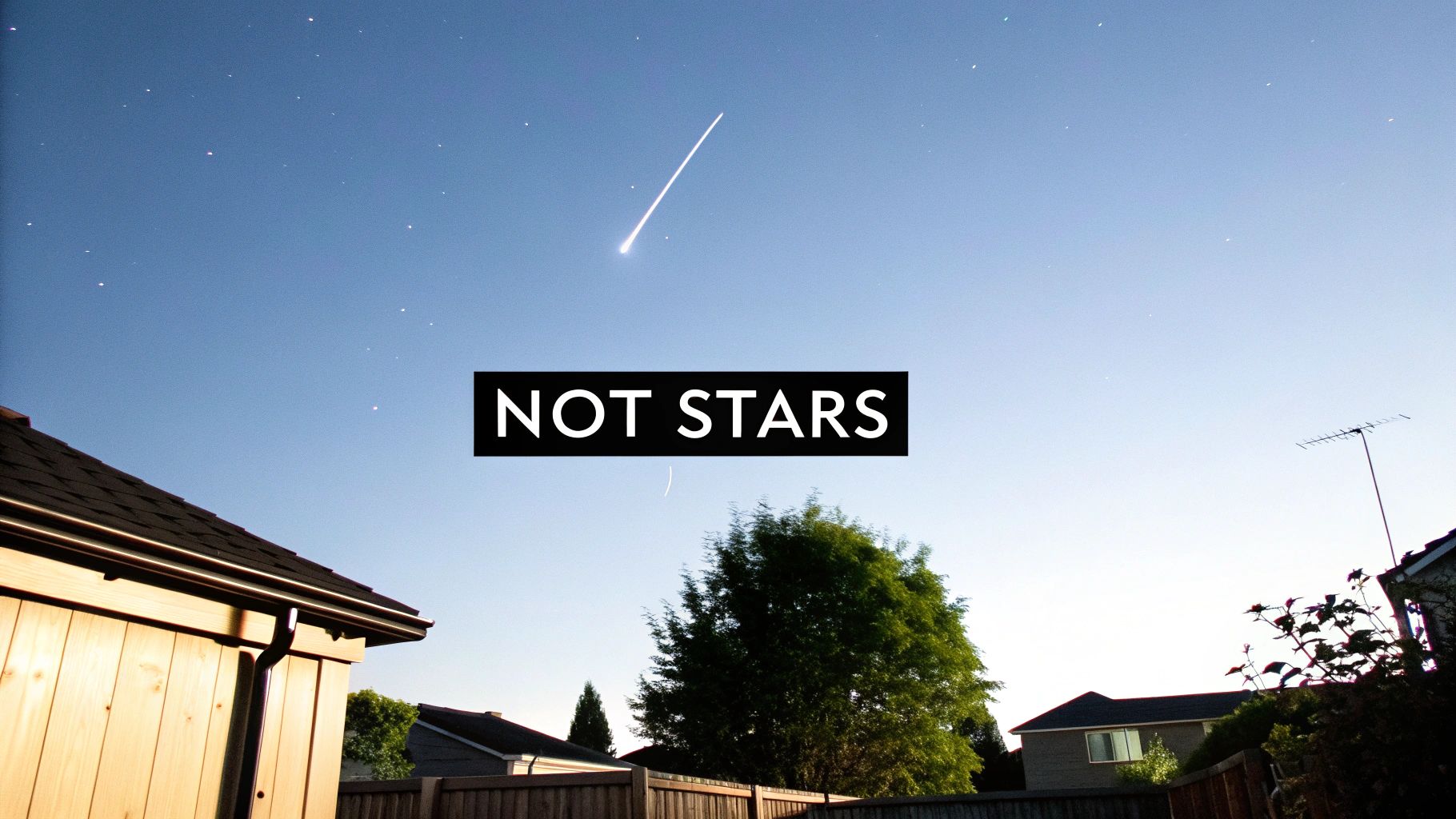
First things first, let's clear up a common mix-up. That beautiful streak of light isn't actually a star falling out of the sky. Real stars are enormous, fiery balls of gas, just like our Sun, but they are trillions of miles away.
A ‘shooting star’ is actually a tiny piece of rock or dust, often no bigger than a grain of sand, that burns up as it smacks into Earth’s atmosphere at mind-boggling speeds.
The bright flash we see isn't the rock itself, but the air around it glowing white-hot from friction. It’s a bit like rubbing your hands together really fast to warm them up, but on a massive, cosmic scale! That glowing trail has an official name: a meteor.
Before we go any further, let's get our space vocabulary sorted. It can get a bit confusing, so I've put together a handy cheat sheet for you.
Your Guide to Cosmic Nicknames
This simple table breaks down the key terms we'll use on our cosmic journey, so you'll always know what we're talking about!
| Official Space Term | What It Means for Us | Space Ranger Fred's Nickname |
|---|---|---|
| Comet | A giant, icy snowball with a tail of dust and gas that orbits the Sun. | A Cosmic Litterbug |
| Meteoroid | A piece of rock or dust floating in space, broken off from a comet or asteroid. | A Space Pebble |
| Meteor | A meteoroid that burns up in Earth's atmosphere, creating a flash of light. | A Shooting Star |
| Meteorite | A meteoroid that survives its fiery journey and lands on Earth's surface. | A Fallen Star |
| Meteor Shower | When Earth passes through a comet's debris trail, causing lots of 'shooting stars'. | A Glitter Storm |
Now that we've got our terms straight, let's find out where all this cosmic glitter comes from.
Our Cosmic Neighbourhood
Those tiny bits of dust are leftovers from visitors to our cosmic neighbourhood. Most meteor showers are caused by comets—those giant, dusty snowballs that zoom through space. As a comet gets closer to the Sun, it starts to warm up and shed a long trail of ice, dust, and rock, like a dog shedding its fur.
To get a better picture of how everything moves around up there, you can explore our simple guide on what is the solar system, which explains how planets, comets, and asteroids all travel around our star.
And that brings us to the big secret behind meteor showers.
A meteor shower isn't a storm of falling stars. It's Earth's annual trip through the dusty, glittery leftovers of a passing comet—a brilliant reminder of the cosmic journeys happening all around us.
So, when you see dozens of shooting stars in one night, you're actually watching our planet plough through an ancient comet's trail. Each streak of light is a tiny piece of that comet’s history, burning up to create a completely harmless and totally awesome show for us to enjoy.
The Messy Story of Comets and Cosmic Dust
To get to the bottom of what causes a meteor shower, we first need to meet the main characters in our cosmic story: comets! Think of a comet as a massive, dusty snowball hurtling through the cold, dark void of space on a long, looping journey around the Sun. It’s a messy jumble of ice, rock, and frozen gases.
For most of its trip, a comet is pretty quiet—just a frozen lump minding its own business. But as its orbit swings it closer to the blazing Sun, things start to get interesting. The Sun’s heat acts like a giant hairdryer, warming the comet’s icy surface until it turns straight into gas in a process called sublimation.
The Comet's Glittery Trail
As all that gas erupts from the comet, it blasts away tiny bits of rock and dust that were trapped inside the ice. This creates a huge, glowing cloud around the comet called a coma and a long, sparkly tail that can stretch for millions of miles behind it.
This whole process leaves behind a trail of cosmic crumbs all along the comet's flight path. It’s a bit like a lorry spilling gravel as it rumbles down the motorway—long after the lorry is gone, the gravel is still scattered across the road. This dusty path left by a comet is called a meteoroid stream.
Think of a meteor shower as our planet's reward for cleaning up after a messy comet. Earth sweeps through the dusty trail, and we get a fantastic light show in return!
Each year, as Earth makes its own way around the Sun, it sometimes sails right through one of these ancient dust trails. When that happens, the tiny meteoroids—often no bigger than a grain of sand—slam into our atmosphere at unbelievable speeds.
The Science Behind the Sparkle
Those brilliant streaks of light we see are what happens when these tiny particles burn up from friction with the air. Here in the UK, meteor showers are almost always caused by Earth passing through these streams of comet debris. The particles hit our atmosphere at incredible speeds, usually between 11 and 72 kilometres per second, creating the bright flashes we call meteors. You can find out more about how we track these events from the dedicated sky-watchers at the UK Meteor Network.
It's a beautiful, fiery end for a tiny piece of an ancient comet, creating a fleeting moment of magic for us all to enjoy.
For an even more hands-on way to understand this, check out our fun space activities for kids, where you can find crafts to bring the cosmos to life. And while not all meteor showers come from comets (some come from asteroids!), these messy, icy wanderers are responsible for most of the amazing shows we see.
Now, you might be wondering why these shows happen at the same time every year.
Why Meteor Showers Are So Predictable
Ever wondered why we talk about the Perseid meteor shower happening every August, almost like a cosmic birthday party? It's not a coincidence! The reason these beautiful light shows are so reliable comes down to Earth's predictable journey around the Sun.
Imagine our planet is a racing car on a giant, invisible track. This track is Earth’s orbit, and it follows the exact same path around the Sun year after year, without fail. It never takes a detour or a shortcut.
Earth's Cosmic Timetable
Now, picture those dusty trails left behind by comets. These aren't just floating around randomly; they’re like fixed puddles of glitter sitting at specific points on Earth’s racetrack.
Because our planet follows the same orbital path, it ploughs through these exact same dust clouds at the same time each year. This is what causes meteor showers to appear on our calendar like clockwork.
This simple animation shows how a comet leaves a trail of dust that Earth passes through.

It’s a fantastic way to visualise how a shower happens when Earth's orbit intersects with the comet's dusty path. It's a cosmic collision course that repeats every single year.
The predictability of a meteor shower is all down to location, location, location! Earth returns to the same spot in its orbit each year, ready to drive through whichever cosmic dust cloud is waiting there.
Take the famous Perseid meteor shower, a real summer holiday treat for stargazers. It always peaks around mid-August. That’s because every August, Earth’s journey takes it right through the trail left by a comet called Swift-Tuttle.
In the same way, the Geminids light up our skies every December because that’s when Earth crosses the debris trail of an unusual rocky object named 3200 Phaethon. This cosmic calendar is how astronomers know exactly when and where to look for these amazing events.
The Radiant Point
Have you ever noticed that during a shower, all the meteors seem to shoot out from a single spot in the sky? This spot is called the radiant. It's an optical illusion, much like standing in a long, straight tunnel and seeing the walls appear to meet at a point in the distance.
Here’s what’s really going on:
- Parallel Paths: The meteoroids in a comet's trail are all travelling in roughly the same direction through space, on parallel paths.
- Perspective: As Earth ploughs into this stream, the dust particles enter our atmosphere from the same direction. From our viewpoint on the ground, their fiery trails seem to radiate outwards from one point, just like snowflakes in a blizzard seem to fly out from a single point ahead of you as you drive through it.
Meteor showers are actually named after the constellation where their radiant point appears to be located. For example, the Perseids seem to come from the constellation Perseus, while the Geminids radiate from Gemini. You don't need to know the constellations to enjoy the show, but it's a fun fact to share while you're stargazing! Grab your own copy of my book, Space Ranger Fred and the Shoestring Ship, to learn more about the constellations on your next adventure.
Your Guide to UK Meteor Showers
Alright, now you know the science behind the shooting stars! But knowing what causes a meteor shower is one thing; seeing one with your own eyes is something else entirely. It's pure magic.
Luckily for us, the UK gets a front-row seat to some of the best celestial fireworks shows all year round. Let's get you ready to meet the 'big three' – the annual meteor showers that reliably put on a spectacular display for families across the country. Each one has its own personality, a unique story, and a different time of year to shine.
The Perseids in August
First up, the superstars of the summer: the Perseids! Peaking around mid-August, this is often the very first meteor shower families watch together, and for good reason—the warmer weather makes it a perfect cosmic camp-out.
- Parent Comet: These meteors are tiny bits of cosmic dust left behind by Comet Swift-Tuttle. It’s a huge comet that takes an incredible 133 years just to make one trip around the Sun.
- What Makes Them Special: The Perseids are famous for their bright, speedy meteors. You’ll see plenty of them, and you might even spot a few ‘fireballs’—extra-bright meteors that can light up the entire sky for a second or two. They’re a brilliant and reliable show, year after year.
The Geminids in December
Time to wrap up warm! The Geminids arrive to light up our chilly skies around mid-December. This shower is a bit of a cosmic mystery, though, because it breaks our main comet rule!
- Parent Object: The Geminids don’t come from an icy comet. Instead, their trail is created by a strange rocky object called 3200 Phaethon. Some scientists think Phaethon might be a ‘rock comet’ or an asteroid that’s shedding dusty debris.
- What Makes Them Special: This is one of the richest showers of the year, often producing over 100 meteors per hour if you’re under a dark sky. The meteors themselves tend to be slower and more graceful than the Perseids, often glowing with a beautiful yellowish colour as they glide across the sky.
The Quadrantids in January
Kicking off the new year with a celestial bang, the Quadrantids arrive in early January. This one is a bit trickier to catch, but it’s absolutely worth the effort if your timing is right.
- Parent Object: Just like the Geminids, the Quadrantids are also thought to come from a rocky body—this time an asteroid named 2003 EH1.
- What Makes Them Special: The Quadrantids are famous for having a very short, sharp peak of activity that only lasts for a few hours. If you happen to be watching during that window, you could see a sudden flurry of bright meteors. Miss it, and you miss the show. Timing is everything!
Top Tip for a Successful Mission: A big, bright moon can be a real show-stealer, washing out all but the brightest meteors. Before you plan your night out, it’s always a good idea to check the forecast. Our guide on understanding moon phases for kids can help you figure out if the Moon will be outshining your meteor show!
Whichever shower you choose, a little preparation makes all the difference. Find a spot away from bright city lights—a local park, a field, or even your back garden if it’s dark enough.
Bring warm blankets, a flask of hot chocolate, and some comfy chairs to lie back on. Most importantly, be patient! Your eyes need about 20 minutes to fully adjust to the darkness. Once they do, you’ll start spotting even the faintest shooting stars zipping across the heavens. Happy stargazing!
How People Watched Meteors in the Past
Have you ever wondered if children a long, long time ago also made wishes on shooting stars? You bet they did! Watching the skies for dazzling lights isn’t some new hobby; people have been gazing up in wonder for thousands of years, long before we had powerful telescopes or any idea what caused these incredible light shows.
Our curiosity about the stars is a timeless human adventure. Before anyone knew that meteors were just dusty leftovers from comets, ancient stargazers recorded seeing amazing 'fireballs' and showers of light. Without science to explain what was happening, they came up with their own ideas, often seeing these events as messages from the gods, strange omens, or even magical dragons flying through the heavens.
Early Records from Around the World
Fascinatingly, ancient records from places like China, Japan, and the Middle East describe meteor showers that happened centuries ago. These early astronomers were like the first sky detectives, carefully noting down what they saw and creating some of the first scientific diaries of the cosmos. Their detailed observations were vital clues that helped later scientists piece together the puzzle of meteor showers.
It wasn't just in faraway lands, either. Right here in the UK, people have been documenting these celestial events for hundreds of years. There are incredibly detailed accounts from the 18th century describing amazing meteor sightings. On 18 August 1783, a particularly bright meteor was seen all across the country. Imagine people in London, Bath, and Yorkshire all looking up at the very same amazing sight at the same moment! You can dive into more of these incredible old sightings in this collection of historical meteorite records.
These stories show us that watching the stars connects us to generations of people from the past. When you look up at a meteor shower, you are sharing an experience with people who lived hundreds, even thousands, of years ago.
Science is a long story of discovery, passed down through generations. Every time you watch the stars, you become part of that story, joining a long line of explorers who have looked up and wondered.
This amazing history is a brilliant reminder that asking questions about our universe is one of the most exciting things we can do. You don’t need any special equipment to be an explorer—just a curious mind and a clear night sky. By learning about the past, we get to appreciate just how special and awe-inspiring our universe truly is.
Plan Your Family Meteor Shower Mission
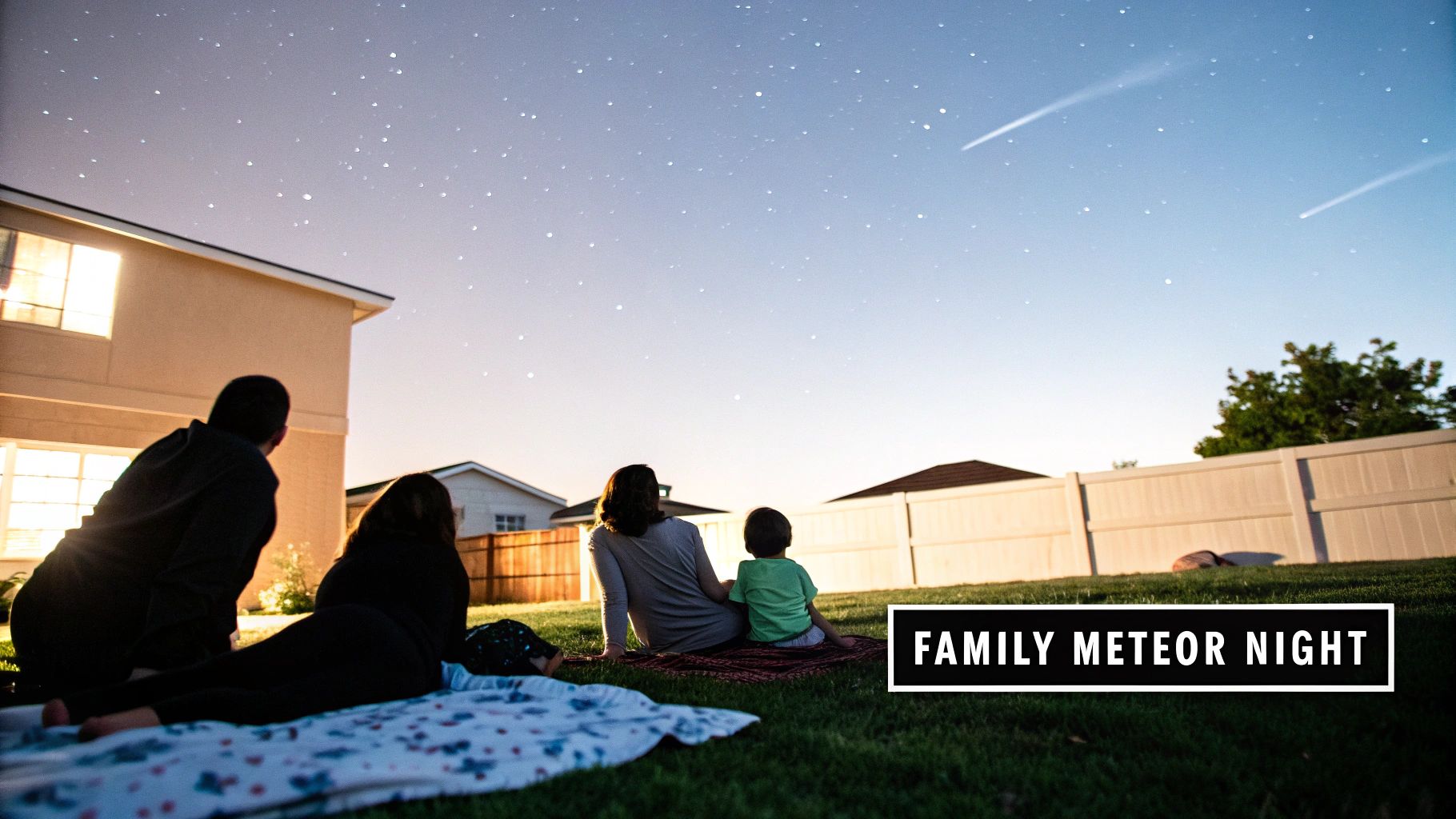
Right, cosmic explorers, are you ready to turn all this amazing science into a real-life space mission? Knowing what causes meteor showers is brilliant, but seeing one for yourself is an adventure you’ll never forget. Planning a special ‘Family Meteor Shower Night’ is the perfect way to bring STEM learning to life in the most fun way imaginable.
Let's get our mission plan sorted! A great meteor watch starts with a comfy base. You can build an amazing viewing fort in the back garden with blankets, pillows, and sleeping bags. The goal is simply to get cosy while you lie back and watch the sky.
You don't need any fancy gear, but if you have binoculars or want to learn about bigger equipment for future missions, our guide on how to use telescopes has some great pointers.
Prepare Your Mission Supplies
Every good mission needs the right supplies. To make your night extra special, why not try some of these space-themed ideas?
- Whip up 'Cosmic Hot Chocolate': Make your favourite hot chocolate and top it with mini marshmallows ('asteroids') and edible glitter ('stardust').
- Create a Comet-on-a-Stick: Grab a wooden skewer, a marshmallow for the comet's head, and long ribbons for its sparkly tail. It's a fun craft and a tasty treat!
- Keep a Meteor Log: Turn your stargazing into a proper science experiment by counting how many shooting stars you spot. You can jot down their brightness, direction, and the time you saw them.
To get you started, you can download a free, printable Meteor Log sheet from our activities page. It's the perfect tool for your little astronomers to record their findings and feel like real space scientists.
The best way to learn about the universe is to get out there and experience it. A family meteor watch isn't just about science; it’s about making memories, sharing stories under the stars, and sparking a lifelong sense of wonder.
Just remember to give your eyes at least 20 minutes to adjust to the dark. The longer you wait, the more shooting stars you’ll see.
Happy watching, Space Rangers!
Got a Question About Meteor Showers?
Even the most seasoned Space Rangers have questions! Here are some simple, cosmic answers to the things you're probably wondering about as you get ready for your next stargazing mission.
Are Shooting Stars Actually Stars?
Great question! It’s a bit of a trick, really. Even though we call them ‘shooting stars’, they have nothing to do with actual stars. Stars are giant, super-hot balls of gas, just like our Sun, but they're incredibly far away.
Those beautiful streaks of light we see zipping across the night sky? They’re actually tiny bits of space dust and rock called meteoroids. When they hit the air surrounding Earth, they burn up in a flash of light. They just look like little stars making a quick journey across the heavens!
Could a Meteor Ever Hit Me?
You can definitely relax and enjoy the show—it's unbelievably rare for a meteor to reach you! Most of the bits of dust that cause these amazing light shows are super small, often no bigger than a grain of sand.
They burn up completely when they're still way, way up in the sky, usually around 50 to 75 kilometres above our heads. It's the perfect firework display, and you have the best (and safest!) seat in the house.
What’s the Difference Between a Meteoroid, Meteor, and Meteorite?
It all sounds a bit confusing, but there’s a simple secret: it all depends on where the space rock is on its journey.
- A meteoroid is what we call the piece of rock or dust when it’s still floating around in space, minding its own business.
- When that piece of dust zips into Earth’s atmosphere and creates that brilliant streak of light, we call it a meteor. That's our shooting star!
- And if a piece is big enough to survive its fiery trip and actually land on the ground, it gets a new name: a meteorite.
Think of it like a raindrop. It's water vapour in a cloud, it becomes a raindrop when it falls, and it's a puddle once it hits the ground. It’s the same idea for a space rock on its incredible journey to Earth!
I hope that clears a few things up, Space Rangers! The universe is full of amazing things to discover, and asking questions is always the best way to kick off a new adventure. To continue your cosmic journey, explore all the exciting stories and activities at Space Ranger Fred.
Ready for your next mission? Blast off to https://spacerangerfred.com.