
Hello, Space Rangers! Have you ever looked up at our bright, warm Sun and wondered where all that light and heat comes from? It’s not a giant lightbulb, but it does have a secret power source. The simple answer to how does the sun produce energy is something incredible called nuclear fusion.
It’s like a massive cosmic powerhouse, constantly squashing tiny particles together in its centre. This process releases enormous bursts of energy that travel all the way across space to warm us here on Earth. Let's find out how it all works!
The Sun's Secret Recipe for Sunshine
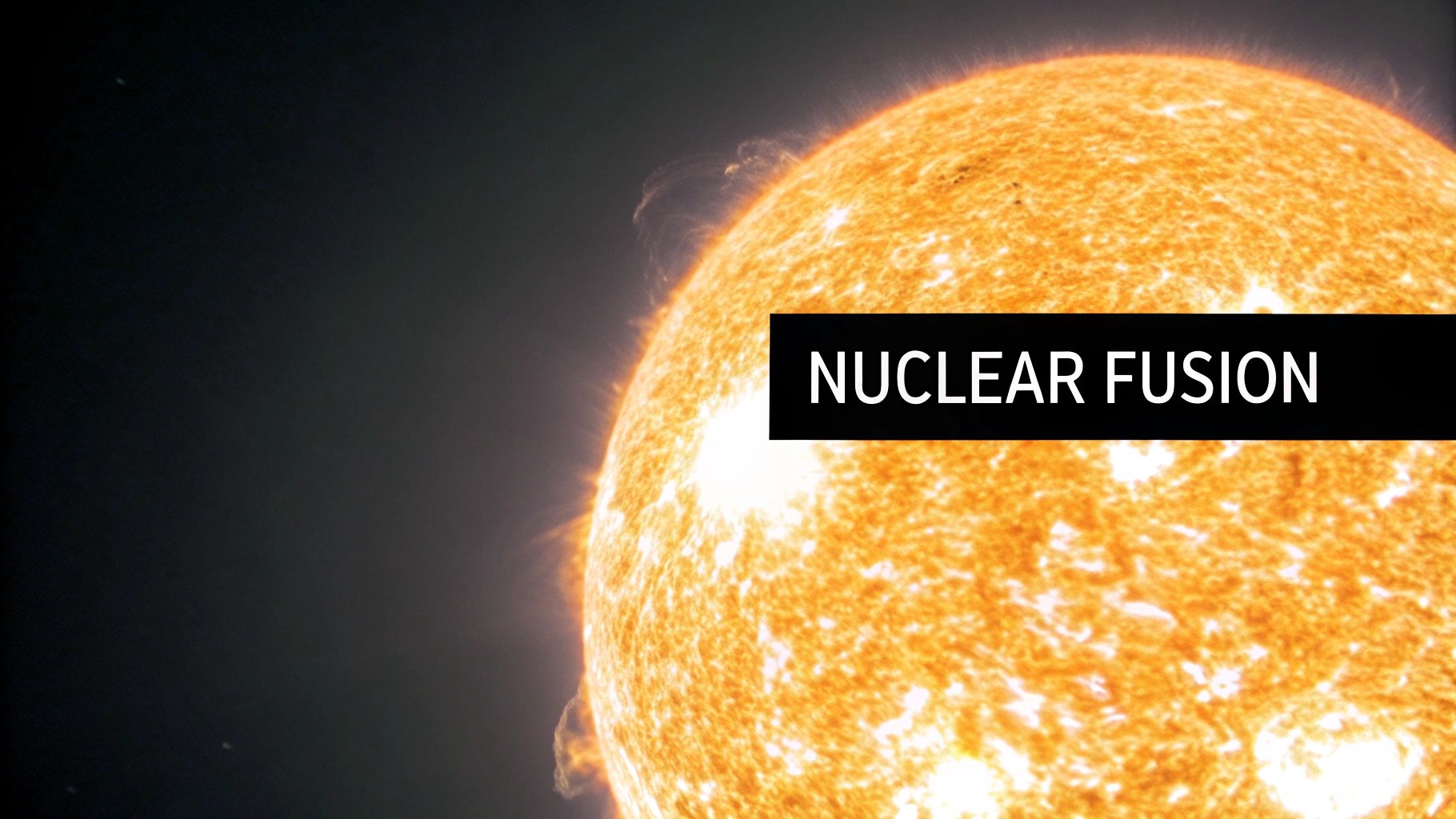
Think about baking a cake. You need the right ingredients, a bit of mixing, and a super hot oven to create something new and delicious. Well, the Sun works in a surprisingly similar way, but its ingredients are atoms, and its oven is hotter than you can possibly imagine!
Our Sun is a star, which means it's a giant ball of unbelievably hot gas. Most of that gas is an ingredient called hydrogen. It’s so mind-bogglingly huge that its own gravity—the same force that keeps your feet on the ground—creates crushing pressure and heat right at its core.
This extreme environment is the perfect place for the most powerful reaction in the universe to happen. Getting to know this energy-making recipe is the first step in understanding what makes our Sun, and every other star, shine so brightly. If you’re ever curious about what makes stars different from planets, you can explore the key differences between stars and planets in our guide!
The Ingredients for Solar Energy
Before we dive into the Sun's fiery core, let’s have a quick look at the main ingredients in its cosmic cookbook. Think of it as a cheat sheet for sunshine!
This table breaks down everything the Sun needs to cook up its energy, making it easy to see how all the pieces fit together.
The Sun's Energy Recipe at a Glance
| Ingredient or Step | What It Is | Why It's Important |
|---|---|---|
| Extreme Heat | The Sun's core is over 15 million degrees Celsius. | This incredible heat makes atoms zip around at ridiculously high speeds. |
| Intense Pressure | The immense crushing force of the Sun's gravity. | It forces all those super-fast atoms to get incredibly close together. |
| Hydrogen Atoms | The main fuel source lighting up our Sun. | These are the tiny particles that get squashed to kick off the reaction. |
| Nuclear Fusion | The process where atoms smash and join together. | This is the magic moment that unleashes a massive amount of energy. |
Pretty amazing, right? Now that we've seen the shopping list, let's explore exactly how the Sun mixes these ingredients to create the light and warmth that makes life on Earth possible.
Alright, Space Rangers, pull on your imaginary heat-proof spacesuits! We're diving straight into the most extreme place in our solar system—the very centre of the Sun, otherwise known as its core. This isn't just some hot spot; it's the engine room where all the Sun's energy-making magic happens.
The core is mind-bogglingly hot, sizzling at temperatures over 15 million degrees Celsius. That's hotter than anything we could ever create on Earth! On top of that, the pressure is so intense it crushes everything together with an unimaginable force. Just try to picture millions of elephants standing on a tiny speck of dust.
This wild combination of incredible heat and crushing pressure creates the perfect recipe for something amazing: nuclear fusion. It's the ultimate cosmic pressure cooker!
The Ultimate Cosmic Squeeze
So, how does this solar pressure cooker actually work? It all boils down to the Sun’s main ingredient, which is hydrogen. The pressure in the core is so powerful that it forces tiny hydrogen atoms to smash into each other and fuse, or join together.
Think about it like this: if you have two small balls of play-doh and you squish them together in your hands as hard as you can, they'll eventually become one bigger ball. That’s a bit like what happens inside the Sun, but on a much, much bigger and more powerful scale!
When two hydrogen atoms are squeezed together with enough force, they don't just stick—they transform into a brand new, slightly heavier element called helium. This amazing transformation is the real secret behind how the Sun makes its energy.
Fun Fact: The Sun's core is so dense that a single spoonful of it would weigh more than a car! This incredible density is what creates the immense pressure needed for fusion to even happen.
A Little Bit of Mass Makes a Lot of Energy
Now for the most exciting part of the whole process. When those hydrogen atoms fuse to become helium, the new helium atom weighs just a tiny, tiny bit less than the original hydrogen atoms did. So, where does that little bit of missing stuff, or mass, go?
It doesn't just vanish! Instead, it’s converted into a massive burst of energy. This is the very energy that eventually travels all the way to Earth as sunlight and heat. This specific type of fusion happening in the Sun is called the proton-proton chain reaction, and it happens billions of times every single second.
It’s a bit like a magical popcorn kernel. A tiny, hard kernel doesn't seem like much, but when you add heat, POP! It explodes into something much bigger. In the Sun, that tiny bit of lost mass "pops" into a huge amount of energy.
Each one of these tiny reactions releases a staggering amount of power. And with countless reactions happening all the time, the Sun's core generates more than enough energy to light up our entire solar system. Ready for another adventure? You can find more amazing science activities on our freebies page.
The Incredible Journey of a Sunbeam
So, we know the Sun’s core is a powerhouse, creating mountains of energy through nuclear fusion. But how does all that energy actually get out of the Sun and make the long trip to Earth? It’s not a straight shot, that’s for sure. It’s an incredible, zig-zagging adventure that can take thousands of years!
Let's follow a tiny particle of light, called a photon, on its epic quest to escape the Sun. Think of a photon as a tiny messenger carrying a burst of energy, and its mission is to reach the surface. This is one of the coolest parts of understanding how the Sun makes the energy we see and feel.
Bouncing Through the Radiative Zone
The first leg of our photon’s journey is through a super-dense layer called the Radiative Zone. This part of the Sun is packed so tightly with atoms that our photon can't go more than a tiny distance before it bumps into one, gets absorbed, and then gets spat back out in a totally random direction.
Imagine trying to get through a ridiculously crowded room where you're constantly bumping into people. You might take one step forward, get knocked sideways, and then end up two steps back! That’s pretty much what’s happening to our little photon. It bounces from atom to atom in a chaotic pinball game that seems to go on forever.
Fun Fact: This 'pinball' journey is so slow that it can take a single photon anywhere from 100,000 to over a million years just to get through the Radiative Zone! The sunlight warming your face today was actually created in the Sun's core long before any humans you know were even born.
Riding the Bubbles in the Convective Zone
After its marathon bounce-a-thon, our tired photon finally reaches the next layer: the Convective Zone. Things work very differently here. Instead of energy bouncing between atoms, it gets carried along in giant, swirling currents of hot gas.
You can picture this zone like a massive pot of boiling soup on the stove. Hot bubbles rise from the bottom, carrying heat to the top, where they cool down and sink again. The Sun’s Convective Zone does the exact same thing, but with hot gas!
These huge loops of rising and sinking gas are called convection currents. Our photon hitches a ride on one of these rising bubbles of super-hot gas, which carries it much more quickly up towards the Sun's visible surface, the photosphere. This part of the trip is much faster than its time in the Radiative Zone, but it's just as important.
Once it hits the surface, our photon is finally free! It bursts out into space and races towards Earth at an incredible speed. You can find out just how fast in our guide on what is the speed of light.
This infographic gives you a simple look at the nuclear fusion process that kicks off this whole journey.
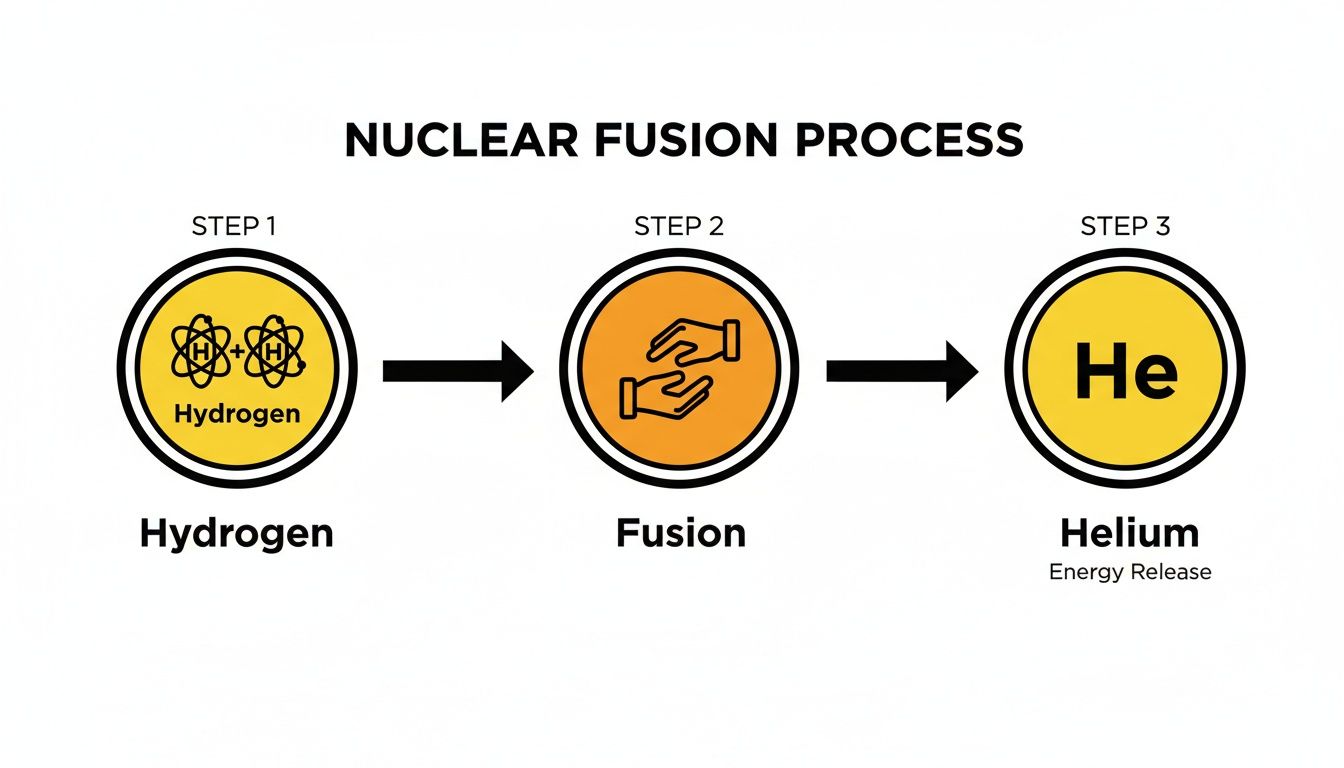
It shows how simple hydrogen atoms are squeezed under immense pressure to form helium, releasing the very energy that our photon carries on its long, long trip.
How Sunshine Powers Our World
That photon's incredible journey from the Sun's core is just the beginning of the story! Once that little packet of light finally reaches Earth, it does a lot more than just brighten our days and warm our skin. The Sun’s energy is the ultimate power source for our entire planet, and you can see its amazing effects all around you.
That powerful energy, born from nuclear fusion millions of miles away, is what makes almost everything on Earth possible. From the food we eat to the wind that blows, it all traces back to our amazing star.
Sunshine is Food for Plants
Have you ever wondered what plants eat for lunch? They don’t munch on sandwiches or crisps like we do! Instead, they perform a special kind of magic trick called photosynthesis, and sunlight is the main ingredient.
Plants soak up sunlight through their leaves, using its energy to turn water and a gas from the air (carbon dioxide) into sugary food. This incredible process not only feeds the plant but also releases the very oxygen we need to breathe. So, every crunchy apple and every tall tree is powered by the Sun!
Space Ranger Fred's Tip: You can watch photosynthesis in action! Just find a leafy green plant sitting in a sunny window. See how its leaves are pointing towards the light? That’s the plant stretching to catch as many sunbeams as it can to make its dinner.
The Sun Makes Our Weather Go!
Believe it or not, the Sun is also the big boss of our weather. It heats up the Earth's land, air, and oceans, but it doesn't do it evenly—some spots get hotter than others. This uneven heating is what creates wind, causes water to evaporate and form clouds, and drives everything from a gentle breeze to a mighty storm.
Sometimes, the Sun sends out powerful bursts of energy and solar winds that create really fascinating effects in space and here on Earth. You can learn all about it in our guide to what is space weather.
Putting Solar Power to Work
Humans have figured out some seriously clever ways to use the Sun’s energy for ourselves. You’ve probably seen those shiny solar panels on the roofs of houses or in big, sunny fields. These panels are specially designed to catch sunlight and turn it straight into electricity.
This electricity can then be used to power our homes, schools, and even charge electric cars! Using solar power is a fantastic way to create clean energy, and it's becoming more and more popular. In the UK, it's expected that solar energy will soon produce enough electricity to power millions of homes for a whole year. It just goes to show how that amazing fusion process happening in the Sun has a real, powerful impact on our daily lives.
Fun Solar Science Activities You Can Do
Reading about how the Sun works is one thing, but seeing its power for yourself is way more fun! Getting hands-on is the best way to wrap your head around big science ideas. These simple experiments use things you probably already have at home to bring the power of solar heat and energy to life.
Ready to become a solar scientist? Let's get experimenting!
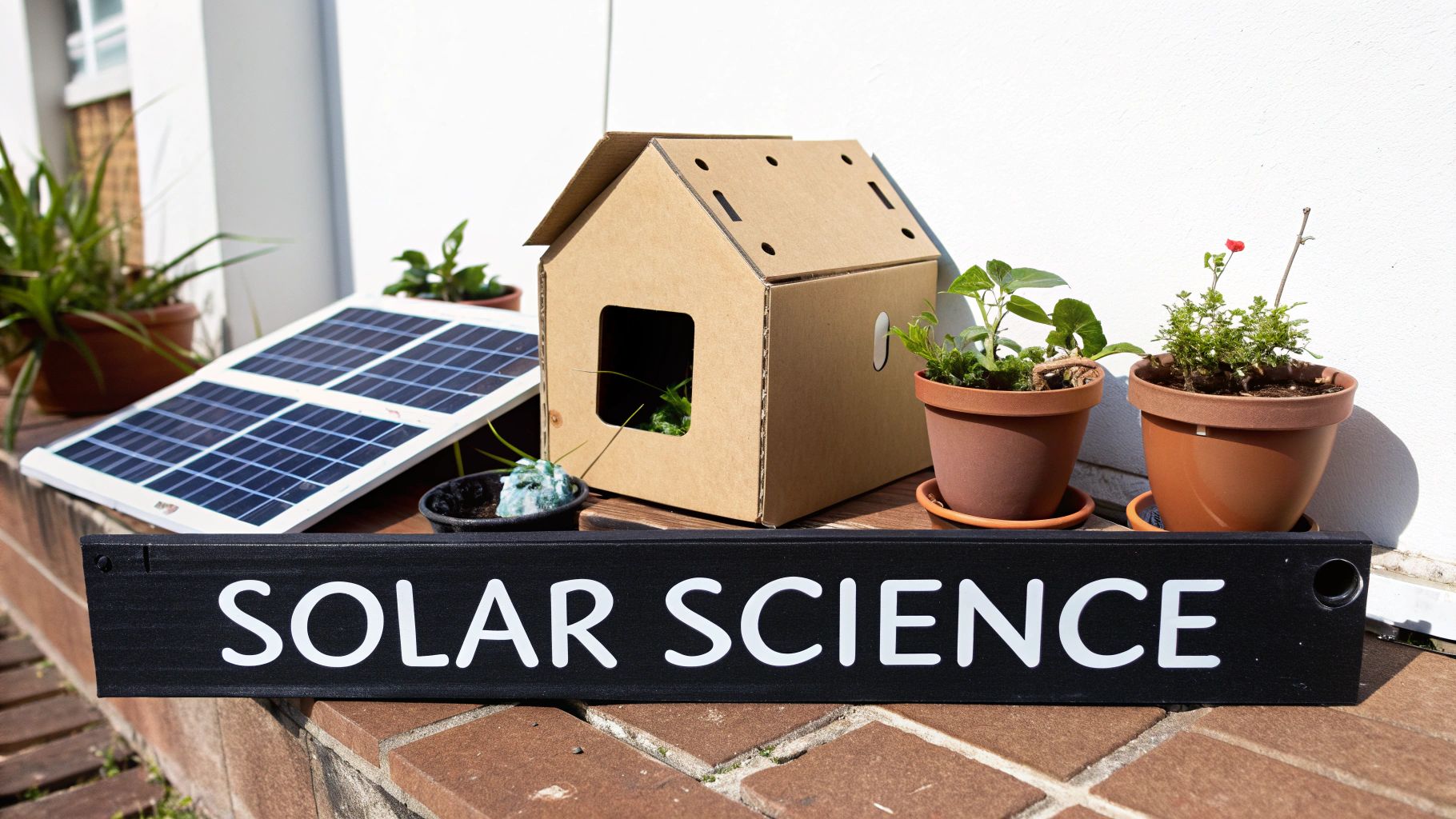
Activity 1: Build a Pizza Box Solar Oven
This classic experiment is a brilliant way to show how the Sun’s energy can be trapped to create heat. The best part? You can make a tasty, gooey treat with it! It’s a perfect demonstration of just how powerful focused sunlight can be.
What You'll Need:
- A cardboard pizza box (or any shallow box with an attached lid)
- Cling film
- Black paper
- Aluminium foil
- Scissors and tape
- A wooden skewer or stick
- Marshmallows or chocolate buttons (the important bit!)
What To Do:
- Cut a Flap: On the box lid, draw a square about an inch from the edges, but leave one side attached to act as a hinge. Carefully cut along the other three sides.
- Create the Reflector: Cover the inside of the flap with aluminium foil, taping it down nice and smooth. This shiny surface will act like a mirror, reflecting sunlight right into your oven.
- Seal the Window: Open the box and tape a double layer of cling film over the opening you just cut. This creates an airtight window that lets sunlight in but keeps the warm air from escaping.
- Absorb the Heat: Line the bottom of the box with black paper. Dark colours are fantastic at absorbing the Sun’s heat!
- Let's Cook! Pop your marshmallows or chocolate on the black paper, close the lid, and prop the foil flap open with your skewer so it catches the sunbeams. Find a sunny spot outside and watch the magic happen as your oven heats up and the treats start to melt!
Activity 2: Create a Convection 'Lava Lamp'
Remember how we learned that energy travels in giant loops inside the Sun's Convective Zone? You can actually see that same process, called convection, happening right inside a bottle. This activity is a groovy way to visualise how hot stuff rises and cool stuff sinks.
What You'll Need:
- A clear plastic bottle or glass jar
- Water
- Vegetable oil
- Food colouring
- An effervescent tablet (like a vitamin C or Alka-Seltzer tablet)
What To Do:
- Fill the Bottle: Pour vegetable oil into the bottle until it’s about three-quarters full.
- Add Water and Colour: Fill the rest of the bottle with water, leaving a little gap at the top. Now, add about 10 drops of your favourite food colouring and watch it sink through the oil.
- Start the Reaction: Break an effervescent tablet in half and drop it into the bottle. Get ready for the show!
- Observe Convection: The tablet will start to fizz, creating gas that lifts the coloured water up through the oil in cool-looking blobs. Once the bubbles reach the top, the gas escapes, and the now-cooler water sinks back down. This creates an amazing 'lava lamp' effect, showing convection currents in action!
These activities are a great start, but the fun doesn't have to stop here. For more brilliant ideas, check out the Space Ranger Fred activities page.
Your Questions About Our Amazing Star
It’s completely normal to have massive questions about our incredible Sun! Learning how it makes all that energy is a huge topic, so let’s blast off and tackle some of the most common questions from curious Space Rangers just like you.
Will the Sun Ever Run Out of Energy?
Yes, it will, but don't start packing your bags for another star system just yet—it won’t be happening for a very, very long time! The Sun is about halfway through its main fuel supply, which is hydrogen. It’s been shining away for roughly 4.6 billion years, and scientists reckon it has enough hydrogen left in its core to keep going for another 5 billion years.
When it finally does start to run low, it will switch to fusing helium instead. This will cause our Sun to puff up into a massive star called a red giant, before eventually shrinking down into a tiny, super-dense object known as a white dwarf. Phew! That's a long way off.
Is the Sun on Fire?
This is a fantastic question because it really gets to the heart of what makes the Sun so special. You see, the Sun isn’t “on fire” in the same way a bonfire or a candle is. Fire, as we know it here on Earth, is a chemical reaction called combustion, and it needs oxygen to burn.
The Sun doesn’t burn at all; it shines because of nuclear fusion. As we've discovered, fusion is a nuclear reaction where atoms get squeezed together under incredible pressure to release energy. There’s no oxygen needed, just mind-boggling heat and pressure creating light in the vast emptiness of space.
Key Difference: Burning is a chemical reaction that breaks molecules apart. Fusion is a nuclear reaction that smashes atoms together.
Why Is It Dangerous to Look at the Sun?
Your eyes are amazing bits of kit, but they are also incredibly delicate. The Sun is so intensely bright that looking straight at it, even for a few seconds, can permanently damage them. Its powerful ultraviolet (UV) light can literally burn the light-sensitive part at the back of your eye, called the retina.
The scary part is that this damage can happen without you even feeling any pain. That’s why you must never look directly at the Sun. Always use special solar viewing glasses or a pinhole projector, especially if you ever get to watch an eclipse. Safety first, Space Rangers!
We hope that’s answered some of your biggest questions about our amazing star! The Space Ranger Fred universe is packed with incredible science, stories, and adventures just waiting to be explored. Continue your journey through the cosmos over at spacerangerfred.com.