
Have you ever wondered what STEAM education is all about? You’ve probably heard the term buzzing around, but what does it actually mean for your child?
In a nutshell, it’s the powerful blend of Science, Technology, Engineering, and Maths (STEM), with the creative, colourful spark of the Arts. It’s an approach that helps children become amazing problem-solvers by using both sides of their brain—the logical and the imaginative.
What Is STEAM Education Anyway?
Imagine your child wants to build a magnificent rocket to explore the cosmos. A pure STEM approach would focus on the science of lift, the engineering of the fuselage, and the maths needed to calculate its trajectory. All incredibly important stuff, of course!
But what about designing a cool mission patch for the astronaut’s uniform? Or writing the thrilling story of the rocket's first voyage to Mars? That’s where the Arts come in, transforming a technical project into an unforgettable adventure.
STEAM education isn’t about tacking an art class onto the end of a science lesson. It’s about weaving creativity, design, and critical thinking into every single stage of learning. It recognises that innovation rarely happens in a straight line. The world's greatest breakthroughs, from sleek smartphones to sustainable cities, all required a brilliant mix of analytical skill and creative vision.
Blending Logic with Imagination
Think of it like baking a spectacular galaxy cake. To get it right, you need:
- Science: Understanding how ingredients like bicarbonate of soda and vinegar react to make the cake rise.
- Technology: Using an oven or mixer correctly to get the perfect bake.
- Engineering: Designing the cake's structure so it doesn’t collapse under the weight of the icing.
- Maths: Measuring all your ingredients with absolute precision.
- Arts: The fun part! Decorating it with swirling colours, sugar stars, and edible planets to make it look like a real nebula.
Without the artistic flair, you’d just have a plain cake. Without the science and maths, you’d have a colourful mess! STEAM teaches children that all these skills work together, hand in hand.
Let’s quickly break down each part of STEAM to see what it looks like from a child’s perspective.
The Five Pillars of STEAM Explained
Here’s a quick-glance table to help make sense of each component.
| Letter | Stands For | What It Means For Kids | A Fun Example |
|---|---|---|---|
| S | Science | Asking "why?" and exploring the world through curiosity and discovery. | Mixing vinegar and bicarb soda to see a fizzy volcanic eruption. |
| T | Technology | Using tools (from simple scissors to complex code) to solve problems. | Building a basic animation using a stop-motion app on a tablet. |
| E | Engineering | Designing, building, and testing ideas to see what works best. | Constructing the tallest, strongest tower you can using only spaghetti and tape. |
| A | Arts | Expressing ideas and creating things that look and feel amazing. | Designing a colourful, alien-proof helmet for a space explorer. |
| M | Maths | Finding patterns, measuring things, and using numbers to make sense of it all. | Halving a recipe for cookies or measuring a rocket's flight distance. |
As you can see, each pillar supports the others to create a well-rounded and deeply engaging way of learning.
A crucial element of STEAM is the integration of creative problem-solving, often through methodologies like the Design Thinking Process. This method encourages learners to empathise, define, ideate, prototype, and test their ideas, putting creativity at the centre of finding solutions.
This integrated approach makes learning far more relevant and exciting. It helps children connect the dots between different subjects and see how skills from art class can help them nail an engineering challenge. By encouraging this holistic way of thinking, we’re not just preparing them for exams; we’re equipping them with the flexible, inventive mindset they’ll need for the future.
The Real Difference Between STEM and STEAM
You might be wondering, "It's just one letter, what's the big deal?" But adding the 'A' for Arts into the mix genuinely changes everything. It takes the learning journey from being purely technical to something wonderfully human-centred and creative.
Think of it like building with LEGO bricks. A classic STEM challenge might be to construct the tallest, strongest tower possible—a great test of engineering and physics, no doubt.
A STEAM challenge, however, asks a different kind of question. It might say, "Can you build a strong tower that also tells a story?" or "What if your tower was a futuristic city for tiny aliens?" Suddenly, the task isn't just about stability; it's about imagination, design, and giving the project a purpose. The 'A' adds the why and the wow to the technical how.
Beyond the Blueprint
STEM gives us the essential blueprint for a project—the rules, the logic, and the structure. It’s the skeleton that holds everything together. STEAM comes in to add the heart, the personality, and the context that brings that skeleton to life. It’s the difference between building a functional robot and creating a robot character with a unique personality and a mission to complete.
This infographic shows just how all five elements of STEAM connect to spark real innovation.
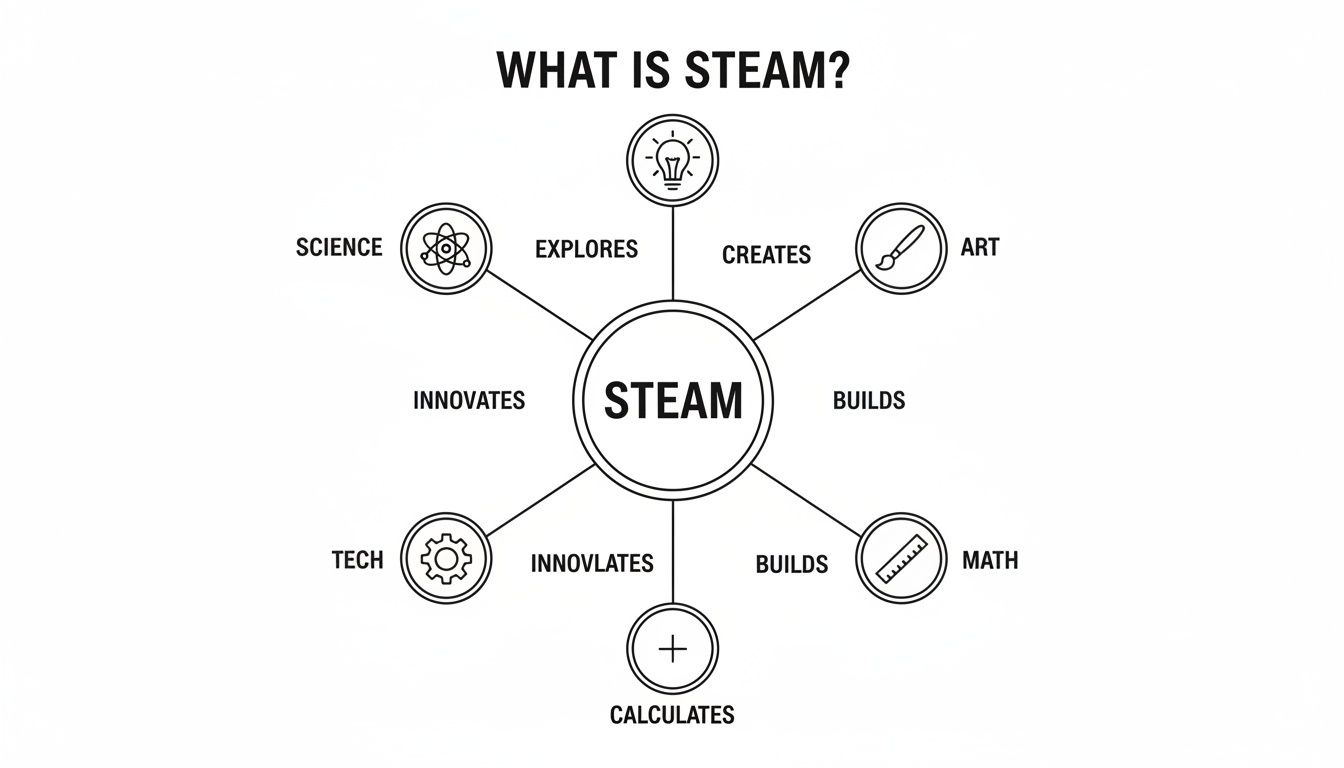
As you can see, the 'A' acts like a central hub, connecting the technical disciplines and encouraging a more joined-up way of thinking and creating.
This shift isn't just a passing trend; it's a direct response to the kind of skills our kids will need in the future. In the UK, the focus on STEM subjects really ramped up in the early 2000s to fill skills gaps in key industries. But by the 2010s, educators began to realise that technical ability alone wasn't cutting it. To truly innovate, young people needed creativity and imaginative problem-solving. This led to the rise of STEAM, especially for children aged 11–14, a crucial time before they make their GCSE choices. Sparking that interest early is known to be a game-changer for future subject decisions. You can dive deeper into this with the Royal Academy of Engineering’s report on the UK STEM education landscape.
STEAM education isn’t about taking anything away from STEM. It’s about enhancing it. It ensures that as we tackle the world’s big problems, we do it with empathy, creativity, and a real understanding of the human experience.
Fostering a New Kind of Thinker
By blending these disciplines, we encourage children to become far more flexible and adaptable thinkers. They quickly learn that there isn't always one "right" answer. Instead, a single problem can have multiple creative solutions.
Here’s how adding the 'A' makes a real difference in a project:
- Problem-solving becomes storytelling: Instead of just building a circuit, kids might design an interactive storybook where different pages light up as the story unfolds.
- Data becomes design: Instead of simply plotting a graph, they could create a beautiful data visualisation that tells a compelling story about the numbers.
- Function meets form: Rather than just coding an app, they learn to think about the user's experience, making it intuitive, engaging, and enjoyable to use.
This integrated mindset is what truly defines what is STEM education with the 'A' and sets it apart. It’s about nurturing well-rounded individuals who can think critically and creatively—preparing them for a future where both sets of skills are absolutely essential.
How STEAM Prepares Children for The Future
STEAM is far more than just the latest buzzword in education. For kids aged 6-12, these learning adventures are a complete game-changer, building the kind of flexible, real-world skills they’ll need for a future we can’t even fully imagine yet.
It’s all about nurturing ‘whole-brain’ thinking. STEAM encourages children to tackle challenges with the analytical mind of a scientist and the creative spark of an artist. One minute they could be calculating the precise angles for a model bridge, and the next, they're dreaming up a design that looks like it belongs in a fantasy world.
This unique blend of skills is becoming absolutely vital. Employer surveys have flagged a massive need for STEM-skilled workers here in the UK, with some estimates suggesting we’ll need an extra 1.8 million workers by 2025. Adding the 'A' for Arts is widely seen as a brilliant way to get more kids interested in technical fields and spark the kind of innovation the future will demand. You can find more on why STEAM is so crucial for the UK's success over at williamlockitt.co.uk.
Nurturing Lifelong Curiosity and Resilience
One of the most powerful lessons STEAM teaches is that it’s completely okay to fail. When an experiment fizzles out or a structure tumbles down, it’s not the end of the road—it’s a clue. It’s a chance to ask, "Right, why did that happen?" and "What could we try differently?"
This process builds incredible resilience. Children quickly learn that setbacks are just a normal, even necessary, part of discovery. They develop a persistence that will help them everywhere, from tricky classroom problems to friendship hurdles on the playground. This teaches them to see challenges as opportunities to get stronger and more clever.
STEAM is all about fostering a mindset where curiosity leads the way. It’s not about having all the answers, but about having the courage to ask brilliant questions and the resilience to keep searching for solutions, even when things get tricky.
Building Skills for Teamwork and Communication
Think about it—very few big, real-world projects are a solo mission. Whether it's designing a model Mars colony or creating a short animated film, it’s always better (and way more fun) with a team. STEAM projects are a natural fit for collaboration.
Children learn to:
- Share ideas: Everyone brings their own unique perspective to the table, whether they’re a natural builder, a great storyteller, or a keen observer.
- Negotiate roles: They figure out who’s best at what, learning to value the different strengths within their group.
- Communicate clearly: You have to explain your brilliant invention clearly if you want your teammates to help you build it!
This isn’t about trying to create future scientists or artists overnight. It's about giving them the essential human skills that will help them succeed, no matter what path they choose to follow.

Fostering Adaptability for a Changing World
At its heart, STEAM education gives children a toolkit of skills, not just a library of facts to memorise. The future will demand people who can adapt, think critically, and solve problems that don't even exist yet.
By learning to think across different subjects, children become incredibly adaptable. They’re ready to tackle complex challenges with confidence because they know how to look at a problem from all sorts of angles. This doesn’t just prepare them for a single job; it prepares them for a lifetime of learning, growing, and contributing to the world in meaningful ways.
Fun STEAM Activities for Home and School
Now for the best part—getting your hands messy and putting all that theory into practice! Knowing what STEAM is feels great, but seeing it come to life is where the real magic happens. These activities are designed to be fun, easy to set up, and perfect for both the classroom and the kitchen table.
The secret is to start with a fun challenge and let curiosity lead the way. You don’t need expensive kits or complicated equipment; just a bit of imagination and a willingness to experiment.
Launch Your Own STEAM Mission
Stories are one of the most powerful launchpads for any STEAM project. When a child is swept up in an adventure, they're far more motivated to build, design, and solve problems related to that world. The adventures found within the Space Ranger Fred books, for instance, are packed with ideas just waiting to be explored.
A story about Fred discovering a wobbly alien planet could inspire a challenge to build an earthquake-proof tower. A tale about navigating an asteroid field might lead to a coding game where kids have to plot a safe course. Reading becomes the start of a hands-on mission, not the end of it.
Here are a few simple, story-inspired activities to get you started.
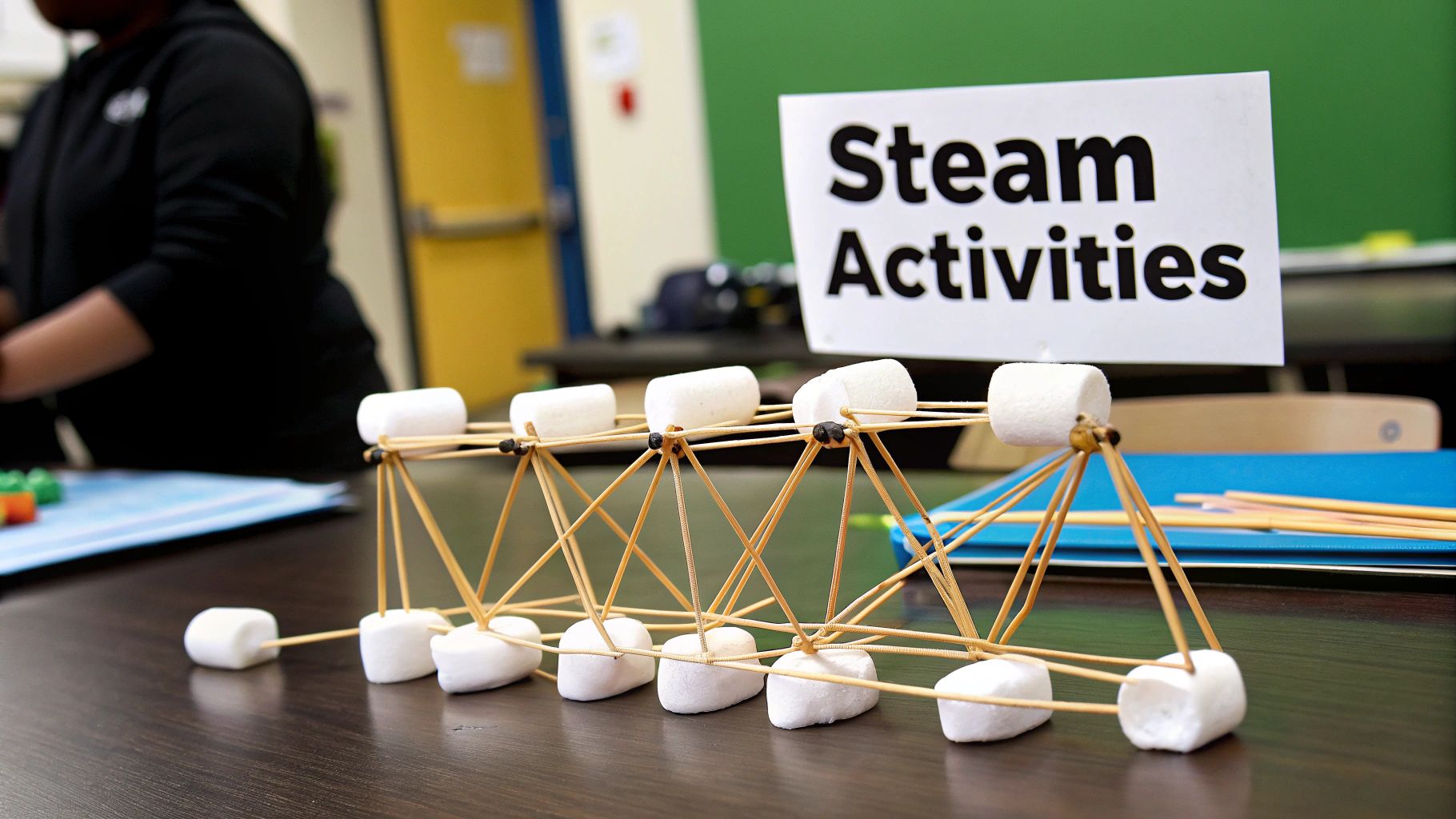
Activity 1: Build a Sturdy Bridge
Can you build a bridge strong enough to hold a toy car or a handful of coins? This is a classic engineering challenge that brilliantly mixes design, physics, and a bit of creative flair.
Materials You'll Need:
- Dry spaghetti or wooden skewers
- Marshmallows or modelling clay
- Two books or blocks of the same height to act as supports
- Small toys or coins to test the weight
The Challenge:
- Plan Your Design: Start by drawing a few ideas. Will you use triangles (the strongest shape!), squares, or a mix of both? This is the 'Art' and design part of the project.
- Start Building: Use the marshmallows or clay as connectors and the spaghetti as beams. Connect them to create your bridge structure, spanning the gap between your two book supports.
- Test and Improve: Gently place one toy or coin at a time onto the middle of your bridge. Does it hold? How many can it support before it wobbles or breaks? This is where the Science and Engineering come in.
- Redesign: If it breaks, don't worry! That's part of the fun. Talk about what went wrong and how you could make it stronger.
STEAM Sparks:
- Which shapes seemed to be the strongest? Why do you think that is?
- What would happen if we used shorter pieces of spaghetti? Or longer ones?
- How could we make the bridge look like it belongs on an alien planet?
Activity 2: Create a Stop-Motion Animation
Bring a story to life with the magic of technology! Stop-motion animation is a fantastic way to combine storytelling, art, and digital skills. You can tell a story about anything—a day in the life of an astronaut, a silly alien dance, or a rocket launch.
Materials You'll Need:
- A smartphone or tablet with a free stop-motion app (like Stop Motion Studio)
- A tripod or a stack of books to keep your device steady
- LEGO figures, clay models, or paper cut-outs for your characters
- A plain piece of card or a decorated shoebox for your background
The Challenge:
- Create Your Story: What will your animation be about? Plan a simple beginning, middle, and end. This is where the 'Arts' shine.
- Set the Scene: Position your character and background in front of your device.
- Take Your First Picture: Open the app and take a single photo.
- Move It Slightly: Move your character a tiny, tiny bit in the direction you want them to go. Take another picture.
- Repeat, Repeat, Repeat: Keep making tiny movements and taking photos. It takes about 10–12 pictures to create just one second of smooth animation!
- Play It Back: Once you're done, the app will stitch all your photos together into a moving film. You’ve just used Technology to become a filmmaker!
STEAM Sparks:
- How could you tell this story without using any words, just movement?
- What happens if you make big movements between photos instead of small ones?
- Could you add sound effects or music to make your story even better?
These ideas are just the beginning. For more inspiration on projects that blend science with hands-on fun, be sure to check out our freebies and activities page. The goal is to show children that learning isn't confined to a textbook; it's an exciting, creative adventure that can happen anywhere.
Connecting STEAM to The School Curriculum
For teachers and parents juggling a packed timetable, the big question is often: "Where on earth does STEAM fit?" It’s a perfectly valid concern. But here’s the secret: STEAM isn’t one more thing to cram into the day. It’s a way of teaching that pulls subjects together, making lessons more powerful without adding to your workload.
Think of it as the ultimate cross-curricular adventure. Instead of teaching maths, science, and art in their own little boxes, a good STEAM project smashes those walls down. It shows kids that skills are connected—what they learn in art can solve a problem in engineering, and the maths they practise is vital for building something amazing.
Weaving Subjects Together Naturally
Let’s imagine a project: designing and building a model of an ancient Roman aqueduct. At first glance, it sounds like a history or DT task. But if you look a little closer, you can see the STEAM magic unfolding.
This one project effortlessly combines:
- History: Children dig into the Roman Empire, exploring how people lived and why these incredible aqueducts were so revolutionary.
- Engineering: They have to design a structure that’s stable, functional, and can actually carry water across a gap.
- Science: They get hands-on with the physics of water flow, gravity, and the gentle gradients needed to make it all work.
- Art: They could sketch out their designs with historical flair or even sculpt tiny Roman-style decorations for their final build.
- Maths: They’re constantly measuring materials, calculating angles, and figuring out the right scale for their model.
Suddenly, learning isn’t about memorising dry facts for a test. It’s about using knowledge from all over the curriculum to tackle a real, hands-on challenge. You can find loads more ideas like this in our guide to primary school teaching resources, which is packed with inspiration for joined-up learning.
Planning and Assessing Creative Projects
One of the hurdles educators often mention is how to mark a project that doesn’t have a simple right or wrong answer. With STEAM, the focus shifts from the shiny final product to the messy, brilliant learning process itself.
Assessment in a STEAM context is about celebrating the journey. It values the questions asked, the resilience shown when things go wrong, and the creative thinking that went into finding a solution—not just whether the final model looks perfect.
Instead of a traditional grade, you can track progress by observing:
- Critical Thinking: Did they spot problems on their own and brainstorm different ways to fix them?
- Collaboration: How well did they work as a team, listen to others’ ideas, and compromise?
- Creativity: Did they bring their own unique twist to the challenge or add an imaginative flair?
This way of assessing allows every child to shine, whether they’re a natural builder, a gifted artist, or a fantastic problem-solver. It creates a classroom where every kind of skill is celebrated.
Is STEAM Part of The National Curriculum?
While the UK curriculum is built around individual subjects, the core ideas of STEAM—critical thinking, problem-solving, and cross-curricular links—are exactly what it aims to promote. The framework is there, even if the label isn't.
However, data shows that truly integrated STEAM-style A-level choices are still quite rare. An analysis from FFT Education Datalab found that even popular combinations like design & technology with maths and physics only had a few hundred entries.
For schools keen to properly integrate the 'Arts', exploring funding opportunities for arts and education programs can be a game-changer for bringing more ambitious projects to life. By embracing STEAM, educators aren’t just ticking curriculum boxes; they’re getting children ready for a future that will demand creative, collaborative, and adaptable minds.
Your Mission Control for STEAM Adventures
Ready to kick off your own STEAM missions, whether at home or in the classroom? Think of Space Ranger Fred as your perfect co-pilot. Our whole universe is built to connect the dots between brilliant stories and hands-on discovery, making learning feel less like a lesson and more like an unforgettable adventure.
We’ve always believed that a great story is the ultimate launchpad for curiosity. The tales of Fred’s cosmic journeys are written to spark questions about space, technology, and what it takes to solve a tricky problem. It’s all about turning passive reading time into an active, immersive experience where children can explore the very concepts they just read about.
Turning Stories into STEAM Projects
It’s incredible how a simple story can fuel a whole world of exploration. A tale about Fred navigating a dense asteroid field can easily become a fun coding game. An adventure where he discovers a planet of wobbly aliens can inspire a hands-on engineering challenge to build a structure that won’t fall over.
Here’s a simple example of how it works:
- Read the Story: Start with one of Fred’s missions to a new planet, paying attention to all the details of its weird and wonderful environment.
- Spark the Challenge: Ask a simple question like, “What kind of house would an alien need to live comfortably and safely on that planet?”
- Get Creative: This question naturally leads to a fantastic STEAM project. Children can design the alien habitat (Art), build a model from recycled materials (Engineering), calculate the resources they’d need (Maths), and explain how it protects against the planet’s unique dangers (Science).
When you link a project to a character kids care about, you give learning a real sense of purpose. It’s no longer just a school task; it’s about helping Fred and his friends succeed on their mission.
Your Partner in Learning
Our goal is to make STEAM feel accessible and genuinely exciting for everyone. The Space Ranger Fred universe is your mission control, packed with resources to support your adventures in learning.
Whether you're looking for project ideas, fun printables, or new stories to fire up your child's imagination, we're here to help you every step of the way. Let's make learning a thrilling journey together! Why not start by exploring the fun ideas on our blog?
Your Top STEAM Questions, Answered
As you get ready to dive into the world of STEAM, it’s only natural to have a few questions buzzing around. Let's tackle some of the most common ones so you can launch your own adventures with confidence.
Do I Need to Be an Expert to Teach STEAM?
Not at all! In fact, it’s often much better if you aren’t. The real magic of STEAM is that you get to learn and discover right alongside the children.
Think of your role less as an expert with all the answers and more as a curious co-pilot or a guide on the adventure. You’re there to ask interesting questions, spark exploration, and celebrate the messy, brilliant process of discovery. Our activities are built to help you guide the learning, so you can focus on the fun.
How Can STEAM Help a Child Who Only Likes Art?
This is where STEAM truly shines. If you have a child who adores drawing, telling stories, or making things, their artistic passion is the perfect launchpad into the worlds of science and tech.
Instead of seeing these subjects as separate, STEAM shows how beautifully they connect. A project could involve designing an incredible comic book about the solar system, which secretly teaches them all about the planets. Or they might build a wild sculpture from recycled materials, learning about engineering and structures without even realising it. It helps them see that technical fields are wonderfully creative at their core.
STEAM doesn't force an artist to become a scientist. Instead, it shows them that their creativity is a superpower that can be used to solve scientific and technical challenges in a whole new way.
What Are Good Starter Projects for Different Ages?
Starting with age-appropriate challenges is key to building confidence and keeping things fun. Remember, you can always dial the complexity up or down depending on the child.
-
For younger children (ages 6-8): Focus on simple, hands-on tasks that give quick, satisfying results. Building a raft from twigs and leaves that actually floats is a perfect start. Or what about creating shadow puppets to learn about light and shadows?
-
For older children (ages 9-12): You can introduce more ambitious, multi-step challenges. Designing a simple chain-reaction machine (like a Rube Goldberg machine) or learning basic block coding to create an animation are fantastic ways to stretch their skills.
Can I Do STEAM on a Tight Budget?
You absolutely don't need expensive kits or fancy gadgets for an amazing STEAM experience. Honestly, the best and most versatile resources are probably hiding in your recycling bin!
Cardboard boxes, empty plastic bottles, and old paper rolls are the building blocks of incredible inventions. Nature is another brilliant and completely free resource, offering up leaves, stones, and sticks for building and creating. It’s all about sparking ingenuity, not spending a fortune.
At Space Ranger Fred, our mission is to make learning an unforgettable adventure. We blend exciting stories with hands-on discovery to show children that science, creativity, and fun go hand in hand. Explore our world and find everything you need to start your next mission.