So, what exactly was a space shuttle? Imagine a super-clever machine that could blast off like a rocket, fly around the Earth like a spaceship, and then glide home to land on a runway just like an aeroplane. It was the world's first reusable spacecraft, a kind of cosmic delivery van and a workshop in the sky, completing an amazing 135 missions over 30 years.
Come on, let’s find out how it worked!
What Was a Space Shuttle Made Of?
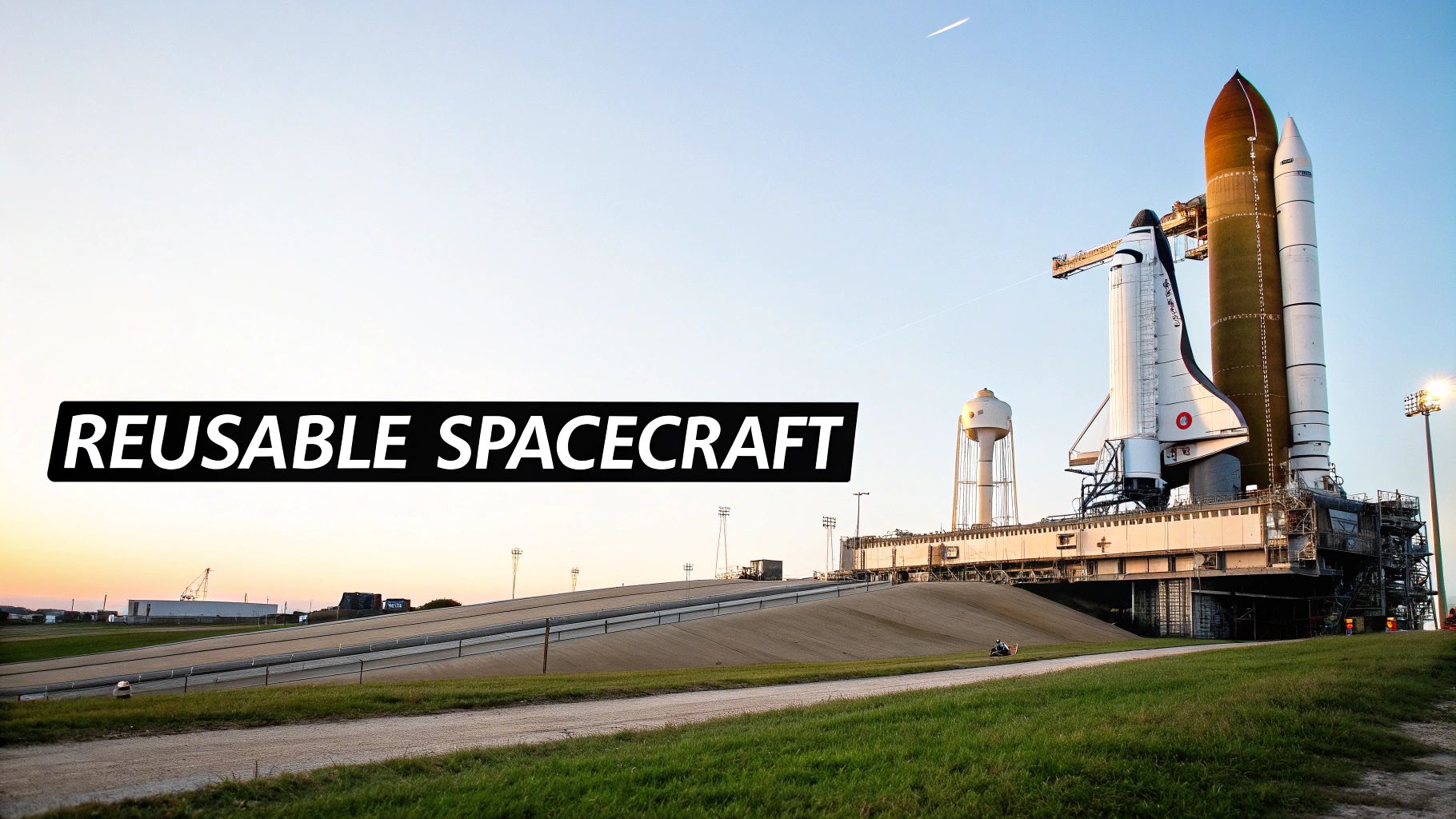
Try to picture a vehicle that's part rocket, part spaceship, and part glider, all rolled into one. That’s a great way to think about the Space Shuttle.
Unlike the rockets that came before it, which were used once and then thrown away, large parts of the shuttle could be flown again and again. This very clever idea was meant to make space travel feel a bit more routine and much less expensive.
The whole thing was a masterpiece of engineering, but we can break it down into three main parts to make it easier to understand.
The Three Main Parts of the Space Shuttle
Thinking about the shuttle's bits and pieces with a simple story makes it much clearer how they all worked together.
Let's imagine the shuttle is getting ready for a huge adventure. To do this, it needs three essential things: a clubhouse for the crew, a packed lunch for the journey, and a massive push to get going!
This quick table breaks down what each part did.
| Shuttle Part | Its Job | A Fun Way to Think About It |
|---|---|---|
| The Orbiter | This aeroplane-like part was where the astronauts lived and worked. It also carried the main cargo. | The crew's clubhouse and the brains of the whole operation. |
| The External Tank | The huge, rust-coloured tank held all the fuel for the Orbiter's main engines during launch. | The shuttle's giant packed lunch for the trip into orbit. |
| Solid Rocket Boosters | These two powerful rockets provided most of the oomph needed to lift off from the launchpad. | The 'big push' needed to get everything off the ground and into the sky. |
Together, these three bits and pieces formed the complete Space Transportation System, or STS, as NASA called it. Each part had a very specific job to do, working in perfect harmony to get the mission started.
The shuttle's main job was to carry things to and from low-Earth orbit. It was a cosmic workhorse, carrying everything from satellites and science experiments to the building blocks of the International Space Station. In fact, if you want to find out more about this amazing orbiting laboratory, you can read our guide that explains what a space station is.
This incredible machine wasn't just about launching things, though. It was a platform for discovery, allowing us to build amazing structures in space and see our universe in a completely new light.
A Quick Trip Through Space Shuttle History
The story of the space shuttle kicks off right after the world-famous Apollo Moon landings. Fresh from that incredible success, NASA’s cleverest minds started dreaming up what would come next. They imagined a new kind of spacecraft that could travel to space again and again—almost like a cosmic bus service. That big dream was the start of the Space Shuttle programme.
The very first shuttle, however, wasn't actually built for space. Her name was Enterprise, and she was a special test glider. Enterprise never made it to orbit, but she had a hugely important job: teaching engineers how to glide and land this massive new vehicle on a runway, just like a plane. Think of it as the ultimate practice run!
The Famous Fleet of Orbiters
Once Enterprise had shown them the ropes, NASA built five more shuttles that would become heroes of the space age. These were the ships that truly went to the stars, and each had its own amazing story to tell.
- Columbia: The trailblazer! She was the very first shuttle to fly into space in 1981, proving to the world that this incredible idea actually worked.
- Challenger: Famously carried the first American woman, Sally Ride, into orbit, smashing barriers along the way.
- Discovery: The real workhorse of the fleet. Discovery flew more missions than any other shuttle, and its most famous passenger was the Hubble Space Telescope.
- Atlantis: A key player in building the International Space Station, she also carried out vital science experiments high above the Earth.
- Endeavour: The youngest member of the fleet, built to replace Challenger. She played a huge part in servicing Hubble and adding to the space station.
These incredible orbiters are part of a massive story of human exploration. You can see where they fit into the bigger picture in our complete space exploration timeline for kids.
Even the test shuttle Enterprise had one last surprise journey up its sleeve. In 1983, it was flown all the way across the Atlantic on the back of a giant jumbo jet. It did a tour of several European cities, including London, where huge crowds gathered to see the unbelievable sight of a space shuttle cruising past Big Ben! You can read more about this unique shuttle flight on NASA.gov.
A Story of Triumph and Learning
The Space Shuttle programme was packed with incredible successes. It launched satellites that give us weather forecasts and GPS on our phones. It ferried the building blocks for the International Space Station. But its most famous delivery was the Hubble Space Telescope, a giant eye in the sky that has sent back the most stunning pictures of faraway galaxies.
Sadly, the story isn't without its heartbreak. Two tragic accidents, involving Challenger and Columbia, were devastating moments. But from that sadness came vital lessons. Engineers worked tirelessly to figure out what went wrong, making the shuttles much safer for all future missions. The shuttle’s history is a powerful tale of courage, our unstoppable need to explore, and how we learn and grow even from the toughest times.
What Was a Space Shuttle Mission Like?
Have you ever wondered what it was like to be an astronaut on a Space Shuttle? Imagine strapping into your seat, feeling the rumble beneath you, and getting ready for the greatest ride of your life. Every shuttle journey was a story in three parts: a thunderous beginning, a peaceful middle floating in space, and a fiery, graceful end.
It all started with a ground-shaking roar. On the launchpad, the shuttle’s three main engines would fire up, followed just seconds later by the two huge Solid Rocket Boosters. The combined power was immense, pinning the astronauts back in their seats as the whole vehicle clawed its way into the sky.
About two minutes after lift-off, the boosters would have done their job. They'd detach with a small bang and parachute back down into the ocean, ready to be picked up and used again. Now much lighter, the shuttle kept climbing, pushed along by its main engines, which were still guzzling fuel from that giant orange external tank.
Reaching the Quiet of Space
Roughly eight and a half minutes into the flight, the shuttle would finally slip into orbit, cruising at an incredible 17,500 miles per hour. The main engines would cut off, and the now-empty external tank would separate and fall away, burning up harmlessly as it re-entered the atmosphere. And then… silence. The crew were officially in space, floating weightlessly.
"A shuttle mission wasn't just about the launch and landing. The time spent in orbit was where the real work—and fun—happened. Astronauts would conduct science experiments, deploy satellites, and even help build the International Space Station."
Life in orbit was a whole new world. Astronauts would float through the Orbiter, sleep in special sleeping bags attached to the walls, and eat food specially designed for zero gravity. Often, a mission would include a spacewalk, where they’d climb into a bulky spacesuit and venture outside to make repairs. It was a cosmic workshop with the best view in the solar system!
This simple timeline shows the key moments in the shuttle's career.
The graphic shows the shuttle's journey from its first test flights all the way to its final landing, showing how it went from being a glider to a fully-fledged spaceship.
Gliding Home to Earth
When the mission was over, it was time to head home. The shuttle would fire its smaller engines just enough to slow down and start its fall back towards Earth. As it hit the top of the atmosphere, it would be travelling so fast that the air around it would glow red-hot.
But the shuttle was protected by thousands of special black heat-shield tiles, which stopped it from burning up. The Orbiter would then glide through the sky like a gigantic, unpowered aeroplane. The commander would carefully steer it towards the runway, lower the landing gear, and touch down with a gentle bump. It's a thrilling process you can explore in more detail in our Space Ranger Fred books.
Amazing Jobs the Space Shuttle Did
The Space Shuttle was far more than just a taxi for astronauts; it was a multi-talented marvel. Think of it as a space-faring combination of a construction crane, a science lab, and a cosmic repair van, all rolled into one. Its huge cargo bay was the key, making it perfect for hauling big things into orbit and, crucially, bringing them home again.
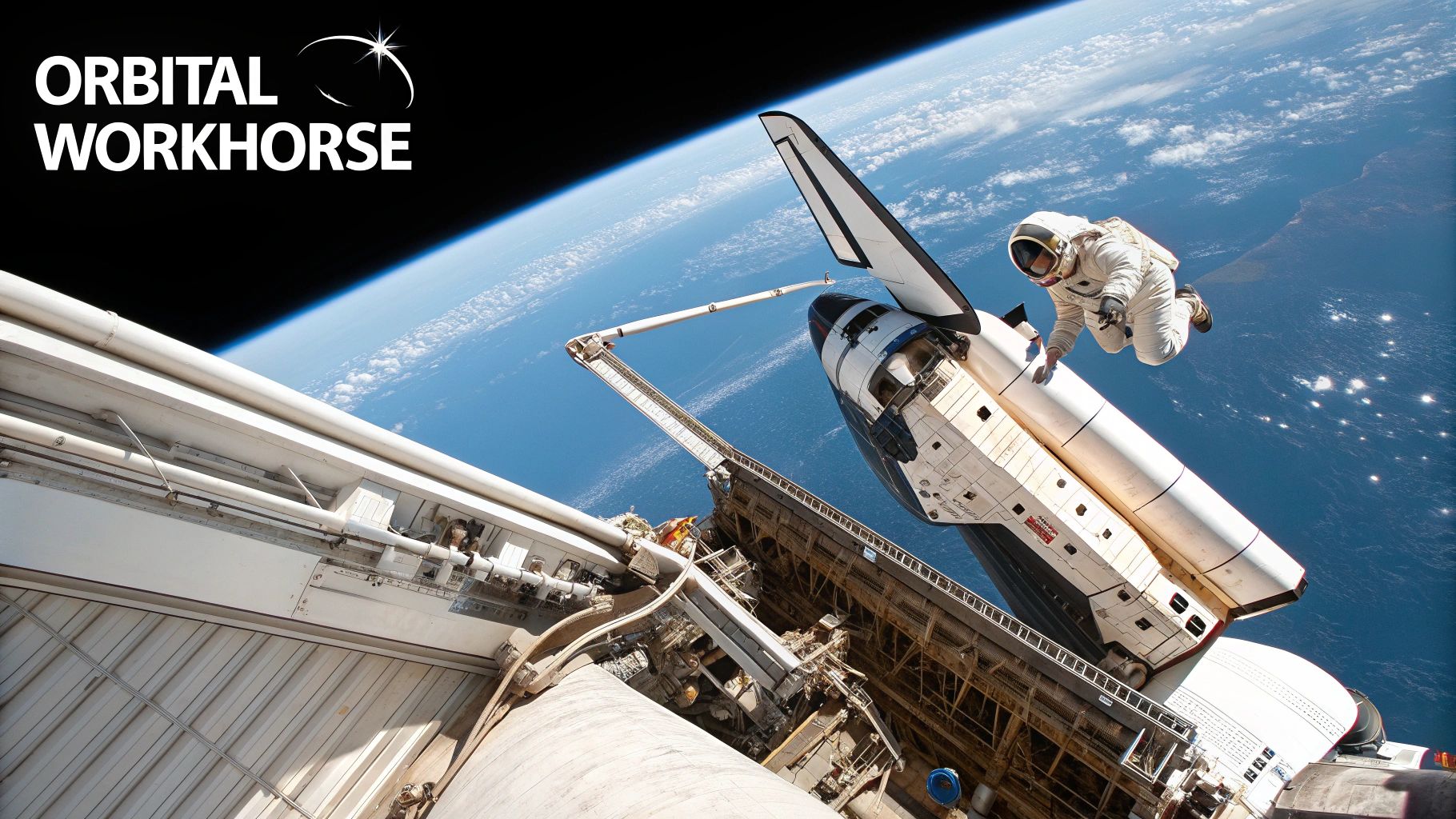
Across its 30 years of service, it took on many different tasks, but a few of its missions changed our relationship with space forever.
Building a House in the Sky
One of the shuttle’s biggest and most important jobs was acting as a construction vehicle high above the Earth. It was responsible for carrying most of the gigantic pieces needed to build the International Space Station (ISS).
Imagine trying to build a massive LEGO set, but floating in zero gravity! The shuttle's robotic arm would carefully lift enormous modules and solar panels out of its cargo bay. Astronauts on spacewalks would then guide them into place, slowly piecing together the incredible orbiting laboratory we have today. Without the shuttle, building the ISS would have been almost impossible.
A Science Lab with a View
The shuttle was also a fantastic place for science. On many missions, it carried a special laboratory called Spacelab right inside its payload bay. This allowed astronauts to run experiments that you simply can't do on Earth.
They studied everything from how plants grow in space to how crystals form without gravity pulling on them. These experiments helped us understand more about the universe and even led to new discoveries that help us right here on the ground.
The Ultimate Space Mechanic
Perhaps the shuttle's most famous job was playing mechanic for the Hubble Space Telescope. After deploying this giant eye on the universe in 1990, astronauts soon realised its main mirror had a tiny flaw, making all its pictures blurry.
But the Space Shuttle became Hubble's saviour. On a daring mission in 1993, astronauts flew up to the telescope, grabbed it with the robotic arm, and performed one of the most complex repairs in history, fitting it with special 'glasses' to correct its vision.
The shuttle visited Hubble four more times for upgrades and repairs, keeping this incredible telescope in business. Thanks to those missions, Hubble has given us breathtaking pictures of distant stars and galaxies. If you want to talk more about these celestial wonders with your children, why not check out our amazing blog post all about the different types of stars?
These incredible jobs show what a truly special machine the space shuttle was. You can explore even more space missions in our fun-filled space activities section.
Britain's Connection to the Space Shuttle Era
Did you know the UK has its own special link to the amazing age of space shuttles? While Britain never built its own shuttle, the story of how the first British person got into space is truly inspiring.
The journey started with a plan for a British astronaut to fly aboard one of NASA's Space Shuttles. But things changed, and a new opportunity popped up – a mission not with NASA, but to the Soviet Union's Mir space station. This led to a nationwide search called Project Juno to find the very first Briton to go into space.
A Chemist from Sheffield Reaches for the Stars
Imagine hearing a radio advert asking, "Astronaut wanted. No experience necessary." It sounds like something from a film, but it really happened! A young chemist from Sheffield named Helen Sharman heard this and, along with more than 13,000 other hopefuls, decided to give it a shot.
Against all odds, she was chosen. After months of tough training, Helen’s journey shows that you don't have to be a test pilot to become an astronaut; a passion for science and a brave heart can take you on the most amazing adventures.
Helen’s story is a powerful example of how curiosity can lead to extraordinary places. It proves that with determination, anyone can achieve their dreams, no matter how far away they seem.
On 18 May 1991, Helen Sharman blasted off in a Soyuz rocket and spent nearly eight days on the Mir space station. She officially became the first British person in space, a true pioneer whose journey started with a simple radio message. You can learn more about the UK's unique path into space and its history.
Helen's amazing flight reminds us that space exploration is a global adventure, with people from all over the world working together. It’s a wonderful story of courage that continues to inspire young explorers across Britain today.
Try This: Build Your Own Space Shuttle at Home!
Reading about the Space Shuttle is one thing, but how about becoming a space engineer for the day? It's time to get your hands busy and build a brilliant model of the shuttle using simple bits and bobs from around the house. This is a super fun way to really understand how all the different parts fit and work together.
First, grab an empty plastic bottle. This is going to be your Orbiter—the part where the astronauts would live. Now, find two cardboard tubes from kitchen roll or loo roll—these are your powerful Solid Rocket Boosters. A bit of card and some sticky tape will be perfect for making the wings and the tail fin.
Let Your Creativity Take Off!
As you put it all together, have a think about what each part does. Why do the boosters need to be so big? Where would that giant orange fuel tank go? This is your chance to solve problems just like a real engineer.
Once your model is complete, give it a cool name and decide on its first mission. Will it be delivering a new part to the space station, or launching a top-secret satellite?
- Engineering Challenge: Try to make your shuttle as strong as you can. How can you attach the wings so they don’t wobble during its flight?
- Design Time: Use pens or paint to add NASA logos and those important heat-shield tiles to your Orbiter. Make it look official!
- Storytelling Spark: Imagine you’re an astronaut. What would your mission patch look like? Draw a design for your shuttle's very first flight.
This is a fantastic way to learn by doing. And if you're looking for more inspiration, finding engaging space books is a great way to discover new ideas.
Did you enjoy this? We've got more hands-on projects you'll love, like our guide on how to make a rocket
Your Space Shuttle Questions Answered
Still got a few questions buzzing around your head? Perfect! Curiosity is the first step to adventure. Here are some quick answers to the most common queries about this amazing piece of space history.
How many space shuttles were there?
All in all, NASA built a fleet of six shuttles. The very first one was Enterprise, but it was a special test vehicle that never flew into space—it was a giant glider used for practice landings.
The five that became true spacefarers were Columbia, Challenger, Discovery, Atlantis, and Endeavour.
How fast did the Space Shuttle go?
To stay in orbit around the Earth, the Space Shuttle had to travel at a truly mind-boggling speed: about 17,500 miles per hour (that's roughly 28,000 kilometres per hour).
To give you an idea of just how fast that is, you could travel from London to New York in about 12 minutes!
Why don't we use space shuttles anymore?
The Space Shuttle programme was retired in 2011 after an incredible 30-year run. Just like an old family car, the orbiters were getting on a bit, and they were also incredibly complex and expensive to prepare for each flight safely.
NASA decided it was time for a fresh start. Using everything they learned from the shuttle era, they began designing new spacecraft to take us on future missions to the Moon, Mars, and even further.
At Space Ranger Fred, we believe every question is a launchpad for a new adventure! If our journey into the world of the space shuttle has sparked your child's curiosity, there’s a whole universe of stories and discoveries waiting for them at https://spacerangerfred.com.