
Have you ever looked up at the sky and imagined what it would be like to ride a rocket that could fly into space and back again, just like an aeroplane? For thirty years, from 1981 to 2011, that's exactly what NASA's Space Shuttles did! These incredible machines were part-rocket, part-glider, and all-amazing. Imagine a vehicle that launches straight up like a rocket but lands gently on a runway like a plane. They were the world's first reusable spacecraft, built to make travelling to space a bit more routine.
This amazing programme completely changed how we explore the cosmos. The shuttles were like a cosmic construction crew, helping to build the enormous International Space Station, piece by piece, high above our planet. They also carried powerful telescopes into orbit and even flew missions to repair them, like the famous Hubble Space Telescope. Their story is one of groundbreaking science and amazing engineering.
Get your space helmets on, because we're about to count down ten of the most brilliant space shuttle facts that are truly out of this world! We’ll discover how they were built, what their most important jobs were, and some of the surprising details that made them so special. Are you ready to explore, Space Ranger? Let's blast off into this amazing chapter of space history!
1. It Was the First Reusable Spacecraft
Before the Space Shuttle, rockets were a one-time-use deal. Imagine building a brand-new car for every single trip you take, and then throwing it away when you arrive! That’s what space travel was like. The Space Shuttle changed everything by becoming the world’s very first reusable spacecraft system. This is one of the most incredible space shuttle facts and what made it a true game-changer.
The main part of the shuttle, called the orbiter, was designed to fly to space, complete its mission, and then return to Earth, landing on a runway just like an aeroplane. After a mission, engineers would check it over, make repairs, and prepare it to fly again. This amazing design allowed the same vehicle to make multiple journeys into orbit.
This reusability was a giant leap forward. It meant NASA could plan complex, long-term projects that needed several trips. Can you imagine being part of the team that did this? The shuttles were used for big jobs like:
- Building the International Space Station (ISS): Shuttles carried up huge modules and equipment, piece by piece, like a cosmic construction crew.
- Servicing the Hubble Space Telescope: Astronauts flew shuttle missions to repair and upgrade the famous telescope, keeping it working for decades.
This ability to fly again and again made ambitious projects like the ISS possible. You can explore the different parts that made this happen and find out more about what a space shuttle is in our detailed guide.
2. It Had a Super-Smart Heat Shield
Imagine diving back to Earth from space at over 17,000 miles per hour! The friction with the air would make the Space Shuttle hotter than a volcano, reaching temperatures of up to 1,650°C. To survive this scorching heat, the shuttle was covered in a special heat shield called the Thermal Protection System (TPS). This clever system is one of the most vital space shuttle facts that made its return journeys possible.
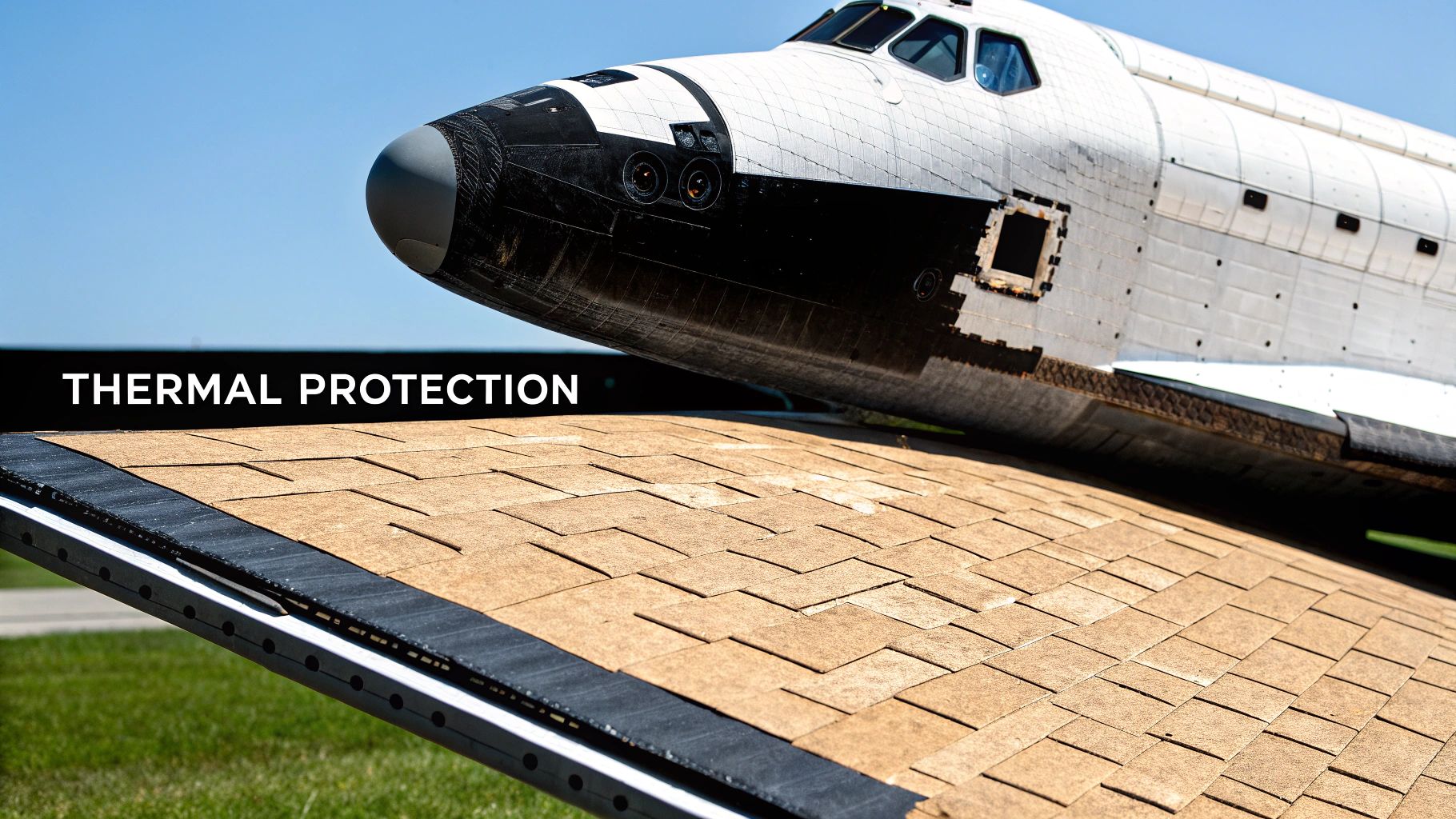
The system used thousands of lightweight silica-based tiles, a bit like a super-strong ceramic, to cover most of the orbiter. Each tile was carefully shaped and placed to fit perfectly. For the hottest parts, like the nose and the front edge of the wings, engineers used an even tougher material called reinforced carbon-carbon. This clever combination of materials worked like a powerful sun cream, keeping the astronauts and the shuttle's structure safe from the extreme heat of re-entry.
The TPS was essential for every mission. After each landing, ground crews would inspect every single tile. This crucial process ensured the shuttle was safe for its next trip to space.
- First Flight Success: The system proved its worth on the very first mission, STS-1, successfully protecting the orbiter Columbia during its return.
- Constant Checks: Post-landing tile inspections became a standard and vital part of preparing the shuttle for its next flight.
- Learning from Tragedy: Following the loss of Columbia on mission STS-107, caused by TPS damage, NASA developed even more advanced ways to check the heat shield was safe.
3. It Had a Giant Robot Arm
Astronauts couldn't just float outside to grab a satellite! To move huge objects in space, the shuttle needed a helping hand, and it got one in the form of a giant robotic arm. Called the Canadarm, this incredible piece of technology was developed in Canada and was one of the most important space shuttle facts that defined its success. It was like a 15-metre-long crane attached to the shuttle's cargo bay.

From inside the orbiter, astronauts could control the arm with amazing precision. Imagine playing a video game where you move a giant arm in space! They used it to lift satellites out of the cargo bay and release them into orbit, or to grab onto satellites that needed repairs. This powerful arm was absolutely essential for some of the shuttle's most famous missions.
The Canadarm was a true workhorse in space and played a vital role in major projects, including:
- Deploying the Hubble Space Telescope: In 1990, the Canadarm carefully lifted the famous telescope and placed it into its orbit.
- Building the International Space Station (ISS): The arm was used to move and connect massive modules, helping to build the station piece by piece.
Without the Canadarm, building something as complex as the ISS or keeping the Hubble telescope working would have been almost impossible. Watch the video below to see how this amazing robotic arm operated in space.
4. It Had a Thirsty Engine and a Giant Fuel Tank
Getting a machine as heavy as a Space Shuttle off the ground requires a mind-boggling amount of power. The shuttle’s secret was its unique combination of engines and fuel tanks, all working together in perfect harmony. This powerful setup is one of the most important space shuttle facts to understand how it reached space.
The full launch stack included three main parts: the orbiter with its three powerful main engines, two white Solid Rocket Boosters (SRBs), and the huge, orange External Tank. This giant orange tank acted like a massive fuel bottle, holding over two million litres of super-cold liquid hydrogen and liquid oxygen. These were fed directly to the orbiter's three main engines during lift-off.
This propulsion system was a marvel of engineering, and it worked reliably for decades. Here are a couple of key mission examples:
- STS-1: The very first shuttle flight in 1981 was a crucial test that proved this complex engine and tank system worked exactly as designed.
- 100+ Successful Operations: Across 135 missions, the shuttle's engines fired successfully, launching crews and cargo to build wonders like the International Space Station.
After about eight minutes, the massive external tank would run out of fuel, separate from the orbiter, and fall back to Earth, burning up safely in the atmosphere. The orbiter would then continue its journey into orbit using its smaller onboard engines.
5. It Was a Repair Van for Space Telescopes
The Hubble Space Telescope is one of the most famous observatories ever built, but it needed help to reach its full potential. The Space Shuttle was the only vehicle that could act as a space-based repair van, flying astronauts to Hubble to fix and upgrade it. This unique capability is one of the most important space shuttle facts in the history of space exploration.
After its launch, scientists discovered Hubble's main mirror had a tiny flaw, making its pictures blurry. Can you imagine building a giant telescope and discovering it needed glasses? In 1993, the crew of Space Shuttle Endeavour flew a daring mission to install special corrective optics. This was just the first of five incredible servicing missions where astronauts performed complex spacewalks to keep Hubble working.
These missions turned Hubble into a scientific powerhouse, allowing it to take breathtaking images of our universe. The shuttle's role was crucial for:
- Installing new instruments: Astronauts fitted more advanced cameras and scientific tools, making Hubble more powerful over time.
- Replacing old parts: They swapped out failing gyroscopes and batteries, extending the telescope's life far beyond its original plan.
Without the Space Shuttle, Hubble's amazing discoveries would never have been possible. You can learn more about the incredible tasks astronauts perform on missions like these in our guide about what astronauts do in space.
6. It Was a Cosmic Construction Lorry
One of the Space Shuttle's most important jobs was acting as a cosmic construction lorry for the largest structure ever built in space: the International Space Station (ISS). Building a science lab that floats above the Earth was a massive undertaking, and it simply wouldn't have been possible without the shuttle fleet. This is one of the most incredible space shuttle facts that highlights its role as a space pioneer.
The shuttle’s huge cargo bay was perfectly designed to carry enormous pieces of the station into orbit. Astronauts on board would then use the shuttle's robotic arm to lift these modules out and carefully attach them to the growing station. Over many missions, the shuttles delivered more than 70% of the ISS, piece by giant piece.
This flying construction platform was essential for delivering and installing key components, turning an ambitious dream into a reality. Some of the major parts delivered by the shuttles include:
- The Columbus Laboratory: Europe’s main science lab for the ISS, delivered by Space Shuttle Atlantis.
- The Kibo Laboratory: Japan’s impressive contribution, a large module with its own robotic arm, brought up by Space Shuttle Discovery.
- The Tranquility Node: Delivered by Endeavour, this module provides extra life support and includes the famous seven-windowed Cupola for amazing views of Earth.
By carrying both the building blocks and the astronaut crews needed to assemble them, the Space Shuttle truly built our home in the heavens. You can discover more about this amazing orbiting outpost and find out what the International Space Station is in our guide.
7. The Challenger Story Taught Us About Safety (STS-51L, 28 January 1986)
While most missions were a huge success, it's important to remember that space travel is very difficult and can be dangerous. On 28 January 1986, the Space Shuttle Challenger broke apart just 73 seconds after its launch. This tragic event was a deeply sad moment for NASA and the whole world. All seven astronauts on board, including the first teacher set to go to space, Christa McAuliffe, were lost.
Investigators discovered that a small part called an O-ring on one of the solid rocket boosters had failed because of the cold weather that morning. This allowed hot gas to escape, which led to the disaster. This terrible accident taught everyone some very important lessons. One of the most critical space shuttle facts is how this event changed space flight forever, leading to major safety improvements.
NASA stopped all shuttle flights for almost three years to figure out exactly what went wrong and how to fix it. This led to:
- Complete redesigns: The rocket boosters and other parts of the shuttle were completely re-engineered to be much safer.
- New safety rules: NASA created stricter rules for launches and put a new office in charge of safety.
This focus on learning from mistakes made future space missions much safer for the astronauts who would bravely travel into orbit.
8. The Columbia Story Taught Us Even More (STS-107, 1 February 2003)
Space travel is exciting, but it is also very risky. One of the saddest space shuttle facts is the story of Space Shuttle Columbia. On its final mission in 2003, it broke apart as it was re-entering Earth's atmosphere. This happened because a piece of foam insulation fell from the external fuel tank during launch and hit the shuttle's left wing, creating a small hole.
During re-entry, the incredibly hot gases of the atmosphere entered the wing through this hole, causing it to overheat and break up. Tragically, all seven astronauts on board were lost. This accident was a painful reminder of how dangerous spaceflight can be and led to major changes in safety for all future missions.
After the accident, NASA made space travel safer by:
- Improving inspection: They developed new ways to check the shuttle for damage in orbit, using cameras and lasers to spot even the tiniest problems.
- Creating repair kits: Astronauts were trained to perform spacewalks to repair any damage found on the shuttle’s heat shield before returning to Earth.
This terrible event led to new safety rules that helped protect the astronauts on the remaining shuttle flights. It showed that learning from mistakes, even very sad ones, is a crucial part of exploring space. You can learn more about how astronauts train for missions on our activities page.
9. One Shuttle Never Went to Space
Did you know there was a space shuttle that never actually went to space? Meet the Space Shuttle Enterprise (OV-101), the very first orbiter built by NASA. Its job wasn't to fly into orbit but to prove that the shuttle could fly and land safely in Earth’s atmosphere. This is one of the most interesting space shuttle facts, as it shows how much testing was needed before a real mission.
In 1977, Enterprise took part in a series of crucial flights called the Approach and Landing Tests (ALT). For these tests, the orbiter was piggybacked on top of a specially modified Boeing 747 aeroplane. The 747 would carry Enterprise high into the sky and then release it, allowing astronaut crews to practise gliding it down to a perfect runway landing.
These tests were incredibly important for a few reasons:
- Testing the design: They proved that the orbiter could handle flying like a glider, which was essential for a safe return from space.
- Astronaut training: It gave pilots hands-on experience of what it felt like to control the huge, unpowered vehicle.
Without these atmospheric test flights, NASA wouldn't have had the confidence to launch the Space Shuttle Columbia into orbit a few years later. Enterprise was the pioneering test vehicle that paved the way for every shuttle mission that followed. You can discover more about the different shuttle vehicles and their unique jobs in our detailed guide.
10. It Was a Launch Pad in Orbit
The Space Shuttle wasn't just a transport vehicle for astronauts; it was also a mobile launch pad floating in space. Instead of launching giant telescopes and deep-space probes directly from Earth, which required massive rockets, NASA used the shuttle's huge cargo bay to carry them into orbit first. This is one of the most important space shuttle facts because it changed how we explore the universe.
Once in the safety of orbit, astronauts would use the shuttle's robotic arm to lift these incredible machines out of the bay and release them. A smaller, attached rocket called an upper stage booster would then fire, sending the probe on its long journey to other planets or into a high Earth orbit.
This method allowed NASA to launch some of its most famous missions. The shuttle served as the first step for:
- The Magellan spacecraft: It travelled to Venus to map its mysterious, cloud-covered surface.
- The Galileo probe: This mission journeyed all the way to Jupiter to study the giant planet and its moons.
- Major observatories: The shuttle also deployed the Hubble, Compton, and Chandra space telescopes, giving us amazing views of the cosmos.
While shuttles deployed instruments to study other worlds, scientists also learn a great deal from materials that arrive on Earth from space. For instance, studying rare pieces of lunar meteorites gives us invaluable insights into the Moon's composition without having to send a mission to collect them.
Space Shuttle Facts: 10-Point Comparison
| Item | Implementation complexity 🔄 | Resource requirements ⚡ | Expected outcomes ⭐📊 | Ideal use cases 💡 | Key advantages ⭐ |
|---|---|---|---|---|---|
| First Reusable Spacecraft System (Space Shuttle orbiter) | Very high — integrated airframe, launch, landing, crew systems | Extensive funding, ground infrastructure, long refurbishment cycles | ⭐⭐⭐⭐ Enables repeated crewed orbital access; enabled ISS/Hubble operations | Crewed transport, large cargo delivery, satellite retrieval/repair | Human-rated reusability, operational flexibility, retrieval capability |
| Advanced Thermal Protection System (TPS) | High — thousands of custom tiles and attachment mechanisms | Specialized manufacturing, extensive inspections, spare inventory | ⭐⭐⭐ Critical for safe reentry; enables reuse but vulnerable to damage 📊 | Any reusable reentry vehicle requiring high‑temp protection | Lightweight insulation, modular repairability, proven thermal performance |
| Canadarm Robotic Manipulator System | Moderate — precision robotics, avionics, operator interfaces | Robotic hardware, operator training, payload‑bay integration | ⭐⭐⭐ High mission impact for assembly and servicing; reduces EVA needs 📊 | Satellite deployment, ISS assembly, on‑orbit servicing tasks | Precise manipulation, reduces astronaut exposure, strong flight heritage |
| Three Main Engines & External Tank Configuration | Very high — cryogenic tanks, RS‑25 engines, SRBs integration | Massive propellant, engine refurbishment programs, SRB recovery ops | ⭐⭐⭐ Provides heavy thrust for crewed payloads; complex maintenance 📊 | Heavy‑lift crewed launches needing high thrust margin | High thrust capability, partially reusable propulsion elements |
| Hubble Servicing & Repair Missions | High — rendezvous, EVA/robotic ops, specialized tools and procedures | Dedicated shuttle missions, trained crews, costly hardware & planning | ⭐⭐⭐⭐ Transformed scientific output; extended telescope lifetime 📊 | On‑orbit telescope repair, instrument upgrades, complex servicing | Enabled in‑situ repairs/upgrades that yielded major discoveries |
| ISS Construction and Assembly | Very high — multi‑module integration, international coordination | Many missions, large cargo capacity, long‑term logistics & crew rotation | ⭐⭐⭐⭐ Enabled permanent orbital laboratory; major international collaboration 📊 | Delivery/assembly of large station modules and logistics | Human‑tended assembly, large payload capacity, adaptability |
| Challenger Disaster & Safety Implications (STS‑51L) | N/A (accident) — investigation and redesign complexity very high | Extensive investigation resources, program suspension costs, redesign work | ⭐⭐ Led to systemic safety reforms; long program delay and human loss 📊 | N/A — serves as safety case study and procedural reform catalyst | Prompted safety culture overhaul, improved engineering standards |
| Columbia Disintegration & Reentry Protocols (STS‑107) | N/A (accident) — TPS inspection and on‑orbit repair processes complex | Increased inspection assets, imaging systems, new repair capabilities | ⭐⭐ Produced stricter TPS inspection/repair protocols and on‑orbit assessment 📊 | N/A — informs TPS design, inspection and contingency planning | Established on‑orbit damage assessment, improved launch imaging standards |
| Space Shuttle Enterprise (Atmospheric Tests) | Low–Moderate — glide/test article without orbital systems | 747 carrier ops, test instrumentation, flight test support | ⭐⭐⭐ Validated aerodynamic handling and landing procedures pre‑orbit 📊 | Flight characteristics testing, pilot training, systems validation | Safe risk reduction, critical flight data, astronaut familiarization |
| Deployment of Magellan, Galileo, IRAS | Moderate — payload‑to‑upper‑stage integration and robotic deployment | Payload accommodations, upper stages (IUS/PAM), crew oversight | ⭐⭐⭐⭐ Successful deployment of major probes; significant scientific returns 📊 | Launch/deploy large scientific probes and observatories | Precise deployment, in‑flight troubleshooting, ability to carry bulky payloads |
Your Space Adventure is Just Beginning!
From its revolutionary reusable design to the iconic Canadarm that built the International Space Station, the Space Shuttle truly changed how we explore the cosmos. We've journeyed through some incredible space shuttle facts, uncovering stories of amazing technology, brave astronauts, and missions that taught us so much about our universe. You’ve discovered how its special heat shield tiles protected it like a suit of armour, and how its powerful engines helped it launch like a rocket but land like a glider.
We also saw how the Space Shuttle was more than just a vehicle; it was a science lab, a construction site, and a delivery van for the stars. It carried incredible telescopes like Hubble into orbit, giving us breathtaking pictures of distant galaxies. It also helped scientists launch probes like Magellan and Galileo on their own grand tours of the solar system, revealing the secrets of Venus and Jupiter.
Learning from Every Mission
More than anything, the Space Shuttle programme taught us the importance of learning and improving. The difficult lessons from the Challenger and Columbia tragedies remind us that space exploration is challenging and requires immense courage and care. These events led to vital safety improvements, making space travel safer for all future explorers. Every mission, whether a perfect success or a challenging lesson, pushed humanity forward.
These stories aren't just history; they are the foundation for the spaceships being built today. The dream that powered the Space Shuttle now inspires a new generation of engineers, scientists, and astronauts. What part of its story sparked your imagination the most? Was it the robotic arm building a home in space, or the brave astronauts venturing out on spacewalks to fix a telescope?
Your Mission Continues
Now it’s your turn to be the explorer! Your space adventure is only just getting started. Here are a few ways to continue your journey:
- Ask Big Questions: What was your favourite of all the space shuttle facts we shared? What new questions do you have? Maybe you’re curious about what it feels like to float in zero gravity or how astronauts eat in space. Keep asking those brilliant questions!
- Build Your Own Shuttle: Grab some building blocks, cardboard, or recycled materials and try designing your own reusable spacecraft. What special features will it have? Check out our free space activities page for more hands-on STEM challenges you can try at home.
- Share What You've Learnt: Tell a friend or family member three amazing things you now know about the Space Shuttle. Explaining these cool facts to someone else is a brilliant way to become a space expert yourself.
The legacy of the Space Shuttle is one of bold dreams and relentless curiosity. It reminds us that with teamwork, courage, and a passion for discovery, we can achieve incredible things. Keep looking up at the stars, keep wondering, and never stop exploring.
Ready for your next mission? Blast off into a universe of stories and science with Space Ranger Fred! Join Fred on his exciting adventures across the galaxy, where learning about space is always part of the fun. Explore the books and start your journey today!