
When you're looking for the best space books for 7 year olds, you want something that perfectly mixes mind-blowing facts with thrilling adventures. Get it right, and you could spark a lifelong passion for science and reading, all by capturing their imagination and building up their confidence.
Launching a Lifelong Love of Space and Reading
Finding the perfect book for a seven-year-old can feel a bit like a mission into the great unknown. At this brilliant age, they’re taking giant leaps in their reading skills, blasting off from simple stories and heading towards more complex tales. Books about space are the ideal rocket fuel for that journey.
Stories about planets, stars, and funny-looking aliens are powerful because they tap right into a child's natural curiosity. They make massive ideas—like gravity, orbits, and just how huge the universe is—feel exciting and easy to grasp.
Why Space Stories Matter at This Age
This is a really important time for their development. Around age seven, many children are making the big jump from picture books to their first chapter books. This opens up a huge opportunity for books that cleverly weave learning into a great adventure. In fact, the global children’s book market is on track to hit USD 16.43 billion by 2033, and science and adventure stories for primary school kids are a big part of that growth. You can discover more insights about the children's book market in this report.
This guide is here to help you navigate the cosmos of choices and find the perfect match for your young explorer. We’ll look at everything you need to know:
- Balancing facts and fiction: How do you choose between a book about real astronauts and a silly story about aliens who love socks?
- Building reading confidence: Find out why character-led stories, like those featuring Space Ranger Fred, are so good at keeping young readers hooked.
- Making learning active: We'll show you how to turn reading time into a hands-on adventure with some simple, fun activities.
A great space book doesn't just teach a child facts about the cosmos; it invites them to imagine their own place within it, sparking questions that can last a lifetime.
Our goal is simple: to help you pick books that make learning feel less like a lesson and more like the start of an incredible mission. Let's get ready to launch your child's imagination into a universe of stories.
What Makes a Great Space Book for a 7 Year Old
Not all space books are created equal, are they? For a seven-year-old, the absolute best ones manage to blend that jaw-dropping sense of cosmic wonder with just the right amount of information. It should feel more like an adventure than a lesson.
Think of it as a mission checklist for picking a winner. A great book for this age group needs to get the balance spot on. Look for exciting, clear text paired with vivid illustrations that make tricky ideas—like gravity or how planets orbit the sun—feel simple and unforgettable. A picture of a planet with rings is nice, but a picture that helps a child understand why it has rings? That's even better.
Engaging Characters and Humour
One of the most powerful things a space book can have is a hero your child can relate to. When they see a bit of themselves in a character on a cosmic quest, learning becomes completely effortless and fun. Stories that feature curious, brave, and sometimes slightly silly heroes, just like in the Space Ranger Fred series, help children connect emotionally with the science.
This mix of story, humour, and science is a winning formula. In the UK, books are a massive gateway into a lifelong love of reading for 6–8‑year‑olds. With children's book revenues hitting £412 million in 2023, it’s clear that parents and teachers are hunting for titles that offer more than just a bit of fun. You can read the full UK book revenue report on Publishing Perspectives to see just how important this market is. A book that makes a kid laugh while explaining how rockets work is a book they'll want to read over and over again.
What to Look For on the Shelf
When you're browsing the bookshelves, keep your eyes peeled for a few key things that signal a high-quality space book. These elements are a good sign that the book will be both educational and a huge hit with your young reader.
- Clear Layouts: The pages shouldn't feel busy or cluttered. Look for plenty of white space and short paragraphs that are easy for a developing reader to follow without feeling overwhelmed.
- A Story That Sparks Curiosity: The best stories don't just hand over all the answers; they inspire a whole universe of new questions and get kids wondering "what if?".
- A Blend of Fact and Fiction: Even in a make-believe tale, grounding the adventure in real scientific concepts helps build a strong foundation for STEM learning. We dive deeper into this idea in our guide to brilliant children's books.
A truly fantastic space book is one that leaves a child gazing up at the night sky, filled with new questions and a fresh sense of wonder about their place in the universe.
By choosing books with these qualities, you’re not just giving them a story. You’re handing them a telescope to see the cosmos in a whole new way.
Choosing Between Fact, Fiction, and Fun Activities
So, what’s it going to be? A book bursting with real astronaut facts, or a funny tale about aliens who’ve lost their socks? Navigating the universe of space books for 7-year-olds can feel a bit like charting a course through an asteroid field, but it’s really just about matching the book to your child’s personality.
The brilliant news is that there’s no wrong answer. Every type of book offers its own unique launchpad for learning and imagination. Whether it’s fiction, non-fiction, or a hands-on activity book, each one plays a special part in building your child’s confidence and curiosity.
If you’re not sure where to start, this simple flowchart can help point you in the right direction. It all comes down to a simple question: does your child love facts, or are they a storyteller at heart?
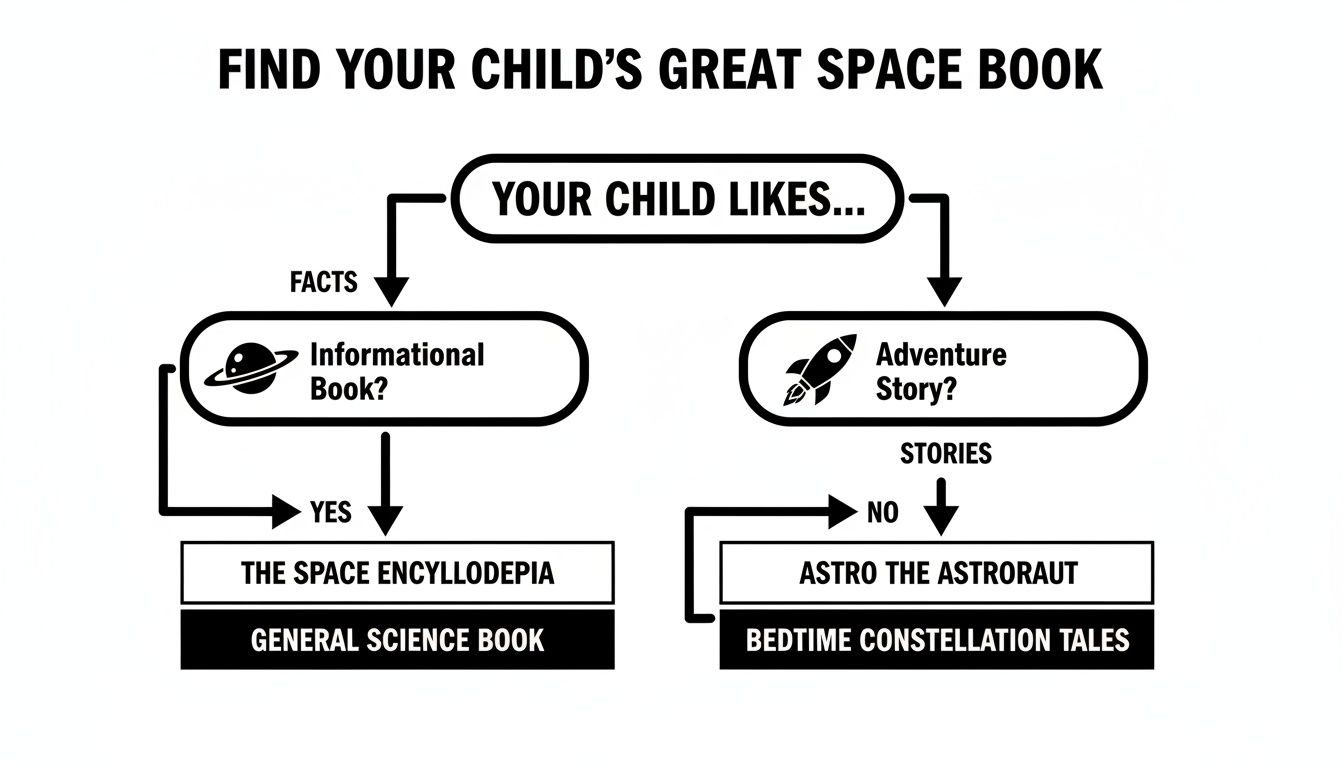
As you can see, a child’s natural interests are the best guide to finding the perfect book, whether it leads to the wonders of non-fiction or the adventures of fiction.
The Power of Factual Books
Does your child’s favourite word seem to be “why?” If so, non-fiction books are your best friend. They’re packed with mind-blowing facts, stunning NASA photography, and clear diagrams that break down complex ideas in a way that just clicks.
These books are perfect for:
- Answering specific questions about planets, black holes, or the International Space Station.
- Building a solid foundation of knowledge and introducing core STEM vocabulary in a completely natural way.
- Inspiring a sense of awe by revealing the incredible reality of our universe.
The Magic of Fiction Stories
On the flip side, imaginative stories take your child on an incredible interstellar journey without ever leaving the sofa. They use brilliant characters, exciting plots, and a big dose of creativity to explore scientific concepts. Think of them as a friendly gateway to some really big ideas.
A story about a clumsy astronaut learning to float in zero gravity can teach a child about microgravity far more memorably than a dry definition ever could.
Fictional adventures are fantastic for:
- Developing empathy and imagination as kids connect with a character’s challenges and triumphs.
- Making abstract concepts relatable through storytelling and a good bit of humour.
- Boosting reading stamina with thrilling plots that make them desperate to turn the page.
Turning Reading into Action with Activity Books
Finally, we have the brilliant world of STEM and activity books. These fantastic resources turn reading into a hands-on experience, which is perfect for children who learn best by doing. They’re often filled with puzzles, colouring pages, simple experiments, or even build-your-own-rocket challenges.
A great activity book doesn’t just tell a child about space; it gives them the tools to become an explorer themselves, encouraging them to try, fail, and figure things out.
These books are ideal for encouraging the kind of problem-solving skills that every Space Ranger Fred mission is built on. For more ideas on how to make learning playful, check out the fantastic resources on our free activities page.
Our Top Book Recommendations for Young Stargazers
Ready for blast-off? We’ve put together our absolute favourite space books for 7-year-olds, covering everything from mind-bending facts to epic adventures. Let's break down what makes each book a brilliant choice, so you can find the perfect launchpad for your young reader's imagination.
To make things easier, we've sorted our picks into a few clear categories. It’s the best way to zoom in on the perfect book for your mission.
Mind-Blowing Fact Books
Is your child constantly asking "why?" If so, these books are a treasure trove of cosmic knowledge. They have a knack for taking huge ideas and making them feel exciting and easy to grasp, mostly thanks to stunning visuals and simple explanations.
- Professor Astro Cat's Frontiers of Space by Dr. Dominic Walliman & Ben Newman: Honestly, this book is a work of art. It’s this clever blend of beautiful illustrations and easy-to-digest scientific facts that makes tricky topics like gravity and black holes feel genuinely fun. It’s perfect for building a solid foundation of space knowledge without them even realising they're learning.
- National Geographic Kids First Big Book of Space by Catherine D. Hughes: You can always count on National Geographic for breathtaking photography, and this book is no exception. It’s ideal for young fact-finders, packing each page with amazing details about planets and stars, but it’s laid out in a way that never feels overwhelming for a seven-year-old.
Epic Space Adventures
If it’s a brilliant story your child is after, these fictional tales will send their imagination into orbit. Adventure books are perfect for building up their reading stamina and making all that science feel personal and thrilling.
Fictional stories do more than just entertain; they invite children to step into an astronaut's boots, making abstract concepts like zero gravity feel real and relatable through a character's journey.
- Space Ranger Fred and the Shoelace Adventure by the Space Ranger Fred Team: We couldn't resist including our own hero! This story wraps up clever, hidden science concepts in a laugh-out-loud plot. Fred’s mission to solve a seemingly silly problem is a brilliant way to introduce problem-solving and resilience, all inside an exciting cosmic adventure that’s a perfect fit for this age group. Books like this are a great stepping stone to longer stories, and you can explore more ideas in our guide to chapter books for 7-year-olds.
Hands-On STEM Fun
For the kids who learn best by doing, activity books can turn reading into an interactive mission. These are fantastic for sparking curiosity and developing practical skills. For other great reading ideas, you might also explore lists of inspiring books for kindergartners, as many of those titles are just right for seven-year-olds, too.
- Look Inside Space by Rob Lloyd Jones: This lift-the-flap book from Usborne is a masterpiece of interactive learning. Every single flap reveals a fascinating fact about space travel, our solar system, or the wider universe. It really encourages children to get hands-on and discover information for themselves, which makes learning feel more like a game. It's an experience that keeps young minds hooked from the first page to the last.
Bringing Space Stories to Life Beyond the Page
A brilliant book is just the start of the adventure! The real magic happens when you take the story off the page, turning reading into a hands-on experience that makes learning truly stick. It’s the perfect way to make space books for 7 year olds even more memorable.
Recent reading trends show a growing need for exciting, science-rich stories to keep this age group engaged, especially with so many digital distractions around. This is exactly where fantastic stories and fun activities can make all the difference.
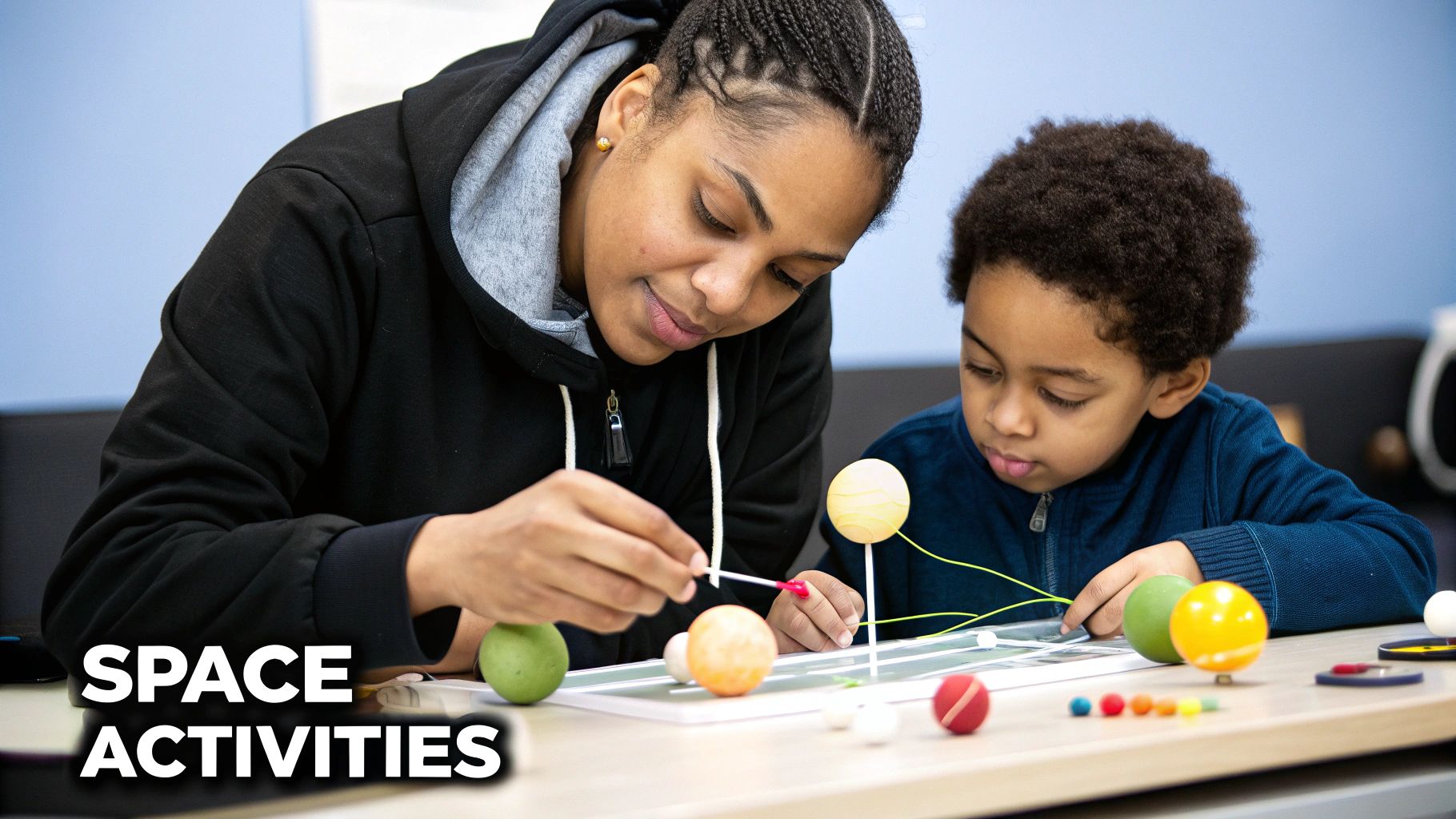
Simple Activities to Launch Their Curiosity
You don’t need a science lab to explore the cosmos. These simple, easy-to-do activities are perfect for bringing space concepts to life, whether you're at home or in the classroom.
- Build a Shoebox Solar System: Grab an old shoebox, some paint, and a few balls of different sizes. This classic craft is a fantastic way to talk about the planets and their order from the sun. Why is Mars red? Which planet is biggest? Let them lead the questions!
- Design a Friendly Alien: Hand over some paper, crayons, and maybe some craft bits like pipe cleaners or googly eyes. Ask them to imagine an alien from a planet they just read about. What does it look like? What does it eat? This is a brilliant, playful way to get them thinking creatively.
- Do a 'Gravity Drop' Experiment: A simple but powerful way to try out gravity. Gather a few different objects—a feather, a small toy, a crumpled piece of paper—and ask them to guess which one will hit the floor first. Trying it out is a great conversation starter for physics, and you can find more ideas in our guide to making space science fun for kids.
A great question is like a key that unlocks a child's imagination. Asking "what if?" and "why do you think that?" during and after reading encourages them to think like a real explorer.
For even more ideas, our free activities page is packed with downloadable resources that connect directly to themes of space exploration and problem-solving. And beyond the pages of a book, you can bring the cosmos even closer by understanding star maps and capturing a special moment in the night sky.
Continue Your Family's Space Adventure
The adventure doesn't stop when you turn the final page. As we’ve seen, the right space books for 7 year olds are so much more than just stories—they’re confidence-builders, question-starters, and proof that learning is the best kind of adventure there is.
By mixing incredible facts with thrilling fiction and hands-on activities, you’re giving your young explorer a toolkit for understanding their place in the universe. Every book they open is another step towards a lifelong love of reading and a deep-seated curiosity about the world. It’s here, in these moments, that a real passion for science, technology, engineering, and maths can take root.
Your Next Mission Awaits
Ready to keep exploring? Your family’s next mission is just a click away. Head over to our free activities page to find a galaxy of playful learning ideas, all packed with downloadable fun that turns big cosmic concepts into hands-on play. They're the perfect way to stretch the adventure long after story time is over.
For more tips on finding the perfect books, our blog is your mission control. You can discover how to track down brilliant chapter books for 7-year-olds and keep that reading momentum going strong.
Every book is a launchpad. It’s an invitation for a child to ask big questions, dream up new worlds, and see themselves as the hero of their own story.
The universe is vast, and there’s always something new to discover. We’d love for you and your family to join Space Ranger Fred on his next mission. Continue your amazing adventure together, exploring the wonders of space one story at a time.
The stars are waiting.
Got Questions About Space Books? We’ve Got Answers
We know you've got questions—parents and teachers always do! So, we’ve gathered some of the most common ones to help you pick the perfect space books for 7-year-olds and make reading a truly stellar experience.
My 7-Year-Old Hates Reading. Will Space Books Actually Help?
Absolutely! Space is one of those magical topics that naturally sparks wonder, and that’s the secret ingredient for tempting a reluctant reader. When a child isn’t keen on picking up a book, you need a high-interest hook to draw them in.
Fictional space adventures, packed with exciting plots and loads of pictures, can make reading feel less like a chore and more like a brilliant game. Activity-based space books are another great bet. They get kids involved with puzzles and challenges, sneakily showing them that books are a portal to incredible adventures.
Should I Stick to Fiction or Non-Fiction?
Honestly, the best approach is to offer a mix of both! Non-fiction books are fantastic for building solid knowledge and answering all those brilliant, endless 'why?' questions they come up with. Look for titles with jaw-dropping photos and bite-sized facts that are easy to digest and remember.
On the other hand, fiction is where imagination and empathy take flight. A great story set amongst the stars can make abstract ideas feel personal and thrilling. Just let their curiosity lead the way—if they’re obsessed with planets, grab a fact book. If they crave action, find a gripping space quest.
How Do I Know if a Space Book Is Scientifically Accurate?
That’s a great question. For non-fiction, it's always best to check the source. Look for books from reputable names like museums, well-known educational publishers (think DK or National Geographic Kids), or authors with a science background. It’s a good sign that the information has been properly fact-checked.
With fiction, it’s less about getting every tiny detail right and more about respecting the basic rules of science. The best stories cleverly weave real scientific principles into the narrative without killing the fun.
They might not be 100% accurate (we don't have talking alien sidekicks… yet!), but they build a wonderful foundation for learning more later on.
How Can I Tie These Books into Schoolwork?
Space books are a fantastic way to support what your child is learning in the classroom. Space is a common topic in the Key Stage 1 and 2 science curriculum here in the UK, so you can easily connect the stories to their lessons by chatting about planets, stars, and astronauts.
Encourage your child to share amazing facts they've learned with their teacher or classmates. You can also try some of the hands-on activities we've mentioned to bring big concepts to life. Reading together is one of the best ways to build vocabulary and comprehension, which helps them across every single subject.
Continue your family’s amazing journey through the cosmos with Space Ranger Fred.
Discover more space adventures at spacerangerfred.com