
Alright, Space Rangers, grab your warmest space suit! We're off on an adventure to the very edge of our solar system. If you fly past all the planets, way, way beyond Neptune, you'll reach the coldest, darkest part of our cosmic neighbourhood. So, what is the Oort Cloud that you’d find floating out there?
Imagine a giant, frosty bubble made of trillions of icy objects wrapping around our entire solar system. It’s like a magical snow globe with the Sun and all the planets tucked safely inside. It's the ultimate cosmic frontier!
The Oort Cloud at a Glance
Before we blast off, here’s a quick mission briefing. This table gives you the essential facts about our solar system's mysterious, icy shell. Get ready to impress your friends with these facts!
| Feature | What It Is |
|---|---|
| Location | The most distant part of our solar system. |
| Shape | A giant, thick-walled spherical shell. |
| Size | It starts about 2,000 times farther from the Sun than Earth. |
| Composition | Trillions of icy bodies made of water, methane, and ammonia. |
| Job | The birthplace of most long-period comets. |
Now you've got the basics, let's gear up and explore this amazing place together.
Exploring the Edge of Our Solar System
Let’s imagine our solar system is a cosy little street. The Sun is the house in the middle, and all the planets live on the same road. The Oort Cloud is like a huge, invisible fence marking the absolute edge of the Sun's garden. It’s so mind-bogglingly big and far away that we can’t see it, not even with our most powerful telescopes.
So how do we know it’s there? Astronomers are a bit like space detectives! They figured it out by studying clues left behind by comets that take thousands of years to visit the Sun. They realised these icy travellers had to be coming from a massive, ball-shaped cloud, far, far beyond the planets we know.
This far-out region is totally different from the flatter areas closer to home, where planets and asteroids cruise around. In fact, just beyond Neptune lies another ring of icy bodies. Fancy another adventure? You can explore our guide on what is the Kuiper Belt.
So, what makes the Oort Cloud so special? Here are a few things to talk about:
- A Giant Bubble: It isn’t a flat ring like the ones around Saturn. It’s a huge sphere that completely surrounds everything in our solar system.
- A Comet Nursery: This is where most long-period comets are born. They hang out there for billions of years, just waiting for a tiny nudge to start their incredible journey towards the Sun.
- Ancient Leftovers: These icy objects are like cosmic fossils! They are bits and pieces left over from when our solar system first formed more than 4.5 billion years ago.
Just How Far Away Is the Oort Cloud?
Trying to imagine how far away the Oort Cloud is can make your brain feel a bit wobbly! It’s not just far away; it's so mind-bogglingly distant that it’s almost impossible to picture.
Let’s try a little thought experiment. Imagine you could shrink our entire solar system so that the distance from the Sun to Neptune fits neatly on your dinner plate. Where would the Oort Cloud be? It wouldn’t just be in your kitchen or even your house. It would be a gigantic, icy bubble surrounding the entire city you live in!
Sizing Up Our Solar System
This colossal distance is exactly why we’ve never sent a spacecraft to visit. Even our speediest probes would take thousands of years just to get there.
Think about it this way: sunlight takes about eight minutes to reach us here on Earth. If you were sitting on a comet in the Oort Cloud, that same sunlight would take over a year to finally reach you!
This quick map helps you picture where the Oort Cloud fits into our cosmic neighbourhood.
As you can see, it’s a huge bubble of icy bits and bobs sitting right at the very edge of the Sun’s influence.
Measuring in Space Miles
When distances get this enormous, astronomers use a special measurement called an astronomical unit (AU). One AU is simply the distance from the Sun to the Earth.
To put that into perspective, try this:
- Neptune, the most distant planet, is about 30 AU away from the Sun.
- The Oort Cloud is thought to start at around 5,000 AU and stretch out to an unbelievable 100,000 AU!
If you want to dive deeper into these incredible distances, check out our guide on what is a light year.
The Oort Cloud is so far away that it marks the very edge of the Sun’s gravitational pull. Anything beyond it is no longer part of our solar system.
This gigantic, icy shell holds trillions of frozen treasures left over from when our planets were first born. Its sheer scale is what makes it one of the greatest and most exciting mysteries in all of space.
What Is the Oort Cloud Made Of?
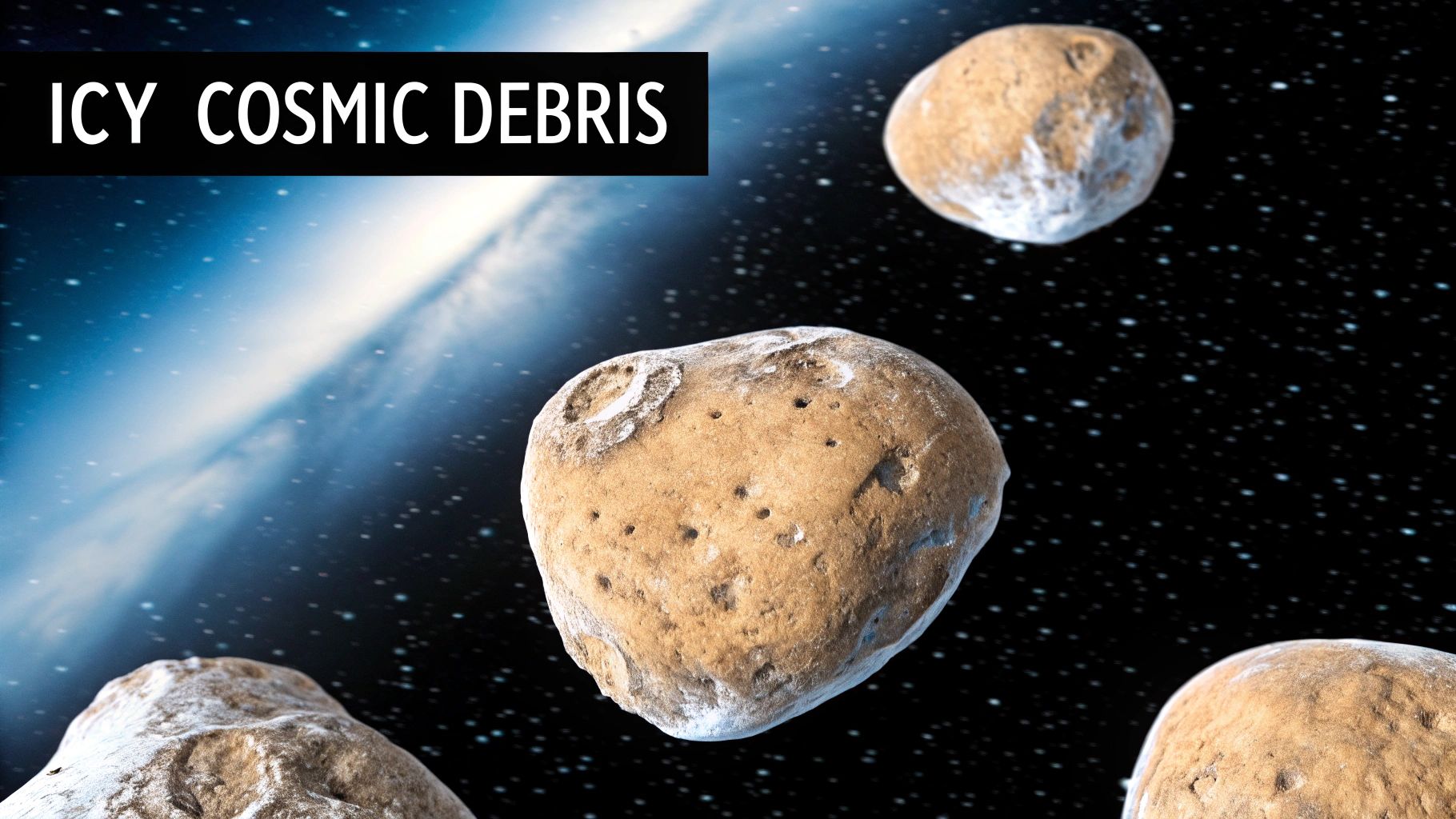
So, what are these trillions of mysterious objects actually made of? Forget solid, rocky asteroids like you see in the movies. The best way to picture them is as giant, dusty snowballs!
Each one is a cosmic slushie, a jumble of bits and pieces left over from when our solar system was first forming billions of years ago. They’re a mix of frozen water, methane, and other icy gases all clumped together with rock and dust. This makes them some of the most ancient, untouched relics in our entire cosmic neighbourhood.
A Giant Cosmic Bubble
One of the most mind-boggling things about the Oort Cloud is its shape. It’s not a flat disc or belt, like the rings of Saturn or the asteroid belt. Instead, it’s a gigantic, thick-walled sphere that wraps around our entire solar system—the Sun, the planets, everything. It’s the true final frontier.
Try to imagine it like this:
- A Cosmic Snow Globe: The Sun and all the planets are the little scene inside, and the Oort Cloud is the huge glass ball surrounding it all.
- The Ultimate Shell: It’s like a massive, protective shell marking the boundary where our solar system ends and deep, interstellar space begins.
This spherical shape is a massive clue for astronomers. It tells them that these icy bodies weren't formed in the same flat disc as the planets. They were most likely flung out in every direction during the wild and chaotic birth of our solar system.
These ancient, icy snowballs are a key part of the Space Ranger Fred story. In Fred's adventure to the Frosty Frontier, he discovers just how important these cosmic leftovers really are.
Where Do Comets Actually Come From?
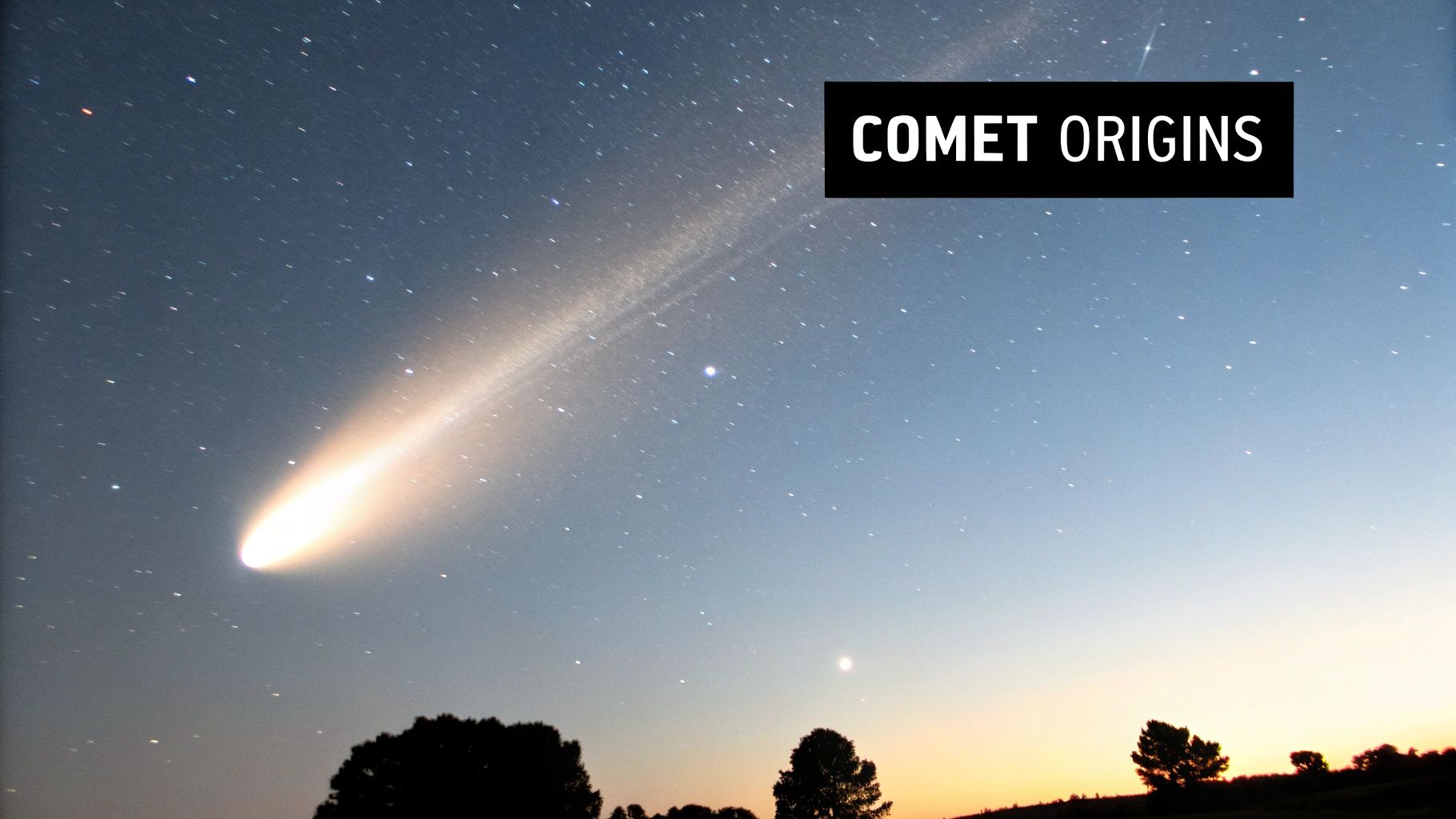
Have you ever seen a picture of a comet blazing across the night sky, its long tail trailing behind it? Well, almost all of those incredible travellers start their journey in the Oort Cloud. Let's imagine it as a giant, cosmic nursery, where trillions of icy objects are just floating around in a deep, deep freeze.
For billions of years, these cosmic snowballs just drift through the quiet darkness. But every now and then, something gives one of them a little nudge. It’s usually the gravity from a star passing by our solar system, millions and millions of miles away.
That gentle push is all it takes. It knocks an icy body out of its comfy spot and sends it on a long, looping path straight towards our Sun. And just like that, a comet is born!
A Long Trip Towards The Sun
As the comet gets closer to the inner solar system, the Sun’s warmth starts to work its magic. The ice on the comet’s surface doesn't just melt; it turns straight into gas in a process called sublimation.
This releases all the dust and rock that was trapped inside the ice, forming a huge, glowing cloud around the comet's icy centre. This fuzzy cloud is called the coma.
Then comes the grand finale! As the comet zooms even closer, the solar wind—a stream of particles always flowing from the Sun—pushes this gas and dust away from the comet, creating that famous, glowing tail. To find out exactly what’s in those icy snowballs, you can whizz over to our guide on what are comets made of.
Fun Fact: A comet's tail always points away from the Sun, no matter which direction the comet is travelling. It’s like a cosmic windsock showing which way the solar wind is blowing!
It’s interesting how words can have different meanings, and some people even talk about the metaphorical 'Comet Era' in digital browsing. But for us Space Rangers, the real excitement will always be with the icy travellers making their incredible journey from the very edge of our solar system.
How We Know the Oort Cloud Exists
Here's a brilliant question: if nobody has ever seen the Oort Cloud, how can we be so sure it’s really out there? The answer is a fantastic story of cosmic detective work, showing how science is a brilliant adventure full of clever thinking and asking big questions.
It all started with an astronomer named Jan Oort. Back in the 1950s, he got very interested in comets that take thousands of years to orbit the Sun, which we now call long-period comets. He spent ages studying their paths, a bit like a detective following clues across the solar system.
Following the Comet Crumbs
While tracking them, Jan Oort noticed something strange and wonderful. These comets weren’t just coming from the same flat disc where all the planets live. Instead, they were zipping in from every possible direction—from above, below, and all sides.
He realised this could only mean one thing. These icy travellers had to be coming from a gigantic, spherical cloud of objects that completely surrounds our entire solar system.
Jan Oort basically worked backwards from the evidence. By tracing the paths of the comets he could see, he managed to predict the existence of a massive, invisible structure nobody had ever imagined before. It was a proper "Aha!" moment in astronomy.
He suggested that these icy bodies were leftovers from when the solar system was born, chucked out to the very edge by the gravity of giant planets like Jupiter. They've been floating out there peacefully ever since, just waiting for a nudge to begin their long journey inwards.
And that’s how what is the Oort Cloud went from being a clever idea to a widely accepted part of our cosmic neighbourhood. It’s a perfect example of how scientists can discover amazing things they can’t see, simply by observing the clues the universe leaves behind for them to find.
Fancy trying some of your own cosmic detective work? Head over to our free activities page for some fun space mysteries to solve.
Activity: Make Your Own Oort Cloud Model
Right then, Space Rangers, are you ready for a hands-on mission? Reading about the Oort Cloud is one thing, but building a model of it makes everything click into place. Let’s create a mini version of our solar system’s giant, icy bubble!
Your Mission Briefing
For this activity, you’ll just need a few simple things you probably already have at home. This is your chance to turn a huge, far-out idea into something you can hold in your hands.
Your Cosmic Craft Kit:
- A balloon: Any colour will do! This is going to be your Oort Cloud.
- Glitter or small beads: These are your trillions of icy comets.
- A small marble or large bead: This little fella will be our Sun, right at the centre of everything.
- A funnel (optional): This just makes getting the glitter inside a bit less messy.
Building Your Solar System
Ready to create? Follow these simple steps to assemble your very own cosmic neighbourhood.
- Prepare Your Sun: Carefully drop your marble (our Sun) into the deflated balloon. It should settle right down at the bottom.
- Add Your Comets: Using the funnel, pour a little bit of glitter and some tiny beads into the balloon. Not too much! These represent the trillions of icy objects floating around out there.
- Create the Oort Cloud: Gently blow up the balloon until it's a good size and tie it off. You've just created the spherical shape of the Oort Cloud!
- Try it Out! Give the balloon a gentle shake. See how the glitter and beads (your comets) float all around inside the big bubble, surrounding the marble (the Sun) in the middle?
That’s a brilliant picture of what the Oort Cloud is—a huge, round shell of icy bodies, far, far away, wrapping around our entire solar system. Great job, Ranger!
Your Oort Cloud Questions Answered!
It’s totally normal to have massive questions about such a mysterious and mind-bogglingly distant place! Thinking about the Oort Cloud can make your imagination spin. So, let’s tackle some of the biggest curiosities that young Space Rangers like you often have.
Think of this as your official mission debriefing from Space Ranger Fred himself, getting you ready for your next cosmic adventure.
Has a Spacecraft Ever Visited the Oort Cloud?
Not yet, and it’s not for lack of trying! The Oort Cloud is just so incredibly far away that even our speediest spacecraft, like Voyager 1, will need hundreds of years just to reach its inner edge.
And once it got there? It would still take thousands more years to fly all the way through. For now, it remains one of the most unexplored parts of our cosmic neighbourhood.
Could a Hidden Planet Be Lurking in the Oort Cloud?
What a great thought! Some scientists think that’s entirely possible. There are some exciting ideas about a giant, undiscovered planet, which some have nicknamed 'Planet Nine'.
This mysterious world could be orbiting way out in the dark, far beyond Neptune, maybe even brushing up against the inner Oort Cloud. It's a fantastic puzzle that astronomers are still trying to solve. What do you think?
Why Is It Called the Oort Cloud?
Excellent question! It’s named after a brilliant Dutch astronomer called Jan Oort. Back in 1950, he was the super-sleuth who first realised that this huge cloud of icy bodies simply had to exist.
He pieced the puzzle together by carefully studying the paths of comets with super-long orbits, and his theory was the perfect explanation for where they were all coming from.
Is the Oort Cloud a Dangerous Place?
Not at all! You might imagine it’s a crowded place with trillions of objects zipping around, but space is just unbelievably vast. The icy bodies in the Oort Cloud are spread millions and millions of kilometres apart from each other.
Imagine placing one tiny grain of sand inside a massive football stadium – that’s a good way to picture just how empty it is out there. It’s actually a very peaceful and quiet corner of the solar system.
What a journey to the very edge of space! We’ve learned that the Oort Cloud is a giant, icy bubble, a nursery for comets, and a wonderful mystery. If you loved this mission, why not join Space Ranger Fred on another adventure? The universe is full of stories waiting to be discovered