
Ever wondered why it rains, where the wind comes from, or how a rainbow appears? The weather isn't just something to look at through the window; it's a giant, exciting science adventure waiting to happen! Just like Space Ranger Fred explores new planets, your family can explore the amazing weather on Earth. Forget tricky textbooks – we’re diving into a world of brilliant games about weather that make learning about clouds, climate, and forecasting an absolute blast.
This guide is designed to help you find the perfect weather-themed game, whether you're looking for a quick digital activity, a hands-on classroom project, or a fun family challenge. We'll explore top-notch resources from organisations like NASA and the Met Office, with ideas for every young meteorologist. Each one has a direct link to help you get started straight away. In this spirit, understanding the role of various educational formats can be valuable; explore further by reading about the importance of teaching children about climate change through diverse media.
Ready to turn a rainy day into a fantastic play-and-learn session? Let's get started!
1. NASA Climate Kids
For a trustworthy and completely free resource packed with engaging games about weather, look no further than NASA Climate Kids. This brilliant website, developed by the experts at NASA, is a fantastic digital launchpad for young learners to explore Earth’s weather and climate. It avoids overwhelming children with dense information, instead offering a colourful, interactive, and ad-free experience.
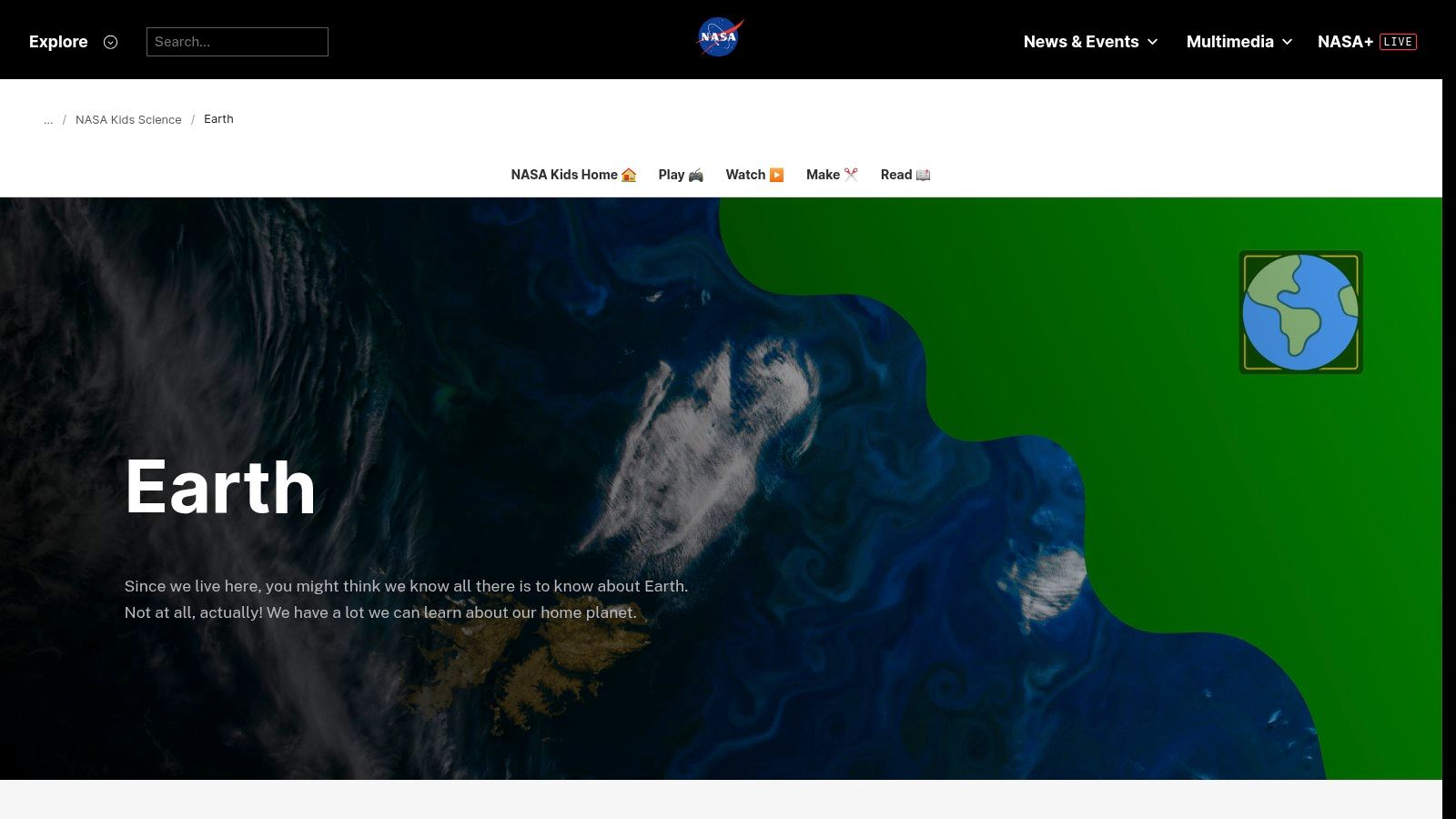
The platform is organised around big questions like "What is the greenhouse effect?" Each section features short, easy-to-read explainers, fun facts, and most importantly, interactive mini-games that make the learning stick. This play-and-learn approach is a perfect fit for both curious kids at home and for teachers looking for reliable classroom activities.
Why It’s a Great Choice
One of its best features is how it makes big topics feel manageable. For instance, children can play "Power Up!", a game where they help a city switch to cleaner energy sources. These activities are more than just entertainment; they’re cleverly designed to help children try out core scientific concepts in a playful way.
- Learning Focus: Earth systems, the water cycle, weather versus climate, and energy.
- Best For: Upper primary learners (Ages 8-12) looking for quick, educational digital activities.
- Accessibility: Completely free with no sign-in or ads.
- User Experience: Simple, intuitive navigation designed for children to explore independently.
Try This Mission Idea!
Imagine Space Ranger Fred is monitoring Earth from his spaceship, the Starseeker. After playing a few games on NASA Climate Kids, can you help him find out what space weather is and how it might affect his missions? This is a great way to talk about how Earth's weather connects to the wider universe, sparking even more curiosity.
Top Tip: Use the "For Educators" section on the site. It offers lesson plans and guidance on how to link the games to specific learning goals, making it a powerful tool for teachers and homeschooling families.
| Feature | Details |
|---|---|
| Price | £0 (Completely free) |
| Access Requirements | Internet connection and a web browser. |
| Primary Age Group | 8–12 years old |
| Unique Offering | High-trust, ad-free content directly from NASA scientists and educators. |
| Link | Visit NASA Climate Kids |
2. NOAA SciJinks
For a huge menu of bite-sized games about weather, NOAA SciJinks is an excellent destination. Originally a partnership between NOAA and NASA, the SciJinks website is a goldmine of simple, effective interactives that demystify tricky weather topics. It’s designed to provide quick, focused learning experiences that are perfect for classroom demonstrations or for individual exploration at home.
The platform shines with its "slider-and-simulation" approach. Children can adjust things like temperature or wind to see what happens, helping them understand cause and effect. They can explore how a tornado forms, see what makes a rainbow appear, or learn how to calculate lightning distance. While the main site has been retired, its fantastic library of games remains accessible, offering a wealth of brilliant, no-fuss educational content.
Why It’s a Great Choice
The strength of SciJinks lies in its sheer variety and simplicity. Instead of one long game, it offers dozens of short activities, each focusing on a single concept. This makes it incredibly versatile for parents and teachers who need a quick, engaging resource to explain a specific weather question. The simple language and clear visuals make these concepts easy for a wide age range to grasp.
- Learning Focus: Severe weather (tornadoes, hurricanes), precipitation, cloud types, and satellite meteorology.
- Best For: Primary and lower secondary learners (Ages 8-13) and educators needing quick, interactive classroom demos.
- Accessibility: Completely free with no login or adverts required.
- User Experience: Straightforward menu of games, though some pages may have outdated links.
Try This Mission Idea!
Space Ranger Fred is trying to plan a safe landing on a new planet, but the weather is wild! After exploring the simulations on SciJinks, challenge your child to design a "Planetary Weather Guide" for Fred. They could draw pictures of the planet’s strange clouds and explain what kind of weather Fred should expect from each one, using what they’ve learned about Earth’s weather.
Top Tip: Use the games as 'learning stations'. Set up several tablets or computers, each with a different SciJinks game. Let children rotate between them to explore different weather topics in a short amount of time. It's a great way to get them moving and talking!
| Feature | Details |
|---|---|
| Price | £0 (Completely free) |
| Access Requirements | Internet connection and a web browser. |
| Primary Age Group | 8–13 years old |
| Unique Offering | A large, diverse collection of single-concept weather simulations and games. |
| Link | Visit NOAA SciJinks Games |
3. Met Office WOW – Education
For those in the UK wanting to turn real-life weather into a compelling game, the Met Office’s Weather Observations Website (WOW) is an exceptional resource. While not a collection of arcade-style games about weather, this platform helps children and teachers engage with live, local data in a gamified way. It’s a citizen-science hub where schools and individuals can record and share their own weather observations.
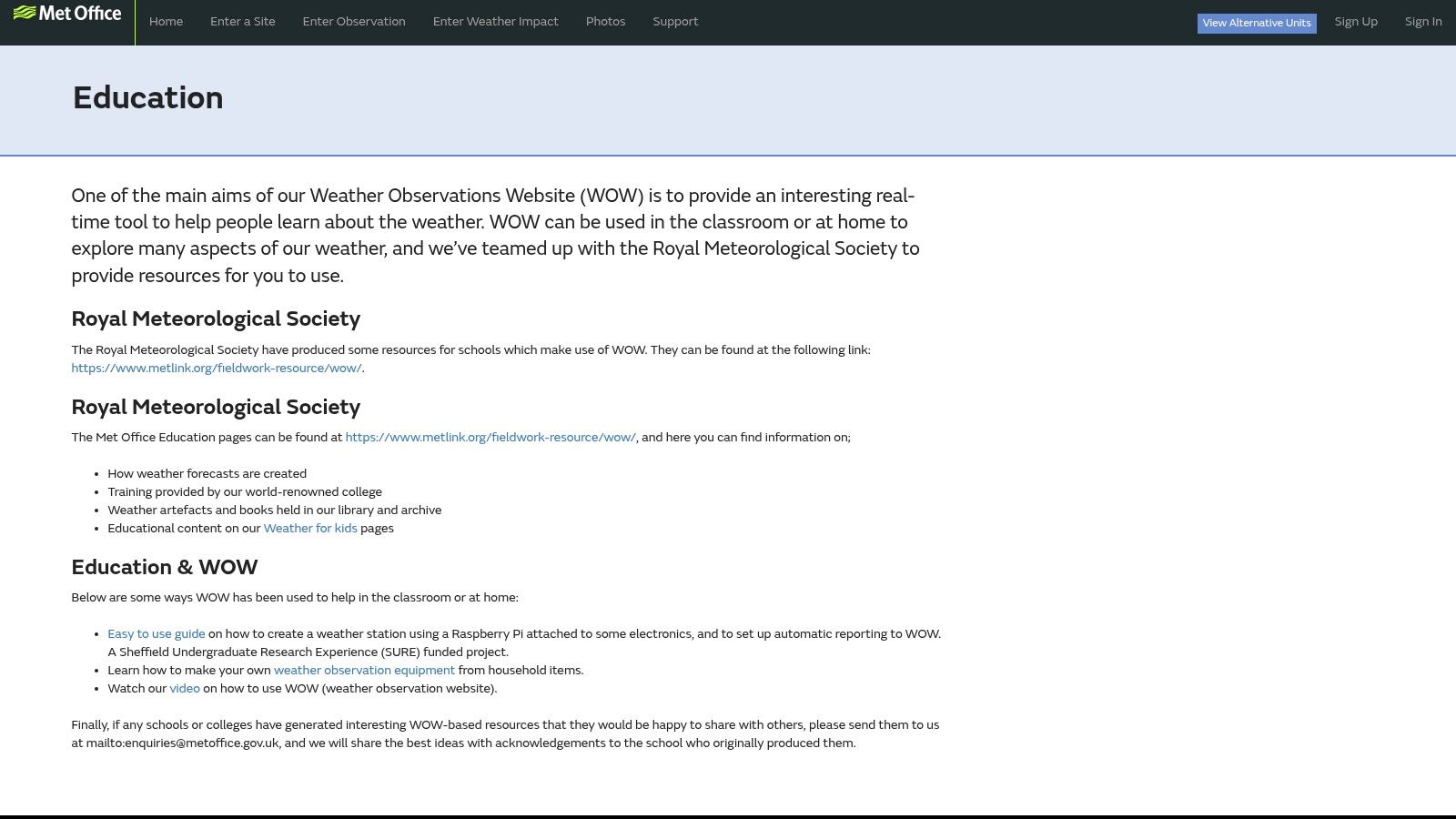
The educational section, supported by the Royal Meteorological Society, provides the framework to transform this data into fun challenges and projects. This approach connects digital learning with real-world science, encouraging children to become active participants in weather monitoring. It’s perfect for a school science club, a classroom project, or even a challenge between neighbouring schools.
Why It’s a Great Choice
WOW’s unique strength is making weather personal and competitive. A teacher can set up a challenge for their class to see who can most accurately record daily rainfall, or create a leaderboard comparing temperature readings with a partner school. It encourages hands-on STEM, from building a simple rain gauge to setting up a weather station, linking physical making with digital data.
- Learning Focus: Data collection and analysis, UK weather patterns, observation skills, and citizen science.
- Best For: UK-based primary and secondary learners (Ages 7-14) and educators looking for long-term, project-based activities.
- Accessibility: Completely free to access and contribute data.
- User Experience: The website is data-rich, so it's best explored with guidance from an adult to help structure the learning activities.
Try This Mission Idea!
Space Ranger Fred needs to plan a safe landing in the UK, but he only has data from his spaceship. He needs your help! Challenge your young meteorologists to set up a basic observation station (even a simple pot to collect rain works!) and log their findings. Can they compare their local data to the official Met Office forecast? Their observations could help Fred choose the perfect landing time.
Top Tip: Explore the linked resources from MetLink. They provide a treasure trove of ready-made lesson plans and activity ideas that use WOW data, taking the guesswork out of turning the platform into an engaging classroom project.
| Feature | Details |
|---|---|
| Price | £0 (Completely free) |
| Access Requirements | Internet connection and a web browser. Basic weather instruments are recommended. |
| Primary Age Group | 7–14 years old |
| Unique Offering | Uses live, crowdsourced UK weather data for authentic, project-based learning. |
| Link | Visit Met Office WOW – Education |
4. MetLink’s “Weather Journey”
For teachers seeking a hands-on, active learning experience, the Royal Meteorological Society’s MetLink platform offers a fantastic printable resource. Their “Weather Journey” game is a brilliant, curriculum-aligned activity designed to get children moving and thinking about daily and seasonal weather patterns. It moves learning off the screen and into the classroom, making it one of the most engaging games about weather for younger children.
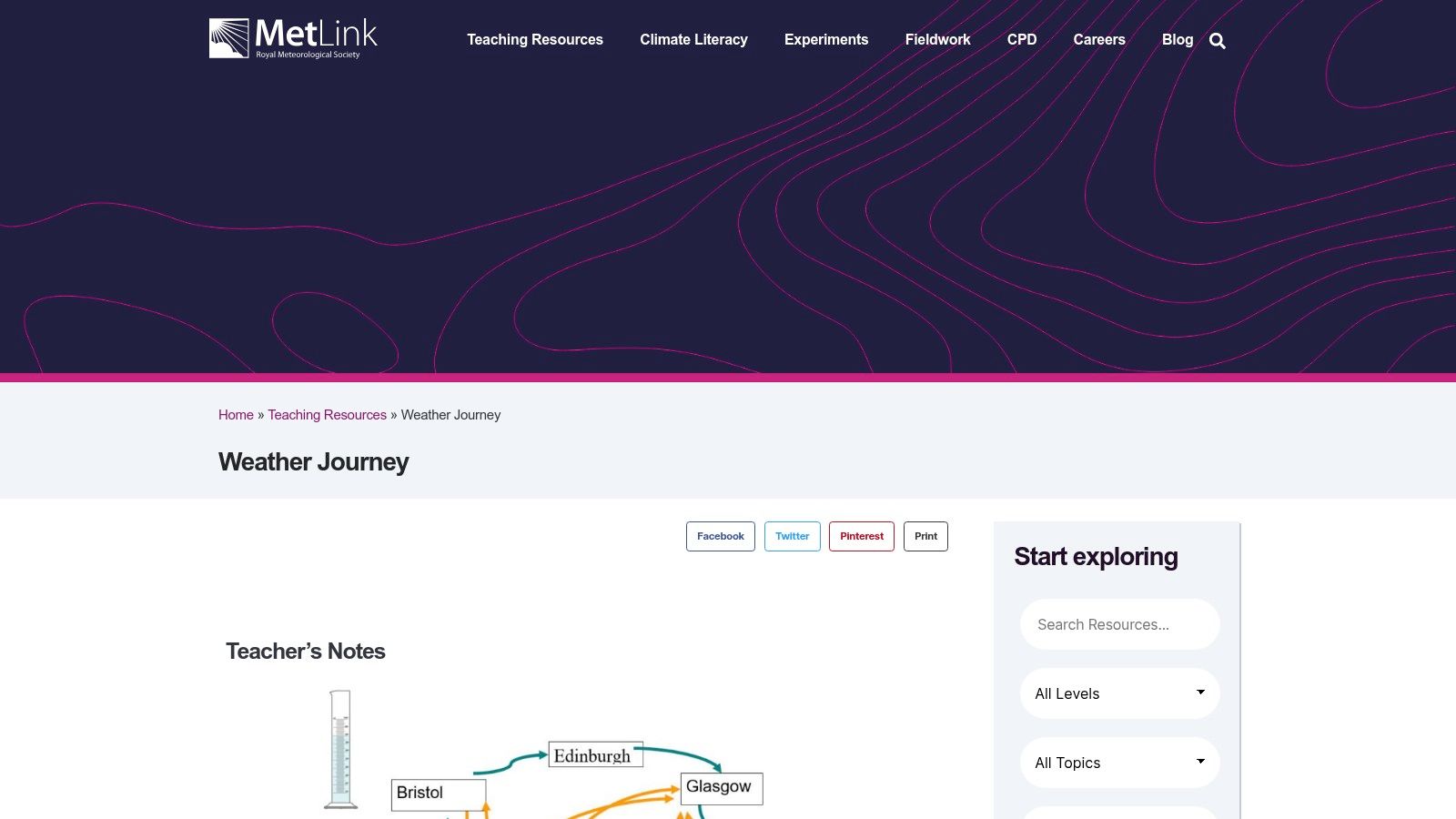
This free-to-download resource transforms your learning space into a giant board game. Children move between different "weather stations," answering questions to advance. It’s a simple concept that effectively combines physical activity with learning, perfect for energetic kids.
Why It’s a Great Choice
“Weather Journey” is fantastic because it’s all about active, collaborative learning. Rather than passively listening, children are physically part of the game. The resource comes with helpful teacher notes and, crucially, question cards for different ability levels. This means you can easily adapt the challenge for mixed-ability groups, ensuring every child feels involved and successful.
- Learning Focus: Seasonal changes, daily weather patterns, weather vocabulary, and basic meteorological concepts.
- Best For: KS1 and lower KS2 learners (Ages 6-9) in a classroom or group setting.
- Accessibility: Completely free to download and print, but needs an adult to set up and lead.
- User Experience: Clear instructions and well-designed printables make it easy for teachers to get started.
Try This Mission Idea!
Space Ranger Fred needs to plan a supply drop, but the local weather is very unpredictable! After playing a round of "Weather Journey," challenge your young explorers to become Fred’s mission control team. They must create a seven-day weather forecast for the outpost, using symbols and drawings from the game to predict what conditions Fred might face each day. It's a great chance to practice communication skills!
Top Tip: Laminate the game cards and board elements after printing. This makes them reusable for future lessons and durable enough to withstand the excitement of active play.
| Feature | Details |
|---|---|
| Price | £0 (Completely free download) |
| Access Requirements | Internet to download, printer, and physical space for gameplay. |
| Primary Age Group | 6–9 years old |
| Unique Offering | An active, station-based physical game designed by UK meteorology experts. |
| Link | Visit MetLink to download Weather Journey |
5. Legends of Learning
For teachers and home educators seeking a structured, curriculum-aligned approach to games about weather, Legends of Learning is a powerhouse platform. It features an enormous library of browser-based science games, all organised by specific learning objectives. You can find collections dedicated to Weather Patterns, Weather Prediction, and Global Climate Change, allowing you to target exactly what your children need to learn.
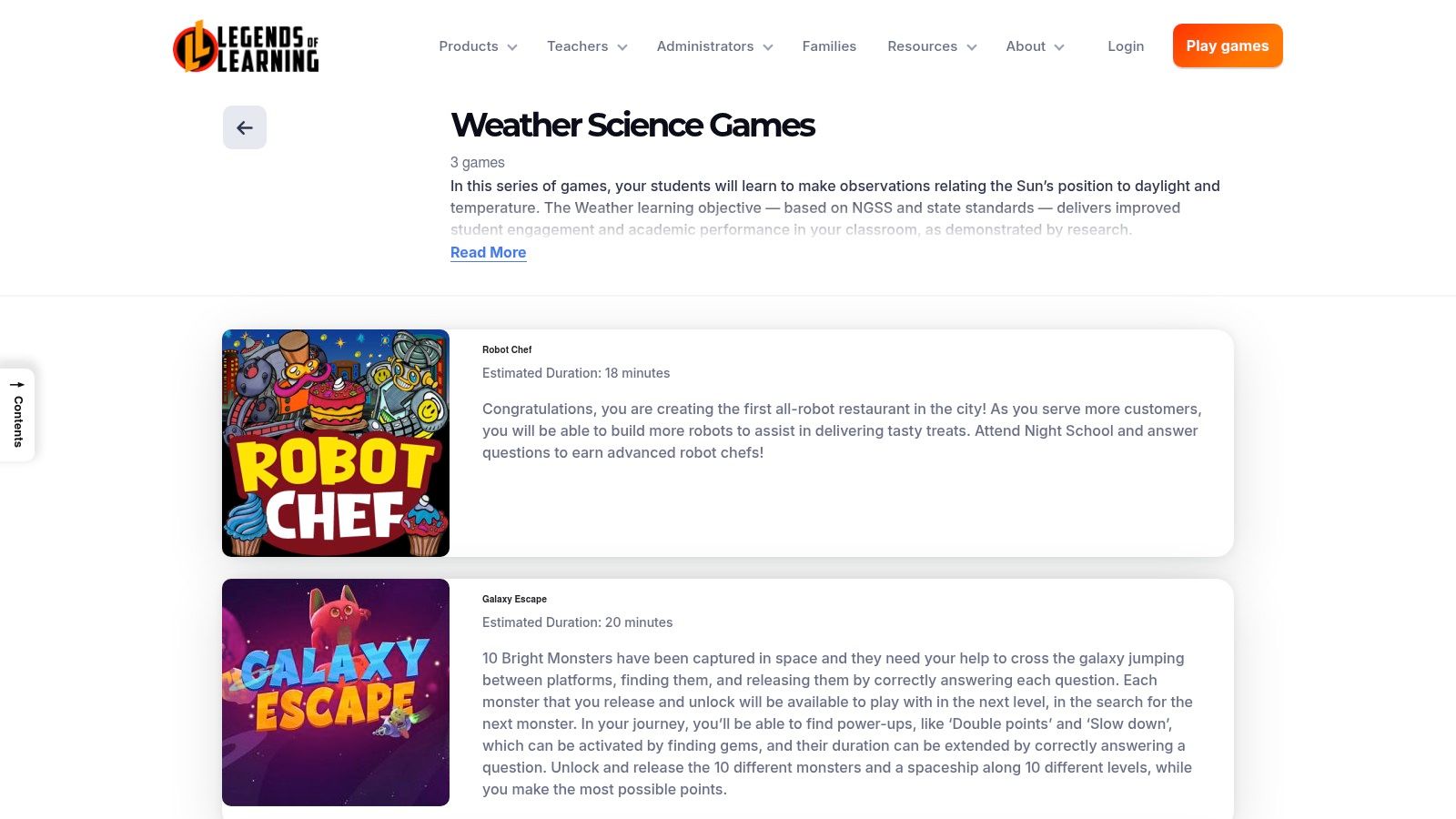
The platform is designed for easy use in a learning environment. Teachers can build custom playlists of games, assign them to students, and see how they're getting on through a special dashboard. With short gameplay episodes (lasting 5–20 minutes), it’s built to fit neatly into a lesson plan, making it one of the most effective children's educational video games for structured science topics.
Why It’s a Great Choice
Legends of Learning is great at building understanding step-by-step. The ability for teachers to create assignments and track results gives you a peek into how well a child is grasping a topic. While the full feature set is part of a paid subscription, you can access a large number of games for free, making it a brilliant resource to try out.
- Learning Focus: Specific, standards-aligned topics like weather patterns, climate factors, and weather prediction.
- Best For: Primary school teachers (Years 3-6) and home educators wanting to assign and track targeted learning activities.
- Accessibility: Freemium model; many games are free, but full features require a school subscription.
- User Experience: Easy-to-use teacher dashboard and engaging, varied games for students. It works perfectly on school computers like Chromebooks.
Try This Mission Idea!
Space Ranger Fred needs to find a safe window to launch the Starseeker. He needs your help to read weather maps and predict patterns! Challenge your child to create a "Weather Prediction" playlist on Legends of Learning and play through the games. Can they use what they learn to advise Fred on the best day to launch?
Top Tip: Use the playlist feature to mix instructional games with quizzes. Start with an engaging game to introduce a topic, follow up with a quiz to check understanding, and finish with a more challenging game to put their knowledge into practice.
| Feature | Details |
|---|---|
| Price | Freemium (Free access with paid school plans for full features) |
| Access Requirements | Internet connection and a web browser. Teacher account for assignments. |
| Primary Age Group | 8–12 years old |
| Unique Offering | Standards-aligned game library with robust teacher dashboards for tracking. |
| Link | Visit Legends of Learning |
6. Tinybop – Weather
For a truly hands-on digital sandbox experience, the Tinybop Weather app is an outstanding choice. This beautifully designed app moves beyond simple quizzes, allowing children to become active creators of weather. It’s an open-ended digital world where young scientists can directly change things like temperature and wind to see what happens, making it one of the most intuitive games about weather available.
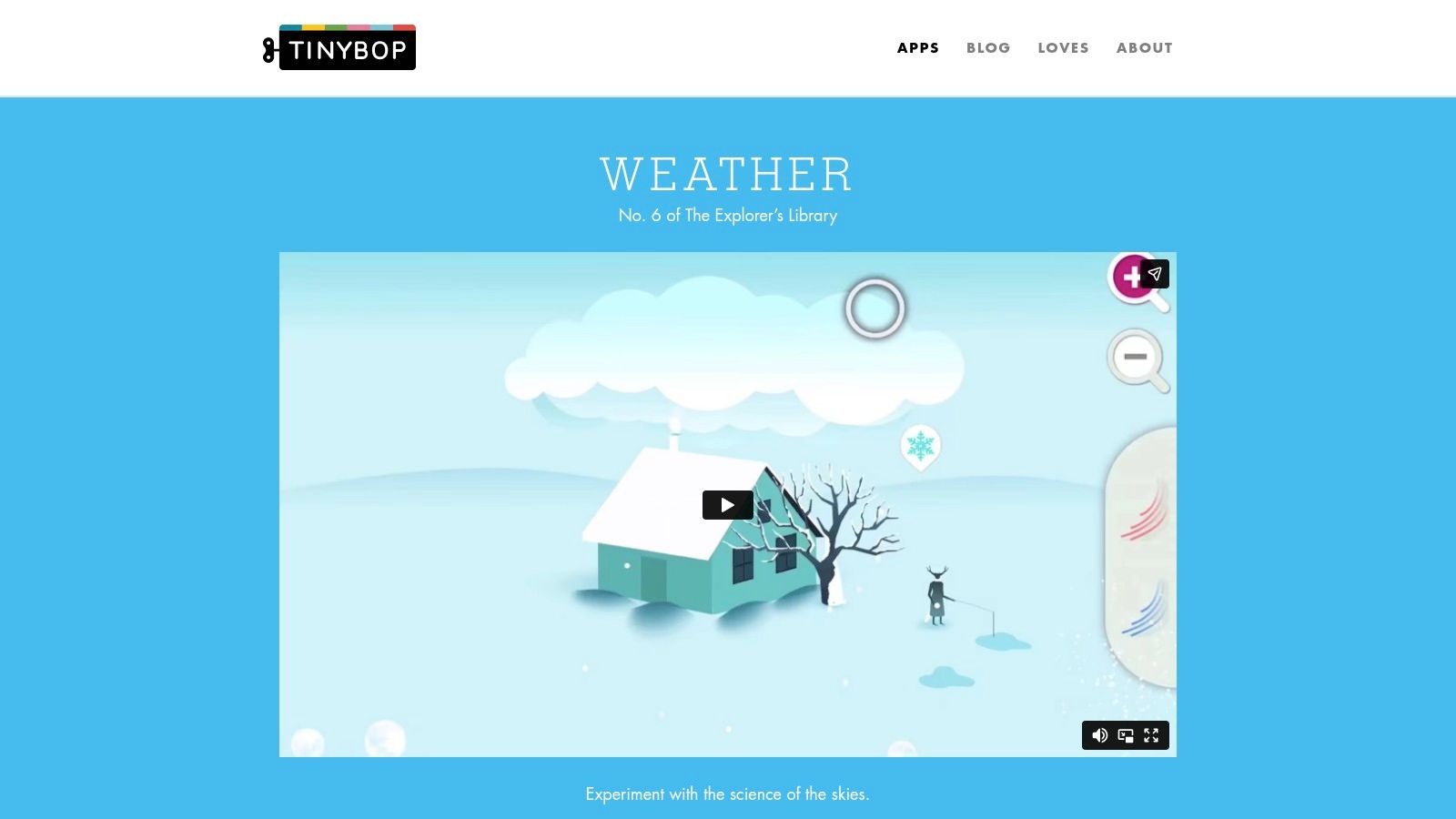
The app encourages experimentation. What happens if you make the air very cold over water? What ingredients do you need to whip up a hurricane? Children can explore different cloud types, create tornadoes, or simply make it rain or snow. This unstructured play empowers them to ask their own questions and discover the answers through doing, perfectly aligning with a curiosity-led approach to learning.
Why It’s a Great Choice
A standout feature is its focus on pure, uninterrupted exploration. The app is completely ad-free and designed with child privacy at its core. It also works offline once installed, making it perfect for car journeys. The inclusion of a printable ‘Weather Handbook’ gives great ideas for parents and teachers to guide discussions and deepen the learning away from the screen.
- Learning Focus: Cause and effect in weather systems, cloud formation, precipitation, and extreme weather.
- Best For: Younger primary learners (Ages 6–10) who benefit from tactile, sandbox-style play.
- Accessibility: Paid one-time purchase from the App Store or Google Play. Works offline after download.
- User Experience: Visually stunning and highly intuitive with no text, making it accessible to children everywhere.
Try This Mission Idea!
Space Ranger Fred is planning a mission to a newly discovered planet known for its wild weather. Before he goes, he needs to understand how different atmospheric conditions work. Challenge your child to use the Tinybop Weather app to create the wildest storm they can imagine. Can they make a hurricane? A blizzard? This helps them think about the powerful forces Fred might encounter on his adventures.
Top Tip: Use the app as a "weather diary." After observing the real weather outside, encourage your child to try and recreate it in the app. This is a fantastic way to connect digital play with real-world scientific observation.
| Feature | Details |
|---|---|
| Price | Varies (One-time purchase) |
| Access Requirements | Requires download from an app store on a compatible device. |
| Primary Age Group | 6–10 years old |
| Unique Offering | A beautiful, open-ended "weather sandbox" for hands-on experimentation. |
| Link | Visit Tinybop Weather |
7. Twinkl – Weather Games and Resources
For educators and parents in the UK seeking a vast library of curriculum-aligned games about weather, Twinkl is an indispensable resource. This platform is a treasure trove of downloadable and interactive materials designed to support learning from Early Years (EYFS) through to Key Stage 2. It offers a huge variety of activities, from printable board games to detailed role-play packs.
Twinkl’s strength lies in its sheer volume and focus on the UK curriculum. You can quickly find resources like a "Weather Forecasting Role-Play Pack," bingo cards with weather symbols, or interactive matching games. The materials are designed for easy use, making them perfect for low-prep lesson plans, wet-play activities, or home learning.
Why It’s a Great Choice
The platform excels at providing ready-made, structured learning tools that save significant preparation time. A teacher can download a weather board game five minutes before a lesson, or a parent can print a weather diary template for a weekend activity. The inclusion of UK-specific terminology and meteorological symbols makes the content highly relevant for children learning within the British education system.
- Learning Focus: UK weather symbols, forecasting, seasons, weather vocabulary, and data recording.
- Best For: EYFS–KS2 learners (Ages 4-11), teachers, and parents looking for curriculum-linked resources.
- Accessibility: Some resources are free, but full access requires a paid subscription.
- User Experience: Well-organised and searchable, though the sheer volume can sometimes be overwhelming.
Try This Mission Idea!
After playing with the Weather Forecasting Role-Play Pack, imagine Space Ranger Fred needs to file a report for Earth Command. His mission is to observe a thunderstorm from his spaceship. Challenge your child to use the role-play props to create and present Fred’s official weather forecast, explaining the conditions he sees below. This encourages confident communication and presentation skills.
Top Tip: Use the filter functions to narrow down your search by age group (e.g., KS1) and resource type (e.g., "game"). This helps you quickly pinpoint the most suitable activities for your child's learning needs.
| Feature | Details |
|---|---|
| Price | Freemium (some free resources, full access via monthly/annual subscription) |
| Access Requirements | Internet connection for download; printer often required for activities. |
| Primary Age Group | 4–11 years old (EYFS, KS1, KS2) |
| Unique Offering | Massive library of UK curriculum-tagged, downloadable, and editable resources. |
| Link | Visit Twinkl |
Weather Games: 7-Item Comparison
| Resource / Tool | Implementation complexity 🔄 | Resources & cost ⚡ | Expected learning outcomes ⭐ | Ideal use cases 💡 | Key advantages / Impact 📊 |
|---|---|---|---|---|---|
| NASA Climate Kids | Low — web-ready activities, minimal setup | Free, no login; browser/tablet required | Introductory climate & weather concepts; high engagement | Short stations, individual exploration, homework | Trusted NASA content; kid-friendly interactives and teacher tips |
| NOAA SciJinks (weather games) | Low — short interactives; link maintenance occasionally needed | Free; browser required (some pages migrated) | Quick demos of meteorological phenomena and satellite visuals | Classroom demos, station rotation, homework extensions | Large variety of bite-size simulations with satellite focus |
| Met Office WOW – Education | Medium — teacher setup to collect/gamify live data | Free; internet + basic instruments (rain gauge, thermometer) | Data literacy, observational skills, citizen-science practice | Long-term projects, inter-class challenges, UK schools | Real-time UK data; fosters inquiry and class competition |
| RMS MetLink “Weather Journey” | Low–Medium — printable, needs adult facilitation and space | Free download; printing/materials required | Foundational weather knowledge for KS1; active learning | Early primary station-based lessons, PE/hall activities | Curriculum-aligned, differentiated, classroom-tested resource |
| Legends of Learning (Weather collections) | Medium — teacher dashboard and playlist setup; account needed | Freemium; browser/Chromebook; full features may need license | Standards-aligned mastery, formative assessment data | Structured lessons, assigned practice, remote learning with tracking | Large game library + analytics and auto-graded quizzes for teachers |
| Tinybop – Weather (app) | Low — install and run; intuitive for children | Paid one-time purchase; works offline after install | Deep exploratory understanding via sandbox simulations | Independent tablet use, small-group exploration, home learning | High-quality design, privacy-first, open-ended cause-effect play |
| Twinkl (UK) – Weather resources | Low — download and print or use interactive quizzes | Subscription for full access; many free items | Curriculum-aligned activities; ready-to-use lesson materials | Quick-prep lessons, wet play, clubs, take-home packs | Massive vetted catalogue, editable resources, UK curriculum tagging |
Your Next Adventure is Just Around the Corner
From launching a digital weather balloon with NASA to crafting your own rain gauge in the garden, we've explored a whirlwind of brilliant games about weather. Each activity, whether it's an interactive app like Tinybop's Weather or a classroom challenge from the Met Office, offers a unique way to turn curiosity into genuine understanding. You've seen how tracking storm patterns and predicting the forecast can be as exciting as any adventure.
The common thread is the power of play. When learning feels like a game, children are more likely to ask questions, experiment with ideas, and connect science to the world they see outside. Understanding weather isn't just about memorising facts; it's about observing, predicting, and appreciating the incredible forces that shape our planet. These games empower children to become budding meteorologists.
Choosing Your First Weather Mission
So, where do you begin? Selecting the right activity depends on your goals, time, and resources. To make the choice easier, consider these points:
- For quick, digital fun: If you have a tablet and a curious child, NASA Climate Kids or NOAA SciJinks offer engaging games that can be played in short bursts.
- For structured classroom learning: The Royal Meteorological Society and Twinkl provide teachers with lesson plans and group activities that align with the UK curriculum.
- For a blend of story and science: To connect these ideas to a bigger adventure, remember to bring in stories. Ask, "How would Space Ranger Fred navigate this storm on an alien planet?" This simple question links a fun game to bigger ideas about problem-solving and exploration.
For parents and educators seeking a broader array of engaging content for slightly younger children, numerous platforms offer diverse educational games for preschoolers that build foundational STEM skills.
Ultimately, the best games about weather are those that spark conversation and encourage hands-on discovery. Whether you’re creating a digital tornado or simply making a story about the clouds, you are building the skills of a future scientist, engineer, or explorer.
Ready for your next STEM mission? The Space Ranger Fred universe is packed with stories and activities designed to make science an unforgettable adventure. Explore our books to see how storytelling brings complex topics to life, or download our free activities for your next rainy day.