
Matching games are so much more than a fun way to keep children occupied. They're a powerhouse for building essential STEM skills like memory, pattern recognition, and focus. When children aged 6-12 match up pairs of planets or quirky aliens, they're actually sharpening the same cognitive muscles they'll need later for complex maths problems or even coding. Think of it as a brilliant training mission for their brain.
Why Matching Games Build Powerful Brains
Ever stopped to think about what’s actually firing away inside your child’s brain during a simple game of memory? It’s far more than just a way to pass the time; it’s a full-on workout for their developing mind. Every single time they flip a card, they’re strengthening the neural pathways that are absolutely vital for learning.
This kind of focused play is fantastic practice for holding information in their minds (what card was where?) and then using that info to make a decision. This is what's known as working memory, and it's a key skill for everything from following multi-step instructions in a science experiment to figuring out a tricky maths equation. It’s a core part of building what we call the Menturity™ approach—developing real confidence and curiosity through hands-on experience.
This diagram gives a great visual of how these simple games build such essential skills.
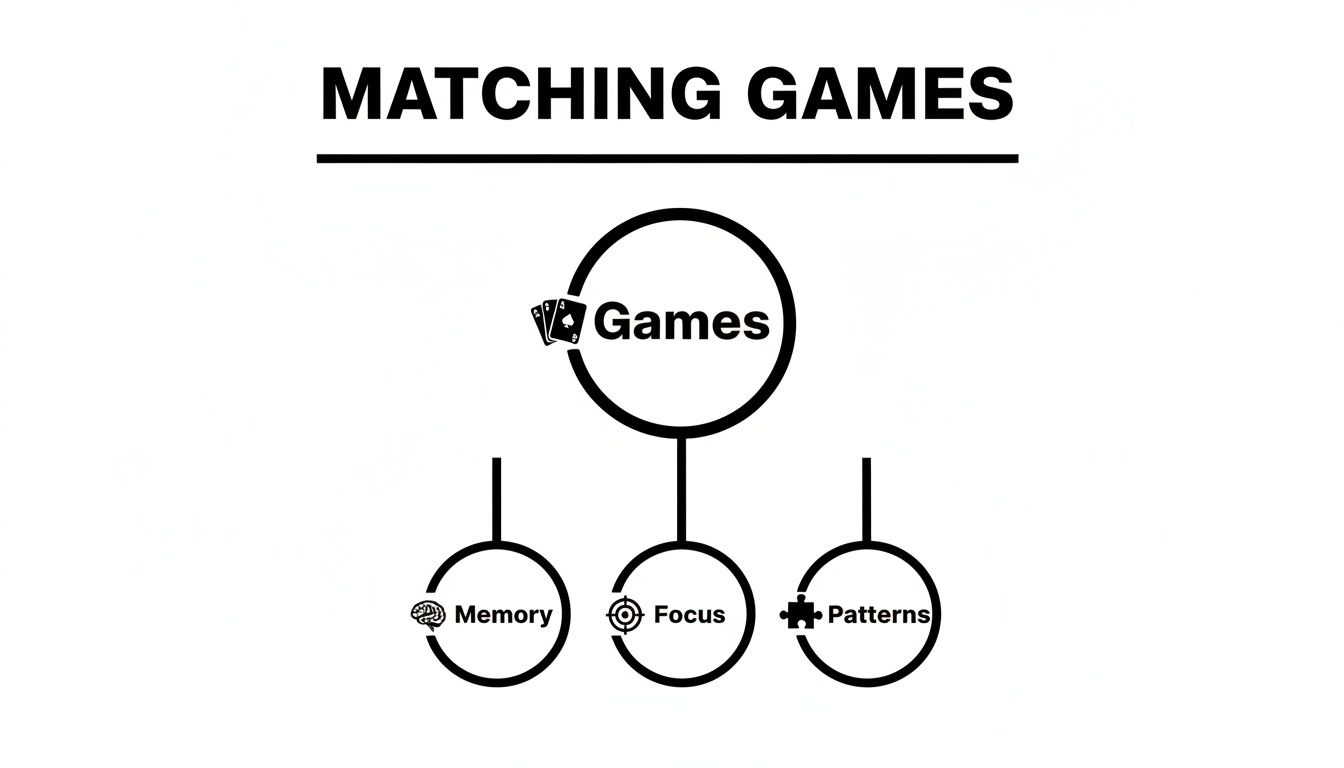
As you can see, matching games are a brilliant way to nurture memory, focus, and pattern-spotting abilities, all at once.
The Science of Playful Learning
The simple act of searching for a matching pair is a masterclass in pattern recognition. Children quickly learn to spot similarities and differences, categorise what they see, and make logical connections. This ability is the absolute bedrock of scientific thinking and problem-solving. A child who can spot the matching astronaut helmets today is practising the exact same skill they’ll use to identify patterns in data or lines of code tomorrow.
It’s no surprise that the children's educational games market in the UK is valued at approximately £10 billion. Matching games are a core part of this expanding market, especially for the 6-12 age group, because they are so effective at strengthening pattern recognition, memory, and concentration.
Take a look at how these skills evolve.
Cognitive Skills Boosted by Matching Games
Here's a quick look at the learning superpowers children gain from matching games at different stages.
| Age Group | Key Skills Developed | Space Ranger Fred Mission Idea |
|---|---|---|
| 3-5 Years | Visual Discrimination: Telling the difference between similar images. Short-Term Memory: Remembering the location of 1-2 pairs. | Match colourful planets or friendly alien faces. Keep the number of pairs small (4-6 pairs) to build confidence. |
| 6-8 Years | Working Memory: Holding multiple card locations in mind at once. Strategic Thinking: Deciding which card to flip next based on previous turns. | Match different spaceship parts or tools from Fred's toolkit. Increase the number of pairs to 10-12. |
| 9-12 Years | Advanced Pattern Recognition: Identifying complex patterns or relationships. Sustained Attention: Maintaining focus through a longer, more challenging game. | Match constellations, scientific symbols, or pairs of rhyming space-themed words to add a literacy challenge. |
These games scale perfectly with a child's development, offering just the right amount of challenge to keep them engaged without causing frustration.
From Fun to Focus
What’s more, these games are fantastic for improving concentration. To win, a child has to pay close attention, filter out all the other distractions in the room, and stay locked in on the task. This ability to concentrate is a true superpower in any learning environment, whether it's the classroom or a mission control centre.
By turning learning into a game, we give children a reason to engage deeply. It’s not about memorising facts; it’s about the thrill of the hunt and the joy of finding a successful match. This playful approach builds resilience and a positive attitude towards challenges.
You can dive deeper into the powerful principles behind this with Gamification in Education. It’s all about making learning feel like an exciting adventure rather than a chore.
Create Your Own Space-Themed Matching Game at Home
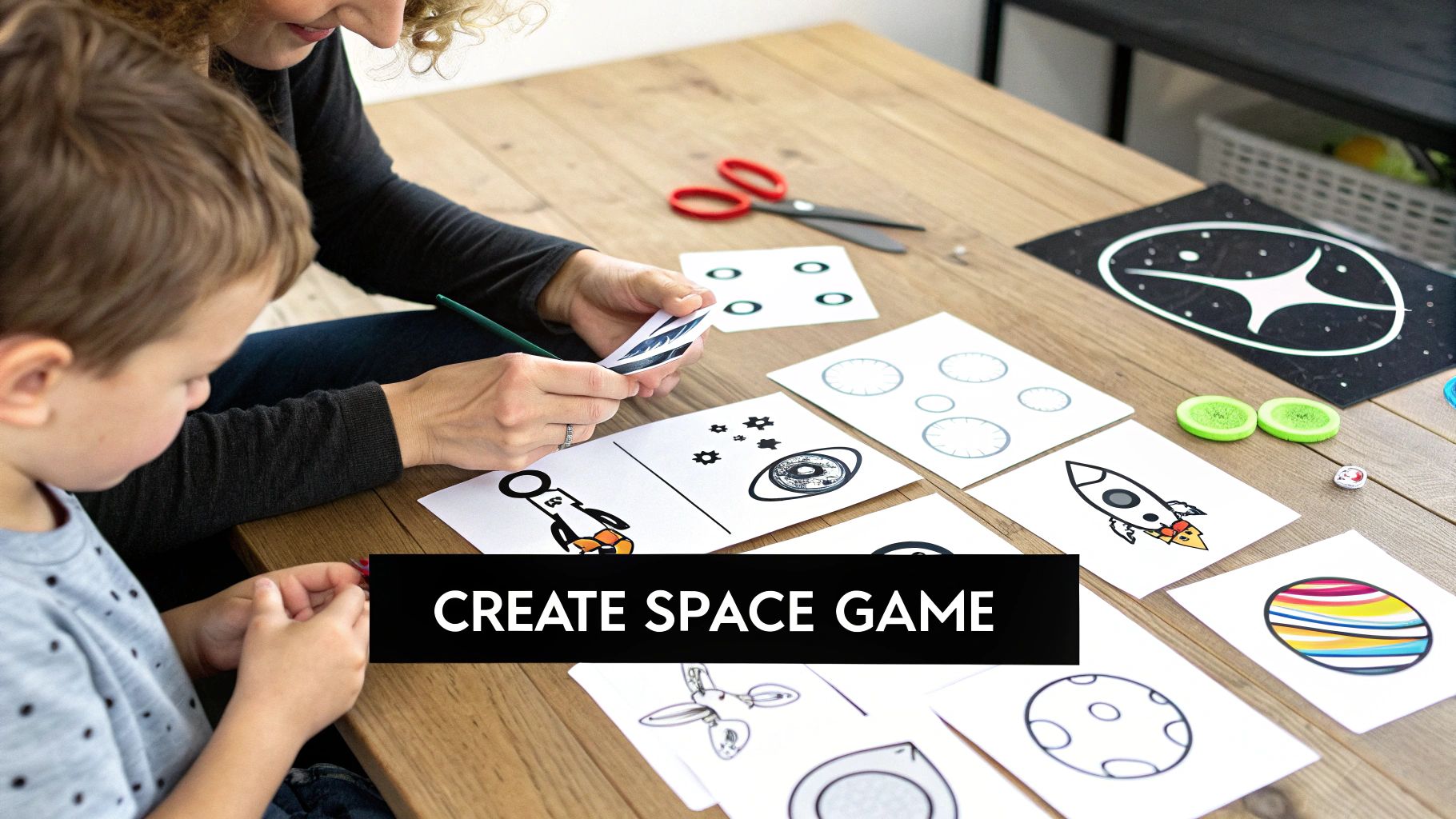
Ready for a hands-on mission? Let’s build a fantastic matching game with a Space Ranger Fred twist, using simple bits and bobs you probably already have at home. This is all about getting creative, making learning a tangible experience, and sparking that all-important curiosity in your young explorer.
This is much more than just a craft project. It’s a brilliant way to empower your child to invent their own rules and game variations, which is a huge confidence booster. When children get hands-on with learning materials, you can almost see the concepts clicking into place on a much deeper level.
Gathering Your Mission Supplies
First up, you’ll need to assemble a few basic items. You can keep things super simple or go all out!
- Card or stiff paper: This will be the base for your cards. An old cereal box is perfect for this—it’s sturdy and a great way to recycle.
- Plain paper or sticky labels: This is where you'll draw or print your images.
- Something to draw with: Get the pencils, crayons, felt-tip pens, or even paints out.
- Scissors: For cutting out the cards (best to have an adult supervising the younger space cadets).
- Optional extras: A ruler is handy for straight lines, and you'll probably need some glue. Why not add some glitter for that extra cosmic flair?
To make things even easier, you can always grab our free downloadable templates from the Space Ranger Fred 'freebies' page. We've got loads of great, printable crafts that are perfect for this mission.
Designing Your Cosmic Cards
Now for the really fun bit—deciding what your matching pairs will be! The possibilities are as vast as the universe itself. This is a brilliant chance to chat with your child about their favourite bits of space and science.
Here are a few mission ideas to get your creative engines firing:
- Planets and Names: Draw a picture of Mars on one card and simply write the word "Mars" on another. This is a fantastic way to link images with words.
- Constellations and Shapes: Sketch a constellation like Orion on one card, and then draw its simple star pattern on the matching card.
- Astronauts and Spaceships: Let your child design a unique alien or astronaut character and then create a matching spaceship just for them. This really encourages storytelling and imagination!
The most important part of this whole process is the fun you have creating it together. Let your child lead the way with their ideas. When they feel a sense of ownership over the game, their engagement and learning will soar to new heights.
Building Your Game
Once you’ve settled on a theme, it’s time to bring your game to life. Cut your card or paper into identical squares or rectangles—consistency is key here so you can't tell the cards apart from the back. Aim for at least eight pairs (16 cards) to start with; you can always add more later on.
Draw, colour, or stick your chosen images onto the cards, making sure each one has an identical partner. If you're matching pictures to words, write the words as clearly as you can.
Once everything is dry and ready, give them a good shuffle, lay them face down, and you’re ready to launch your first game! Your very own, homemade children's matching games are ready for action.
Adapt Your Matching Game for Different Learning Goals
One of the best things about a simple game is its power to evolve. A basic set of matching cards isn't just a single activity; it's a launchpad for countless learning adventures. By tweaking the rules or changing the content, you can transform your homemade game to target specific skills, making it a brilliant tool that grows right alongside your child.
This flexibility is why traditional toys and games are making such a comeback. In the UK, where consumer spending on toys and games has reached nearly £12.5 billion, parents are increasingly looking for activities with real educational value. It's a key reason why board game sales alone have seen a 48% increase. You can explore more about the UK toy industry and its growth on Statista.
So, how can you adapt your own children's matching games to keep them fresh, challenging, and perfectly tuned to your child's learning journey? Let's explore a few missions.
Mission Maths Blast-Off
Why not turn your matching game into a fun maths challenge? It's a fantastic, low-pressure way to practise sums and build number confidence. Instead of just matching identical pictures, you can create pairs that represent the same value.
Here are a few ideas that work brilliantly:
- Equations and Answers: One card has a simple equation like “3 x 4” and its partner has the answer, “12”.
- Fractions and Pictures: Match a card showing a picture of a half-eaten pizza with a card that has the fraction “1/2” written on it.
- Numbers and Dots: For younger children, match the numeral “5” with a card showing five dots or five tiny stars.
This approach turns what could be repetitive maths practice into an exciting game of discovery, helping to really solidify concepts in a playful way.
Sparking Storytelling and Vocabulary
You can also use your game to boost literacy and communication skills. This is where you can really lean into the world of Space Ranger Fred and his cosmic adventures.
Create pairs that encourage your child to talk, imagine, and connect ideas. For example, you could match a character from the books with their favourite gadget, or an alien with its home planet. Each time a match is found, it becomes a storytelling prompt.
Ask open-ended questions like, "What adventure do you think these two will have together?" or "Can you tell me a story about how this astronaut found their spaceship?" This simple step shifts the focus from just finding a pair to building a narrative, which is a powerful way to encourage creative thinking.
Upgrading the Challenge Level
As your child's skills grow, so can the game. Keeping things challenging is key to maintaining their engagement and supporting their development. The goal is to make them think, not frustrate them.
Consider these simple adjustments:
- Increase the numbers: Add more pairs to the game to make it a tougher memory test. Start with 8 pairs and work your way up to 15 or even 20.
- Introduce a timer: For children who love a bit of friendly competition, timing the game can add a thrilling new dimension.
- Create 'near matches': Make some cards very similar but not identical. This forces players to pay much closer attention to detail.
Adapting a game in this way is a wonderful exercise in itself, helping children to develop problem-solving skills and think strategically about rules and challenges.
Venturing into Digital Matching Games
Let's venture into the digital frontier of learning. In a world where screens are part of our children’s everyday lives, digital matching games have become another brilliant tool in our toolkit. They certainly don't replace hands-on, physical play, but they offer some fantastic benefits that can support your young explorer’s development in new and exciting ways.
One of the biggest wins with digital children's matching games is the immediate feedback they provide. A correct match might trigger a fun sound or a celebratory animation, giving your child that instant and rewarding sense of achievement. This buzz keeps them engaged and motivated, encouraging them to try again if they don't get it right the first time.
Many apps and websites also have clever ways of tracking progress, so you and your child can actually see how far they’ve come. This can be a wonderful confidence-booster, showing them tangible proof of their growing skills.
How to Spot a Quality Digital Game
With so many options popping up on app stores, choosing the right digital game can feel a bit overwhelming. From my experience, the key is to look for apps that genuinely prioritise learning and creativity over flashy, hollow distractions.
Here’s what I look for in a great educational app:
- Clear Learning Goals: The game should have an obvious educational point, whether that’s learning planet names or recognising shapes.
- Child-Led Pacing: Your child should feel in control, able to move at their own speed without being rushed by timers or penalised for taking their time.
- Minimal Distractions: Steer clear of games filled with pop-up ads or in-app purchases that constantly interrupt the learning flow.
- Creative Elements: The best games often encourage children to create something themselves, not just mindlessly consume content.
Bridging the Gap Between Screen Time and Real-World Play
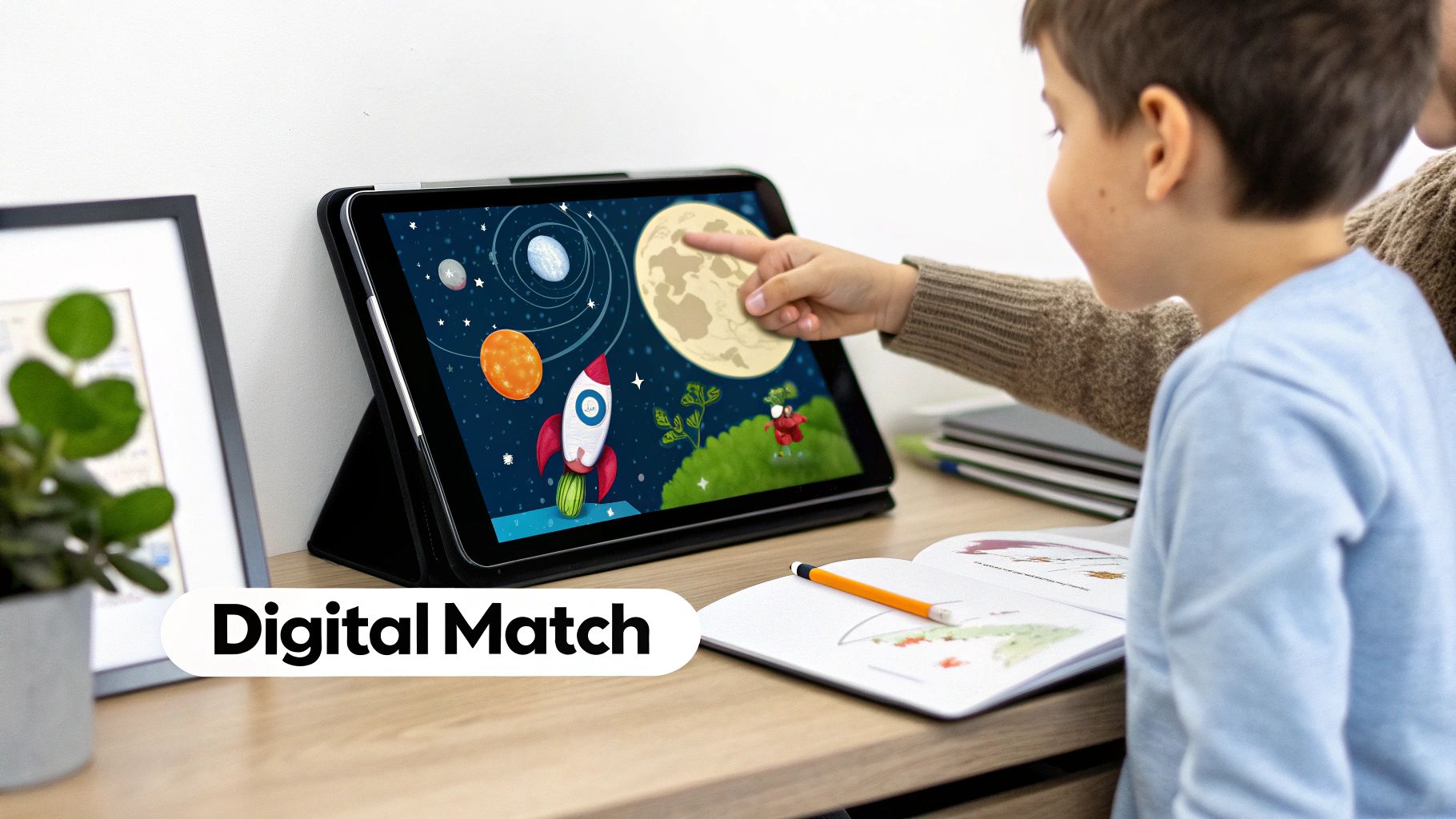
Digital games are most powerful when they spark curiosity that spills over into real-world activities. If your child has been hooked on a planet-matching game on a tablet, use that as a launchpad for a bigger conversation. You could borrow a book about space from the library together or try to spot constellations in the night sky.
Digital learning has definitely reshaped how our children play. In the UK, 56% of children aged 3-15 play online games, and parents noted that a staggering 85% of 8 to 17-year-olds spent more time gaming online after the pandemic hit. This shift really highlights how important it is to guide children towards quality digital experiences. You can find more insights about the UK gaming market here.
The Space Ranger Fred website is a great example of blending digital engagement with real-world learning.
It shows how an online home base can act as a hub for stories, activities, and information that inspires brilliant offline adventures. For more tips on finding that perfect balance, check out our guide on choosing children's educational video games.
How to Spot and Celebrate Your Child's Progress
So, how do you know the learning mission is a success? It's a great question. Spotting your child’s progress during playtime isn’t about turning a fun game into a test. Far from it. Instead, it’s about gently observing those small wins that show their confidence, curiosity, and communication skills are really taking off.
Celebrating their effort is so much more important than just getting the right answer. When you notice them trying a new strategy or remembering where a tricky card was hidden, a simple, "Wow, that was a brilliant move!" can make a world of difference. These are the moments that reinforce learning as a joyful journey of discovery, not a chore.
Tuning into Their Thinking
One of the best ways to see learning in action is simply to listen. You'd be amazed what you can learn. Simple, open-ended questions during gameplay can reveal so much about their thought process and turn a quiet game into a fantastic conversation.
You could try asking things like:
- "How did you know those two were a match?"
- "What's your plan for your next turn?"
- "Which pair do you think will be the hardest to find?"
These little chats encourage children to put their strategies into words and think critically—key skills for any young explorer. You’re not quizzing them; you’re inviting them to share their clever thinking. If you're using these games in a more formal educational setting, you might also want to track learner progress with more structured approaches.
Noticing the 'Aha!' Moments
Progress isn't always about speed or winning. Keep an eye out for the quieter signs of growth. Has their focus improved? Are they remembering where more cards are located than they did last week? These are the real mission successes.
An 'aha!' moment—that little spark in their eyes when they solve a puzzle or make a connection—is pure learning magic. Celebrating these moments shows them that the process of figuring things out is just as exciting as finding the final match.
Focus on these key indicators of progress:
- Growing Confidence: Are they more willing to take a chance and flip a card they aren't sure about?
- Improved Memory: Are they finding pairs more quickly or remembering card locations from previous turns?
- Strategic Thinking: Do they start to form a plan, perhaps by clearing one section of the game board at a time?
Each of these is a sign that their brilliant brain is building new pathways, all powered by the simple fun of children's matching games.
Ready for Your Next Mission?
So, where does the adventure go from here? We’ve covered a lot of ground, showing how a simple children's matching game can be a powerhouse for building core skills like memory, focus, and creativity. But the real fun starts when you take these ideas and try them out for yourself. I really hope you give some of these activities a go and see what amazing things your family’s imagination can create.
For more STEM-fuelled fun, why not blast off into the universe of the Space Ranger Fred books? Each story is jam-packed with science, silliness, and adventure.
You can also refuel your creative engines over on our activities page where you’ll find even more brilliant freebies and printable missions. They’re perfect for keeping the hands-on learning going long after the game has been tidied away.
The best kind of learning always feels like play. Every game you share, every story you read together, is another step on an incredible journey of discovery.
To keep the momentum going, have a look at other posts on our blog, like our guide to choosing educational video games. Join our growing community of explorers and continue the adventure with Fred and his friends.
Still Got Questions About Matching Games?
Before you blast off on your next play mission, you might have a few lingering questions. Let's tackle some of the most common ones I hear from parents and teachers about using matching games to support learning.
At What Age Do Matching Games Really Shine?
While toddlers get a real kick out of simple picture matching, the sweet spot for using these games to seriously boost learning is between ages 6 and 12.
This is when you can move beyond basic shapes and colours. Think about introducing games that match scientific concepts, maths problems, or more advanced vocabulary. They become a brilliant, low-pressure way to reinforce what's being taught in school and build up a child's confidence.
How Can I Make Matching Games More of a Challenge?
It’s easy to level up the fun for an older child. The quickest way is to simply increase the number of pairs or use images with more subtle, tricky differences between them. You could even add a timer for a bit of friendly, fast-paced competition.
For a real brain-teaser, try this: create a rule where they have to explain the connection between the pairs they've matched. This simple tweak adds a fantastic layer of critical thinking and communication to the game.
Are Physical or Digital Matching Games Better?
Honestly, both have their own unique strengths, and a healthy mix is usually the best approach for our young explorers.
- Physical Games: These are just brilliant for developing fine motor skills. Plus, they offer a wonderful, screen-free experience that really encourages focus and proper face-to-face interaction.
- Digital Games: The big win here is instant feedback. Digital games can track progress and keep children engaged with exciting sounds and interactive elements that are hard to replicate on a tabletop.
By offering both, you can cater to different learning styles and keep the adventure feeling fresh every time. The most important thing is that learning always feels like a joyful discovery, not a chore.
Ready to explore more? The Space Ranger Fred universe is packed with stories, activities, and adventures that make learning an exciting mission. Blast off into our world and discover your next favourite book or activity at https://spacerangerfred.com.