
Ready for an adventure? From rocket ships exploring distant galaxies to friendly robots discovering what it means to be human, the best children's science fiction books do more than just entertain. They are a brilliant launchpad for curiosity, encouraging young readers to ask big questions about technology, the universe, and their place in it all.
These stories are powerful tools for sparking an early interest in science, technology, engineering, and maths (STEM). By exploring futuristic worlds and amazing possibilities, children develop their problem-solving skills and a sense of wonder that can last a lifetime. This list is here to help parents, teachers, and young explorers find their next great read. Let's blast off!
Why We Love Children’s Science Fiction Books
Sci-fi stories aren't just about aliens and spaceships (though they are brilliant fun!). They help children:
- Think Big: They tackle huge ideas like space travel, artificial intelligence, and what the future might look like.
- Build Empathy: By stepping into the shoes of characters in different worlds, kids learn to understand different points of view.
- Boost Confidence: Seeing characters solve tricky problems with science and creativity shows children they can do it too!
Let's dive into some of our favourite children's science fiction books that will get your little explorer's imagination soaring.
1. Space Ranger Fred Series
Best For: Integrated STEM Learning Through Storytelling and Play
Website: spacerangerfred.com
Kicking off our list is the Space Ranger Fred universe! This isn't just a series of fantastic children's science fiction books; it's a whole world of learning and fun. It cleverly combines storytelling, education, and hands-on play, making it a top choice for families and teachers looking to spark a love for STEM in children aged 6–12.
The adventures follow Fred, a charming young hero whose missions are packed with real science and tricky problems to solve, all wrapped up in funny, engaging stories. In our latest Space Ranger Fred book, for example, a simple mix-up in the kitchen becomes a hilarious lesson in chemistry and teamwork!
This approach makes tricky ideas feel simple and exciting. Whether your child loves reading, watching cartoons, or getting stuck into activities, there’s something here for them.
Try This at Home!
Inspired by Fred’s problem-solving skills? Have a go at a fun STEM challenge!
The Egg Drop Challenge: Can you design a protective casing for a raw egg so it doesn't break when dropped from a height? You can only use simple household items like paper, straws, tape, and cotton wool. It’s a brilliant way to think like an engineer!
The Space Ranger Fred website is a treasure trove of resources. You’ll find animated videos, games, and a brilliant Freebies page packed with printable activities like colouring sheets and science experiments to try at home or in the classroom. The site also has a blog with kid-friendly posts that break down scientific topics, like these real-world Mars rover facts. It’s a fantastic hub for curious minds.
2. The Wild Robot Series by Peter Brown
Peter Brown's The Wild Robot series is a modern classic. The story follows Roz, a robot who finds herself stranded on a remote island. What follows is a powerful tale of survival, friendship, and family as Roz learns to communicate with the island's animals and becomes a mum to a little gosling.
This series brilliantly blends technology with nature. It gently introduces ideas like artificial intelligence and ecology in a way that’s easy for kids to understand and connect with. The short chapters and beautiful illustrations make it a perfect read for children aged 7-11, and it's a wonderful story to read aloud as a family.
- STEM Themes: Artificial Intelligence (AI), robotics, ecology, animal behaviour.
- Why we love it: It’s a heartwarming story that opens up conversations about empathy, belonging, and looking after our planet.
Find the series here: https://www.bonnierbooks.co.uk/books/piccadilly-press/the-wild-robot-protects/
3. The Jamie Drake Equation by Christopher Edge
Christopher Edge is a master at weaving real, mind-bending science into thrilling adventures. The Jamie Drake Equation follows a young boy named Jamie, whose astronaut dad is orbiting Earth on the International Space Station (ISS). Jamie's world is turned upside down when he picks up a mysterious signal on his phone that seems to come from an alien…
The story brilliantly balances the excitement of potential first contact with the real-life feeling of missing a parent. It makes big ideas like light years and the search for alien life feel personal and exciting. It’s one of those children's science fiction books that feels like it could really happen!
- STEM Themes: Astronomy, space exploration (ISS), radio waves, SETI (Search for Extra-Terrestrial Intelligence).
- Why we love it: It makes the science of space feel real and connects it to a powerful family story. Nosy Crow also offers free classroom resources, making it great for school projects.
Find the book here: https://nosycrow.com/product/the-jamie-drake-equation/
4. George’s Secret Key to the Universe by Lucy & Stephen Hawking
Want to introduce your child to the biggest ideas in the universe? This book, co-written by the world-famous physicist Stephen Hawking and his daughter Lucy, is the perfect way to do it. It follows a boy named George who discovers his new neighbours have a super-computer called Cosmos that can open a doorway to any point in space.
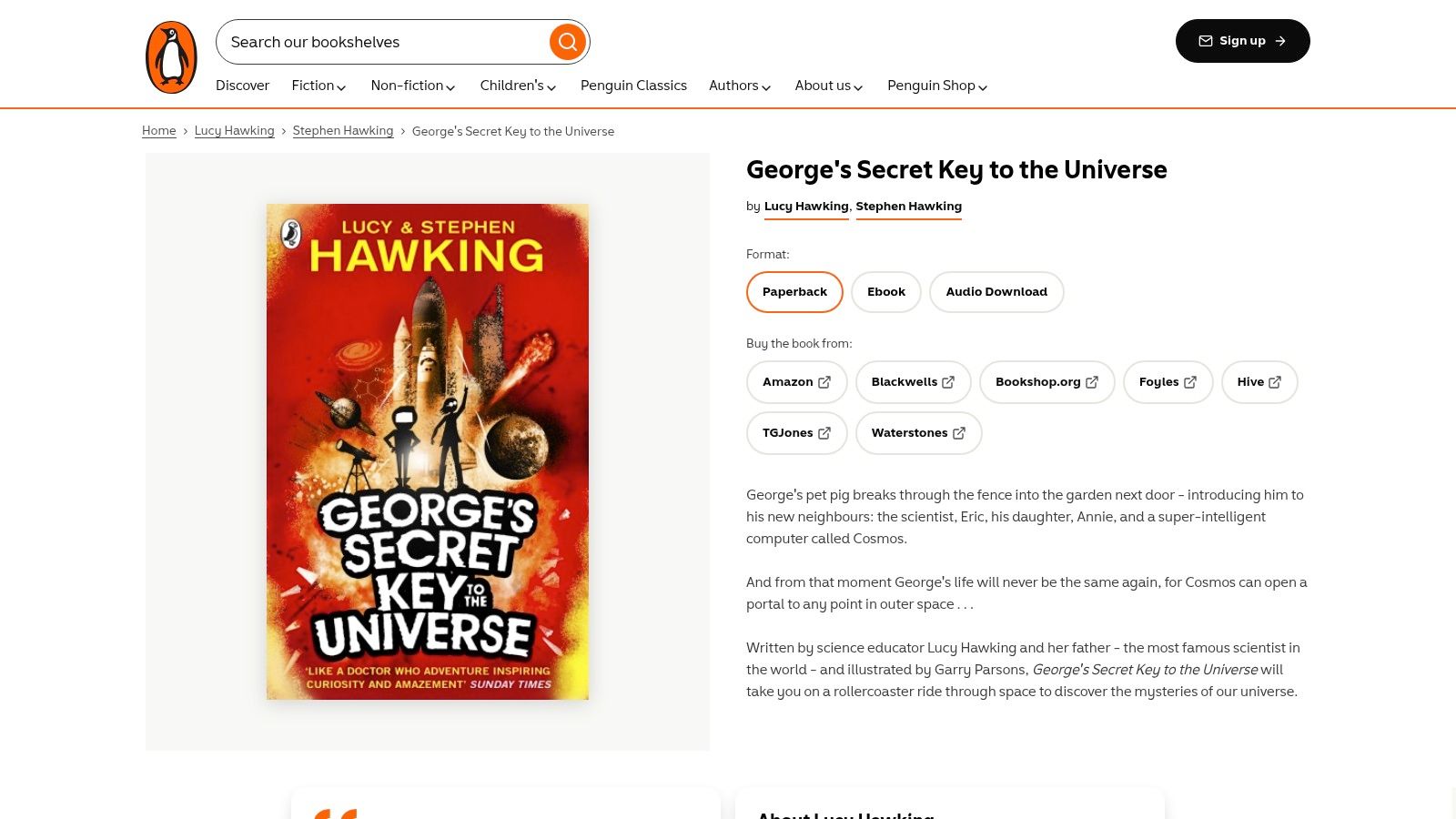
What makes this book special is that it mixes a thrilling adventure with real science. Throughout the story, there are colourful, easy-to-read pages explaining the facts behind George’s journey to black holes and distant planets. It’s a fantastic blend of fiction and non-fiction, making it a powerful educational tool. It's a great companion for learning about mind-boggling concepts like what the Big Bang theory is.
- STEM Themes: Astrophysics, black holes, the solar system, general relativity.
- Why we love it: It makes complex astrophysics exciting and understandable for children, backed by the credibility of a world-class scientist.
Find the series here: https://www.penguin.co.uk/books/393354/georges-secret-key-to-the-universe-by-lucy-and-stephen-hawking/9780552559584
5. Tin by Pádraig Kenny
For older readers ready for a story with a bit more depth, Tin is a beautiful and thought-provoking adventure. Set in a world with child-like robots, the story follows a group of mechanical friends who must go on a quest to save a "real" boy. Along the way, they begin to question what it means to be alive and whether they have souls of their own.
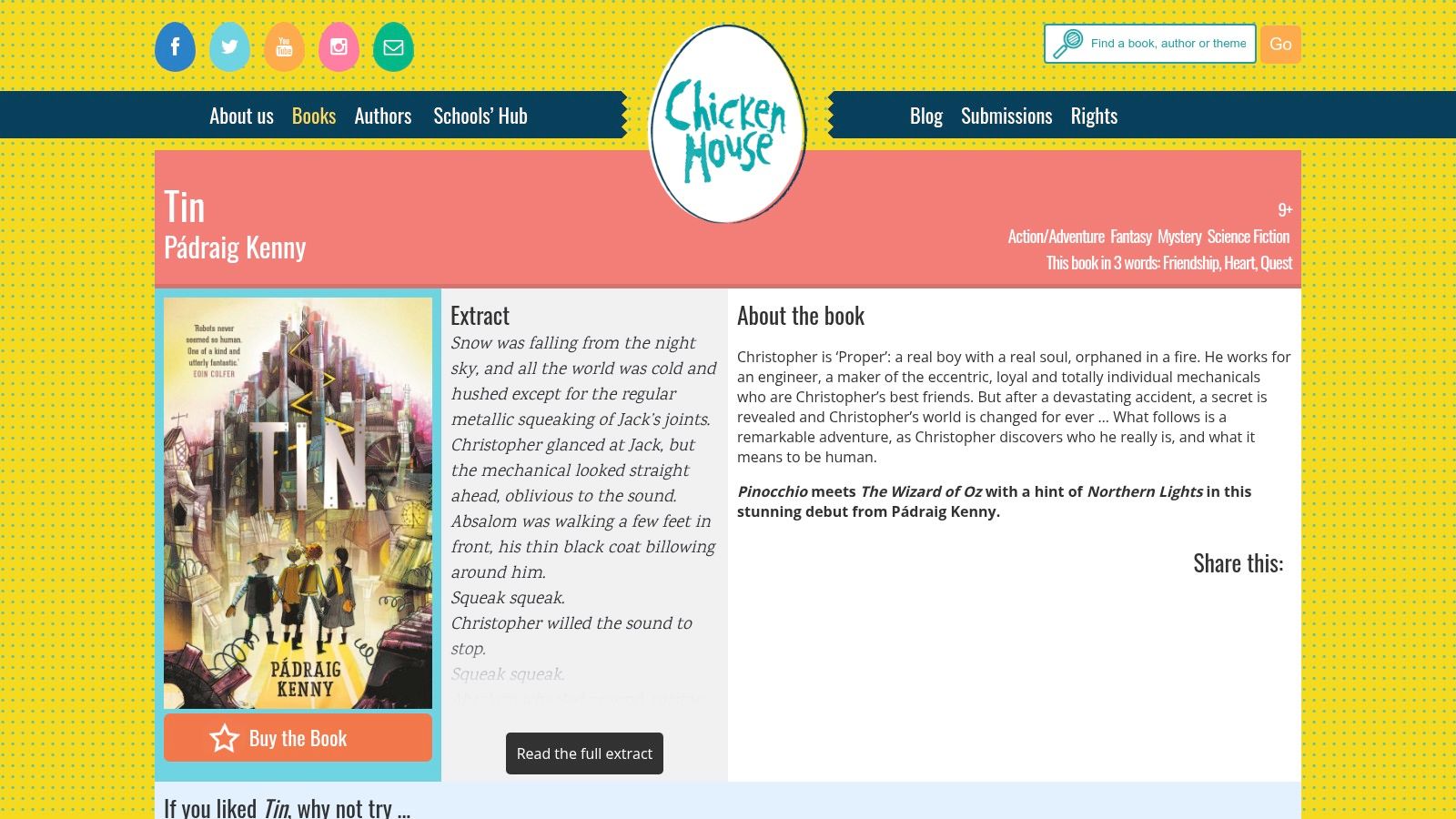
This book blends historical fiction with sci-fi and asks some big, philosophical questions. It’s perfect for confident readers aged 10 and up who are ready to think about ideas like identity, prejudice, and consciousness. It's a brilliant story for sparking deep conversations in a classroom or book club.
- STEM Themes: Robotics, artificial intelligence (AI), ethics in technology.
- Why we love it: It’s a beautifully written story that encourages older children to think critically about technology and what it means to be human.
Find the book here: https://www.chickenhousebooks.com/books/tin-book/
6. See You in the Cosmos by Jack Cheng
This unique and heartwarming book is told through the audio recordings of 11-year-old Alex Petroski. Alex is on a mission: to launch his iPod, full of sounds from Earth, into space for aliens to find. He's inspired by his hero, Carl Sagan, and his famous Golden Record. His journey takes him on an unexpected road trip where he uncovers family secrets and learns about human connection.
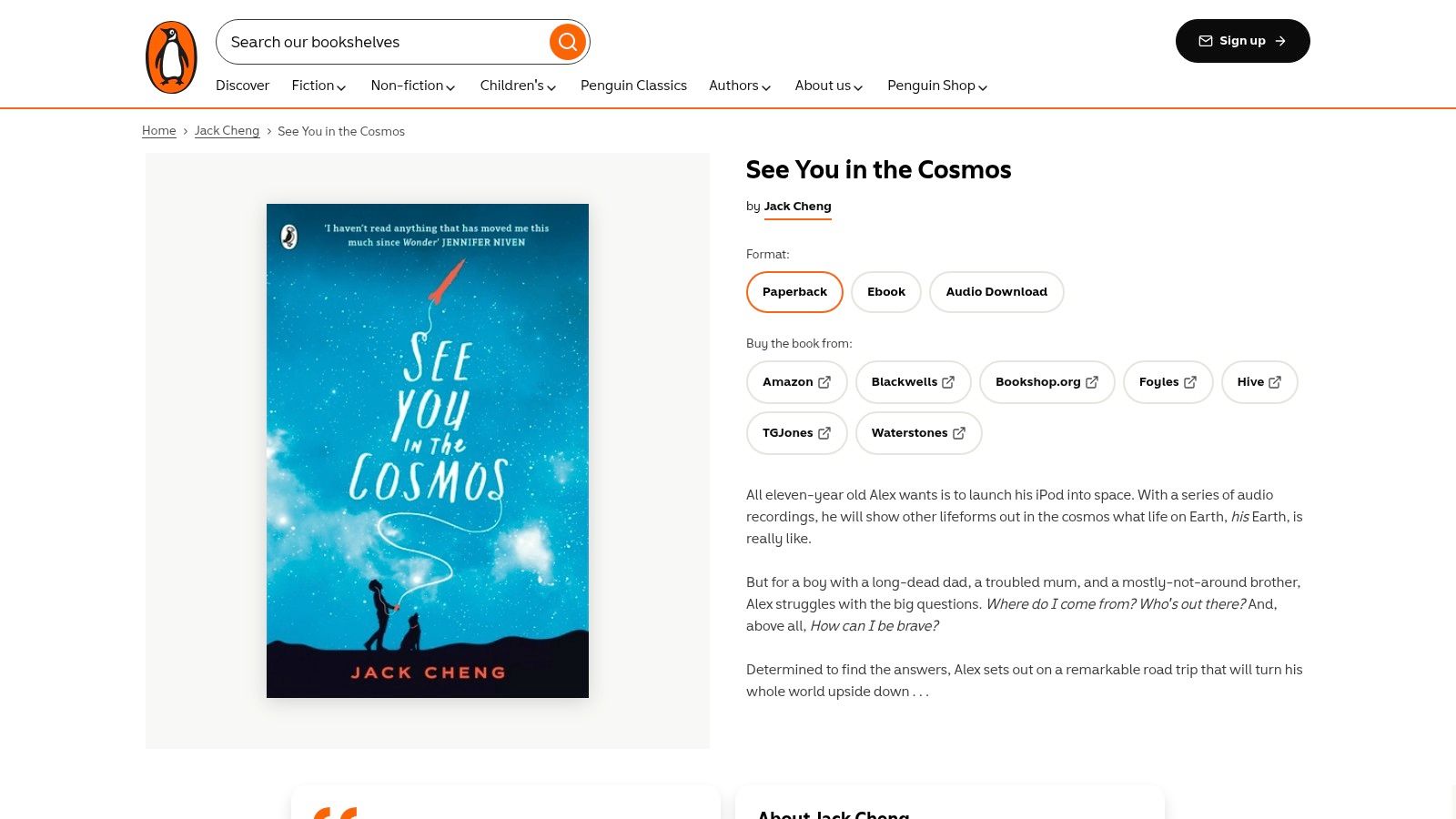
The story is told in a fun, transcript style, which makes it very easy to read. It gently introduces ideas about space exploration, rocketry, and communicating with extraterrestrials through Alex’s enthusiastic and curious voice. It’s a story about science, but it’s also about family, resilience, and finding your place in the universe.
- STEM Themes: Astronomy, rocketry, SETI, sound recording.
- Why we love it: It's a perfect blend of realistic fiction and science, with a unique format that’s great for reluctant readers. It’s a story with a huge heart.
Find the book here: https://www.penguin.co.uk/books/289757/see-you-in-the-cosmos-by-cheng-jack/9780141365602
7. Max Einstein Series by James Patterson & Chris Grabenstein
If your child loves fast-paced, action-packed adventures, the Max Einstein series is a perfect choice. This series, officially endorsed by the Albert Einstein Archives, follows Max, a 12-year-old genius recruited by a secret organisation. Her mission? To use science to solve the world’s biggest problems with a team of other young inventors.
This series is fantastic for showing kids that science is a powerful tool for making a real difference. Each book is a globe-trotting mission filled with puzzles, teamwork, and exciting challenges. It’s a brilliant way of understanding what STEM learning truly is – applying knowledge to help people and the planet.
- STEM Themes: Applied physics, engineering, renewable energy, problem-solving.
- Why we love it: It makes STEM feel like a thrilling spy mission and inspires a can-do attitude. The diverse international team of characters is fantastic, too!
Find the series here: https://www.penguin.co.uk/series/MES/max-einstein-series
8. A Wrinkle in Time by Madeleine L'Engle
A true classic of children's science fiction, A Wrinkle in Time has captivated readers for generations. The story follows Meg Murry, her brilliant younger brother Charles Wallace, and their friend Calvin as they travel through space and time to rescue her missing scientist father. Guided by three mysterious celestial beings—Mrs. Whatsit, Mrs. Who, and Mrs. Which—they learn about the tesseract, a "wrinkle" in time that allows them to travel across the universe in an instant.
This book is a deep and rewarding read, blending cutting-edge physics (for its time) with themes of love, individuality, and the battle between good and evil. It doesn’t shy away from complex ideas, making it a fantastic book for curious children who love to think. It's a story that champions the idea that our flaws and unique qualities are what make us strong.
- STEM Themes: Theoretical physics (tesseracts, dimensions), astronomy, conformity vs. individuality.
- Why we love it: It's a timeless adventure with a strong, intelligent female protagonist that encourages readers to embrace their uniqueness. You can learn more about the science behind it on sites like the NASA Space Place.
Choosing Your Next Sci-Fi Adventure
| Book Title | Age Range | Best For | Key STEM Idea |
|---|---|---|---|
| Space Ranger Fred | 6-12 | Fun, interactive learning | Applied science & engineering |
| The Wild Robot | 7-11 | Nature lovers & deep thinkers | AI & ecology |
| The Jamie Drake Equation | 9-12 | Budding astronomers | Space exploration & SETI |
| George's Secret Key | 8-12 | Fact-hungry kids | Astrophysics & cosmology |
| Tin | 10-13 | Advanced readers | AI ethics & identity |
| See You in the Cosmos | 9-12 | Reluctant readers & empaths | Rocketry & communication |
| Max Einstein | 8-12 | Action lovers & problem-solvers | Applied engineering |
| A Wrinkle in Time | 10+ | Philosophical kids | Theoretical physics |
Keep Exploring!
These incredible children's science fiction books are more than just stories—they are invitations to explore, question, and dream. They show that science is a grand adventure, and that curiosity is the most important tool we have.
So, are you ready to blast off on a new reading mission?
- Explore our stories: Dive into the world of Space Ranger Fred and join his latest mission!
- Get freebies: Sign up for our newsletter to get free printables and activities delivered straight to your inbox.
- Join the crew: Follow us on social media for more fun facts, challenges, and story updates.
What’s your family’s favourite science fiction book? Let us know in the comments below—we’d love to hear from you!
Frequently Asked Questions (FAQs)
1. Why are science fiction books good for children?
Science fiction books are brilliant for children! They encourage creative thinking, introduce complex scientific ideas in an accessible way, and help build problem-solving skills. Stories about space, robots, and future worlds inspire curiosity about STEM subjects and our universe.
2. What age is best to introduce children to science fiction?
You can start at any age! For younger children (6-8), books like the Space Ranger Fred series or The Wild Robot are perfect because they blend simple science with strong, relatable stories. As children get older, they can move on to more complex books like George’s Secret Key to the Universe or A Wrinkle in Time.
3. How can I use these books to support STEM learning?
Pair reading with hands-on activities! After reading about rovers, try building a model out of Lego. After a story about space, visit the NASA website to see real pictures from the Hubble telescope. The Space Ranger Fred website has lots of Free Activities designed to connect stories with real-world science.
4. Are there any science fiction books with strong female characters?
Absolutely! Many of the books on this list feature fantastic female protagonists. Max in the Max Einstein series is a brilliant inventor, Meg Murry in A Wrinkle in Time is a courageous hero, and Roz from The Wild Robot is a strong and caring leader. These characters show girls that they can be leaders in science and adventure.