
Right then, let's talk about STEM. You’ve probably heard the term flying around, but what does it actually mean for your child?
Simply put, STEM is a hands-on way of learning that weaves together Science, Technology, Engineering, and Maths. It’s not about teaching four separate subjects on their own. Instead, it’s about using them as a team to figure things out, solve problems, and make sense of the world.
So, What Exactly Is STEM Learning?
Forget dusty textbooks and long, complicated definitions. Think of STEM as a practical toolkit for your child’s boundless curiosity. It’s an approach that champions asking questions, tinkering with ideas, and actually building things with their own two hands.
Instead of just reading a chapter on how a rocket works, a child learning through STEM might design, build, and launch their own model. They’re not just memorising facts; they’re experiencing how things work in the real world. That’s the heart of it: doing, trying, failing, and discovering.
The Four Pillars of STEM
At first, the four pillars of STEM might sound a bit formal, but they’re already a huge part of your child’s everyday life. From baking a cake to building an epic pillow fort, they're already a mini scientist and engineer!
Let’s break it down.
- Science is all about asking “Why?” It’s that natural curiosity that drives children to watch what happens when you mix vinegar and baking soda, or to notice how plants in the garden bend towards the sun.
- Technology is about using tools to make tasks easier. This isn’t just about iPads and computers; it could be as simple as using a pair of scissors to cut out a shape or a pulley to lift a heavy toy car.
- Engineering is the sheer joy of designing and building things. It’s the process of figuring out how to build a LEGO tower that won’t topple over or constructing the perfect paper aeroplane for a long-haul flight across the living room.
- Maths is the language we use to measure things and spot patterns. It’s counting down the seconds to a rocket launch, measuring ingredients for a recipe, or finding the different shapes in a star constellation.
This concept map is a great way to see how these four areas all connect to one central idea.
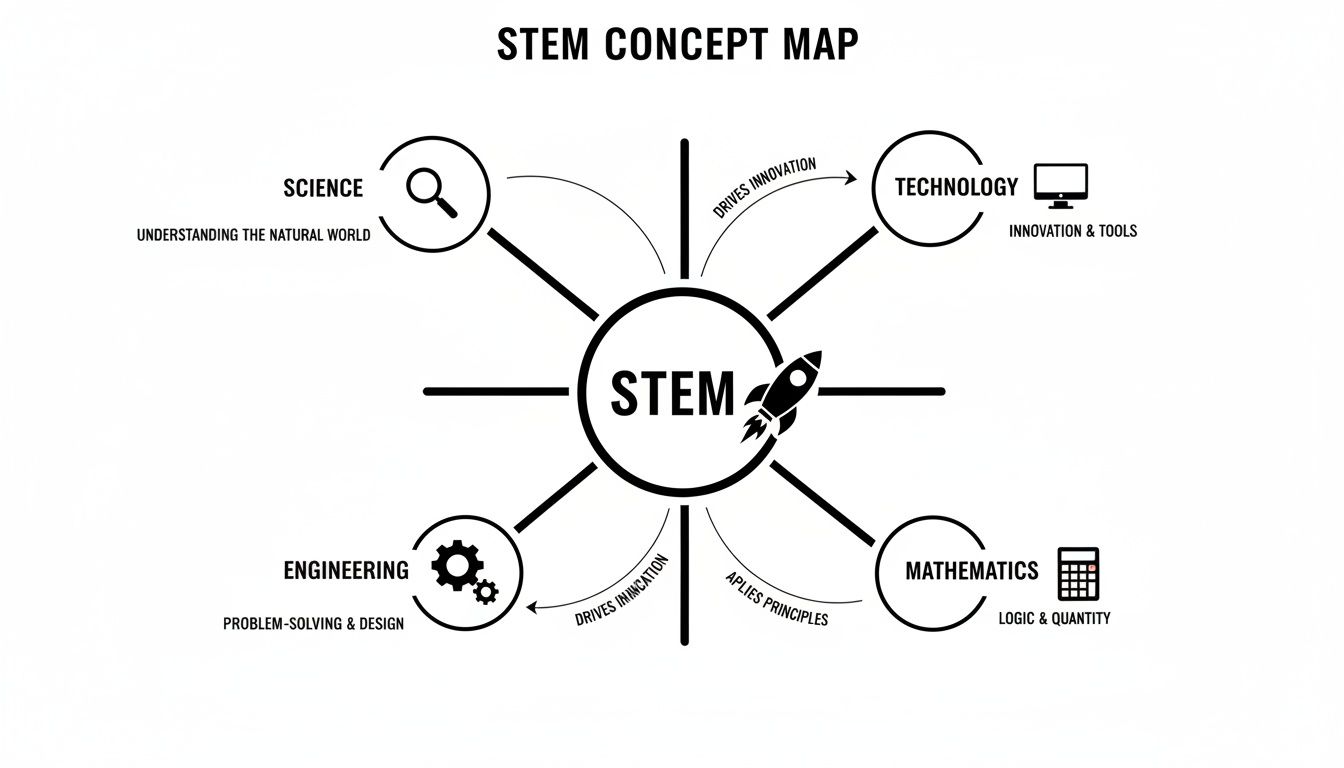
As you can see, STEM isn’t just one thing. It's a blend of interconnected skills for exploring, creating, and making sense of just about everything.
To make this even clearer, here’s a quick guide to what each pillar of STEM looks like in your child’s world.
The Four Pillars of STEM Made Simple
A quick guide to understanding what each part of STEM means for your child's learning adventure.
| STEM Pillar | What It Looks Like in Real Life | A Space Ranger Fred Example |
|---|---|---|
| Science | Wondering why leaves change colour in autumn or experimenting with what sinks and floats in the bath. | Analysing a strange goo on Planet Jambori to figure out what it's made of. |
| Technology | Using a digital camera to take pictures, a magnifying glass to inspect a bug, or even a simple wheel and axle on a toy car. | Using his spaceship’s scanner (a handy tool!) to map out a dangerous asteroid field. |
| Engineering | Building the tallest possible tower out of blocks, designing a bridge out of straws, or creating a waterproof den in the garden. | Designing and building a new landing gear for his spaceship using spare parts and a bit of ingenuity. |
| Maths | Counting steps to the park, sorting toys by colour and size, or measuring ingredients to bake a batch of cookies. | Calculating the exact trajectory needed to launch a rescue pod and save his friend Zando. |
This table shows how these "big" subjects are really just part of the everyday fun and games children already love.
It All Starts With a Story
One of the best ways to bring these concepts to life is through storytelling. When Space Ranger Fred faces a mission to fix his spaceship, he doesn’t rely on just one skill.
He uses science to understand the problem, technology (his trusty gadgets!), engineering to design a solution, and maths to make sure all the parts fit together perfectly.
This approach shifts the focus from "learning subjects" to "solving missions." It reframes challenges as exciting adventures, which helps build confidence and a genuine love for discovery.
By connecting these ideas to stories and play, we show children that STEM isn't something to be intimidated by; it's a superpower for understanding how their world works.
You might also have heard about a similar idea, STEAM, which adds 'Arts' into the mix. If you're curious, you can learn more about what is STEAM education in our detailed guide. It all helps frame learning as a creative and imaginative process, empowering children to ask big questions and have a blast finding the answers.
Why STEM Skills Matter More Than Ever
Getting stuck into STEM is about so much more than prepping children for a future job in a lab coat; it's about handing them a toolkit they can use right here, right now. When a child dives into a STEM activity, they’re not just fiddling with science or maths—they’re learning how to tackle life's little (and big) challenges.
This is where the Menturity™ approach really shines. Through playful, hands-on discovery, children build the confidence to try new things and the grit to handle whatever comes their way. It’s all about nurturing that natural curiosity and showing them it's okay to try, fail, and try again.

Building Resilience One Wobbly Tower at a Time
Ever watched a child construct a magnificent LEGO tower, only to see it wobble and crash to the floor? That flicker of frustration, quickly followed by the determination to rebuild it even better, is the heart of STEM learning. It teaches perseverance, one of life’s most valuable lessons.
STEM activities create a safe space to fail. When an experiment fizzles out or a carefully folded paper aeroplane takes a nosedive, it isn’t the end. It's a clue. It sparks questions like, "What could I change?" or "Let's try it a different way!" This cycle of trial and error builds resilience, teaching children to see setbacks not as failures, but as opportunities to learn and improve.
Fostering Creativity and Problem Solving
Think STEM is all logic and no fun? Think again. STEM and creativity are two sides of the same coin. Challenge a child to build a boat from tin foil that can hold the most pennies, and watch their imagination run wild. There’s no single "right" answer, just a sea of possibilities to explore.
This kind of open-ended play is rocket fuel for their creative thinking. They learn to brainstorm, design, test, and tweak their ideas—the very same process engineers use to build bridges and scientists use to discover new medicines, just on a kitchen-table scale.
By framing challenges as playful missions, we empower children to become creative thinkers and confident problem-solvers. They learn that their ideas have the power to create real, tangible results.
Improving Communication and Teamwork
So many great STEM activities are built for collaboration. Whether it’s two friends figuring out how to build a den in the garden or a classroom team designing a marble run, children learn to share ideas, listen to others, and pull together to reach a common goal.
They have to explain their thinking ("I think we should put this piece here because…") and navigate different approaches. This builds vital communication skills, helping them become better collaborators in the classroom, on the playground, and beyond.
These skills are more important than ever. In the UK, the STEM workforce is booming, hitting 9.4 million workers—that’s a 22% jump since 2013, far outpacing the 11% growth across all other jobs. Inspiring children today with playful learning helps lay the groundwork for these future roles. You can explore more insights into the growing UK STEM workforce here.
Developing Critical Thinking Skills
At its core, STEM learning is all about thinking critically. It encourages children to look at a problem, gather clues, and figure out a logical way forward. When their LEGO tower keeps collapsing, they naturally start to analyse the structure, spot the weak points, and think about how to strengthen the base.
This isn’t about memorising facts for a test; it's about understanding cause and effect. It’s the kind of real-world thinking that helps them make sense of everything, from why the toast burns to how their favourite video game works. By encouraging them to ask "why" and test their theories, you’re helping them become sharper, more analytical thinkers for life.
How to Bring STEM to Life in the Classroom
For all the fantastic primary school teachers out there looking to ignite a universe of curiosity, this is your mission briefing. Bringing STEM to life doesn’t demand a big budget or complicated gear; it just needs a bit of imagination and a willingness to embrace playful discovery.Think of your lessons as exciting ‘missions’ where the journey is just as important as the destination. When children feel like they’re part of a story, they aren't just memorising facts—they're solving a meaningful problem. This simple shift can turn an ordinary science experiment into an epic adventure.
From Lessons to Missions
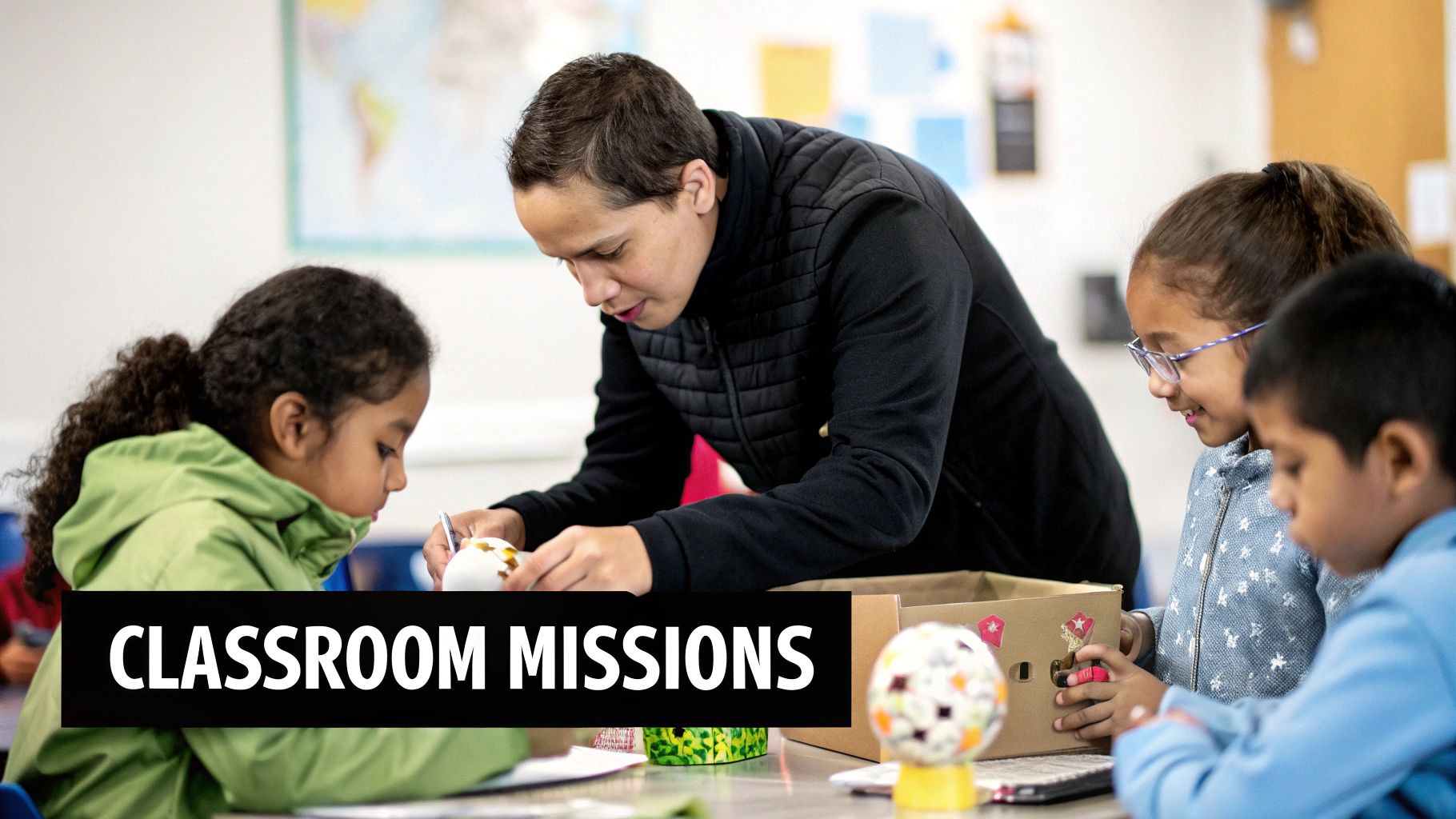
Instead of a dry lesson on structures, why not launch ‘Mission: Egg Drop’? The challenge is simple: your young engineers must design a protective landing pod for an egg using only scrap materials like straws, paper, and sticky tape. This one task covers core principles of engineering, physics, and creative problem-solving, all while being heaps of fun.
Another great mission is to explore the world of coding. Using a free, block-based platform like Scratch, pupils can create their own animated stories or simple games. This isn't just a technology lesson; it's a powerful exercise in storytelling, logic, and creative thinking. They learn about sequencing and computational thinking without even realising it.
Using Story as a Launchpad
Stories are the ultimate launchpad for tricky topics. The adventures of Space Ranger Fred offer a perfect entry point for weaving STEM into your curriculum. For example, when you read about Fred’s mission to Planet Gloopiter—a world covered in strange, bubbling goo—you have a natural springboard to discuss states of matter.
By connecting abstract concepts to a character's journey, you make them relatable and memorable. The story provides the 'why', turning a potentially dry science topic into a compelling mystery to be solved.
Similarly, a story about Fred navigating an asteroid field can introduce concepts like gravity, velocity, and trajectory. You could follow up by having the children design and test their own paper rockets, measuring whose creation travels the furthest.
There's a reason for the growing emphasis on STEM. The UK's K-12 STEM education market is expanding rapidly, generating USD 2,809.1 million and projected to more than double by 2030. This growth is driven by a real skills gap, with 49% of engineering firms struggling to hire qualified staff, making early exposure for 6–12-year-olds absolutely vital. Discover more insights about the UK's STEM education market.
Practical Resources for Your Classroom
To make things even easier, we’ve created a whole host of free resources you can download and use in your classroom tomorrow. From colouring sheets that spark conversations about space to hands-on activity guides, there's plenty to get you started.
These freebies are designed to be low-prep and high-engagement, supporting the Menturity™ approach by encouraging children to talk, try, and think for themselves.
To really dial up the fun, try integrating principles of gamification in education. Turning a challenge into a game with points or badges adds an extra layer of motivation and makes complex STEM concepts much more approachable.
Ultimately, the goal is to create a classroom where curiosity is king and questions are always welcome. As you explore these ideas, you’ll see how seamlessly STEM fits into the discovery-led learning you’re already championing. Learn more about the power of discovery learning in our detailed article. By framing learning as an adventure, you empower your pupils to become confident, creative explorers.
Fun and Easy STEM Activities for Home
Ready for some kitchen-table science? You don’t need a fancy lab or expensive kits to start exploring the wonders of STEM. In fact, some of the best discoveries happen with everyday bits and bobs you already have at home.
This is all about playful learning, where the real treasure is the experience and the conversation, not just finding the 'right' answer. Bringing STEM home turns your living room into a design studio and your kitchen into a science lab. It’s a chance to fire up their curiosity, build their confidence, and show them that science and engineering are all around us, just waiting to be uncovered.
Let's get our hands messy and our minds whirring with a few fun challenges!
Mission One: Spaghetti Tower Challenge
This is a classic for a reason! It’s a brilliant engineering task that’s surprisingly tricky and always leads to a good laugh.
Your Mission Materials:
- 20 sticks of uncooked spaghetti
- One large marshmallow
- A small roll of sticky tape
- A metre of string
The Challenge: Working in teams or on your own, the mission is to build the tallest free-standing tower you can with only these materials. The catch? The marshmallow has to sit right on top. You'll need to think like an engineer—planning your structure, testing its strength, and making tweaks as you go.
Curiosity Questions to Ask:
- What shapes do you think will be the strongest? (Hint: triangles are an engineer's best friend!)
- What happens if we make the base wider?
- How can we use the string and tape to stop our tower from wobbling?
This is a fantastic way to explore structural engineering concepts without any pressure. It shows children that planning, testing, and even having things fall apart are all crucial parts of the design process.
Mission Two: The Unsinkable Boat
Right, time to test your sea-faring designs! This challenge mixes engineering with a bit of physics as you try to get to grips with buoyancy.
Your Mission Materials:
- A sheet of tin foil (about 30cm x 30cm)
- A bowl, sink, or tub filled with water
- A collection of small, heavy objects (like coins, marbles, or LEGO bricks)
The Challenge: Your goal is to design and build a boat from a single sheet of tin foil. Once it's afloat, the real test begins: how many coins (or other bits) can your boat hold before it sinks? Encourage them to experiment with different shapes and designs.
Curiosity Questions to Ask:
- Do you think a flat boat or a boat with high sides will hold more? Why?
- Where’s the best place to put the coins to keep it balanced?
- What happens if we make the bottom of the boat bigger?
This simple activity is a powerful way to show how shape and weight distribution affect buoyancy. It’s a hands-on lesson that demonstrates how engineers think about designing everything from tiny boats to massive cargo ships.
A Space Ranger Fred Mission
Inspired by our favourite cosmic explorer, let’s try a space-themed challenge. In the book, Space Ranger Fred has to design a craft to land safely on a new planet. Now it's your turn! To keep the adventure going, find even more fun science activities for kids on our blog.
And remember, just as STEM can be fun and engaging, so can other areas of learning. Discovering fun reading activities for 2nd grade can spark that same curiosity and love for learning.
The most important part of these home-based missions is just to have fun and talk about what you’re seeing and doing. When you encourage your child to ask questions, share their ideas, and test them out, you’re nurturing a curious, confident, and creative thinker. That’s the very heart of what is STEM learning.
Overcoming Common STEM Hurdles
“I’m just not a maths person.” “Science is too hard.”
Ever heard those words? They’re incredibly common, and they usually come from a simple misunderstanding of what STEM is all about. Many children (and adults!) feel put off by these subjects, picturing complicated sums and baffling experiments where you’re either right or you’re wrong.
But what if we looked at it differently? What if a wobbly tower or a fizzled-out potion wasn't a failure, but an exciting new clue? This is the secret to getting over STEM hurdles: celebrating the process of discovery, not just the final result. By shifting the focus to trying things out and asking questions, we can spark that natural curiosity every child is born with.

From Fear to Fun: The Power of Story
One of the biggest barriers to STEM is that its concepts can feel abstract and completely disconnected from real life. That’s where the magic of storytelling comes in.
When a child follows a character like Space Ranger Fred on a mission to fix his spaceship, big ideas like engineering and physics suddenly become part of a thrilling adventure.
Fred doesn’t just sit down to "do engineering." He needs to figure out how to patch a hull breach with whatever supplies he has. The story gives it all context and purpose, turning a potential school subject into a high-stakes challenge. This narrative approach breaks down barriers, proving that STEM is for everyone, because everyone loves a good story.
Changing the Conversation Around Mistakes
The way we talk about challenges makes a huge difference. Instead of zeroing in on getting the answer right, we can praise the effort and the creative thinking that went into the attempt.
Here’s how you can reframe common STEM frustrations:
Instead of: "That's the wrong answer."
Try: "That’s a really interesting idea! What do you think would happen if we tried it this way instead?"
Instead of: "Your tower fell down."
Try: "Great first attempt! What clues did the collapse give us for building a stronger one?"
This simple change in language supports the Menturity™ approach by building a resilient mindset. It teaches children that mistakes aren't just okay—they are an essential and exciting part of learning.
Why It Matters Now More Than Ever
Nurturing this positive mindset from a young age is incredibly important. Student dropout in UK STEM subjects is a real challenge. In higher education, computer science sees a 9.8% dropout rate. Even at the GCSE level, students report getting hands-on science experience only 26% of the time fortnightly.
This lack of practical engagement can make concepts feel tough and lead to early disinterest. For children aged 6–12, the pipeline starts now. Read the full research about the UK STEM pipeline challenges.
By making STEM feel playful, story-driven, and accessible, we aren't just helping with homework. We're showing children that they are capable problem-solvers, ready for any mission that comes their way.
You can start today by grabbing a character-led story like one of our Space Ranger Fred books or downloading a challenge from our free activities page. By framing STEM as an adventure, we empower children to see themselves as curious explorers, ready to tackle any problem with confidence and creativity.
Your Next Mission Awaits
And just like that, our exploration of the STEM universe comes to an end. Hopefully, you’ve discovered that what is STEM learning isn't some scary, complicated checklist of subjects to get through. It’s really a lifelong adventure—one fuelled by asking questions, getting your hands dirty, and making those brilliant little discoveries.
We’ve seen how it quietly builds crucial life skills like resilience and teamwork, and how simple, playful activities can bring it all to life, whether you’re in the classroom or at the kitchen table. STEM isn’t about having all the answers; it’s about having the courage to ask the questions.
So, where do you go from here? Just start! Pick one simple idea from this guide—a spaghetti tower, a tin foil boat, anything—and just see what happens. You'll be amazed at the conversations and ideas your young explorer comes up with.
The real magic of any STEM adventure is the shared experience. It’s the laughter when a tower finally tumbles, the focused silence during a tricky build, and that incredible "aha!" moment when it all clicks.
Ready to blast off on your next mission? The adventure doesn’t have to stop here. You can dive into a new story with a Space Ranger Fred book, explore another topic on our blog, or download a fresh challenge from our free activities page.
Thanks for joining us on this journey. We hope you feel fired up and ready to keep exploring.
Welcome to the crew.
Your Questions Answered
Even with all the excitement around STEM, it’s completely normal to have a few questions. Let's tackle some of the most common ones we hear from parents and teachers.
My Child Says They Hate Maths. How Can I Make STEM Fun?
I hear this one a lot! The trick is to reframe what STEM is and connect it to something they already love. It’s not about sitting down with a worksheet.
If they’re arty, you can explore the science behind mixing colours or build a sculpture from recycled materials (hello, engineering!). If they’re obsessed with stories, why not read an adventure like Space Ranger Fred and the Planet of the Fluffs and then try to build a model of his spaceship? It’s all about showing them that STEM is a creative tool for exploring their world, not just a list of sums and formulas.
Do I Need to Buy Expensive Kits for At-Home STEM?
Absolutely not. In fact, some of the best STEM learning happens with everyday stuff you already have lying around the house. Cardboard boxes, tape, plastic bottles, and a few kitchen ingredients are your new best friends.
The whole point is to spark their creativity and resourcefulness, not just to have them follow a complex instruction manual. Building a den in the living room, designing the ultimate paper aeroplane, or making a fizzy 'potion' with vinegar and bicarb soda are all fantastic STEM experiences that cost next to nothing.
Remember, the value isn’t in the kit, but in the curiosity it sparks. Fostering a mindset of 'let's try it and see' with simple household items is far more powerful than any expensive gadget.
We’ve got a bunch of great, low-cost ideas over on our free activities page.
What Is the Best Age to Start Introducing STEM?
Here’s the thing—you’re probably already doing it without realising! That 6–12 age range is the sweet spot for being a bit more intentional, as their natural curiosity is off the charts. They are little 'why?' and 'how?' machines.
You can introduce STEM concepts just by leaning into those questions and exploring the answers together. It’s less about formal lessons and more about nurturing a mindset of experimentation and wonder in your daily life. Your job is to simply encourage the little scientist they already are.
How Does STEM Align with the UK Primary School Curriculum?
Brilliantly! Think of fun STEM activities as a hands-on support system for what children are learning in school, especially in Key Stage 1 and 2.
The science curriculum's focus on ‘working scientifically’—which is all about asking questions, testing ideas, and seeing what happens—is the very heart of STEM. The Design and Technology (D&T) curriculum is basically the engineering design process in action. When your child is wrapped up in a fun STEM project at home, they are directly practising the skills they need for science, computing, D&T, and maths. It helps connect the dots and makes learning feel much more relevant and engaging.
We dive a bit deeper into this in our guide on how to bring STEM to life in the classroom.