Hello, space explorers! Have you ever looked up at the big, beautiful Moon and wondered what it’s really like up there? It’s not just a friendly light in the night sky – it’s a whole world of secrets and wonders, just waiting to be discovered.
Like Space Ranger Fred on one of his daring missions, we’re about to blast off on an adventure to uncover some of the most amazing and fun facts about the moon. We'll find out why it has quakes, why it’s slowly drifting away, and how it holds clues to the history of our solar system.
So, pop on your imaginary space helmet, fire up your curiosity, and get ready for launch. Let’s explore the marvellous Moon together!
What is the Moon and Why is it So Special?
The Moon is Earth’s best friend in space! It’s a natural satellite, which is a fancy way of saying it’s a rocky ball that orbits, or travels around, our planet. It’s the fifth-largest moon in our entire solar system and the brightest object in our night sky.
But the Moon is more than just a pretty sight. Its gentle gravitational pull helps to control the ocean tides and keeps our planet from wobbling too much, which gives us stable seasons. It’s a silent guardian that has helped life on Earth to flourish for billions of years. Let's dive into some more amazing moon facts!
1. The Moon is Drifting Away from Us!
Believe it or not, our Moon is a bit like a shy friend slowly backing away from a hug! Every year, it drifts about 3.8 centimetres (that’s about 1.5 inches) further from Earth. That’s about as fast as your fingernails grow!
This slow-motion escape is caused by the way the Moon’s gravity pulls on Earth’s oceans, creating the tides. This interaction gives the Moon a tiny bit of extra energy, pushing it into a slightly higher orbit.
Try This! Hold your arm out straight. Now, slowly move your hand just a tiny bit further away. It doesn’t seem like much, does it? But over billions of years, that tiny movement adds up to a huge distance!
2. The Moon Has ‘Moonquakes’
You might think of the Moon as a quiet, still place, but it actually rumbles and shakes! It has its own version of earthquakes called moonquakes. Unlike quakes on Earth that are usually over in a minute, some moonquakes can make the Moon vibrate like a giant bell for more than ten minutes.
Astronauts on the Apollo missions left special instruments called seismometers on the Moon to measure these rumbles. They found that moonquakes can be caused by the pull of Earth's gravity, meteorites crashing into the surface, and even by the Moon's core slowly cooling and shrinking.
3. We Only Ever See One Side of the Moon
Have you ever noticed that the pattern of dark and light patches on the Moon always looks the same? That’s because the Moon is ‘tidally locked’ with Earth. This means it spins around on its axis at the exact same speed it orbits our planet.
This perfect cosmic dance keeps the same side, known as the "near side," always facing us. People often call the other side the "dark side," but that's not quite right! The "far side" gets just as much sunlight; we just can't see it from Earth. It was a complete mystery until a spacecraft finally took pictures of it in 1959.
4. You Would Be Super Bouncy on the Moon!
Ever dreamed of jumping so high you feel like you’re flying? On the Moon, you could! The Moon’s gravity is much weaker than Earth’s – only about one-sixth as strong. This means if you can jump 30 cm (about one foot) high on Earth, you could leap a whopping 1.8 metres (six feet) on the Moon!
This is because the Moon is much smaller and has less mass (less ‘stuff’) than Earth, so its gravitational pull is weaker. That’s why astronauts bounced and hopped across the lunar surface in such a fun, slow-motion way.
Space Ranger Fred Says: "In our latest Space Ranger Fred book, we had to practise our 'moon hops' at the academy! Kicking a football on the Moon would be amazing – it would fly six times further. Just be careful when you try to stop!"
5. Footprints on the Moon Could Last for Millions of Years
Imagine leaving your mark somewhere and knowing it will stay there for a truly epic amount of time! That's exactly what the Apollo astronauts did. The boot prints they left in the lunar dust will remain on the Moon's surface for millions of years.
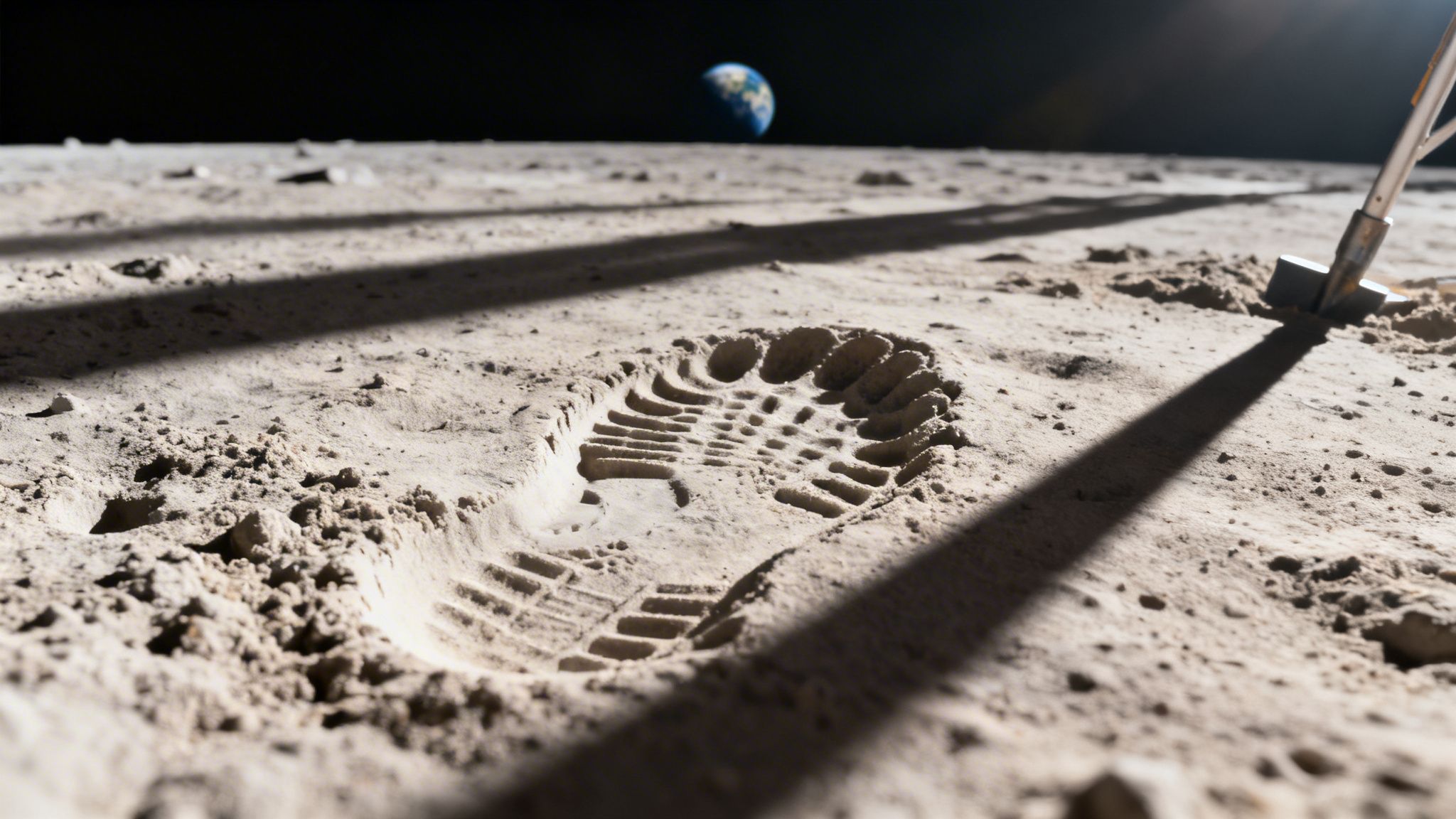
This incredible preservation is possible because the Moon doesn't have weather like we do. There’s no wind to blow the dust around and no rain to wash the prints away. The only thing that will eventually erase them is the slow, steady bombardment of tiny space dust called micrometeorites.
6. The Moon Has Water Ice!
You might think of the Moon as a dry, dusty desert, but it’s hiding a refreshing secret! Scientists have discovered water, frozen as ice, tucked away in craters near the Moon's poles.
These special craters are in "permanently shadowed regions," which means the Sun’s rays have never, ever reached their floors. It’s so cold in these shadows (around -163°C!) that the ice has stayed frozen for billions of years. For more amazing facts about water in space, check out the information on NASA's website.
Try This! Find a spot in your garden or a corner of a room that the sun never touches. Notice how it stays cool and damp long after other places have dried out? The Moon’s shadowed craters are like that, but much, much colder!
This discovery is a game-changer for STEM learning and future space missions. Astronauts could one day melt the ice for drinking water, or even split it into hydrogen and oxygen to make rocket fuel!
Lunar Exploration Activities for Your Family
Ready to bring the Moon into your home? Exploring these fun facts about the moon doesn’t have to stop here. Try these simple and playful activities to spark even more curiosity.
| Activity | What You Need | What It Teaches |
|---|---|---|
| Baking Tin Craters | A baking tin, flour, cocoa powder, small pebbles or marbles. | How the Moon's surface got its craters from asteroid impacts. |
| Moon Phase Journal | A notebook and pencil. | How the Moon's appearance changes over a month (the lunar cycle). |
| Gravity Jump Challenge | A measuring tape. | The difference between Earth's gravity and the Moon's weaker pull. |
You can find more brilliant ideas like these on our Free Activities page. These hands-on projects are a fantastic way to make big ideas about space feel real and exciting.
Your Next Mission Starts Here!
Well done, explorers! You’ve just journeyed through some truly astonishing fun facts about the moon. From its slow drift away from Earth to the frozen water hidden in its shadows, the Moon is a place of endless wonder.
Every fact we learn sparks new questions, and that curiosity is the most powerful rocket fuel there is! You can keep your cosmic quest going by exploring the world around you, asking big questions, and sharing what you learn with your family and friends.
Continue Your Cosmic Quest with Space Ranger Fred
- Dive into a book: Blast off on another adventure with our latest Space Ranger Fred book. Fred’s missions are packed with real science and stories that bring the wonders of the solar system to life.
- Get free printables: Sign up for our newsletter to get more fun activities and freebies sent straight to your inbox.
- Join our crew: Follow us on social media for daily doses of space facts and fun.
- Share your thoughts: What was your favourite moon fact? Do you have a question about space? Leave a comment below – we’d love to hear from you!
Keep looking up at that big, beautiful Moon and remember all the incredible stories it has to tell.
Frequently Asked Questions (FAQ)
1. How old is the Moon?
Scientists believe the Moon is about 4.5 billion years old, formed not long after Earth and the rest of the solar system.
2. Why does the Moon shine so brightly?
The Moon doesn't make its own light! It shines because its surface reflects sunlight. It’s like a giant, dusty mirror in the sky.
3. Has anyone lived on the Moon?
No one has lived on the Moon, but 12 astronauts have walked on its surface during the Apollo missions between 1969 and 1972. Future missions, like NASA's Artemis program, plan to send humans back to build a long-term base.
4. How long does it take to get to the Moon?
It takes about three days for a spacecraft to travel from the Earth to the Moon.
5. Are there different types of moons in the solar system?
Yes! Our solar system is full of fascinating moons. Some are rocky like ours, while others are icy, have volcanoes, or even have oceans hidden beneath their surface. Exploring the different moons is a huge part of space science