
What if your child’s next animal game felt less like filling time and more like joining Space Ranger Fred on a real mission?
Children are natural explorers. Give them a roaring lion, a waddling penguin, or a very suspicious-looking alien hamster, and they start asking big questions fast. Where does it live? What does it eat? Why does it move like that? Those questions are the first sparks of science.
Play helps those sparks grow. A sorting game builds classification skills. A mimicry challenge sharpens observation. A habitat mission turns loose craft materials into early engineering. Bit by bit, children practise how to notice patterns, test ideas, explain their thinking, and change course when a plan goes a bit wonky. That is proper learning. It just happens to come with more growling.
Space Ranger Fred would approve.
That is why these animal games for children work so well. They turn playtime into a story-led expedition with a job to do. Children are not only pretending. They are acting like young biologists, engineers, trackers, and storytellers, one mission at a time. Resources such as the WWF Go Wild games and quizzes page also show how animal-themed activities can make wildlife learning lively and memorable for children.
You might hear a child slithering across the carpet or announcing that a cardboard box is now a moon-jungle habitat. Good. That kind of play has educational muscle. It helps children connect movement, language, curiosity, and problem-solving in a way that sticks far better than a worksheet ever could.
This list is your mission handbook. Each game is framed as one of Space Ranger Fred’s adventures, with simple ways to build STEM thinking, creativity, and confidence into the fun. If you’d like one more playful idea alongside these, have a peek at fun activities with plush toys.
Let’s launch.
1. Mission 1 Alien Creature Classification
Sorting games are brilliant because they help children notice patterns. Does this creature live in water? Does it have feathers? Is it a herbivore? Suddenly, a pile of picture cards becomes a science investigation.
In this mission, children become Xeno-Biologists aboard Space Ranger Fred’s ship. They’ve landed on Planet Zogleaf and discovered a jumble of creatures. Their task is to sort them into groups using clues such as habitat, body covering, diet, movement, or whether they’d fit with mammals, birds, fish, reptiles, or insects on Earth.

Alt text: animal games for children with astronaut sorting cards
How to play it
Use animal cards, toy animals, or printed pictures. Mix in a few made-up alien beasts too. If a child says, “This one has wings and scales and eats moonberries,” even better. Now they have to defend their thinking.
Try prompts like these:
- Sort by habitat: Forest, ocean, desert, farm, polar region, or outer space.
- Sort by diet: Herbivore, carnivore, omnivore.
- Sort by body features: Fur, feathers, scales, shell, wings, legs.
- Sort by evidence: Ask, “How do you know?”
That last one matters. Children aren’t only naming animals. They’re building the sentence, “I think this because…”
Mission shortcut: If you’ve got mixed ages, let younger children sort by colour or size first, then help older ones move into scientific groups.
Games like this fit beautifully with Key Stage 1 and Key Stage 2 science because animal classification sits right inside those early biology topics. They also build confidence with observation and explanation. A child who can say why a camel belongs in one group is already practising scientific reasoning.
For a Space Ranger Fred twist, create an “Intergalactic Animal Encyclopaedia”. Each child adds one creature, draws it, classifies it, and writes one fact. By the end, you’ve got a proper ship log. Very official. Slightly sticky. Usually covered in glitter.
2. Mission 2 The Creature Mimicry Challenge
What if the fastest way to teach animal behaviour was to ask children to become the animal for a minute?
This mission turns wriggles, stomps, and dramatic penguin waddles into useful learning. Children practise balance, coordination, and body control while they notice how different creatures move. A frog does not travel like a tiger. A crab does not move like a butterfly. That simple contrast helps children connect movement to body structure and habitat.
It also gives language a job to do. Words like stalk, pounce, slither, flutter, crouch, stretch, and balance make more sense when children feel them in their muscles. The brain likes a good shortcut. Movement helps ideas stick.
How to run the mission
Call out an animal. Children copy the movement across the room or on the spot. Keep each turn short so the energy stays bright and everyone gets a chance to try again.
You can shape the challenge in a few different ways:
- Animal Command Game: Children move only when Space Ranger Fred gives the signal.
- Cross the Crater: Pick one animal and travel from one side of the room to the other.
- Guess the Creature: One child performs the movement. The crew names the animal and explains how they knew.
- Habitat Match: After the movement, ask, “Where would this creature live, and why?”
A few reliable favourites:
- Elephant stomp: Heavy feet, swinging trunk arms.
- Crab scuttle: Sideways travel with hands and feet on the floor.
- Snake slither: Wiggle along a line or mat.
- Butterfly flutter: Light arm patterns and tiptoe steps.
If you want a ready-made visual cue, this movement video can spark ideas:
Why this mission teaches more than movement
Mimicry games work like a living science sketchbook. Children test a movement, notice what makes it work, then link that action to a creature’s body and environment. Long legs help some animals stride or leap. Wide feet can help with balance. A low body shape can help a creature creep, hide, or slide.
That is early scientific thinking in trainers.
There is a nice design link here too. After children act out how an animal moves, they are often much better at building homes or obstacle courses that fit the creature’s needs. That makes this mission a clever partner for later STEM activities, especially animal habitat building challenges.
Add the Space Ranger Fred story layer
Tell the crew that Space Ranger Fred and Zando have landed in a low-gravity jungle full of unfamiliar beasts. To cross safely, they must copy each creature exactly. A careful crouch gets them under glow-vines. A giant hop gets them over the Blibble Swamp. A slow crab scuttle helps them sidestep a patch of suspicious moon-mud.
Now each movement has a reason. That matters.
For older children, add one more question after each action. “Why would this creature need to move that way?” That small step turns a fun PE break into a mini lesson on adaptation. For younger children, keep it simple. “Show me who is heavy. Show me who is light. Show me who is fast.”
If your group enjoys inventing, let each child create one new alien creature move for the rest of the crew to copy. Then ask the class to guess its planet, habitat, and survival trick. You get science, drama, storytelling, and quite a lot of delighted flapping. A strong result for one mission.
3. Mission 3 Interplanetary Habitat Engineering
What would Space Ranger Fred build first on a new planet. A roof, a pond, or a hiding place?
That question turns this mission into real science. Children are not just making a model. They are working like young habitat engineers, matching an animal’s home to its body, food, safety, and weather needs.
A habitat works like a life-support system on a spaceship. If one part is missing, the whole mission gets wobbly. A frog cannot thrive with only dry land. A hedgehog will not feel safe in an open, shiny box. A polar bear needs cold conditions as well as shelter and space.
So start with one clear prompt. “What does this animal need every day?”
That small question helps children sort wants from needs. It also slows down the rush to decorate, which is often where confusion begins. Children may add flowers, flags, and tiny doors because they look nice. Then you can smile and ask, “Would the animal choose this, or did the builder choose it?” That is a lovely moment of thinking.
You can build with almost anything:
- Blocks and bricks: Good for quick tests and rebuilds.
- Recycled boxes and tubes: Helpful for bigger shelters and tunnels.
- Natural materials: Leaves, twigs, pebbles, sand, and bark add texture and realism.
- Digital tools: Minecraft or simple drawing apps suit older children who want to plan before they build.
If your crew enjoys making and testing structures, these building games for children fit nicely with this mission.
Sketching first often helps. A simple plan with labels such as food, water, shelter, warmth, and safety gives children a map for their ideas. It keeps the project playful, but gives it bones.
The learning value is rich here. Children compare environments. They solve problems. They test materials. They also begin to see that animals are shaped by where they live, and homes are shaped by what animals need. That is biology meeting engineering at the craft table, with a bit of planetary drama thrown in for good measure.
Space Ranger Fred’s version makes the challenge even brighter. Fred and Zando have landed on Pebbletron after a bumpy meteor shower. Three local creatures need help before nightfall. A sand fox needs shade and a burrow entrance that stays cool. A cliff puffin needs a high nesting ledge away from ground predators. A slow river turtle needs both water and a sunny basking spot. Children must adapt each mini-habitat to fit the planet and the creature.
Older children can test their builds with “mission failures.” Add wind from a fan. Remove the water source. Change the temperature card from warm to icy. Then ask, “What must the engineer fix?” Younger children can keep to one animal and one big need. “Where will it sleep?” is plenty.
The joy of this mission is simple. Children build a home, then realise a home is really a bundle of clever choices. That is a fine lesson for Earth, and for the far corners of Fred’s galaxy too.
4. Mission 4 Echo-Location and Sensory Training
How do you spot an animal when your eyes cannot help much? That question turns this mission into a fine bit of explorer training. Space Ranger Fred knows the problem well. On foggy moons and dusty planets, careful listening and touch can do the work of sight.
Try a simple challenge first. Play an animal sound and ask, “What could make that noise?” Then switch to touch. Place safe objects or materials in mystery bags, such as something furry, smooth, rough, prickly, or feathery, and let children describe what they notice before they guess.

Alt text: animal games for children with sensory animal toys
Sensory ideas that work well
- Sound station: Match animal calls to picture cards.
- Texture boxes: Feel materials and connect them to scales, fur, shell, or feathers.
- Blindfold guide game: One child follows safe sound cues around a space.
- Describing challenge: No naming at first. Only clues.
The learning value is easy to see. Children slow down. They sort information. They choose better words. Instead of saying “bird,” a child may say, “soft, light, feathery, maybe it flies.” That is stronger vocabulary, and it is early scientific observation in miniature, like a tiny field report from a junior cadet.
Sensory play also helps children who do not always shine in fast, shouty games. Some children need a moment to listen, feel, and think aloud. This mission gives them that space. It shows the group that learning has many routes, and some of the best ones begin with quiet attention.
Space Ranger Fred’s version adds a cheerful twist. Fred and Zando are exploring Misty Crater on Nebula Nine, where swirling fog hides every creature by supper time. Children become ranger trainees. They identify a “moon bat” by echoing clicks, a “dust rabbit” by its soft tail sample, or a “shell hopper” by the tap-tap sound it makes on metal rocks. Silly names help. Good science still sneaks in.
If children get stuck, give them a prompt. “What do you notice first?” works well. That question acts like a flashlight for the brain. It helps them focus on one clue at a time, rather than guessing wildly like a captain who has misplaced the map.
That is the joy of this mission. Children discover that careful senses are tools, and tools help explorers solve mysteries. Fred would call that excellent training for space. I would call it excellent training for life.
5. Mission 5 The Galactic Food Chain Game
Food chains can feel abstract on a worksheet. Put children inside one, and suddenly it clicks. The sun feeds plants. Plants feed herbivores. Herbivores feed predators. Every part connects.
I like using role-play for this. One child is the sun. A few are grass or leaves. Others become rabbits, foxes, insects, birds, or sharks. Use string or ribbons to connect who depends on whom.
Make the web visible
Start small. Don’t begin with a giant ecosystem unless you enjoy educational chaos.
Build it in layers:
- Step one: Sun to plant.
- Step two: Plant to herbivore.
- Step three: Herbivore to carnivore.
- Step four: Add decomposers or multiple links for older children.
Then ask the fun question. “What happens if one part disappears?” Remove the plant. Watch the chain wobble. Children can see the system fail in front of them.
Think like a scientist: Ask children to predict before you remove one link. Then compare their prediction with what happens.
This mission opens the door to ecology, balance, and even conservation. It also encourages children to explain systems, not just memorise facts. A child saying, “The fox can’t eat if the rabbits have no plants” is already reasoning across cause and effect.
If you want a Space Ranger Fred version, invent an alien world where Moon Moss feeds Snufflebeasts, which are hunted by Glimmer Hawks. Draw the chain on a giant poster afterwards. Keep the names ridiculous if you like. Children remember ridiculous things very well. I’ve tested this thoroughly across several galaxies and a few school halls.
6. Mission 6 Animal Fact-Finding Frenzy
What happens when a quiz becomes a rescue mission?
Children stop treating facts like loose pebbles and start using them like tools. One answer helps with the next clue. One clue leads to the next creature. Suddenly, recall has a job to do. That makes learning stick.
Mission 6 works best when you run it like Space Ranger Fred’s ship database has gone delightfully wrong. Animal files are scrambled. Habitat records are missing. A sleepy bat has been filed under “daytime garden helpers,” which is awkward for everyone. The crew must sort the facts before launch.
Keep the pace light. Give children questions they can answer quickly, then add a few that make them pause and reason. A good fact game is a bit like packing for space. Start with the obvious gear. Then check whether you remembered the helmet.
Ways to run the frenzy
You can scale this mission up or down without much fuss:
- Flashcard sprint: Pairs ask and answer quick animal questions.
- Team board race: Children write answers on mini whiteboards and hold them up together.
- Digital quiz: Use a classroom quiz tool if devices are available.
- Mystery animal round: Reveal one clue at a time until someone identifies the animal.
The learning value is bigger than simple recall. Children practise sorting information, spotting patterns, and explaining why an answer fits. “A hedgehog is nocturnal because it comes out at night” is doing more work than a lucky guess. It shows memory, vocabulary, and reasoning all working together.
You can also weave in empathy. Ask questions about what animals need, where they feel safe, or how humans should behave around them. Facts then connect to care, which is a lovely outcome for one small mission.
Let story carry the facts
Story helps the brain file information neatly. Instead of asking random questions, give the facts a problem to solve. Try this: “Cadets, Fred needs the correct animal file to return each creature to the right planet sector. Which one lives in a burrow? Which one lays eggs? Which one uses whiskers or ears to sense danger?”
That small story frame changes the energy in the room. Children are no longer reciting facts into the void of space. They are helping the crew make decisions.
For a Space Ranger Fred variation, create “mission cards” with categories such as diet, habitat, body covering, and active time. Children draw one card from each pile and match them to the correct animal, or spot the silly mismatch. A penguin in the desert at midnight might survive the quiz, but not the mission.
If your children enjoy this kind of story-led science, there’s more to explore in the Space Ranger Fred book collection. One chapter can spark a whole new round of questions, and possibly a very serious debate about whether alien llamas would need space helmets.
7. Mission 7 The Alien Tracker Expedition
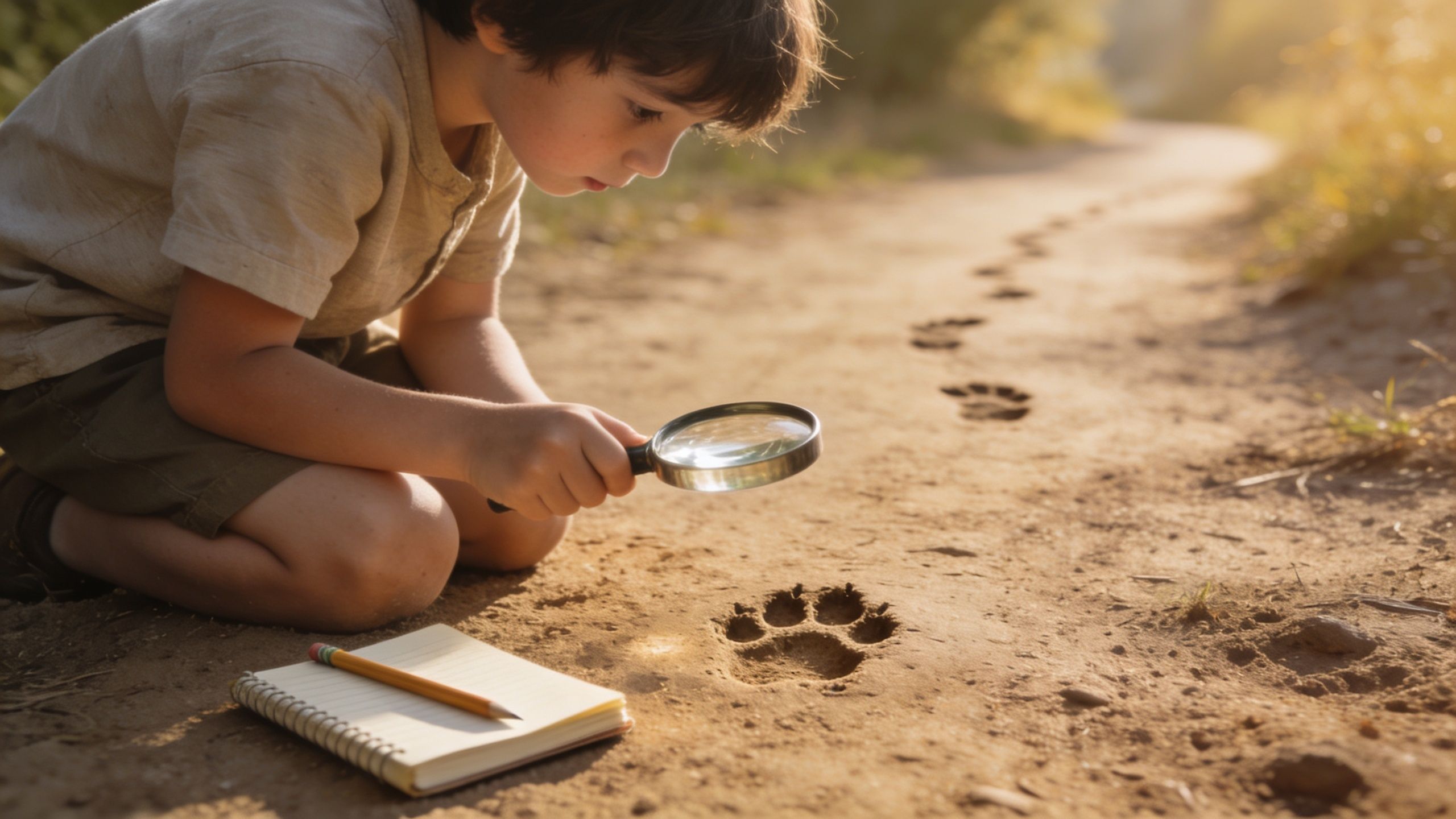
Tracking games turn children into detectives. They stop. They look closely. They notice that something bent a leaf, pressed into mud, or left behind a feather. That quiet observation is powerful.
Outdoors, you can search for real signs of animal life such as footprints, nests, nibbled leaves, or feathers. Indoors, you can build a tracking trail with paper prints, toy clues, and little evidence cards.
Alt text: animal games for children with outdoor animal tracking
What makes it work
Children need a reason to follow the clues. Try this setup. “A creature has escaped from the cargo bay. It’s crossed the playground. Can you work out what it is and where it’s gone?”
Good clues include:
- Footprints: Different sizes and shapes.
- Food signs: Half-eaten leaf, nutshell, pretend berries.
- Body clues: Fur, feathers, scales made from craft materials.
- Habitat hints: Nest, den, pond, tree hollow.
In 2025, a Childwise Monitor survey found 68% of UK parents were seeking active animal play that also supports STEM curiosity, according to the Childsplay in Action piece on animal games. Tracking fits that beautifully because it gets children moving, questioning, and making evidence-based guesses.
Keep a tracker’s log
Ask children to draw what they found, write where they found it, and decide what it might mean. Even one sentence helps. “I found three small prints near the fence, so I think a small animal crossed there.”
This mission doesn’t need expensive gear. A magnifying glass helps. So does a clipboard if you want children to feel properly official. Clipboards have magical powers in education. Hand one over and suddenly everyone becomes very serious.
8. Mission 8 Animal Character Story-Building
What happens when a child speaks as a moon penguin, worries like a fox, or stomps about as a grumpy Martian tortoise? Language starts to move. Ideas start to stick. Story-building turns animal play into a small expedition through feelings, choices, and cause-and-effect.
This mission works like a training simulator for literacy. Children give an animal a voice, a goal, and a problem. Suddenly they are practising speaking, listening, reading, writing, and empathy all at once. Quite a lot for one cardboard beak.
Build the character first
Start small. Ask one clear question. “Who is this animal, and what does it want today?”
That question helps children avoid a common wobble. They often invent a funny creature first, then get stuck. A simple character frame gives the story somewhere to go.
Try these launch points:
- Role-play the animal: How does it move, sound, and react?
- Make a simple prop: A mask, puppet, tail, or paper ears can help children stay in role.
- Use a story opener: “I woke up in my nest and noticed…”
- Add a mission problem: The food has vanished. A storm is coming. Space Ranger Fred needs help on the red dust moon.
As noted earlier, animal play supports communication beautifully because children must explain needs, solve problems, and respond to other characters. One child might say, “I am a hedgehog and I need somewhere safe.” Another replies, “I am Ranger Fred. I can help you build a shelter.” That is storytelling, but it is also planning, perspective-taking, and oral language practice.
For children who enjoy familiar faces, the Space Ranger Fred post on animal cartoons characters can spark ideas for voices, expressions, and costume details. You can also borrow prompts from Kubrio's storytelling activities.
Shy children often find this mission easier with a puppet in hand. The puppet does the talking first. Then the child joins in. It is a lovely little piece of classroom magic.
For the Fred variation, give each child a space-animal identity card. A squirrel engineer. A comet koala. A nervous moon penguin who has lost the star map. Then give the crew one goal. Repair the ship. Find the missing supplies. Rescue the baby nebula rabbits. The sillier the setup, the better the sentences usually become.
9. Mission 9 The Adaptation and Evolution Challenge
Older children are ready for a harder question. Not just “What is this animal?” but “Why is it built that way?”
That’s where adaptation games come in. Give children an environment first. Then ask them to design a creature that could survive there. Ice world. Dust planet. Swamp moon. High-gravity canyon. Pick one and let their brains get to work.
Ask survival questions
A strong creature design usually begins with a few practical prompts:
- How will it move? Crawl, hop, glide, swim, burrow?
- How will it stay safe? Camouflage, armour, speed, spikes?
- How will it eat? Sharp beak, long tongue, filter mouth, claws?
- How will it cope with the climate? Fur, fat layer, scales, large ears?
Children love this because it feels like invention, but it also builds scientific reasoning. Features should match environment. Big fluffy fur on a lava planet is a brave choice. Not a wise one.
For younger older children, compare with real creatures first. Desert animals, Arctic animals, deep-sea animals, and woodland animals all show how bodies suit habitats. Then let children create their own “evolved” creature from those clues.
If your class already enjoys prehistoric themes, the Space Ranger Fred post on dinosaur games for children can help bridge from ancient creatures to adaptation thinking.
There’s also a digital angle worth noting. UK-specific adoption rates for animal games in nursery and early years settings reached 42% in 2025, and UKIE’s 2025 games research reported satisfaction scores of 91 out of 100 for conservation-themed animal games, according to the global animal simulators market analysis. That suggests children respond strongly when games connect creatures, environment, and care for the natural world.
10. Mission 10 Creative Creature Construction
What would your child discover if Space Ranger Fred asked them to design a brand-new beast for a strange planet?
This mission turns art time into a science expedition. Children draw, sculpt, snip, glue, and test ideas with their hands. While they work, they start noticing the fine details that make animals work. Claws for gripping. Tails for balance. Whiskers for sensing. Suddenly, a lump of clay becomes a lesson in biology.
Build a beast with a purpose
Ask children to create one of two things. A real animal they study closely, or an invented creature for one of Space Ranger Fred’s far-off worlds. Then give the mission its scientific twist. Every feature needs a job.
That is where the learning gets exciting.
If a child adds giant ears, ask what those ears do. If they add a shell, ask what danger the creature faces. If it has webbed feet on a dry desert planet, pause and explore that choice together. Young builders are not just making something cute. They are practising cause and effect.
Useful materials include:
- Drawing tools: Pencils, felt tips, crayons, chalk pastels
- Collage bits: Tissue paper, foil, fabric scraps, feathers
- Modelling materials: Clay, dough, recycled packaging
- Reference images: Real animal photos for close looking
A simple Space Ranger Fred variation works brilliantly here. Give each child a mission card with a planet problem, such as icy storms, low gravity, deep caves, or sticky purple swamps. Then ask them to build a creature that could survive there. The creature becomes a mini engineering project in disguise. Very sneaky. Very teacher-friendly.
Creative construction also supports language development. Children explain choices, defend ideas, and describe how their creature lives. That explanation matters as much as the artwork. A paper creature with six legs is fun. A paper creature with six legs because it needs stability on a rocky moon is science thinking.
Turn artwork into a mission gallery
Display each finished creature with a short mission file beside it. Include its name, habitat, diet, special body feature, and one survival challenge it can overcome. This helps children move from “I made it” to “I understand it.”
You can add one more playful step. Let children present their creature as if they are junior space biologists reporting back to Space Ranger Fred. A few will take this very seriously. Expect dramatic voices. Possibly antennae.
That is a good sign. When children care about the creature they built, they remember the science behind it.
10-Mission Childrens Animal Games Comparison
| Mission | Implementation complexity | Resource requirements | Expected outcomes | Ideal use cases | Key advantages |
|---|---|---|---|---|---|
| Mission 1: Alien Creature Classification | Moderate, rule sets and progression design | Low–Medium, cards or digital platform | Taxonomy, observation, critical thinking | Classroom STEM lessons, small groups | Adaptable, scalable, collaborative |
| Mission 2: The Creature Mimicry Challenge | Low, simple instructions and supervision | Minimal, open space, optional music | Gross motor skills, coordination, body awareness | Nursery, early years, PE breaks | Inclusive, low-cost, movement-focused |
| Mission 3: Interplanetary Habitat Engineering | High, planning, research, assessment rubrics | Medium–High, building materials or software, time | Engineering design thinking, problem-solving | Maker spaces, STEM projects, long-term units | Hands-on, tangible results, sustainability focus |
| Mission 4: Echo-Location & Sensory Training | Moderate, careful sensory design and safety | Medium, quality audio, tactile materials | Auditory discrimination, memory, sensory awareness | Inclusive classrooms, sensory sessions | Multi-modal engagement, accessibility |
| Mission 5: The Galactic Food Chain Game | Medium, role mechanics and scenario setup | Medium, space, props, tracking materials | Systems thinking, ecology, cause-and-effect | Upper primary science, workshops | Memorable, interactive ecosystem simulation |
| Mission 6: Animal Fact-Finding Frenzy | Low, quiz design and scoring setup | Low, flashcards or digital quiz tools | Factual recall, rapid retrieval, engagement | Library programs, classroom review sessions | Easy to implement, highly scalable |
| Mission 7: The Alien Tracker Expedition | Moderate, trail planning and safety considerations | Low–Medium, outdoor access, guides, documentation tools | Observation skills, field inference, confidence | Outdoor education, family events, forest school | Promotes exploration and real-world learning |
| Mission 8: Animal Character Story-Building | Low–Medium, facilitation and prompts | Low, costumes, puppets, props | Language development, empathy, creativity | Literacy lessons, drama activities | Builds communication and imaginative play |
| Mission 9: The Adaptation & Evolution Challenge | High, conceptual scaffolding and simulation rules | Medium, materials or digital tools, teacher guidance | Understanding adaptation, natural selection, systems thinking | Upper primary/secondary STEM units | Deep conceptual learning, experimental design |
| Mission 10: Creative Creature Construction | Low–Medium, art facilitation and critique | Medium, multi-media art supplies, display space | Fine motor skills, creative expression, reflection | Art sessions, calm-down activities, exhibitions | Inclusive, tangible creative outputs |
Your Next Mission, Should You Choose to Accept It…
What happens when a child stops being a student for a moment and becomes Space Ranger Fred’s chief animal expert?
Play starts doing some very clever work.
These ten missions turn animal games for children into a story-led expedition through science, language, art, movement, and problem-solving. One mission asks children to sort alien creatures like young biologists. Another invites them to build habitats like tiny planetary engineers. A different one gets them listening like bats, tracking like field researchers, or storytelling like explorers sending reports back to base.
That shift matters. A worksheet asks for an answer. A mission gives a child a reason to care about the answer. It works like putting a rocket under curiosity. Suddenly, “Why does this creature have wide feet?” is not a random question. It is a survival puzzle on a dusty moon.
I’ve seen quiet children come alive in these kinds of games. A child who shrugs at a science prompt may happily explain why a cave creature needs huge ears. A child who hesitates during writing may speak in full character as an astronaut hedgehog filing an emergency habitat report. The story gives them cover. The learning sneaks in wearing a space helmet.
Each mission also teaches something different, which is why the set works so well together. Classification sharpens noticing and comparing. Mimicry builds coordination and body awareness. Habitat engineering joins animal needs with design choices. Sensory training strengthens listening and descriptive language. Food chain play helps children see connections and consequences. Fact-finding improves recall. Tracking builds patience and inference. Story-building grows empathy and communication. Adaptation challenges stretch reasoning. Creature construction helps children turn ideas into something visible and explainable.
You do not need a futuristic lab full of blinking buttons. Although I would never refuse one. A few simple materials, a clear mission brief, and some room for children to test ideas is plenty.
For families, that means after-school play can become richer without becoming harder. For teachers, librarians, and group leaders, it means one playful theme can support several learning goals at once. For children, it still feels like fun first. That is the secret fuel.
A helpful mission rhythm looks like this:
- I notice. The child spots patterns, details, or problems.
- I test. The child tries an idea, changes it, and tries again.
- I explain. The child puts their thinking into words.
- I remember. The child keeps the idea because they used it, not just heard it.
That explaining stage is where the stars really sparkle. When a child can tell you why their alien animal needs camouflage, why a habitat failed, or why one creature depends on another for food, they are no longer repeating facts. They are building understanding.
If you want to keep the adventure going, the Space Ranger Fred book series offers a playful way to revisit these ideas through story, humour, and exploration. School visits can also bring the missions into a shared live experience through interactive storytelling, STEM discussion, reading engagement, and confidence-building.
Start with one mission. That is enough.
One game can spark a question. One question can lead to an experiment, a drawing, a story, or a trip outdoors to look more closely at the natural world. That is a fine result for any classroom, library, or living room on this little blue planet.
Learning is strongest when children can move through it, talk through it, and laugh through it too. Space Ranger Fred would approve.