
When we talk about critical thinking, what we’re really talking about is teaching kids how to think, not what to think. It's about moving beyond simply memorising facts and figures.
Instead, we want to encourage them to be observers, to analyse what they see, and to solve problems like little detectives. It’s this shift that turns them from passive learners into active, curious explorers of their world.
Why Critical Thinking Is Your Child's Superpower

Think about it this way: when your child is playing with a toy car, are they just pushing it around, or are they a tiny engineer trying to figure out why one of the wheels is stuck? That’s critical thinking in action.
My goal here isn't to give you a bunch of boring lessons. It's to show you how to unlock this real-world superpower in your kids—a skill that will help them with everything from school projects to navigating the flood of information they see online. We’ll look at how to nurture their natural curiosity through everyday adventures, turning simple moments into powerful learning opportunities.
Beyond Rote Memorisation
In a world overflowing with information, just being able to remember facts isn't enough anymore. The real skill is being able to sift through it all, figure out what's credible, and come to your own well-reasoned conclusions.
This is where critical thinking really shines. It gives children the tools to:
- Look at problems from all angles: They learn to see beyond one simple answer and start exploring different possibilities and perspectives.
- Question everything: They begin to understand that not everything they hear or read is automatically true—a vital defence against misinformation.
- Connect the dots: They might see how a concept from a science lesson, like friction, relates to a problem they're solving with their LEGOs.
Making that leap from memorisation to genuine analysis is a game-changer for their academic and personal growth. It’s the difference between just knowing a fact and truly understanding it.
Fostering critical thinking isn't just an extra; it's at the very heart of a child's education. It builds intellectual independence and gets them ready to tackle complex challenges with confidence and creativity.
Everyone seems to agree on how important this is. A 2020 survey found that a massive 94% of people believed critical thinking was extremely or very important. The catch? The same study showed that 60% had never formally studied it in school. This just highlights the massive role parents and carers can play in building this skill from an early age. You can learn more about these critical thinking findings here.
We’ll see how even simple stories, like those in the Space Ranger Fred and the Shoelace Adventure book, can spark the kinds of conversations that lay the groundwork for a lifetime of smart thinking. By turning learning into an adventure, the whole process feels less like a chore and more like an exciting discovery.
Build a Foundation by Questioning Everything

At the very heart of critical thinking is the simple act of asking questions. It sounds obvious, I know, but there's a world of difference between just telling kids to 'be curious' and actively showing them how to ask the kind of powerful, probing questions that unlock real understanding.
Kids are naturally brilliant at asking "what" questions. "What is that?" or "What does this button do?" are their bread and butter. These are fantastic starting points for gathering facts, but the real magic happens when we nudge them towards asking "why" and "how". That’s where they start to untangle systems, consequences, and the invisible threads connecting ideas.
Moving From 'What' to 'Why'
Picture this: your child is building a block tower. They might ask, "What are these blocks made of?" That’s a classic 'what' question, and it's a good one. But to really get those critical thinking gears turning, we need to go deeper.
The perfect moment arrives when the tower inevitably tumbles down. Instead of just sighing and rebuilding, you can use this little disaster to your advantage. Suddenly, the question isn't about the blocks themselves, but about the physics of the situation. The crucial question shifts from a simple observation to a genuine investigation: "Why did my tower fall over when I put the small block at the bottom?"
That single question cracks open a whole world of concepts like gravity, balance, and structural integrity, all without you ever needing to use those big, scary words. They're discovering the principle for themselves, which is a far more powerful way to learn. This whole process is a cornerstone of what we call inquiry-based learning, where children lead their own discovery through curiosity.
Using Conversational Prompts
You don't need a formal lesson plan for this; you just need to become a facilitator of their thinking. Your job is to model the questioning process and explore the possibilities with them, not just hand them the answers.
Here are a few prompts I love to weave into everyday chats:
- "What do you think would happen if…?" This gets them making predictions and thinking about cause and effect. "What do you think would happen if we used saltwater to water our house plants?"
- "How could we find out?" This is a huge one. It teaches them that knowledge isn't just given; it's something you actively seek out. It empowers them to think like a researcher, whether that means grabbing a book or just looking a bit closer.
- "What does this remind you of?" This helps them forge connections between new information and what they already know—a vital part of analysis.
- "Can you tell me a bit more about why you think that?" This simple prompt encourages them to articulate their reasoning, helping them organise their thoughts and build a logical argument.
By turning statements into questions, we invite children to become active partners in their own learning. Instead of saying, "A heavy base makes a tower stronger," we can ask, "What have you noticed about the towers that stay up the longest?"
It’s a technique you see in great children's stories all the time. In my book, Space Ranger Fred and the Shoelace Adventure, Fred doesn't just keep re-tying his laces over and over. His big breakthrough comes when he finally stops and asks why they keep coming undone. That shift—from just reacting to a problem to investigating its root cause—is a perfect example of critical thinking in action. Fred has to analyse the situation, question his methods, and experiment with a better solution.
This approach transforms everyday moments into powerful exercises in logic and reasoning. You're not just answering their questions; you're teaching them the invaluable skill of how to ask better ones.
Learn to Connect Clues and Draw Conclusions
Once your child gets comfortable asking deeper questions, it’s time to help them become a detective in their own world. This is where they leap from simply gathering information to actually figuring out what it all means. It's about connecting the dots, spotting patterns, and really understanding that actions have consequences.
And you don't need a complicated science lab for this. Your own kitchen will do just fine. Honestly, everyday activities are packed with opportunities to practise this skill in a low-pressure, hands-on way.
Turn Everyday Moments into Investigations
Let's say you're baking a cake together and it comes out of the oven disappointingly flat. The knee-jerk reaction is to say, "Oh well, that didn't work!" and bin it. But hold on—this is a golden opportunity.
Instead of just shrugging it off, you can guide them through a mini-investigation:
- "Hmm, what do you think happened here?"
- "Let's think back. What did we do differently this time?"
- "Did we forget something? Let's check the recipe again."
- "What does baking powder actually do in a cake, anyway?"
Suddenly, a flat cake isn't just a baking fail; it's a puzzle to be solved. They're learning about cause and effect in a way they can see, touch, and even taste. That kind of hands-on analysis sticks with them far better than just reading about chemical reactions in a book.
This kind of questioning is what builds real analytical skills. The chart below gives a good sense of the best mix of questions to use to get them thinking deeply.
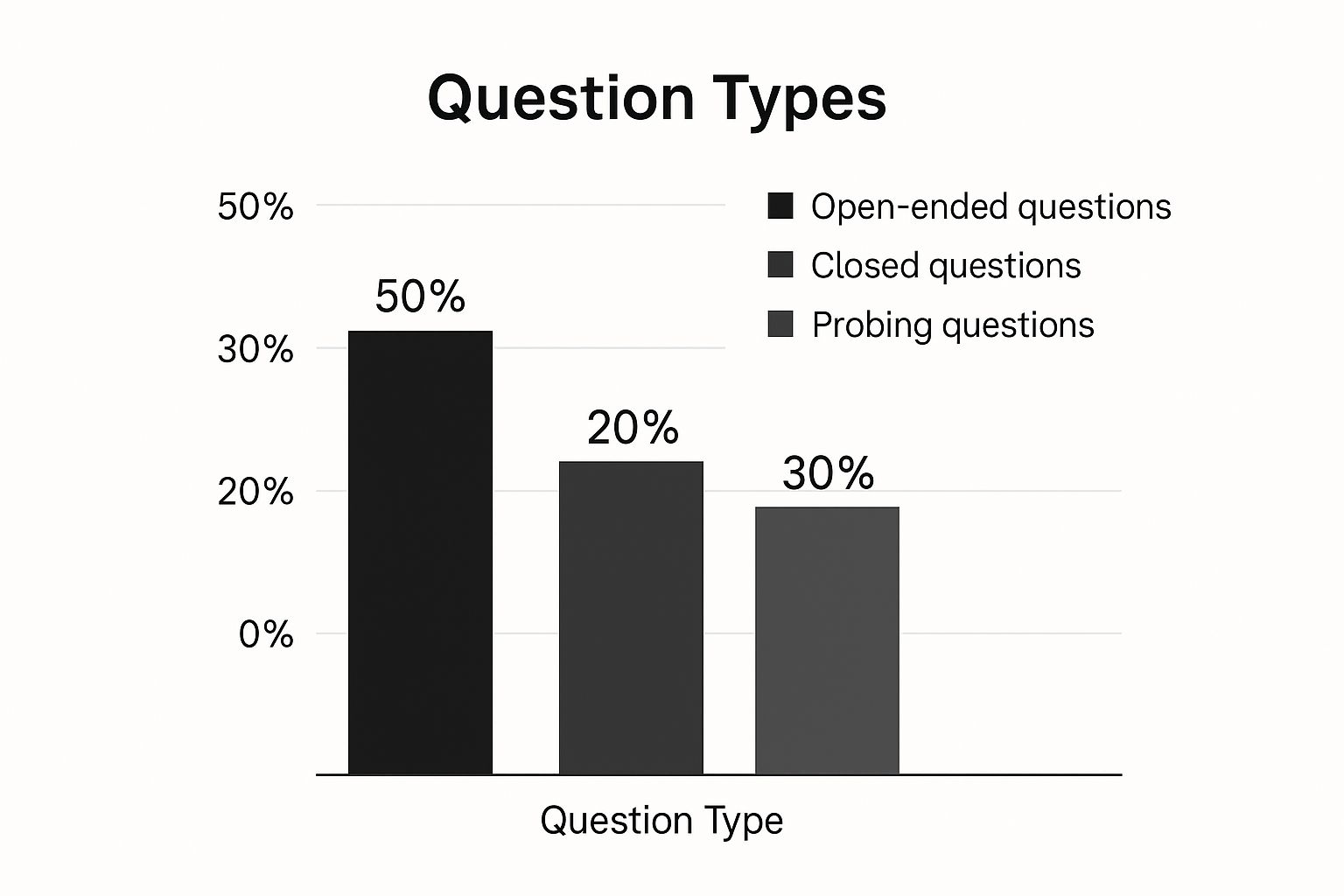
As you can see, open-ended questions should be your bread and butter. They give kids the space to explore their own ideas without worrying about getting the 'wrong' answer.
Become a Story Archaeologist
Reading together is another fantastic way to work on drawing conclusions. I like to think of it as 'story archaeology'—you're digging beneath the surface of the words to uncover hidden meanings, clues, and motivations. This is where the power of inference really comes alive.
A book like Space Ranger Fred and the Umbrella Rescue is perfect for this. As you read, you can pause and ask questions that make your child use clues from both the text and the pictures:
- "Why do you think that little alien needs an umbrella on a sunny planet?"
- "Are there any clues in the pictures that suggest rain might be coming later?"
- "Fred looks a bit worried on this page. What do you think he's thinking about?"
These aren’t simple comprehension questions with one right answer. They nudge your child to piece together information, make educated guesses, and then back up their ideas with evidence from the story. This is exactly how to develop critical thinking through stories.
By asking questions that demand a bit of guesswork, you're teaching your child that stories—and the world—are full of clues. Their job is to find them, piece them together, and figure out what they mean.
Matching Activities with Thinking Skills
To make this all a bit more intentional, it helps to see exactly how certain activities build different analytical skills. You're probably already doing a lot of these things, but when you realise the skills they foster, you can be more deliberate in your approach.
Here’s a simple breakdown of some common activities and the thinking skills they naturally strengthen.
Everyday Activities to Boost Critical Thinking
| Activity | Core Skill Practiced | Example Question to Ask |
|---|---|---|
| Cooking or Baking | Cause and Effect | "What would happen if we used salt instead of sugar?" |
| Playing a Board Game | Strategic Planning | "If you make that move, what do you think I will do next?" |
| Building with LEGOs | Problem-Solving & Analysis | "Why does the tower keep falling? What could make the base stronger?" |
| Observing Nature | Pattern Recognition | "Why do you think spiders build their webs in these specific spots?" |
By consciously weaving these little investigative moments into your routine, you help your child build the mental muscles needed to analyse information and form logical conclusions. They start to learn that their observations matter and, most importantly, that they have the power to figure things out for themselves.
Master Thinking from Different Angles

One of the biggest leaps in critical thinking is the realisation that there's rarely just one way to look at a problem. Kids, especially, have a strong sense of fairness that can lead to very black-and-white thinking. Helping them see the world in shades of grey is a powerful step in their analytical development.
This is all about teaching them to consider multiple perspectives before jumping to a conclusion. It’s about building the mental flexibility to step into someone else’s shoes, which nurtures empathy right alongside logic.
From Disagreements to Discoveries
Playground squabbles and arguments over game rules are the perfect, real-world laboratories for this skill. Instead of immediately playing referee, you have a golden opportunity to guide them through a completely different kind of problem-solving.
Think about a classic scenario: a dispute over whether a player was 'out' in a game of tag. Rather than focusing on who’s right, you can shift the conversation with a few gentle questions:
- "Let's pause for a second. What's your friend's side of the story?"
- "Why do you think they might see it that way from where they were standing?"
- "Is there another way we could look at the rule to make it fair for everyone next time?"
This simple shift changes the goal from winning an argument to understanding a situation. It’s no longer about being right; it’s about figuring out why the disagreement happened in the first place.
A Simple Framework for Seeing the Whole Picture
To make this a habit, you can introduce a simple framework they can use for almost any problem, from a friendship tiff to a tricky homework question. Think of it as a mental checklist to run through.
- What's the real problem here? Help them get past the surface-level frustration to find the core issue.
- What are all the possible viewpoints? Encourage them to brainstorm every angle, even the silly ones. This is about creative thinking, not just being right.
- What facts do we have? Get them to separate what they know for sure from what they feel or assume.
- What could we try? Come up with a few different solutions together.
- Which one feels best and why? This final step asks them to weigh their options and explain their choice.
This structure helps children slow down and move away from those impulsive, single-minded reactions. It gives them a reliable process for untangling complex situations.
This approach is a huge step up from traditional, one-answer methods. In the UK, 84% of teachers now support using simulation-based exams because they are better at engaging higher-order thinking and problem-solving skills. Learn more about these UK education statistics.
Learning from Space Ranger Fred
This idea of exploring multiple possibilities is a theme we see in great stories. In the book Space Ranger Fred and the Tick Tock Tale, Fred discovers a planet where the giant town clock is running backwards. His first instinct might be to assume it's simply broken.
But Fred is a brilliant critical thinker. He doesn't just stop at the first, most obvious answer. Instead, he has to consider all sorts of wild possibilities: Is it a prank? Is time itself behaving strangely on this planet? Could there be a creature messing with the gears for a reason he doesn't understand?
By investigating many different angles—some logical, some fantastical—Fred eventually uncovers the real, unexpected cause of the problem. His adventure shows kids that the first idea isn't always the best one, and that exploring different perspectives is the key to finding the right solution. Using stories like this helps frame perspective-taking not as a chore, but as an exciting part of solving a mystery.
Assemble Your Critical Thinking Toolkit
Alright, we’ve covered a lot of ground—from asking better questions and connecting clues to looking at problems from completely new angles. Now it's time to pull all these fantastic ideas together into a practical action plan you can start using with your family today.
Think of this as your family's very own 'Critical Thinking Toolkit'.
This isn't about piling more onto your already packed schedule. Far from it. It's about weaving small, fun, and intentional habits into the everyday rhythm of your life. These simple activities help create a home where curiosity is celebrated and thinking deeply becomes second nature.
Create a Question of the Day Jar
One of my favourite tools, because it's so easy and effective, is a 'Question of the Day' jar. This is just a brilliant way to get conversations started, especially around the dinner table when you’ve finally got everyone in one place.
All you do is write a mix of fun, silly, and genuinely thought-provoking questions on small slips of paper and pop them into any old jar. Each night, someone pulls out a question, and everyone gets a chance to share their thoughts. The goal isn’t to find one ‘right’ answer, but to see how many different ideas you can all come up with.
Here are a few STEM-focused ideas to get you going:
- If you could invent a robot to do one chore, what would it be and how would it work?
- What would happen to Earth if gravity suddenly turned off for five seconds?
- If you were designing a new mission for Space Ranger Fred, what problem would he need to solve on a new planet?
This simple ritual does more than just fill the silence; it encourages creative thinking and shows your child that their unique ideas are valued. It strengthens that crucial link between asking questions and discovering amazing new possibilities.
Host a Fun Family Debate Night
Debates don't have to be serious, stuffy affairs. In fact, when you're doing it with kids, the sillier the topic, the better! A regular 'Debate Night' is a brilliantly playful way to practise forming an argument, digging for evidence, and—most importantly—seeing things from someone else's point of view.
Pick a light-hearted topic like "Is Pluto a planet?" or "Would it be cooler to have a teleportation device or a time machine?". Assign sides (or let everyone choose) and give each person a few minutes to state their case. The key is to keep it fun, light, and respectful.
This activity is pure gold for teaching children how to structure their thoughts logically. They learn to move beyond just saying "because I said so" and start using actual reasons and examples to support what they believe. It’s a foundational skill for school and for life.
The importance of this kind of structured thinking is being recognised more and more. When the Critical Thinking AS level was introduced here in the UK, participation grew tenfold in just eight years, from around 2,000 to over 22,000 candidates by 2009. That tells you a lot about how valuable these skills are, and reinforces why it's so great to nurture them at home. You can read the full research on the growth of Critical Thinking education if you're curious.
Practise Analysing Information Together
We are all absolutely surrounded by information, from news headlines and school reports to YouTube videos and TikTok trends. Learning to sift through it all and analyse it properly is probably one of the most vital skills they'll ever need. You can practise this together in really simple, everyday moments.
Next time you see a commercial on TV or an ad online, just pause and have a quick chat about it. Ask questions like, "What is this advert trying to make us feel?" or "Who do you think they made this for?". This helps them see that messages are almost always created with a specific purpose and audience in mind. It's a huge step towards becoming a savvy consumer of information. These skills are also closely tied to building rock-solid problem-solving abilities. For more on that, check out our guide on how to develop problem-solving skills.
This whole journey is about making small, consistent efforts—not about achieving perfection overnight. By using these simple tools, you’re giving your child one of the most valuable gifts imaginable: a curious, adaptable, and creative mind, ready for any adventure life throws their way.
Common Questions About Critical Thinking
As you start this journey, it’s completely normal to have a few questions. I get asked these all the time. Think of this as a quick chat to clear up some of the common uncertainties and give you a bit more confidence as you guide your child.
At What Age Should I Start Teaching Critical Thinking?
Honestly, you can start laying the groundwork much earlier than most people realise—even around age three or four. For toddlers, it’s all about nurturing that raw, unfiltered curiosity. It’s that constant stream of ‘why?’ questions that builds the very first foundation for real inquiry.
For the 6–12 age range this guide is really aimed at, you can bring in more structured activities without ever losing that element of play. The secret is keeping it age-appropriate. For example, a six-year-old would have a fantastic time just comparing two different leaves they found on a walk—spotting differences in colour, shape, and texture.
A twelve-year-old, on the other hand, is ready for something more complex. They can start analysing a character's motivations in a book or film. The goal isn't to run formal lessons. It’s about weaving an analytical mindset into the fabric of your everyday life, turning ordinary moments into brilliant learning opportunities.
What if My Child Gets Frustrated or Gives a Wrong Answer?
This isn’t just a common question; it's one of the most important ones. When your child gets frustrated or lands on a wrong answer, it's actually a golden learning moment in disguise. The real goal here isn’t just about getting the 'right' answer, but about embracing the process of thinking itself.
If they start to get bogged down, the best thing you can do is praise their effort. Simple phrases like, "I love how hard you're thinking about that," can make all the difference. It shifts the focus from the outcome to the hard work they’re putting in.
When an answer is incorrect, try to resist the urge to correct them straight away. Instead, gently guide them with more questions to help them rethink their own logic. You could try something like, "That's a really interesting idea! What do you think would happen if we tried it that way?"
This approach transforms mistakes from something to be feared into simple experiments. It reframes a 'wrong' answer as just another piece of data, keeping their confidence—and more importantly, their curiosity—fully intact.
It’s a skill that takes a bit of practice on our part as parents, but it's one of the most powerful ways to show them that thinking is a safe and exciting adventure. This is exactly how to develop critical thinking in a way that also builds resilience.
How Can I Make This Fun and Not Like a School Lesson?
The absolute key is to weave these ideas into activities your child already loves. Use their passions as the vehicle for learning. If you can connect critical thinking to their world, it will never feel like a chore.
Are they obsessed with video games? Use that! Chat about strategy with them: "Why do you think that move worked so well? What could you try differently next time to get past this level?". If they enjoy art, talk about their creative choices: "Why did you choose blue for the sky here? What does that colour make you feel?".
Reading stories together is another fantastic and almost effortless method. Sharing a book provides endless opportunities to get them thinking.
While reading, you can pause and ask engaging questions:
- "What do you think is going to happen next?"
- "Why do you think the character made that decision?"
- "If you were in their shoes, what would you have done?"
The secret is to keep it playful and driven by their own curiosity. When you make thinking a game, you're not just teaching a skill; you're giving them a lifelong love for learning and discovery. For even more ideas, you can find additional resources on critical thinking on our blog.
At Space Ranger Fred, we believe every child has the potential to be a great thinker. Our books and stories are designed to spark that curiosity and make learning a thrilling adventure. Explore our universe and join us in inspiring the next generation of explorers and problem-solvers at https://spacerangerfred.com.