Finding the right children's online math games can feel like navigating an asteroid field. You want something fun enough to hold your child's attention but educational enough to make a real difference, right? Let's be honest, the best games are powerful tools for building foundational STEM skills like logic, problem-solving, and numerical fluency. But with so many options out there, how do you choose the one that truly fits your child's needs?
This guide is designed to help you make an informed decision without the guesswork. We’ve explored the vast universe of online maths resources to bring you a curated list of the top 12 platforms for UK families and primary school classrooms. For each one, we provide a practical, honest assessment, complete with screenshots, direct links, and insights into what they do best. We'll show you which games excel at teaching specific topics and how storytelling, like in the adventures of Space Ranger Fred and the Tick Tock Tale, can transform learning concepts like time-telling into an exciting mission rather than a chore.
Prepare for launch as we explore the best platforms that make maths an adventure, helping you find the perfect fit to boost your child’s confidence and skills.
1. Space Ranger Fred – Home
Space Ranger Fred™ represents a comprehensive and story-driven approach to STEM education, making it a standout choice for parents and educators seeking high-quality children's online math games. Unlike platforms that rely solely on drills, this edutainment universe integrates crucial maths concepts directly into engaging narratives, ensuring learning is both contextual and memorable for children aged 6–12. The brand’s multi-platform strategy, spanning books, animation, and an upcoming interactive game, creates a cohesive and immersive educational experience.
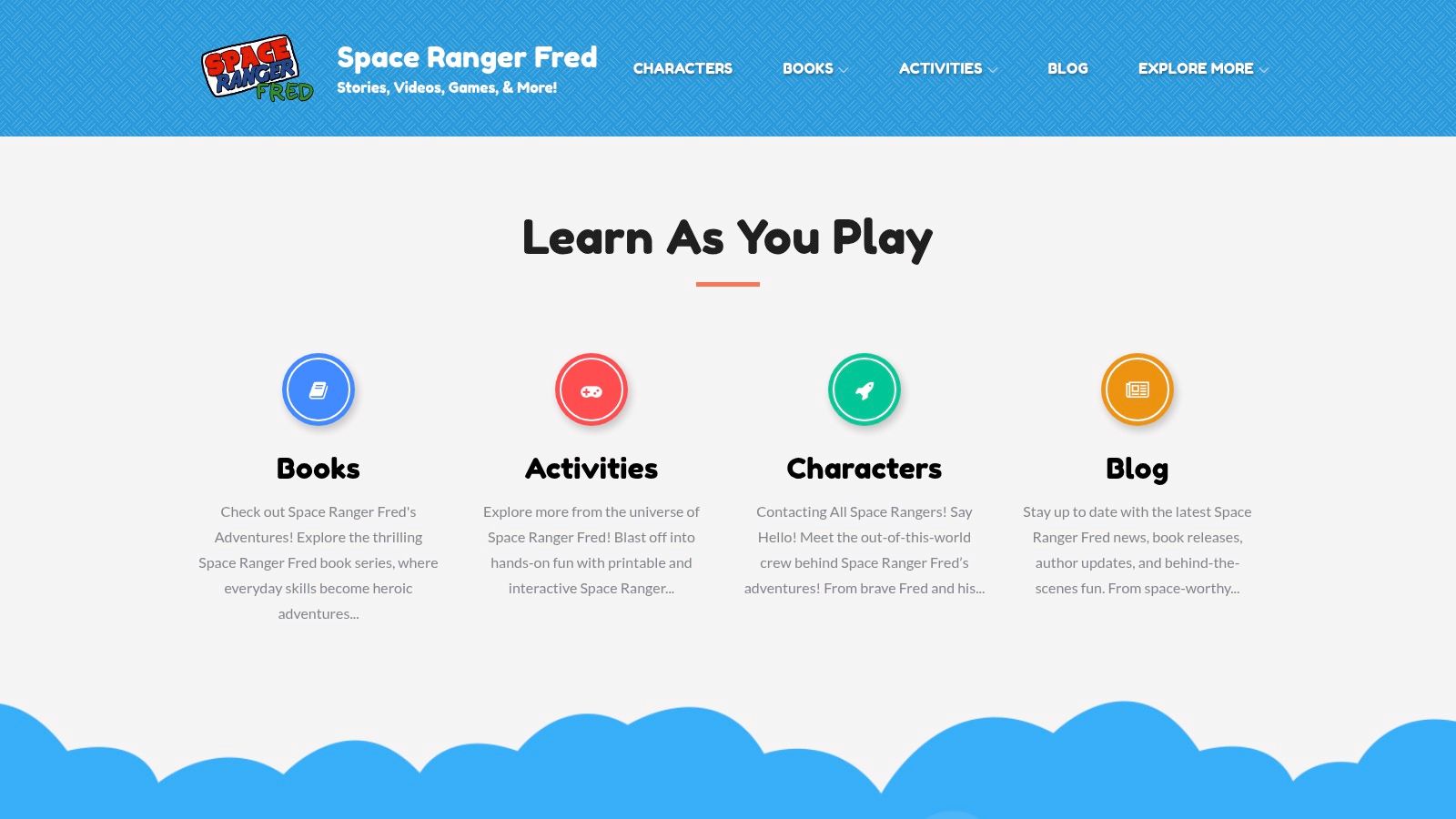
The core strength lies in its ability to make complex topics accessible and fun. For instance, the book Space Ranger Fred and the Umbrella Rescue masterfully weaves concepts like physics and problem-solving into a thrilling space adventure, transforming a potentially tricky STEM skill into a captivating quest. This narrative-first method encourages children to engage with problems organically, fostering critical thinking rather than rote memorisation.
Key Features and Strengths
The platform is designed to build a deep, lasting interest in STEM. Here’s how it excels:
- Integrated STEM Learning: Mathematical concepts are not isolated exercises but are essential plot points within the stories. This seamless integration helps children understand the practical application of maths in a fun, pressure-free environment.
- Multi-Platform Universe: The experience extends beyond a single game. Children can read the books, watch animations, and soon, play an interactive game, which reinforces learning through diverse and interconnected activities.
- Focus on Foundational Skills: The content specifically targets key skills like time-telling, problem-solving, and logical reasoning, which are crucial for a child's development.
The website currently serves as the central hub for the brand’s expanding universe, offering access to its books and updates on the much-anticipated game. While the full suite of online games is still in development, the existing resources and educational philosophy firmly establish Space Ranger Fred as a premier destination for story-based maths learning.
| Feature Analysis | Assessment |
|---|---|
| Learning Approach | Narrative-driven; integrates maths into stories |
| Target Age Group | 6–12 years |
| Key Maths Skills | Time-telling, problem-solving, critical thinking |
| Platform Access | Free to browse website; books available for purchase |
Pros:
- Integrates maths and science seamlessly through storytelling.
- Multi-platform approach creates an immersive learning world.
- Targets a key developmental age for sparking STEM interest.
Cons:
- The main interactive computer game is not yet released.
- As an emerging brand, it has less content than established competitors.
Website: https://www.spacerangerfred.com/
2. BBC Bitesize (Primary Games and Maths Games)
BBC Bitesize is a trusted, free resource from the UK's national broadcaster, offering a fantastic collection of children's online math games that align directly with the UK curriculum. It provides a safe, ad-free environment where kids can dive into educational content without any registration or login. The platform is especially useful for reinforcing classroom learning at home in short, engaging bursts.
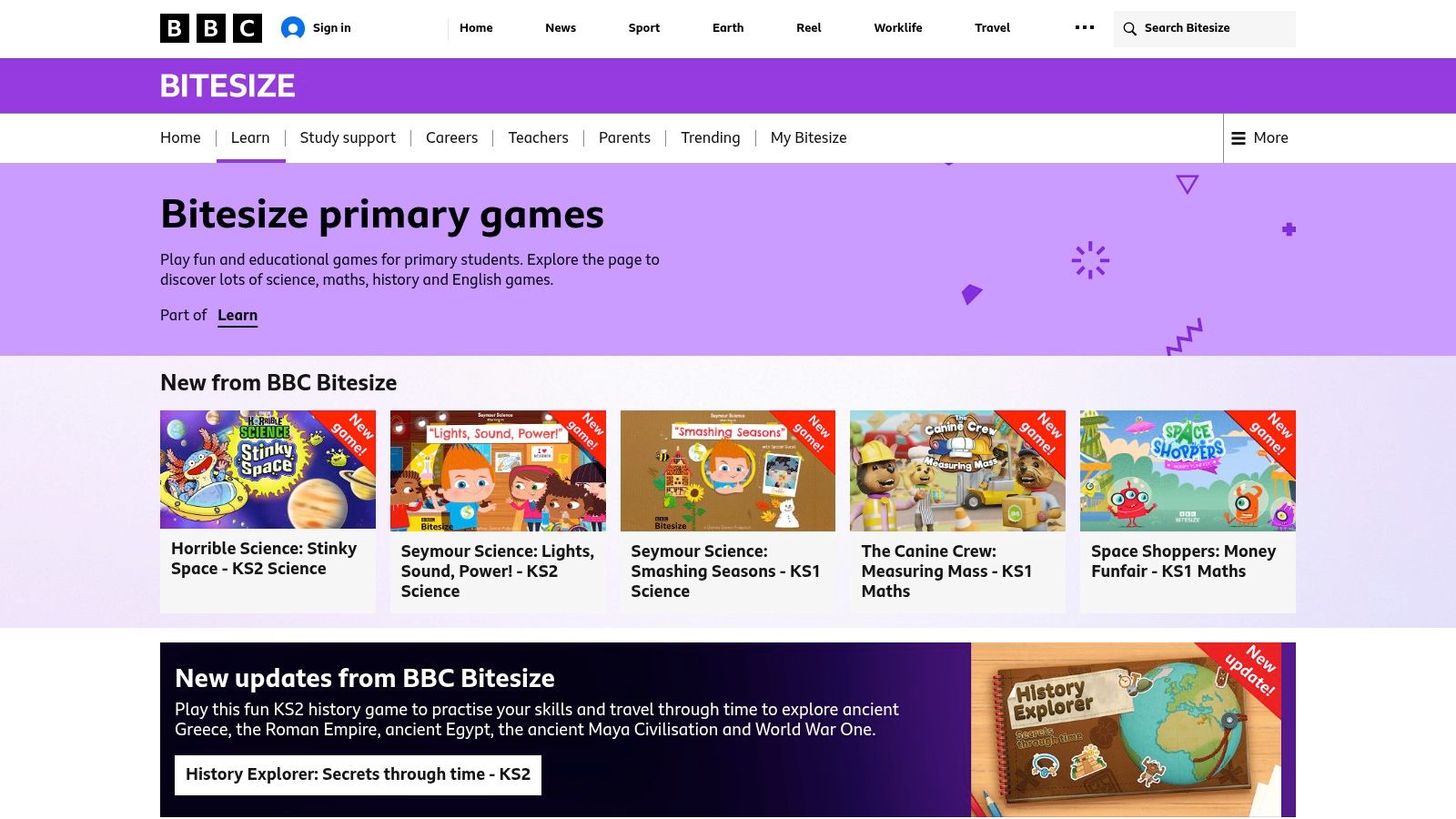
The games, like the popular Karate Cats Maths and Guardians: Defenders of Mathematica, cleverly blend skill practice with light narrative adventures. For instance, a child practising telling time to solve a puzzle in a game might also enjoy reading about a character like Fred in Space Ranger Fred and the Tick Tock Tale, which creatively links time-telling concepts to a fun story. This combination of interactive play and narrative helps make abstract concepts more tangible.
Key Features and Assessment
- Curriculum Alignment: Games are organised by Key Stage (from Early Years to KS3) and specific maths topics, making it simple for parents and teachers to find relevant content.
- Accessibility: Completely free with no ads, subscriptions, or sign-ups needed. It runs directly in a browser on most devices.
- Trust and Safety: As a BBC platform, it’s a highly reputable and safe online space for children.
Pros:
- Endorsed and widely used by UK schools.
- Excellent for quick, focused practice sessions.
- Covers a broad age range effectively.
Cons:
- Lacks a parent dashboard for progress tracking.
- The depth of content for each topic is lighter than dedicated paid platforms.
Website: https://www.bbc.co.uk/bitesize/primary-games
3. Topmarks
Topmarks is a highly respected UK-based directory that curates hundreds of free children's online math games. Think of it as a trusted portal, hosting its own original content and linking to quality third-party games, all organised by age and topic. The platform is incredibly popular with primary school teachers for its straightforward, no-frills approach to finding quick, topic-specific activities.
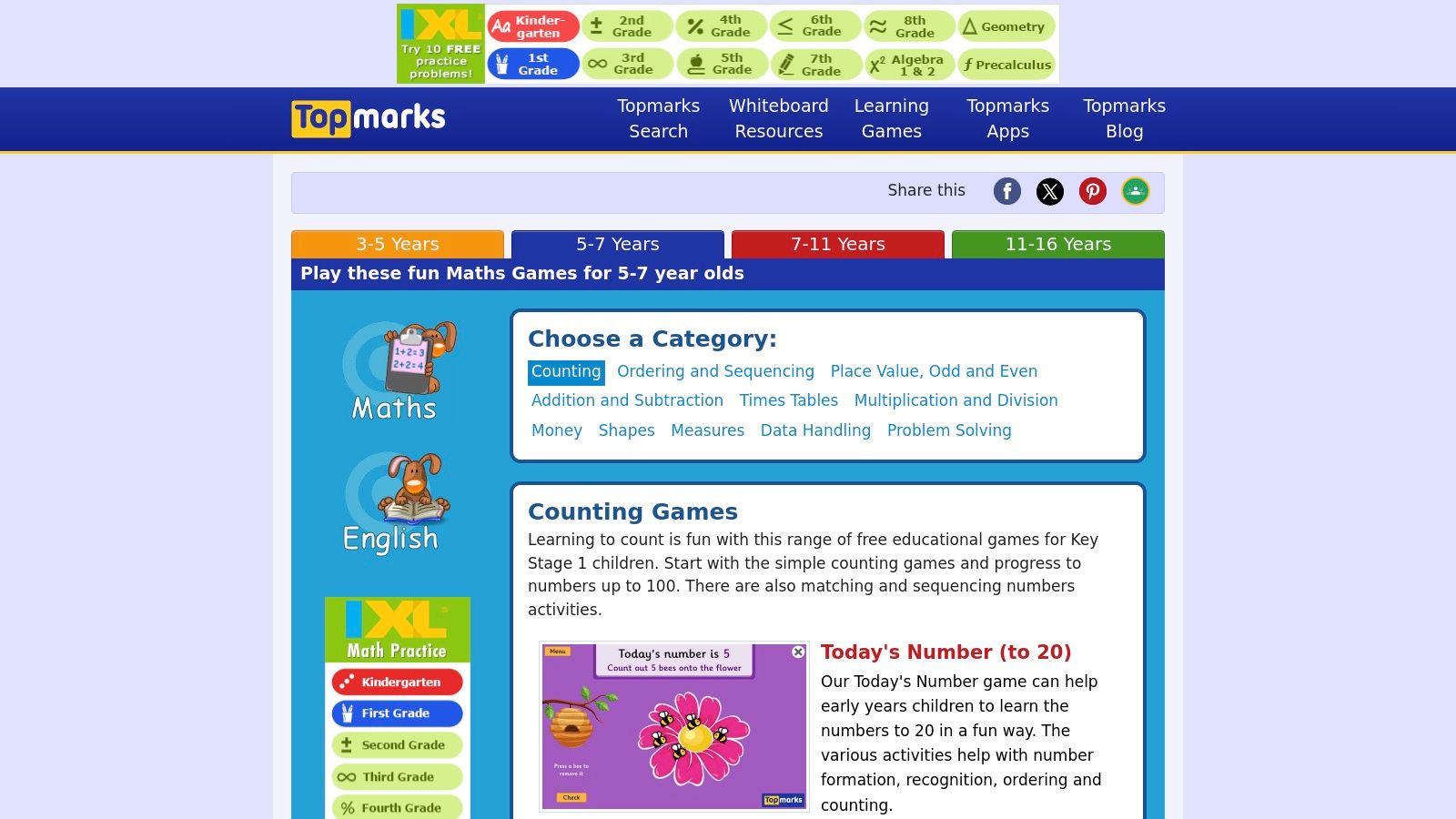
The strength of Topmarks lies in its sheer volume and variety, covering core concepts from counting and place value to telling the time. Children can practise their skills with fun, fast-paced games like Hit the Button or reinforce concepts learned in books like Space Ranger Fred and the Shoelace Adventure with a range of pattern and logic-based challenges. As an aggregator of online educational games for kids, it provides an invaluable resource for parents needing targeted practice materials.
Key Features and Assessment
- Curated Catalogue: Games are neatly organised by age bands (3–5, 5–7, 7–11, and 11–14) and specific maths topics, making navigation simple.
- Device Compatibility: A large number of its games are tablet-friendly and built on HTML5, ensuring accessibility across different devices without needing special software.
- Free Access: The entire collection of games is free to use directly in the browser, though some third-party games may contain ads.
Pros:
- An extensive and diverse selection of games covering almost every primary maths topic.
- UK-centric focus on concepts like money in pounds (£) and metric measurements.
- No registration required for immediate access.
Cons:
- Quality can be variable as it includes many third-party games.
- Lacks a unified system for tracking a child's progress across different games.
Website: https://www.topmarks.co.uk/maths-games
4. Mathsframe
Mathsframe is a purpose-built library of over 200 interactive children's online math games and 300 assessments, created by a UK primary school teacher. It is designed to rigorously align with the new UK National Curriculum, with a particularly strong focus on Key Stage 2. Its no-frills, content-first approach makes it a favourite resource for teachers who need effective tools to demonstrate concepts or for children who need targeted practice without distraction.
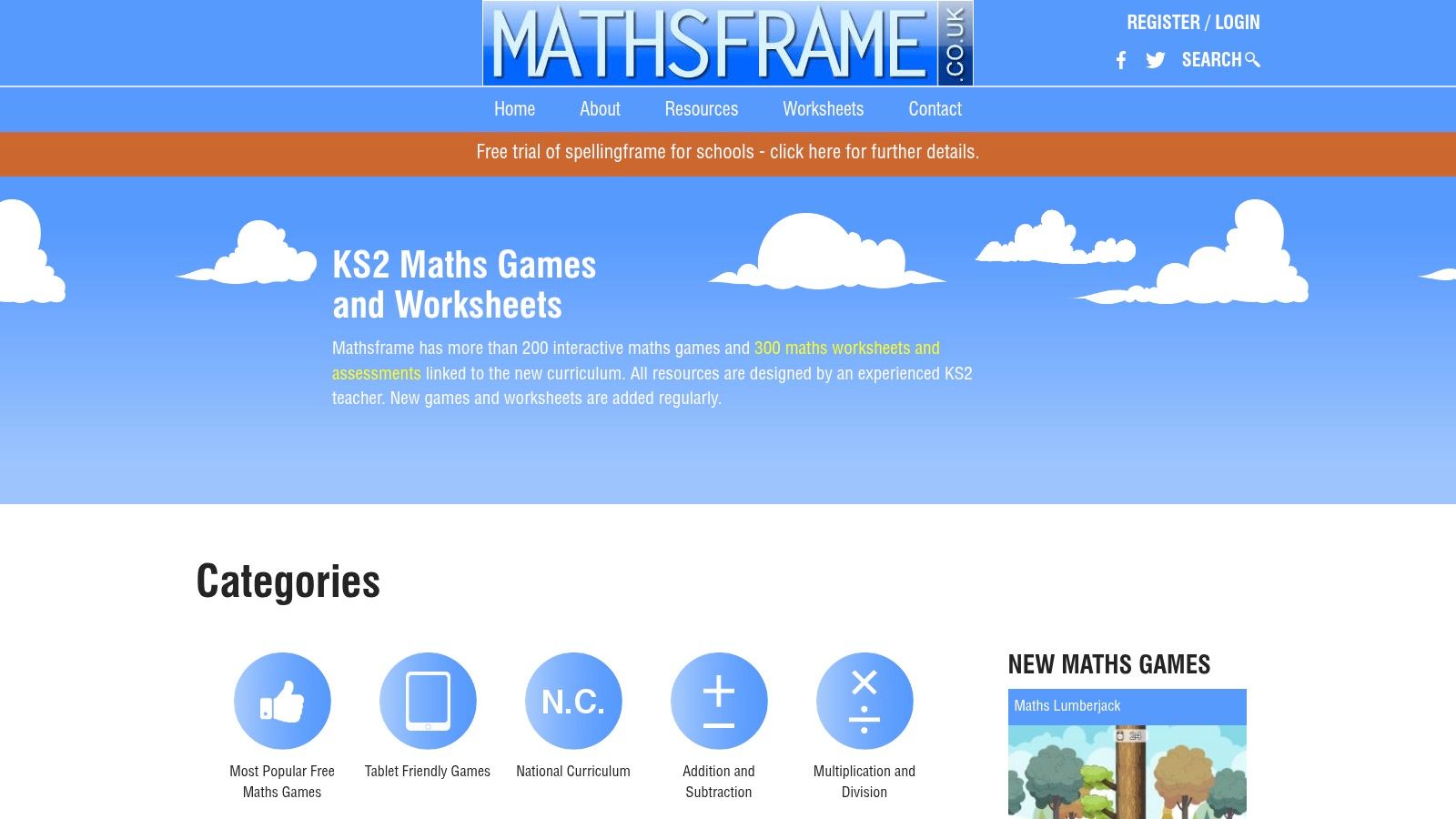
The platform’s strength lies in its simplicity and direct curriculum mapping. Games like Monty’s Maths Wall and Super Maths Bowling are excellent for drilling specific arithmetic skills in a competitive format. While the games are more functional than narrative-driven, they effectively gamify practice. For parents looking to blend practice with storytelling, pairing a Mathsframe session on shapes with a book like Space Ranger Fred and the Shoelace Adventure could be a great way to reinforce concepts in different contexts, connecting logical patterns with creative adventures.
Key Features and Assessment
- Curriculum Alignment: All games and activities are explicitly linked to specific objectives from the UK maths curriculum, making it easy to find relevant practice.
- Device Compatibility: Optimised for use on interactive whiteboards, desktops, and tablets, catering to both classroom and home environments.
- Affordability: Offers very low-cost single-user and whole-school subscriptions, providing excellent value for the volume of content available.
Pros:
- Trusted and widely used by UK primary teachers.
- Excellent for targeted skill reinforcement and assessment.
- Highly affordable licensing options for families and schools.
Cons:
- The interface is more utilitarian and less game-like than competitors.
- Limited parent reporting features compared to larger platforms.
Website: https://mathsframe.co.uk
5. Times Tables Rock Stars (TTRS)
Times Tables Rock Stars is a UK-born platform that brilliantly gamifies the essential practice of multiplication tables. It transforms repetitive drills into an engaging, fast-paced arcade experience, making it a standout among children's online math games for mastering times tables and related division facts. The platform's core appeal is its competitive and progressive nature, where children create a rock star avatar and aim to improve their recall speed to earn virtual coins and status.
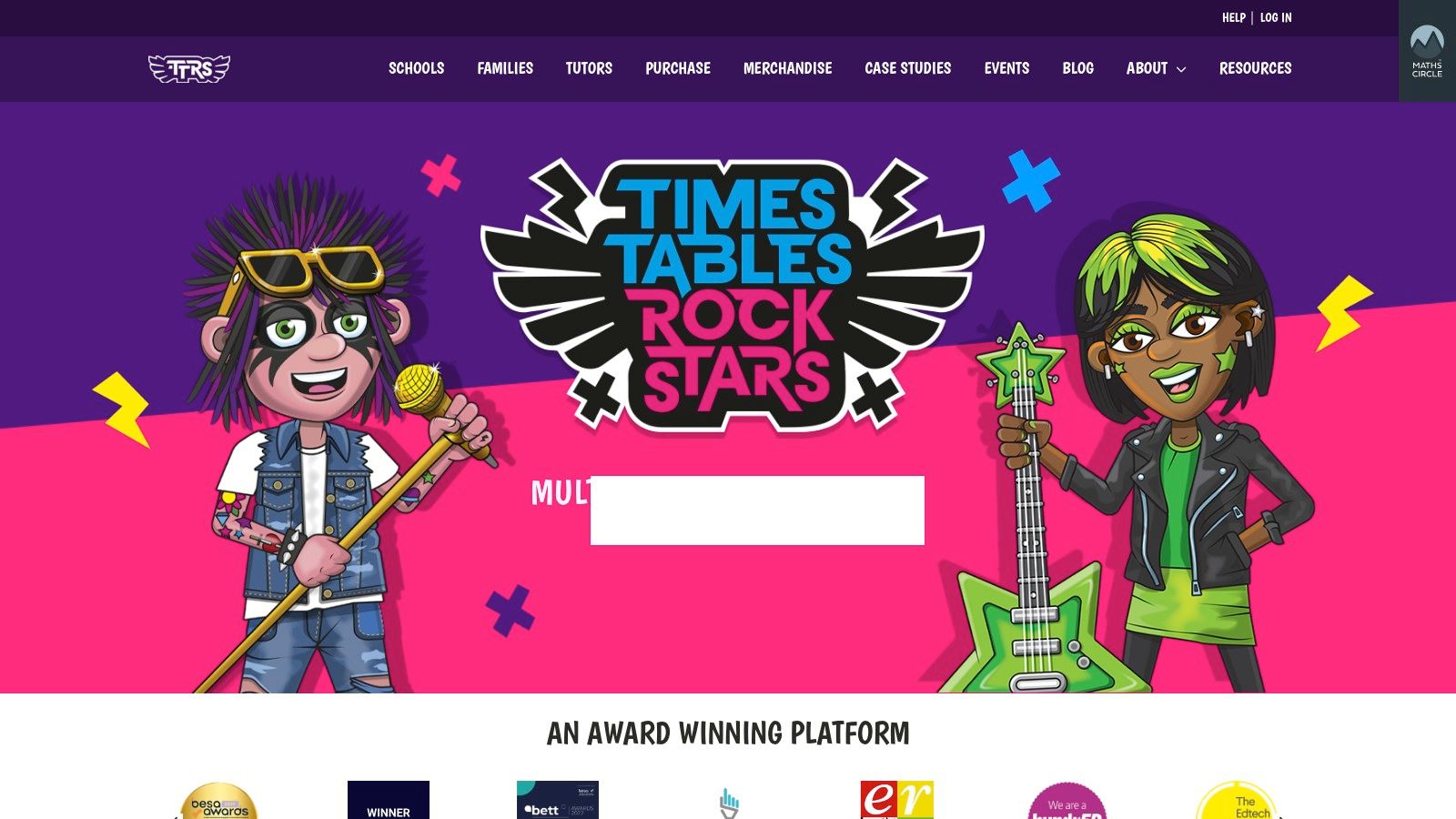
The gameplay is simple yet addictive, with different modes like the "Garage" for personalised practice and the "Arena" for live competitions against classmates. This focused approach ensures children build a solid foundation in arithmetic, which is crucial for more complex STEM fields later on. While a character like Fred in Space Ranger Fred and the Tick Tock Tale explores time concepts through stories, TTRS uses speed and competition to make number facts just as memorable and exciting for young learners.
Key Features and Assessment
- Personalised Practice: An intelligent algorithm adapts to each child’s abilities, focusing on the specific multiplication and division facts they need to practise most.
- Motivating Gamification: Children can customise their rock star avatars, compete in "Battle of the Bands," and climb school leaderboards, which fuels engagement.
- Detailed Reporting: Parents and teachers have access to comprehensive dashboards that track accuracy, speed, and overall progress over time.
Pros:
- Highly effective and motivating for learning multiplication facts.
- Widely used in UK schools, making it easy to align home and school learning.
- Very affordable family and school subscription plans.
Cons:
- Has a very narrow focus solely on times tables and division.
- Its full potential is best realised when used in conjunction with a school subscription.
Website: https://ttrockstars.com
6. Sumdog
Sumdog is a highly motivational, game-based learning platform that uses adaptive technology to tailor maths challenges to each child’s ability. Widely adopted in UK schools, it offers a suite of over 30 arcade-style children's online math games that cover a broad curriculum. The platform’s strength lies in making practice feel like play, using rewards like virtual coins, customisable avatars, and digital pets to keep children engaged and eager to learn.
The games automatically adjust their difficulty based on performance, ensuring each user is challenged without feeling overwhelmed. This adaptive engine supports how to develop critical thinking by presenting problems that encourage students to apply different strategies. Just as Space Ranger Fred and the Umbrella Rescue makes learning about physics feel like an exciting quest, Sumdog transforms maths revision into a fun, rewarding experience.
Key Features and Assessment
- Adaptive Learning: The platform’s diagnostic tool and adaptive engine ensure questions are perfectly matched to each child's level.
- Motivational Rewards: A robust system of coins, pets, and house customisation encourages regular practice and achievement.
- Parental Reporting: The family subscription provides detailed reports on progress, skills mastered, and areas needing more focus.
Pros:
- Strong gamification elements keep children highly engaged.
- Adaptive engine is excellent for siblings with different abilities.
- Content is aligned with the UK school curriculum.
Cons:
- Requires a subscription for full access to all features and reports.
- The trial auto-renews, so parents must remember to cancel.
- Game variety is great, but some games feel less polished than others.
Website: https://www.sumdog.com/en-gb
7. Mathletics (3P Learning, UK)
Mathletics is a comprehensive maths programme widely used in UK schools, offering a structured, curriculum-aligned experience through a home subscription. It successfully gamifies learning by awarding points and certificates for completed activities and features fast-paced competitive games. This makes it one of the most robust platforms for children's online math games that also provides deep educational content.
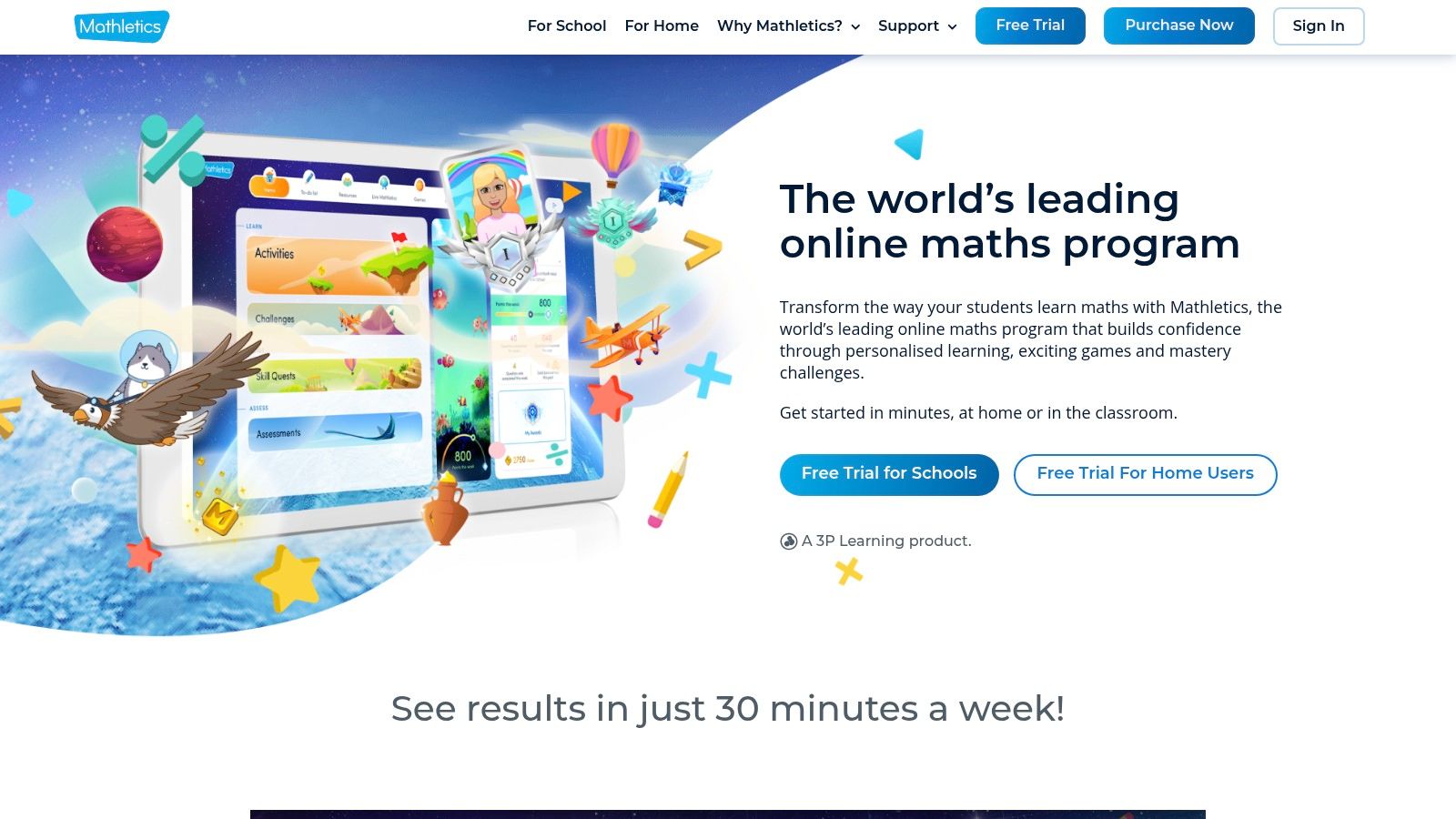
The platform’s standout feature is Live Mathletics, where children compete in real-time one-minute maths challenges against others from around the world. This adds a thrilling competitive edge to practising basic numeracy. While the core activities feel more like structured lessons, the gamified elements keep learners motivated. For those who enjoy reading, the printable workbooks could complement stories like Space Ranger Fred and the Shoelace Adventure, linking mathematical patterns and problem-solving to creative narratives.
Key Features and Assessment
- Curriculum Alignment: Content is precisely mapped to the UK curriculum from Key Stage 1 to Key Stage 3.
- Live Competition: Live Mathletics offers exciting, real-time challenges that build speed and accuracy.
- Parental Reporting: A dedicated parent dashboard provides detailed progress reports and weekly email updates.
Pros:
- Excellent, in-depth content coverage for a wide age range (approx. 5–16).
- Strong reporting tools help parents monitor and support their child's learning.
- Often available through discounted UK home subscription plans.
Cons:
- The interface feels more like a learning platform than a pure game environment.
- Subscription cost is higher than many single-focus apps and pricing can vary.
Website: https://www.mathletics.com/uk
8. Mangahigh
Mangahigh offers a game-based learning platform that stands out by combining over 1,000 maths and coding activities with a genuinely fun, engaging feel. Designed for continuity between school and home, it uses adaptive learning to tailor challenges to each child's level. This makes it a powerful tool for both reinforcing concepts and introducing new ones in an environment that feels more like a gaming arcade than a classroom.
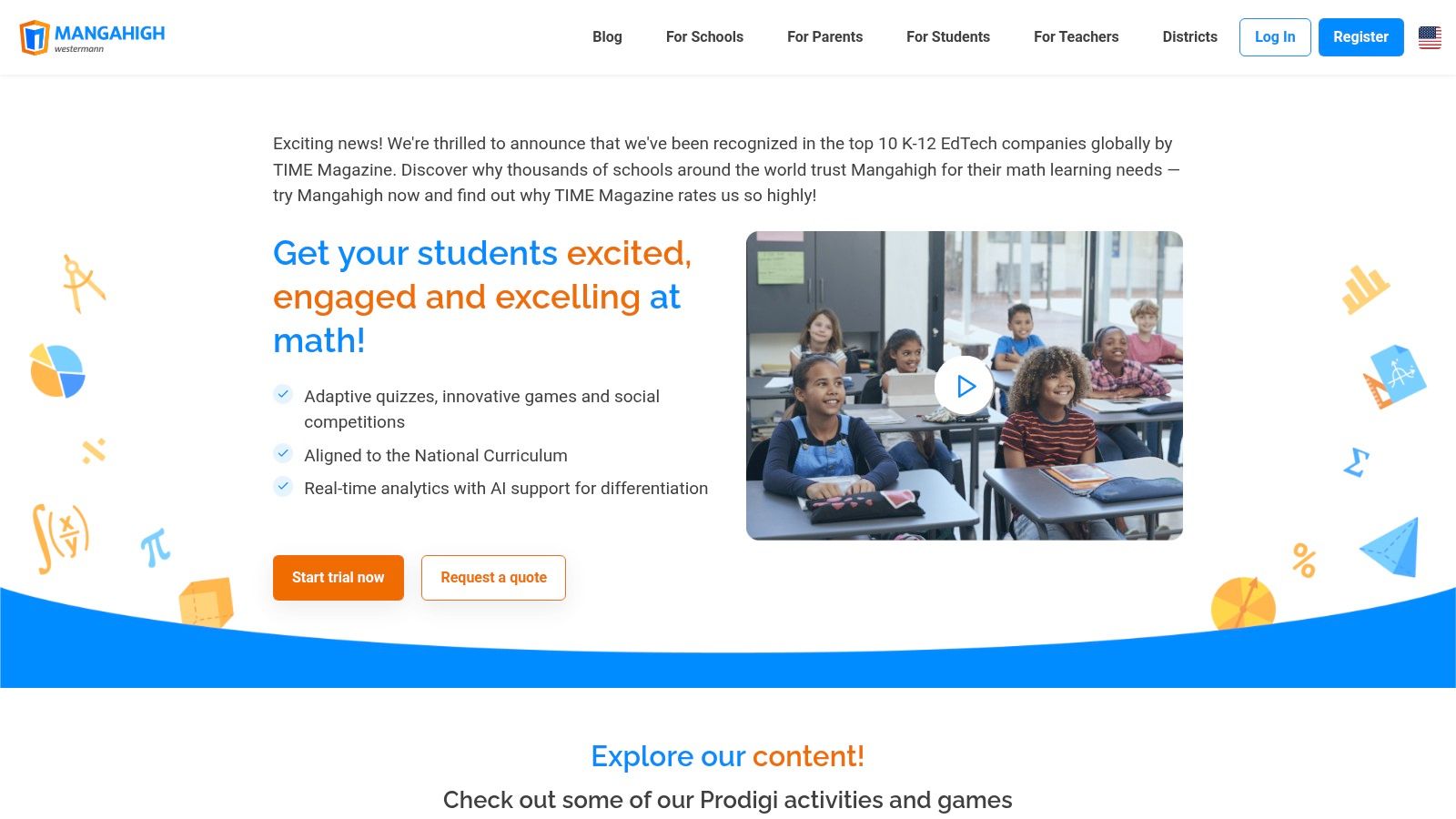
The platform features a mix of conceptual games and quizzes, with popular titles like Flower Power (for algebraic thinking) and Prodigi (for quick-fire arithmetic). The game-first approach ensures children are motivated to master skills, much like a character in a story, such as Fred in Space Ranger Fred and the Umbrella Rescue, must use physics to solve a problem. This collection of children's online math games provides a rich, interactive experience that supports curriculum learning.
Key Features and Assessment
- Adaptive Learning: Activities automatically adjust in difficulty based on the child's performance, ensuring they are always appropriately challenged.
- Curriculum Alignment: Content is mapped to various international curricula, including the UK system, making it easy to find relevant activities.
- Real-time Reporting: Parents and teachers can access detailed reports to monitor progress, track effort, and identify areas needing more support.
Pros:
- Strong, authentic game feel enhances motivation and engagement.
- Covers a wide age range (5–16) with extensive topic strands.
- Provides excellent continuity between school and home learning.
Cons:
- Home subscription pricing is not always clearly displayed upfront.
- The extensive interface can feel initially overwhelming for new users.
Website: https://www.mangahigh.com
9. Prodigy Math
Prodigy Math is one of the most popular children's online math games, transforming maths practice into a fantasy role-playing game (RPG) adventure. Aimed at children in Years 1-8, it cleverly embeds curriculum-aligned questions into engaging quests and battles where players cast spells by solving problems. Its game-based learning approach is highly motivating for children who might otherwise be reluctant to practise maths.
The platform’s core gameplay is free, allowing children to create an avatar, explore a magical world, and battle monsters. A premium membership is available, which unlocks cosmetic items and extra in-game perks but doesn’t restrict access to the educational content. This model makes it accessible to everyone, with optional upgrades for those who want a richer gaming experience. The adaptive algorithm ensures that the challenges suit each child’s skill level, helping to build both confidence and competence in a fun, immersive environment.
Key Features and Assessment
- Adaptive Learning: The game's algorithm adjusts the difficulty of maths questions based on the player’s performance, ensuring they are always challenged but not overwhelmed.
- Parent Dashboard: Parents can create a free account to monitor their child's progress, see which skills they are mastering, and set specific learning goals.
- Curriculum Alignment: Content is aligned with the UK curriculum, making it a useful supplement to schoolwork.
Pros:
- Highly engaging RPG format motivates children to play and learn.
- The free-to-play model makes the core educational content accessible to all.
- Strong parent and teacher tools for tracking progress.
Cons:
- Heavy promotion of paid membership can be distracting for children.
- The emphasis is more on gameplay motivation than deep conceptual learning.
Website: https://www.prodigygame.com
10. SplashLearn
SplashLearn is a highly visual, game-based learning platform offering thousands of children's online math games and activities for ages 3 to 11. It takes an app-first approach, delivering a curriculum-aligned experience that works especially well on tablets and phones. Its adaptive learning path adjusts the difficulty based on a child's performance, ensuring they remain challenged but not overwhelmed.
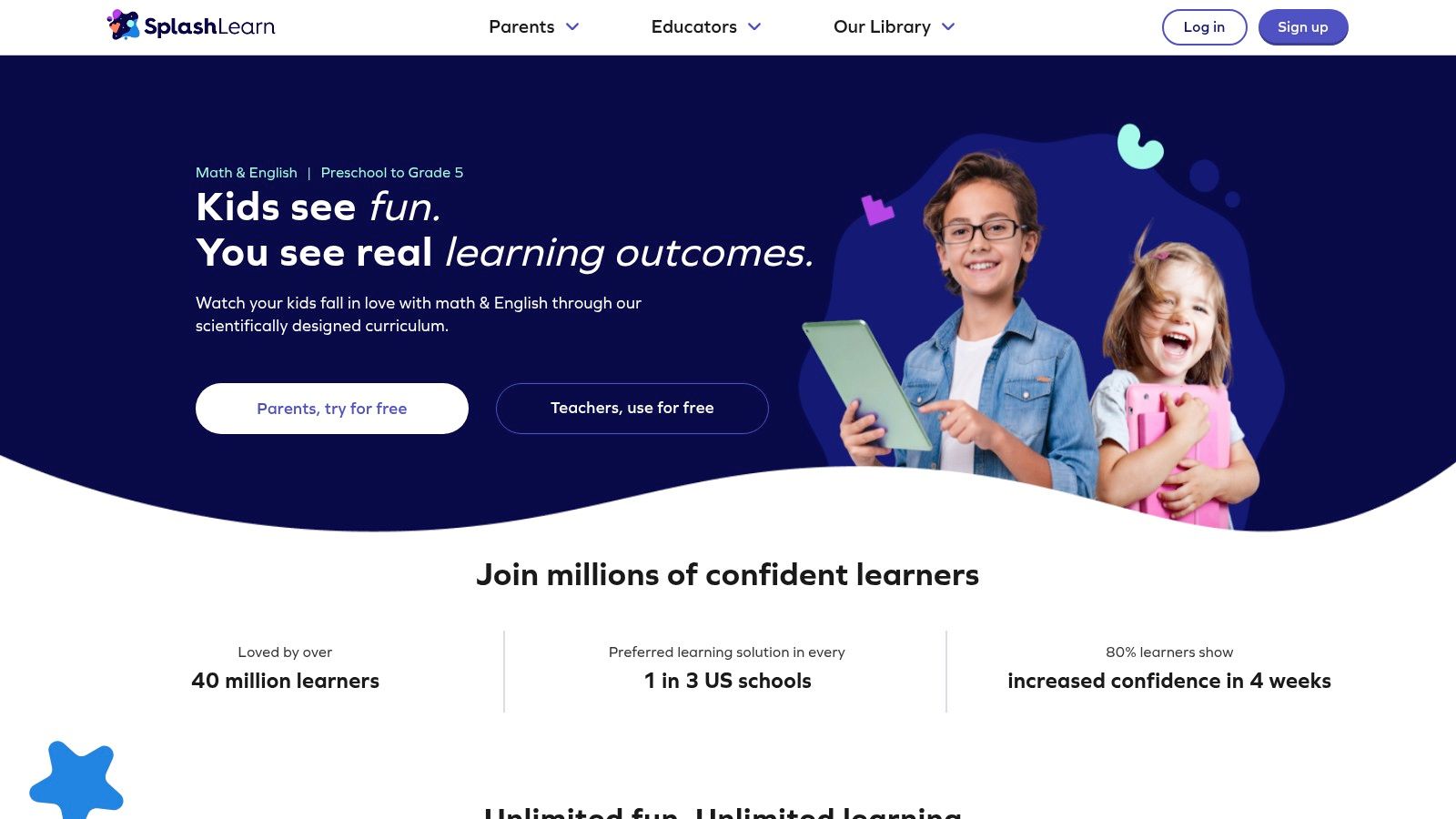
The platform turns maths practice into a vibrant adventure where children earn rewards for completing activities, keeping them motivated to progress. The gamified journey guides them through various maths topics, from basic counting to more complex geometry. This narrative-driven approach is similar to how a storybook like Space Ranger Fred and the Shoelace Adventure can make learning a new skill, like tying shoelaces or understanding patterns, feel like part of an exciting quest.
Key Features and Assessment
- Adaptive Learning: The platform’s algorithm automatically adjusts the difficulty of problems to match the child's skill level.
- Comprehensive Content: Offers over 4,000 maths games and activities covering a broad range of topics for the Early Years and Primary stages.
- Parent Dashboard: Paid subscriptions provide parents with detailed progress reports, highlighting areas of strength and topics needing more practice.
Pros:
- Extensive library of colourful and engaging activities.
- Excellent mobile and tablet experience.
- Free home access is available if a child's teacher signs up.
Cons:
- Pricing can vary depending on the platform and current offers.
- Some users report that the difficulty can sometimes jump unevenly between levels.
Website: https://www.splashlearn.com
11. Twinkl Go! (Twinkl)
Twinkl Go! is the interactive digital arm of Twinkl, a massive educational publisher trusted by teachers across the UK. It offers a huge collection of children's online math games and activities that are designed to complement their extensive library of printable worksheets and lesson plans. Access to the full suite of games requires a Twinkl membership, turning the platform into a comprehensive resource hub for parents and educators.
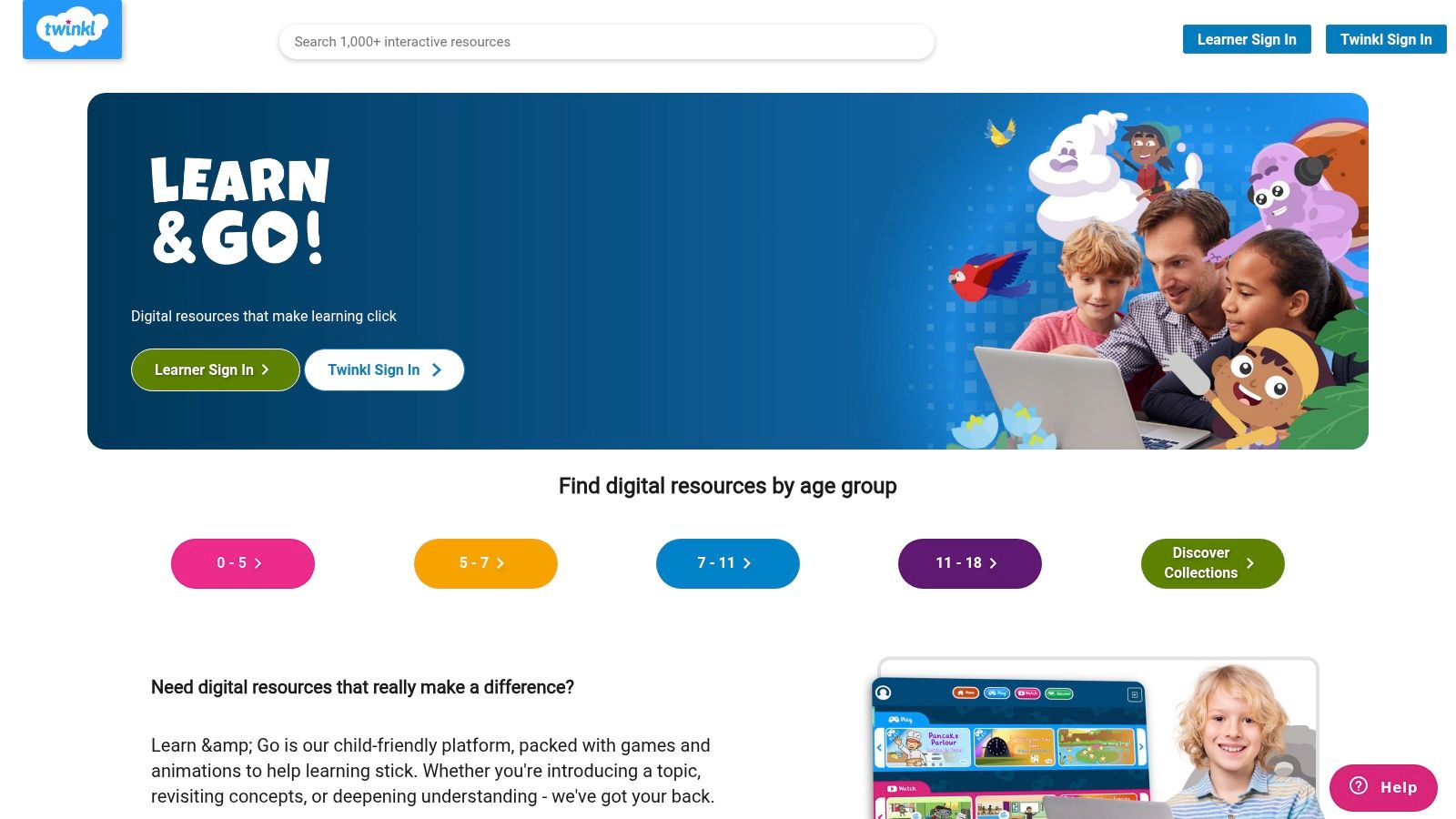
The platform’s strength lies in its direct link to classroom practice. Games covering topics like times tables, fractions, and money skills are built by teachers, ensuring they are relevant and effective. Teachers can share games directly with pupils using a simple PIN code, making it easy to set specific tasks for homework or in-class activities. The sheer volume of resources available means you can find a game to support almost any primary maths concept, often alongside corresponding worksheets and lesson packs.
Key Features and Assessment
- Teacher-Created Content: All games and resources are made by experienced teachers, ensuring quality and curriculum relevance.
- PIN-Code Access: A simple system allows teachers and parents to share specific games with children without complex logins.
- Integrated Resources: Games are part of a wider ecosystem of lesson plans, PowerPoints, and printable activities.
Pros:
- One membership unlocks a vast library of educational resources beyond just games.
- Strong alignment with the UK national curriculum.
- Excellent for supplementing structured lesson plans.
Cons:
- The site can feel overwhelming for parents unfamiliar with educational jargon.
- It is not a standalone, sequentially tracked maths programme.
Website: https://www.twinkl.co.uk/go
12. NRICH (Games and Interactives)
NRICH, a project from the University of Cambridge, offers a collection of free children's online math games that prioritise deep mathematical thinking over simple drills. The platform is designed to develop reasoning and problem-solving skills, presenting children with challenges that encourage them to think strategically. It provides a unique, ad-free space where the focus is on exploring mathematical concepts rather than just finding the right answer quickly.
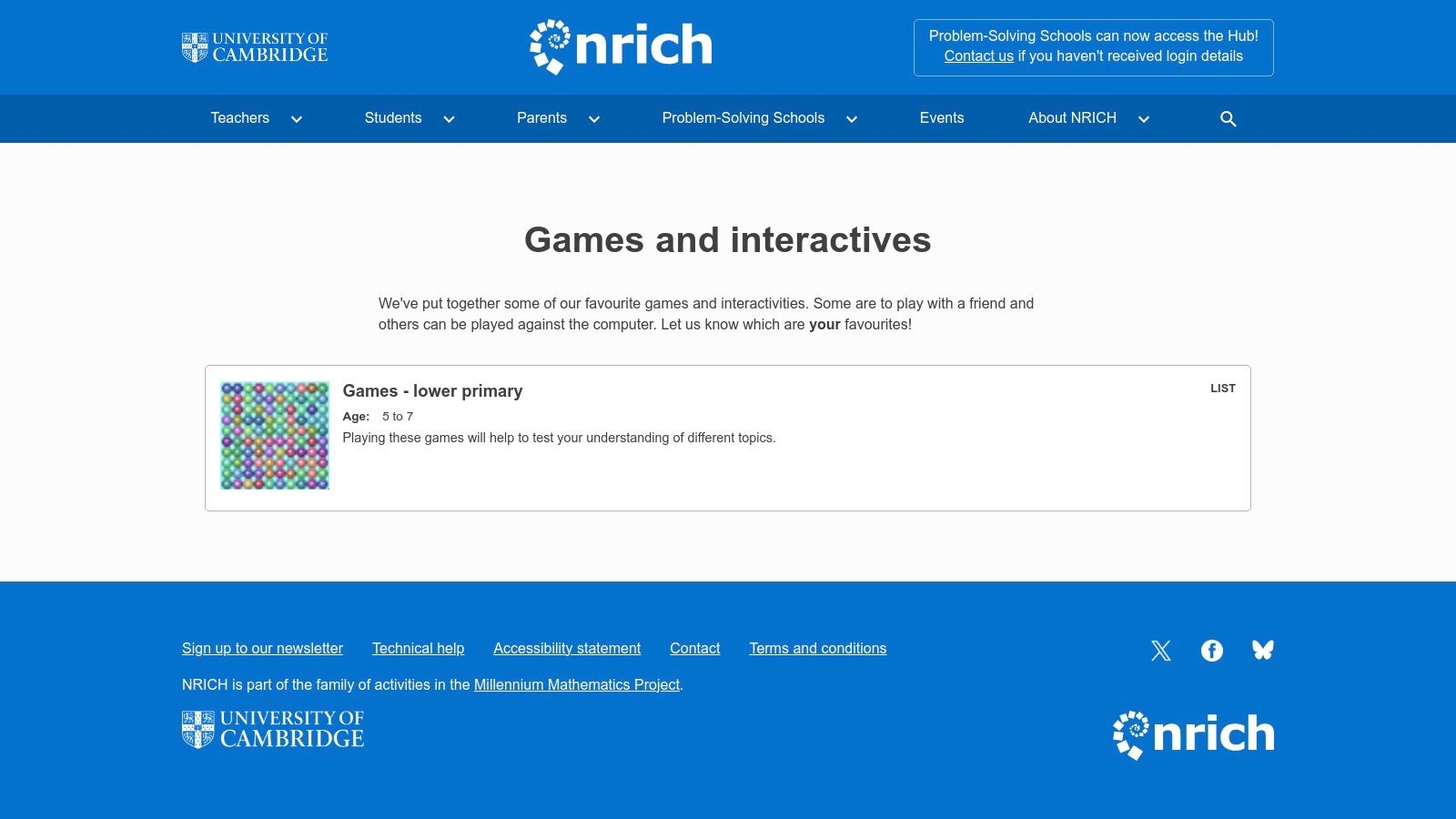
The games often involve strategy and can be played against a computer or another person, fostering a collaborative and competitive learning environment. Unlike platforms focused on narrative adventures like those found in Space Ranger Fred and the Umbrella Rescue, NRICH’s interactives are pure, focused mathematical puzzles. This makes it an excellent resource for children who are ready to move beyond basic arithmetic and engage with more complex logical challenges that build a solid foundation in mathematical reasoning.
Key Features and Assessment
- Problem-Solving Focus: The activities are specifically designed to build reasoning, logic, and strategic thinking skills.
- Curriculum Support: Tasks are organised by age band (Lower Primary to Secondary) and include extensive notes for teachers and parents to guide learning.
- Accessibility: Completely free to use with no login, subscriptions, or paywalls. All games and interactives run directly in a web browser.
Pros:
- High-quality, research-informed activities from a world-leading university.
- Excellent for developing sophisticated problem-solving abilities.
- Encourages strategic thinking through two-player games.
Cons:
- Lacks the polished, arcade-style presentation of many commercial apps.
- No parent dashboard or automated system for tracking a child's progress.
Website: https://nrich.maths.org/games-and-interactives
Children’s Online Math Games Comparison
| Product | Core Features / STEM Focus | User Experience / Quality ★ | Value / Price 💰 | Target Audience 👥 | Unique Selling Points ✨ |
|---|---|---|---|---|---|
| 🏆 Space Ranger Fred — Home | Story-driven STEM learning, multi-platform | Engaging narrative, immersive ★★★★ | Growing brand, scalable 💰 | Kids 6–12, curious learners | Multi-platform universe: books, animation, games, events ✨ |
| BBC Bitesize (Primary Games) | UK curriculum aligned, no signup required | Simple, ad-free ★★★★ | Free 💰 | EYFS–KS3 students | Trusted UK brand, quick curriculum-linked practice ✨ |
| Topmarks | Curated game directory, tablet-friendly | Mixed quality due to sources ★★★ | Free 💰 | Ages 3–14 broad range | Large variety of free maths games ✨ |
| Mathsframe | 200+ interactive games, curriculum mapped | Utilitarian interface ★★★ | Affordable licenses 💰 | KS2 focus, primary schools | Teacher trusted, interactive whiteboard compatible ✨ |
| Times Tables Rock Stars (TTRS) | Arcade-style tables practice, competitions | Highly engaging ★★★★ | Affordable subscriptions 💰 | Primary/middle school kids | Personalised practice, live leaderboards ✨ |
| Sumdog | Adaptive arcade games, parental reports | Motivational features ★★★★ | Subscription-based 💰 | Mixed ability children | Adaptive learning with fun rewards ✨ |
| Mathletics (3P Learning, UK) | Curriculum courses, live games, reports | Deep content, platform style ★★★ | Paid subscriptions, discounts 💰 | Ages 5–16 broad range | Strong parental reporting, extensive content ✨ |
| Mangahigh | 1000+ adaptive maths & coding activities | Authentic game feel ★★★★ | School & home plans 💰 | Ages 5–16, coding included | Real-time reporting, wide topic coverage ✨ |
| Prodigy Math | RPG-style adaptive maths, parent dashboard | Highly motivating ★★★★ | Free tier + paid memberships 💰 | Grades 1–8 children | Fantasy RPG gameplay with goals and reports ✨ |
| SplashLearn | App-first, 4000+ activities, progress tracking | Large library, frequent updates ★★★ | Free and subscription tiers 💰 | Ages 3–11 primary learners | Adaptive practice, live classes on paid tiers ✨ |
| Twinkl Go! (Twinkl) | Pin-code access, UK curriculum linked games | Classroom ready ★★★ | Membership required 💰 | KS1–KS2 students & teachers | Extensive resources beyond games ✨ |
| NRICH (Games and Interactives) | Strategy maths games, no login or paywall | Research-based, less polished ★★★ | Free 💰 | Lower Primary to Secondary | University-backed deep reasoning challenges ✨ |
Launching Your Child's Lifelong Love for Maths
Navigating the vibrant universe of children's online math games can feel like a mission in itself, but with the right map, you can find the perfect tools to spark your child's curiosity and build lasting confidence. We've journeyed through twelve distinct platforms, from the curriculum-aligned challenges of Mathletics to the puzzle-solving depth of NRICH, and the rock-and-roll fun of Times Tables Rock Stars. Each offers a unique approach to making numbers engaging and accessible.
The key takeaway is that there is no single "best" platform. The most effective choice depends entirely on your child's individual needs, their current learning stage, and what truly motivates them. A learner who thrives on narrative and adventure may get lost in the world of Prodigy Math, while another who craves fast-paced competition might excel with Sumdog. The true power of these resources is realised when they are used not just as homework tools, but as launchpads for mathematical exploration.
Finding Your Perfect Fit: A Mission Checklist
As you prepare to select a game, consider these crucial factors to ensure a successful launch:
- Learning Style: Does your child prefer competition, creative problem-solving, or story-driven quests? Match the platform's core gameplay loop to their natural inclinations. A game that feels like play is one they will return to again and again.
- Curriculum Alignment: For targeted support, platforms like BBC Bitesize and Mathsframe offer resources organised by National Curriculum objectives. This makes them invaluable for reinforcing classroom learning or tackling specific areas of difficulty.
- Parental Controls & Feedback: Evaluate the level of oversight you need. Do you want detailed progress reports, the ability to assign specific tasks, or simply a safe, ad-free environment? Platforms vary significantly in their parent-facing features.
- Budgetary Considerations: Begin with the wealth of free, high-quality options available, such as Topmarks and the core games on Mathsframe. Use these to gauge your child's interest before committing to a subscription-based service.
Integrating Games into Your Learning Routine
Once you've chosen a platform, successful implementation is key. Think of these children's online math games not as isolated activities but as part of a broader conversation about maths. Connect the concepts they are learning on-screen to real-world scenarios. Just as characters like Space Ranger Fred use logic and problem-solving to overcome challenges in Space Ranger Fred and the Tick Tock Tale, encourage your child to see the maths in everyday life, from cooking to planning a journey.
By transforming maths from a rigid set of rules into a dynamic and interactive adventure, you are doing more than just helping with homework. You are fostering resilience, developing critical thinking skills, and laying the groundwork for a lifelong, positive relationship with numbers. This journey is about exploration and discovery, and with these tools at your disposal, you are well-equipped to guide your young mathematician on their exciting voyage.
Ready to blend digital learning with captivating storytelling? Explore the world of Space Ranger Fred, where maths and science concepts are woven into thrilling adventures. Discover how our books make learning an exciting mission at Space Ranger Fred.