
Ever looked up at the night sky and wondered why the Moon keeps changing its shape? One night it’s a big, bright circle, and a few nights later, it’s just a tiny, silvery sliver. It’s not a magic trick—it’s the amazing science of the Moon's phases, and we're about to uncover this cosmic mystery together!
Your Adventure into the Moon's Changing Shapes
Welcome, young space explorers, to a cosmic journey you can take right from your back garden! That glowing orb in the sky is one of the most exciting things to watch, but why does it seem to play hide-and-seek with its shape?
The secret is that the Moon doesn't make its own light. Think of it as a giant, dusty ball that acts like a huge mirror, reflecting the brilliant light of the Sun. As the Moon travels on its path—or orbit—around our Earth, we get to see different parts of its sunlit side.
A Simple Torch Analogy
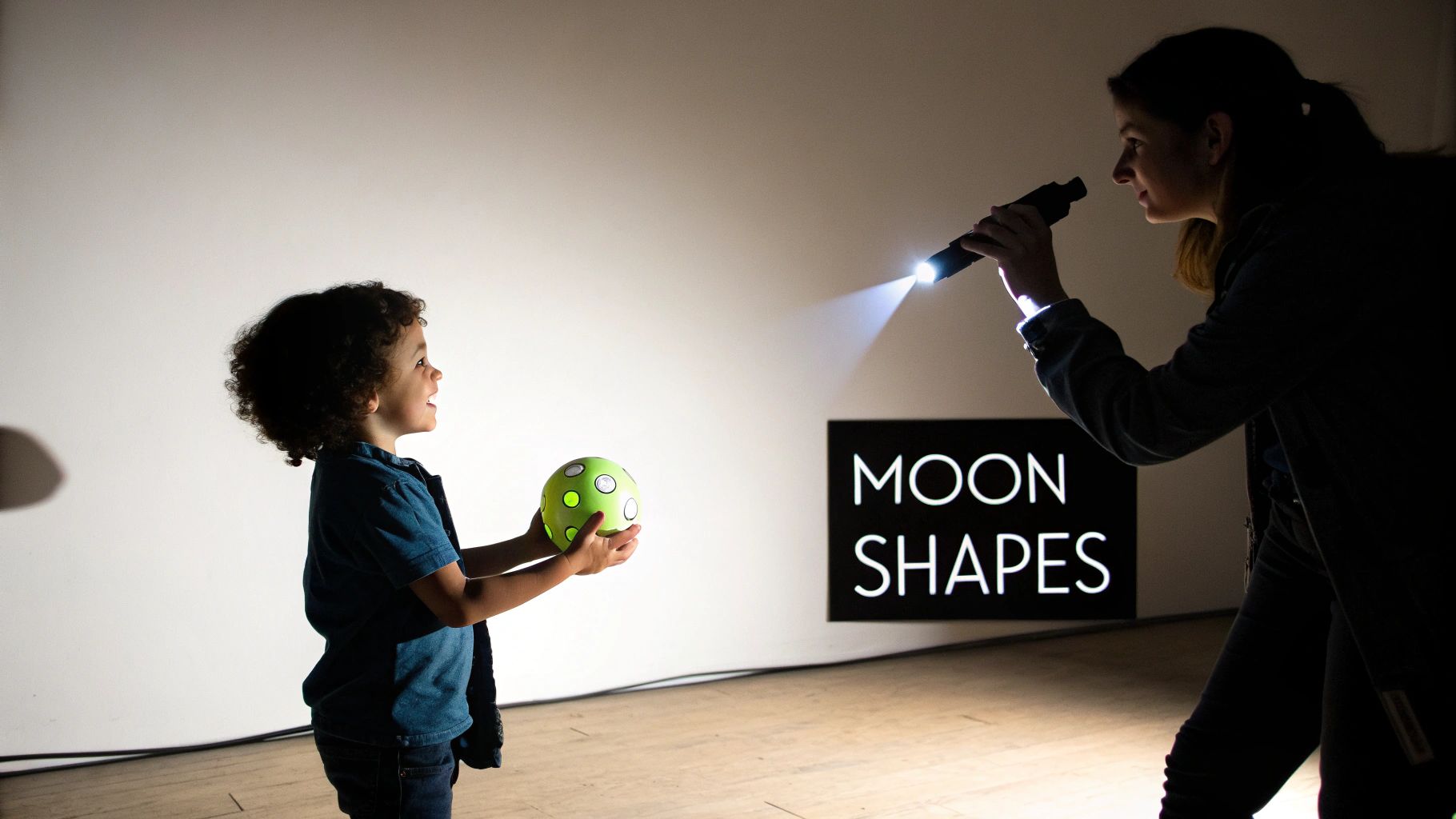
Let's try a little experiment in our minds. Imagine you're in a pitch-black room holding a white ball. Now, picture a friend standing across the room, shining a bright torch (that’s our Sun!) right at the ball.
As you slowly turn around on the spot, still holding the ball out, you’ll see that the light on it changes. Sometimes you'll see the whole bright circle, other times just a little sliver, and for a moment, none at all. That’s exactly what happens up in space with the Moon, the Earth, and the Sun!
This amazing cosmic dance is what creates the moon phases. It's a predictable, repeating pattern that tells a story in the night sky—a story of movement, light, and perspective.
Watching these changes is a fantastic first step into the world of astronomy and STEM. Here in the UK, where there are approximately 10.6 million pupils in school, learning about the Moon is a brilliant way to spark a lifelong interest in science. You can learn more about UK education trends and see how amazing topics like this fit into the national curriculum.
Just like the characters in exciting stories such as Space Ranger Fred and the Tick Tock Tale explore the wonders of the universe, we are about to begin our own exploration. Together, we'll journey through each of the Moon’s changing faces and discover the real science behind its magical appearance.
Ready to become a Moon expert? Let’s blast off!
The Moon's Eight Main Phases at a Glance
Before we dive in, here is a quick summary of the eight main phases of the Moon your child will learn about in this guide. This table shows what each phase is called and gives you a sneak peek at what it looks like from here on Earth.
| Phase Name | What It Looks Like | Position in Cycle |
|---|---|---|
| New Moon | Completely dark or invisible | Beginning of the cycle |
| Waxing Crescent | A small sliver of light on the right | A few days after New Moon |
| First Quarter | The right half is lit up | About a week into the cycle |
| Waxing Gibbous | More than half lit, still growing | Leading up to the Full Moon |
| Full Moon | The entire Moon is lit up | Middle of the cycle |
| Waning Gibbous | More than half lit, but shrinking | Just after the Full Moon |
| Third Quarter | The left half is lit up | About three weeks in |
| Waning Crescent | A small sliver of light on the left | Just before the New Moon |
Now that you've seen the whole line-up, we can get started on exploring each one of these phases up close. Let's begin our journey with the very first phase: the New Moon.
Why the Moon Plays Hide-and-Seek with the Sun
So, how exactly does the Moon pull off its amazing disappearing act every month? It’s not magic, but it is a brilliant cosmic puzzle! The secret lies in the Moon’s constant journey around our planet. This journey is called an orbit, and it takes about a month for the Moon to travel all the way around the Earth.
Think of the Moon on a giant, invisible racetrack with the Earth at its centre. The Sun, our super-bright star, is always lighting up one half of the Moon. The ‘shape’ we see from our back gardens simply depends on where the Moon is on that racetrack. Sometimes we see the whole sunny side, and other times we only get a peek.
This is why learning about the moon phases is such a fantastic STEM adventure. It’s like being a detective, piecing together clues of light, shadow, and movement to solve a giant cosmic mystery.
Waxing and Waning: A Cosmic Hello and Goodbye
To become true Moon experts, there are two really important words we need to learn. These words help us describe whether the moonlight we see is growing or shrinking, and they're the key to understanding the whole lunar cycle.
- Waxing: When the sunlit part of the Moon we can see is getting bigger each night, we say it’s ‘waxing’. Think of it as the Moon giving us a slow hello, showing us a little more of itself every evening.
- Waning: After the Moon is full and bright, the light starts to get smaller again. This is called ‘waning’. It’s like the Moon is waving goodbye, disappearing bit by bit before it starts its cycle all over again.
Getting your head around these two simple ideas is the first big step. It’s how we can start to predict what the Moon will look like tomorrow, or next week!
It's just like in the book Space Ranger Fred and the Shoelace Adventure, where solving one small puzzle leads to a much bigger discovery. Understanding 'waxing' and 'waning' is our first clue to solving the entire mystery of the Moon’s changing faces.
In the UK, the government’s commitment to education is clear, with over £111.5 billion recently allocated to support learning across the country. This investment shows just how important it is to provide brilliant educational experiences for all students. By exploring engaging topics like the moon phases, educators can spark a real interest in science and astronomy. You can discover more about UK education spending and see how STEM subjects are valued.
Now that we know the secret behind the Moon’s changing shapes and we've cracked the code of waxing and waning, we're ready for the main event. It’s time to meet each of the eight moon phases up close and personal! Let's continue our journey.
Meeting the Eight Phases of the Moon
Right, now that we’ve cracked the code of waxing and waning, it’s time for the main event! Let's meet each of the eight moon phases one by one. Think of this as your VIP tour of the entire lunar cycle, a journey that takes our Moon just under a month to complete.
For each phase, we’ll discover what it looks like from our back gardens, figure out where the Moon is on its cosmic racetrack around the Earth, and share a fun fact to help you remember it. Let’s blast off and meet our first phase: the shy and mysterious New Moon.
This simple map shows the two key terms we use to describe the Moon's journey: waxing (growing bigger) and waning (getting smaller) as it orbits the Earth.
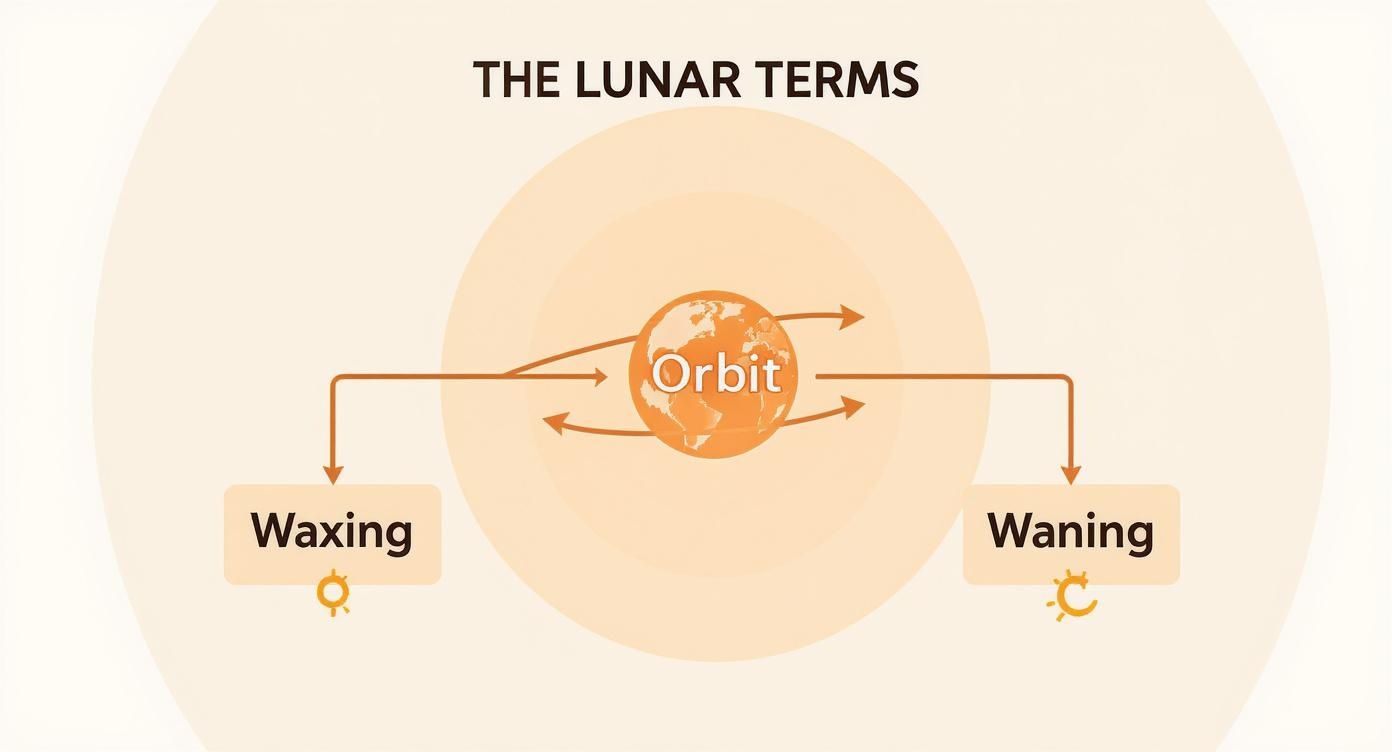
Understanding these two words is the secret to following the entire lunar cycle from beginning to end.
1. New Moon: The Invisible Start
The journey begins with the New Moon. At this stage, the Moon is passing right between the Sun and Earth. Because the side facing us isn't getting any direct sunlight, it’s completely dark from our point of view. We can’t see it at all!
2. Waxing Crescent: The First Hello
A few nights later, a tiny sliver of light appears. This is the Waxing Crescent. The word ‘waxing’ means the light is growing, so this is the Moon’s first little hello after being invisible. It often looks like a glowing fingernail clipping in the sky.
3. First Quarter: The Halfway Point?
About a week into the cycle, we get to the First Quarter. This one can be a bit confusing! It looks like a half-moon, but it's called a quarter because the Moon has only travelled one-quarter of its orbital path around the Earth. During this phase, you can see the right half of the Moon all lit up.
4. Waxing Gibbous: Getting Bigger
Next up is the Waxing Gibbous phase. ‘Gibbous’ is a funny-sounding word that just means more than half but not quite full. You can see that the lit-up part is still growing (waxing), getting ready for the big show.
Understanding each step of the moon's journey is a fantastic way to build your astronomy knowledge. It’s like being a detective, gathering clues from the sky each night to understand a bigger cosmic story.
5. Full Moon: The Main Event
This is the phase everyone knows and loves—the Full Moon! The Earth is now sitting between the Sun and the Moon, so we can see the entire sunlit side. It looks like a huge, brilliant circle in the night sky and it's the brightest phase of them all. For more ways to make space science for kids exciting, check out our guide on how to make learning about space fun.
6. Waning Gibbous: The Light Fades
After the big show of the Full Moon, the light begins to get smaller. We call this ‘waning’. The Waning Gibbous phase still looks bigger than a half-moon, but you’ll notice a little bit of darkness creeping in from the right side as the light starts to shrink.
7. Third Quarter: The Other Half
Three weeks after the New Moon, we reach the Third Quarter, which is sometimes called the Last Quarter. Just like the First Quarter, it looks like a half-moon. This time, however, the Moon has travelled three-quarters of its way around the Earth, and it’s the left side that we see shining brightly.
8. Waning Crescent: The Last Goodbye
Finally, we see the Waning Crescent. The Moon is giving us its last little wave before disappearing again. It’s a thin, silver sliver of light on the left, which gets smaller and smaller each night until the sky is dark and the cycle starts all over again with a New Moon.
It's a cosmic cycle that repeats every single month, a reliable clock in our night sky. Just like in Space Ranger Fred and the Umbrella Rescue, where teamwork saves the day, the Sun, Earth, and Moon all work together to create this amazing show for us.
Bringing The Moon Phases Into Your Home
Watching the Moon in the night sky is absolutely brilliant, but the best way to really understand its magic is to get your hands dirty! Fun, hands-on activities can bring the science of the lunar cycle right into your living room or kitchen. These experiments turn learning about the moon phases for kids into an unforgettable, interactive adventure for the whole family.
The activities we've chosen are designed to be super easy, using things you probably already have around the house. By building models you can actually touch and see, you'll get that "aha!" moment and truly understand how the Moon, Earth, and Sun work together to create the amazing show we see in the sky.
Get Your Supplies Ready
Before you blast off on your lunar mission, it’s always a good idea to get organised. Having everything ready to go means you can focus on the fun and the science without any last-minute searching. We’ve put together a little planner to help you gather what you'll need for our two amazing moon phase activities.
Moon Phase Activity Planner
Here’s a quick checklist of the simple things you’ll need to bring the lunar cycle to life.
| Activity Name | What You Need | Time to Complete |
|---|---|---|
| Oreo Moon Phases | A packet of Oreo biscuits, a plate, and a plastic knife or spoon. | 15-20 minutes |
| Moon Phase Ball and Lamp | A bright torch or lamp, a white ball (like a polystyrene or tennis ball), and a dark room. | 20-25 minutes |
With your supplies gathered, you're all set for some cosmic creativity. Let's get started!
Activity 1: Oreo Moon Phases
Ready for what might be the most delicious science lesson ever? The Oreo Moon Phases activity is a massive family favourite because it’s fun, creative, and you get to eat your experiment at the end!
- Prepare Your Moons: Carefully twist open eight Oreo biscuits. The trick is to keep all that lovely cream filling on one side. This cream-covered half is now your Moon.
- Create the Phases: Using a plastic knife or spoon, gently scrape away the white cream to show each of the eight main phases.
- New Moon: Scrape all the cream off. Simple!
- Waxing Crescent: Leave just a thin sliver of cream on the right side.
- First Quarter: Scrape away the cream from the left half to show a perfect half-moon.
- Full Moon: This one's easy—leave the cream completely untouched!
- Arrange and Learn: Place your biscuit moons in the correct order on a plate and have fun naming each one. It’s a brilliant, hands-on way to remember the shapes and the sequence.
Activity 2: Moon Phase Ball and Lamp
This next experiment is fantastic for showing how the Moon’s position changes what we see from Earth. It’s like creating a mini solar system right in your own home!
For this to work, you'll need a very dark room. One person gets to be the Earth, holding the Moon (the ball), while the Sun (your torch or lamp) shines from one spot. As the 'Earth' slowly turns on the spot, you'll see the light on the 'Moon' change, creating every single phase from New Moon to Full Moon and back again.
This simple activity is such a powerful way to understand perspective. It shows that the Moon isn't actually changing its shape at all—it’s our view from Earth that changes as the Moon orbits around us.
Interestingly, it reminds us how important perspective is in a child's development. In the UK, for example, studies have shown that even the timing of a child's birth can influence their early school years. Engaging activities like these are a fantastic way to support every child's learning journey, no matter their age. Discover more insights about student development in the UK.
Once you've mastered these activities, you might feel inspired to look even closer at the real thing. For tips on taking your stargazing to the next level, check out our guide on how to use telescopes.
Keep Exploring with Space Stories and Books
Don't let the cosmic adventure stop here! While getting hands-on is a brilliant way to understand the moon phases for kids, the magic of a good story can launch your curiosity into a whole new universe. Children's books have this amazing ability to make massive topics like astronomy feel friendly, accessible, and incredibly exciting.
Stories are a fantastic launchpad for a child's natural curiosity about STEM. When a character in a book uses a bit of science to solve a tricky problem, it shows young readers that learning is a superpower. It’s not about memorising facts; it’s about exploring, discovering, and figuring out the amazing world around us. A quick trip to your local library could open up a galaxy of possibilities.
Blast Off with a Good Book
A brilliant series that mixes thrilling stories with problem-solving and space exploration is Space Ranger Fred. Books like Space Ranger Fred and the Shoelace Adventure really capture the imaginations of young explorers by weaving genuine scientific ideas into fun narratives that are easy to follow.
Reading these kinds of stories can fuel a lifelong interest in science and the stars, showing kids that anyone can be an explorer.
Storytelling is one of the most powerful ways to connect with new ideas. A great book can make a distant star feel like a close friend and a complex scientific concept feel like a fun puzzle waiting to be solved.
For even more ideas to fill your bookshelf, you can find a wonderful selection in our guide to the best space books for kids, which offers fantastic choices for all ages.
To keep the adventure going, here are a few other types of space-themed books to look out for:
- Non-fiction picture books filled with amazing, real-life photos from space missions.
- Science fiction stories that let your imagination run wild about what life on other planets could be like.
- Biographies of famous astronauts who have travelled beyond our world.
Answering Your Big Questions About the Moon
Every great space explorer has questions—in fact, being curious is the best part of any adventure! Now that you’re a pro on the eight main moon phases, let's tackle some of the biggest mysteries kids wonder about when they look up at our glowing neighbour.
Just like in a great book, asking questions is how we uncover the secrets of the universe. It's how we learn, discover, and turn a simple glance at the night sky into a proper STEM investigation.
Why Can We See the Moon During the Day?
Have you ever spotted a pale, ghostly Moon hanging in a bright blue sky and wondered how that's even possible? The answer is simpler than you might think! The Moon is always up there, travelling on its orbit around the Earth. We just need it to be brighter than the sky around it to see it.
During the day, the Sun lights up our atmosphere, making it a brilliant blue. The Moon is actually in the daytime sky just as often as it is at night, but when it’s too close to the super-bright Sun (like during a New Moon), we can't see it. It gets completely washed out.
But during phases like the First and Third Quarters, the Moon is far enough away from the Sun in the sky and reflects enough sunlight for us to spot it easily, even with the Sun shining.
What Is a Supermoon or a Blue Moon?
Sometimes you’ll hear grown-ups talking about special moons. Don't worry, these aren't different types of moons, just special moments in our Moon’s regular cycle.
- A Supermoon: The Moon’s orbit around Earth isn't a perfect circle; it’s a slight oval. A Supermoon happens when a Full Moon lines up perfectly with the Moon’s closest point to Earth. This makes it look a little bit bigger and brighter than usual—up to 14% bigger and 30% brighter!
- A Blue Moon: This one has absolutely nothing to do with colour! A "Blue Moon" is just the nickname for the second Full Moon that happens in a single calendar month. Because the Moon’s cycle is about 29.5 days and most months are 30 or 31 days long, every so often two Full Moons can just about squeeze in.
Learning these fun facts helps you realise that the sky is always changing. It’s a dynamic and exciting place full of predictable patterns and occasional surprises, just waiting for curious explorers to look up and notice.
Does the Moon Have a 'Dark Side'?
This is a classic space mystery! You might have heard people talk about the "dark side of the Moon," but that name is a bit misleading. The truth is, all sides of the Moon get sunlight at some point. There is no permanently dark side.
What is true is that we only ever see one side of the Moon from Earth. This happens because the Moon takes the exact same amount of time to spin once on its axis as it does to orbit the Earth. This perfect timing is called tidal locking, and it means the same face is always pointing towards us.
The side we can’t see isn't always dark; it's just the "far side." It's a tricky concept to get your head around, just like the puzzles Space Ranger Fred has to solve in Space Ranger Fred and the Tick Tock Tale.
Keep looking up and asking questions! The universe is full of amazing things to discover, and every question you ask is the start of a new adventure. For more stories that blend science with excitement, explore the world of Space Ranger Fred. You can start your journey at spacerangerfred.com and find books, activities, and more to fuel your curiosity.