
Have you ever looked up at all the twinkling stars in the night sky and thought, what even is the universe? It’s a brilliant question, and the simplest answer is that the universe is… everything. It’s every single thing that exists, from the tiniest grain of sand on a beach right up to the biggest, brightest star you can possibly imagine.
Your Cosmic Adventure Starts Here
Try to picture the universe as a gigantic treasure chest, one so enormous that it has no walls and no end. Inside this incredible chest, you’ll find absolutely everything. That means all the stuff we can see, like planets, moons, and dazzling star cities called galaxies. But it also holds all the things we can't easily see, like invisible dust clouds, mysterious forces, and even time itself.
It’s so mind-bogglingly big that it’s almost impossible to picture it all at once. But don't worry! We're going to explore it together, one step at a time, just like an intrepid explorer from a children's book setting off on a grand quest.
What's Inside the Cosmic Treasure Chest?
To really get our heads around what the universe is, let’s take a peek inside and see what amazing things it holds. It’s a bit like getting to know the characters in a story before the big adventure really kicks off.
Before we dive deeper, let's get a quick snapshot of the biggest players in our cosmic neighbourhood. This little cheat sheet breaks down the key parts of our universe into simple ideas, perfect for a young astronomer just starting out.
The Universe at a Glance: Key Cosmic Ideas
| Cosmic Component | Simple Explanation |
|---|---|
| Stars | Gigantic, glowing balls of hot gas, like our Sun. They are the powerhouses of the universe. |
| Galaxies | Huge families of billions of stars, dust, and gas all held together. We live in the Milky Way galaxy. |
| Planets | Big, round worlds that travel around stars. They can be rocky like Earth or gassy like Jupiter. |
| Moons | Smaller worlds that travel around planets. Earth has one, but some planets have dozens! |
| Space | The vast, mostly empty area between all the stars and galaxies. It’s what makes the universe so big. |
| Time | The ‘tick-tock’ that keeps everything moving forward, from a planet’s spin to your own birthday. |
Now that we've met the main characters, we're ready to see how they all fit together in this grand, cosmic story.
Our journey to understand the universe is a lot like the one Space Ranger Fred takes in Space Ranger Fred and the Tick Tock Tale. We start with a simple question and end up discovering a whole cosmos of wonders.
This first step is all about getting a basic feel for this incredible place we call home. By breaking down such a massive idea into fun, bite-sized pieces, we can get ready for the fantastic cosmic wonders that await.
Are you ready to continue the adventure?
Discovering The Building Blocks Of Space
Alright, so we’ve established that the universe is basically ‘everything’. But what is all that ‘everything’ actually made of? Let's zoom right in.
Imagine the universe is like a gigantic city that goes on forever in every direction. This cosmic city isn't built with bricks and roads, but with something far more spectacular: massive star clusters called galaxies.
Our home address is a galaxy we call the Milky Way, but it's just one neighbourhood in a city that has billions of them. Each galaxy is a whirlwind of activity, jam-packed with countless stars, planets, mysterious gas, and glittering dust, all held together in a grand cosmic ballet. Some look like beautiful spinning spirals, while others are more like giant, glowing snowballs of light.
The Stars: Our Cosmic Lighthouses
So, what exactly is a star? Think of it as a gigantic, glowing ball of super-hot gas—like a colossal bonfire floating in space. Our very own Sun is a star, and it’s the one that keeps us warm and gives us light here on Earth.
Even though our Sun feels massive to us, it’s just one of hundreds of billions of stars in the Milky Way galaxy alone. Some stars are much smaller, but others are true giants, hundreds of times bigger than our Sun! They are the brilliant lighthouses that illuminate the universe.
Just like in the story Space Ranger Fred and the Shoelace Adventure, where something small leads to a huge discovery, understanding a single star helps us understand the whole galaxy. It’s all connected in the amazing puzzle of space.
Where Stars Are Born
Stars don't just appear out of thin air; they have to be born somewhere. Their journey begins inside enormous, colourful clouds of dust and gas drifting through space. We call these incredible stellar nurseries nebulae.
Gravity—the same force that keeps your feet planted firmly on the ground—starts pulling clumps of this dust and gas together. As these clumps get bigger and squeeze tighter, they heat up until… WHOOSH! A brand-new star bursts into life and starts to shine. It’s an incredible process that takes millions of years! If you want to learn more about these amazing cosmic clouds, you can check out our fun guide explaining what is a nebula.
Stars then live for billions of years, shining their light across unimaginable distances.
So, the next time you gaze up at the night sky, remember you’re not just seeing twinkly lights. You’re looking at the fundamental building blocks of our universe—countless stars, all organised into beautiful, sprawling galaxies. That’s the stuff our vast and wonderful cosmos is made of.
Just How Big Is The Universe?
Prepare to have your mind well and truly blown! Trying to wrap your head around the sheer size of the universe can make your brain feel a bit fizzy. The simplest way to say it is this: the universe is bigger than anything you can possibly imagine. And then some.
In fact, scientists can only really see a part of it, a cosmic neighbourhood they call the observable universe. This patch of space is about 93 billion light-years across. A light-year is the distance light travels in one whole year, and light is the fastest thing we know. So, yeah… that's a really, really long way.
Thinking about numbers that enormous is tough. It’s a bit like in Space Ranger Fred and the Umbrella Rescue, where a seemingly simple problem requires a clever solution. To understand the universe, we have to start with smaller, more familiar pieces to get a grip on the whole enormous picture.
Our Cosmic Building Blocks
To get a better sense of scale, it helps to see how everything is organised, from our own starry home all the way up to the entire universe.
This chart lays out the basic hierarchy of our cosmic address, starting with stars and building up to the vastness of it all.
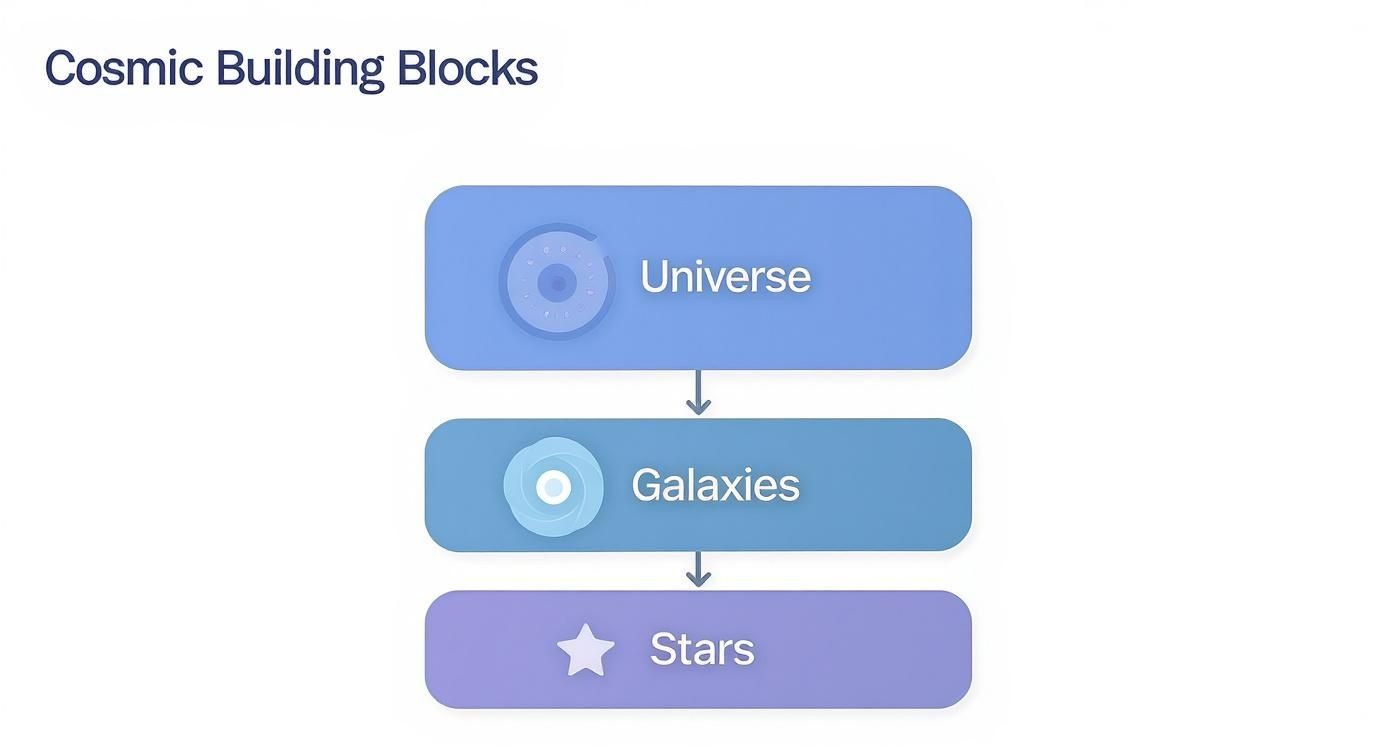
As you can see, countless stars clump together to form galaxies. Billions and billions of those galaxies then come together to fill the universe.
An Ever-Expanding Space
Here’s another mind-bending idea: the universe isn't just sitting still. It’s actually getting bigger all the time!
Imagine drawing lots of dots on a balloon. As you blow it up, all the dots move further and further away from each other. The universe works in a similar way. The galaxies are like the dots, and the space between them is constantly stretching, pushing them further apart.
This constant expansion is one of the most incredible facts about the universe. It’s not a static, unchanging place but a dynamic, growing cosmos full of energy and motion.
This amazing discovery is precisely what astronomers all over the world are studying right now. The United Kingdom, for instance, is a major player in this field. UK astronomers secure more than 40% of the country's astronomy programme funding, which supports a huge range of research from our own solar system to the very edges of the cosmos. You can read the full research about the UK's role in universe science to learn more.
So, not only is the universe unbelievably massive, but it's also on a never-ending journey of expansion, making it a place of endless wonder and discovery.
Uncovering Cosmic Mysteries
Ready for a real cosmic puzzle? So far, we've explored all the brilliant things we can actually see in the universe—the stars, planets, and galaxies twinkling back at us. But scientists have figured out that all this visible stuff makes up only a tiny slice of the cosmic pie.
In fact, it’s only about 5%! So, what on Earth (or in space!) is the other 95% made of?
This is one of the biggest and most exciting mysteries in all of science! Most of what makes up our universe is completely invisible to us. Scientists have given names to these two mysterious ingredients: dark matter and dark energy. They might sound like something from a superhero adventure, but they're very real and incredibly important.
The Universe's Invisible Glue
First up is dark matter. The best way to think about it is as the universe’s invisible glue. When astronomers look at galaxies, they see them spinning so incredibly fast that they should, by all rights, just fly apart. Stars ought to be flung off into deep space like water from a spinning top.
But they don't. Something extra is holding them all together, and that ‘something’ is dark matter.
We can’t see it directly, but we can definitely see its effects on everything else. It’s a bit like the wind. You can't actually see the air moving, but you can watch the leaves on a tree rustling and dancing about. In the same way, we can see the pull of gravity from dark matter yanking on stars and galaxies, keeping them neatly organised.
Dark matter is a fantastic example of how science is a thrilling adventure. Just like in the children's book Space Ranger Fred and the Umbrella Rescue, scientists are working together to figure out a huge puzzle with clever ideas and teamwork.
The Mysterious Push
Now for the other invisible ingredient: dark energy. If dark matter is the cosmic glue holding things together, dark energy is the mysterious force pushing everything apart. Remember we said the universe is expanding? Well, scientists were amazed to discover it's not just expanding—it's speeding up!
This acceleration is caused by dark energy, a strange kind of pressure that works against gravity, making the space between galaxies stretch faster and faster. While dark matter pulls things together on a local scale (like within a galaxy), dark energy is winning the cosmic tug-of-war across the entire universe. It’s a truly baffling part of what the universe is, and we still have so much to learn. The most extreme objects out there, which we explore in our article on what is a black hole, also challenge our understanding of these incredible forces.
Solving these cosmic riddles is a huge mission for scientists right here in the UK. The UK government actively supports this research, with places like the Institute of Cosmology and Gravitation at the University of Portsmouth receiving over £2 million to study these very mysteries. This funding helps them join massive international projects to finally understand what dark energy really is. You can learn more about this cutting-edge research and its funding and see how the adventure continues.
How We Explore The Universe From The UK
So, how on Earth do we know all this amazing stuff about the universe, from mysterious dark matter to how fast galaxies are zooming through space?
Well, exploring the cosmos is a bit like being a detective. Astronomers need incredible tools to find clues about what’s out there. They don't use magnifying glasses, though. Their gear includes enormous telescopes here on Earth and super-clever robotic probes that travel for millions of miles.
The United Kingdom plays a really important part in all this cosmic exploration. Just like Space Ranger Fred needs his special equipment in Space Ranger Fred and the Umbrella Rescue to solve tricky problems, astronomers need their own high-tech gadgets. UK scientists and engineers are absolute experts at helping to build these amazing instruments for some of the world's most powerful telescopes.
Teamwork Makes The Dream Work
Exploring space is far too big a job for one person, or even one country. It’s a massive team effort! Scientists from all over the world, including lots from the UK, share their discoveries and work together to piece together the giant puzzle of the universe.
This global teamwork is how we make the biggest breakthroughs. For instance, UK-funded projects have led to thousands of scientific discoveries. A close look at the UK Space Agency's work showed that from 2010 to 2020, their projects led to over 3,000 scientific papers from more than 4,100 researchers worldwide, with a big focus on astronomy and astrophysics.
It just goes to show how important working together is in our quest to understand the cosmos. You can see for yourself and read the full report on UK space research.
Tools Of The Cosmic Trade
Astronomers have a whole box of clever tools to study the universe, and each one helps tell a different part of the cosmic story.
- Giant Telescopes on Earth: Think of these as huge eyes staring up at the sky. They collect starlight that has travelled for millions or even billions of years, letting us see galaxies that are incredibly far away.
- Space Telescopes: By putting telescopes into space, like the famous Hubble and James Webb Space Telescopes, astronomers get an even clearer view. It’s like opening a window when it’s foggy outside—suddenly, you can see everything without Earth's blurry atmosphere getting in the way.
- Robotic Probes: These are brave robot explorers sent on missions to other planets, moons, and asteroids. They send back fantastic pictures and information, helping us get to know our solar system neighbours up close.
By studying all the clues these tools send back, scientists in the UK and around the globe help us answer the biggest questions about our universe. If you're curious about how these missions get started, you might like our guide on space exploration for kids.
Why Exploring The Universe Matters
So, after our incredible journey finding out what the universe is, just how big it is, and what it’s all made of, you might be asking yourself: why does any of this matter? Well, it turns out that exploring space isn't just about far-off stars and galaxies—it’s also about making life better right here on Earth.
Every time we gaze up at the night sky, we're giving our curiosity a little workout. This itch to explore and understand has led to some truly amazing inventions that we use every single day, often without even realising it. Many of these gadgets came from clever scientists and engineers trying to solve tricky problems for space missions.
From Space To Your Pocket
Here’s a fun fact: did you know that the camera inside your mobile phone uses technology that was first dreamed up for giant space telescopes? It’s absolutely true! Scientists needed to invent tiny but powerful cameras to snap pictures of distant planets, and now we use that exact same idea to take selfies and photos of our pets.
And that's just the start! Here are a few other amazing things we have thanks to space exploration:
- Medical Scanners: Those life-saving machines in hospitals that can see inside our bodies were made much better using technology designed to analyse images sent back from space.
- Stronger Firefighter Gear: The special materials created to keep astronauts safe from the super-hot and super-cold temperatures in space are now used to make safer gear for firefighters.
- Satellite Navigation: The GPS that helps your parents drive the car without getting lost works by talking to satellites zipping around high above the Earth.
Exploring the universe helps us understand our own special place in the cosmos. It reminds us just how precious our home, Planet Earth, really is, and encourages us to protect it.
Learning about the universe is a huge adventure that pushes us to ask big questions and dream about what’s possible. So keep looking up, stay curious, and who knows? Maybe one day you'll become a space explorer, just like your hero in Space Ranger Fred and the Shoelace Adventure.
Burning Questions About The Universe
Now that we’ve zipped across the cosmos together, I bet you’ve got a few more brilliant questions buzzing around in your head. That’s brilliant! A curious mind is exactly what every great explorer needs. Let's tackle some of the biggest questions young space adventurers like you often ask.
Did The Universe Have A Beginning?
It sure did! Most scientists are on the same page about this one: our universe exploded into life with an incredible event called the Big Bang, which happened around 13.8 billion years ago. It all kicked off from a single spot that was unbelievably tiny, scorching hot, and super-duper dense.
From that one moment, it started expanding and cooling down, kind of like a giant cosmic balloon being blown up. That expansion is what made room for everything we know and love—from the sparkliest stars to our very own planet Earth—to take shape. It’s the ultimate "once upon a time" story!
Are There Other Planets Like Earth?
Ah, now this is one of the most exciting questions in all of astronomy! Scientists have already found thousands of planets orbiting other stars—they call them exoplanets. So far, we haven't found a perfect twin for Earth, but the universe is a mind-bogglingly enormous place.
Think about it: there are billions of galaxies, and each one is packed with billions of stars. With numbers that big, many astronomers believe it’s almost certain that other Earth-like planets are out there, just waiting for us to find them. The hunt is on, and it's one of the most thrilling parts of space exploration today.
Can We Travel To Other Galaxies?
For now, travelling to other galaxies is something we can only do in our imaginations and in amazing stories, like the adventures in Space Ranger Fred and the Tick Tock Tale. The distances are just too vast for the spaceships we have today.
The closest major galaxy to our own, Andromeda, is more than 2.5 million light-years away. That means even if we could build a rocket that travels at the speed of light, the journey would still take millions of years! For now, our most powerful telescopes are our spaceships, letting us explore these faraway star cities from right here on Earth.
What’s the deal with black holes? A black hole is a place in space where gravity is so strong that absolutely nothing—not even light—can escape its pull. It’s the universe’s ultimate one-way street!
Because light can’t get out, we can’t actually see what’s inside a black hole. Scientists have lots of clever theories about what might be going on in there, but for now, it remains one of the greatest and most fascinating mysteries in the entire cosmos.
Ready for more cosmic fun? The adventures don’t stop here! Join Space Ranger Fred on exciting missions that blend storytelling, science, and a whole lot of humour. Discover a universe of books, games, and learning at https://spacerangerfred.com and keep your curiosity soaring