
Have you ever looked up at the night sky and wondered about the little red dot called Mars? It’s a whole other world, full of rusty red deserts, giant volcanoes, and deep canyons. But how do we know so much about it without sending people there? The answer is our amazing robot explorers called rovers! These incredible machines are like space detectives, rolling across the Martian surface, taking pictures, and digging for clues about the planet's past.
Just like Space Ranger Fred uses his special gadgets to solve cosmic puzzles in Space Ranger Fred and the Shoelace Adventure, these rovers use incredible tools to uncover the secrets of Mars. They are built to survive freezing temperatures, giant dust storms, and tricky terrain, all on their own, millions of miles from home. From their powerful six-wheel drive systems that can climb over rocks to the clever robotic arms that analyse Martian soil, every part of a rover has a special job.
This article is your mission briefing, packed with fascinating Mars rover facts that will show you exactly how these brilliant machines operate. Are you ready to discover the technology that powers our exploration of the Red Planet? Let’s blast off and find out how these rovers work, what they look for, and the clever ways they phone home to Earth.
1. They Have Different Ways to Get Power!
Just like you need yummy food to give you energy to play, Mars rovers need power to explore the Red Planet. But they can’t just plug into a wall socket! Instead, these robotic explorers have two very clever ways of making their own electricity, making them some of the most interesting mars rover facts to learn about.
Sun Power vs. Nuclear Power
Some rovers are like robotic sunflowers. They use big solar panels to soak up the Sun's light, turning it into electricity.
- Solar-Powered Rovers: The amazing Opportunity rover used its fan-like solar panels to explore Mars for over 14 years, far longer than anyone expected!
- Nuclear-Powered Rovers: Rovers like Curiosity (since 2012) and Perseverance use a special power source called a Radioisotope Thermoelectric Generator, or RTG for short. Think of it as a super-powered, long-lasting battery that uses a tiny bit of special material to create heat, which is then turned into electricity.
Space Ranger Fred's Fun Fact: In my book, Space Ranger Fred and the Tick Tock Tale, I learn all about how important it is to have the right energy for a mission. An RTG is brilliant because it lets rovers work at night, during winter, and even when a massive Martian dust storm blocks out the Sun. These storms are a type of space weather that can be a real problem for solar-powered robots. You can learn more about the wild weather in space on my blog.
2. They Have a Super-Powered 'Forever Battery'!
Imagine having a battery for your favourite toy that never runs out, even when it’s dark or cloudy outside. That’s a bit like what some of the most advanced Mars rovers have! This amazing power source is called a Radioisotope Thermoelectric Generator, or RTG, and it's one of the coolest mars rover facts out there.
How Does a 'Nuclear Battery' Work?
Instead of using sunlight, an RTG uses the natural heat given off by a special material called plutonium-238. This clever device turns that heat directly into electricity, giving the rover a constant and reliable supply of energy day and night.
- Curiosity and Perseverance: These famous rovers both use an RTG to power their computers, wheels, and science tools. This allows them to keep exploring during the cold Martian nights and even through giant dust storms that would cover up solar panels.
- A Long-Lasting Legacy: The technology isn't just for Mars! The incredible Voyager space probes, launched in 1977, have been using RTGs to explore the very edge of our solar system for over 45 years.
Space Ranger Fred's Fun Fact: In my adventure, Space Ranger Fred and the Shoelace Adventure, I learn that having a reliable plan is crucial for any mission. An RTG is the ultimate reliable plan for power. It guarantees a rover can keep working and sending back amazing discoveries, no matter what the tricky Martian weather throws at it. It’s like having an energy superhero on your side.
3. They Have Super-Strong Six-Wheel Drive!
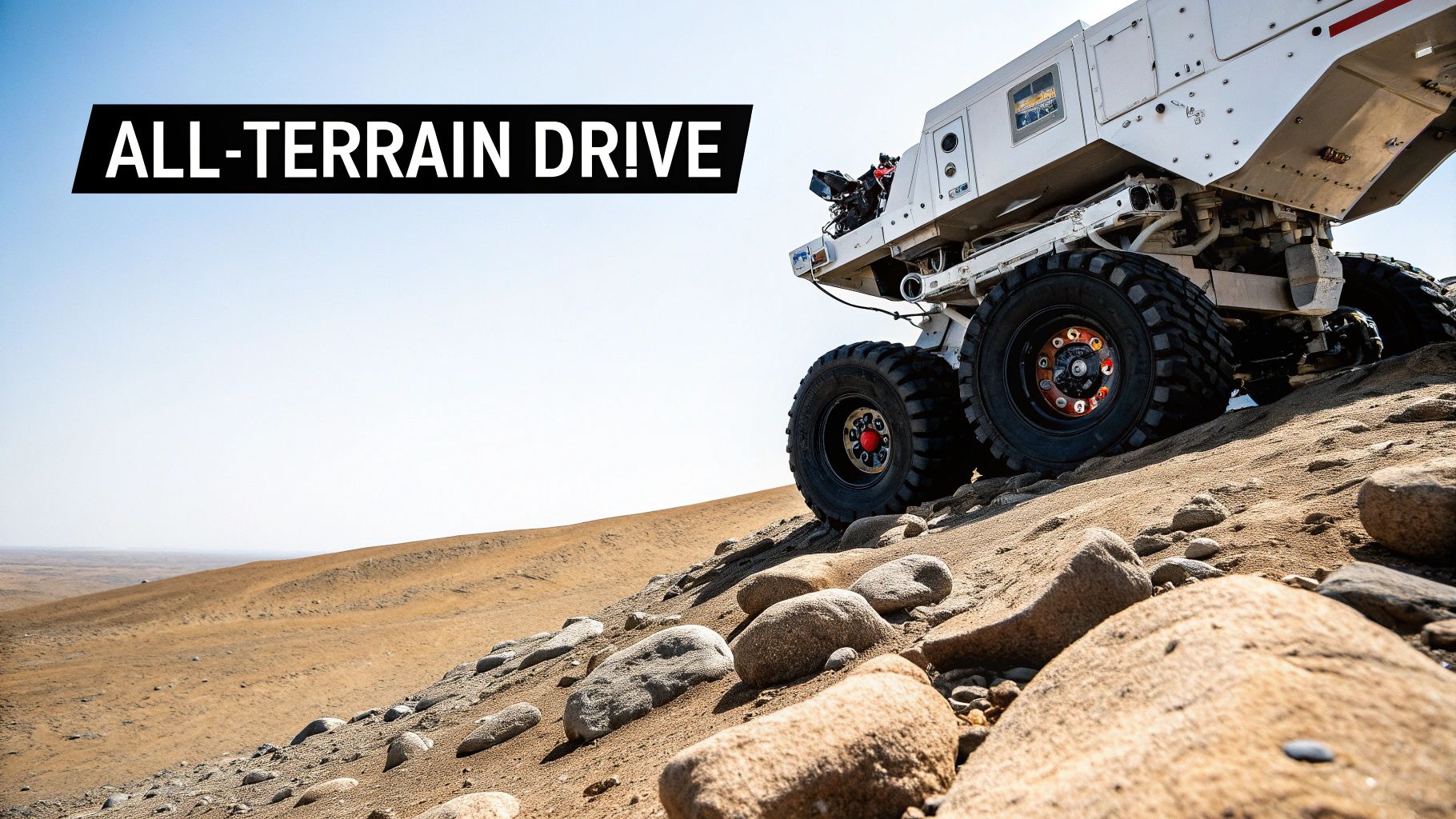
Imagine trying to drive a toy car over a big pile of rocks. It would probably get stuck! Mars rovers have a special trick to stop this from happening. They are built like amazing off-road adventurers with six powerful wheels and a super-bendy suspension system, which is one of the coolest mars rover facts about their design.
The Rocker-Bogie System
This clever setup is called a "rocker-bogie" suspension. It lets each wheel move up and down on its own, so the rover can keep all six wheels on the ground even when climbing over big rocks or up steep, sandy hills.
- Amazing Climbers: This system is so good it lets rovers like Curiosity and Perseverance climb slopes up to 45 degrees. That’s steeper than most hills you’d ever try to walk up!
- Navigating Tricky Terrain: Rovers like Spirit and Opportunity used this system to drive for thousands of kilometres across the Martian landscape, carefully avoiding sharp rocks whenever possible to protect their wheels.
Space Ranger Fred's Fun Fact: In my book, Space Ranger Fred and the Umbrella Rescue, my own rover, Sparky, had to get over some tricky obstacles. The rocker-bogie system is a bit like having really flexible knees and ankles. It helps the rover stay stable and not tip over, which is very important when you are millions of miles from the nearest mechanic!
4. They Have Super-Sight with Advanced Cameras!
Imagine having eyes that can see in super high-definition, zoom in on tiny grains of sand, and create giant 360-degree pictures! Mars rovers have exactly that, using a whole collection of amazing cameras to see the world around them. These cameras are their eyes for both driving safely and making incredible scientific discoveries, making them one of the coolest mars rover facts.
Different Eyes for Different Jobs
Rovers don't just have one type of camera; they have several, each with a special purpose. This helps them understand everything from a giant mountain in the distance to a tiny crystal right under their wheels.
- Navigation and Safety Cameras: Special cameras called Navcams and Hazcams (Hazard Cameras) act like the rover's eyes for driving. They help the rover spot rocks, slopes, and other dangers so it can navigate the Martian landscape without getting stuck.
- Science Cameras: Rovers like Curiosity and Perseverance have powerful cameras on a tall mast, like a head. Curiosity's Mastcam can take amazing colour photos, while Perseverance has a zoom lens that works like a pair of binoculars to see things far away in incredible detail.
Space Ranger Fred's Fun Fact: In my book, Space Ranger Fred and the Shoelace Adventure, I learn how important it is to look closely at details to solve a problem. Rovers do the same thing! They use special cameras like SHERLOC and PIXL to get microscopic close-ups of rocks, helping scientists look for clues about ancient life. These cameras are like super-powered magnifying glasses, way more powerful than any telescope. You can learn more about how to use telescopes on my blog.
5. They Have a Super-Smart Robotic Arm!
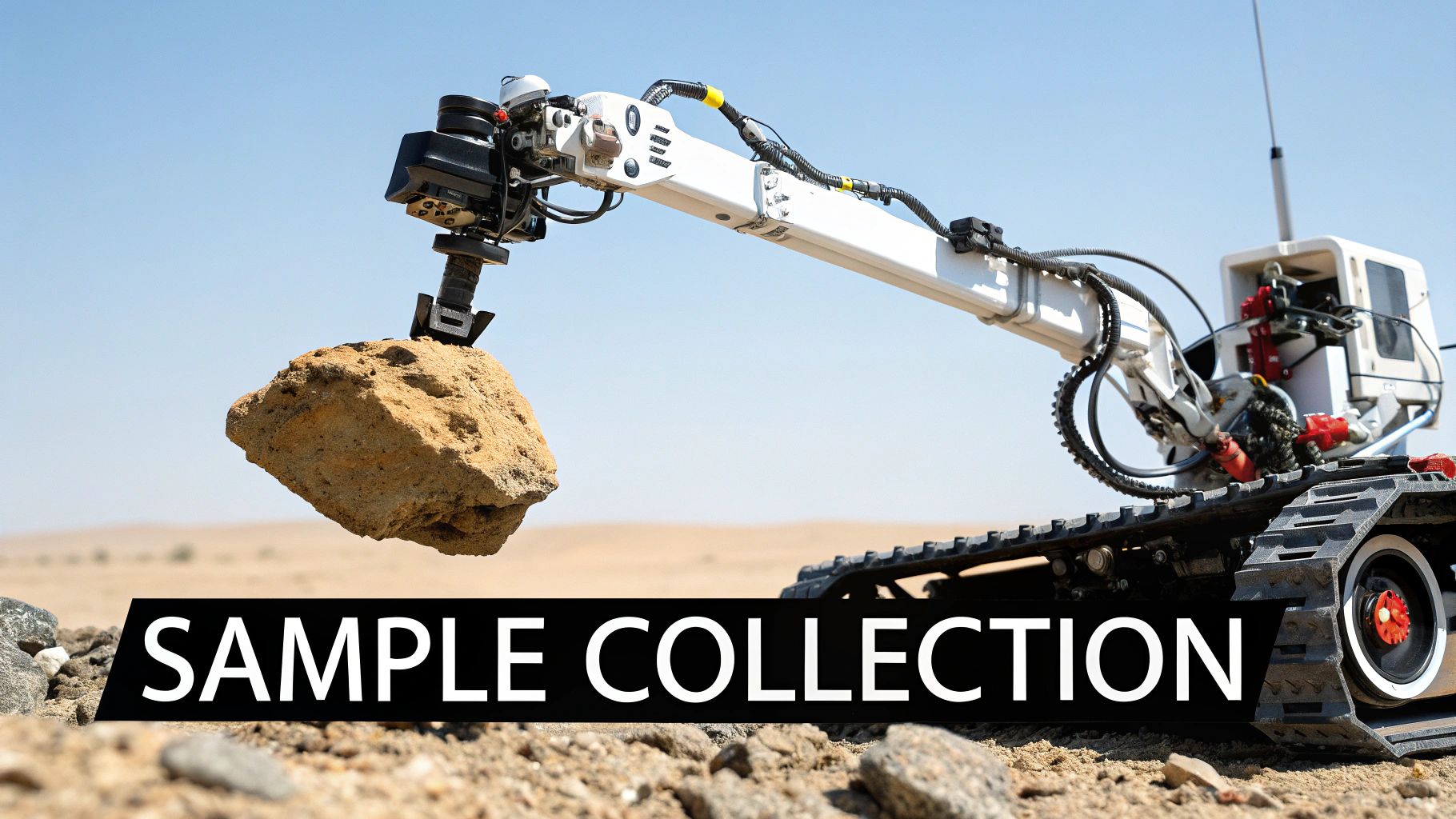
Imagine having an arm that can stretch out really far and has cool science tools instead of fingers. That's exactly what Mars rovers have! These amazing robots are equipped with a long, multi-jointed arm that acts like a scientist's toolkit, allowing them to reach out, touch, and study the Martian world up close. It's one of the most incredible mars rover facts because it's how they do their detective work.
A Toolkit at the End of an Arm
This robotic arm is much more than just a limb; it’s a mobile science laboratory. It can carry a whole suite of different instruments that help scientists understand what Mars is made of, from its soil to its most interesting rocks.
- Rock Grinders and Drills: The Opportunity rover had a tool called the Rock Abrasion Tool (RAT) to grind away the old, dusty surface of rocks to see the fresh material inside. Curiosity and Perseverance have drills that can collect samples from deep within a rock.
- Cameras and Spectrometers: Instruments like Perseverance’s PIXL can look at a rock and tell scientists exactly what chemical elements it’s made of, almost like giving it a high-tech scan!
Space Ranger Fred's Fun Fact: In my book, Space Ranger Fred and the Shoelace Adventure, I had to use all my gadgets carefully to solve a big problem. The rover’s arm is just like that! Mission controllers on Earth have to plan every single move the arm makes to make sure it doesn't bump into anything and can collect the best samples to search for signs of ancient life. You can read about some of my other favourite space gadgets on my blog.
6. They Can Drive Themselves!
Imagine driving a car when the steering wheel, brake, and accelerator are millions of miles away on another planet! That’s the challenge for scientists controlling Mars rovers. Because it takes 5 to 20 minutes for a radio signal to travel from Earth to Mars, the rovers can’t be driven in real time like a remote-control car. Instead, they have amazing robot brains that let them drive all by themselves.
Smart Driving on a Faraway Planet
These clever robots use a system called autonomous navigation, or “AutoNav”. It uses cameras to see the path ahead and computers to think, making it one of the most incredible mars rover facts.
- Perseverance's AutoNav: This is the most advanced driver on Mars! It can map the terrain in real time, spot hazards like big rocks or steep slopes, and choose the safest path forward, driving over 200 metres each Martian day.
- Curiosity's Upgrades: Curiosity received software updates all the way from Earth that improved its driving skills, making it smarter and faster over time. China's Zhurong rover also successfully used its own autonomous system to explore.
Space Ranger Fred's Fun Fact: In my book, Space Ranger Fred and the Shoelace Adventure, I learn that thinking ahead and planning my route is key to solving problems. The rover scientists do the same thing! They analyse the terrain before a drive and choose the best navigation mode. The rover’s smart software lets it make its own safe choices on the long journey, avoiding danger without anyone having to touch a joystick back on Earth.
7. They Can Drill into Rocks!
Imagine trying to find out what a cake is like just by looking at the icing. You wouldn’t know what flavour it is inside! Mars rovers have a similar problem; the surface of Mars has been changed by radiation and weather. To see what the planet is really made of, rovers use special drills to dig deep into the ground, revealing some of the most exciting mars rover facts.
Going Below the Surface
These aren't just any drills. They are super-strong robotic arms that can bore into hard Martian rock to collect samples from deep underground, where the rocks have been protected for billions of years. This helps scientists look for clues about Mars's ancient past.
- Curiosity's Big Find: The Curiosity rover’s drill found special molecules in 3-billion-year-old rocks, which are the building blocks of life as we know it!
- Perseverance's Sample Collection: The Perseverance rover is using its drill to collect and store the most interesting rock samples. These will one day be brought back to Earth for scientists to study up close.
Space Ranger Fred's Fun Fact: In my book, Space Ranger Fred and the Shoelace Adventure, I learn that sometimes you have to look deeper to solve a mystery. That's exactly what these rover drills do! They help scientists choose the best spots to drill and have clever systems to make sure the precious rock samples don't get contaminated before they can be studied.
8. They Phone Home in a Very Special Way!
Imagine trying to talk to someone on the other side of a giant playground. Now, imagine that playground is millions of kilometres of empty space! That’s the challenge Mars rovers face when they need to send their amazing discoveries back to scientists on Earth. They can’t just use a mobile phone, so they have a super clever communication system.
Direct Calls and Space Messengers
Rovers have two main ways to "talk" to us. Sometimes, they send signals directly to Earth, but a much faster way is to use a space messenger.
- Relay Power: Rovers like Perseverance send their data up to a satellite orbiting Mars, like the Mars Reconnaissance Orbiter. This orbiter then acts like a powerful relay station, sending all the pictures and science information back to Earth much faster. This method can boost data rates by ten times!
- Data Delivery: Even with this speedy system, it still takes a while for the signal to travel. Depending on where Earth and Mars are in their orbits, it can take anywhere from 5 to 20 minutes for a message to travel one way. That’s one of the most mind-boggling mars rover facts!
Space Ranger Fred's Fun Fact: In my book, Space Ranger Fred and the Shoelace Adventure, I learn that good communication is key to solving any problem. Scientists have to be very patient, sending instructions and then waiting for the rover to receive them and send back a reply. They can’t control it in real-time like a video game.
9. They Are Martian Weather Reporters!
Did you know Mars rovers are like robotic weather stations? They don’t just look at rocks; they also feel the Martian air, check the temperature, and even measure sneaky space radiation. This is one of the most important mars rover facts because it helps scientists understand the Martian climate and prepares us for future human explorers.
Feeling the Martian Environment
Rovers are packed with special tools called sensors that act like their senses. These sensors can measure everything from the speed of the wind to the amount of dust in the air, giving us a daily weather report from millions of miles away.
- Measuring the Invisible: The Curiosity rover has an instrument called RAD that measures high-energy radiation from the sun and space. This helps NASA understand if it would be safe for astronauts on Mars.
- Checking the Climate: The REMS instrument, also on Curiosity, is a mini weather station. It measures wind speed, temperature, and even how much water is in the thin Martian air (humidity). Perseverance has a similar, even more advanced, weather station.
Space Ranger Fred's Fun Fact: In my book, Space Ranger Fred and the Shoelace Adventure, I learn that you always need the right gear for the environment you're exploring! The data from these rover weather stations is crucial. It tells engineers how to build suits and habitats for future astronauts. You can discover more about the Martian environment on my blog.
10. They Can Survive Planet-Sized Dust Storms!
Imagine a storm so big it covers the entire planet! Mars has gigantic dust storms that can block out almost all sunlight for weeks. This is a huge problem for rovers, so NASA engineers had to design them to be super tough and clever survivors, which is one of the most incredible mars rover facts.
How Rovers Hunker Down
When a storm hits, rovers can’t just pack up and go inside. Instead, they have special plans to stay safe. They carefully manage their power, sometimes even going into a deep sleep or "hibernation" to save energy until the Sun comes out again.
- Solar-Powered Survival: The Opportunity rover was a champion survivor! In 2018, it faced a massive global dust storm that blocked 99% of sunlight. It hunkered down and waited, having already survived another huge storm back in 2007.
- Nuclear-Powered Advantage: Because the Curiosity rover uses nuclear power (an RTG), it doesn't need sunlight. It can keep doing science and sending back data even when a dust storm is raging around it, a bit like having a powerful torch in the dark.
Space Ranger Fred's Fun Fact: In my book, Space Ranger Fred and the Umbrella Rescue, I learn that being prepared for bad weather is vital for any mission. Martian dust storms teach us that rovers must be adaptable. Engineers tell the rovers to use less power, keep only their most important parts warm, and reduce sending messages back to Earth until the storm passes. This smart planning is how they survive the wild Martian weather.
10-Point Comparison of Mars Rover Systems
| Technology | Implementation complexity 🔄 | Resource & logistics ⚡ | Expected outcomes 📊 | Ideal use cases 💡 | Key advantages ⭐ |
|---|---|---|---|---|---|
| Solar Power Systems in Mars Rovers | Moderate 🔄 — PV integration + dust-mitigation systems | Low ongoing ⚡ — sunlight + batteries; vulnerable to dust | Good impact 📊 — reliable when sunny (⭐⭐) | Long-duration, low-power science in sunlit regions 💡 | Renewable, low-maintenance, cost-effective ⭐ |
| Radioisotope Thermoelectric Generators (RTG) Technology | High 🔄 — nuclear handling, shielding, regulatory overhead | High ⚡ — Pu‑238 supply and transport complexity | Excellent impact 📊 — continuous 24/7 power (⭐⭐⭐) | High-power instruments, operations through night/storms 💡 | Uninterrupted power; long mission lifetimes ⭐ |
| Six-Wheel Drive System and Suspension | Moderate 🔄 — proven mechanical design, precise fabrication | Medium ⚡ — mechanical parts, weight and mass constraints | High impact 📊 — superior terrain traversal (⭐⭐⭐) | Rugged, obstacle-rich terrain mobility and long traverses 💡 | Redundancy, stability, proven field performance ⭐ |
| Advanced Camera Systems and Imaging Technology | Moderate 🔄 — optics, calibration, data processing | Medium ⚡ — high data rates, storage and bandwidth needs | High impact 📊 — detailed science & navigation (⭐⭐⭐) | Geological survey, target selection, autonomous nav support 💡 | High-resolution imaging; dual nav/science role ⭐ |
| Robotic Arm with Scientific Instruments | High 🔄 — articulated mechanisms, precision control | High ⚡ — power, contamination control, calibration needs | High impact 📊 — precise sampling & in-situ analysis (⭐⭐⭐) | Close-range geology, sample collection, instrument deployment 💡 | Precise sample access; multi-instrument capability ⭐ |
| Autonomous Navigation and Hazard Avoidance | High 🔄 — complex software, extensive testing | Low–Medium ⚡ — onboard compute reduces ops but needs validation | High impact 📊 — faster, safer traverses (⭐⭐⭐) | Long traverses with comms delay; time-efficient exploration 💡 | Real-time hazard avoidance; increased autonomy ⭐ |
| Drill Systems for Subsurface Sampling | High 🔄 — mechanical complexity, contamination control | High ⚡ — power-intensive; requires stable platform | High impact 📊 — access to preserved subsurface organics (⭐⭐⭐) | Searching for organics, stratigraphy, sample caching missions 💡 | Subsurface access and coring for high-value science ⭐ |
| Communication Systems and Data Transmission | High 🔄 — multi-path networks, error-correction protocols | Medium ⚡ — relies on orbiters, DSN scheduling and bandwidth | High impact 📊 — reliable data return and telemetry (⭐⭐⭐) | High-data-return missions, relay-dependent operations 💡 | Multiple pathways; data integrity and compression ⭐ |
| Environmental Sensing and Weather Monitoring | Moderate 🔄 — sensor integration and calibration | Low ⚡ — generally low‑power sensors; limited spatial reach | Medium impact 📊 — local climate & radiation insight (⭐⭐) | Climate studies, lander/crew safety assessments 💡 | Real-time weather and radiation data for mission planning ⭐ |
| Dust Storm Resilience and Operational Adaptability | Moderate 🔄 — protective materials + operational modes | Medium ⚡ — power rationing, thermal control, coatings | Medium impact 📊 — survival through storms but possible downtime (⭐⭐) | Long-duration missions in dust-prone regions 💡 | Enhanced survivability; mission continuity strategies ⭐ |
Your Own Martian Adventure Awaits!
From powering through dust storms to zapping rocks with lasers, the Mars rovers are truly the superstars of space exploration. We’ve journeyed across the red dust, discovering how these brilliant robots are not just vehicles, but mobile science laboratories packed with incredible technology. Each of the amazing mars rover facts we've explored shows just how much creativity and teamwork goes into exploring a new world.
Think about it: these rovers are our robotic pioneers, driving millions of kilometres away on another planet. They are a testament to human curiosity, designed by brilliant minds to answer some of the universe's biggest questions. Are we alone? Was Mars once like Earth? Every rock sample drilled and every landscape photo taken brings us one step closer to finding out.
Your Mission Briefing: Key Takeaways
Let’s recap some of the most important things we’ve learnt about our robotic friends on Mars:
- Ingenious Power: Whether soaking up the sun’s rays with solar panels or using the steady heat from Radioisotope Thermoelectric Generators (RTGs), rovers are masters of staying powered up in a harsh environment.
- Unstoppable Mobility: With their special six-wheel drive and clever 'rocker-bogie' suspension, these machines can climb over obstacles taller than themselves, navigating the tricky Martian terrain like champions.
- Super Senses: Armed with everything from high-definition cameras that act as their eyes to a robotic arm that can feel and analyse rocks, the rovers gather crucial data. They can even listen to the wind and check the weather!
- Smart Brains: The rovers are not just remote-controlled cars. They have autonomous brains, allowing them to make their own decisions to avoid dangers and find the safest path forward. This clever thinking is essential when a message from Earth can take up to 20 minutes to arrive.
Learning these fascinating mars rover facts does more than just teach us about space; it shows us what’s possible when we combine science, technology, engineering, and maths (STEM). The same problem-solving skills that NASA engineers use to design a rover's robotic arm are the ones you use when you build with LEGOs or figure out a tricky puzzle.
Perhaps these stories have sparked your own curiosity. Maybe you’re already imagining what a rover you design would look like, or what mysteries it could solve. Every great explorer, from the scientists at mission control to characters like Space Ranger Fred in his book Space Ranger Fred and the Umbrella Rescue, starts with a question and a sense of wonder. Your adventure into science is just beginning, and who knows where it might lead? One day, it could be your discoveries we are all celebrating!
Ready for more out-of-this-world fun? Continue your journey into STEM with the adventures of Space Ranger Fred. Just like the rover scientists, Fred uses clever thinking and science to solve exciting problems across the galaxy! Blast off into your next reading adventure at Space Ranger Fred.