
Have you ever wondered what a space station actually is? In the simplest terms, it’s a huge spacecraft where people can live and work while orbiting the Earth for a very long time. Imagine it's a house, a science lab, and a stargazing observatory all rolled into one, zooming high above our heads.
A Human Outpost in the Cosmos
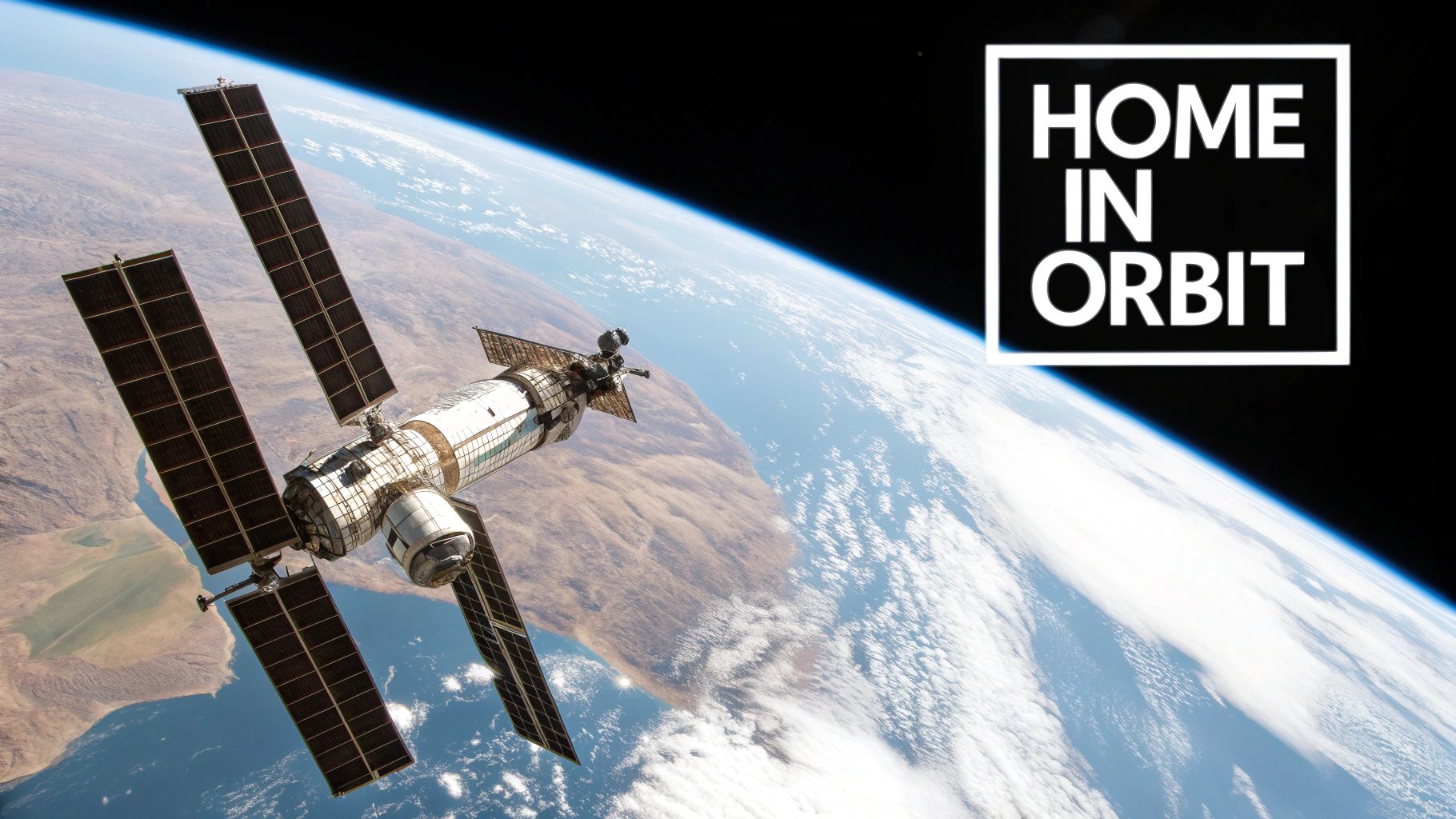
Picture a massive, high-tech treehouse floating in the endless dark of space. That’s a pretty good starting point! Unlike a spaceship designed to travel to other planets, a space station doesn’t have powerful engines for long journeys. Instead, it stays locked in a stable orbit around Earth, travelling at an incredible 17,500 miles per hour. That’s fast enough to circle the entire planet roughly every 90 minutes.
Astronauts can live aboard a station for months at a time, carrying out amazing experiments that would be impossible to do down here on the ground. These orbital outposts are humanity’s foothold in space and an essential stepping stone for future missions to the Moon, Mars, and beyond.
So, Why Do We Need Them?
Living and working in space throws up some pretty unique challenges—a bit like the ones Fred faces in Space Ranger Fred and the Shoelace Adventure, where clever thinking always saves the day. Space stations are so important for a few big reasons:
- Amazing Science: They’re one-of-a-kind labs for studying how microgravity affects everything from the human body and growing plants to creating new materials.
- A Bird’s-Eye View: From their incredible vantage point, astronauts can watch over Earth, monitoring weather patterns, helping during natural disasters, and tracking the effects of climate change.
- Testing New Tech: A space station is the perfect place to test out all the new equipment and technology we’ll need for long-haul trips to other worlds.
A space station is more than just a big metal structure; it's a shining example of international teamwork. It shows what amazing things we can accomplish when countries from all over the world work together to explore and understand our universe.
The most famous example, of course, is the International Space Station (or ISS). It’s so enormous that it couldn’t be launched in one go. Instead, it was built piece by piece in orbit over many years. To learn all about this incredible achievement, check out our guide on what is the International Space Station.
Space Station Key Facts
To help you get your head around it, here's a quick summary of what makes a space station so special.
| Feature | Simple Explanation |
|---|---|
| Orbiting Lab | It's a place for science experiments that can only be done in space. |
| Long-Term Home | Astronauts live here for months, not just a few days. |
| Earth Observer | It provides a unique view of our planet for research. |
| International | Countries from around the world often work together to build and run them. |
| Tech Testbed | It's a proving ground for new technologies needed for deep space exploration. |
These orbiting platforms are a testament to what teamwork and a whole lot of curiosity can build.
A Brief History of Our Homes in Orbit
The enormous International Space Station (ISS) orbiting Earth today didn’t just pop into existence. It stands on the shoulders of giants—the pioneering early space stations that taught us everything we know about living and working amongst the stars. It was a journey of trial and error, a bit like in Space Ranger Fred and the Tick Tock Tale, where every second brings a new challenge and a lesson to be learned.
The whole adventure kicked off in the 1970s with the Soviet Union's Salyut programme. These were the first-ever crewed laboratories in orbit, starting with Salyut 1 in 1971. It was a truly bold step, but these early missions were also incredibly risky. They taught engineers some hard but vital lessons about keeping astronauts safe and healthy on long journeys far from home.
From Solo Missions to Team Efforts
Not long after, the United States launched its own station, Skylab, in 1973. For its time, it was absolutely huge. Skylab hosted three different crews who carried out hundreds of scientific experiments, proving that humans could live and work productively in space for months on end.
Up until this point, space stations were a solo act, run by a single country. But a powerful new idea was beginning to take hold: what if we worked together? The Soviet (and later Russian) Mir space station, which was in orbit from 1986 to 2001, became the first great symbol of this new spirit of cooperation. It welcomed astronauts and cosmonauts from many different nations, setting the stage for the incredible global project that would follow.
The real breakthrough wasn’t just the engineering; it was the teamwork. Early space stations proved that when it comes to exploring the cosmos, humanity’s greatest strength is our ability to work together.
The UK's Collaborative Role
While some nations built their own outposts in space, others like the United Kingdom chose a different path. Historically, the UK has been a key partner and collaborator rather than building its own crewed stations. The British space programme has always played to its strengths, focusing on world-class satellites and uncrewed robotic missions.
When it came to the ISS, for example, the UK government didn't contribute funding until 2011, well after its launch in 2000. Instead, its experts provided crucial know-how in robotics and designed amazing science experiments for British astronauts to run on board. It just goes to show there are many different ways to be part of the incredible journey into space.
How to Build a Laboratory in the Sky
You can’t just launch a fully-built space station on a single rocket. It would be way too big and heavy! Instead, think of it like putting together a giant, super-advanced LEGO set while floating hundreds of miles above the Earth. It’s an incredible bit of engineering that happens one piece at a time.
Each major part of the station is called a module. These are designed and built right here on the ground, and they can be anything from laboratories and living quarters to special connecting hubs. One by one, they get packed into a rocket’s cargo bay and blasted into space—a trip that takes enormous power and perfect aim.
Connecting the Pieces in Orbit
Once a new module makes it to orbit, the real puzzle begins. A huge robotic arm, like the station’s own Canadarm2, gently grabs the new piece. It then guides it slowly towards the rest of the station in a delicate dance where every single movement is planned and controlled with incredible care.
This is where astronauts get to do one of their coolest (and most challenging) jobs: a spacewalk, also known as an Extravehicular Activity (EVA). They pop on their bulky spacesuits, head outside, and get to work connecting the new module. They bolt it into place and hook up all the vital power and data cables, a job that needs massive amounts of teamwork and focus—a bit like the problem-solving in Space Ranger Fred and the Shoelace Adventure.
Building a space station in orbit is a masterclass in patience and precision. Astronauts and engineers on the ground must work together perfectly to connect massive modules travelling at over 17,000 miles per hour, with no room for error.
This amazing timeline shows how early stations like Salyut and Skylab paved the way for the modular construction of the International Space Station we know today.
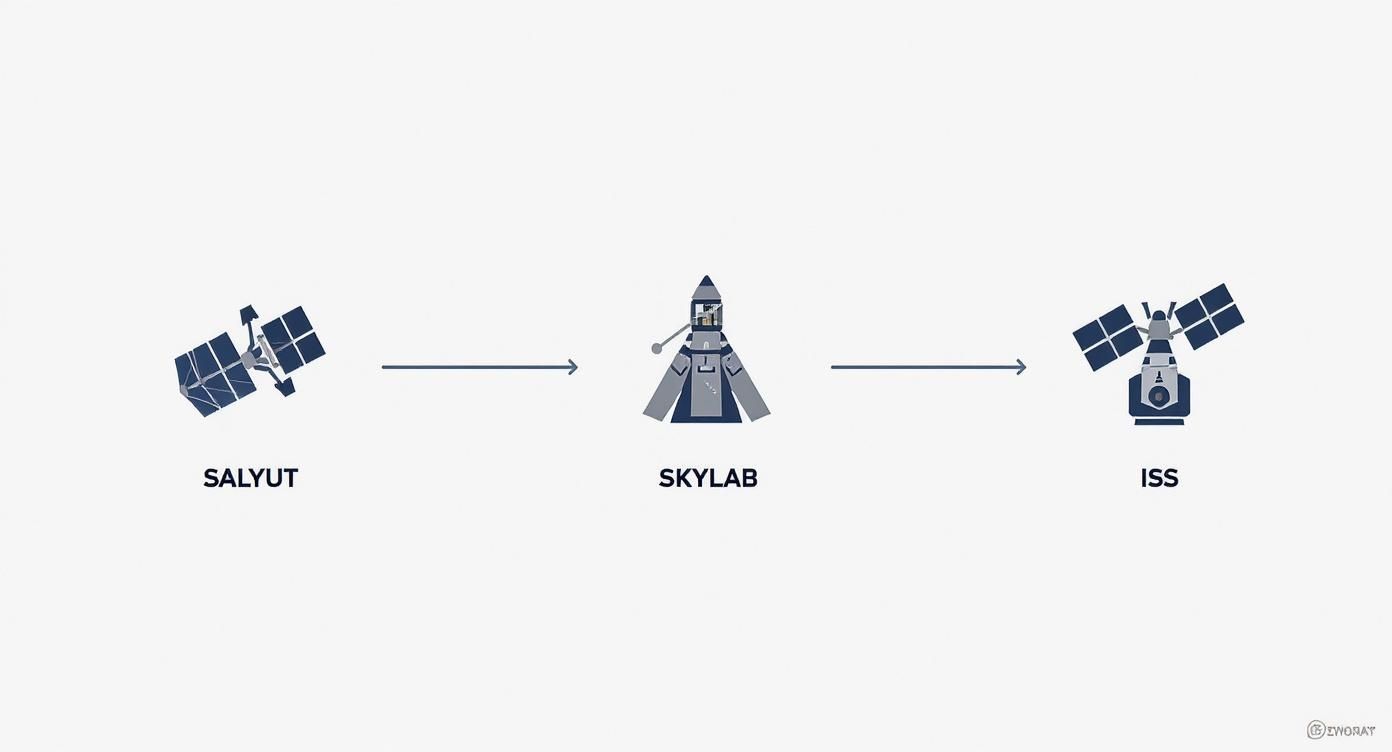
You can really see how each new station learned from the last one, growing more complex and capable over the decades.
The Technology That Holds It All Together
So how do these massive pieces actually stick together? Specialised docking systems act like powerful, super-smart latches. They click into place and create a perfect, airtight seal between the old and new sections. Without these clever mechanisms, the station couldn't grow or be repaired. This modular design is brilliant because it allows stations to be upgraded over many, many years.
But all this construction can create tiny bits of leftover material floating around. To get a better idea of the risks this causes, you can find out what is space debris and why keeping orbit clean is so important for the future. Building in space is an ongoing mission that requires careful planning to keep both the station and its brave crew safe.
Daily Life for Astronauts in Zero Gravity
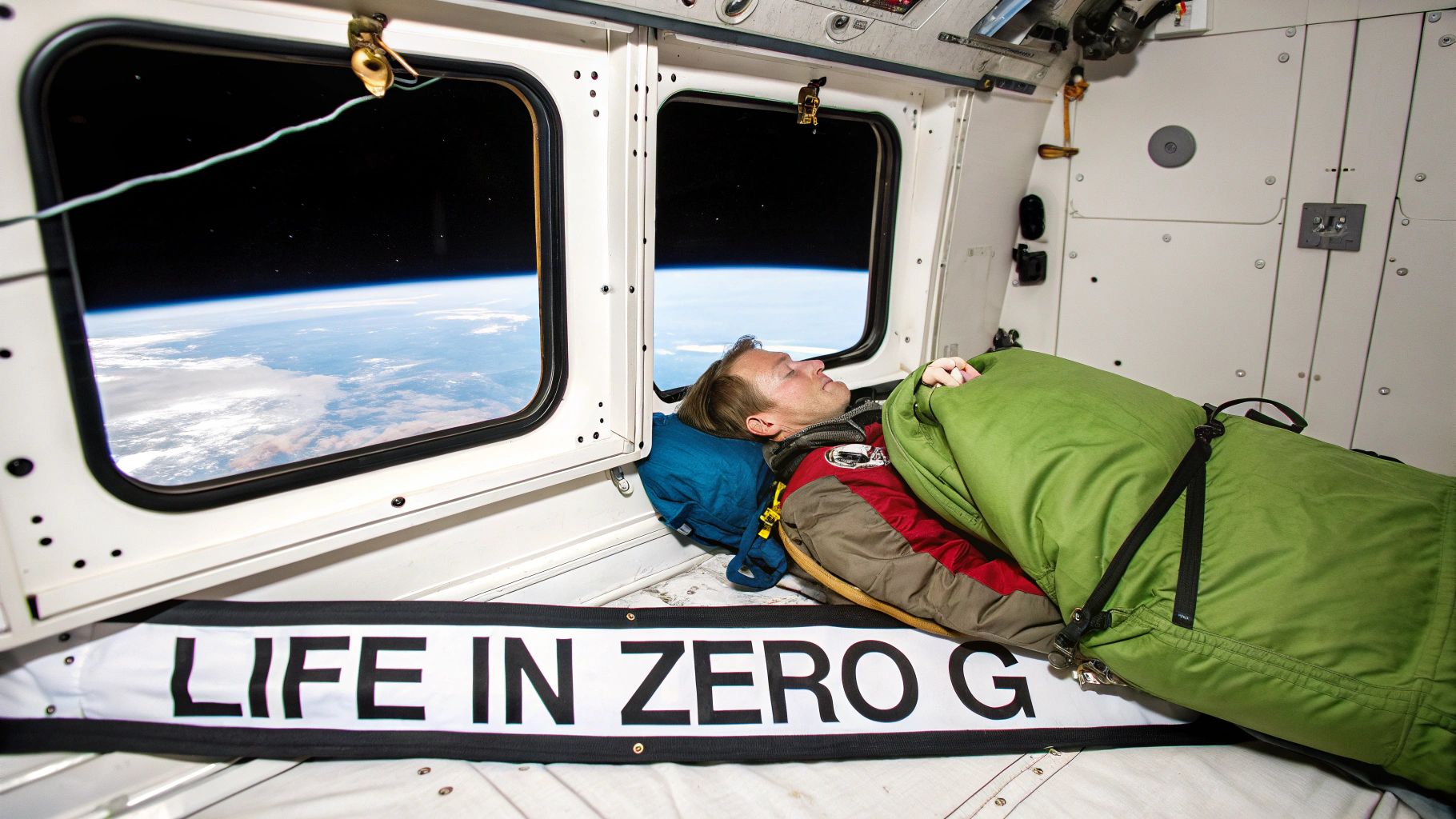
Living on a space station is an extraordinary adventure where the everyday rules of life on Earth just don't apply. Can you imagine waking up and floating out of your sleeping bag instead of standing up? That’s the reality for astronauts, whose days are a carefully planned mix of cutting-edge science, essential chores, and taking in the most incredible view in the solar system.
Life in orbit is a constant dance with zero gravity, where up and down are just a matter of opinion!
Eating and Sleeping in Orbit
Mealtime in space is a little different. Food is often freeze-dried or comes in special pouches to stop crumbs from floating away and getting stuck in important equipment. Astronauts just add water to rehydrate everything from spaghetti to pudding! Even salt and pepper come in liquid form to prevent tiny grains from causing big problems.
When it's time to rest, astronauts zip themselves into sleeping bags tethered to a wall. This stops them from drifting around and bumping into things while they sleep. With no sense of up or down, they can sleep in any direction they choose—sideways, upside-down, it makes no difference!
Teamwork is everything on a space station. Just like in Space Ranger Fred and the Umbrella Rescue, where creative thinking saves the day, astronauts must work together to solve problems, run experiments, and keep their orbital home safe and tidy.
To stay healthy, astronauts have to exercise for about two hours every single day. They use special treadmills they are strapped to and resistance machines that help them maintain muscle and bone strength, which can weaken without the constant pull of gravity.
A Unique Global Collaboration
Life on board is a testament to incredible international cooperation. The ISS itself, which has had people living on it continuously since 2000, is a marvel of engineering. It orbits Earth 16 times a day at a mind-boggling 27,600 km/h!
The station has a mass of 420,000 kg—that’s the same as more than 320 cars all stuck together. Its construction was a massive project involving 16 participating nations. You can discover more amazing facts about the ISS and its history at Sky at Night Magazine.
Even simple tasks like washing hair or using the toilet require special solutions. Astronauts use a no-rinse shampoo, and the space toilet works like a vacuum cleaner, using air suction instead of water to keep waste contained. It's a daily reminder that living in space requires brilliant and often unusual problem-solving for even the most basic human needs.
The Groundbreaking Science Conducted in Space
A space station is so much more than just a home for astronauts floating high above our heads; it’s a world-class laboratory. In the unique environment of microgravity, scientists can conduct experiments that are simply impossible down on Earth. This is where the real magic happens, sparking amazing discoveries that benefit all of us.
These orbital labs are hotspots for incredible research. By removing the constant tug of gravity, scientists can study the hidden properties of liquids, flames, and metals. They also get to see how human cells, plants, and animals react to life in space, giving us vital clues for creating new medicines and keeping astronauts healthy on long journeys to places like Mars.
Unlocking Discoveries in Microgravity
The science carried out on a space station has a huge range of uses back on the ground. Clever thinking is essential, just like in the book Space Ranger Fred and the Shoelace Adventure, where a simple problem leads to a brilliant solution. Aboard the station, that kind of creative problem-solving happens every single day.
Some of the incredible science includes:
- Medical breakthroughs: Studying how our bodies change in space helps us understand diseases like osteoporosis and muscle wasting, which leads to better treatments for people on Earth.
- Creating better materials: Without gravity pulling everything down, scientists can mix metals to create super-strong, lightweight alloys that we could never make on the ground.
- Growing plants in space: Experiments to grow vegetables in orbit teach us how to farm more efficiently in harsh environments and provide fresh food for future space explorers.
The most powerful tool on a space station isn't a high-tech laser or a powerful telescope; it's the microgravity environment itself. It allows us to peel back the layers of physics and biology in a way that is truly unique to orbit.
This research doesn't just push the boundaries of human knowledge—it has direct, practical benefits for everyone.
The UK’s Vital Role in Space Science
Although the UK didn't lead the construction of major space stations, its contribution to the science happening on them is enormous. The nation’s space sector plays a vital part in the global space community, especially by developing cutting-edge scientific instruments and experiments that fly aboard the International Space Station.
The UK's space industry has seen remarkable growth, with a total income of £16.4 billion in 2018/19. This boom highlights a smart focus on building sophisticated satellites and finding new ways to use space data, rather than building crewed stations. The growth in areas like space applications and manufacturing shows the UK's strength as a key partner in space exploration. You can learn more about the UK's thriving space industry and its important contributions.
Frequently Asked Questions About Space Stations
Ever spotted a bright, moving light sailing across the night sky and wondered what it was? It might not have been a star or a plane—it could have been a space station! Here are a few answers to the questions we hear most from curious explorers just like you.
How Do Astronauts Get to the Space Station?
Astronauts get a very special ride to work! They blast off in a small spacecraft, often called a capsule, which sits on top of a massive, powerful rocket. Depending on the mission, the journey up to the International Space Station (ISS) can take just a few hours or a couple of days.
The real nail-biting part is the docking. The capsule has to perfectly match the station’s orbit and its incredible speed—zipping along at over 17,000 miles per hour. Then, it has to carefully inch its way towards a specific docking port and connect with a gentle click. Imagine trying to thread a needle that’s whizzing around the world faster than a speeding bullet!
Can We See the Space Station from Earth?
Yes, you absolutely can! The ISS is actually one of the brightest objects in the night sky. It doesn’t twinkle like a star or flash like an aeroplane. Instead, it looks like a steady, brilliant point of light moving smoothly and quickly from one horizon to the other.
Spotting it is a brilliant activity you can do right from your own back garden. NASA has some fantastic websites and apps that tell you exactly when and where to look up to see it fly over your house. A pass usually only lasts a few minutes, so you have to be ready!
Seeing the space station fly overhead is an amazing reminder that there are people living and working inside that tiny speck of light, doing incredible science for all of us down here on Earth.
What Happens When a Space Station Gets Old?
Just like a car or a computer, a space station eventually wears out and its mission comes to an end. When this happens, it’s carefully brought back down to Earth in a process known as de-orbiting. It doesn't just fall out of the sky.
Mission controllers on the ground use the station's last bit of fuel to fire its engines, which acts like hitting the brakes. This slows it down, causing it to gradually fall out of orbit and back towards our planet. They carefully aim its path so it re-enters the atmosphere over a remote and empty stretch of the Pacific Ocean, sometimes called the 'Spacecraft Cemetery'. Most of the station burns up from the intense heat of re-entry, and any small pieces that survive splash harmlessly into the sea.
Are New Space Stations Being Planned?
Definitely! The ISS has been a wonderful home in orbit for more than two decades, but it won’t be around forever. Several space agencies and private companies are already busy designing the next generation of space stations.
Some of these future outposts will be for science, just like the ISS, while others might become hotels for space tourists or even factories for building things in orbit. Characters in stories like Space Ranger Fred and the Tick Tock Tale show us that adventure is always just around the corner, and these new stations are the next big step. They'll be absolutely vital for humanity's future adventures, like missions back to the Moon and eventually to Mars.
At Space Ranger Fred, we believe learning about space should be just as exciting as exploring it. Our books and adventures are all about sparking curiosity and making tricky STEM topics fun for the next generation of innovators. Discover a universe of fun at https://spacerangerfred.com.