
Ever heard the term STEM buzzing around and wondered what it's all about? It's pretty simple, really. STEM stands for Science, Technology, Engineering, and Maths. But it’s not just a list of school subjects. Think of it as a mission kit for understanding the world, one that gets kids asking big questions, solving tricky puzzles, and building brilliant things.
What Is STEM Education, Anyway?
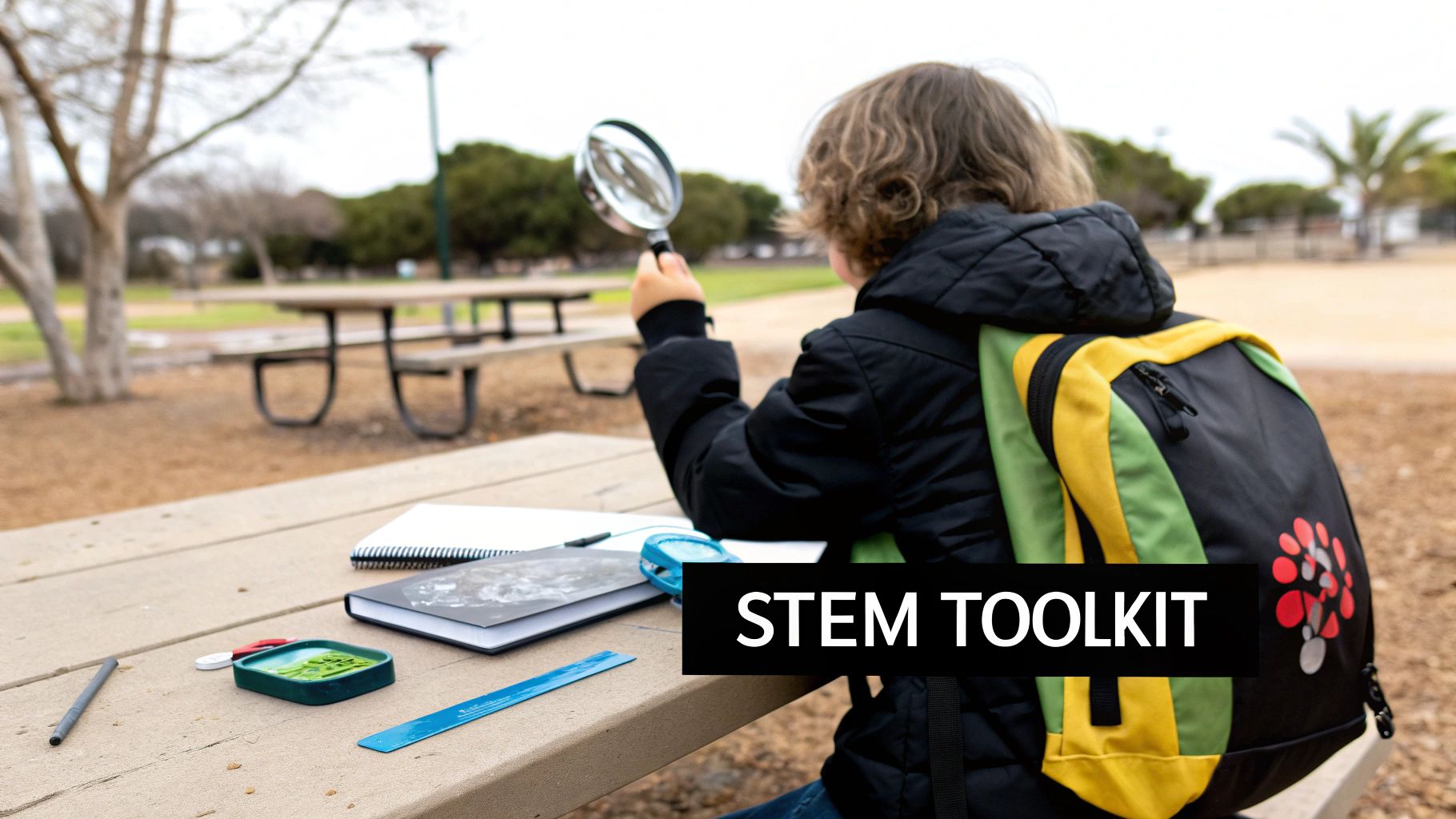
Imagine STEM as an explorer’s toolkit. Instead of learning about science in one lesson and maths in another, totally separate from each other, STEM education mixes them all together. It’s a way of showing children how these four areas team up to solve real problems out in the world. The whole approach is less about remembering facts and figures and more about getting your hands dirty—doing, creating, and discovering.
It's all about nurturing a special way of thinking, one that celebrates curiosity, gets creative, and isn't afraid to try again when things don't go to plan. It’s building a den in the garden (that’s engineering!), figuring out why a plant twists towards the sun (that's science!), or using a tablet to design a new story character (hello, technology!).
A Hands-On Way to Learn
The best bit? This integrated learning style often just feels like playing. This is where exciting methods like project-based learning come into their own, turning lessons into proper missions. Instead of just reading about rockets in a textbook, children might get to design and build their own mini-rocket or code a simple game from scratch. If you're curious, you can find out more about what is project-based learning in our guide.
This whole approach turns learning from something you just sit and listen to into an active adventure. It gives children the tools not only to understand the world around them but to start shaping it, too.
STEM education is about providing children with a mindset to investigate, innovate, and solve problems. It’s the curiosity to ask 'why?' and the confidence to figure out 'how?'.
To help you and your young explorer get started, here’s a quick mission briefing that breaks down what each part of the STEM toolkit does.
Your Mission Briefing: The Four Parts of STEM
Each field is a vital part of any great adventure, whether you’re exploring a new planet with Space Ranger Fred or just building the tallest-ever tower of blocks in your living room.
| STEM Field | What It Means for a Young Explorer | A Space Ranger Fred Example |
|---|---|---|
| Science | Asking "why?" and "what if?" about the world. It’s about being curious, doing experiments, and discovering how things work. | Figuring out why Fred’s spaceship needs fuel to zoom through the galaxy. |
| Technology | Using cool tools and gadgets to solve problems and create new things, from a simple magnifying glass to a computer. | Using a tablet to design a map of the planet Jambori for a rescue mission. |
| Engineering | Designing, building, and making things work! It's all about planning and putting pieces together to create something useful. | Building a bridge out of straws and tape to help the Togz cross a cosmic canyon. |
| Maths | Finding patterns, counting, measuring, and solving number puzzles. It’s the secret code for understanding the universe. | Calculating the right trajectory to land a spaceship safely on a new moon. |
As you can see, these four areas aren't separate subjects but different tools in the same adventure kit, ready to help your child explore, create, and solve any challenge that comes their way.
Why STEM Skills Are Your Child's Superpower
Let’s be honest, STEM subjects can sound a bit serious. But the skills your child picks up through them are anything but. Think of them as secret superpowers, giving young explorers the tools they need to not just understand the world, but to truly thrive in it.
A STEM mindset gives them practical advantages that stretch from the playground to the classroom and well into their future.
So, what are these amazing powers? Let's start with resilience. When a young engineer's tower of blocks inevitably tumbles down, they learn a massive lesson: it's okay to fail. More than that, they learn to figure out why it failed and try again with a better plan.
Building a Brilliant Mind
This 'try-and-try-again' attitude is brilliant for sharpening their problem-solving skills. Whether they're puzzling out the best way to build a den in the garden or working with friends to invent a new game, they're putting their critical thinking hats on.
This naturally leads to another crucial skill: collaboration. Most STEM challenges, just like Space Ranger Fred’s missions, are too big for one person to tackle alone. Children quickly realise they need to share ideas, listen to what others have to say, and work as a team to get the job done. This teamwork is a brilliant spark for creativity, as different perspectives mix together to create brand-new solutions.
By encouraging a STEM mindset, you’re not just teaching children facts; you’re teaching them how to think, how to solve, and how to create. It’s about building a foundation for lifelong learning and innovation.
Preparing for Future Adventures
These skills aren't just 'nice-to-haves' anymore; they're becoming essential. In the UK, interest in STEM is taking off, with nearly 44% of all GCSE exams taken in recent years being in STEM subjects. It’s partly because the country is crying out for more skilled thinkers—government reports highlight a need for 124,000 engineers every single year. You can dive deeper into these trends by exploring the insights from the Institution of Engineering and Technology.
By sparking a love for STEM today, you’re giving your child a head start for the exciting careers of tomorrow. You're handing them a superpower that will help them become the next generation of inventors, explorers, and problem-solvers.
Bringing Each Letter of STEM to Life
Thinking about STEM as four separate subjects can feel a little daunting. But the real magic happens when you see them as different tools for the same grand adventure, all working together to solve problems and create amazing things.
Let's break down each part with some hands-on examples that make learning feel less like a lesson and more like a playful mission.
Science: The Art of Asking ‘Why?’
Science is pure curiosity. It’s the spark that makes us ask questions like, “Why does that bubble float?” or “What happens if I mix these colours together?” It’s all about watching the world, guessing what might happen next, and then testing those ideas with fun experiments.
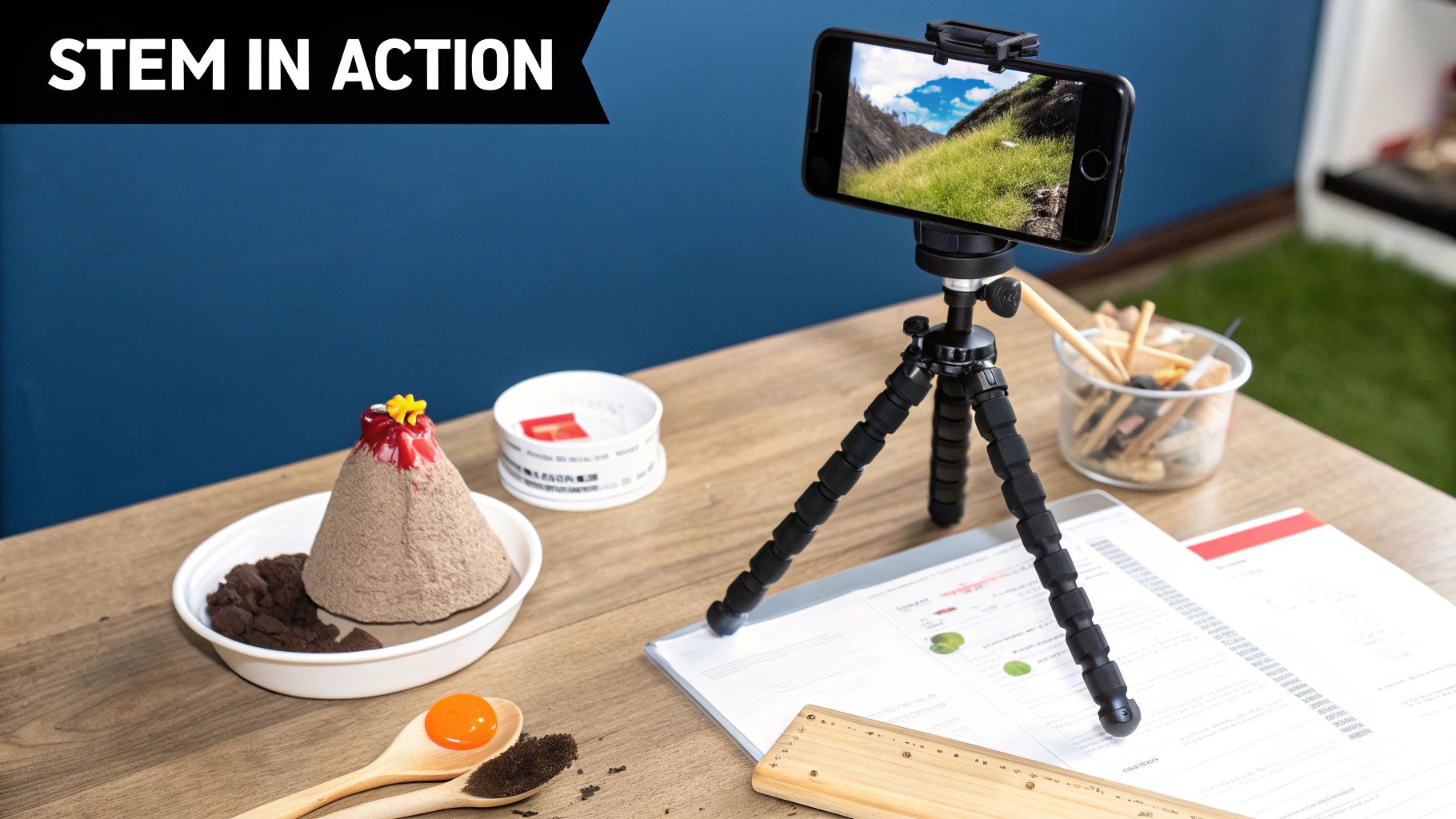
A brilliant way to bring science to life is the classic kitchen volcano. Mixing bicarbonate of soda with vinegar creates a fizzing eruption, showing a chemical reaction in real-time. It’s a simple, safe, and super-exciting way to see scientific principles firsthand. When Space Ranger Fred studies alien plants on Planet Jambori, he’s using his science skills to understand a new world—just like a young explorer in their own kitchen.
Technology: More Than Just Screens
When we hear the word ‘technology’, our minds often jump to phones and computers. But it’s so much more than that. It’s any tool that helps us solve a problem. A magnifying glass is technology. So is a wheel. Even a simple pulley system is a clever piece of tech.
For a great weekend project, try creating a stop-motion animation using a smartphone. Just grab some plasticine or your favourite toys, take lots of pictures as you move them a tiny bit at a time, and use a simple app to stitch them together into a film. It’s a wonderfully creative way to use modern tech, turning your child into a storyteller and animator.
STEM isn't just about what you know; it's about what you can do with what you know. Each letter represents a different way to explore, create, and solve puzzles.
Engineering: The Joy of Building
Engineering is the art of designing and building things that actually work. It’s about picturing a solution, sketching a quick plan, and then bringing it to life with whatever you can find. This teaches children to think through problems and turn their ideas into something real.
Challenge your young explorer to build a bridge out of recycled materials like cardboard tubes, lolly sticks, and string. Can it hold the weight of their favourite toy car? This is exactly how Space Ranger Fred thinks when he has to build a shelter on a rocky moon, using his engineering skills to create something strong and stable. Find more inspiration with our fun activities and freebies.
Maths: The Universe’s Secret Code
Maths isn’t just something you find in textbooks; it’s everywhere! Think of it as the universe’s secret code, helping us understand patterns, measure ingredients, and even tell a story. When you start spotting maths in everyday life, it feels less like a subject and more like a superpower.
Next time you’re baking, let your child help measure the flour and sugar. It’s a tasty lesson in fractions and measurements! Or, go on a nature walk and count the petals on different flowers—you might be surprised by the patterns you find. In Space Ranger Fred and the Blasteroid Beasts, Fred uses maths to calculate his spaceship's flight path, showing just how essential numbers are for any successful mission.
Fun STEM Activities You Can Do at Home
The absolute best way to get a feel for what STEM is all about is to dive in and get your hands messy! You don’t need a high-tech lab or expensive kits to start exploring. Your own home is packed with potential for amazing discoveries, using everyday stuff you probably already have in the cupboards.
These simple, low-cost activities are perfect for the whole family, turning a rainy afternoon into a brilliant learning adventure. Remember, the goal isn't perfection—it's about experimenting, having a laugh, and learning together.
The Marshmallow Challenge
This one’s a classic for a reason! It’s a fantastic test of engineering, teamwork, and quick thinking, all rolled into one sticky, fun challenge.
- Your Mission: Build the tallest freestanding tower you can that will support a single marshmallow on top.
- Your Toolkit: 20 sticks of uncooked spaghetti, one metre of tape, one metre of string, and one marshmallow.
- The STEM Secret: This activity is all about engineering. It sneakily teaches children about structural integrity, how to balance weight, and why a strong foundation is so important. They’ll quickly discover that triangles are much stronger than squares!
Create a Mini Ecosystem
This science project is a brilliant way to watch the natural world up close and see how living things really depend on each other.
A mini-ecosystem in a jar is a living lesson in biology and environmental science. It shows how even the smallest parts of nature—soil, plants, and water—work together in a self-sustaining cycle.
To get started, you just need a large, clean glass jar with a lid. Layer some small pebbles at the bottom for drainage, add a thin layer of charcoal, and then top it off with some potting soil. Gently place small plants like moss or ferns inside, give them a light mist of water, and seal the lid.
Find a spot for your jar with indirect sunlight and watch your tiny world thrive! It’s a fantastic, hands-on way to understand how ecosystems work. For more great ideas, check out our guide to fun science activities for kids.
Design Your Own Game
Looking for a brilliant mix of technology and creativity? You can encourage your child to explore their imagination by learning about creating a game app without coding. It’s an incredible way to blend storytelling with logical thinking, giving them a peek behind the curtain at how their favourite games are made.
How Stories Make STEM Unforgettable
Ever wonder why a child can recite every line from their favourite film but forgets a list of facts five minutes later? It’s because our brains are wired for stories. When we wrap learning in a narrative, it’s no longer a dry collection of information—it becomes a memorable adventure.
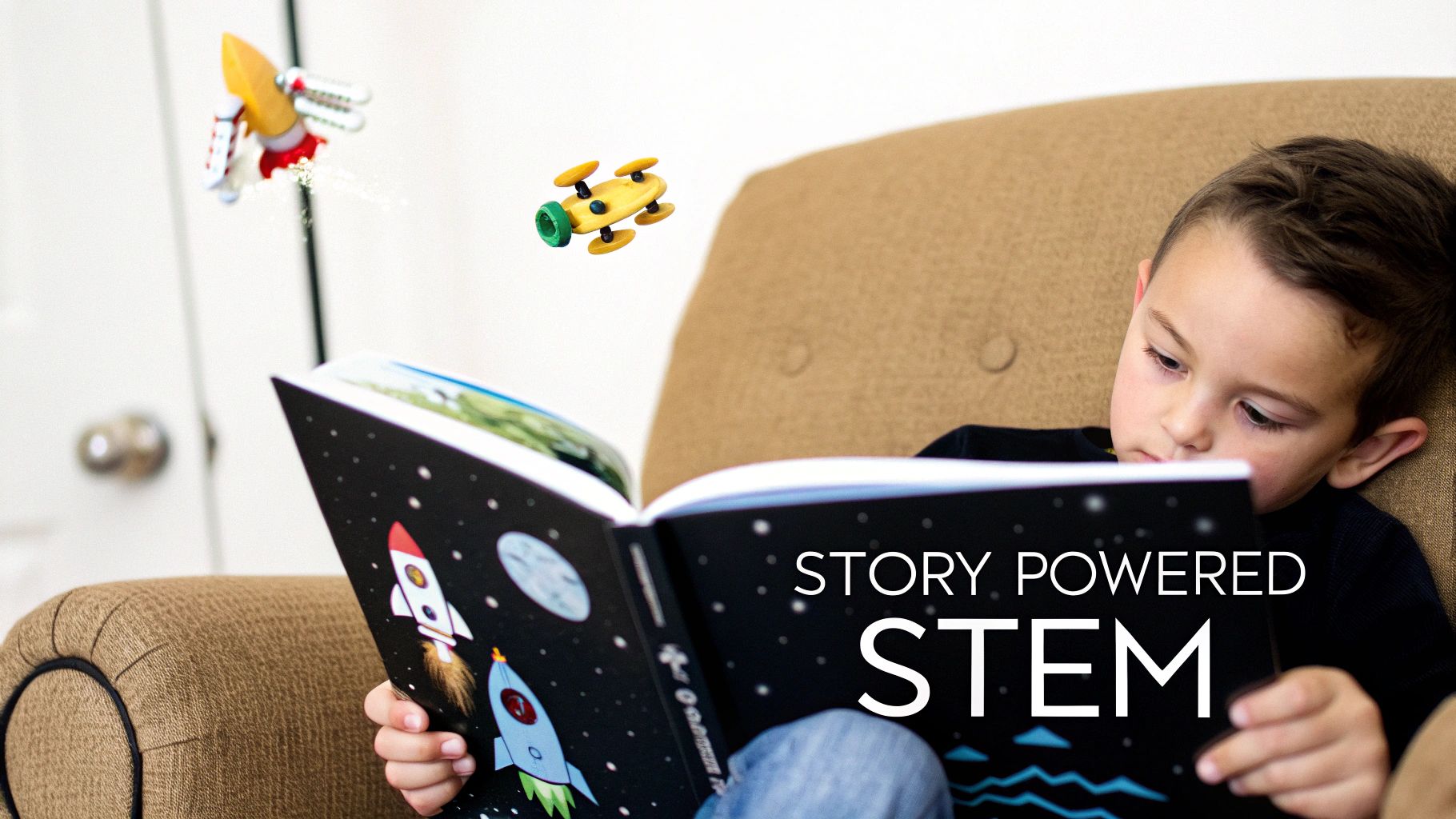
This is the secret sauce for making STEM education truly stick. A mission to calculate a spaceship's trajectory with Space Ranger Fred is infinitely more exciting than a standard maths problem on a worksheet. Stories give context and purpose to learning, turning abstract concepts into thrilling challenges that just have to be solved.
Merging Imagination with Investigation
A story-driven approach helps children see Science, Technology, Engineering, and Maths as one big toolkit for exploration, not just separate subjects on a timetable. They learn to pull different skills together to overcome obstacles in the plot, which makes the whole learning process feel natural and vital for the mission's success.
This method also beautifully hooks in creative minds by showing them that science and imagination are perfect partners. Digging into the wider techniques of storytelling in education really highlights just how powerful this connection is for learners of all ages.
When facts are embedded in a story, they gain emotional weight. Children aren’t just learning a principle; they're helping a character succeed, making the knowledge personal and unforgettable.
By weaving STEM concepts into exciting narratives, we show children that asking questions and solving problems are the very heart of any great adventure. It’s a fantastic way to blend learning with the magic of a good tale. To see just how well this works, read our post on why creativity and STEM belong together.
Your STEM Questions Answered
Jumping into the world of STEM can feel a bit like exploring a new planet—it’s exciting, but it’s natural to have a few questions. That's perfectly normal! We’ve gathered some of the most common ones we hear from parents and teachers to give you clear, simple answers and help you feel ready for your next adventure.

My Child Isn't a Fan of Maths or Science. How Can I Encourage Them?
That's a common worry! The secret is to connect STEM to what they already love. If your child is a budding artist, you could explore the science of how colours mix or the technology behind their favourite animated film. Do they live for building with LEGO? That’s engineering, right there!
The trick is to focus on fun, hands-on activities rather than anything that feels like a formal lesson. Stories, like Space Ranger Fred's intergalactic missions, are also a brilliant way to show how these subjects are used in thrilling situations. It makes it all feel less like schoolwork and more like an epic quest.
Do We Need Expensive Kits for STEM at Home?
Absolutely not! In fact, some of the best STEM learning happens with things you already have around the house. You can explore engineering by building an amazing cushion fort, practise maths while baking a cake, or study biology by becoming an insect detective in the back garden.
The most important tool you need is curiosity. The rest can almost always be found lying around, turning ordinary playtime into a powerful learning experience.
Our free activities page is packed with ideas that use simple, everyday materials.
At What Age Should We Start Introducing STEM Concepts?
You can start much earlier than you might think. For toddlers, it’s all about play and exploration—stacking blocks, splashing in the bath, and that endless curiosity that drives them to ask 'why?'. For children in the 6–12 age group, you can introduce slightly more structured activities, like simple science experiments or fun coding games.
The key is to always keep it playful and follow your child's lead. STEM is really just about nurturing that inquisitive spirit that children are born with, so it's never too early to start encouraging it.
We hope this has helped answer the question 'what is STEM education?' and shown you just how fun and accessible it can be for your family. At Space Ranger Fred, we believe every child is a natural-born explorer, and our stories are here to fuel their biggest and boldest adventures. Dive into our universe of books, games, and activities to keep that curiosity firing