
Alright, Space Rangers, let's talk about something truly enormous. Have you ever wondered how grown-ups measure really, really big things? A light year sounds like it measures time, doesn't it? But it’s actually a mind-bogglingly huge way of measuring distance.
Imagine the fastest thing in the entire universe. A light year is the answer to the question, "how far can that speedy thing travel in one whole year?"
Measuring Space with Sunshine and Starlight
How do astronomers work out how far away stars and galaxies are? They can't exactly stretch a tape measure across space! Instead, they use something much, much faster: light. So, a light year is simply the distance a beam of light travels in one Earth year.
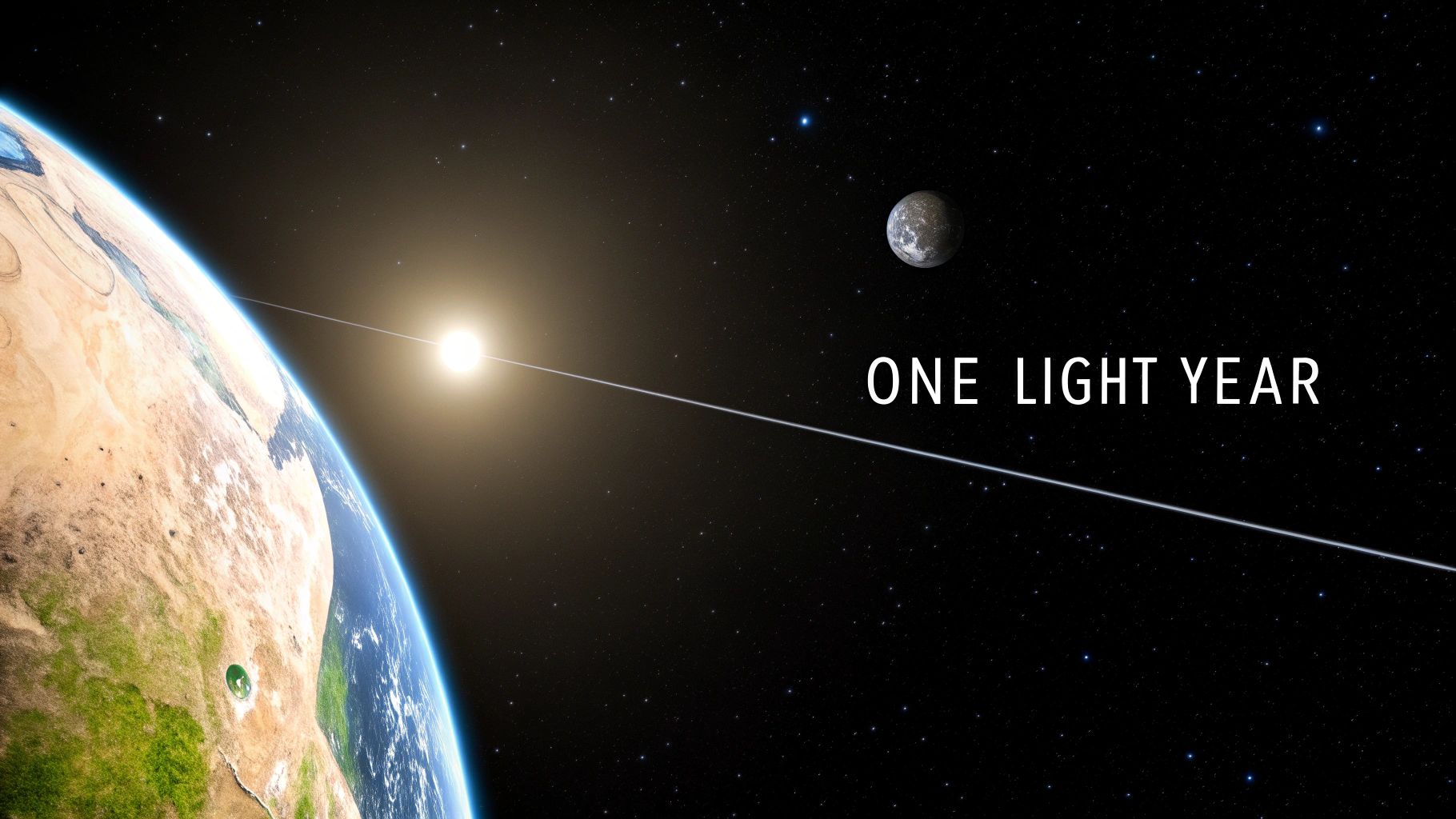
To really get our heads around this cosmic measuring stick, we need to know just how speedy light is. You can discover the full story in our guide to what is the speed of light, but here are a few fun facts to get you started:
- In just one second, a beam of light can zip around our planet Earth more than seven times! Wow!
- The sunshine we feel on our faces took just over eight minutes to get here all the way from the Sun.
- The distance to the Moon? That's just a little over one light-second.
Putting the Numbers into Perspective
So, what happens when light keeps travelling for a whole year? The distance becomes truly enormous. One light year is about 9.46 trillion kilometres. That’s a 9 with twelve zeroes after it! It’s such a big number, it’s almost silly.
Let's try to picture it another way.
How Far Can Light Travel?
This little table shows just how quickly the distance adds up as light zips through space.
| Time | Distance Covered by Light |
|---|---|
| 1 second | 300,000 kilometres (over 7 trips around Earth) |
| 1 minute | 18 million kilometres |
| 1 hour | 1.08 billion kilometres |
| 1 day | 26 billion kilometres |
| 1 year | 9.46 trillion kilometres |
As you can see, we need a massive unit like the light year because kilometres just aren't big enough for the job once we leave our Solar System.
A light year is our way of making the unimaginable distances of space a little bit easier to talk about. It turns a ridiculously long string of numbers into a simple idea we can share, just like telling a story.
For anyone trying to explain big, real-world ideas, taking a creative non-fiction approach can be a huge help. It’s all about blending amazing facts with the fun of storytelling.
Now that we know what a light year is, let's find out why we need such a gigantic ruler in the first place.
Why Do We Use Light Years to Measure Space?
It’s a great question: why can’t we just use kilometres? They work perfectly well for everything here on Earth, from the trip to school to a long car journey. So why do astronomers stop using them when they start looking at the stars?
The short answer is that space is just mind-bogglingly enormous. Trying to measure the distance to the next star in kilometres would be like trying to measure the ocean with a teaspoon. You’d get there eventually, but the number would be so gigantic it would be almost meaningless!
A Cosmic Measuring Stick
Think about a long car journey to visit your grandparents. You wouldn't tell your friends how many footsteps it took to get there, would you? That would be a ridiculously huge number! Instead, you’d probably just say, "It's about a three-hour drive."
You’ve instinctively switched from a small unit (footsteps) to a much bigger, more practical one (hours). Astronomers do exactly the same thing. They swapped kilometres for light years because they needed a much, much bigger measuring stick for an unbelievably big job.
A light year is basically the 'car-hour' of the cosmos. It’s a handy tool scientists came up with to make talking about these enormous distances a whole lot simpler.
This clever switch stops astronomers from having to write out numbers with fifteen zeroes after them every time they measure something outside our Solar System. It turns a ridiculously complicated number into something we can all get our heads around.
Making Big Numbers Feel Small
When we say the nearest star system is "4.2 light years away," it’s much easier to grasp than saying it’s "40,000,000,000,000 kilometres" away. See? The light year just tidies everything up, making the universe feel a little less intimidating.
It’s all about picking the right tool for the job. You wouldn't measure a swimming pool with a school ruler, and you wouldn't measure a road trip in footsteps. In the same way, astronomers don’t use kilometres for the gaps between stars. They use the perfect cosmic ruler: the light year.
Now that we know why we need this giant measuring stick, let's take it for a spin and go on a grand tour of the universe. It's time to see just how far a light year can really take us.
A Grand Tour of the Universe in Light Years
Alright, Space Rangers, ready for a cosmic adventure? Now that we know what a light year is, let’s buckle up and see just how far this amazing measuring stick can take us. We're about to go on a grand tour of the universe, one light-jump at a time!
Our first stop is right here in our own cosmic back garden—the Solar System. You might be surprised to hear we don't even need a full light year to get around here. The massive distance from our Sun all the way out to chilly Neptune is only about four light-hours. That’s just a tiny fraction of a single light year!
Hopping to the Nearest Star
Now for our first proper jump into deep space. Let’s wave goodbye to our Solar System and set a course for the nearest star to our Sun, a little red dwarf named Proxima Centauri. To get there, we’d need to travel 4.2 light years.
That’s a seriously long way—more than 9,000 times further than the trip to Neptune!
A quick hop to our nearest stellar neighbour really shows why light years are so essential. What feels like a short journey in light years becomes an impossibly big number in kilometres, reminding us that we need the right tool for a cosmic journey.
This is where you realise that you can't measure the universe with a tiny ruler. Just like you wouldn't use a spoon to measure the road to another city, astronomers need a much bigger measuring stick for space.
Crossing Our Home Galaxy
Feeling brave? Good, because we’re about to zoom out even further to see our entire home, the Milky Way galaxy. Our galaxy is a gigantic, swirling city of stars, gas, and dust. It's truly enormous.
To travel from one edge of the Milky Way all the way to the other would take a staggering 100,000 light years. Think about that for a moment. Even travelling at the speed of light, it would take you a hundred thousand years to cross our own cosmic neighbourhood! To get a feel for these incredible star cities, check out our guide on what is a galaxy. And to bring these wonders to life, you could even generate some amazing images in a Space Sci Fi Style.
Journeying to Another Galaxy
For our final stop, we’re going intergalactic! Our closest major galactic neighbour is the beautiful Andromeda Galaxy. It’s so far away that the journey is almost too big to wrap your head around.
The distance from Earth to Andromeda is a mind-boggling 2.5 million light years.
The light we see from that galaxy tonight actually started its journey towards us long before humans even existed on Earth! It’s a humbling thought, isn't it? It's a great reminder of just how vast and amazing our universe truly is.
How Looking at Stars Is Like Time Travelling
Have you ever wanted a real-life time machine? Well, here’s a secret, Space Rangers: every single time you look up at the night sky, you’re already looking back in time. It’s one of the most mind-bendingly cool facts about what a light year really means!
It all comes down to the incredible speed of light. Even though it’s the fastest thing in the entire universe, it still takes time for light to travel from a distant star all the way to our eyes here on Earth. The starlight we see tonight actually left its star a long, long time ago.
A Postcard from the Past
Think of it like this: imagine your friend sends you a postcard from a holiday in a faraway country. It might take a whole week for that postcard to travel across the world and land in your letterbox. By the time you’re looking at the picture, that moment is long gone. Your friend isn't on holiday anymore!
Starlight works in exactly the same way! A star that is 10 light years away sent its light on a journey 10 years ago. For all that time, its light has been zipping across space, just like that postcard in the post. When it finally gets to us, we are seeing that star as it was a whole decade ago.
Every telescope is a window into the past. The further we look into space, the further back in time we see, revealing what the universe looked like millions or even billions of years ago.
What does this mean for stargazing?
This cosmic time-delay has some amazing results for how we see the universe. It means we get to be cosmic historians just by looking up!
- Seeing Ancient Stars: When you look at the Andromeda Galaxy, which is 2.5 million light years away, the light hitting your eyes is 2.5 million years old. That light began its journey long before modern humans even walked the Earth!
- Watching Stars Change: If a star that is 100 light years away were to suddenly explode, we wouldn’t know about it for 100 years. We’d only see the incredible event when its light finally reached us after a century-long trip.
- A Sky Full of History: The night sky isn't a single snapshot in time. It's a beautiful, sparkling patchwork of different moments in history, with each star showing us what it looked like at a different point in the past.
This is why understanding a light year feels so magical. It’s not just a mind-boggling distance; it’s the key to unlocking the story of our universe and turning every single one of us into a real-life time traveller.
Fun Light Year Activities to Try Together
Reading about enormous distances is one thing, but getting hands-on is the best way to really understand a mind-boggling idea like a light year. Let's try some fun activities to bring these cosmic numbers down to Earth.
Let's get our adventuring boots on and try a few experiments!

Pace Out the Solar System
This one is perfect for a park, a playground, or any big open space. We’re going to shrink our Solar System down to a walkable size to see why we need light years.
Imagine that one of your biggest steps is the distance from the Sun to the Earth.
- Start at the Sun: Place a football or a bright jumper on the ground. That’s your Sun.
- Pace to Earth: Take one giant step away. That’s us! Earth is now one step from the Sun.
- Find the Gas Giants: Now, take four more big steps to reach Jupiter. After that, you’ll need another five steps to get all the way to Saturn.
- Journey to Neptune: To get to the edge of the main planetary system, you’ll need to take 20 steps in total from your Sun to reach Neptune!
Now, stand at Neptune and look back at your "Sun." It's quite a long way, isn't it? But here’s the amazing part: to reach the next nearest star, Proxima Centauri, you would need to take another 70,000 steps! This is a great way to see why kilometres (or even steps!) just don't work for measuring the epic gaps between stars.
Light Year on a String
Here’s a great indoor activity for a rainy day. All you need is a ball of string and some beads or buttons to represent the stars. Let's build a real model of our stellar neighbourhood.
- Get Your Supplies: Grab a ball of string, some colourful beads, and a pair of scissors.
- Set Your Scale: Let’s decide that 10 centimetres of string equals one light year.
- Thread Your Stars:
- Pop a yellow bead (for the Sun) right at the start of your string.
- Measure out 42 cm of string and add a red bead for Proxima Centauri (4.2 light years away).
- Measure another 86 cm from the Sun and add a bright bead for Sirius, the Dog Star (8.6 light years away).
You’ll quickly realise your string is getting very long, showing just how spread out the stars really are. This is a fantastic way to picture these distances. If you’re inspired to look up at the real thing, find tips in our guide on how to use telescopes.
The Cosmic Postcard Challenge
Ready for a creative challenge? Time to put our time-travelling knowledge to the test!
Imagine you’re an astronaut visiting a planet that’s orbiting a star 10 light years away. Your mission: write a postcard back to your family on Earth. But here’s the cosmic twist: how long will it take for your postcard to arrive if it travels at the speed of light?
Get your young Space Ranger to draw a picture of their alien planet and write a message. On the back, they can write the answer: "This postcard will take 10 years to reach Earth!" It's a playful way to connect the distance of a light year with the actual time it takes for light to travel.
Your Cosmic Questions Answered
Still got a few questions buzzing around your head? Brilliant! That means you’re thinking like a real scientist. Let's tackle some of the most common cosmic queries about light years.
Can anything travel faster than light?
According to everything we know about physics, nothing with mass can travel faster than the speed of light. You can think of it as the ultimate cosmic speed limit—a rule the entire universe has to follow!
How long would it take us to travel one light year?
Light takes exactly one year to travel a light year (that's where the name comes from!), but our spaceships are much, much slower.
The fastest probe humanity has ever launched, NASA's Parker Solar Probe, would still need many thousands of years to travel that same incredible distance.
Even our speediest technology is just a snail's pace compared to the zip of a light beam. It’s a great reminder of just how enormous the distances between stars really are.
Do astronomers use other units for space distance?
They sure do! When the distances get even more mind-bogglingly huge, astronomers sometimes switch to a unit called a parsec.
One parsec is equal to about 3.26 light years, so it’s an even bigger measuring stick for an even bigger job.
But for most of us Space Rangers, the light year is the perfect tool. It helps us wrap our heads around the breathtaking vastness of space in a way that feels like part of a grand adventure.
Keep Exploring with Space Ranger Fred
You’ve just taken a huge leap into understanding the universe! Getting your head around the idea of a light year is exactly the kind of smart thinking that helps Space Ranger Fred on his adventures.
If you thought these mind-boggling distances were cool, why not blast off on another mission? Keep that brilliant curiosity firing by jumping into one of our books about interstellar travel or grabbing a new challenge from our free activities page.
You can even zoom out further and explore the biggest things in the universe by reading our post on the different types of galaxies.
The Space Ranger Fred universe is packed with incredible things to discover. The cosmos is out there—what will you find next?