
Resilience isn’t about raising children who are tough as nails or never show their feelings. It’s about teaching them to bend without breaking. It’s giving them the tools to handle life’s inevitable ups and downs, from a tricky maths problem to a playground squabble, so they can feel their emotions and have the courage to try again. This one skill is a game-changer, building their confidence, sharpening their problem-solving instincts, and fostering a truly positive sense of self.
Why Building Resilience Matters in Today's World
Have you ever watched a child’s face crumble when their LEGO tower topples? Or felt their bone-deep frustration when they just can’t get the hang of riding a bike? These small, everyday moments are more than just fleeting disappointments. They are the training grounds where a child’s resilience can either grow or stall.
Giving our children the gift of resilience is one of the most powerful things we can do. It's the inner strength that lets them face challenges, learn from mistakes, and bounce back from setbacks with their spirits intact. Think of it as their personal mission control, helping them navigate the asteroid fields of life without losing their way.
Alt text: A diverse group of happy children running and laughing in a sunlit park, showcasing a positive and resilient spirit.
More Than Just Bouncing Back
Resilience is often described as the ability to ‘bounce back,’ but it’s so much more than that. It’s also about ‘bouncing forward’—using a tricky experience to learn something new and get better. A resilient child doesn’t just get back on the bike; they might ask, “What if I try starting on the grass this time?” or “Can you hold the back just for a second longer?”
This mindset connects directly to the curiosity and creative problem-solving we see in every Space Ranger Fred adventure. When Fred’s rocket fuel experiment fizzles out, he doesn’t just stomp his feet and give up. He gets curious, asks questions, and tries a new formula. That right there is resilience in action, framed as an exciting part of the journey.
For children, resilience isn't about avoiding difficulty. It's about developing the confidence to face it, knowing they have the tools—and the support—to find a way through.
The Foundation of Emotional Wellbeing
In today’s world, supporting a child's emotional wellbeing is more important than ever. The ability to handle stress, manage big feelings, and maintain a positive outlook is crucial for their overall happiness. To really get a handle on why resilience is so vital, it's worth understanding the fundamentals of supporting children's emotional development.
Recent statistics highlight just how urgent this is. An NHS England report from 2023 found that one in five children aged 8 to 16 had a probable mental health problem. That’s roughly five children in every single classroom. The report also noted these children were seven times more likely to miss significant amounts of school, showing a direct link between emotional health and learning.
Building resilience acts as a proactive, protective tool. It helps children:
- Feel Capable: By overcoming small challenges, they build a powerful belief in their own abilities.
- Develop Coping Skills: They learn healthy ways to manage frustration, disappointment, and anxiety.
- Build Stronger Relationships: Resilience helps them navigate social situations with more confidence and empathy.
- Embrace Learning: They see mistakes not as failures, but as valuable feedback on their journey of discovery.
Ultimately, by focusing on building resilience in children, we aren't just preparing them for the tough times. We are empowering them to live with more curiosity, courage, and joy every single day.
Unpacking the Three Cs of Resilience
Resilience can feel like a big, floaty idea, a bit like trying to catch a cloud. To bring it down to Earth, it helps to think of it as a sturdy, three-legged stool. Each leg stands for one of the 'Three Cs' of resilience: Control, Challenge, and Commitment. Get these three working together, and you’ve got a solid foundation for helping your child navigate just about anything life throws their way.
Imagine Space Ranger Fred on a mission. His rover suddenly gets a wobbly wheel. He can’t control the bumpy terrain, but he can control how he reacts. Does he panic? Nope. He assesses the situation, tightens a few bolts, and decides to slow down. That’s the first C in action.
Feeling in Control
Helping a child understand what they can and cannot control is a huge step in building resilience. They can't control if it rains on sports day, but they can control their attitude and choose to have fun indoors instead. They can’t control another child’s unkind words, but they can control their response—by walking away or telling a trusted grown-up.
This sense of agency is incredibly empowering. It shifts their focus from helpless frustration to proactive problem-solving. It's the difference between shouting, "It's not fair!" and asking, "Okay, what can I do about this?"
Try This: Next time something doesn't go to plan, try asking your child, "What part of this can we control? Let's make a plan just for that little bit."
Seeing a Challenge, Not a Threat
The second leg of our stool is Challenge. This is all about reframing how we see obstacles. When resilient children face a setback—like a tough spelling test or a disagreement with a friend—they see it as a puzzle to solve, not a disaster.
Think back to Fred’s mission. A surprise asteroid field appears on his scanner! He could see this as a mission-ending threat. Instead, he sees it as a navigational challenge, a chance to test his piloting skills. He has to stay calm, plot a new course, and trust his training.
This perspective is closely linked to having a growth mindset, where children believe their abilities can be developed through dedication and hard work. For more on this, you can explore our guide on how to develop a growth mindset in young explorers. Nurturing this view helps them see effort as the path to mastery.
Staying Committed to the Goal
The final leg is Commitment. This is the 'stick-with-it' power that keeps children going when things get tough. It's about staying dedicated to their goals, values, and the people around them, even when their motivation dips.
Imagine Fred is trying to grow the first-ever carrot on Mars. His first few attempts fail; the soil is all wrong. Commitment means he doesn’t just pack up his space-gardening tools. He feels disappointed, sure, but he stays committed to his mission. He tries a new compost mix, adjusts the water levels, and keeps going because he believes in what he's doing.
This is where the magic happens. These pillars don’t just stand on their own; they work together, creating a cycle where resilience builds confidence, which in turn strengthens problem-solving skills.
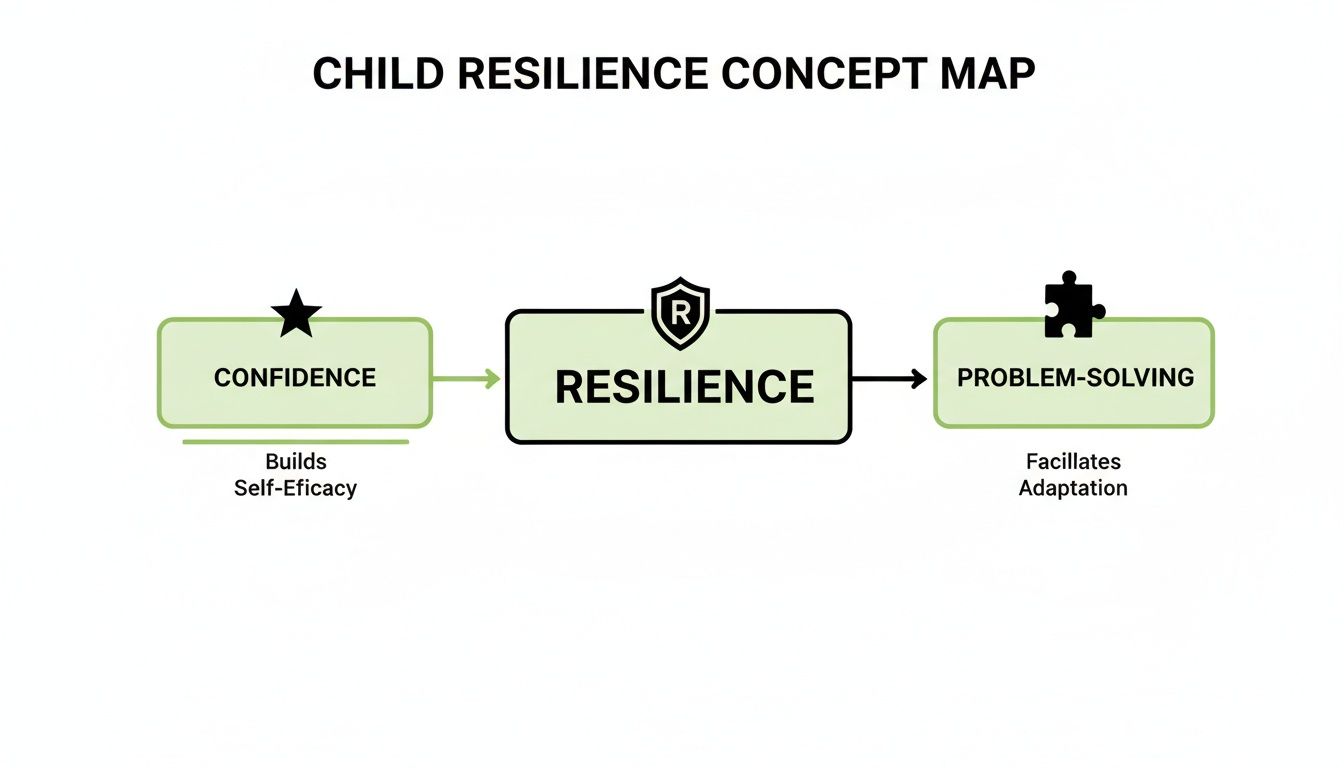
As you can see, each element feeds into the next. Building resilience is a dynamic process, not a final destination.
Spotting the Three Cs in Your Child's World
Sometimes it’s hard to see these big concepts in the small moments of everyday life. This little table should help you recognise what each resilience pillar looks like in your child's world and how you can gently encourage it.
| Resilience Pillar | What It Looks Like in a Child | How You Can Encourage It |
|---|---|---|
| Control | Saying, "I can choose to try again later," after a frustrating game. | Ask, "What's one small thing you can do right now?" or "How do you want to respond to that?" |
| Challenge | Viewing a hard maths problem as a fun puzzle instead of a scary test. | Frame setbacks positively: "Wow, this is tricky! What a great chance for our brains to get stronger." |
| Commitment | Practising their instrument for 10 minutes, even when they'd rather not. | Acknowledge their effort: "I know you were tired, but you still practised. That shows real dedication to your goal." |
When we help children understand these three simple ideas through stories and everyday conversations, we give them a map to navigate their own adventures. They learn they have control over their actions, can rise to a challenge, and have the strength to stay committed to what matters.
Fun Activities to Boost Resilience at Home
Now for the best bit—turning all that theory into some real, hands-on fun! Building resilience doesn't have to feel like a serious lesson. In fact, it works much better when it’s wrapped up in play, curiosity, and a bit of silly, imaginative adventure.
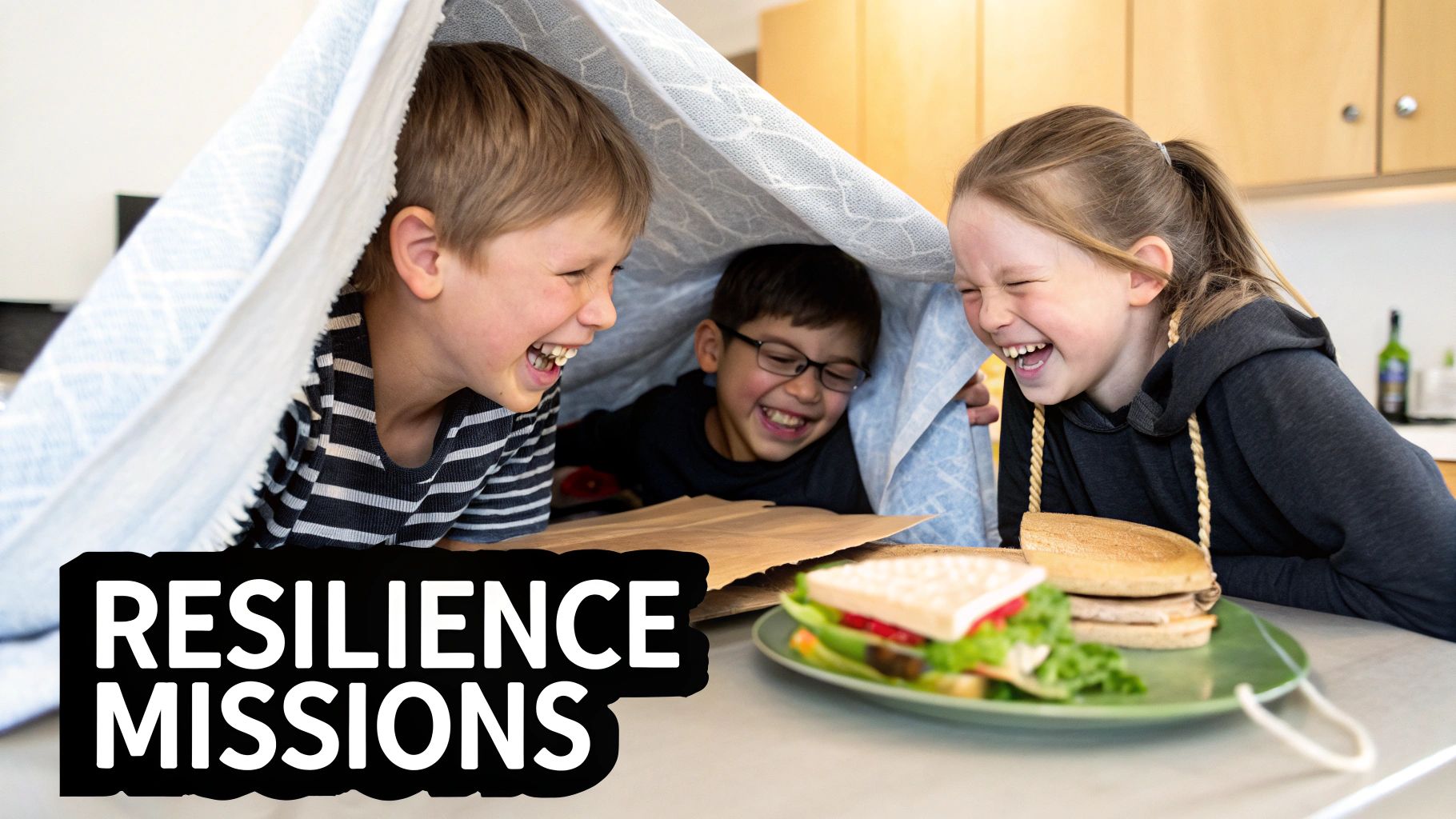
Think of these as 'Resilience Missions'—exciting challenges, not chores. They give children a safe space to practise problem-solving, get comfortable with making mistakes, and see for themselves just how capable they really are. Let's get our mission gear ready and dive in!
Create a 'Failure Fuel' Log
Mistakes aren't dead ends; they're fuel for the next attempt! This mission is all about reframing 'failure' as something genuinely useful and even a little exciting. A 'Failure Fuel' Log is simply a notebook or a few sheets of paper where your child can track what they learn from things that don’t go quite to plan.
Did their paper aeroplane nosedive? Log it! "Fuel collected: A folded nose is too heavy. Next mission: Try a flatter design." Did they guess the wrong word in a board game? Log it! "Fuel collected: Learned a new word! Next mission: Use it in a sentence tomorrow."
The goal here is to turn the momentary sting of a mistake into a moment of pure discovery. It’s a brilliant, hands-on example of what educators call discovery learning, and you can learn more about its power in our guide explaining what is discovery learning.
To get your log started:
- Decorate It: Turn it into a top-secret mission logbook from a spaceship. Stickers and doodles are essential.
- Keep it Simple: Each entry only needs two bits: "What Happened?" and "What Fuel Did I Collect?"
- Celebrate the Fuel: Whenever an entry is added, celebrate that new knowledge! High-fives are mandatory.
Map a Problem-Solving Planetarium
This family activity transforms a tricky problem into a creative, adventurous quest. It’s all about brainstorming together and showing children that a few heads are always better than one when you’re feeling a bit stuck.
Start with a fun, low-stakes problem. Imagine you're Space Ranger Fred's mission control and you’ve just received an urgent message: "A friendly robot is lost on Mars, and we only have a rope, a sandwich, and a blanket to rescue it! What’s our plan?"
Grab a big sheet of paper—your 'Planetarium Map'—and let the ideas fly. Write or draw every single idea, no matter how wild it seems. The sandwich could be bait, the rope could become a lasso, and the blanket might be a parachute or even a signal flag.
This isn't about finding the 'right' answer. It's about exercising that problem-solving muscle and showing your child that the first step to overcoming a challenge is to just start thinking of possibilities.
This mission teaches some vital resilience skills without them even realising it:
- Creative Thinking: It encourages them to look at everyday objects in completely new ways.
- Collaboration: It highlights the power of asking for help and bouncing ideas off each other.
- Persistence: It demonstrates how even huge problems can be broken down into smaller, more manageable ideas.
The 'What's in My Control?' Sorting Game
Here's a quick and simple game that helps children practise the first 'C' of resilience: Control. It gives them a visual way to separate what they can influence from what they can't, which is a powerful tool for dialling down anxiety.
Write down different scenarios on small slips of paper. Make sure you have a good mix of things they can control and things they can’t.
Examples of what they can't control:
- It starts raining during our picnic.
- A friend chooses someone else to play with.
- The shop is sold out of my favourite biscuits.
Examples of what they can control:
- Asking to play a game with my brother.
- Doing my homework before I watch telly.
- Tidying up my toys after I play.
Place two boxes on the floor, labelling one "My Mission" (things I can control) and the other "Space Weather" (things I can't). Have your child read each slip and decide which box it belongs in. This physical act of sorting helps the concept stick. It’s a truly playful way of building resilience by giving them a real feeling of agency.
How Stories and Play Shape Resilient Minds
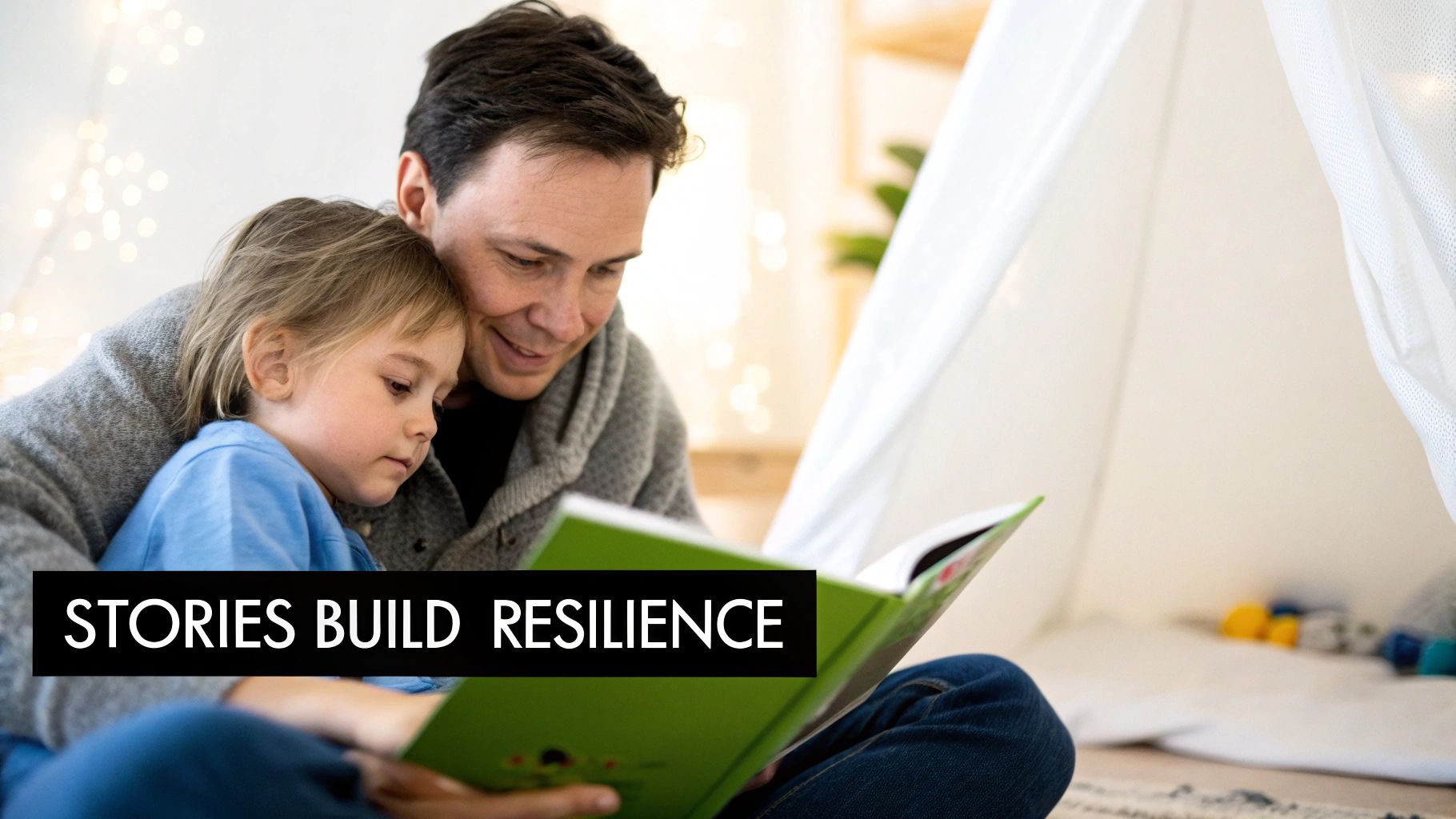
Have you ever seen a child’s whole world light up during story time? It’s magical. They aren't just hearing words; they’re stepping into another universe, walking in a character's shoes, and feeling every win and wobble right alongside them. This incredible power of imagination is more than just fun—it's one of the most brilliant tools we have for building resilience in our kids.
When children follow a character like Space Ranger Fred on his adventures, they get a front-row seat to problem-solving in action. They see him face down a tricky asteroid field, puzzle out a glitch in his spaceship, or feel that sting of disappointment when an experiment doesn't go to plan. These aren’t just exciting plot points; they are safe, emotional rehearsals for real life.
Stories as a Safe Rehearsal Space
The psychology behind this is beautifully simple. Stories give children a safe space to explore big emotions and tricky situations from a comfortable distance. When Fred feels frustrated, a child can feel that frustration too, but without any real-world pressure. They can mull over what they might do in his situation, all from the safety of the sofa.
This process helps them build an emotional toolkit. They learn to name feelings, weigh up different choices, and see that setbacks are rarely the end of the story. You can gently guide this by turning reading time into a conversation, helping them connect with these important themes on a deeper level.
Turning Story Time into Resilience Practice
You don’t need a formal lesson plan to make stories work for you. Just a few thoughtful questions can open up a world of learning. The next time you're reading together, try pausing to ask things like:
- "Oh no, his experiment fizzled out! How do you think Fred was feeling in that moment?"
- "Hmm, what do you reckon he’ll try next?"
- "Have you ever felt a bit like that when something you built fell over?"
These simple prompts help children connect the dots between a character's world and their own. They start to see that feeling frustrated is normal and that trying again is what heroes do. This is a powerful way to reinforce the ideas found in our fantastic selection of children's books that inspire young minds.
A story is like a flight simulator for life. It lets children practise navigating turbulence and exploring new solutions, so they're better prepared when they take the controls themselves.
This kind of guided play is more than just a nice activity; it's a direct way to support crucial developmental needs. Early childhood development data from the UK reveals gaps in problem-solving and personal-social skills, which are the very cornerstones of resilience. For example, some regions show a 4.1 percentage point gap in personal-social skills. Interactive stories and games, like the missions Fred undertakes, can directly help bridge these gaps by making these skills fun to learn. You can find more details in these child development statistics.
For a deeper look at the cognitive benefits, it's worth exploring how interactive stories and their role in enhancing empathy and critical thinking can further support a child's growth. At the end of the day, stories and imaginative play aren't just an escape; they are a training ground where our children build the courage, creativity, and inner strength they need to navigate their own amazing adventures.
Guiding Children Through Disappointment and Frustration
We’ve all seen it. The carefully built LEGO tower comes crashing down, a drawing doesn't look quite right, or a friend says something that stings. In that moment, a child’s world can feel like it’s wobbling on its axis.
Our first instinct as parents and teachers is often to swoop in and fix it. But what if these little moments of frustration are actually the perfect training ground for building real, lasting resilience?
Guiding a child through disappointment isn’t about making the problem vanish. It’s about being their calm, steady co-pilot as they navigate the emotional storm. Sometimes, your quiet presence is the most powerful tool you have.
What to Say When Things Get Tricky
When a child is upset, our words matter. A lot. The goal is always to connect before you try to correct. By validating their feelings first, you show them you’re on their team and that it’s okay to feel what they’re feeling. Only then can you gently steer them towards finding a solution.
Next time you’re facing a meltdown over a tricky task, try this simple two-step approach:
-
Acknowledge the Feeling: Start by just naming what you see. It shows them you get it.
- “Wow, that puzzle piece is really frustrating, isn't it? It’s so tricky when they just won’t fit.”
- “I can see you’re feeling sad that the game is over. It’s hard to stop when you’re having so much fun.”
-
Offer to Help, Not to Solve: Once they feel heard, you can nudge them toward finding a way forward—together.
- “I wonder what would happen if we turned that piece around? Shall we try it?”
- “What’s one tiny thing we could try next?”
This simple shift changes your role from 'fixer' to 'guide'. You're not taking over the mission; you're just helping them read the map.
Dealing with Roadblocks like Perfectionism
Sometimes, frustration comes from a deeper place, like a fear of making mistakes. For a child who struggles with perfectionism, anything less than a flawless result can feel like a massive failure. It’s a common roadblock, but one you can help them navigate.
The key is to shift the focus from the outcome to the process and effort. Praise their courage for trying something difficult, their persistence when it got tough, or their creative thinking—no matter what the final result looks like.
You could try saying things like:
- “I loved watching you figure out how to build that tower. You tried so many different ways to make it stable!”
- “This drawing is full of brilliant ideas. I can see how much thought you put into every detail.”
This helps redefine what ‘success’ means. It’s not about getting it perfect; it’s about all the amazing learning that happens along the way.
Your calm presence is the most powerful tool for helping your child navigate their emotional storms.
By offering a few gentle words and your steady presence, you’re doing more than just soothing a fleeting upset. You’re teaching a skill for life. You're showing your child that they have the inner strength to face a challenge, feel their feelings, and find the courage to try again.
Got Questions About Building Resilience? We’ve Got Answers
As you navigate your mission to raise a resilient child, it’s only natural to have a few questions pop up. Think of this as your mission debriefing—we’ve tackled some of the most common queries from parents and teachers to give you clear, straightforward answers.
Alt text: A young child with glasses looks up thoughtfully, clearly pondering a question about building resilience, in a room filled with books.
At What Age Should I Start Building Resilience?
The short answer? Right away! The foundations for resilience can be laid even in the toddler years. It starts small—like encouraging them to try again when their block tower tumbles over. It’s all about celebrating the effort, not just the perfect result.
For kids in the 6–12 age range, we can go a bit deeper. Now’s the time to help them put names to their big feelings, work through simple problems, and start seeing that mistakes are actually brilliant learning opportunities. The key is keeping it age-appropriate, which is why the playful missions and stories we've shared are perfect for these primary school years—they tap right into a child's natural sense of adventure and curiosity.
How Can I Help a Child Who Gives Up Easily?
First off, know that this is an incredibly common challenge, so you're definitely not alone in this. The best first step is always to validate their feelings. Try saying something like, "I can see you're feeling really frustrated with that drawing. It's tough when it doesn't look how you imagined." This simple act shows them you get it and that it's okay to feel that way.
Your role isn't to fix the problem for them, but to become their co-pilot. You could help break the task into smaller, more manageable steps. Or, you might brainstorm a new approach together: "What if we tried a different colour here?" Sometimes, just suggesting a short break can do wonders. Remember to praise their effort and persistence, no matter what the outcome is. That's far more powerful than only praising a perfect final result.
The goal isn't to prevent the struggle; it's to support them through it. Every time they stick with something tricky, their resilience muscle gets a little bit stronger.
Is Resilience Just About Being Tough?
Not at all. This is a huge misconception, and it’s an important one to clear up. Building resilience isn't about teaching kids to bottle up their emotions or just "power through" hard times. In fact, it's quite the opposite.
True resilience is built on a foundation of emotional intelligence—the ability to recognise, understand, and manage what they're feeling. It means creating a safe space for them to feel disappointed, frustrated, or sad. From there, you can give them the tools to process those feelings and figure out what to do next. It’s all about being supportive, not about creating hardship.
How Can I Use the Space Ranger Fred Books to Talk About Resilience?
The Space Ranger Fred stories are practically designed for these conversations! They’re packed with moments that can spark great discussions. As you read together, try pausing when Fred hits a snag.
Here are a few ideas to get you started:
- "Oh no, Fred's rover is stuck! I wonder what he's feeling right now?"
- "What do you think he'll try first to get it moving again?"
- "Has anything like that ever happened to one of your toys? What did you do?"
By chatting about Fred’s challenges and choices, you're helping your child explore problem-solving and perseverance in a really fun, low-pressure way. It’s a fantastic method for showing them what resilience looks like in action. For more ways to spark their imagination, check out our free activities page for more downloadable missions!
Building resilience in children is a journey, not a destination. It's about planting seeds of confidence, curiosity, and courage through everyday play and conversation. By turning challenges into missions and mistakes into fuel, you give children the tools to navigate their own incredible adventures.
Ready for your next mission? Explore the Space Ranger Fred universe, where every story is a launchpad for learning and discovery. Dive into our books, download a free activity, and join us on an adventure to the stars