
A child is wobbling on a chair. A teacher is eyeing the clock. A parent has just heard the famous words, “I’m bored.”
That’s often the moment a popping bubbles game saves the day.
Not because it’s noisy, silly, and strangely irresistible, though it is all three. It works because one tiny bubble can become a lesson in movement, noticing, predicting, counting, coding, and storytelling. That’s a proper mission, not just a time-filler.
Your Next Mission Turn a Popping Bubbles Game into an Adventure
A bubble looks simple. Floaty. Shiny. Gone in a second.
But children rarely treat bubbles as “just bubbles”. They chase them, track them, compare them, miss them, laugh at them, and try again. That’s where the learning lives. A popping bubbles game gives children a reason to move with purpose, watch carefully, and respond quickly.
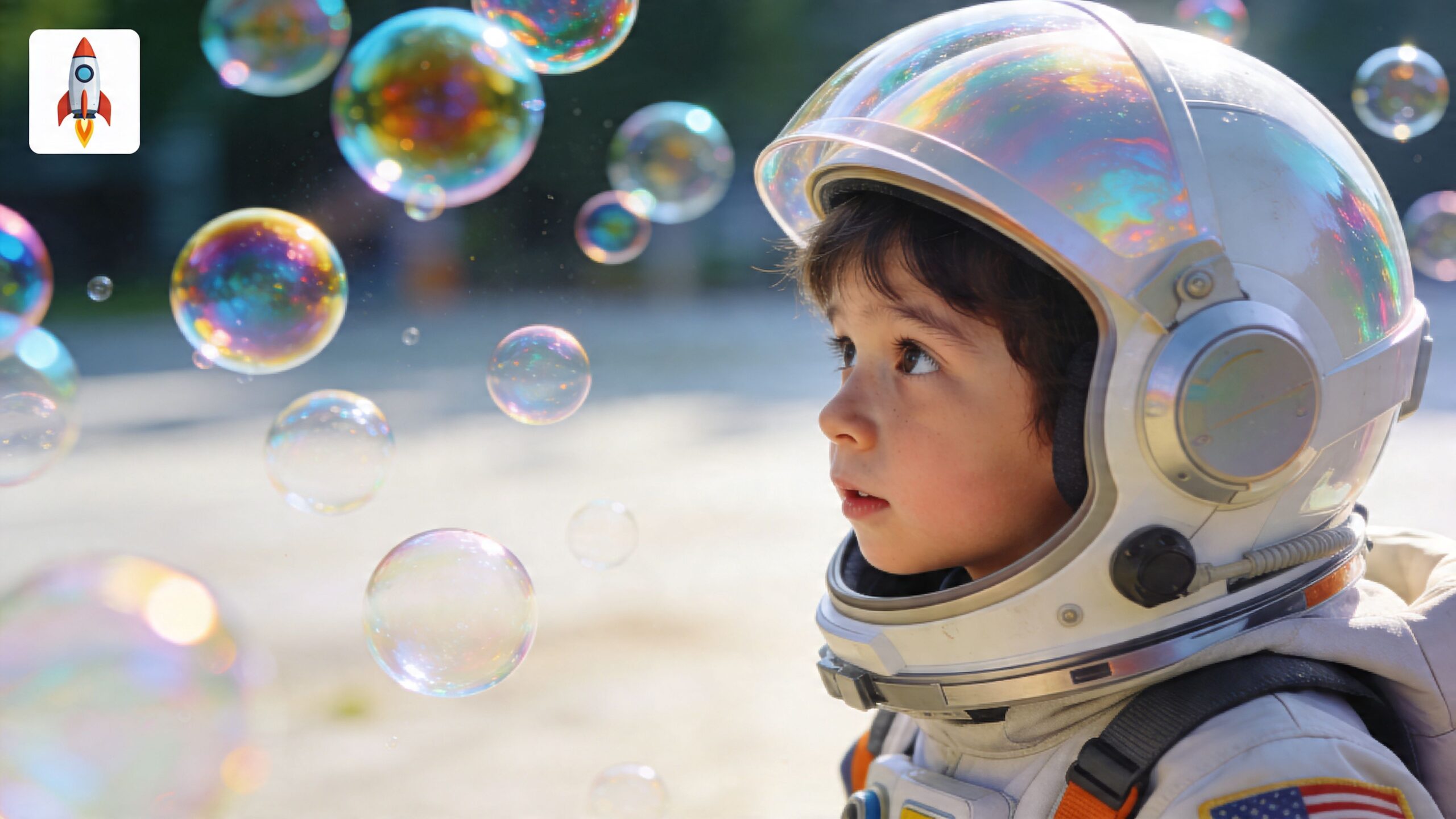
One useful data point stands out. Bubble-popping mechanics can improve hand-eye coordination by 35% in children aged 6 to 8 after 20 minutes of daily play, and 68% of primary teachers in a UK Department for Education report from 2025 said they were seeking more interactive digital resources for fine motor development according to the reported app listing reference. That helps explain why so many adults are looking for playful activities that still feel purposeful.
Why children stay with this game
A good bubble mission has instant feedback. Tap, clap, poke, reach. The child knows what happened straight away.
That matters for confidence. A child can think, “I nearly got that one,” and then try again five seconds later. No long instructions. No complicated setup. Just action, adjustment, and another attempt.
Mission insight: Fast feedback helps children connect effort with outcome. They can see what worked.
There’s another secret ingredient. Story.
If you tell a child, “Pop the bubbles,” you’ll get a minute or two. If you tell them, “These are drifting oxygen pods and the station needs your help,” you’ll suddenly get focus, teamwork, and dramatic leaping. If you want fresh ideas for crafting engaging narratives, that guide is handy because it shows how a simple activity becomes a memorable adventure.
What adults often worry about
Parents and teachers sometimes wonder if a bubble game is “too small” to count as learning. It isn’t.
A bubble game can support:
- Motor control through reaching, tracking, and timing
- Early science thinking through questions about shape, air, and movement
- Language through describing what children notice
- Confidence through repeated trying without heavy pressure
You don’t need expensive kit. You need a clear mission and enough room for curious humans to move safely.
Gearing Up for Your Bubble Mission Physical Games
The best physical bubble missions feel a bit like preparing for launch. A little planning makes the fun smoother, safer, and far less slippery.
Mission supplies
You can keep this refreshingly simple:
- Bubble basics. Bubble solution, a tray, and a wand are enough to begin.
- A popping tool. Fingers work brilliantly, but children also enjoy using fly swatters, cardboard stars on sticks, or pool noodles cut short for giant “space paddles”.
- A sensible launch zone. Grass, a playground, or a hall with clear boundaries works better than a cramped room full of chairs.
- A score plan. Some children love counting pops. Others prefer a cooperative challenge such as “Can our crew clear the sky?”
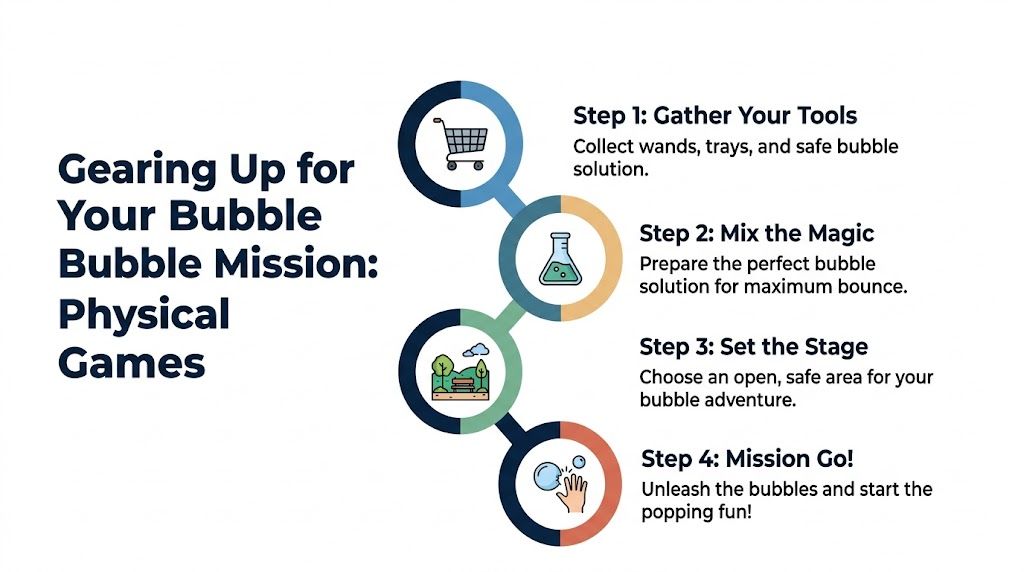
If you’re running this with a group, assign roles. One child can be launcher, another tracker, another popper, another scorekeeper. Suddenly the game includes turn-taking and observation without needing a lecture about either.
The science bit children can actually grasp
Children often ask, “Why are bubbles round?”
A plain answer works best. The soap film pulls evenly around the air inside, so the bubble settles into a round shape. Round is an efficient shape for holding air in that thin stretchy skin. If you want a child-friendly version, say this:
The bubble is trying to make the smoothest, neatest little air blanket it can.
That usually lands better than “surface tension”, though older children may enjoy learning the proper word too.
You can build mini investigations from this:
- Blow a small bubble and a big bubble.
- Ask which one moves faster.
- Try popping with a finger, a sleeve, or a soft tool.
- Ask what changes when the wind picks up.
No lab coat required. Though if someone insists on wearing goggles for dramatic effect, I’d allow it.
Safety briefing
Physical bubble play is exciting. It can also become a comedy sketch if no one sets boundaries.
Keep these rules clear:
- Running rule. Fast feet are for open spaces only.
- Floor check. If the surface gets slippery, pause and reset.
- Face rule. No wands or tools near faces.
- Turn rule. In groups, decide where children wait so the popping zone stays clear.
Why active versions matter
The movement side isn’t a small extra. It’s part of the value. Research from the Exertion Games Lab in the UK, across 28 Scottish primary schools, found that active bubble-popping games led to 1.7x higher physical activity than sedentary video games, and the method achieved an 85% success rate for accurate pops in multiplayer modes in its Bubble Popper project summary.
That’s a useful reminder for schools and families. A popping bubbles game can be playful, social, and properly active all at once.
Mission Variations Adapting the Game for All Cadets
Not every child needs the same mission.
Some need a simple “reach and pop”. Some want rules, scoring, and deadlines. Some want to ask why one bubble zig-zags while another floats like a sleepy moon. A strong activity adapts without losing its sparkle.
Bubble Mission Challenges by Age Group
| Space Ranger Rank (Age) | Activity Focus | Space Ranger Fred Challenge Example |
|---|---|---|
| Junior Ranger (6 to 8) | Tracking, reaching, gentle popping, naming colours and directions | “Pop the blue repair bubbles before they drift past your rocket boots.” |
| Star Scout (9 to 10) | Timed rounds, scorekeeping, simple team rules, prediction | “Your crew has one minute to clear the meteor bubbles and report the final score.” |
| Galaxy Commander (11 to 12) | Observation, strategy, pattern spotting, explaining what happened | “Test which bubbles are easiest to pop and explain your theory to mission control.” |
Adults often overcomplicate things. Younger children usually need less explanation and more repetition. Older children often enjoy adding rules and discussing tactics.
Matching challenge to confidence
For ages 6 to 8, keep it concrete. Use clear targets and playful language.
Try prompts like:
- Spot it. “Pop the highest bubble.”
- Say it. “Tell me if it floated left or right.”
- Try again. “You missed that one. What will you change?”
For ages 9 to 10, children often enjoy measured challenge. Add a timer, a score sheet, or a partner system. They can start noticing patterns, such as which bubbles are hardest to catch and when they tend to drift lower.
For ages 11 to 12, move into explanation. Ask them to observe before acting. Let them invent rules. Let them compare techniques. Let them design a better game than yours. Frankly, they’ll probably try anyway.
A child moves from doing to understanding when you ask, “How do you know?”
The menturity layer in action
The progression can be beautifully simple:
- I think. “I think the big bubbles are easier.”
- I try. The child tests that idea during the game.
- I can. “I can pop more if I stand still first.”
- I can explain. “I hit more bubbles when I waited for them to come down.”
That’s learning you can hear.
If you want more ways to stretch this kind of reasoning, these kids problem-solving activities offer useful follow-on ideas for home or school.
Adaptations for mixed groups
Mixed ages can still play together if the goals differ.
One child might count. Another might pop. Another might observe which bubbles lasted longest. The same popping bubbles game can serve different levels without anyone feeling left behind. That’s especially handy in classrooms, libraries, and family groups where one-size-fits-all usually fits nobody particularly well.
Going Digital Creating Your Own Popping Bubbles Game
Physical bubbles are brilliant. Digital bubbles add another kind of magic. Children stop being only players and become makers.
That shift matters. When a child builds a popping bubbles game, they practise logic, sequencing, testing, and fixing mistakes. Those are big skills hiding inside cheerful little circles.
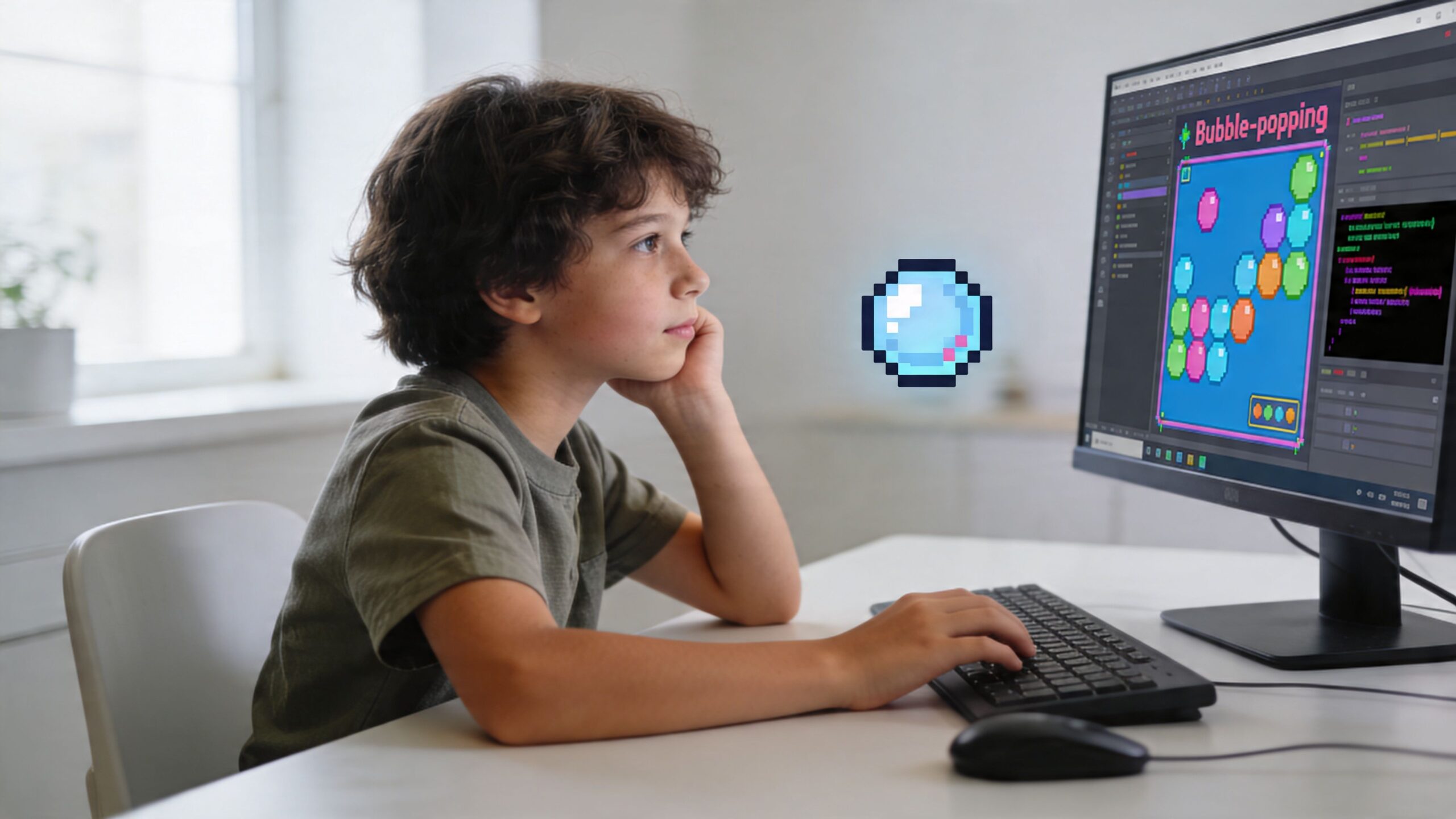
A beginner mission in Scratch-style thinking
You don’t need heavy coding language to start. Use game language children understand.
- Sprite means the thing on screen that moves, such as a player tool or bubble.
- Loop means “keep doing this”.
- Collision means “these two things touched”.
A classroom-tested approach from a UK Scratch bubble game tutorial reported a 92% success rate among pupils aged 7 to 11, and 34% of initial failures came from a simple logic error that could be fixed during debugging, as described in the LearnLearn bubble popping tutorial.
The simple build path
Here’s a child-friendly version of the process:
Create the player sprite
Make a sprite that follows the mouse. In Scratch-style blocks, this usually means placing it in a forever loop so it keeps moving to the mouse position.Add a “ready” rule
This is the part children often miss. The game needs to know when the player is allowed to pop a bubble. A simple yes-or-no variable can control that.Make bubble clones appear
Set bubbles to clone themselves at intervals. Give them movement so they drift across the screen.Check for touching
If a bubble touches the player and the game is in the correct state, play a pop animation, add to the score, and remove the bubble.
Debugging rule: If bubbles pop at the wrong moment, check the game state before changing anything else.
That “ready” rule is gold for teaching logic. Children see that the game doesn’t just guess. It follows instructions exactly. Ruthlessly. Like a tiny robot with no patience for vague ideas.
If you’d like children to compare playful design ideas, this quick look at different use cases for games can help spark discussion about what games are for and how they can teach, entertain, or encourage exploration.
See the idea in action
A short visual demo often helps children connect the code with the result:
Keeping digital play meaningful
Children don’t need a huge project. A tiny working game is a win.
Useful extension ideas include:
- Add levels with faster bubbles
- Change bubble size to test difficulty
- Use different scores for different targets
- Swap the theme from bubbles to planets, germs, treasure or letters
If you’re gathering options for screen-based learning that still feel active and purposeful, these kids free online learning games are a sensible next stop.
Integrating the Mission into the Classroom
A popping bubbles game earns its place in school when it does more than fill five lively minutes before lunch. It can support curriculum goals in a way that feels natural, memorable, and manageable.
Strong curriculum links
Teachers and librarians can connect the activity to several areas without forcing it.
- Science. Children notice materials, movement, air, and observation.
- Computing. Digital versions introduce algorithms, sequencing, logic, and debugging.
- PE. Physical bubble play develops coordination, spatial awareness, and controlled movement.
- Maths. Children can count pops, compare scores, sort by size, and discuss shape.
The trick is not to announce all of that at once like a headteacher with a megaphone. Let the game happen first. Then draw out the learning through questions.
Story-led teaching works well here
A plain instruction gets compliance. A mission gets buy-in.
Try a scenario such as “cleaning dangerous spores from a research dome” or “collecting floating fuel cells before the shuttle lands”. That gives children a reason to care about accuracy, timing, and teamwork. It also helps quieter children step into a role.
Use the story to organise the task, not to bury it. One clear narrative is enough.
You can also rotate the classroom roles:
- Pilot who pops
- Navigator who gives direction
- Scientist who records what happened
- Reporter who explains the crew’s strategy
That creates speaking and listening opportunities with very little extra planning.
A simple way to observe progress
The “I think, I try, I can, I can explain” sequence works well as informal assessment.
Listen for children making predictions. Watch for whether they alter their approach. Notice when they move from copying to choosing. Then ask them to explain what changed. That gives you evidence of understanding without turning a joyful activity into a paperwork festival.
For staff shaping wider STEM provision, this overview of what STEM learning is can help connect playful tasks with bigger educational aims.
Why this matters in libraries too
Libraries are ideal for this sort of mission because they already blend curiosity, conversation, and discovery.
A librarian can run a short bubble challenge, then follow it with a book display on weather, materials, coding, movement, or space. The activity becomes the hook. Reading becomes the next step. That’s a strong chain of engagement, and it feels far more alive than handing over a worksheet and hoping for the best.
Mission Debrief From Bubbles to Books and Beyond
The mission is bigger than the bubble.
By the time children have finished popping, chasing, predicting, recording, and explaining, they have done far more than fill five lively minutes. They have practised the habits that sit underneath good STEM learning. They noticed patterns, tested choices, adjusted their approach, and put ideas into words. That is the treasure haul.
A strong bubble mission works like a well-run space launch. You do not need flashy equipment. You need a clear target, a manageable challenge, and time to talk about what happened. Children learn most from the moment after the pop, when they explain why one bubble was easy to catch and another drifted away like a mischievous little moon.
Here is the part adults sometimes miss. The explanation matters just as much as the action.
A child who says, “I stood closer because the bubbles were moving too fast,” is showing strategy. A child who says, “The big bubbles floated longer,” is beginning to observe and compare. A child who turns that into a drawing, sentence, tally, or story is connecting play with literacy and science at the same time. That is where a simple game starts pulling double duty in the classroom or at home.
Learning lasts longer when children act, notice, and retell.
That is also why books belong in this mission plan. A story gives children somewhere to send their new ideas. After a bubble game, they might write a mission report, invent a weather planet, describe a floating experiment, or help Space Ranger Fred escape a foam-filled asteroid field. Reading and writing do not sit off to one side. They become the next stage of the adventure.
For parents, teachers, and librarians, the takeaway is reassuring. You do not need to turn every activity into a giant project. One playful task, one thoughtful question, and one chance to reflect can go a very long way. The bubble is the spark. The conversation, drawing, chart, or story is where the learning grows legs and marches off on its next expedition.
If you want one home base for stories, activities, and school visit information, explore the world of Space Ranger Fred.
Meta title: Popping Bubbles Game for STEM Learning
Meta description: Turn a popping bubbles game into a playful STEM mission for children aged 6 to 12, with ideas that link movement, observation, storytelling, and classroom learning.